
Author’s Note: The quotation discussed here in this essay below appears in Vedanta Desikan’s Rahasya Traya Saram, where a Mahabharata episode is re-read within a later Sri Vaishnava interpretive framework. The essay is merely an observation — neutral , non-judgmental and wholly academic. The writer’s purpose in penning the essay is solely to invite religious scholars and erudite Sri Vaishnava theologians to further examine the observation on its merits and offer further explications and clarifications, if warranted.
****************************
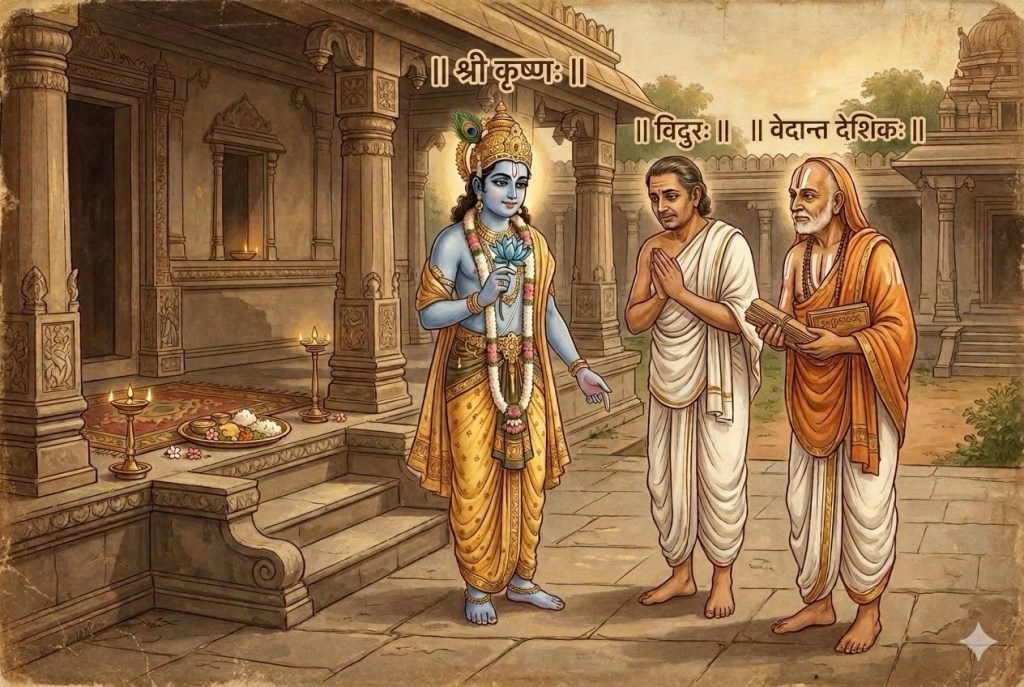
The Vidura episode is one of the most revealing sites of interpretive tension in the Mahabharata.
On one level, the story is simple and powerful: Krishna prefers the humble hospitality of Vidura’s house to the ceremonial grandeur of Duryodhana’s court.
On another level, later devotional commentary seems to seek to read this episode in ways that could reinforce a birth-based social hierarchy.
It is precisely here that one sees the difference between the itihasa text and its later sectarian afterlives.
The original epic’s moral emphasis is difficult to miss. Vidura is not treated as a marginal figure because of his birth; rather, he is honored because of his dharma, prudence, and inner purity. Krishna’s choice is not a ritualistic endorsement of rank, but an ethical recognition of sincerity over display. The episode thus works as a critique of empty social prestige, not as its confirmation.
Yet later interpretive traditions did not always leave the matter there. In some Sri Vaishnava and allied exegetical settings, the story was pressed into service for a different purpose: to uphold the sanctity of varna-bound order and to explain devotional or ritual inclusion in terms of birth, status, and inherited social location.
This move is not unusual in the history of Indian — and not only Sri Vaishnava— textual reception. Sacred texts are often reread to answer the needs of later communities, and the result is frequently a layered tradition in which the original narrative and the inherited interpretation sit uneasily together.
Hermeneutic Authority and Latitude
A further question arises from this pattern: how far can later Sri Vaishnava interpretive works go in re-reading scriptural narratives without straining credibility?
In the case of a towering figure such as Vedanta Desika (1268-1368 CE), the issue is tempered by the fact that he is not a marginal polemicist but a major architect of the sampradaya’s theological self-understanding. A master theologian may be granted a degree of interpretive latitude because his work is presumed to arise from deep learning, disciplined reasoning, and intimate familiarity with the inherited tradition.
The difficulty becomes sharper when similar interpretive moves are repeated in lesser works that do not display the same doctrinal range or intellectual force. What may appear as a sophisticated theological synthesis in a major text can, in more ordinary hands, begin to look like a routine doctrinal retrofit.
At that point, the line between interpretation and special pleading becomes much harder to discern. The issue is not simply whether a tradition may read texts normatively, but whether every later reading is equally persuasive, equally grounded, or equally faithful to the narrative texture of the source.
This is where the distinction between constructive theology and mechanical proof-texting becomes important. A strong interpretive tradition can tolerate boldness when it is supported by coherence, scale, and intellectual seriousness. It becomes more vulnerable when the same mode of reading is reproduced without the same discipline. Then the strain is visible not only in a single passage, but in the larger habit of interpretation itself.
The Mahabharata
The quotation in the two image-files does not belong to the Mahabharata as such, but to Vedanta Desikan’s Rahasya Traya Saram. That matters, because the Vidura episode is no longer being cited simply as a narrative incident; it is being re-read through a later Sri Vaishnava doctrinal lens.
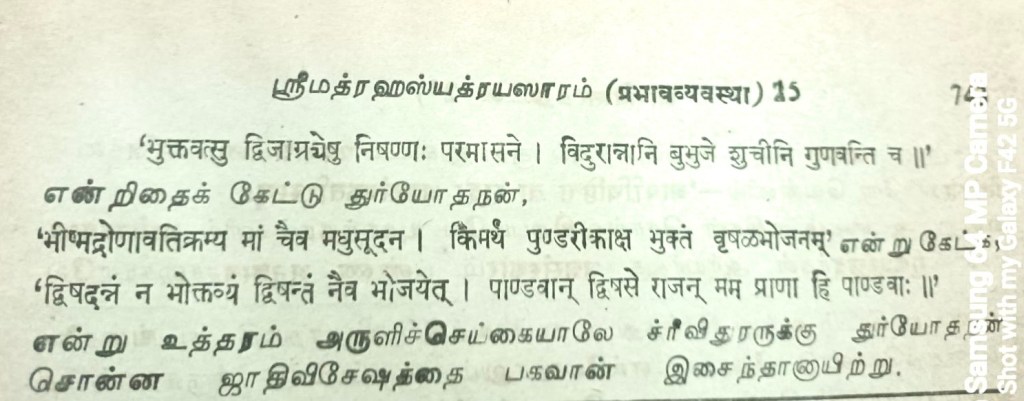
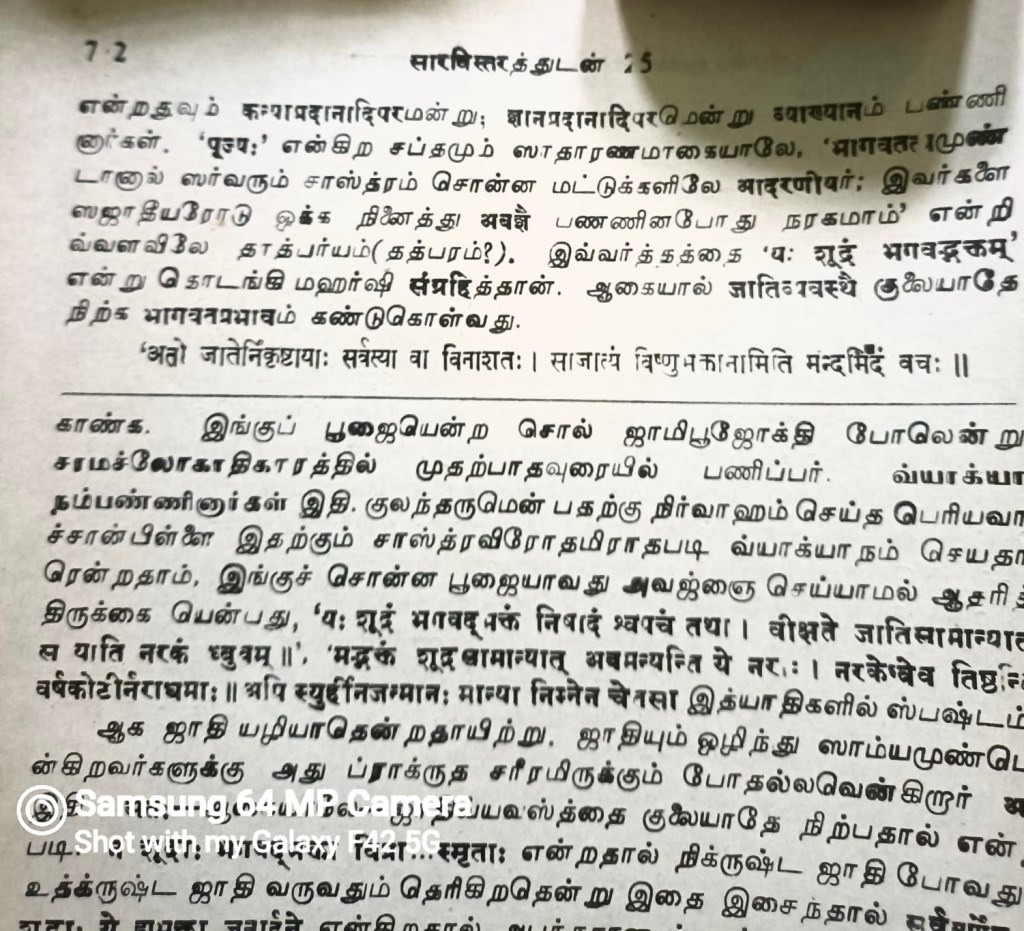
What the epic presents as an ethical vindication of Vidura, the commentary recasts as a lesson about inherited status, ritual caution, and the social force of birth.
In other words, the passage is not primary epic testimony but a hermeneutical appropriation of the epic within a later sampradaya framework.
The above image-pages are an excerpted Tamil commentary with Sanskrit quotations embedded in it. The Sanskrit lines are phrased to convey :
विषदन्नं न भोक्तव्यं त्विषन्तं नैव भोजयेत्।
देशिकं त्विषते मूर्खः मम प्राणो हि देशिकः॥
One should not eat food from one who hates, nor feed one who hates; and the guru/desika is one’s very life.
The surrounding Tamil commentary appears to explain this in terms of:
• not receiving food from the hostile,
• not honoring the hostile with food,
• and then extending that idea to a social/religious discussion about Vidura and birth.
The passage does not deny Vidura’s moral excellence. In fact, the Mahabharata itself shows Krishna choosing Vidura’s house because he was the only neutral, dharmic person in the Kaurava court.
But the stated principle in the interpretative passage is that birth still sets the boundary of social membership and ritual acceptance during life. This is a classic Varnashrama claim: varna is determined by birth, and social/ritual inclusion follows that.
So, in the logic of this incident as presented here, the social order is not overturned by individual merit; rather, birth-based hierarchy is reaffirmed even while acknowledging personal righteousness.
This is exactly the kind of tension that later reformers and contemporary critics of caste have highlighted: the text admits the virtue of the “low-born” person but still insists that the hierarchical order remains valid.
What the Mahābhārata episode actually says
The authentic story is the well-known one in which Krishna visits Hastināpura as an envoy and chooses to eat at Vidura’s house rather than at Duryodhana’s court. In the epic, the emphasis is on Vidura’s devotion, dharma, and pure hospitality, not on a statement that birth alone determines permanent exclusion. The core sense, thus, is:
— Krishna accepted Vidura’s simple offering because it was offered with devotion and without guile.
— Vidura is treated in the epic as a man of wisdom and dharma, despite his socially lower birth.
— The episode therefore functions more as a praise of inner worth than as a defense of rigid hierarchy.
Textual relationship between Mahabharatha and Rahasya Traya Saram interpretation
— The Rahasya Traya Saram text uses the Vidura episode to argue a birth-based social principle.
— The Mahābhārata itself does not straightforwardly support that exact doctrinal claim in the way the commentary seems to imply.
— The episode in the epic is better read as elevating conduct, devotion, and dharma over merely external rank.
Bottom line
So, the above excerpted passages do not clearly preserve an authentic Mahābhārata verse that says what the commentary is making it say. It is a later interpretive reading, using the Vidura story and the food/guru maxim to support a hierarchical interpretation.
For an orthodox reader, this may appear as a faithful extension of tradition: the older itihasa is being harmonized with received social and ritual assumptions.
For the laity, however, it can sound like a retrospective tightening of the epic’s moral horizon, forcing a dharmic narrative about inner worth into a more rigid birth-based mold.
That gap between epic and commentary is precisely where the tension lies. That uneasiness matters. If one reads the Mahabharata closely, Vidura is among the clearest examples of a morally superior figure whose social birth does not define his worth. The epic repeatedly elevates persons whose inner character exceeds outward category.
A later commentator may insist on hierarchy, but the narrative itself often complicates that insistence. This is why the Vidura episode remains so useful for discussing the relationship between text and tradition: it exposes the difference between what the itihasa says and what later readers wished it to say.
For orthodoxy, this tension is not a trivial matter. A traditional reader may wish to preserve the integrity of the varna order and see later commentary as a legitimate doctrinal extension of the text.
For the contemporary laity, however, the story speaks in a more direct moral register: sincerity matters more than status, and spiritual worth cannot be reduced to pedigree. Both readings have had their history, but they are not equally faithful to the narrative force of the original episode.
What emerges, then, is not simply a debate about Varna or ritual propriety. It is a deeper question of hermeneutics: who has the authority to say what a scripture means, and how far may later tradition go in retooling an older text to serve a newer doctrinal need?
In the case of Vidura, the answer is not merely academic. It touches the heart of how the Mahabharata has been used, inherited, and sometimes domesticated by later theological systems.
The episode still invites a serious reader to ask a hard question: does bhakti sanctify hierarchy, or does it expose the vanity of hierarchy?
The Mahabharata itself leans toward the latter. Later interpretive traditions, however, often have indeed tried to steer it toward the former. The tension between those two impulses is exactly what gives the story its enduring force.
In this sense, later hermeneutics did not merely interpret the itihasa; at times they domesticated it, bending a morally disruptive story back into a socially conservative frame.
(Concluded)
Sudarshan Madabushi