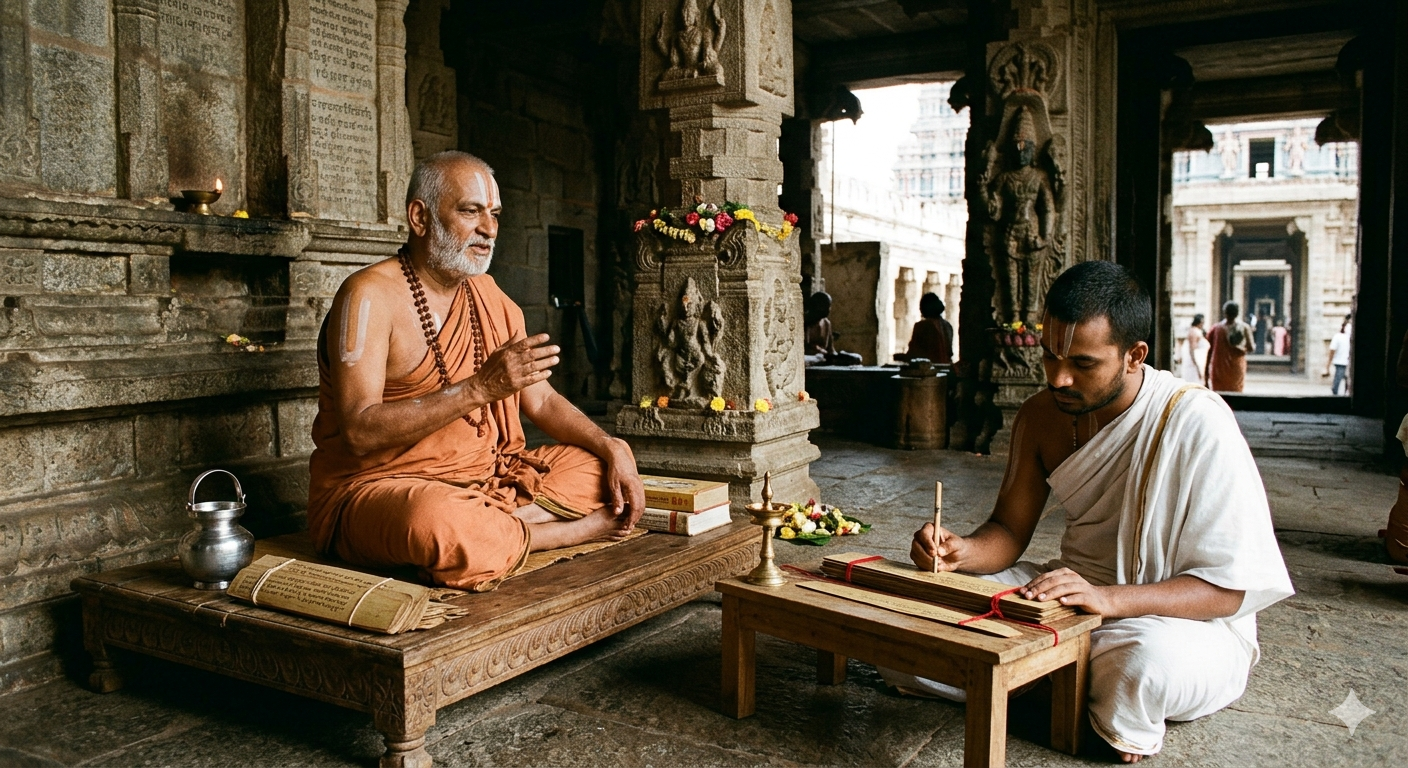

“Eureka at Srirangam: The shared dawn of Viśiṣṭādvaita — when guru and disciple together saw the soul and world as real.”
“When the teacher and his faithful disciple together beheld the soul and the world as truly real, and the living truth of Viśiṣṭādvaita dawned.”
by M.K. Sudarshan
______________________________
I. The teacher and the disciple: setting and relationship
In the great temple-town of Śrī Ranganātha, where the tidal hush of devotion meets the disciplined flame of philosophical enquiry, Sri Rāmānuja stood as both luminous ācārya and patient reformer. He had tested many lines of thought, read the terse breath of Bādarāyaṇa’s sūtras, and felt the need for a reading that did justice to devotion (bhakti), the reality of the soul (jīva), and the intimate relation between Creator and Creation.
To him came Kureśa—Kureśaṇ, Kurathalvar or Kuresan in later parlance—whose devotion was matched by a mingled fidelity of ear, mind, and hand.
Kuresan functioned not as a mere copyist but as amanuensis, critic, interlocutor, and mirror. He sat beside the guru in the study, the lamp between them, ink ready, palm-leaf or paper poised. He listened beyond the cadence of dictation; he listened into the architecture of thought.
Where the guru phrased, he tested; where the guru asserted, he demanded reasons; where the guru hesitated, he helped draw the line of exposition. This was not service by rote. This was co-creation within a tradition that prized both authoritative transmission and rigorous intellectual discipline.
Knowing Kuresan possessed an unmatched photographic memory, Ramanuja appointed him as his scribe (amanuensis). Because they had previously journeyed to Kashmir to consult the rare Bodhayana Vritti manuscript, Kuresan was the only one who held the full framework of text in his mind. Ramanuja laid down a specific rule for their sessions:
“Kuresa, write down my dictation. But if you find anything I say that deviates from the core principles of Viśiṣṭādvaita we have established, stop writing immediately.”
II. The labour of composition: dialogue, doubt, and painstaking craft
The crafting of the Sri Bhashya was long and arduous. It was an exercise in exegesis and invention. Ramanuja read the sūtras with fresh eyes; he sought to make each terse aphorism serve the twin aims of metaphysical clarity and soteriological import.
Kuresan’s role was to be the sounding-board and the bar of logic: to ask, to object, to demand clarification, to push the formulation until it would not yield to counterexample.
Draft followed draft; a clause was dictated, questioned, rephrased, excised, and restored. Sometimes the disciple’s objections were pithy, sometimes scathing; sometimes the guru’s temper flared. The story preserved in the sampradaya—of a quill flung in anger and a heartfelt apology ensuing —captures the human intensity of this labour.
This methodological rigor is crucial to understand. The pair did not merely transcribe old doctrines; they re-described reality’s basic architecture.
The Great Disagreement
A historical turning point occurred when Ramanuja dictated a line defining the individual soul (jeeva). He explained that the definitive, defining characteristic of the atomic soul is its cognitive power.
Upon hearing this, Kuresan silently laid down his bamboo quill and refused to write. Frayed by years of intense labor, Ramanuja initially took this silent protest as an affront and stormed out in anger.
However, upon reflecting, Ramanuja realized his disciple’s profound precision. Defining the soul merely by cognition was incomplete. The most vital element of a soul in Viśiṣṭādvaita is its Seshatva—its inherent, absolute allegiance and organic belonging to the Supreme Lord.
To define the soul without its relationship to God was like defining light without mentioning the sun.
Ramanuja gracefully returned, embraced Kuresan, and corrected the dictation. This dynamic collaboration solidified the Sri Bhashya as a masterpiece of qualified non-dualism.
The Sri Bhashya is therefore a work that bears marks of dialectic—of proposal and refutation, of thought sharpened in real time. Kuresan’s scrutiny ensured the statements were not merely devotional slogans but philosophical theses able to withstand rival counters and scholastic cross-examination.
III. The Eureka: discovery of the defining kernel of Viśiṣṭādvaita
After many months and years of such labour, indeed, , there had come such a moment—the luminous instant that every tradition of reasoning and revelation recognises as defining.
In a passage of dialogue between the two, perhaps as Ramanuja had attempted to reconcile the sūtras’ terse claims with the lived reality of jīvas and world, both guru and disciple had perceived the central insight as if by sudden convergence: the jīva (cit) is real; the acit (prakṛti, the world) is real; both stand in an ontological inseparability to Brahman who is qualified (viśiṣṭa) by these modes.
Brahman is not a formless, impersonal absolute in which the world is mere illusion; nor is Brahman a plurality of independent souls pitched against Him. Rather, Brahman is the substantive whole, the ontological support whose self-manifestation includes sentient selves and insentient matter as His attributes—inseparable, dependent, yet truly real.
Thus, what guru and sishya had arrived at was an intellectual rupture with the dominant interpretive alternatives. Advaita’s monism (paramārthika non-dualism that regards the world and jīva as mithyā) and certain readings influenced by Buddhist anatman-like negations could not accommodate a theologically robust theist-philosophy where individual selves retained identity and moral responsibility. The conviction that the jīva’s sentience is not illusory but ontologically significant re-opened the relationship between soteriology and ethics, devotion and ontology.
For Ramanuja and Kuresan, that moment felt like suddenly seeing the pattern that had been hinted at in many sutras and which now all fell into place with crystalline inevitability.
The word “Eureka” is Greek, but the Indian equivalent—ananda, pratibhā, jñāna-darpaṇa bursting into light—fits the suddenness of that moment: not a gradual accumulation but a cognitive coalescence whereby a subtle terminological, metaphysical, and devotional alignment made the new darsana unmistakable. Both teacher and disciple felt it: the guru’s insight galvanized; the disciple’s scrutiny confirmed. The doctrine that emerged gave ontological dignity to the soul and made the world an integral dimension of the divine reality, thereby preserving both bhakti’s warmth and metaphysics’ precision.
[ “யூரெக்கா” என்பது ஆங்கிலேயம் சொல். இது “வெட்டி வெளிச்சம்” என்று பொருள்படும்.
ஆனால் ஆன்மீகமான அर्थத்தில், இது ஒரு புத்தித் திடீர் தெளிவு —
ஒரு கணத்தில், முன்னே தெரியாத உண்மை suddenly தெரிந்து விடுகிறது.
திருவாய் மொழிந்த அருணகிரி நாதர் போலும், இராமானுஜர் மற்றும் கூரத்தாழ்வான் அவர்களும், ஒரு கணத்தில் விசிஷ்டாத்வைதத்தின் மைய உண்மையைக் கண்டார்கள்.
அதுவே — “ஈச்சே! எனக்குத் தெரிந்தது! இதுவே உண்மை!” — என்று சொல்லும் புத்திப் பிரதிபா.
தமிழில் அதை “தேவ தெளிவு”, “உண்மை உதயம்”, அல்லது “விளக்கி விடை” என்று சொல்லலாம். ]
IV. Why the Eureka was under-dramatised in tradition
Despite the importance of this momentous discovery, in today’s Sri Vaishnava sampradaya’s living memory, celebrating this moment or instant as a great festival-day or a heavily dramatized myth is rather muted or reticent.
Several reasons—historical, doctrinal, and devotional—explain why.
• Guru-centred narration: Hagiography privileges the ācārya. The tradition’s principal pedagogic aim is to present the guru as the channel of revelation and grace. Highlighting a collaborative discovery risks complicating the simple didactic tableau: a luminous teacher revealing truth to followers.
• Private, intellectual occurrence: The insight took place within the intimate precincts of composition. Festivals and ritual calendars commemorate public acts—temple restorations, journeys, miracles, samādhi—not necessarily private moments of intellectual genesis that lack a ritual enactment.
• Didactic utility: Hagiographies emphasise stories that model devotion, moral courage, and service. A private doctrinal breakthrough provides less moral exemplum than stories of liberation granted to the lowly, fights for temple justice, or acts of charity, etc.
• Institutional prudence: Publicly magnifying a disciple’s intellectual role might create lineage ambiguities. For institutional cohesion, a clear chain of authority—teacher as primus inter pares—helps maintain unity and orthodoxy. Emphasising co-authorship or mutual insight could spawn rival claims or factional readings.
• Cultural modesty and humility: Many Vaishnava texts and accounts stress humility as a virtue. Ramanuja’s persona as humble teacher who showed compassion and reordered worship and religious life aligns better with ritual memory than an emphasis on rhetorical or polemical triumphs.
• Genre and transmission biases: Manuscripts, commentarial glosses, and ritual manuals preserved doctrine and ritual more than composition history. Subsequent teachers taught the Sri Bhashya as settled scripture; the textual provenance mattered less than its interpretive use.
V. What recognising the Kuresan factor gives us
To resuscitate this moment in communal memory is not to diminish Ramanuja’s genius but to deepen our understanding of how great doctrine emerges: by collaborative, rigorous labour that mixes devotion and critique.
Recognising Kuresan’s role underscores important virtues the sampradaya itself prizes—sravana (listening), manana (reflection), and nididhyāsana (profound contemplation)—all enacted between guru and disciple. It recovers the social and intellectual texture behind the text: the limits of solitary-authority narratives, the role of critical friendship, the discipline of scruple, and the humanity behind the sūtras. It also affirms the guru-sishya sambhandham.
Commemoration of this very special moment in the history of Sri Vaishnavism need not replace any existing festival structures or Utsavams already in place or practice that glorifies Kuresan’s memory. But such a special event to mark the “Eureka moment” can only enrich them. By honoring the Kuresan figure and the Eureka instant, the sampradaya would surely celebrate intellectual humility, critical fidelity, and the relational birth of truth—the very virtues that underpin both scholarship and bhakti.
श्रीरामानुजकुरेशाभ्यां नमः ।
ययोः सहचिन्तनात् सत्यं स्फुटमभूत् ।
श्रीविशिष्टाद्वैतसिद्धये नमः ।
śrīrāmānujakureśābhyāṃ namaḥ.
yayoḥ sahacintanāt satyaṃ sphuṭam abhūt.
śrīviśiṣṭādvaitasiddhaye namaḥ.
Salutations to Śrī Rāmānuja and Kureśa.
Through whose shared contemplation truth became clear.
Salutations to the accomplishment of Śrī Viśiṣṭādvaita.
(Concluded)
Sudarshan Madabushi