Nine Dialogues on Trust, Betrayal, and Mahāviśvāsam
by M. K. Sudarshan
October 23, 2026: Chennai, India
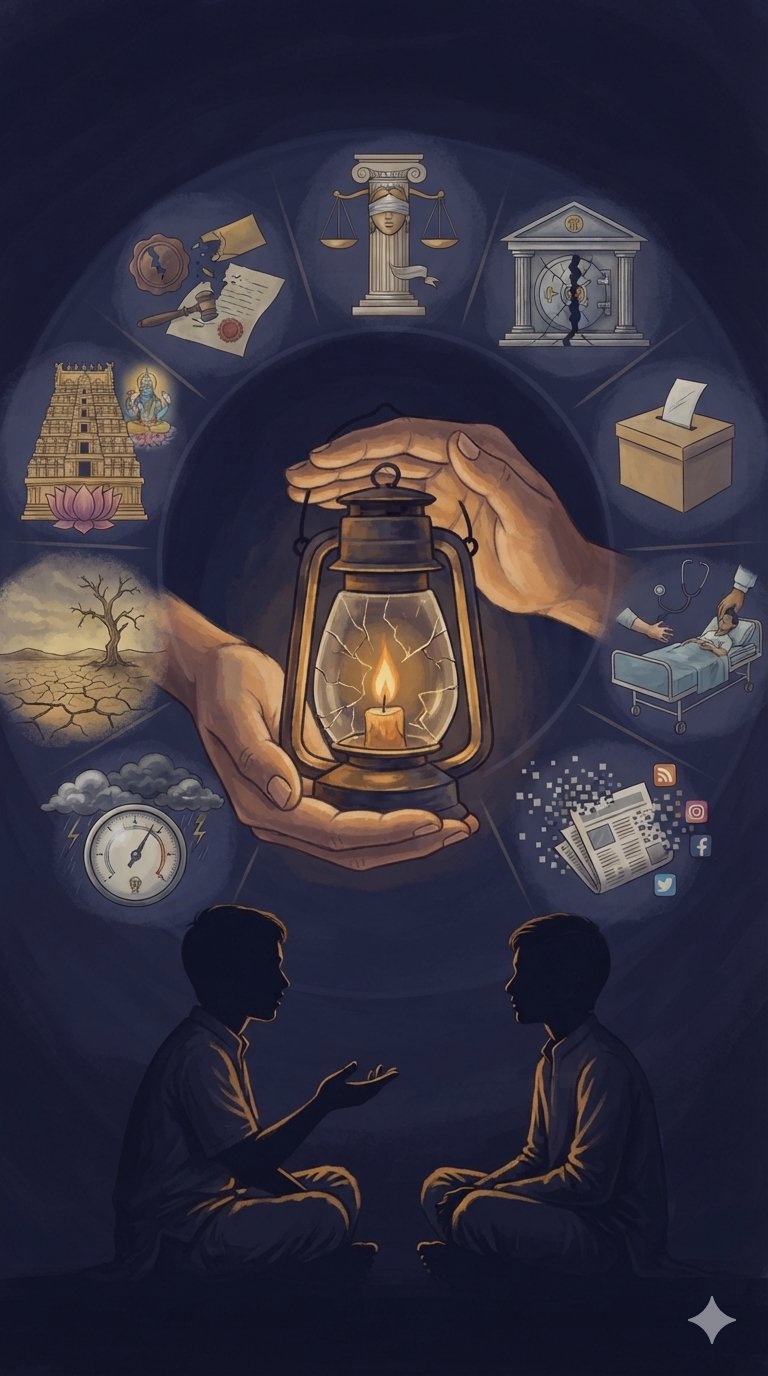
In God We Trust may be less a declaration of faith than humanity’s confession: we no longer know whom to cling to when the rain sets in.
A nine-day dialogue on the death of trust—and its possible resurrection.
A Series Introduction
We live in an age that speaks endlessly of trust—and practises it with increasing difficulty.
Governments ask for trust while citizens question their motives. Banks ask for trust while memories of financial betrayal remain fresh. Doctors, judges, journalists, priests, scientists, technology companies, and even the weather forecast are asked to prove themselves before they are believed. The ballot box asks the loser to trust the process; the patient asks the stranger in a white coat to touch the most intimate facts of his life; the depositor asks an invisible institution to safeguard his earnings.
We call the result a “trust deficit.” But perhaps it is more than that. Perhaps it is the mother of all deficits: the deficit that makes every other deficit harder to remedy. Trade deficits, budget deficits, food and energy deficits, deficits of well-being and happiness—all require cooperation among parties who no longer fully believe one another.
Even the climate now seems to suffer from a predictability deficit. The old rhythms of nature, on which human life once rested with a certain confidence, have become uncertain. And uncertainty breeds anxiety; anxiety breeds suspicion; suspicion makes cooperation more difficult.
This series of nine dialogues — which I will be posting one a day, starting tomorrow Oct 24 over the succeeding 9 consecutive days — all arose from a simple but unsettling question:
“How did the world come to suffer so widely from a deficit of trust?”
Was it a consequence of the primal breach of trust narrated in the story of Adam and Eve? Was the first sin not merely disobedience, but the collapse of confidence in God’s word? And if so, has human history ever ceased to repeat that original movement—receiving trust, doubting it, grasping at certainty, and then hiding from the consequences?
The dialogues that follow are set in an imaginary Vedic university in South India. Two students meet there: Ānanda, restless, sceptical, poetic, and wounded by the betrayals of the modern world; and Madhava, calm, learned, and steeped in Vedānta and the Sri Vaishnava tradition.
Ānanda does not speak as a cynic for the pleasure of cynicism. He speaks for all of us who have watched institutions demand trust while failing to deserve it. Madhava does not offer easy consolation. He tests Ānanda’s despair, distinguishes distrust from wisdom, and gradually leads the conversation toward a more demanding question:
“Can trust be rebuilt after betrayal—or must we learn a humbler, more discerning form of reliance?”
The 9 dialogues move through the modern landscape of public-relations surveys, commercial media, institutional decay, and social entropy. But they also move inward, toward the old spiritual insight that human beings cannot ultimately be their own refuge.
The series ends in the Sri Vaishnava doctrine of prapatti—self-surrender—and in mahāviśvāsam: the soul’s great, unshakeable trust in the saving grace of Sriman Nārāyaṇa.
This is not a denial of the world’s betrayals. It is a refusal to allow betrayal to become the final truth of human existence.
Perhaps trust is indeed a “candle in the wind”. But even a candle can light another candle. And perhaps, from many small flames faithfully preserved, a dawn becomes possible.
Author’s Note:
These 9 dialogues were not composed in a calm, academic frame of mind. They emerged from questions that had been moving through my mind throughout the nine days of the Navarathri festival that has just concluded.
Navarathri is a festival of the Divine Mother: nine nights of worship, remembrance, and inner preparation. It is also, in its deeper meaning, a passage through struggle toward clarity—the movement from darkness toward light, from fragmentation toward wholeness.
As the festival proceeded, I found myself thinking less about celebration and more about trust: trust in God, trust in institutions, trust between human beings, and the strange modern condition in which we are asked to trust powers we can neither fully understand nor hold accountable.
The questions came unbidden.
Why does the modern world speak so much of a “trust deficit”?
Why do institutions that exist only because people once trusted them now struggle to command belief?
Why does the media, which claims to speak for the public, itself suffer from a credibility deficit?
Why do we place the words “In God We Trust” upon our currencies and public monuments, while finding it increasingly difficult to trust one another in ordinary life?
And then came the harder question: if human trust is so fragile, is God worthy of Man’s trust? If yes, why?
It was in the course of these Navarathri reflections that the Sri Vaishnava idea of mahāviśvāsam came to feel central. In the doctrine of prapatti, or self-surrender, mahāviśvāsam is not naïve optimism. It is the soul’s unshakeable confidence that, having surrendered itself to Sriman Nārāyaṇa, it will not be abandoned.
That thought did not, of course, dissolve the world’s betrayals. It did not make corruption, falsehood, cruelty, or institutional failure any less real. But it changed their final significance. They became wounds within a larger story, not the whole story.
These nine dialogues are therefore offered as a Navarathri meditation—on the death of trust in our public life, and on the possibility of its resurrection through truthfulness, accountability, discernment, and ultimately surrender to the Divine.
They are dialogues, not verdicts. Ānanda’s doubts are my doubts; Madhava’s responses are my attempts to think beyond them. If the series has a single underlying conviction, it is this:
The death of trust is not overcome by demanding belief. It is overcome when human beings, and the institutions they create, once again become worthy of belief.
And when they do not, the soul must still find a refuge deeper than fear.
That refuge, in the Sri Vaishnava tradition, is the Lord’s grace.
Narayana! Narayana! Narayana!