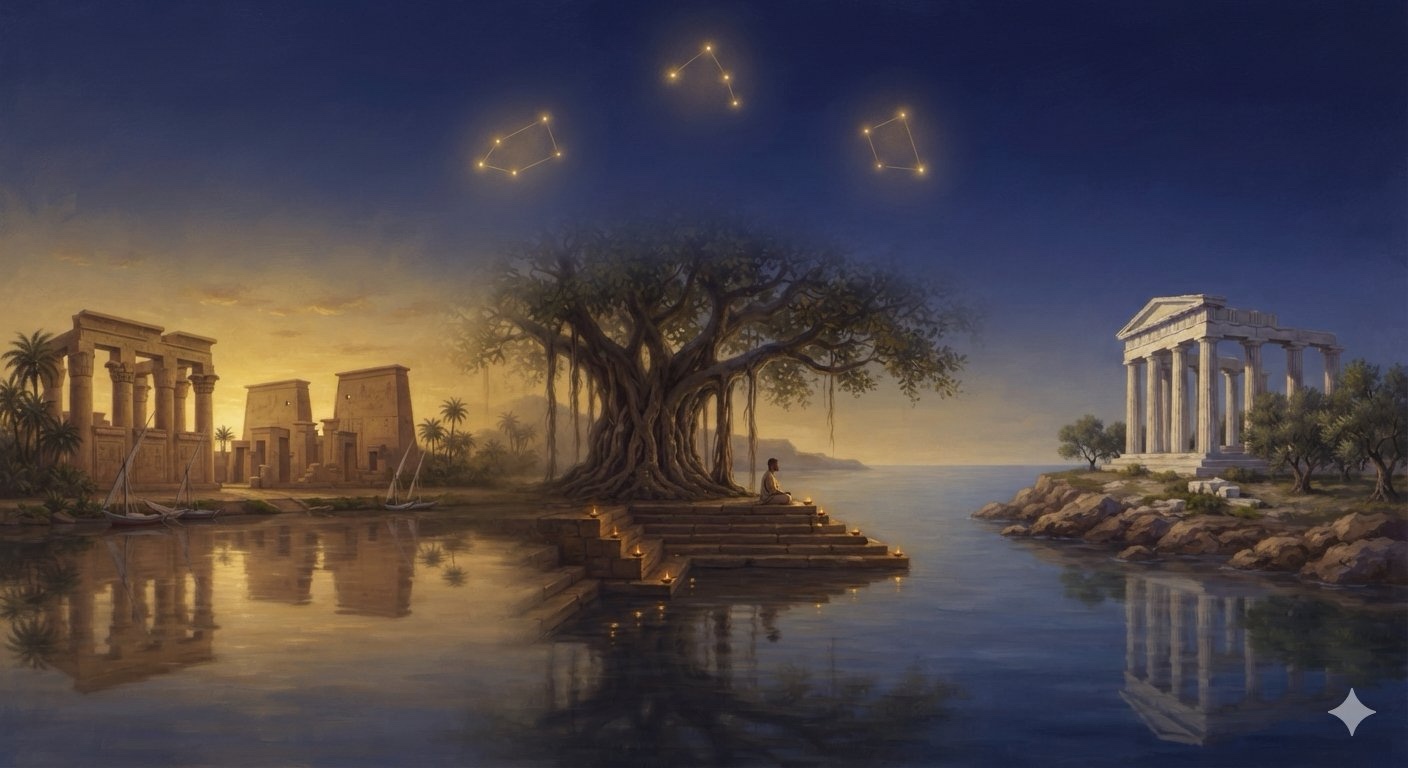
In this essay, we’re taking a journey across three ancient civilizations—Egypt, India, and Greece.
Separated by deserts, mountains, and seas, all three asked the exact same question:
How does a human being remain inwardly steady in an unpredictable world? Remarkably, without copying one another, all three arrived at nearly identical portraits of the ideal human being.
Life brings gain and loss, praise and blame, triumph and ruin. Rather than treating mental peace as luck, Egypt, India, and Greece treated inner steadiness as the highest human achievement. Let’s look at how each civilization built its own path up this mountain.
When we place all three side by side, the differences in metaphysics—afterlife judgment in Egypt, moksha in India, rational flourishing in Greece—only highlight how remarkable their psychological agreement is.