How Three Great World Civilizations, Searching in Parallel, Arrived at the Same Destination of the Ideal Human
M.K.Sudarshan
November 17, 2026: Chennai, India
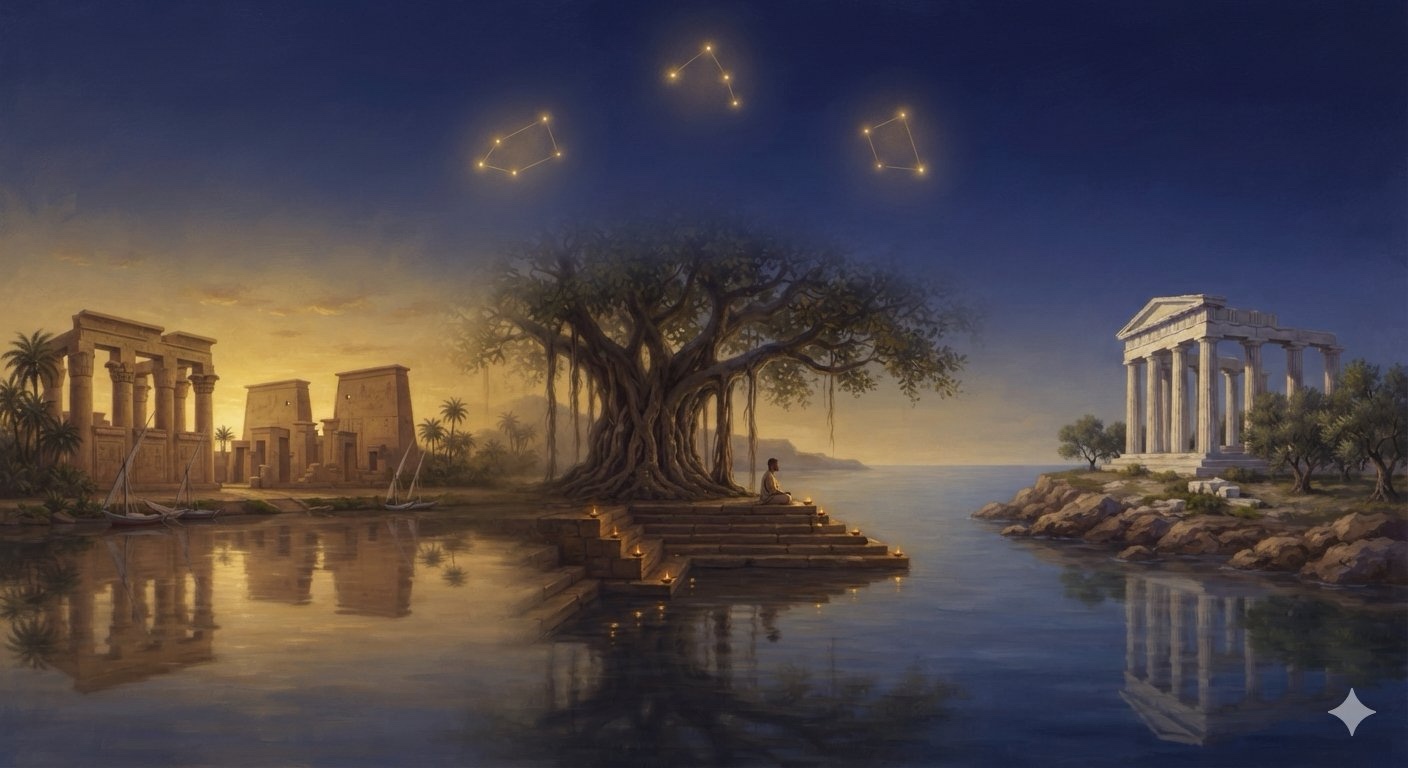
Across the ancient world, separated by vast deserts, mountain barriers, and open seas, three great civilizations independently confronted the same enduring human dilemma:
How does a human being remain inwardly steady, lucid, and whole while living in a world defined by impermanence, uncertainty, and suffering?
Along the fertile banks of the Nile, across the river plains and forest hermitages of India, and within the marble colonnades of Greece, thinkers arrived at remarkably similar answers. Though they spoke different languages, worshiped under different skies, and built radically different metaphysical systems, all three converged on a shared portrait of the ideal human being:
- In Ancient Egypt, it was the Geru Maa—”the Truly Silent” or self-controlled sage—living in alignment with Ma’at (cosmic order, truth, and balance).
- In Vedantic India, it was the sthitaprajna—”one of steady wisdom”—anchored in the unchanging Self (Atman) amidst the shifting tides of the material world.
- In Ancient Greece, it was the sage of ataraxia—”un-troubledness”—possessing an unshakeable mental tranquility freed from irrational fear and craving.
For centuries, historians and philosophers debated whether this striking resemblance was the result of cultural borrowing—either from East to West or West to East. Yet when the historical, linguistic, and textual evidence is weighed carefully, a far more profound conclusion emerges: these three ideals were born independently through parallel philosophical discovery, only to recognize one another as kindred truths when trade, diplomacy, and empire eventually brought their worlds together.
I. The Nile and the Silent Sage of Ma’at
Our inquiry begins along the Nile, where one of humanity’s oldest continuous civilizations developed an intricate philosophy of inner and outer equilibrium nearly two millennia before classical Athens.
To the ancient Egyptians, the cosmos was not a random collision of forces; it was sustained by Ma’at—a foundational principle uniting cosmic law, seasonal rhythm, truth, justice, and personal integrity. Just as Ma’at kept the stars in their courses and brought the life-giving flood of the Nile each year, human beings were called to mirror that same steadiness within their own minds and communities.
Out of this worldview emerged the Egyptian ideal of the Geru Maa—literally, “The Truly Silent One” or “The Self-Controlled One.” In classical Egyptian Sebayt (“Wisdom Literature”), such as the Instruction of Ptahhotep (c. 2300 BCE) and the Instruction of Amenemope (c. 1100 BCE), the Geru Maa is vividly contrasted with the shemem—the “heated” or “hot-headed” person who reacts impulsively to insults, chases wealth feverishly, and collapses into despair when fortune turns.
“As for the heated man in the temple, he is like a tree growing indoors; only for a moment does it put forth shoots… The truly silent one sets himself apart; he is like a tree growing in a sunlit field—it flourishes, doubles its yield, and stands before its owner.”
— Instruction of Amenemope, Chapter 4
Crucially, Egyptian “silence” did not mean muteness, passivity, or withdrawal from civic responsibility. These wisdom texts were written primarily for judges, scribes, administrators, and citizens. To be a Geru Maa meant mastering anger, resisting greed, and speaking truth with measured calm so that one could uphold justice in society without becoming emotionally enslaved to public praise or sudden ruin.
II. The Ganga and the Sthitaprajna of Vedanta
Thousands of miles to the east, Indian sages were probing the same human predicament—pushing their inquiry into the deepest layers of consciousness itself.
Whether viewed through traditional Indian chronology—which places the events of the Mahabharata at the close of the Dvapara Yuga around 3102 BCE—or through modern philological scholarship, which traces the written compilation of the Bhagavad Gita to the final centuries BCE out of much older Vedic and Upanishadic oral streams, the Vedantic ideal of mental equipoise stands on unmistakably indigenous foundations.
In the second chapter of the Bhagavad Gita (verses 54–72), Arjuna asks Krishna how a person of steady wisdom—a sthitaprajna—speaks, sits, and walks in the world. Krishna’s reply remains one of world literature’s most penetrating portraits of psychological freedom:
“One whose mind is unshaken in adversity, who does not crave pleasure in prosperity, and who is free from attachment, fear, and anger—such a sage is called a sthitaprajna.”
— Bhagavad Gita 2.56
Like the Egyptian Geru Maa, the sthitaprajna is not an escapist hiding from reality. On the contrary, Krishna delivers this teaching on the brink of battle, urging Arjuna to engage fully in his duty (karma yoga) while surrendering obsessive attachment to the outcomes of his actions. Drawing a vivid natural metaphor, the Gita compares the wise person to a tortoise drawing its limbs safely into its shell—not out of fear, but out of sovereign self-mastery over the senses.
Underpinning this psychological poise is a distinct metaphysical insight: while the phenomenal world (Prakriti) is perpetually in motion like waves rising and falling on an ocean, the true Self (Atman) is the calm, immutable depth beneath. By discerning the difference between the fleeting outer world and the eternal inner witness, the sthitaprajna ceases to be tossed about by dualities—heat and cold, honor and disgrace, gain and loss.
III. The Aegean and the Quest for Ataraxia
On the rocky shores of Greece, a third great civilization arrived at a remarkably similar destination through its own native lineage of rational inquiry.
Long before Greek armies or merchants ever reached the Indus River, the pre-Socratic philosopher Democritus (c. 460–370 BCE) used the exact Greek term ataraxia—literally “un-troubledness”—alongside euthymia (“tranquility of soul”) to describe the supreme human good achieved by moderating desires and freeing the mind from fear. Building upon Socratic self-mastery (enkrateia) and Cynic self-sufficiency (autarkeia), the major Hellenistic schools placed ataraxia at the very center of human flourishing (eudaimonia):
- Epicureanism sought ataraxia by understanding the natural laws of the universe (atomism) so that human beings would be liberated from superstitious dread of death and vengeful gods.
- Stoicism sought ataraxia by aligning human reason with the rational order of nature (Logos), distinguishing strictly between what lies within our control (our judgments, intentions, and character) and what lies outside it (wealth, reputation, illness, and external events).
- Pyrrhonism (Skepticism) sought ataraxia by suspending dogmatic judgment (epoché) on uncertain matters, discovering that peace of mind follows naturally when the intellect stops exhausting itself over rigid opinions.
“Men seek retreats for themselves—houses in the country, seashores, and mountains… Nowhere can a man find a quieter or more untroubled retreat than in his own mind.”
— Marcus Aurelius, Meditations 4.3
Just as in Egypt and India, Greek ataraxia was never intended to turn human beings into unfeeling stone. Stoics explicitly rejected emotional numbness; whether practiced by a freed slave like Epictetus or a Roman emperor like Marcus Aurelius, ataraxia provided an “inner citadel” that enabled citizens and leaders to serve humanity with clarity and courage.
IV. Borrowing or Parallel Discovery? Weighing the Historical Evidence
When scholars across the centuries noticed how closely sthitaprajna, ataraxia, and Ma’atresembled one another, two competing diffusion theories emerged:
- The “India-to-Greece” Claim of Antiquity: Many ancient Greek and Greco-Roman writers assumed that because Indian and Egyptian civilizations were far older than Athens, philosophy itself must have migrated westward. In the 2nd century CE, Clement of Alexandria wrote in his Stromata that philosophy flourished first among the Egyptians and the Indian Brahmins and Sramanas before reaching Greece, claiming that Pythagoras and Plato had learned their doctrines of the soul directly from Eastern sages. Writers such as Philostratus, Apuleius, and Lucian echoed similar traditions, while the Neoplatonist founder Plotinus even joined a Roman military expedition to Persia in 243 CE hoping to reach India and study under the Brahmins.
- The “Greece-to-India” Claim of the 19th Century: Centuries later, several European Orientalists—including Albrecht Weber, Christian Lassen, and W. W. Tarn—inverted the claim, arguing under the sway of colonial Hellenocentrism that Indian epics, drama, and philosophical systems must have borrowed heavily from post-Alexandrian Greece.
Modern comparative philosophy and historical scholarship—championed by thinkers such as Sarvepalli Radhakrishnan, Surendranath Dasgupta, Bimal Krishna Matilal, Wilhelm Halbfass, and A. A. Long—have thoroughly dismantled both sweeping “copying” theories in favor of independent parallel development, while recognizing genuine points of historical contact:
- Why Borrowing Is Ruled Out as the Primary Origin:
- Chronology: Egyptian wisdom texts predated classical Greece by over a millennium; the early Upanishads predated Socrates and Zeno; and Democritus defined ataraxia in Greece a full century before Alexander the Great ever crossed the Hindu Kush (327 BCE).
- Zero Textual Translation: Not a single Sanskrit philosophical work—neither the Upanishads nor the Bhagavad Gita—was translated into Greek in antiquity, nor was a single work of Plato, Aristotle, or Zeno translated into Sanskrit.
- Distinct Metaphysical Roots: Borrowed concepts carry the DNA of their parent system. Yet sthitaprajna is inseparable from karma, rebirth (samsara), and union with Brahman; Greek ataraxia rests on atomistic materialism or Stoic Logos; and Egyptian Geru Maa rests on cosmic Ma’at and judgment before Osiris.
- Where Genuine Cross-Pollination Did Occur:
- Egypt to Greece: Unlike distant India, Egypt sat directly across the Mediterranean from Greece. From the 7th century BCE onward, Greek thinkers—including Thales, Pythagoras, Solon, and Plato—visited Egypt and openly acknowledged their debt to Egyptian priestly wisdom.
- India and Greece After Alexander: When Alexander reached Taxila in 327 BCE, the Greek philosopher Pyrrho of Elis spent roughly eighteen months observing Indian ascetics (whom the Greeks called gymnosophists), such as Kalanos and Dandamis, who remained utterly unmoved by physical pain, royal threats, and death. Scholars widely recognize that Pyrrho’s firsthand encounter with Indian ascetic equanimity directly shaped his formulation of Skeptical ataraxia upon returning to Greece.
- Mauryan Diplomacy and Indo-Greek Dialogue: Around 300 BCE, the Greek ambassador Megasthenes resided at Chandragupta Maurya’s court in Pataliputra. In his Indica, he marveled that the teachings of the Indian Brachmanes on the soul and cosmos coincided remarkably with Plato’s, while also recording widespread devotion to Vasudeva-Krishna (“Herakles”) among the Shurasenas of Mathura. Two centuries later, the Indo-Greek king Menander I debated the Buddhist sage Nagasena in the Milinda Panha, and the Greek envoy Heliodorus erected a pillar at Vidisha around 113 BCE declaring himself a devotee of Krishna and inscribing verses echoing the Mahabharata on self-restraint and alertness.
- The Crossroads of Alexandria: Finally, in cosmopolitan Alexandria—where Nile barges met Mediterranean galleys and monsoon merchant ships returning from Indian ports—Egyptian, Greek, and Indian traditions converged in the same intellectual marketplace, allowing thinkers like Clement and Plotinus to trace the golden thread linking all three.
V. Understanding Reality, Not Escaping It
Viewed side by side, the civilizational quests of Egypt, India, and Greece correct a persistent modern misunderstanding about inner peace.
None of these three traditions sought to insulate human beings from life by building a padded wall against reality, nor did they aim to make the mind cold, apathetic, or inured to human suffering. On the contrary, all three insisted that deep comprehension of the phenomenal world is the very key to mental freedom:
- Egypt studied the cosmic and social laws of Ma’at so the Geru Maa could act justly without anger.
- India analyzed the shifting nature of Prakriti and the unchanging witness of Atmanso the sthitaprajna could perform sacred duty without anxiety.
- Greece investigated the physical and rational laws of nature so the seeker of ataraxia could meet fate without fear.
In each civilization, the goal was not to flee the storm of existence, but to build a keel deep enough that the vessel would remain upright in any weather.
Conclusion: Three Lamps on the Same Summit
That three great civilizations—working independently across millennia and continents—arrived at nearly identical portraits of the ideal human being is one of the most illuminating facts of intellectual history. It suggests that sthitaprajna, ataraxia, and Ma’atare not merely local cultural artifacts; they are convergent discoveries about the architecture of the human mind itself.
Whenever human beings look honestly at the impermanence of fortune and the restlessness of desire, wisdom points toward the same quiet summit: to see the world clearly without illusion, to act within it responsibly without attachment, and to guard an inner stillness that no outward storm can ever take away.
(Concluded)