A Constitutional Crisis Disguised as Fiscal Prudence
by M.K.Sudarshan
(Temple Worshipper, Author, Hindu religious affairs observer-commentator and a Charteted Accountant)
Published: May 30, 2026

Introduction: The Sacred and the Secular Collide
The Madras High Court is currently seized with a Public Interest Litigation that strikes at the heart of a question that has haunted India’s temple-state relationship for decades: Can the government, which is supposed to protect temple funds, use its administrative control to divert those very funds into state-run corporations to finance its own deficit?
The answer, I would argue — if I were a lawyer, which I’m not — before the Court, is an emphatic no. And yet, the Tamil Nadu government has attempted to dress this constitutional violation in the garb of a “sovereign guarantee”—a fig leaf that obscures the fundamental breach of fiduciary duty owed to the deities whose funds are being misappropriated.
This op-ed examines the legal, constitutional, and financial dimensions of this contentious PIL and proposes a five-point due process formula that the Court can adopt to ensure a fair and just resolution.
I. The Historical Context: How We Got Here
The February 17, 2026 Government Order
On February 17, 2026, Tamil Nadu’s Department of Tourism, Culture and Religious Endowments issued a Government Order amending the Religious Institutions (Custody, Investments and Lending or Borrowing of Money) Rules, 1963. This amendment permitted surplus temple funds to be deposited in two state-run non-banking financial corporations:
- Tamil Nadu Power Finance and Infrastructure Development Corporation (TNPFIDC/TNPFC)
- Tamil Nadu Transport Development Finance Corporation (TNTDFC)
The petitioner—TR Ramesh of the Indic Collective Trust—challenged this Government Order, arguing that it:
- Is illegal and arbitrary
- Exceeds the powers granted under the HR&CE Act, 1959
- Violates Articles 25 and 26 of the Constitution (freedom of religion and right to manage religious affairs)
- Exposes ₹2,700 crore of temple funds to serious financial risk.
Why This Matters
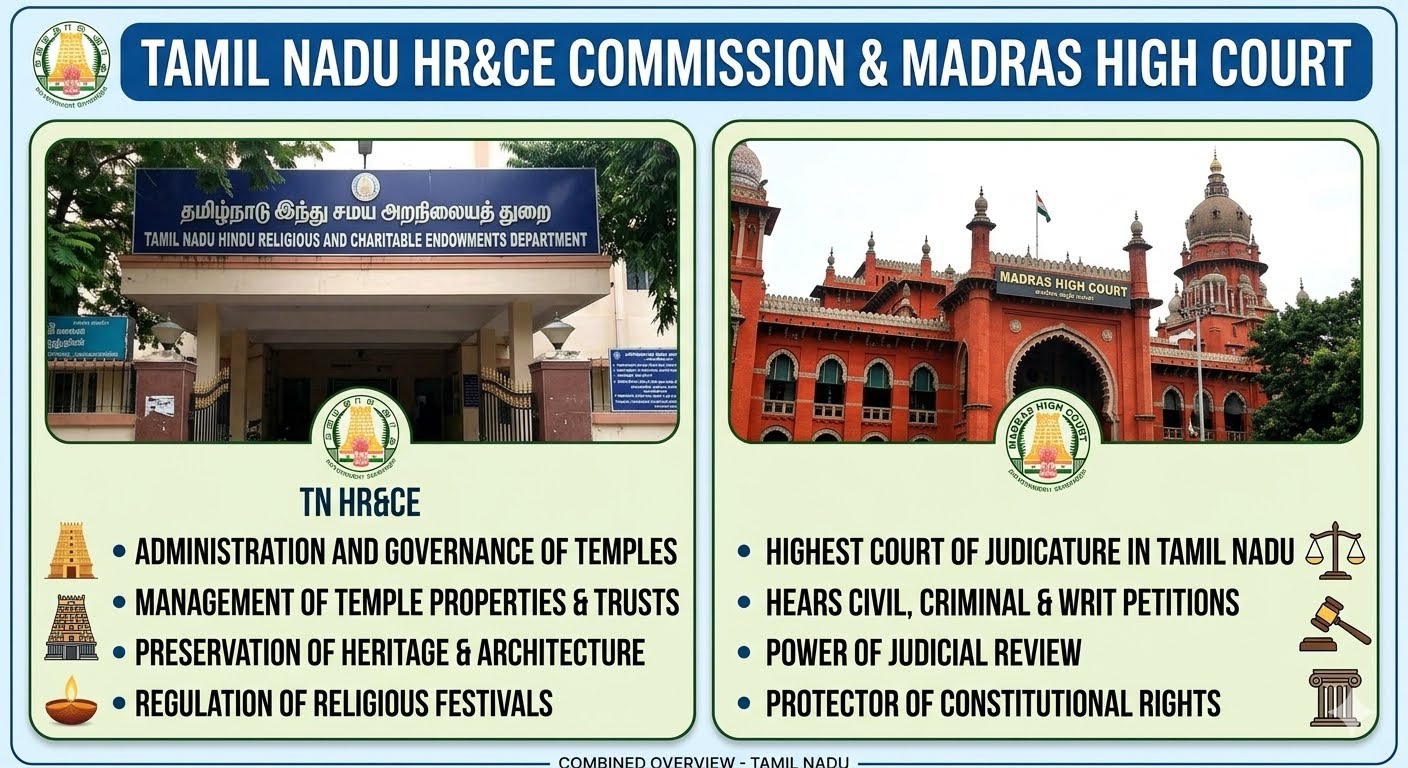
The HR&CE Department manages over 31,000 temples across Tamil Nadu. Of these, only 7,500 temples (24%) have trustee committees as of December 2024. The remaining temples are managed directly by the Executive Officer (EO) and “fit persons” appointed by the department—effectively making the state government the administrator of temple assets.
This is the structural coercion at the heart of the PIL. When the government controls both the policeman (HR&CE Commissioner) and the property (temple funds), there is no genuine choice for temples to refuse investment in state corporations.
II. The Financial Reality: Why the Sovereign Guarantee is a Fig Leaf
The Sovereign Guarantee: What It Claims to Do
On May 29, 2026, the Tamil Nadu government informed the Madras High Court that it would provide a sovereign guarantee for temple funds deposited in TNPFIDC. The state’s Attorney General, Vijay Narayan, filed a memo signed by Secretary J Kumaragurubaran, guaranteeing:
- Safety of principal
- Timely repayment of interest
- Full state backing for HR&CE temple funds only.
The Financial Reality Behind the Guarantee
But a sovereign guarantee is only as good as the fiscal health of the guarantor. Here’s what the government is not telling the Court:
Parameter Tamil Nadu’s Status Why It Matters
— Outstanding Debt (2026-27)₹10.71 lakh crore
— Highest absolute debt among all Indian states
— Debt-to-GSDP Ratio26.1% : Declining but still above pre-COVID levels (~24%)
— Revenue Deficit₹48,696 crore (2026-27)
— Missed 15th FC target of zero revenue deficit by 2025-26
— Fiscal Deficit 2.99% of GSDP. At the statutory limit of 3%
The CAG report for 2023-24 explicitly noted that Tamil Nadu met only one of three fiscal targets, missing the revenue deficit elimination and fiscal deficit targets.
The Concentration Risk: TNPFIDC’s Business Model
The sovereign guarantee looks even weaker when we examine what TNPFIDC actually does with the money:
Risk Factor
TNPFIDC’s Status
— 90-92% Lending ToTNPDCL (TANGEDCO) — debt-ridden power distribution company
— TNPDCL Accumulated Losses₹1.62 lakh crore across power sector companies
— Credit RatingBWR A (CE) (Stable) — not AAA
— Regulatory ExemptionCredit concentration norms waived by RBI
— ProfitabilityLow profitability despite adequate liquidity.
This is the circular guarantee risk:
The state guarantees temple funds invested in TNPFIDC, which lends to TNPDCL, which requires continuous state bailouts. The guarantee merely shifts the risk from investor to state, but doesn’t eliminate the underlying financial weakness.
Would a Private Entity Accept This?
A financially prudent private sector corporation would NOT be satisfied with just a sovereign guarantee because:
- Concentration risk: 90% exposure to a single loss-making borrower (TNPDCL)
- Non-AAA rating: BWR A (CE) is below the AAA threshold for safe fixed deposits
- Circular dependency: State → TNPFIDC → TNPDCL → State bailout
- No safeguards: No minimum credit rating requirements or diversification mandates
The petitioner’s affidavit explicitly states:
“TNPFC may have a perceived advantage of being 100% owned by the Government of Tamil Nadu, and that is perhaps the only reason that prevents its rating from going below BBB(-).”
This is a BBB-minus rating—the minimum required for an NBFC to accept public deposits. Any lower rating would incapacitate TNPFIDC from accepting or renewing deposits.
III. The Constitutional Violation: Articles 25, 26, and 14
Article 25: Freedom of Religion
Article 25 guarantees the freedom of conscience and right to freely profess, practice, and propagate religion. When the state diverts temple funds to finance its own infrastructure projects (power, transport), it instrumentalizes religious donations for secular purposes, violating the devotees’ religious intent.
Article 26: Right to Manage Religious Affairs
Article 26 grants religious denominations the right to:
- Manage their own affairs in matters of religion
- Own and acquire movable and immovable property
- Administer property in accordance with law
The February 2026 Government Order violates all three because:
- Investment decisions are administrative acts, not religious ones, but they affect the temple’s ability to continue religious activities
- The state seizes control of temple property (funds) without trustee consent
- The HR&CE Act’s Section 116 restricts rule-making to safeguarding temple properties, not converting them into state financing sources.
Article 14: Equality Before Law
The PIL argues that temple funds are being treated as state treasury, while similar funds managed by private trusts or religious denominations outside HR&CE control are not subject to the same coercion. This violates Article 14’s guarantee of equality.
IV. The Judicial Precedent: What Courts Have Said About Temple Funds
Madras High Court (2026): “Temple Funds Belong to the Deity”
In a January 2026 judgment, the Madras High Court quashed a ₹40 crore Kallazhagar Temple project, ruling:
“Temple funds belong to the deity and cannot be diverted for government projects.”
This is the core legal principle that the February 2026 Government Order violates.
Vacation Bench’s Skepticism (May 20, 2026)
The Madras High Court vacation bench (Justices G R Swaminathan and V Lakshminarayanan) demonstrated clear judicial concern during the May 20 hearing:
“You are planning to empty the temple [coffers] along with TANGEDCO?”
This remark is significant because it shows the Court recognizes the coercive dynamic and the financial risk to temple funds.
Himachal Pradesh High Court (October 2025)
The Himachal Pradesh High Court ruled:
“Temple funds cannot be diverted, transmitted, or donated to any government welfare scheme or to activities unrelated to religious purposes.”
This is directly on point: Temple funds must be used for religious purposes, not state infrastructure.
Supreme Court (December 2024): Arangavalar Committees
The Supreme Court directed Tamil Nadu to:
“Spell out its proposed actions over the appointment of the ‘Arangavalar Committee’ (trustee committee) for all Hindu temples in the state.”
This is relevant because the five-point due process proposal— discussed below — includes trustee appointments, which the Supreme Court has already ordered.
V. The Structural Coercion: HR&CE’s Control Over Temples
The Problem: No Independent Trustees
Fact Implications
— 31,000 temples in Tamil Nadu Only 7,500 (24%) have trustee committees
No trustees appointed for 10+ years “Fit persons” manage day-to-day operations but cannot make major policy decisions
HR&CE Commissioner is state authority Ultimate administrative control lies with government official, not independent trustees
Statutory override powers HR&CE Department can remove trustees and appoint “fit persons” under HR&CE Act.
The Consequence: No Genuine Choice
When the government:
- Controls the HR&CE Commissioner (policeman)
- Manages 26,000+ temples directly (property)
- Issues a Government Order (law)
- Demands investment in state corporations (policy)
There is no meaningful consent from temples. This is institutional coercion, even if it doesn’t meet the legal threshold of “duress.”
VI. A Five-Point Due Process Formula for Fair and Just Resolution
Given the legal, constitutional, and financial complexities of this PIL, I wish to propose and place before the larger community of Temple Worshippers in State of Tamil Nadu a five-point due process formula that the Court in its wisdom may perhaps consider adopting to ensure a fair resolution while respecting the fiduciary duty owed to deities.
Point 1: Arrange for the Appointment of Trustees or Trust Boards in All Temples
Legal Basis:
- Section 47(1)(c) of HR&CE Act, 1959 — mandates Board of Trustees with 3-5 members
- Madras HC (2021): Directed trustee appointments within 12 weeks
- Supreme Court (Dec 2024): Directed TN to file action plan for Arangavalar Committees
Court Order:
- Direct Tamil Nadu government to complete trustee appointments for all 31,000 temples within 6 months
- Ensure mandatory SC/ST and women representation per Section 47(1)(c)
- Set up a monitoring committee to track progress
Point 2: Transfer Administrative Control from EO/Fit Persons to Trustees
Legal Basis:
- Madras HC (2021): “Trustees alone have full authority over assets and properties”
- HR&CE Act: Major policy decisions (investments) require trustee approval
Court Order:
- Direct transfer of administrative control to newly appointed trustees
- Restrict Executive Officer’s powers to routine administration only
- Require trustee board approval for any investment decisions
Point 3: Await Trust Board Decision on Investment Merits
Legal Basis:
- Fiduciary duty: Temple funds belong to deity (juristic person), NOT government
- Himachal HC (2025): Funds must be used for religious purposes
- PIL’s core argument: Investment decisions require trustee consultation
Court Order:
- Adjourn PIL to allow trustee boards to deliberate independently
- Require trustees to provide written decision on investing in state NBFCs
- Ensure no coercion from HR&CE Department during deliberation
Point 4: Transfer Funds to RBI Escrow Account During Suspended Animation of the PIL
Legal Basis:
- Article 226: Court’s power to issue interim orders to preserve temple funds
- RBI is already a party: Notice issued May 20, 2026
- Precedent: Courts have ordered escrow accounts in fiduciary disputes.
Court Order:
- Direct immediate transfer of ₹2,700 crore from TNPFIDC/TNTDFC to RBI escrow account
- Interest accrued to flow to temples for routine administrative purposes only
- No principal withdrawal without Court’s permission
Point 5: PIL Fate to Be Decided When Trustees Reveal Investment Decisions
Legal Basis:
- Mootness: If trustees approve investment, PIL may be dismissed as moot
- Standing: PIL petitioner must show actual harm; if trustees approve, standing may be questioned
- Procedural justice: Courts often adjourn PILs to allow affected parties to voice position
Court Order:
- Decide PIL after trustees reveal investment decisions
- If trustees reject investment: Quash Government Order permanently
- If trustees approve investment: Dismiss PIL as moot (no controversy)
- If trustees diverge (some approve, some reject): Allow each temple’s decision to stand
VII. Why This Formula is Legally Sound
A. Constitutional Consistency
Constitutional Provision How Formula Addresses It Article 25 Enables genuine religious freedom by removing state coercion Article 26 Restores temples’ right to manage affairs independently Article 14 Ensures equal treatment across all temples (HR&CE and private) Article 226 Court has inherent power to issue all five interim orders
B. Alignment with Existing Court Orders
Court Order and the Formula Alignment
Madras HC (2021) Trustee appointments within 12 weeks.
Point 1 completes this Supreme Court (2024) Arangavalar Committee action plan.
Point 2 fulfills this Madras HC (2026) “Temple funds belong to deity”.
Point 3 protects this Himachal HC (2025) No diversion to govt welfare. Point 4 prevents this.
C. Procedural Justice
Principle : How Formula Addresses It
— Natural Justice Trustees hear all parties before deciding
— Due Process 6-month timeline for trustee appointments
— Fiduciary Duty Funds transferred to escrow pending decision
— Non-Coercion HR&CE’s power restricted during interim period
VIII. The Bigger Picture: Why This Matters Beyond Tamil Nadu
National Context
This PIL is not just about Tamil Nadu. It’s about India’s entire temple-state relationship:
- Over 1 lakh temples across India are under HR&CE or similar state control.
- Temple funds estimated at ₹50,000+ crore nationwide.
- State control of temples has been a colonial legacy continuing post-independence.
The Uniform Law Question
A PIL was filed in the Supreme Court (2021) calling for a uniform law on all religious charities, arguing that HR&CE acts have allowed states to assume financial and managerial control of over 1 lakh temples.
This Tamil Nadu PIL is a microcosm of that larger debate: Should the state continue to control temple funds, or should temples be granted autonomy to manage their own affairs?
The Economic Stakes
Metric Value TN Temple Funds in Question₹2,700 crore.
TN State Debt₹10.71 lakh crore (2026-27).
TNPDCL Accumulated Losses₹1.62 lakh crore.
Number of Temples Affected 31000+ (all HR&CE temples).
IX. Conclusion: The Court’s Opportunity to Restore Justice
The Madras High Court stands at a historic juncture. The PIL before it is not merely about ₹2,700 crore in temple funds. It is about:
- Constitutional morality: Whether Articles 25 and 26 have real meaning
- Fiduciary duty: Whether temple funds belong to the deity or the state
- Due process: Whether due process can be restored to temple governance
- Judicial oversight: Whether courts can check executive overreach
The Sovereign Guarantee is a Fig Leaf
The Tamil Nadu government’s announcement of a sovereign guarantee is a fig leaf that:
- Does not eliminate risk: TNPFIDC’s 90% concentration in TNPDCL remains
- Does not restore autonomy: HR&CE’s control over temples remains
- Does not address coercion: Structural pressure on temples remains
- Does not fulfill fiduciary duty: Funds still belong to deity, not state
The Path Forward
The five-point due process formula I have humble submitted above is:
- Legally sound: Based on existing court orders and constitutional provisions
- Procedurally fair: Respects trustees’ fiduciary duty and autonomy
- Practically feasible: Can be implemented within 6-12 months
- Judicially defensible: Aligns with Article 226 powers
Final Appeal to the Court
Your Lordships, the deities whose funds are at stake cannot speak. The devotees whose donations are being misappropriated cannot object. The trustees who should protect temple assets do not exist.
This is why the Court must step in and restore the balance that the February 2026 Government Order has disrupted.
I pray that the Court:
- Accepts the five-point due process formula
- Directs trustee appointments and fund transfers
- Preserves temple funds in RBI escrow pending decision
- Delivers a judgment that restores constitutional morality and fiduciary duty
The fate of ₹2,700 crore in temple funds and the thousands of temples under HR&CE control hangs in the balance. The Court’s decision will determine whether religious freedom in India is a substantive right or merely a pocket verbal guarantee.
References
- TN Govt Offers Sovereign Guarantee For Temple Funds Deposited in State NBFCs — The Commune (May 28, 2026)
- HC seeks TN’s guarantee for temple funds invested in TNPFC — Times of India (May 27, 2026)
- TN assures safety of temple funds with sovereign guarantee — New Indian Express (May 29, 2026)
- Tamil Nadu govt gives sovereign guarantee to temple funds invested in TNPFIDC — Times of India (May 29, 2026)
- Madras HC: “Temple Funds Belong To Deity, Can’t Be Used For Government Projects” — Law Chakra (August 27, 2025)
- Madras High Court questions Tamil Nadu’s move to deposit temple funds in state NBFCS — MyInd (May 21, 2026)
- Madras HC issues notices to RBI, Centre against temple fund investment in state NBFCs — OpIndia (May 20, 2026)
- Rating Rationale: TNPFIDC — Brickwork Rating (September 9, 2025)
- HC questioned ₹2,700cr in TNPFIDC lending 90% to debt-ridden TNPDCL — Times of India (May 27, 2026)
- Tamil Nadu’s outstanding debt to touch ₹10.71 lakh crore in 2026-27 — Investment Guru India (February 16, 2026)
- Tamil Nadu leads India’s state debt burden at ₹9.6 lakh crore — LinkedIn (April 21, 2026)
- Appointment of trustees for temples by May ’24, HC told — Times of India (2023)
- SC asks TN to list steps for appointment of trustee committee for temples — Business Standard (December 10, 2024)
- Madras HC Slams TN Govt’s Move To Park Temple Funds In State NBFCs — Daily Bhaskar (May 20, 2026)
To read the follow-up blog , click the below link :
M.K.Sudarshan
(“Unknown Sri Vaishnava”)