Beyond the Historicist Spin: An Imaginary Roundtable on Toxic Neo-Zionism, Neo-Nazism, and the Mirror of Intolerance

by M.K. Sudarshan

September 12, 2026: Chennai, India

“Beyond the Historicist Spin, let’s examine the raw operational mindsets of toxic neo-Zionism and Neo-Nazism.

This imaginary roundtable strips away realpolitik and propaganda to confront a dark cornerstone of human nature: our infinite capacity for political self-deception.”

Introduction

When stripped of conventional historical window-dressing, do modern political agendas, exceptionalist strategies, and the philosophy of “the ends justify the means” reveal a structural kinship between ideologies historically thought to be worlds apart?

This imaginary roundtable brings together five distinct perspectives to strip away standard academic detours and look directly at the operational mindset of state power, structured intolerance, and the universal capacity for human self-deception.

The Participants

  • The Moderator: Facilitates the dialogue, focusing the inquiry on the conceptual and operational blueprints of state power.
  • The Philosopher: Examines the moral baseline, the ethics of ends and means, and the philosophical lineage of sovereign exceptionalism.
  • The Professor of International Relations (IR): Analyzes realpolitik, the strategic manipulation of global treaties, and institutional asymmetries.
  • The Psychologist: Focuses on collective trauma, cognitive dissimulation, and the psychological defense mechanisms of states.
  • The Zionist Sympathizer: An American perspective articulating the mainstream Israeli defensive framework, emphasizing existential survival and sovereign necessity.
  • The Palestinian Journalist: An exiled writer living in Iran, articulating the raw human cost, the lived reality of containment, and the hypocrisy of global enforcement.

The Dialogue

Moderator: Welcome, everyone. We are gathered to examine a deeply unsettling thesis: that when looked at through the prism of modern political agendas, strategies, and the philosophy of “the ends justify the means,” there is remarkably little daylight between modern Zionism and historical Nazism. Let us bypass standard rhetorical defenses and look directly at the operational mindset of these systems.

The Philosopher: If we are to speak plainly, we must begin with a moral baseline: intolerance is intolerance. When a state framework establishes an absolute binary between an “in-group” whose survival is paramount and an “out-group” whose rights are secondary, the foundational ethics become functionally identical.

To understand why modern ethnonationalism and historical supremacist regimes resemble each other on an operational level, we must look at the concept of Sovereign Exceptionalism. This is a philosophical lineage running from Thomas Hobbes to the mid-twentieth-century political theorist Carl Schmitt, who famously argued that “Sovereign is he who decides on the exception.”

When a state declares a permanent existential crisis, it creates a “state of exception.” Within this space, the state suspends normal constitutional law, international treaties, and universal human rights—all under the guise of protecting the nation. Nazism used the Reichstag fire to permanently suspend the Weimar constitution. Modern Zionist policy utilizes a perpetual state of emergency to maintain military rule over millions of Palestinians. Philosophically, both rely on the exact same premise: the state’s survival replaces the moral law.

The Zionist Sympathizer: That is an incredibly dangerous academic conflation. Hobbes and Schmitt were talking about the raw mechanics of state power, but you are completely stripping away the motive for the exception. For Israel, the state of exception is not an aggressive philosophical choice; it is an empirical reality forced upon us by a region that has repeatedly tried to drive us into the sea.

Zionism is, at its root, a defensive national liberation movement born from centuries of global slaughter and stateless vulnerability. When we implement strict security measures, checkpoints, or a nuclear posture of deliberate ambiguity, it is because our neighbors have given us no alternative. It is defensive necessity, not a philosophy of lawlessness. Intent matters.

The Palestinian Journalist: With respect, to the person under the boot, your intent is a luxury. When my family is displaced, when our lands are expropriated under the West Bank settlement enterprise, and when a separate military legal track is applied to us while civil law protects the settler next door, the academic distinction between “defensive nationalism” and “supremacist dogma” vanishes. The human cost is identical. It is a system of structured intolerance designed to maintain ethnic dominance. You prioritize your “end”—a demographic majority—and justify any devastating “means” to achieve it.

Carl Schmitt also wrote that the core of politics is the ability to distinguish between Friend and Enemy. By defining Palestinians as the permanent, unassimilable “Enemy,” the Israeli state ensures that international law can never apply to us. This is exactly what sovereign exceptionalism looks like on the ground: the law is twisted to protect the in-group and weaponized to contain the out-group.

The Professor of International Relations: This tracks perfectly with how states manipulate international law to protect their exceptionalism. The international system is fundamentally an anarchy where powerful states only respect treaties as long as those treaties serve their immediate national interest.

When the international community tries to impose global norms—whether it is UN Security Council Resolution 487 from 1981, which called on Israel to open its nuclear facilities to IAEA inspections, or ICJ rulings on the illegality of the West Bank occupation—the state simply retreats behind its sovereign borders. Israel, a non-signatory to the Nuclear Non-Proliferation Treaty (NPT), completely ignores inspections with impunity because it is shielded by Western vetoes.

Meanwhile, the global community aggressively censures and sanctions Iran for its nuclear program because Iran is an NPT signatory. The international legal system is structurally asymmetric, and ideologies of exceptionalism calculate exactly how to use this “might makes right” reality to their advantage.

The Zionist Sympathizer: That is simply the reality of state sovereignty! Israel never signed the NPT; it broke no contractual treaty. Iran did. You cannot accuse a state of lawlessness for refusing to bind itself to a system that cannot guarantee its security.

The Palestinian Journalist: And that is the exact legalistic spin that proves our point. You use the “structure” of the law as an instrument. When a law suits your adversary, you demand compliance; when a UN resolution demands your own accountability or calls the occupation unlawful, you dismiss it as biased.

The Psychologist: This is where we see the true perversion of human nature. What we are witnessing is the profound human capacity for dissimulation—the creative moral acrobatics we invent to fool ourselves so we never have to look in the mirror and see the villain. The human mind cannot tolerate seeing itself as cruel. Therefore, it creates noble-sounding alibis. A state uses the memory of genuine, catastrophic past suffering as a permanent moral shield, creating a psychological blind spot: “Because we were victims, we cannot be oppressors.”

In political psychology, we study a phenomenon known as “the chosen trauma.” When a nation experiences a catastrophic tragedy—like the centuries of pogroms culminating in the Holocaust—that trauma becomes a core pillar of the collective identity.

The tragedy is that this trauma creates a profound cognitive distortion: the group develops an absolute conviction of its own permanent vulnerability. Consequently, any action taken in the present—no matter how intolerant, aggressive, or violent—is automatically filtered through the lens of past victimization. The psychological ego reasons that because the world tried to destroy them, any measure taken to ensure survival is inherently righteous. The memory of genuine past suffering is perverted into a blank check for modern cruelty.

The Zionist Sympathizer: Are you seriously weaponizing the Holocaust to explain away our security measures? The Holocaust proved that the Jewish people cannot rely on the “moral conscience” of humanity or international law to save them. We learned that lesson in blood. If we are hyper-vigilant, it is because history taught us that the alternative is total erasure!

The Psychologist: I am not weaponizing your history; I am describing a universal psychological trap. Sigmund Freud spoke of the “narcissism of minor differences,” where human groups project absolute hatred onto neighboring populations that are actually quite similar to them, precisely to preserve their own fragile identity.

When a group is trapped in its “chosen trauma,” it loses the capacity for empathy toward the out-group. It constructs a sophisticated cognitive shield where the suffering of the Palestinian is invisible, because it is entirely eclipsed by the historic suffering of the Jew.

The state’s dissimulation is so complete that the soldier pulling the trigger at a checkpoint genuinely believes he is defending his ancestors from historical oppressors, completely blind to the fact that he has become the administrator of a highly organized system of state oppression.

The Professor of International Relations: Exactly, and that psychological projection scales up into state propaganda worldwide.

Look at the current grammar of global conflict. Russia justifies a brutal, imperial invasion of Ukraine under the banner of “denazification.” Iran uses the banner of “anti-Zionism” to justify regional proxy wars and maintain its autocratic domestic grip.

Conversely, Western powers reduce complex geopolitical realities by labeling adversaries as “naked autocracies” or “irrational Islamists” to bypass diplomacy and justify economic warfare or military strikes.

Labeling the adversary as absolute evil is a universal weapon.

The Palestinian Journalist: Because once you label the enemy as uniquely monstrous, you grant yourself a clean conscience. You tell your public that normal rules of international law, morality, and human rights no longer apply.

The Nazi state also exploited a manufactured trauma—the myth of the “stab in the back” during World War I and the humiliation of the Versailles Treaty—to convince the German people that they were the real victims, surrounded by existential enemies who wanted to destroy them. They used that grievance to clean the language of its cruelty, calling expansionism Lebensraum and genocide a Solution.

Today, Zionism uses a genuine historical trauma to achieve the exact same psychological result. When you bomb Gaza or expand settlements in the West Bank, your politicians do not talk about land theft or collective punishment; they talk about “mowing the lawn,” “restoring deterrence,” or “defending civilization.” You have invented a clean, bureaucratic language to hide the reality of your actions from your own conscience.

The Philosopher: This brings us back to the ultimate philosophical bankruptcy. Whether we call it the “state of exception” or “collective psychological projection,” the underlying truth remains plain: human nature is deeply perverted by the pursuit of absolute power.

When an ideology dictates that one group’s survival or identity is so sacred that it places them above the civilized consensus of mankind, it inevitably collapses into the same moral vacuum. The tragedy of the human condition is that we possess an almost infinite capacity to creatively invent narratives of victimization, security, and legal exceptionalism—only to fool ourselves into believing that our own intolerance is the highest form of justice.

Moderator: Thank you, dear participants, that’s all the time we have left to conclude this roundtable.

The circle is complete. From the philosophy of the state of exception to the psychology of inherited trauma, the mechanisms of state-level self-delusion operate on an identical track. It appears that on the global stage, the most enduring kinship between these ideologies is not found in their specific political goals, but in their shared mastery of the art of human self-deception.


Epilogue: Questions for the Reader

To prevent this inquiry from hardening into dogma, this dialogue adjourns not with a definitive verdict, but with a challenge. If we accept that the ultimate defect of power is its capacity for creative self-delusion, we must turn the mirror away from the state and toward the human condition.

  • The Psychological Dilemma: If historical trauma can be so effectively weaponized to justify modern oppression, is it ever possible for a historically victimized nation to exercise absolute state power without eventually inheriting the methods of its former oppressors?
  • The Philosophical Dilemma: If we concede that a “state of exception” is sometimes genuinely required for a nation’s physical survival, how can any society prevent that emergency survival mechanism from mutating into a permanent system of structured intolerance?
  • The Universal Dilemma: When we look at global conflicts and find ourselves immediately labeling one side as “civilized” and the other as “monstrous,” how much of our moral clarity is genuine principle—and how much of it is our own complicity in the very language of self-deception we have just dismantled?

(Concluded)
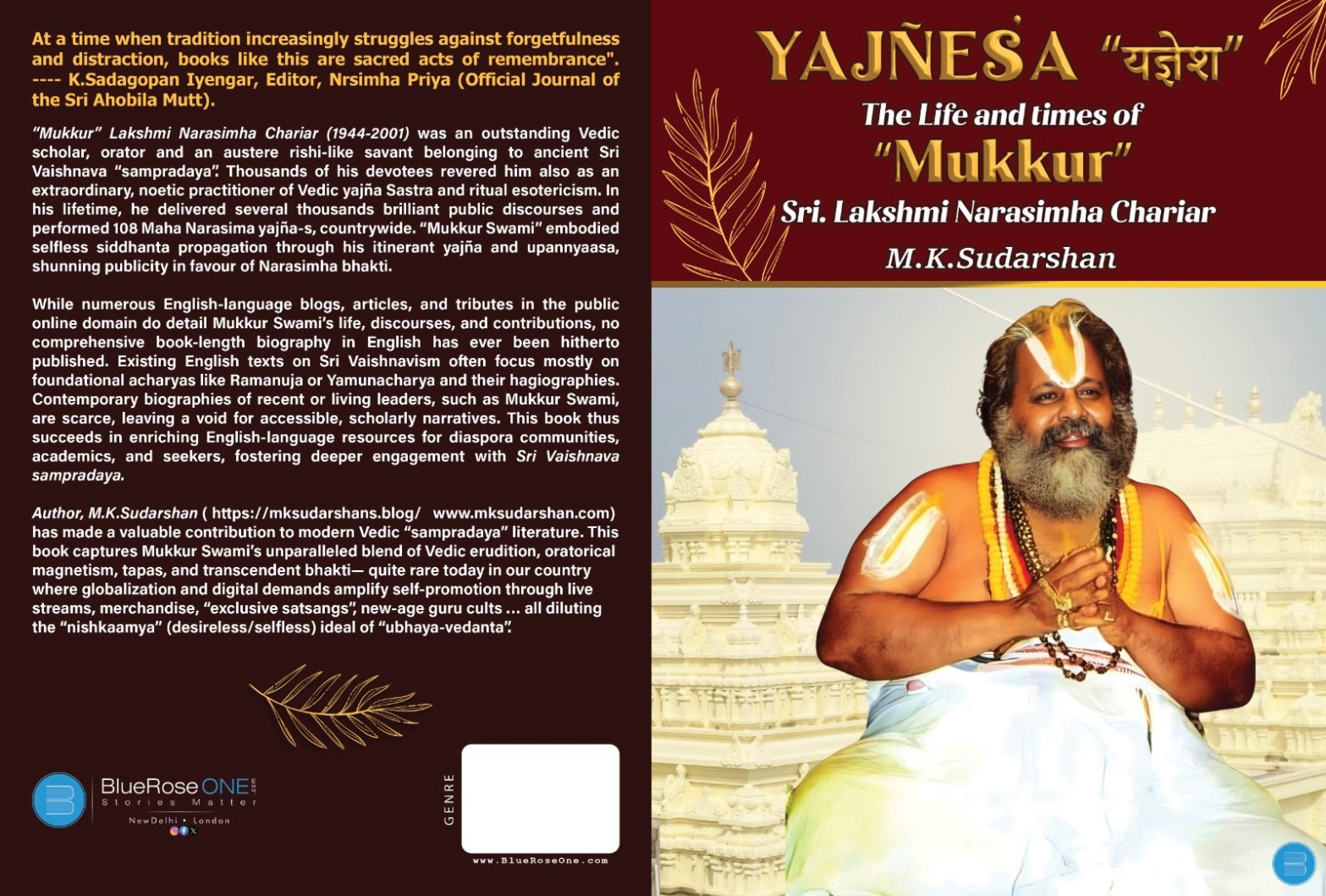
Book Arrives ! “Yajñeśa: The Life and Times of “Mukkur” Sri Lakshmi Narasimha Chariar”- Book your Order Copy now !!

By M. K. Sudarshan

September 11, 2026, Chennai, India

A 370-page English biography of:

• A great Vedic scholar.
• An outstanding Vedantic exponent.
• A popular and eloquent upanyasaka.
• An austere practitioner of Vedic yajna.
• A devoted servant of Sri Narasimha.
• The spiritual force behind the revival of Mattapalli (Andhra Pradesh) as a major pilgrimage centre.

For two decades, devotees and admirers have preserved the memory of Mukkur Swami through Tamil tributes, reminiscences, articles, and personal recollections.

Yet the English-speaking world has had very little access to a comprehensive account of his life and work.

This book seeks to fill that important gap. It brings together the story of an extraordinary Vedavith, yajna-karta, upanyasaka, and devotee of Sri Narasimha for readers across India and the global Hindu community.

A life remembered.
A legacy made accessible.

Available in:
• Coloured paperback edition.
• Black-and-white hardcover edition.

Look for it on Amazon, Flipkart, and the BlueRose Publishers online portal.

Please find the links below :
BLUEROSE STOREhttps://blueroseone.com/store/product/yajnesa-yajaniasha-the-life-and-times-of-mukkur-sri-lakshmi-narasimha-chariar

AMAZON:https://www.amazon.in/dp/9378259014

FLIPKART:https://www.flipkart.com/yajea-life-times-mukkur-sri-lakshmi-narasimha-chariar/p/itm8c07f6de73af5?pid=9789378259012

Link optimization usually takes some time, so if the book is unavailable on either Flipkart or Amazon, it’ll be updated in a couple of days. Thank you for your cooperation.

A remarkable life is now available to reach readers everywhere.

Mukkur” Lakshmi Narasimha Chariar (1944-2001) was an outstanding Vedic scholar, orator and an austere rishi-like savant belonging to ancient Sri Vaishnava “sampradaya”. Thousands of his devotees revered him also as an extraordinary, noetic practitioner of Vedic Yajna Sastra and ritual esotericism. In his lifetime, he delivered several thousands brilliant public discourses and performed “108 Maha Narasima Yajna-s”, countrywide. “Mukkur Swami” embodied selfless siddhanta propagation through his itinerant yagnya and upannyaasa, shunning publicity in favour of Narasimha bhakti. 

While numerous English-language blogs, articles, and tributes in the public online domain do detail Mukkur Swami’s life, discourses, and contributions, no comprehensive book-length biography in English as this one has ever been hitherto published.

Existing English texts on Sri Vaishnavism often focus mostly on foundational acharyas like Ramanuja or Yamunacharya and their hagiographies. Contemporary biographies of recent or living leaders, such as Mukkur Swami, are very scarce, leaving a void for accessible, scholarly narratives. This book thus truly succeeds in enriching English-language resources for diaspora communities, academics, and seekers, fostering deeper engagement with Sri Vaishnava sampradaya. 

At a time when tradition increasingly struggles against forgetfulness and distraction, books like this are sacred acts of remembrance”. (“Nrisimha Priya” —  official Journal of the Sri Ahobila Mutt) 

“Scholar, Orator, Yajna-Karta” : Mukkur Sri Lakshminarasimha Chariyar: On the Vedas- 4

by M. K. Sudarshan

September 10, 2026: Chennai, India

Performer of Vedic yajnas on a scale rarely witnessed in modern times.

Thursday, September 10

He was not merely a preacher.
He was a performer of Vedic yajnas on a scale rarely witnessed in modern times.

He was not merely a scholar.
He was a compelling orator whose discourses carried the force of conviction, learning, and lived experience.

He was not merely a religious figure.
He was a man who dedicated his life to preserving and communicating the spiritual inheritance of Bharathavarsha.

Sri Mukkur Lakshminarasimhachariar:
The life and times of a modern Vedic luminary.


A 370-page English biography, coming soon.

वेदम् परम प्रमाणम् – Vedam Parama Pramaanam* Part 4*

In the Brahma Sutra Bhashyam, a question is raised: “_Vedadhyayanam nama kim..?_” (What is the study of the Veda?).

The answer given is “_Akshara raasi grahanam_”—grasping the multitude of syllables. Is it just one syllable or two? How many syllables are there in the Veda?! How many swaras (intonations) does it have? Thus, it is a vast multitude of syllables.

Every syllable has its designated swaram.

Take the phrase, “_Pratyang shadago bhavati_“. In that specific place, one must pause for exactly one matra (a measure of time)—an eka maatra virama.

If we analyze it, there are so many incredibly difficult passages like this. Phrases like “_Anubhogam bhogam anvanu bhogam maanada_” consist of complex, hard-to-render terms.

Then there are sequences like: “_Praagapaag apaak praak praak apaagudagudagapaak… praak praak apaagudagu… apaagudagudaga paaga paagudagudha raagadha raagudha gapaaga paagudagadha raagu_”.

Can anyone easily figure out what words are hidden within this chanting..?

When we break down the sandhi (conjunction of words), the root words are: Praak, Apaak, Udak, and Adharaak. Praak means the Eastern direction. Apaak means West. Udak means North. Adharaak means South. When the Veda mentions these four directions, and when it is chanted in the complex Ghanam style, it sounds like: “_Praak apaak apaak praak praak apaak apaak praak praak apaagudagu dagupaaga paagudagudha raagadharaa udagapaaga paagudagadharaagu_”. The words intertwine seamlessly. Such deeply interwoven, perfectly intoned sounds can only be mastered if the student sits directly opposite the Acharya, listens to him utter them with the correct swaram, and perfectly reproduces them.

Consider this chant: “_Avarun therrun thae……. Earkkae… Oarkko… Oarkko earkkae erkka kachcheeyathae theeyathae thearkkae… Earkko oarkkor kachcheeyathae…_”

How can one possibly write this down? “_Earkkae…_”—how much of that drag can you capture on paper? “_Oarkko…_”—even if you manage to write it down, can you pronounce it correctly just by reading it? Never.

Only if a master utters it, and the student meticulously listens to exactly how he says it, can the student repeat it. It takes many, many days of such practice…!

To grasp this sandhi, to master this kampam (vocal vibrato/modulation), one might get thrashed for fifteen days!

When the student incorrectly chants “Thearkkae… Earkko...”, the Acharya would firmly smack him on the cheek, correcting him: “No, it is Earkkae… Oarkko...”. The physical force of that correction would literally shake the boy’s head.

Imagine a boy who studied as a Brahmachari (student) at the age of fifteen. He is now ninety years old. He comes to the bhajana matham here for Veda Parayanam.

Whenever he reaches that specific passage in the chant, his head still shakes!

Someone sitting opposite him once asked, “Why is his head shaking like that?” It is because, at the age of fifteen, his Upadhyaya (teacher) gave his head such a jolt. The shake he received then makes his head tremble even today! His head naturally moves to the exact rhythm of that swaram.

In Vedic education, the teacher makes the student sit right next to him, constantly observing closely to ensure he is chanting it perfectly.

Once, an Acharya chanted a Vedic phrase: “_Yadurgu rudayachchathu_“.

The young student, however, was looking elsewhere. If a student doesn’t repeat the phrase properly, the Acharya would kick him!

When asked to repeat “Yadurgu rudayachchathu“, the distracted boy blurted out the Tamil phrase: “_Yeruthu kuthiraiyai ochchathu..!_” (Meaning: The bull drove the horse)! Both sound phonetically identical. But will he ever learn the Veda this way?

The Veda will only be internalised if one listens with intense focus. Therefore, one’s hearing must be sharp. One must listen to the Acharya’s words _saavadhaanamaa_ (with absolute concentration) and care. Only then can the Vedic sounds be successfully grasped. Hence, one must never chant it inauspiciously, nor with apaswaram (incorrect intonation). There is a strict rule that it must be chanted entirely with the perfect swaram. Therefore, the *Veda is a Vidya (sacred knowledge) that must be earned with immense effort and hardship..!*

(Reproduced in English translation by Mukkur Sri Srinivasachariar (MLS Swami, ‘Tiru Kumarar’ of Mukkur Sri Lakshminarasimhachariar).

Sudarshan Madabushi

“The Call of Mattapalli”: Mukkur Sri Lakshmi Narsimha Chariyar: On the Vedas-3

by M. K. Sudarshan

September 10, 2026: Chennai, India

He performed yajnas. He expounded Vedanta. He lived his ideals.

Wednesday, September 9

What happened at Mattapalli?

On the banks of the Krishna River, in a village in Andhra Pradesh, Sri Mukkur Swami experienced a profound spiritual revelation concerning an idol of Sri Narasimha believed to be buried deep within a cave.
The idol was eventually unearthed.

In the years that followed, a magnificent temple arose at the site, and Mattapalli grew into an important pilgrimage centre for devotees from Andhra Pradesh and across India.

The story of this extraordinary episode—and the life behind it—forms an important part of the forthcoming biography.
The journey begins in faith.
It culminates in sacred service.

वेदम् परम प्रमाणम् – Vedam Parama Pramaanam* Part 3 -* 

The word ‘ *Veda* ‘ is a Sanskrit term. What does Vedah signify? ‘ *Vedayati iti Vedah* ‘—that which reveals or makes known is called the Veda. It reveals the Parabrahman (the Supreme Absolute).

What is its name in Tamil? It is called ‘ *Marai* ‘ (மறை). Marai means to hide or conceal. It gets this name precisely because it conceals.

But to whom does it reveal..? And from whom does it conceal..?

Observe this carefully. It conceals its truths from those who lack the kataksham (divine grace or compassionate glance) of the Acharya.

But what about those who have received that Acharya kataksham..?

Imagine a divine mansion built entirely of pristine crystal. If you light lamps on all four sides and pour the Navanidhi (nine cosmic treasures such as _navarathnams_) right in the center, imagine how brilliantly and dazzlingly it would shine! In that exact manner, the profound esoteric meanings hidden deep within the texts become crystal clear. It is understood by the great Jnanis, but through the grace of the Acharya, these profound truths are made easily accessible and comprehensible even to ordinary people.

One cannot understand these truths simply by looking at a book. Furthermore, one _should not_ attempt to learn them that way. One must surrender at the feet of great Mahans and learn the subject by listening to them.

If a person reads and acquires knowledge entirely on their own, what is the nature of their scholarship? The Shastras declare, ” _Jaara garbha iva striyah_ ” (Like the child of an adulterous woman). Just as such a child receives no honor in a dignified assembly, a person who acquires knowledge merely by reading books will never be respected in a Sabha (assembly) filled with learned pandits. He will never be able to speak with majesty or authority.

Swami Desikan strictly questions this: “_*स्वयं तर्तुमक्षमः किमपरान् संतारयेत्?*_- S_wayam tartum akshamah kimaparaan santaarayet?_” (When one is incapable of crossing the ocean of samsara oneself, how can one help others cross?). He compared this bookish knowledge to “*_kalavu kondu aabharanam poondaa pole_*” (wearing stolen jewelry).

Consider this scenario: A grand wedding is taking place, and everyone is busily engaged in various tasks. A woman goes to the bathing quarters. Someone who had bathed before her had forgotten a beautiful _kantha haaram_ (necklace) and left it hanging there. Seeing the necklace, this woman immediately takes it and goes straight back to her home.

Once home, she beautifully adorns herself with the stolen necklace. She looks in the mirror and admires how lovely it looks. For two whole days, she stays inside her house, repeatedly wearing it, admiring herself, and feeling deeply satisfied.

Four days later, she has to attend another wedding. She decides to wear this necklace to the event. However, all the guests from the previous wedding are also present here. The moment she arrives wearing it, she realizes she cannot show it off openly. She constantly pulls at her saree to conceal it.

Not only that, but she is utterly terrified of everyone she looks at. She lives in constant fear: “Will someone grab my hand and question me?” She is afraid of whoever stands opposite her. She cannot converse freely with anyone. She finds no real joy in wearing the necklace, yet she cannot display it to the outside world either.

Whose state is this..? This is the exact state of the one who has acquired knowledge only by reading books..! Without an Acharya’s grace, if a man simply memorizes texts from books and climbs onto the speaker’s seat, he will be terrified of everyone in the audience. “What will he ask? What will this person ask? If they ask a question, will I know the answer? Is what I am saying even correct?” If the speaker himself harbors such doubts, how can he impart matters to others? How can he convince or satisfy them with his explanations?

Therefore, such knowledge will never shine. It is precisely “like wearing stolen jewelry.”

Instead, one must surrender at the feet of Mahans and listen to their teachings over a long period. “*_बहुधा श्रोतव्यम् बहुभ्यः श्रोतव्यम् – Bahudha shrotavyam, bahubhyah shrotavyam_*” (One must listen in many ways, and from many preceptors). One must repeatedly listen and carefully retain those teachings. Therefore, since the Veda is the supreme authority (Parama Pramaanam) in revealing the glories of Emperuman, one must sit humbly beside the Acharyas and study it flawlessly with immense dedication and effort.

(Reproduced in English translation by Mukkur Sri Srinivasachariar (MLS Swami, ‘Tiru Kumarar’ of Mukkur Sri Lakshminarasimhachariar).

Sudarshan Madabushi

When Ideology Blinds Us to Beauty: In Defence of “Sangha Tamizh”

By Sudarshan Madabushi
September 10, 2026, Chennai, India

நீ ப்ரணதார்த்திஹரனோடா? நீ ப்ரணதார்த்திகரனாக்கும்.”
Are you with the Lord who removes devotees’ distress?
No—you’re the one who causes distress to those around you!”

This was a Sanskrit teacher’s favourite way of reprimanding a naughty classmate while tweaking the boy’s ears — And the incident was narrated to me with nostalgic mirth by my good and very respected email-friend, Sri Ramamurthy Swaminathan (USA) reminiscing about his schooldays.

On the surface, it was a classroom scolding. Beneath that, it was a miniature masterpiece of bilingual wit—a śleṣa (சிலேடை), a pun that lives only where Sanskrit and Tamil breathe together.

To hear the joke, you must know that praṇatārtihara (ப்ரணதார்த்திஹரன்) is a classic Sanskrit epithet for God: “the remover of the distress of those who bow.” The punchline swaps hara (“remover”) for a Tamil-sounding kara (“doer, causer”), turning a divine savior into a classroom menace. The laughter depends on two linguistic worlds colliding in one sentence.

That is sangha Tamizh: not a political slogan, but a lived reality in which Tamil and Sanskrit enrich each other in vocabulary, meter, rhetoric, and devotion.

A hybrid heritage, not a colonial imposition

Long before Dravidian parties made language a battlefield, Tamil authors chose—freely, creatively—to write in Sanskrit, in Tamil, or in a blend.

  • The Alvars (6th–9th centuries) composed their hymns in Tamil, yet freely used Sanskrit words and concepts, embedding Vishnu’s pan-Indian theology in local idiom.
  • Their commentaries later evolved into manipravalam—literally “ruby-coral”—a register where Sanskrit and Tamil words share the same sentence, sometimes even the same word, with Tamil suffixes on Sanskrit stems.
  • Poets and philosophers like Vedāntadeśika wrote parallel treatises in both languages, harmonizing Tamil devotional poetry with Sanskrit Vedānta.

This was not “imposition.” It was choice: a confident Tamil culture absorbing, adapting, and re-expressing Sanskritic ideas without losing its own voice.

The rise of taṉittamiḻ: purity as politics

In the early 20th century, a different vision took hold.

Maraimalai Adigal, often called the father of the taṉittamiḻ iyakkam (Pure Tamil Movement), argued that Tamil’s liberation required purging Sanskrit—seen as the linguistic arm of Brahminical and “Aryan” domination. He even changed his own name from Vedhachalam to Maraimalai to embody this ideal.

The movement’s logic was clear:

  • Sanskrit = northern, Brahminical, oppressive.
  • Tamil = Dravidian, indigenous, oppressed.
  • Therefore, true Tamil pride demands de-Sanskritization.

This ideology seeped into party rhetoric, education, and temple politics. Inscriptions were reinterpreted, rituals were “Tamilized,” and Sanskrit words were stripped from public speech wherever possible.

What gets lost in the purge

The cost of this linguistic nationalism is not just political; it is literary and aesthetic.

  1. Literary impoverishment
    Much of medieval and early modern Tamil literature—Śaiva, Vaiṣṇava, Jain, and courtly—relies on Sanskrit frameworks, meters, and vocabulary. To deny that link is to flatten the tradition.
  2. Rhetorical narrowing
    Figures like śleṣa / siḷeḍai thrive on dual etymologies and cross-lingual resonance. In a strictly “pure Tamil” frame, such wordplay becomes ideologically suspect, even unintelligible. (Arthur Koestler defined this brilliantly as “two strands of thought (or linguistics) tied together by one acoustic knot”)
  3. Historical distortion
    The long record of Tamil authors consciously choosing Sanskrit, Tamil, or a blend is recast as a simple story of oppression and resistance. Nuance gives way to polemic.

When a student hears Sri. Swaminathan’s teacher’s pun today, the first response from a Dravidianist purist might not be laughter, but suspicion: “Why is a Tamil classroom echoing with Sanskrit compounds?” The beauty is overshadowed by ideology.

Sangha Tamizh as cultural confidence

“Sangha Tamizh” is not a call to replace Tamil with Sanskrit. It is a reminder that Tamil has always been porous, adaptive, and self-assured.

  • It absorbed Persian and English terms without losing its identity.
  • It hosted Jain, Buddhist, Śaiva, and Vaiṣṇava traditions in multiple languages.
  • It produced devotional poetry that could quote the Vedas and sing in village dialects within the same breath.

To deny the Sanskrit strand in this tapestry is to deny part of Tamil’s own history. A language confident in its roots need not fear foreign branches.

A small plea

Next time you hear a Tamil speaker use a Sanskrit word—ārādhana, saṅgama, kṣetra, or even praṇatārtihara—pause before calling it “impure.” Ask instead:

  • Does this word carry a meaning or resonance that enriches the thought?
  • Does it connect this moment to a longer literary and devotional conversation?
  • Does it allow for a śleṣa, a spark of sparkling wit that only bilingual ears can catch?

If the answer is yes, then what you have is not linguistic servitude, but sangha Tamizh: a Tamil that is wide enough to host multiple traditions without losing its soul.

Sri Swaminathan’s memory of his old teacher’s Sanskriti-Tamil or Manipravalam pun survives today not because it is politically correct, but because it is beautiful. And beauty, unlike ideology, does not need a party flag to stand.


(Concluded)

“By Order of the Hoodwink Syndicate”: Why the Media Industry Can Never Tell the Truth

by M.K. Sudarshan

September 10, 2026: Chennai, India

Prologue: The Garrison Briefing

The air inside the private room of the Garrison is thick with the acrid stench of cut tobacco and cheap gin. At the head of the long oak table, Tommy sits perfectly still, the brim of his tweed flat cap tilted forward, casting a heavy shadow over eyes that have seen too many men die for a lie. He doesn’t look up when Arthur slams a heavy leather ledger onto the table, the pages stained with ink and grease.

“The papers in London are calling it a bloody disaster, Tommy,” Arthur spits, his voice raw, pacing the length of the floor. “They’re saying our ships are gone. Sunk in the canal. The public’s out in the streets screaming for blood, ready to march into another war before the week is out.”

Tommy draws slowly on his cigarette, the tip glowing a sharp, brief orange in the gloom. He exhales a long, thin stream of gray smoke toward the ceiling, watching it dissolve into the rafters.

“Let them scream, Arthur,” Tommy says, his voice a quiet, freezing calm that stops his brother mid-stride. “The ships are still afloat. I know it, the admirals know it, and the bastards who fired the guns know it.”

“Then why aren’t we telling the truth of it?” Arthur roars, leaning over the table, his knuckles turning white against the wood. “Why let them print the fiction?

Tommy finally raises his head, his gaze cutting through the haze like a razor. A faint, humorless smile touches the corner of his mouth.

“Because the truth doesn’t pay the printers, Arthur. And it damn sure doesn’t keep the constables looking the other way. We don’t sell the truth in this house. We sell certainty. We give them a nice, bloody story to keep them terrified, and while they’re looking at the headline, they aren’t looking at our pockets.

“The media isn’t a newsroom, brother. It’s a protection racket. And it runs by order of the company.”

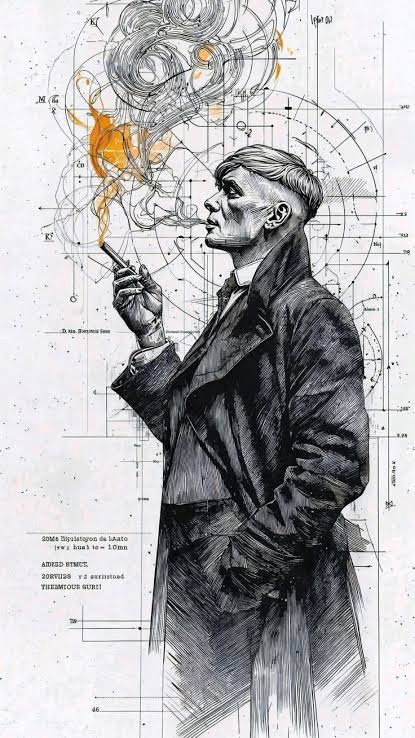
— A spoof on “The Peaky Blinders”:

Tommy Shelby (Peaky Blinders): Used as a metaphorical caricature for the modern, calculating media tycoon who treats public perception as a highly lucrative protection racket.

Tom Shelby : “Peaky Blinders”

The Fiction of the Frontline

Just days ago, the night sky over Jordan lit up with the arcs of Iranian ballistic missiles, allegedly targeting U.S. Navy warships and regional airbases. Step onto social media or tune into state-backed Eastern channels, and you are presented with images of total devastation—U.S. guided-missile destroyers burning in the water and imperial outposts reduced to rubble.

Switch over to Western mainstream news networks, and the reality flips seamlessly: the attacks were total failures, air defense shields operated flawlessly, and the enemy’s reports are dismissed as wholesale fiction.

Yet, look closer at independent, unvetted visual data days later, and a third reality emerges—one of localized runway craters and damaged hangars that both sides initially chose to ignore or exaggerate.

What the public witnessed was not a standard documentation of military conflict, but the frontlines of a highly coordinated, multi-directional disinformation war. It is an indictment of a global information ecosystem where truth is the first casualty, long before the first missile is even fueled.

The Architecture of the Compromise

This ongoing spectacle exposes a deeper, structural rot within the global information architecture.

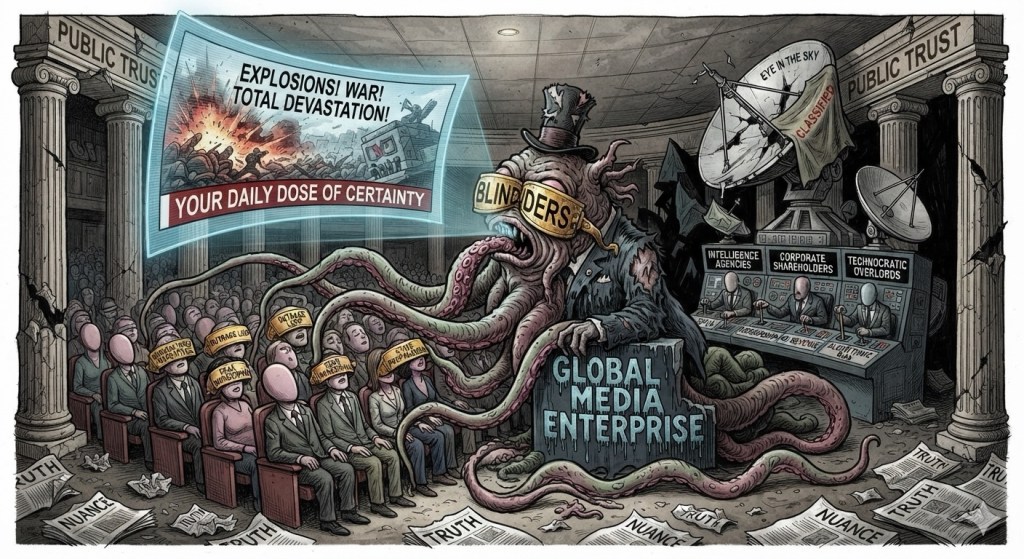
The general public operates under the comforting illusion that journalism is a civic service, funded by the masses to keep power accountable. The stark reality is that the global media industry—whether state-sanctioned or privately owned—is structurally incapable of truth.

For government-owned media networks, information is merely an extension of kinetic warfare. During active crises, state networks do not exist to inform; they exist to maintain regime survival, boost domestic morale, or project artificial psychological dominance. Broadcasts are carefully curated weapons designed to manage the strategic narrative.

Conversely, privately owned corporate networks operate under a different, though equally compromising, mandate: the maximization of shareholder value. To secure exclusive scoops, corporate journalists must engage in access journalism, routinely laundering unverified intelligence community press releases to maintain proximity to power. When national security imperatives or corporate survival collide with objective facts, the facts are quietly edited out.

The Playbook of Manufactured Bloodshed

This is not a new dysfunction; it is a time-tested playbook with a devastating body count.

Look no further than the run-up to the 2003 Iraq War, where the supposedly independent Western press functioned as the promotional wing of the pentagon. The American liberal press, breathless 24/7 cable news networks, and the sweeping global reach of Rupert Murdoch’s media empire in the UK and Australia did not question power—they amplified it. They took unverified, fabricated intelligence briefs regarding “weapons of mass destruction” and packaged them into a terrifying, non-stop spectacle that hoodwinked entire populations into backing an illegal invasion.

The media did not fail to see the truth; they actively chose to bury it because war is highly profitable, and challenging the state drumbeat was deemed a commercial suicide.

The Syndicate of Perpetual Conflict

Today, that exact same syndicate remains active, operating in the shadows of the world’s most volatile flashpoints. Intelligence agencies like the Mossad, MI6, and the CIA do not merely monitor conflicts; they feed them, working in tight tandem with major Western media houses to manipulate public perception.

In the fields of Ukraine and the waters of the Persian Gulf, the script remains unchanged. Media outlets act as the megaphone for intelligence briefs that are selectively leaked to justify endless military spending, stall diplomatic solutions, and keep the flames of war burning indefinitely. By controlling the narrative boundaries—labeling any call for de-escalation as enemy propaganda—the media-intelligence alliance ensures that peace never stands a chance against the lucrative machinery of perpetual war.

The Technocratic Enemies of the Open Society

If legacy media houses serve as the traditional megaphones for this cartel, the modern digital architecture has introduced a far more insidious threat to truth: the technocratic billionaire autocrat.

By weaponizing private infrastructure under the guise of absolute freedom, platforms like Elon Musk’s X (formerly Twitter) and satellite networks like Starlink have become active saboteurs of public reality.

In the Karl Popperian sense, these entities function as the ultimate enemies of the Open Society. Popper argued that an open, democratic society relies on rational public discourse and access to objective truth to self-correct. Instead, X defiles the public domain by replacing verified verification with an algorithm that financially rewards viral, inflammatory deception and boosts state-backed propaganda.

Simultaneously, the physical backbone of global connectivity is subjected to the geopolitical whims of a single contractor. Starlink’s arbitrary intervention in war zones—such as cutting off vital communications during military counteroffensives—proves that modern information warfare is no longer just managed by states, but gatekept by private corporate overlords. By choking off objective real-time data while flooding the digital square with algorithmic noise, this technological monopoly systematically destroys the possibility of an informed populace, fracturing the very foundation of public reason.

The Economy of the Outrage Loop

The economic rationale for peddling these false news cycles and manufactured narratives is baked directly into the modern media business model. In a digitized global marketplace, the public is rarely the consumer; they are the product. Media conglomerates survive on advertising revenue driven entirely by user attention, clicks, and prolonged screen time. The objective truth is frequently long, complex, and frustratingly nuanced—attributes that do not generate viral velocity. Outrage, tribalism, and manufactured fear, however, are highly lucrative commodities. By presenting international conflicts as binary, hyper-emotional dramas of absolute good versus absolute evil, media enterprises trigger the exact neurological responses needed to keep audiences hooked.

Sensationalised falsehoods and comforting illusions outperform the messy reality of geopolitics every single time. Truth is structurally bad for business, and the market rewards those who distort it most effectively.

The Blindness of the Orbital Spy

Even the technological marvels promised to break this information monopoly have been co-opted by the same venal incentives. The public is told to trust the “eyes in the sky”—the highly advanced reconnaissance satellite fleets operated by superpowers and private tech firms alike. But these eyes serve only the closed doors of national security networks and lucrative defense contracts.

Classified military satellite data is selectively leaked only when it serves a psychological warfare objective, weaponizing transparency to deceive. Meanwhile, private commercial satellite companies, heavily reliant on billions in government defense spending, routinely enforce imagery blackouts and distribution delays over active war zones. They choke public access to raw mapping data when the real-time physical reality threatens to contradict official state narratives, proving that even orbital technology is chained to the dictates of the defense establishment.

The Opium of the Captured Mind

The inescapable, cynical reality is that the modern news industry has devolved into a multi-billion-dollar hoodwinking enterprise—the ultimate opium of the masses. It operates not to document history, but to manage public behavior, selling manufactured certainty to an audience terrified of ambiguity. It gives the masses the profound illusion of being informed while actively rendering them passive, predictable, and profoundly distracted.

To look at the global press and expect unvarnished truth is to misunderstand the very plumbing of the machine. The game is rigged to hook emotions and manage consent, and the only modern form of intellectual resistance is a radical, unyielding skepticism that treats every breaking headline not as a factual record, but as a calculated act of deception.

(Concluded)

“The Veda in Word, Work, and Worship” : Mukkur Sri Lakshminarasimha Chariyar: On the Vedas- 2

by M.K.Sudarshan

September 9, 2026: Chennai, India

The life of a modern Vedic luminary is coming soon as a book to English readers.

Wednesday, September 9

Some men merely speak about tradition.
Some preserve it.

A rare few actually embody it.
Sri Mukkur Lakshminarasimhachariar belonged to that rarest category.

Through his discourses, yajnas, spiritual discipline, scholarship, and tireless propagation of Narasimha bhakti, he demonstrated how the values of the Vedic tradition could be lived in the modern world.

His extraordinary life is now being presented in a new English biography.

A life of learning.
A life of service.
A life of tapas.

Coming soon.

वेद प्रमाणम् – Vedam Parama Pramaanam* 
(Part 2)

To truly realize Him, one must look only to the Veda.

Because, as Nammazhwar declares:
Othaar mikkaar ilaiyaaya maamaayaa

He has no equals, nor does He have any superiors. He is supreme, exalted above all else!

A devotee was once performing archana to Bhagavan. He was chanting rapidly, “Om vibhavaya namaha, Om prabhave namaha, Om sarvatomukhaya namaha, Deeptarashmaye namaha...” and while doing so, suddenly in the middle, he chanted “ॐ दरिद्राय नमः – Om daridraya namaha”.

The moment he chanted daridraya namaha, Bhagavan, who was presiding in that divine portrait, suddenly snatched the offering plate right out of the devotee’s hands.

What is this new usage? Has anyone ever performed archana like this before? Do you know what you are doing? Did you read this in some book? Is it a printing mistake?” Bhagavan demanded. “You are worshipping me with daridraya namaha, is this acceptable anywhere?!” He asked with great anguish.

The devotee replied, “I am not doing anything new. I am only stating what exists, and I am doing it perfectly. There is absolutely no error in what I said. You cannot find a flaw in it.”

Bhagavan then asked, “You chant daridraya namaha, but do I have that quality?”


“I am chanting it precisely because You possess it,” the devotee affirmed.


“What is this? Am I impoverished? Am I poor? Do I suffer from poverty?” asked Bhagavan.

“You certainly do,” the devotee insisted.

“I do not!” said Bhagavan.

“If You do… if I prove that You have it, will You accept it?” the devotee challenged.

“If it exists, I will certainly accept it,” Bhagavan agreed.

Then, looking directly at Him, the devotee asked, “You possess the competence to manifest everything. Show me one who is equal to You. Show me someone about whom You can say, ‘He is comparable to me, he is my equal.'”

Paramatma, who has the power to reveal all things, could not show this. He blinked. He could only show someone if there were another like Him!

Seeing His hesitation, the devotee asked: “अस्मिन् विषये दारिद्र्यम् अस्ति वा नवा?Asmin vishaye daridryam asti va nava?” He immediately switched to Sanskrit. “Do You have poverty in this aspect or not?”

Bhagavan conceded, “Asti, asti.” It is, it is.

“अधिकः कुतोन्यः?Adhikah kutonyah?” “Who is greater than You? When there is no equal, could there be a superior?” the devotee probed.

“I do not have that either,” admitted Bhagavan.

“Then shut your mouth, I will continue my archana,” said the devotee.

“What archana are you going to do now?” asked Bhagavan.

ॐ समाभ्यधिकदरिद्राय नमःOm samabhyadhikadaridraya namaha (Salutations to the one lacking both equals and superiors). In what do You have poverty? You are unable to point out a person equal to You; isn’t that a form of poverty? There is no one greater than You; in that aspect, do You have poverty or not? Therefore, You must accept that in both these aspects, You suffer from poverty!”

How could Bhagavan open His mouth to argue? He remained silent and simply said, “Proceed further..!!”

Therefore, this signifies the greatness of Bhagavan. He is devoid of equals and superiors. Thus, He is the wondrous Lord (Maamayan) who has no equal or superior.

Naḷirmathic chaḍaiyanum nāṉmugak kaḍavuḷum 
Thaḷiroḷi yimaiyavar thalaivaṉum mudalā 
Yāvagai yulagamum yāvarum agappaḍa 
Nilanīr thīgāl suḍariru visumbum 
Oruporuḷ puṟappā ḍinṟi muḻuvadum 
Agappaḍak karandu ōr ālilaic chērndavem 
Perumā māyaṉai yalladu 
Orumā dheyvam maṭṭruḍaiyamō yāmē 

( _Swami Nammazhwar – Thiruvāsiriyam_ ) 

Peṭṭraṉai nīyē maṭṭruḷa vellām 
Peṟuvathu niṉṉai uṟuvathu koḷvār 
Niṉṉalāl aṉṟi maṉṉār iṉbam 
Niṉporuṭṭu nī eṉporuṭṭilai 
Niṉṉuru niṉṟum miṉṉurut thōṉṟum 
Niṉthaṉakku nigar niṉṉaḍi aḍaivār 
Niṉṉalāl aṉṟi aṉbāl uyyār 
Vāraṇam azaikka vandha kāraṇaṉē 

( _Swami Desikan – Śrī Mummaṇikkovai_ ) 

Thus, when we examine the Sri Sookthis of great Mahans like Nammazhwar and Swami Desikan, we understand that there is no one superior to Him. Therefore, if we wish to know the glory of that Sarveshvara who has no superior, we must look only to the Veda which is supreme, unmatched, and unexcelled in explaining and revealing Him..!!

(Reproduced in English translation by Mukkur Sri Srinivasachariar (MLS Swami, ‘Tiru Kumarar’ of Mukkur Sri Lakshminarasimhachariar).

Sudarshan Madabushi

A Giant Returns: Mukkur Sri Lakshminarasimha Chariyar: On the Vedas- 1

by M.K. Sudarshan

September 8, 2026:Chennai, India

Before the book arrives, meet the man behind the legend.

September 8, 2026:

The life and times of a giant of the modern Hindu religious world is about to be re-chronicled.

He was a Vedic scholar, Vedantic exponent, eloquent “upanyasaka”, austere “yajna” practitioner, and a spiritual personality of extraordinary intellectual and intuitive power.
He was known with affection and reverence as “Mukkur Swami.”

His full name was:
Sri Mukkur Lakshminarasimhachariar
(1944–2001)


A new English biography of this remarkable Vedic luminary will soon be available online.
Coming this September.
Follow this space for more.

*The Vedas are the Supreme Authority*

आदौ वेदाः प्रमाणं स्मृतिरुपकुरुते सेतिहासैः पुराणैः
न्यायैः सार्धं त्वदर्चा-विधिमुपरि परीक्ष्यते पूर्वभागः ।
ऊर्ध्वो भागस्त्वदीहा-गुण-विभव-परिज्ञापने त्वत्पदाप्तौ
वेद्यो वेदैश्च सर्वैरहमिति भगवन् स्वेन चैवाचकर्थ ॥

ādau vedāḥ pramāṇaṃ smṛtir upakurute setihāsaiḥ purāṇaiḥ
nyāyaiḥ sārdhaṃ tvadarcā-vidhim upari parīkṣyate pūrva-bhāgaḥ |
ūrdhvo bhāgas tvadīhā-guṇa-vibhava-parijñāpane tvat-padāptau
vedyo vedaiśca sarvair aham iti bhagavan svena caivācakartha ||

( Sri Parāsara Bhattar – “Sri Rangarāja Sthavam”)

For our tradition and religion, the root source is the Veda.

​” *Adau Vedah Pramanam* ” (In the forefront, the Vedas are the authority).

​What is the primary authority (Pramanam)? It is indeed the Veda.

Great scholars and elders categorize these concepts into Manam, Pramanam, Parama Pramanam, Meyam, Prameyam, and Parama Prameyam.

​ “Manam” refers to the instrument or means through which we perceive or realize what needs to be understood. We must come to know the truth using this. That which acts as the medium or tool is called “Manam”. The superior, elevated form of this is “Pramanam” (Valid Authority). That which is unparalleled and ultimate is “Parama Pramanam” (Supreme Authority).

​”Meyam” is the object that needs to be known. “Prameyam” refers to the most excellent object of knowledge. “Parama Prameyam” means the highest, unequaled, and ultimate object of knowledge.

​What is the Parama Pramanam? It is the Veda.

​Using the Veda, which is the Parama Pramanam, one must understand the Supreme Brahman (Parabrahman), who is the Parama Prameyam. The great Acharyas explain that it is only through the supreme authority of the Vedas that we can realize the true nature of Parabrahman, the ultimate goal we must attain.

Therefore, to realize HIM, we must look solely to the Vedas.

(Reproduced in English translation by Mukkur Sri Srinivasachariar (MLS Swami, ‘Tiru Kumarar’ of Mukkur Sri Lakshminarasimhachariar).

Sudarshan Madabushi

The Scattered Mind and the Sacred Sound: A Vedantic Diagnosis of Modern Attention Deficit

By M.K.Sudarshan

September 7, 2026: Chennai, India

“Are algorithms causing a structural collapse of human consciousness?

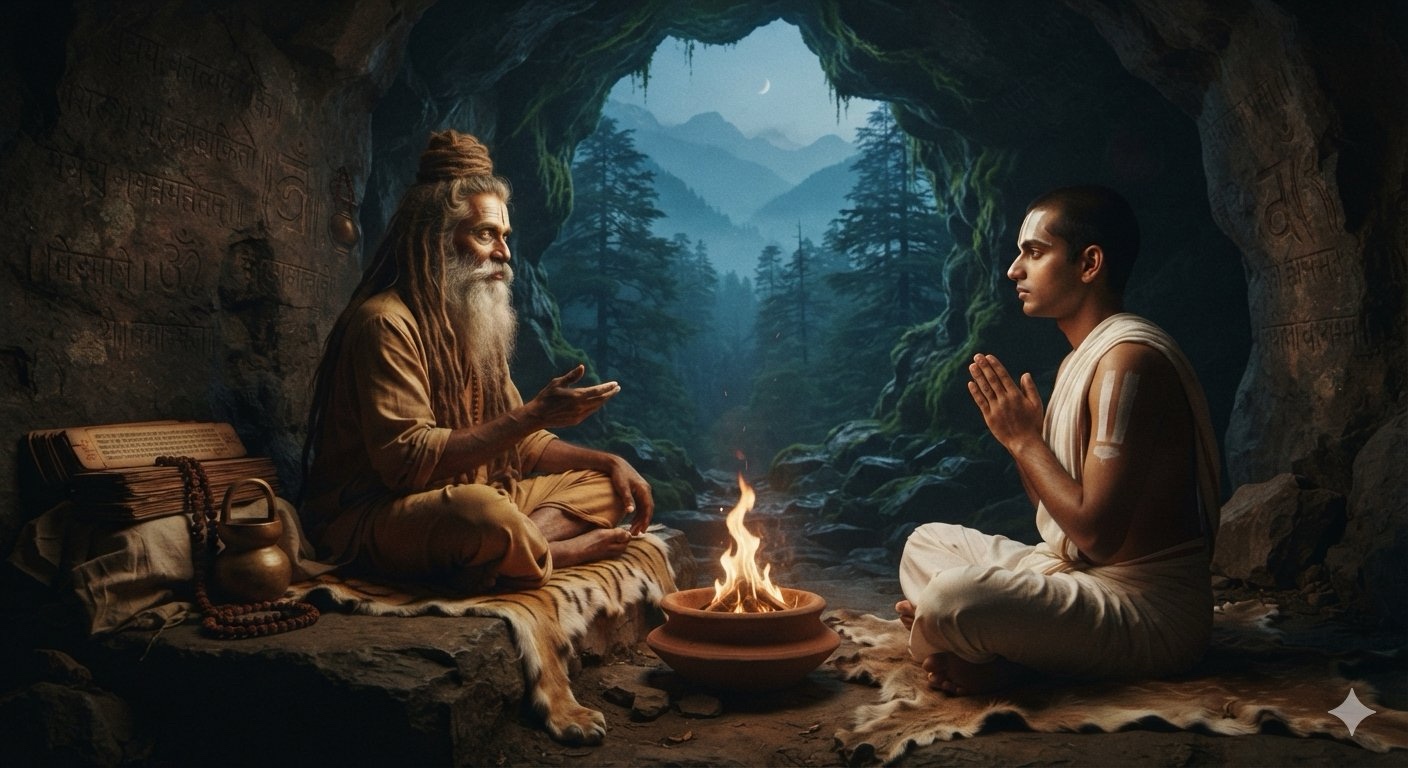
Explore a profound spatio-temporal dialogue between an Unknown Sri Vaishnava and a Himalayan Maharishi, offering a raw Vedantic diagnosis of our modern attention-span deficit and the ancient acoustic technology of “Smriti Balam” that can cure it.”

The air in the foothills of the Himalayas did not merely cool the skin; it stilled the breath. Moving past the tangled canopy of ancient Devadaru trees, the scent of wild herbs and wet earth grew thick. The world left behind—with its mechanical clocks, fractured noise, and desperate speed—seemed to dissolve into the mist rising from the fast-flowing glacial streams below.

Deep within the dark forest, where the light filtered down in pale, golden shafts, stood the ashram. It was a simple dwelling of mud, thatch, and timber, completely open to the elements. Seated upon a mat of Kusha grass, motionless as the mountains themselves, was the Maharishi. His eyes were closed, his presence radiating a deep, unfathomable Shanti.

As the traveler approached, the dry leaves beneath his feet gave way with a soft crunch. The Sri Vaishnava, wearing the sacred marks of his lineage, felt a profound wave of recognition wash over him. This was the exact spot, the exact face, and the exact presence that had visited him in his dream only hours before waking. A bridge across the vast spatio-temporal expanse had brought him here, to the feet of ancient wisdom. The Maharishi slowly opened his eyes. They were bright, clear, and unburdened by time. He gestured softly to a wooden plank before him.


THE MAHARISHI: “Welcome, child of the future. You carry the marks of devotion, yet your mind bears the heavy burden of a world I have not seen. The Spatio-temporal winds have brought you far to this valley. Tell me, what brings an Unknown Sri Vaishnava so far from his home to these quiet woods? What burns within you?”

THE UNKNOWN SRI VAISHNAVA: “O Gurudeva, I bow at your feet. I have crossed time and space because a vision led me to your light. I come seeking your wisdom on what I believe is the most crippling, enervating mental infirmity afflicting mankind in the world from which I hail.

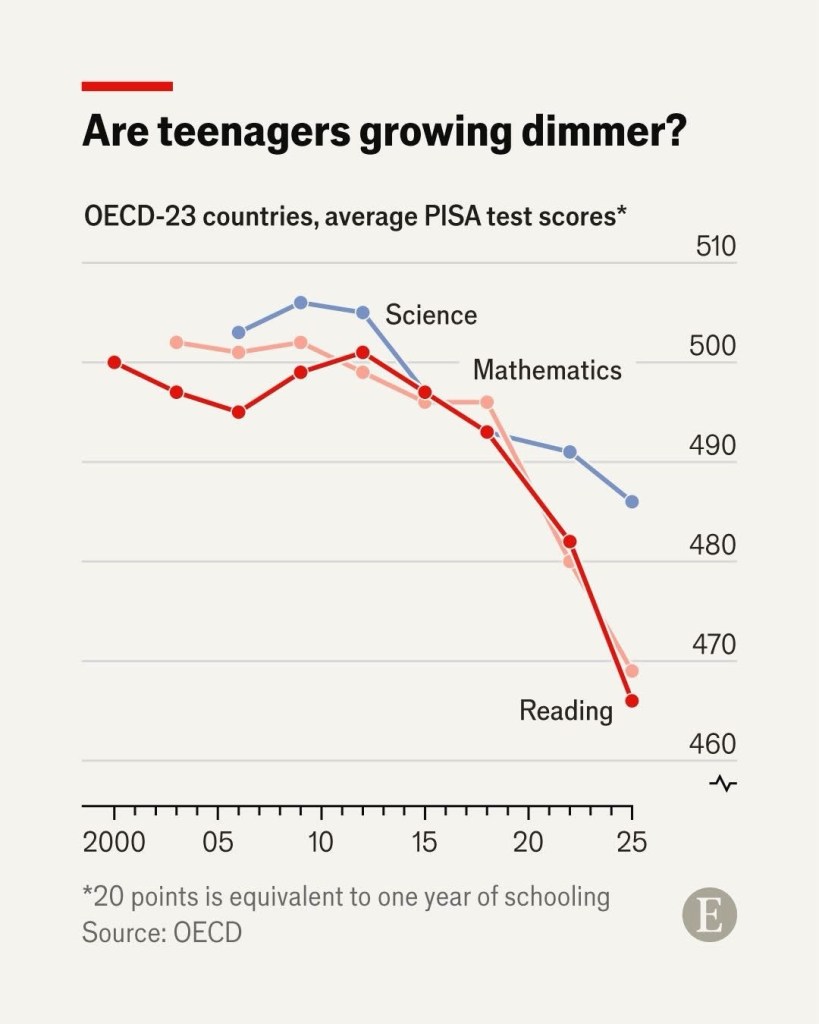
In my time, ‘attention span deficit’ has become a worldwide mental affliction. The symptoms of this disorder are many and varied: we see deficient listening skills, fretful and stilted conversations, and an utter inability to read, compose, or write cogently long letters, essays, or books. My contemporaries rely prolifically on social media platforms to communicate with an acronymic lingo, showing a complete disdain for grammar, syntax, and diction. There is an inability to let others speak without constantly interrupting them, an inadequate application of the mind, and an over-dependence on gadgets, gizmos, and artificial intelligence tools to accomplish complex tasks. Tasks that otherwise would require serious ideation, the formulation of ideas, and deep conceptions are outsourced. These are mentally debilitating predilections.

This attention deficit syndrome seemed to be a mild and even rather amusing nervous tic of the condition of millennials about twenty years ago. But that nervous tic, twenty years later among the generations we call Gen Z and now Gen Alpha, threatens to become a permanent disability of sorts.

Parents, teachers, employers, and psychologists worldwide worry and wring their hands about it, but hardly anyone is able to come up so far with an accurate, credible diagnosis of it. Nor does anyone seem to have the faintest clue about how to effectively combat this enervating mental condition. Most simply shrug their shoulders in an attitude of giving up on our young generations, leaving them to fashion a brave new world in the way they wish to do as they please.

The young generations justify themselves with a quip: ‘If an AI algorithm can in a jiffy solve my needs and challenges of all communication—reading, writing, reflecting, and even abstract thinking—why on earth should I worry about Attention-span deficit? What’s the big deal here?!’

Tell me, Holy One, how do we answer them? What is the true diagnosis of this disease?”

THE MAHARISHI: “Ah. You speak of a famine of the spirit, a structural collapse of the Antahkarana—the inner psychological instrument. Your young ones make a fatal philosophical error. They confuse the mere retrieval of information with the actual assimilation of knowledge.

The human mind is not a vessel to be filled by external mechanical means; it is a sacred fire that must be tended. In the Yoga Sutras and our ancient Vedantic psychology, the mind is a four-fold instrument. There is the Manas, the sensory, oscillating mind that jumps from object to object; the Buddhi, the discriminating intellect; the Ahamkara, the ego; and the Chitta, the deep storehouse of memory and consciousness.

What your world has done with its algorithms and gadgets is over-stimulate the Manas. It feeds the mind constant, fragmented, sensory data packets. This scatters the consciousness, creating Chitta Vikshepa—a state of perpetual distraction.

When your youth ask, ‘What’s the big deal if a machine can think for me?’, they do not realize that deep attention is a cognitive muscle. The human brain operates on the law of the universe: that which you do not use, you lose. Long-form writing, deep reading, and sustained focus are not just ways we express thoughts—they are the very fires in which thoughts are forged. The friction of trying to find the right word or connecting two complex conceptions forces the soul to build dense pathways of understanding.

When you use a machine to bypass this friction, you eliminate the mental workout. It is the spiritual equivalent of using a motorized chariot when your legs function perfectly. Eventually, the muscles will atrophy. You will be left intellectually hollowed out, possessing an empty Antahkarana. You will become entirely dependent on the corporations and machines that hold the summaries of the world. Whoever controls the summary controls your worldview. You will hand over the steering wheel of human consciousness to automated systems, demoting mankind from creators to passive consumers of your own civilization. This is the ‘big deal’ they do not see.”

THE UNKNOWN SRI VAISHNAVA: “Your words strike at the absolute truth, Gurudeva. Hearing you describe this cognitive conditioning reminds me deeply of the foundational pillars of our own heritage.

One of the fundamental building blocks of Vedic education is the grueling training of ‘smriti balam’—the strength of memory. In a Veda Pathashala, a student undergoes eight to twelve years of grueling vedadhyaaya, which consists mainly of the oral transmission of Veda shakha texts by a guru to a sishya. The sessions are repetitive, known as the ‘sandhai’ method of a ceaseless classroom drill. The student must listen to what the master is chanting and repeat it faithfully without error, again and again and again. No reference to printed textual material is allowed.

Memorization takes place over the years of the entire Veda shakha—so voluminous that a printed document of the same would fill more than four thousand pages of A4 sheets printed on both sides. This entire volume gets committed indelibly to memory through the method of sheer ‘paying unrelenting, intense, and cerebrative attention’ to what the curriculum demands: listening to chants, word for word, syllable for syllable, with absolute attention to metrical rhythm, correct intonation, and an absolute fidelity to the word, or ‘pada’.

The whole of Vedic traditional learning is thus oriented to human attention-span enhancement, rather than the opposite, which is the outsourcing of the attention span.

Yet, Vedic learning in India since colonial times has been in severe decline. It was, and continues to be, demeaned by the modern intellect as ‘Brahminical’, ‘anachronistic’, and ‘valueless to modernity’. I see now that the devaluation of this traditional method of Vedic learning has in large part led to the widespreaded-ness of what in our present day we see as these ‘attention-span deficit’ afflictions and disorders.”

THE MAHARISHI: “Malyavan! You have spoken a profound truth. The decline you speak of is the direct karmic debt of replacing a system that cultivated deep Shravana—radical, acute listening—with a system that prioritizes superficial, machine-like regurgitation.

The Sandhai method is not blind rote-learning, as the modernists ignorantly claim. It is an exercise in absolute, unyielding presence. You cannot repeat a complex metrical rhythm or a precise Svara (intonation) if the mind wanders for even a split second. The vibration, rhythm, and structure of the text alter the very consciousness of the boy who chants it. The knowledge becomes part of his nervous system; he becomes the knowledge.

By dismantling this sophisticated system of cognitive engineering under the guise of progress, your modern society threw out the baby of profound cognitive development with the bathwater of social rigidities. Without Smriti Balam (memory power), the Buddhi (intellect) has no stable ground to stand on. A mind without memory cannot meditate; a mind that cannot meditate cannot achieve Viveka—the discernment between the real and the unreal. If humanity does not rebuild Smriti, you will face a civilizational shift where humans possess the volatile, short-term desires of animals, while machines hold the repository of structured human wisdom.”

THE UNKNOWN SRI VAISHNAVA: “It is a tragedy of monumental proportions, Gurudeva. I believe that the Veda Pathashala system of education itself should be left alone as a specialism for those who wish to preserve the texts in their purest form. What is truly required is to bring a few elements of this Vedic pathashala regime into the secular educational system’s classroom. A few schools, like the Sri Ahobila Mutt Oriental and Chinmaya Mission schools, are already doing this: children are taught orally to imbibe fully chapters from the Bhagavad Gita. That surely has a most wholesome effect in instilling in them the virtues of a robust attention span.

Unfortunately, in the so-called Constitutional regime of a so-called secular India today, any attempt to blend Vedic methods of teaching into school and college classrooms will immediately be condemned as attempts to ‘Saffronise’ or ‘Sanskritise’ the Indian education system. The whole idea then gets shot down by liberal-secularist brigades that politicize it as a treacherous Hindutva agenda. It would no longer be regarded as a problem of how to address the ‘attention span deficit’ of young minds, but as how to resist “Hindu majoritarianism”. The political gridlock seems absolute.”

THE MAHARISHI: “The politics of your age are like dust storms in the desert—they blind men to the water right in front of them. They mistake the cultural vehicle for the cognitive technology. If they cry out against the sacred texts, then the mechanics of the technology must be preserved by shifting the form.

The brain does not develop Chitta Ekagrata (one-pointedness) merely because the words are religious; it develops it because the text is complex, rhythmic, and orally transmitted. If the secular classrooms reject the Gita, let them apply the Sandhai drill to secular literature. Let the children orally repeat, memorize, and declaim complex, rhythmic poetry—the verses of your great modern seers, classical literature, or even the very words of your nation’s Constitution chanted in rhythmic cadence. Frame it not in the language of theological debate, but in the language of health, wellness, and neuro-plasticity training.

If schools introduce fifteen minutes of daily acoustic cognitive drilling, the political weapon is neutralized, but the cognitive anvil remains. The Manas will still be tamed. But tell me, dear time-traveler, is the classroom the only place where this fire has died? What of the home?”

THE UNKNOWN SRI VAISHNAVA: “Alas, Gurudeva, the rot runs even deeper within the home. In the social churn, the pulls and pressures, and all the heaving, stress, and strains that present-day nuclear families and couples experience to make ends meet in sustainable careers, jobs, and livelihoods, parents themselves suffer from attention deficits of another dangerous kind.

In a family where both father and mother are compelled to pursue careers, or choose to do so, the children themselves suffer from a parental attention deficit. Parents are caught in an unrelenting grind, their minds perpetually scattered by the anxieties of their livelihoods. Even when they are physically present, they are mentally absent, checking their digital tethers.

When human attention is withdrawn from the child, an emotional vacuum is created. The parents, lacking the emotional surplus and cognitive bandwidth to sit with their children, hand them a smartphone or a digital tool. The algorithm becomes the surrogate parent, the surrogate guru. The attention deficit of our children is but a mirror reflecting the fragmented attention of the parents.”

THE MAHARISHI: “Then the Rta—the cosmic and natural order of the home—has been broken. The Grihastha Ashrama (the householder stage) was created to be the backbone of society, designed for Dharma and the nurturing of the next generation’s consciousness. If the home becomes merely an extension of the corporate factory floor, driven entirely by Rajasic anxiety and greed, the soul of the family dies.

You cannot fix the reflection in the mirror without fixing the object casting it. If parents are to save their children, they must first reclaim their own minds. They must practice Prana Pratishtha of time—consecrating a non-negotiable window each day where they are entirely present, casting away their digital tethers, anchoring themselves in pure Shravana to their children. They must replace the screen with the ancient oral tradition of storytelling, forcing both parent and child back into the present moment. They must exercise Viveka to simplify their material desires, recognizing that buying back their mental bandwidth to nurture their children’s souls is worth more than any luxury the modern world can offer.”

The Maharishi fell silent, the crackle of the ashram’s small dhuni fire the only sound remaining in the vast forest. He looked deeply into the eyes of the Unknown Sri Vaishnava.

THE MAHARISHI: “You have your diagnosis, dear time-traveler. The ancient tools are not dead; they are merely waiting for courageous minds to strip away the political noise and apply them to the wounds of your age. Go back across the expanse of time. Carry this light into your fractured world.”

The Unknown Sri Vaishnava bowed his head to the earth, touching the dust at the Rishi’s feet. When he opened his eyes, the scent of the Devadaru trees was gone, replaced by the faint morning light entering his room. The dream had ended, but the dialogue was etched indelibly into his Smriti, a timeless compass for a distracted world.

(Concluded)

Before you go “shaming” the “Manu Mind-Set”, Mr Rahul Gandhi, first check out your own mindset.

(News Analysis in The Hindu Dt. Sept 6, 2026: Varghese K George)

News Analysis in The Hindu Dt. Sept 6, 2026: Varghese K George

Brief summary of the column

Varghese K. George’s column, titled “The dilemma over treatment of ancient, religious texts,” considers the contrasting public treatment of the Manusmriti and the Quran after Rahul Gandhi’s criticism of the Manusmriti and comments attributed to Islamic scholar Kanthapuram A. P. Aboobacker Musliar about women.

It argues that modern constitutional values conflict with patriarchal prescriptions attributed to both texts, identifies rejection, reinterpretation and agnosticism as broad approaches to ancient religious texts, and observes that political calculation and theological loyalty often shape selective reinterpretation.

Its concluding proposition is that public life should be governed by the Constitution and the rule of law rather than any ancient text.


Shri. Rahul Gandhi: Leader of the Indian National Congress Party

Rahul Gandhi’s denunciation of the Manusmriti at Pune was not a passing aside. He quoted the familiar proposition that a woman is under her father in childhood, her husband in youth and her sons in widowhood, and then pronounced it “a shame.” He told young women that they belong to no one but themselves. He urged them, in effect, to break the social cage built by patriarchy.

No decent constitutional democrat need quarrel with the moral core of that appeal. A woman is not the property of her father, husband, son, community or cleric. Her liberty, equality and civic personality do not depend on the permission of a family, a caste assembly, a priesthood or a scripture. The Constitution must be the final public authority.

But Mr Gandhi chose a language larger than criticism of a particular verse. He spoke of a “Manusmriti mindset.” That phrase invites a necessary question: does he apply the same test to every religiously sanctioned form of female subordination in India, or does his moral thunder fall selectively upon Hindu texts and Hindu social history?

That is not a demand that he ban books. It is not even a demand that he renounce religion. “Banish” here means banish from the political and moral mind: reject, clearly and without evasion, the belief that an ancient authority may diminish the equal citizenship of women. If the Manusmriti must be morally expelled from contemporary public reasoning when its verses contradict equality, then the same rule must apply to patriarchal claims advanced under the name of sharia, church doctrine, custom or any other sacred inheritance.

The principle is simple: no text—Hindu, Muslim, Christian, Sikh, Jewish, Buddhist or otherwise—has a constitutional right to command inequality.

Not a ban, but a standard

The relevant distinction is elementary. A free society may study an old work, criticise it, translate it, defend it, contextualise it or reject its social prescriptions. The State need not and should not prohibit texts merely because they contain propositions that modern citizens find morally indefensible. India’s constitutional guarantee of freedom of conscience and religious practice does not turn every scriptural injunction into enforceable civil law; still less does it license the State to suppress every contested religious book.

What constitutionalism demands is different. It demands that where a religious doctrine, clerical pronouncement or personal-law claim is invoked to reduce women’s liberty or legal equality, the public authority of the Constitution prevails.

That standard gives no community a special exemption. It permits a Hindu to say that the Manusmriti is historically important but not a binding code for modern India. It permits a Muslim to reject a patriarchal reading of Islamic law. It permits a Christian to reject ecclesiastical or scriptural interpretations that restrict women’s agency. It asks no believer to abandon faith; it asks every citizen to accept that faith cannot displace equal citizenship.

The Manusmriti itself is not Hinduism in its entirety. It is only one ancient dharmaśāstra text — albeit a very important and seminal one — among a vast, internally diverse civilisational archive, interpreted, debated, neglected and contested across centuries. The Quran occupies a different place in Muslim religious life, and the Bible a different place in Christian life. Yet differences of theological status do not alter the constitutional issue. A text’s sacredness to a believer cannot be a defence for unequal civil rights.

The unanswered question of sharia

Here lies the difficulty for Mr Gandhi. In Pune he found unequivocal words for a verse he associated with the Manusmriti: “a shame.” Has he, with comparable clarity and regularity, condemned the doctrinal and legal claims made in the name of sharia when they subordinate Muslim women?

The question is not fanciful. India has repeatedly confronted controversies over divorce, maintenance, marriage, inheritance, seclusion, guardianship and religious personal law. In such disputes, the central moral issue is not whether a particular practice is Hindu or Muslim, majority or minority, fashionable or unpopular. It is whether an Indian woman stands before the law as an autonomous equal.

A secular politician should be able to say all of the following without hesitation:

  • Instant triple talaq was unjust and incompatible with women’s equal dignity.
  • A divorced Muslim woman is entitled to meaningful legal maintenance and protection.
  • No religious interpretation can make a woman permanently dependent upon a father, husband, son or clerical establishment.
  • State policy must oppose discrimination without converting a necessary civil reform into a communal instrument of political theatre.

That last qualification matters. Criticising the criminalisation scheme of the 2019 triple-talaq law is not necessarily a defence of triple talaq; a legislator can object to imprisonment as the remedy while accepting that the practice itself is invalid. But a politician who takes that route must still speak plainly about the injustice being remedied. Procedural objections cannot become a refuge from moral clarity.

Mr Gandhi’s public persona makes this contrast unavoidable. He has made the Manusmriti a vivid emblem of patriarchy. Yet the public memory does not contain an equally memorable Gandhi campaign against patriarchal religious claims in minority personal law… or in the ongoing debate on Uniform Civil Code. That asymmetry may be politically expedient. It is not the even-handed secularism he professes so loudly on the public stage.

Shah Bano: the Congress inheritance

The most inconvenient historical exhibit is Shah Bano.

In 1985, the Supreme Court held that Shah Bano, a divorced Muslim woman, could claim maintenance under Section 125 of the Criminal Procedure Code. The provision was a secular social-protection measure: it applied to persons unable to maintain themselves and was not confined to any one religious community. The judgment thus affirmed a basic proposition of citizenship—that a divorced woman should not be left destitute because of the religious personal law invoked by her former husband.

The Rajiv Gandhi government responded to the political backlash by enacting the Muslim Women (Protection of Rights on Divorce) Act, 1986. The legislation was widely understood as limiting the immediate reach of the Shah Bano ruling and as an accommodation to conservative religious pressure. Later judicial interpretation ensured that Muslim women could seek maintenance under Section 125 as well as under the 1986 law. But the political symbolism of 1986 cannot be erased.

Rajiv Gandhi, of course, was Rahul Gandhi’s father, not Rahul Gandhi himself. A son is not automatically responsible for every decision of a father. Yet Rahul Gandhi is not an ordinary son discussing private inheritance. He is the principal heir and contemporary standard-bearer of the Congress political tradition. When he deploys morally absolute language against the “Manusmriti mindset,” he cannot evade the question whether his own party’s historic mindset placed electoral management and clerical appeasement above the secular rights of a divorced Muslim woman.

The Shah Bano episode remains a warning about selective secularism: one law for abstract equality, another for religiously sensitive constituencies; one indignation for a majority tradition, another prudential silence for minority orthodoxy.

Women’s representation and political seriousness

The same question applies to women’s reservation in Parliament. Congress leaders, including Sonia Gandhi and Rahul Gandhi, supported the Women’s Reservation Bill when it was brought before Parliament in 2023. It would therefore be inaccurate to say that they opposed women’s reservation.

But endorsement at the moment of passage is not the same as a record of sustained political achievement. The proposal circulated through Indian public life for decades. Congress-led governments had long periods in office and repeatedly declared their commitment to women’s political representation, yet did not deliver the constitutional measure. The law was finally enacted in 2023, that too with implementation tied to the post-census delimitation process.

This does not prove indifference to women’s advancement. It does expose a difference between symbolic radicalism and legislative resolve. It is easier to denounce an ancient text before an appreciative audience than to assemble parliamentary consensus, confront entrenched political interests and secure enduring institutional representation for women.

A serious feminist politics must be judged not only by its villains but by its achievements: maintenance rights, access to justice, safety, education, employment, property rights, representation, equal family-law protection and the practical capacity of women to live independently.

The one rule that matters

The sensible secular position is neither scriptural iconoclasm nor scriptural immunity. It is constitutional priority.

Let Hindus argue over the authority, date, reception and interpretation of the Manusmriti. Let Muslims debate jurisprudence, reform and the meaning of justice within Islamic traditions. Let Christians confront the long history of gender hierarchy sustained in parts of church doctrine and biblical interpretation. Such debates belong to the freedom of a living society.

But when any of these traditions enters public life with a demand that women be legally subordinate, the answer should be identical: No. Not in a constitutional republic.

Mr Gandhi is right that women belong to themselves. The proposition is not controversial; it is the moral minimum of modern citizenship. But he must not reserve its most vehement application for Hindu society alone. If “Manu mindset” denotes the belief that women require male or religious guardianship, then the mindset is not confined to a Sanskrit legal text. It reappears wherever a woman’s freedom is made conditional upon religious authority, family control or communal respectability.

The real test is therefore not whether Rahul Gandhi will or will not ban the Manusmriti, the Quran or the Gospels — the unlikely event of his getting elected Prime Minister of India. He should banish from his own political thinking the temptation to measure patriarchy by the religious identity of those who practise it. Until he confronts patriarchal claims in every tradition with equal candour, his denunciation of the “Manu mindset” will remain rhetorically impressive but morally incomplete.

Before you go “shaming” the “Manu Mind-Set,” Mr Rahul Gandhi, first check out your own mindset.

(Concluded)