Śaraṇāgati, Prapatti and Nyāsa on the Tirumala Hills
by M.K. Sudarshan
September 15, 2026: Chennai, India
An explicatory dialogue about a Veda-Vedantic tattva that two pilgrims conduct impromptu with each other in a leisurely, non‑pedantic, but illuminative exchange of thoughts/views.
Characters
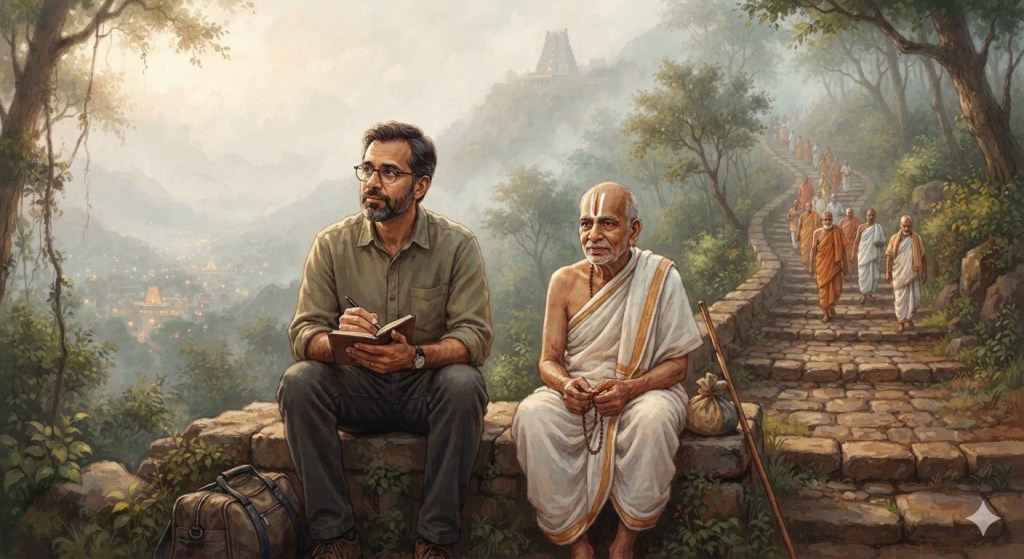
- The Professor — An American of Indian origin, Professor of Indian Religious Studies at a U.S. university, in Tirupati for a conference on Srīvaiṣṇavism.
- The Unknown Srīvaiṣṇava — A quiet pilgrim, deeply rooted in the Srīvaiṣṇava sampradāya, making his way up the Tirumala hills for darśana.
Setting
A resting place on the old footpath up the Tirumala hills. The air is cool. The chant of Govinda! Govinda! rises from the stream of pilgrims below. Two strangers, both slightly out of breath, sit on a stone ledge and begin to talk.
The First Question
Professor:
Namaskāra. You walk with the ease of someone who has done this climb many times.
Unknown Srīvaiṣṇava:
Namaskāra. Only a few times. The legs remember less than the heart does.
Professor:
I am visiting Tirupati University here briefly to attend an academic conference on Srīvaiṣṇavism, but I must confess to you that after 3 days listening to the several expositions, I still get tangled in three specific words which kept appearing in every paper that was presented: śaraṇāgati, prapatti, nyāsa. Are they simply synonyms?
Unknown Srīvaiṣṇava:
A good question with which to begin a climb. The short answer is: no, not strictly synonyms. They point to the same reality — total surrender to the Lord — but each highlights a different facet.
Professor:
How so?
Unknown Srīvaiṣṇava:
Lexically:
- Śaraṇāgati — śaraṇa (refuge) plus āgati (coming): “coming to refuge.”
- Prapatti — from pra-√pad, “to go forward, to resort to”: “resorting to” or “complete surrender.”
- Nyāsa — from ni-√ās, “to place down, deposit”: “placing oneself in God’s care.”
Thus:
- Śaraṇāgati is coming to refuge.
- Prapatti is surrendering oneself.
- Nyāsa is entrusting or depositing oneself.
They name the same ultimate act, but from different angles.
Professor:
So in ordinary usage they overlap, but technically they differ?
Unknown Srīvaiṣṇava:
Exactly. In daily Srīvaiṣṇava speech, one may say that a person “did śaraṇāgati,” “did prapatti,” or “did nyāsa,” and mean simply that he surrendered to Nārāyaṇa. But in śāstric discussion the distinctions become important.
Doctrine, Ideal, and Turning
Professor:
Let me attempt a formulation, and you may correct me. Prapatti is the fully developed ritual of Srīvaiṣṇavism. Nyāsa is a Vedic ideal, perhaps even a summum bonum. And śaraṇāgati is an attitudinal inflection point in bhakti.
Unknown Srīvaiṣṇava:
Very close. I would only add a little nuance.
Prapatti: doctrine, practice, and often ritual
Prapatti is certainly the fully systematised doctrine and practice of self-surrender in Srīvaiṣṇavism. It is conventionally described through six aṅgas, or limbs:
- Ānukūlyasya saṅkalpaḥ — resolving to do what is favourable to the Lord.
- Prātikūlyasya varjanam — relinquishing what is contrary to Him.
- Mahāviśvāsaḥ — firm faith that He will protect.
- Goptṛtve varaṇam — choosing Him as protector.
- Kārpaṇyam — acknowledging one’s helplessness and insufficiency of self-effort.
- Ātma-nikṣepaḥ — placing oneself in Him.
The final limb, ātma-nikṣepaḥ, is in substance nyāsa. Prapatti, then, is not only a ritual. It is a theological doctrine, an inner disposition of faith and dependence, and often a formal practice conducted before an ācārya or the Lord.
Professor:
So ritual is part of it, but not the whole of it.
Unknown Srīvaiṣṇava:
Yes. It is the complete upāya, the means to mokṣa, as codified in the tradition.
Nyāsa: the Vedic ideal of self-entrustment
Nyāsa means “placing down” or “depositing.” Srīvaiṣṇava teachers identify the Nyāsa Vidyā of the Mahānārāyaṇa Upaniṣad, embedded in the Taittirīya Āraṇyaka, as a Vedic core of prapatti.
Thus nyāsa may be understood narrowly as ātma-nikṣepa, one constituent of prapatti. More broadly, it names the Vedic teaching of self-entrustment itself. To call it a Vedic ideal, even a kind of spiritual summit, is appropriate if we mean the soul’s complete placing of itself in the care of the Divine.
Professor:
So nyāsa is both a limb of prapatti and its Vedic heart.
Unknown Srīvaiṣṇava:
Precisely.
Śaraṇāgati: the bhakti inflection point
Śaraṇāgati emphasises “coming to refuge.” In stotras and gadyams — Rāmānuja’s Śaraṇāgati Gadyam, for example, and Vedānta Deśika’s Śaraṇāgati Dīpikā — it carries a special warmth of bhakti.
It names the inward turning-point: “I now come to You as my refuge.” It is less a technical label than prapatti, and more an attitudinal movement from self-reliance to God-reliance.
Professor:
Then one might say: prapatti is the fully developed Srīvaiṣṇava doctrine and practice of surrender; nyāsa is the Vedic ideal of self-entrustment; and śaraṇāgati is the heart’s decisive turn toward God as refuge.
Unknown Srīvaiṣṇava:
That is very well put.
A Sprinter at the Start
Professor:
May I risk an analogy? Imagine a sprinter at the start: “On your mark,” “Get set,” “Go!”
Could we say:
- Śaraṇāgati is “on your mark”: turning towards God.
- Prapatti is “get set”: assuming the full posture of surrender.
- Nyāsa is “go”: the decisive placing of oneself in His hands.
Unknown Srīvaiṣṇava:
It works, with one caveat. In Srīvaiṣṇava theology these are not three separate acts. They are three aspects of a single inward movement.
The soul comes to the Lord as refuge — that is śaraṇāgati; resolves and surrenders — that is prapatti; and places itself in His care — that is nyāsa. Your image is useful so long as we remember: it is one start, not three starts.
Professor:
So the divisions are conceptual, not three temporally separate rituals.
Unknown Srīvaiṣṇava:
Exactly.
Śaraṇāgati Across Traditions
Professor:
Śaraṇāgati seems to be a common theme across Vedāntic schools. Advaitins speak of surrender to Īśvara or Guru. Dvaitins emphasise dependence upon Viṣṇu. Śaiva Siddhāntins speak of yielding to Śiva’s grace. Gauḍīya Vaiṣṇavas, ISKCON, and many modern devotional movements all treat surrender as a central principle.
Yet the technical aspects — prapatti with its six limbs, nyāsa as Vedic vidyā — seem most fully expressed in Rāmānuja’s Siddhāntam. Is that fair?
Unknown Srīvaiṣṇava:
It is fair. Śaraṇāgati, as the basic act of seeking refuge in the Divine, is a pan-Vedāntic and wider bhakti intuition. But the systematic definition of prapatti as a distinct upāya, its six aṅgas, its soteriological claims, and its explicit link with Nyāsa Vidyā are the distinctive achievement of Srīvaiṣṇavism.
Professor:
So śaraṇāgati is broadly shared; prapatti-nyāsa as a codified upāya becomes distinctly Srīvaiṣṇava in its depth and precision.
Unknown Srīvaiṣṇava:
Yes.
A Shared Spiritual Grammar
Professor:
May I raise a difficulty that confronts an outsider? Once one sees śaraṇāgati celebrated by Advaitins, Dvaitins, Śaiva Siddhāntins, Gauḍīya Vaiṣṇavas, and modern devotional movements, one can easily suppose that it has been doctrinally borrowed from Srīvaiṣṇavism — or, conversely, that Srīvaiṣṇavism has merely appropriated a language already common to everyone.
Unknown Srīvaiṣṇava:
That is an understandable impression. But the history and theology are more spacious than such a dispute. Śaraṇāgati — the movement of taking refuge in the Divine — is older and wider than any one sectarian system. It is a recurring Vaidika and Vedāntic intuition, nourished by Upaniṣadic language of refuge, by the Gītā’s call to seek the Lord as sole shelter, and by the devotional temper of the Itihāsas and Purāṇas.
Professor:
Then it would be wrong to treat śaraṇāgati as proprietary Srīvaiṣṇava vocabulary?
Unknown Srīvaiṣṇava:
Wrong, if one means that the fundamental religious impulse belongs exclusively to Srīvaiṣṇavism. What Srīvaiṣṇavism did — pre-eminently and with unusual precision — was to give that widespread impulse a highly articulated doctrinal form: prapatti as a distinct upāya, with its aṅgas, theological rationale, and relation to nyāsa.
Professor:
But does śaraṇāgati mean precisely the same thing everywhere?
Unknown Srīvaiṣṇava:
No. It may be regarded as an omnibus soteriological upāya: a large religious category within which different schools speak in differing metaphysical accents.
- For a Srīvaiṣṇava, it can mean placing oneself entirely beneath Nārāyaṇa’s saving grace, in the technically developed mode of prapatti.
- For a Dvaitin, it coheres with the soul’s eternal dependence upon the supreme and distinct Viṣṇu.
- For a Gauḍīya Vaiṣṇava, it flowers as exclusive and loving surrender to Kṛṣṇa.
- In Śaiva Siddhānta, it can name the soul’s yielding to Śiva and to His liberating grace.
- In Advaitic devotional practice, it may signify surrender to Īśvara or Guru, as ego is relinquished and the mind becomes fit for liberating knowledge.
The vocabulary and metaphysics vary. Yet the basic movement remains recognisable: the relinquishing of self-sufficiency and the seeking of ultimate refuge in the Divine.
Professor:
So theologians of different traditions may differ radically about God, soul, grace, agency, liberation, and the relation between bhakti and jñāna, while not denying the truth contained in surrender itself.
Unknown Srīvaiṣṇava:
That is the sensible way to put it. Śaraṇāgati is a shared spiritual grammar; prapatti and nyāsa are the especially refined Srīvaiṣṇava grammar of that surrender.
Three Concentric Circles
Professor:
You have spoken of these three as facets of one movement. Do you carry any personal image that helps you hold them together?
Unknown Srīvaiṣṇava:
I do. It is only my own pet visualisation, not a formulation from the śāstras, but it has helped me.
Professor:
Please share it.
Unknown Srīvaiṣṇava:
I think of śaraṇāgati, prapatti and nyāsa as three concentric circles around a single epicentre: the parama-puruṣārtha, the highest human goal — everlasting liberation, Vedāntic mokṣa.
- The largest circle, with the widest circumference, is śaraṇāgati. Its boundary is fluid and flexible. It embraces every heartfelt turning to God as refuge, across traditions and temperaments.
- Within it lies a well-defined and crystallised circle: prapatti. Here the attitude of surrender assumes doctrine, sacrament and architecture — a clear upāya, with limbs, conditions, and soteriological claims.
- The innermost circle is nyāsa: the Vedic esotericism of ātma-samarpaṇam, the core gesture of placing oneself in God, distilled to its essence in Nyāsa Vidyā.
At the heart of all three circles, nested like a seed, stands the parama-puruṣārtha itself: mokṣa.
Professor:
That is a striking image. The outer circle suggests breadth, the middle clarity, and the innermost depth.
Unknown Srīvaiṣṇava:
Yes. And the essential qualities of these circles — indeterminacy, definitiveness and centrality — seem reflected in the literary attention Vedānta Deśika gives to each.
Professor:
How so?
Unknown Srīvaiṣṇava:
Consider his works:
- For the core Vedic ideal of nyāsa, he composed three concentrated stotras: Nyāsa Tilakam, Nyāsa Viṃśati, and Nyāsa Daśakam.
- For the wide and immeasurable horizon of śaraṇāgati, he wrote the Śaraṇāgati Dīpikā — a lamp shedding light upon its many shades and possibilities.
- For the entire gamut of prapatti — doctrine, sacrament and practice — he devoted a magnum opus of thirty-two adhikāras: the Śrī Rahasya Traya Sāram.
Professor:
So the largest literary architecture is reserved for prapatti, the middle circle.
Unknown Srīvaiṣṇava:
Exactly. That fact alone tells us much. The three words constitute a triad of spiritual dimensions, each with its own scope and emphasis, yet all point toward a single tattva.
- Śaraṇāgati — the wide, living horizon of refuge.
- Prapatti — the structured path through that horizon.
- Nyāsa — the innermost point at which the self is laid down in God.
All converge upon the same centre.
The Itihāsa Spectrum
Professor:
Let me test this against the epics. I have noticed that Vibhīṣaṇa’s surrender in the Rāmāyaṇa and Draupadī’s cry in the Mahābhārata are normally called śaraṇāgati; Arjuna’s surrender in the Gītā is often associated with prapatti; Bharata’s consecration of Rāma’s pādukās is read as fully instituted prapatti; and Kākāsura’s surrender is seen as nyāsa. Does this mapping hold?
Unknown Srīvaiṣṇava:
It does. It reveals a spectrum of surrender.
Vibhīṣaṇa and Draupadī: śaraṇāgati
Vibhīṣaṇa comes to Rāma seeking refuge. Rāma’s famous assurance — that even one who surrenders once will be protected — makes the scene an archetype of śaraṇāgati. Draupadī’s cry to Kṛṣṇa in the sabhā is similarly remembered as the abandonment of every lesser support and the appeal to God alone.
In both episodes the emphasis lies on helplessness, trust, and the decisive turning towards the Divine. There is little ritual formalisation. Śaraṇāgati is therefore the natural name for them.
Arjuna: prapatti in a doctrinal register
In the Gītā, Kṛṣṇa enjoins Arjuna to abandon all dharmas and seek refuge in Him alone; Arjuna finally responds that his delusion is gone and that he will act according to Kṛṣṇa’s word.
There is no elaborate ritual in this battlefield act. Yet, in Srīvaiṣṇava interpretation, it becomes paradigmatic prapatti because it is embedded in a teaching concerning the Lord as the saving upāya. The act is interior and dialogical, but doctrinally charged.
Bharata: prapatti enacted as life
Bharata refuses the throne, receives Rāma’s pādukās as sovereign, installs them on the throne, governs only as Rāma’s regent, and lives austerely at Nandigrāma.
In him, commentators discern goptṛtve varaṇam, kārpaṇya, mahāviśvāsa, and ātma-nikṣepa. Since his surrender is symbolised through the pādukās, solemnised through their installation, and sustained throughout his life, it may be read as fully instituted prapatti — surrender made into a durable mode of life.
Kākāsura: nyāsa in extremity
Kākāsura, stricken by Rāma’s brahmāstra after offending Sītā, has nowhere else to go. In desperation he falls under Rāma’s protection and is spared, though not without consequence.
The story foregrounds the simple, extreme gesture of entrusting one’s life to the Lord: “I place myself in Your hands.” It is thus readily read as nyāsa — ātma-nikṣepa under the pressure of utter helplessness — rather than as a prolonged discipline of bhakti or a formal doctrinal act.
Professor:
Then the spectrum might be put this way:
- Vibhīṣaṇa and Draupadī: śaraṇāgati — coming to refuge in helpless faith.
- Arjuna: prapatti — accepting the Lord as sole upāya in a doctrinal moment.
- Bharata: fully instituted prapatti — surrender enacted through life, symbol and duty.
- Kākāsura: nyāsa — the urgent depositing of oneself in divine hands.
Unknown Srīvaiṣṇava:
Yes. And each illuminates one facet without excluding the others.
The Vedic Root: Prapadye
Professor:
Before we reach the top, may we return to the Vedic thread? Does the term śaraṇāgati itself occur in the Vedas?
Unknown Srīvaiṣṇava:
Not as a technical compound in the Veda-saṃhitās or Upaniṣads. Nor does prapatti occur there as the later technical noun. Those are systematised theological terms.
But the Vedic corpus contains the roots and phrases which express the idea: śaraṇam, refuge; and prapadye, “I seek refuge” or “I surrender.” The most memorable example occurs in the Mahānārāyaṇa Upaniṣad, within the Taittirīya Āraṇyaka, in the Nyāsa Vidyā:
bhūr prapadye
bhuvaḥ prapadye
suvaḥ prapadye
bhūr-bhuvaḥ-suvaḥ prapadye
vāyuṃ prapadye
anārtāṃ devatāṃ prapadye
ātmānam akhaṇḍaṃ prapadye
prajāpater brahma-kośaṃ brahma prapadye
oṃ prapadye
Professor:
So the Veda repeatedly says, “I surrender,” and later ācāryas name and shape that movement as prapatti and śaraṇāgati.
Unknown Srīvaiṣṇava:
Precisely. The doctrine is later codified; the underlying tattva is already present in śruti.
Near the Top
Professor:
We have covered a great deal of ground for one resting place.
Unknown Srīvaiṣṇava:
And perhaps the legs feel lighter for it. Sometimes the climb is as much for the mind as for the body.
Professor:
If I were to compress our conversation into a single sentence, I would say this: śaraṇāgati is the heart’s turn to God; prapatti is that turn codified as a complete upāya; nyāsa is the Vedic gesture of placing oneself in His hands — and all three name one movement of surrender.
Unknown Srīvaiṣṇava:
That will do. And perhaps, as we reach the hilltop, and go into the sanctum of the Deity Srinivasa there, we may let darśana do the rest of the talking.
Professor:
Agreed. Some truths are seen more clearly than spoken.
They rise, adjust their shawls, and resume the ascent. The chant of “Govinda! Govinda!” grows louder as the temple comes into view.
Note for Readers
This dialogue is an illuminative introduction to three closely related terms in Srīvaiṣṇava thought. It does not attempt to settle every textual, historical or intra-sampradāyic debate.
Its central suggestion is simple: śaraṇāgati, prapatti and nyāsa name different dimensions of one profound movement — the soul’s relinquishment of self-sufficiency and its entrustment to the Divine, with mokṣa as its ultimate horizon.
(Concluded)