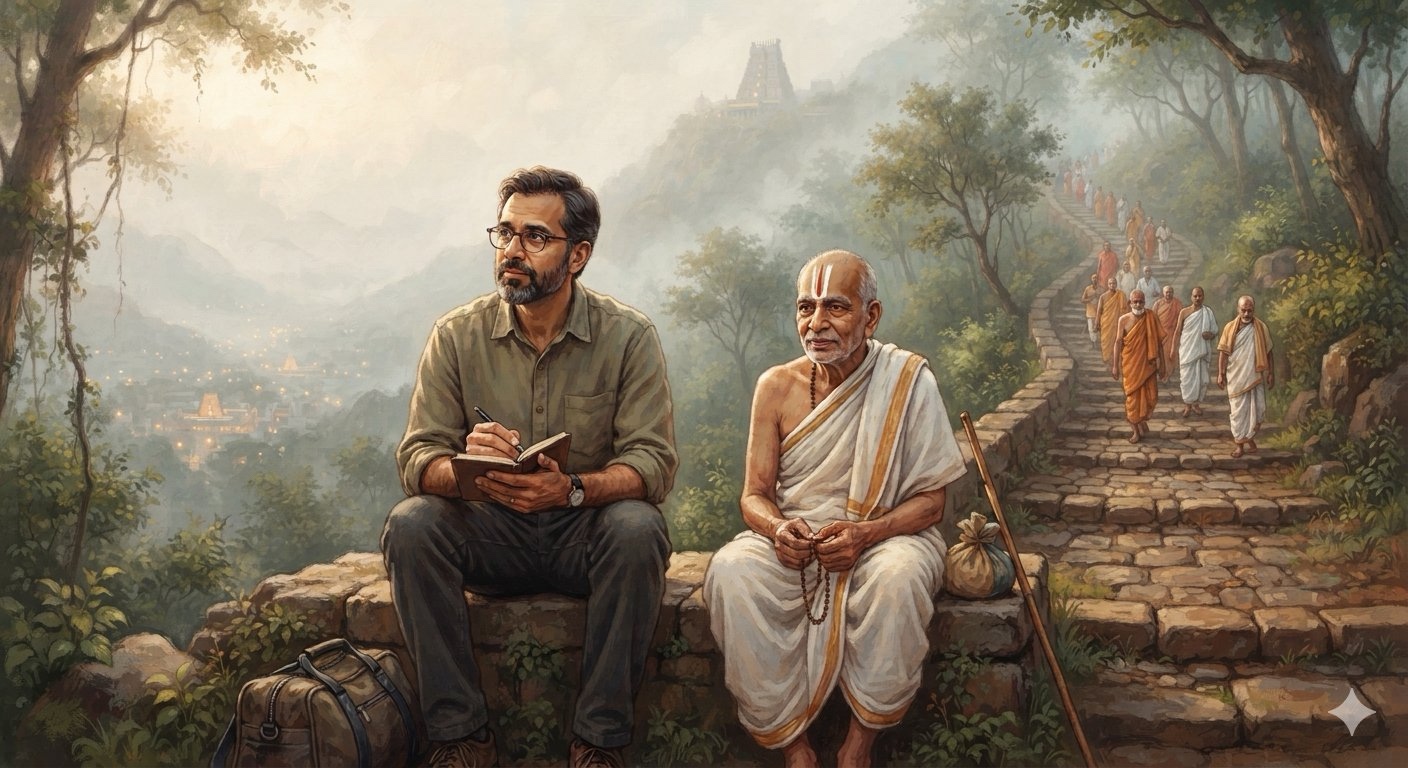
“The Call of Mattapalli”: Mukkur Sri Lakshmi Narsimha Chariyar: On the Vedas-3

What happened at Mattapalli?

On the banks of the Krishna River, in a village in Andhra Pradesh, Sri Mukkur Swami experienced a profound spiritual revelation concerning an idol of Sri Narasimha believed to be buried deep within a cave.

The idol was eventually unearthed.
In the years that followed, a magnificent temple arose at the site, and Mattapalli grew into an important pilgrimage centre for devotees from Andhra Pradesh and across India.

The story of this extraordinary episode—and the life behind it—forms an important part of the forthcoming biography.

The journey begins in faith.
It culminates in sacred service.

“The Veda in Word, Work, and Worship” : Mukkur Sri Lakshminarasimha Chariyar: On the Vedas- 2

by M.K.Sudarshan September 9, 2026: Chennai, India Wednesday, September 9 Some men merely speak about tradition.Some preserve it. A rare few actually embody it.Sri Mukkur Lakshminarasimhachariar belonged to that rarest category. Through his discourses, yajnas, spiritual discipline, scholarship, and tireless propagation of Narasimha bhakti, he demonstrated how the values of the Vedic tradition could beContinue reading ““The Veda in Word, Work, and Worship” : Mukkur Sri Lakshminarasimha Chariyar: On the Vedas- 2”

How Visishtadvaita Distinguishes Between Ego-Bashing and Ego-Massaging : விசிஷ்டாத்வைதம் காட்டும் வழி: அகந்தையை ஒடுக்குவதா? வளர்ப்பதா?

Is your ego an enemy to crush or a spark to celebrate? Visishtadvaita Vedanta reveals a beautiful middle path: aligning individual choice (Sankalpam) with divine service. Read the full bilingual (English/Tamil) breakdown featuring the story of Vibhishana.

Discover why Sri Ramanuja’s Visishtadvaita Vedanta rejects both crushing and inflating the Ego. Learn how Svarupa-Jnana aligns the self toward Moksha.

Beyond Sectarian Labels: Reclaiming the Metaphysical and Historical Truths of South Indian Philosophy

📝 New Essay Launch: Beyond Sectarian Labels — Reclaiming the Metaphysical and Historical Truths of South Indian PhilosophyWhat began as a fascinating theological riddle posed to me by the legendary playwright and Sahitya Akademi winner, Sri Indira Parthasarathy (Eepa), evolved into an extensive historical and sociological exploration.

How did Shankara’s Advaitin disciples come to adopt Shiva as a personal deity?

What connects Saiva Siddhanta structurally to Ramanuja’s Visishtadvaita?

And why did the Sri Vaishnavas never experience a breakaway group like the Karnataka Lingayats, only to fracture intensely from within over temple administrative dominance?

In this three-part essay, I revisit the universalist-humanism of Ramanuja—so brilliantly captured in Eepa’s historic 1970s play “Ramanuja”—and contrast it with the institutional realpolitik documented in my book, “A Tale of Two Cities: The Decline and Fall of the ‘ubhaya-Vedantins'”.

It is time to look past the superficial armor of sectarian labels and return to a unified, transcendental vision.🔗 Read the full reflective brief on my website here: