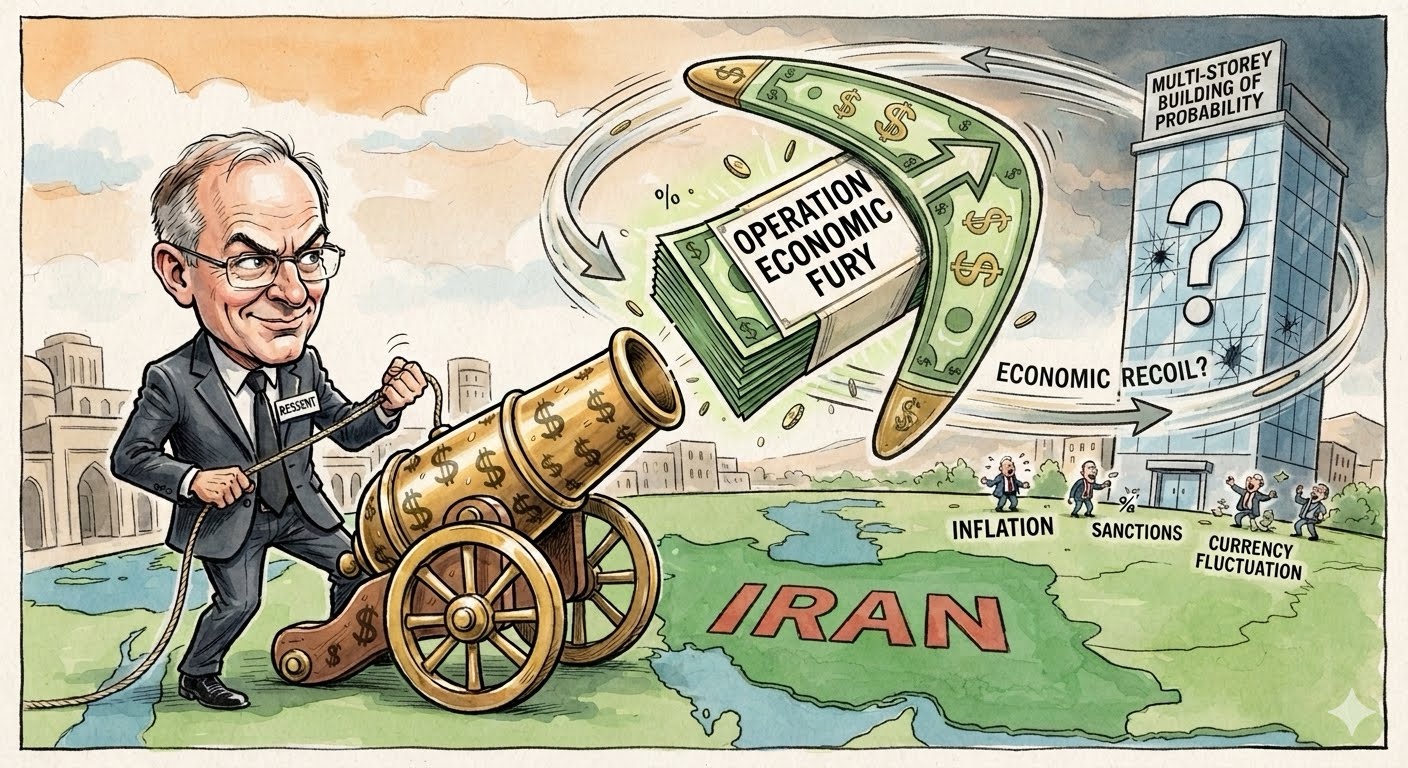
The United States Treasury has officially pulled the pin on what it describes as the most aggressive financial campaign in modern history. Dubbed “OperationEconomic Fury,” the strategy outlined by Treasury Secretary Scott Bessent aims to push the Islamic Republic of Iran past the baseline economic misery it has endured for decades and force a total collapse of the regime. By combining an absolute squeeze on remaining oil channels with aggressive secondary tariffs, Washington is attempting to execute a financial blueprint of total state isolation.
Yet, as the smoke clears over the global financial map, a stark disconnect emerges between macroeconomic cruelty and geopolitical reality. While the strategy is a masterpiece of economic warfare, prominent realist scholars and military analysts—such as Professor John Mearsheimer, Lieutenant Colonel Daniel Davis, and Alastair Crooke—warn that Washington is confusing tactical economic cruelty with achievable geopolitical victory. In their view, the campaign risks becoming another chapter of strategic sound and fury, yielding high-voltage regional chaos rather than a clean political transition.
Part 1: The Case for Absolute Strangulation
To understand why Washington believes this campaign will succeed where thirty years of previous sanctions failed, one must look at the unprecedented structural seals applied to Iran’s economic escape valves. Historically, the regime survived through a combination of dark-tanker oil smuggling to China and informal financial clearinghouses in the United Arab Emirates. Operation Economic Fury has methodically dismantled this architecture.
First, the baseline has shifted due to physical and geopolitical shocks. Following the intense military escalations that began on February 28, 2026, Iran’s maritime trade has been subjected to a highly restrictive naval framework, effectively choking oil exports to zero. Simultaneously, the United Arab Emirates completely severed its financial and logistics ties with Tehran, closing Iran’s largest gateway to the global economy.
Second, Washington has weaponized the global tariff system. By threatening an immediate 25% secondary tariff on any nation continuing to trade with Iran, the United States has forced a brutal mathematical choice upon major economies like China and India: access to the multi-trillion-dollar American market, or heavily discounted Iranian crude oil. Even Iran’s traditional partners, China and Russia, are calibrating their responses purely out of strategic opportunism rather than altruism. While Beijing publicly condemns the sanctions, it is quietly treading carefully to avoid a total trade collapse with the West, opting to lock up Iranian oil revenues inside Chinese bank accounts to prevent Tehran from accessing cash. Moscow, heavily constrained by its own military commitments, provides electronic warfare data and localized arms sales to fuel a US distraction but refuses to offer a mutual defense clause or risk its lucrative ties with the broader Arab Gulf. With Iran’s foreign currency reserves frozen abroad and annual food inflation hovering near 90%, the macroeconomic metrics suggest a state staring down the barrel of total financial bankruptcy. On paper, the blueprint for state collapse appears absolute.
Part 2: The Mirage of Financial Attrition
The fundamental flaw of Operation Economic Fury, however, lies in the assumption that macroeconomic devastation automatically translates into military incapacitation or democratic revolution. Realist assessments emphasize that this logic misunderstands both the cheap economics of asymmetric warfare and the brutal survival mechanics of an entrenched autocracy.
Asymmetric warfare does not require a thriving, high-functioning economy. A long-range Shahed drone costs roughly $20,000 to manufacture—a mere fraction of the multi-million-dollar Western interceptor missiles (such as the SM-2 or Patriot) required to shoot them down. As Lt. Col. Daniel Davis points out, this creates a severe attrition deficit for the West, burning through finite US precision-guided munition stockpiles at a rate that Western factories cannot replace for years. Because Iran possesses highly decentralized, underground manufacturing lines insulated from financial systems, it can sustain a high-frequency asymmetric defense grid on a shoe-string budget.
Furthermore, historical precedents like Cuba and North Korea demonstrate that severe economic degradation rarely translates to a loss of military capability or a change in governance. North Korea has been economically destitute and entirely isolated for decades, yet it successfully developed thermonuclear weapons and intercontinental ballistic missiles. When resources become scarce, an authoritarian regime does not cut its military budget; it strips food, health care, and civilian infrastructure from its people to shield its security core.
The “threshold of pain” theory—the idea that popular misery will inevitably spark a successful domestic revolution—chronically fails because hyperinflation destroys the middle class, leaving citizens entirely consumed by the exhausting daily struggle for food and water rather than organized political resistance. Paradoxically, as private industries collapse, the population becomes entirely dependent on state-rationed survival supplies, increasing the government’s leverage over the public.
Crucially, powerful neighbors like Turkey and Pakistan view an unstable, fracturing Iran as an unmitigated national security nightmare rather than an opportunity. A collapse of the Iranian state would push millions of starving refugees across Turkey’s fortified eastern border, threatening its economy and potentially creating a power vacuum for autonomous Kurdish militant factions. For Pakistan, an imploding Iran threatens to trigger a reverse flow of refugees and spill volatile Baloch insurgencies directly into its unstable Balochistan province, while risking catastrophic domestic sectarian conflicts. To protect their own sovereign borders, Ankara and Islamabad have a direct national interest in keeping the central government in Tehran functional enough to police its own territory, creating a natural regional wall against US-led regime change.
Conclusion: The Multi-Storey of Risks
The ultimate trajectory of Operation Economic Fury can be visualized through a clear metric of probability, mapped out as a three-story strategic building where the chance of success drops precipitously with each higher floor:
[THE STRATEGIC OUTCOME PROBABILITY MATRIX]
Floor 3: Stable Regime Change ──► [ 30% Success Probability ] (Requires popular revolt to defeat an insulated security apparatus)
▲ │ Floor 2: Halting the Military ──► [ 40% Success Probability ] (Stalled by cheap $20k asymmetric weapons & underground factories)
▲ │ Floor 1: Breaking the Economy ──► [ 90% Success Probability ] (Achieved: Bankrupted state, hyperinflation, frozen assets)
The fatal hazard of this strategy is that by successfully locking Iran onto Floor 1 while demanding it climb to Floor 3, the United States leaves a highly armed, cornered regime with absolutely nothing left to lose. Stripped of conventional economic alternatives, Tehran’s strategic incentive shifts entirely toward weaponizing regional chaos. As Mearsheimer warns, Iran’s path to victory does not require defeating the US military conventions; it merely requires surviving and making the Persian Gulf unsafe for maritime shipping. By mining the Strait of Hormuz and driving global oil prices past $100 a barrel, a desperate Iranian regime can inflict an immediate, catastrophic financial tax on Western voters and global supply chains.
Ultimately, Operation Economic Fury achieves immense tactical pain but lacks a viable strategic exit. By ignoring the structural realities of asymmetric warfare and the defensive interests of regional neighbors, Washington may find that it has not engineered a democratic transition, but rather ignited a catastrophic regional fire that burns the entire building down.
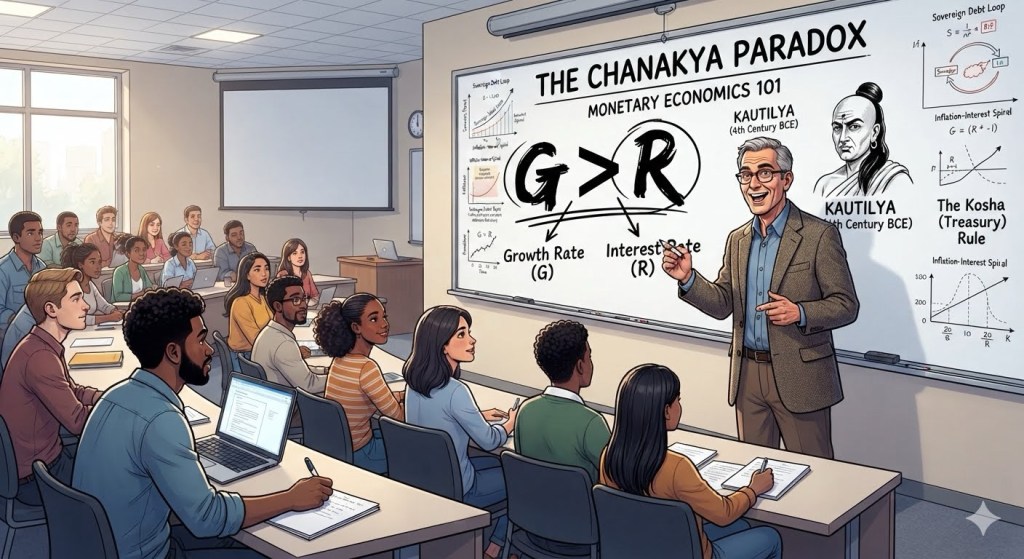
“…Today, we are going to look past the superficial headlines of Washington’s balance sheet to explore a timeless mathematical reality.
Long before Western economists drew up the rules of leverage, a 4th-century BCE master strategist named Kautilya (aka Chanakya) laid down the ultimate law of state survival in the Arthashastra: a state that destroys its economy to fund its government will lose both.
Welcome to The Chanakya Paradox: Why the Printing Press Eats the Empire and Private Banks Wag the Dog.”
🎬 Introduction: The Great Illusion of the Ledger
Good morning, everyone. Welcome to Monetary Economics.
If you open any standard undergraduate textbook, you will be told that economics is the study of scarce resources. But if you look at the real world, you will find that the most powerful force in human history isn’t scarcity—it is an illusion etched into an accounting ledger.
Today, we cross a historic milestone. The national debt of the United States has officially crossed $40 trillion [𝖯𝖡𝖲 𝖭𝖾𝗐𝗌𝗁𝗈𝗎𝗋]. The alarms are blaring in Washington. Pundits are predicting the immediate collapse of the American empire.
But as graduate students, your job is to look past the sensational headlines and understand the underlying mathematics of power. Today, we are going to look past the superficial headlines of Washington’s balance sheet to explore a timeless mathematical reality. Long before Western economists drew up the rules of leverage, a 4th-century BCE master strategist named Kautilya laid down the ultimate law of state survival in the Arthashastra: a state that destroys its economy to fund its government will lose both.
Welcome to The Chanakya Paradox: Why the Printing Press Eats the Empire and Private Banks Wag the Dog.
📉 Part 1: The Myth of the Number—Why the Size of Debt Does Not Matter
Let’s start with a foundational truth that confuses almost every politician on earth: The absolute size of a nation’s debt does not matter.
If I told you that a man owes $10 million, you might think he is ruined. But if I tell you that man is a multi-billionaire tech mogul, you realize $10 million is pocket change. Debt is completely meaningless without context. In sovereign economics, that context is defined by a simple, elegant race between two variables: g and r.
g is the nominal growth rate of the economy (GDP + Inflation). It represents how fast the economic pie is expanding.
r is the effective interest rate the government pays to borrow money. It represents how fast the debt is compounding.
If a country has $40 trillion in debt, but its economic engine (g) is expanding at 10% while its borrowing cost (r) is locked at 2%, that nation is completely safe. The rising tide of economic productivity naturally dilutes the debt over time.
The absolute number on the ledger is just a ghost. The only thing that is real is the structural relationship between your growth and your interest rate.
The Professor:(Pausing, scanning the room for maximum dramatic effect)
“Now, let’s look at the United States today through this exact mathematical lens. The headline data tells us that the U.S. economy is growing at a seemingly resilient real GDP rate of 2.0%. Against a sovereign borrowing cost of around 4.5%, that’s a tough position to be in—it means r > g, and the debt is technically compounding faster than the pie is growing.
But it gets much worse. As graduate students, you must learn to dissect headline indicators.
If we look under the hood of that 2.0% GDP growth and strip away the massive, hyper-concentrated capital expenditure of a single sector—the Artificial Intelligence tech boom—do you know what the real underlying growth rate of the U.S. economy actually is?
(Writing the number on the whiteboard)
It is a near-stagnant 0.66%.
Think about what that means. Nearly two-thirds of all economic growth in the United States today is driven by tech giants spending hundreds of billions of dollars constructing data centers and buying advanced computer hardware. The consumer-facing economy—the main street shops, the factories, the everyday services—is crawling at less than one percent under the crushing weight of sticky inflation and high interest rates.
This is the ultimate modern manifestation of our thesis. The United States is relying entirely on a localized tech capital wave to artificially inflate its growth engine (g), desperate to prevent the wider r > g death spiral from swallowing its $40 trillion balance sheet. If that AI infrastructure spending slows down before it can organically boost the productivity of traditional industries, the illusion shatters, and the empire slides directly into structural stagflation.
(Pausing, the Professor lets the gravity of the number sink in)
So, keeping this fragile 0.66% core in mind, let’s look back at history to see what happens when the illusions fade and the debt loop truly takes hold…”
⏳ Part 2: The Correlation of Debt and Decline
When that mathematical relationship flips—when r permanently overtakes g—empires begin to crumble. Let us walk through the cemetery of history to see how this played out across four great civilizations.
🇬🇧 The British Empire: The Fiscal Exhaustion
Following World War II, Great Britain sat on the winning side of history, but its balance sheet was completely broken. Its debt-to-GDP ratio had plummeted past 250% [𝖴𝖪 𝖯𝖺𝗋𝗅𝗂𝖺𝗆𝖾𝗇𝗍]. Britain didn’t lose its empire to a military invasion; it lost it to a spreadsheet. The cost of maintaining military garrisons across the globe (r) vastly outstripped its stagnant post-war domestic growth (g). Bankrupt and entirely dependent on foreign concessional loans [𝖴𝖪 𝖯𝖺𝗋𝗅𝗂𝖺𝗆𝖾𝗇𝗍], Britain was forced by its creditors to liquidate its imperial holdings, leading directly to Indian Independence in 1947.
🇹🇷 The Ottoman Empire: The Debt Colony
By 1875, the Ottoman Empire was trapped. Decades of borrowing from European banks to fund lavish palaces and modernization projects left them with £214.5 million in foreign debt. Annual debt servicing alone consumed 80% of total state revenues. The empire officially declared bankruptcy via the Decree of Ramazan (1875). To protect their investments, European creditors forced the Sultan to sign away one-third of his tax revenues directly to the Ottoman Public Debt Administration. Long before the empire physically dissolved after WWI, it had ceased to be a sovereign state; it was merely a debt-collection territory for European banks.
🇲🇳 The Mongol Empire: The Paper Catastrophe
The Mongols did not have a bond market, but they pioneered a different monetary trap. During the Yuan Dynasty in China, the Mongol rulers ran massive deficits to fund court extravagances and foreign wars. To pay for it, they printed paper fiat currency (Chao) with zero silver backing. The market quickly realized the money was empty paper. Trust evaporated, hyperinflation took hold, and the entire commercial economy collapsed, triggering the domestic rebellions that violently chased the Mongols out of China.
🏛️ The Roman Empire: The Shrinking Coin
Rome did not have a national debt, but it faced a brutal cash-flow deficit. As imperial expansion halted, the influx of war plunder dried up, but the fixed costs of maintaining a massive standing army and administration kept rising. To bridge the gap, Roman Emperors began systematically debasing the currency. They melted down the silver Denarius and mixed it with cheap copper. Over two centuries, the silver content of Roman coins dropped from 95% to less than 0.5%. The result? Severe hyperinflation, the complete destruction of internal trade, and an empire so financially hollowed out it could no longer afford to pay the legions guarding its borders.
👑 Part 3: The Fatal Trap of Regime Survival—Why Rulers Cannot Help It
Looking back, we might wonder: Why were these rulers so foolish? Why didn’t they just cut spending?
The answer is that governments do not mismanage their treasuries because they are stupid. They do it because they are trying to survive the next ten minutes.
Imagine you are a Roman Emperor. If you do not pay the legions their bonuses tomorrow morning, they will assassinate you and replace you with a general who will. You know that debasing the currency will cause inflation in ten years, but if you don’t do it today, you won’t survive the week.
Governments consistently prioritize short-term institutional survival over long-term structural health. As an empire expands, its bureaucratic machinery grows massive, self-serving, and inflexible. To buy social peace, fund welfare, and appease elite factions, the state must spend more than it extracts.
The fatal economic error these regimes make is confusing currency with wealth. Real wealth is the productive capacity of your people—their farms, factories, and trade. When a government over-taxes, inflates, or over-borrows, it is actively cannibalizing the productive base of its own economy to sustain a bloated, unproductive state apparatus. They destroy the house to keep the furnace burning for one more night.
📈 Part 4: The Birth of the Bond Market—Accelerating Global Leverage
For centuries, an empire’s ability to mismanage its finances was limited by the physical amount of gold and silver it could squeeze out of its population. But then came the greatest financial innovation in human history: The Institutional Bond Market.
Invented in the Italian city-states and perfected by the Dutch and the British, the bond market allowed governments to trade future tax revenues for immediate cash. Instead of stealing gold today, a king could issue an IOU promising to pay investors back over the next thirty years.
Suddenly, global debt was completely decoupled from physical constraints. It became an engine driven by three distinct gears:
If an empire had a powerful economic growth engine (g), global investors would happily buy its bonds at very low interest rates (r). This created a massive accelerant. The bond market allowed the British Empire to fund global wars and the United States to fund the Industrial Revolution by borrowing against their future prosperity.
But this engine has a dark side. The bond market functions as an unyielding, cold machine. The moment an empire’s growth begins to slow down, or its debt becomes too heavy, the gears reverse. Investors demand a higher risk premium, driving up the yield (r). Suddenly, the bond market transforms from a financial turbocharger into an inescapable debt trap.
🖨️ Part 5: The Forbidden Fruit—The Pitfalls and Temptations of Printing Money
This brings us to the ultimate temptation of the modern era. When the bond market demands higher yields and the debt becomes unsustainable, modern governments look at their printing presses and ask a seductive question:
“Since we borrow in our own currency, why don’t we just print the money to pay off the debt?”
This is the core illusion of modern political discourse. Let’s map out exactly what happens when a government prints money specifically to fund its largest line item: Interest on its borrowing.
Every single month, the U.S. Treasury must pay billions of dollars in interest to bondholders. If the Federal Reserve creates new dollars out of thin air to cover these checks, it does not bypass the real economy. That newly printed cash enters the banking system immediately .
Because you have flooded the market with paper money without increasing the actual production of food, energy, or housing, the value of each dollar drops. You get immediate domestic inflation.
But the story doesn’t end there. Bond investors are highly rational actors. If a pension fund or a foreign central bank realizes the government is paying them interest in depreciating, printed currency, they will protect themselves. The next time the government tries to borrow money, investors will refuse to buy the bonds unless they receive a significantly higher interest rate—an inflation premium.
Yields spike. Because the government has to constantly roll over trillions of dollars of old debt into new bonds, a 1% or 2% jump in interest rates instantly adds hundreds of billions of dollars to the annual budget deficit. The government is forced to print even more money next month just to cover the newly inflated interest cost. You have entered the terminal Inflation-Interest Spiral.
📜 Part 6: Chanakya’s Defense—The Anti-Debt Philosophy of the Arthashastra
Long before Western economists began tracking g > r, an ancient Indian polymath named Kautilya (also known as Chanakya) identified this exact systemic vulnerability. In the 4th Century BCE, he wrote the Arthashastra, the world’s first comprehensive treatise on statecraft and political economy.
Kautilya’s philosophy was explicitly and fiercely anti-debt.
In his Saptanga (seven-limb) theory of the state, Kautilya positioned Kosha (the Treasury) as explicitly more important than Danda (the Army) [𝖯𝗈𝗅𝖲𝖼𝗂 𝖨𝗇𝗌𝗍𝗂𝗍𝗎𝗍𝖾]. He簡 argued that a standing army is completely useless without a well-filled treasury to sustain it [𝖯𝗈𝗅𝖲𝖼𝗂 𝖨𝗇𝗌𝗍𝗂𝗍𝗎𝗍𝖾].
Kautilya warned that running a state on borrowed money or structural debt was a critical weakness that directly compromised a nation’s sovereignty. If a king faces an extraordinary emergency (Apatkala)—such as an invasion or a famine—Kautilya did not prescribe borrowing money. Instead, he outlined a highly strategic system of temporary emergency resource extraction:
Benevolences (Pranaya): Demanding one-time financial contributions from the wealthiest merchants and landowners based strictly on their capacity to pay.
State Monopolies: Temporarily taking direct control over high-yield commercial sectors like mining, salt, and liquor to immediately refill the state’s coffers.
The Rule of the Bee: Kautilya issued a stern warning to rulers: “A king must collect taxes from his economy as a bee sucks honey from a flower—taking just enough to sustain the state without damaging the underlying petals.”
Kautilya understood that a treasury built on debt makes the king a hostage to lenders. For ancient Indian dynasties, financial survival was achieved by boosting internal productivity and maintaining real, physical surpluses, never by building a mountain of structural liability.
🐕 Part 7: The Tail Wags the Dog—Who Really Rules the World?
This brings us to the final, unsettling conclusion of our story.
Most people grow up believing that the government is the supreme authority—the “dog”—and the central bank and the commercial banking empire are merely the technocratic “tail.”
But when a nation crosses the tipping point into systemic debt, the financial system completely inverts. The tail begins to violently wag the dog.
When a government owes $40 trillion, it is no longer an independent sovereign ruler. It is a captive patient on permanent financial life support. Every single week, the government must go back to the banking system to roll over its expiring debt and borrow billions more just to keep its offices open.
At that stage, power shifts entirely to the Primary Dealers—the massive global commercial banks and institutional investors who control the bond auctions. If the banking empire decides a government’s policies are unfavorable, they don’t need to deploy an army. They simply stop buying the government’s bonds. Yields spike, the national budget fractures, and the government is forced to capitulate.
The central bank is pulled into this trap via Fiscal Dominance. It can no longer raise interest rates to protect the currency because doing so would instantly bankrupt its own government. The central bank’s primary mission shifts from maintaining economic stability to ensuring government liquidity.
Politicians sit in parliaments, sign decrees, and give speeches about war and peace. But behind the scenes, the elite banking apparatus decides what is possible. They decide if a nation can afford to wage a war, if it can fund infrastructure, or if it must implement austerity. The government becomes a glorified debt-collection agency, extracting taxes from its citizens and routing that wealth straight back into the banking system to service compounding interest.
🎓 Conclusion: Your Challenge as Economists
As you step into the world of graduate-level monetary economics, I want you to remember this framework.
Do not get distracted by the raw numbers. Don’t look at $40 trillion and assume immediate collapse [𝖯𝖡𝖲 𝖭𝖾𝗐𝗌𝗁𝗈𝗎𝗋]. Instead, look at the structural relationship. Look at whether a nation’s organic economic growth engine (g) is outpacing its systemic cost of capital (r).
The moment that inequality flips, the clock begins to tick. The state survival loop activates, the printing presses start running, and the banking tail begins to wag the political dog.
Throughout this semester, we are going to unpack the mathematical models behind this power dynamic. Your goal is to understand how this machine works—because those who understand the relationship between g and r are the ones who can predict the rise and fall of modern empires.
Thank you. Let’s open the floor for questions.
🎬 Scene: After the Applause Clears
Setting: The lecture hall of the university. The hum of industrial air conditioners fills the room as first-year graduate students chatter, pack their bags, and shuffle toward the exit doors. The professor is at the podium, shutting down the laptop and neatly piling up lecture notes.
A sharp, inquisitive student steps out of the dispersing crowd. He holds a tablet displaying a copy of the Reserve Bank of India’s State Finances Report. He hails from Chennai, Tamil Nadu.
The Student:(Politely, waiting for the professor to look up) “Professor? Do you have two minutes? That lecture was absolutely fascinating, especially the framework on how the banking tail completely wags the political dog when r > g flips.”
The Professor:(Smiling, closing the laptop case) “Of course. That’s why we’re here. Go ahead. What’s on your mind?”
The Student: “So, I was applying your model to India while you were talking. I look at my home state, Tamil Nadu. According to the latest data, Tamil Nadu holds the largest absolute debt volume among all Indian states—nearly ₹9.6 Lakh Crore. When you see that number in the local newspapers back home, political opposition parties use it to scream about an impending economic apocalypse. But looking at your framework… the absolute size of the debt shouldn’t matter, right? What is Tamil Nadu’s actual g > r dynamic?”
The Professor:(Leaning back against the podium, impressed) “Excellent connection. You’ve bypassed the political theater and looked straight at the plumbing. You are completely right: the absolute number of ₹9.6 Lakh Crore is just a ghost headline. To understand Tamil Nadu’s health, we have to look at its Gross State Domestic Product (GSDP) and its borrowing costs.”
The Student:(Nodding, pulling up a chart on his tablet) “Right. Because Indian states can’t print currency like the U.S. Federal Reserve does. They issue State Development Loans (SDLs).”
The Professor: “Exactly. They have no printing press to hide behind. Now, let’s run the math for Tamil Nadu. The market yield on its 10-year SDLs—your r—is tightly managed by the RBI and hovers around 7.4% to 7.7%. But look at Tamil Nadu’s nominal growth rate, your g. Driven by its massive automotive hubs, electronic manufacturing, and deep industrial diversification, the state’s nominal growth is surging at roughly 11.5%.”
The Professor:(Continuing) “Do you see the spread? That is a highly healthy +3.8% positive gap. Because the underlying economic engine is expanding significantly faster than the debt is compounding, Tamil Nadu’s debt-to-GSDP ratio remains entirely manageable at around 29%. It’s using leverage correctly—borrowing to fund high-value capital expenditure and infrastructure, which in turn expands the future tax base. It is structurally secure.”
The Student:(Contemplating) “So the alarmists back home are treating it like a household budget instead of a sovereign-adjacent economy. But Professor, does that mean every heavily indebted state in India is safe?”
The Professor: “Far from it. Turn your eyes northwest to Punjab. Punjab doesn’t have Tamil Nadu’s absolute volume of debt, but it is in a classic Chanakya structural trap. Its debt-to-GSDP ratio is nearing 47%—the highest among all major non-hilly states. Its nominal growth (g) has slowed down to around 8.5%, while its borrowing cost (r) sits at that same 7.6%market rate.”
The Professor:(Tapping the student’s tablet) “Look at that razor-thin spread of just 0.9%. Punjab isn’t using its debt for capital investments or industrial corridors like Tamil Nadu is. It is trapped in the ‘Survival Loop’ we discussed in class. It is borrowing money to pay for power subsidies, committed legacy pensions, and day-to-day administrative survival. Over 20% of Punjab’s entire revenue receipts are swallowed up just to pay the interest on its past debt.”
The Student: “Ah! So because Punjab can’t print rupees, it can’t inflate its way out of that trap. What happens when a subnational state hits a wall like that?”
The Professor: “The tail wags the dog, but on a federal scale. The central government in New Delhi steps in under the FRBM Act, clamps down on the state’s borrowing ceilings, and effectively takes over its fiscal policy. The state loses its political autonomy.”
The Student:(Smiling, locking his tablet) “So Kautilya’s rule of the bee applies perfectly even to modern Indian states. Collect taxes like a bee taking honey to invest in the flower’s growth… otherwise, you become a hostage to your creditors.”
The Professor:(Picking up his laptop bag, smiling) “Spoken like a true monetary economist. Write this down as a short postscript case study for your mid-term paper. I’ll see you in seminar on Thursday.”
The Student: “I will, Professor. Thank you so much!” (Turns and walks out of the empty lecture hall)
Summary: This article uncovers the unsettling paradox of our time: why global stock markets smash records while everyday people face soaring inflation, joblessness, and devastating wars.
By pulling back the curtain on the financial centers of New York, London, and Brussels, we expose how the banking elite structurally profit from instability and inflation.
Drawing powerful parallels to the Napoleonic Wars and the British East India Company, this piece offers both the solace of clear understanding and a stark, historical warning: when desperate people are pushed past the brink, the silent dance of survival inevitably transforms into revolution.
Have you ever walked outside, looked at the world around you, and felt like you were losing your mind?
We look at our lives and see a raging storm. The war in Ukraine has been grinding on for nearly five years. A devastating conflict in Iran has passed its six-month mark. Prices at the grocery store climb every single week. Jobs are insecure, the climate is throwing erratic disasters at our doorsteps, and a quiet, heavy desperation hangs over the street.
Yet, if you turn on the financial news, the scene is completely different. The stock markets in New York, London, and Frankfurt are breaking records. The global elite are smiling, clinking glasses, and celebrating “unprecedented prosperity.”
It feels like a surreal theater. The world is flooded, but the powerful are doing a silent dance in the rain.
If you are confused, angry, and trying to make sense of how your hunger and pain can coexist with their billions, you are not alone. And you are not crazy. There is a method to this madness, and understanding it is the first step to reclaiming your peace of mind.
1. The Tale of Two Worlds: The Street vs. The Market
The first thing we must understand is a simple, brutal truth: The stock market is not the economy.
The stock market does not care about human happiness, the price of your bread, or whether you can pay rent this month. The stock market is simply an auction house for giant multinational corporations.
When life gets harder for you, it often gets more profitable for them:
Inflation hurts your pocket, but it means corporations are raising prices and making more money.
Joblessness frightens you, but to a corporation, cutting workers means lowering costs, which makes their stock look better to investors.
Chaos and War destroy communities, but they drive massive profits into the pockets of defense contractors, security tech companies, and energy giants.
The market isn’t humming because the world is healthy. It is humming because big corporations have learned how to turn the storm into a cash machine.
2. The Puppeteers in the Financial Fortresses
To find out who is playing the music for this dance, we have to look at the global financial capitals: Wall Street in New York, the City of London, and the banking hubs of Brussels and Berlin.
These are not just places on a map; they are the heart of a global banking machine. For decades, these institutions have piled up mountain after mountain of toxic debt. To keep their own system from collapsing, they rely on the very things that cause us pain.
Why they love Inflation: When inflation drives up the price of oil, metals, and land, the value of the “collateral” (the physical assets the banks own or hold as security) goes up too. This artificially inflates the banks’ balance sheets, hiding the fact that their financial foundation is rotting.
Why they profit from War: Modern wars are incredibly expensive. Governments don’t fund them with immediate taxes; they fund them by borrowing billions. Who lends them that money? The mega-banks in New York and London. They underwrite this massive government debt, collecting billions in fees and interest while everyday people pay the price in blood and inflation.
3. An Old Playbook: How Financial Centers Have Always Profited from War
This system was not invented yesterday. The financial centers of New York and London are simply using an old imperial playbook. History shows that whenever the world bleeds, the counting houses grow rich.
Consider the history of the City of London. Between the mid-1700s and the early 1800s, the British East India Company fomented and fought a series of brutal, extractive wars across India. From the aggressive plundering of Robert Clive at the Battle of Plassey to the sweeping campaigns of Lord Hastings, India was kept in a state of manufactured instability, heavy taxation, and famine. Yet, across the ocean in London, the East India Company’s stock boomed. The plundered wealth flowed straight into British banking houses, laying the literal foundations for modern global finance.
Look also at the Napoleonic Wars (1803–1815) in Europe. While the continent was being torn apart by relentless battle, the financial centers were quietly consolidating unprecedented power. Legendary banking dynasties amassed immense fortunes by lending money to both sides of the conflict, manipulating the bond markets, and trading the very commodities that starving populations desperately needed.
When you look at Wall Street or London today profiting from prolonged conflicts in Ukraine or Iran, you are looking at the exact same machinery. The pipeline transferring wealth from the blood and instability of distant lands into the glass towers of financial capitals remains exactly the same.
4. A Dire Warning: The Flashpoint of Desperation
The financiers and elites watch the streets bemusedly, believing that the forced “silent dance” of the desperate is a sign of permanent submission. They assume that because people are exhausted by the daily struggle to survive, they will endlessly absorb the hunger, the inflation, and the pain.
But this is where the orchestrators of the storm make their most fatal miscalculation. History proves that when people are pushed past the brink of endurance, the silent dance stops, and revolutions begin.
Before and after Napoleon, Europe was convulsed by populations rising up to tear down the very structures that starved them. The French Revolution was born not out of abstract political theory, but because the common people could no longer afford the price of bread while the elite lived in insulated opulence.
Similarly, the British East India Company believed its chokehold on India was absolute—until 1857. What the colonial powers dismissed as the “Sepoy Mutiny” was, in reality, a massive, explosive eruption of decades of pent-up civilian and military fury against ruthless economic exploitation, heavy taxation, and a total disregard for human dignity. It shook the British Empire to its very foundations and brought a violent end to the Company’s century-long corporate rule.
Desperate people, when pushed into a corner by endless wars and artificial scarcity, eventually turn around. The very populace that the banks look down upon can instantly transform from compliance into an unstoppable force that tears down the casino itself.
The Solace of Understanding
If you are waiting for the people dancing in the rain to stop and build you a shelter, they won’t. They have umbrellas made of historic wealth and corporate power.
But there is a deep, quiet solace that comes from finally seeing the machinery for what it is.
You can stop blaming yourself for struggling in a system that was literally designed to extract wealth from your labor and your savings. You can stop looking at the roaring stock market and feeling like you are the problem.
The storm is real, but so is your resilience. When we understand that the financial towers are built on illusions of debt and paper wealth, we can stop looking to them for answers. The true antidote to their cold, global machinery isn’t joining their dance—it is turning toward each other, building local resilience, reducing reliance on their debt traps, and finding strength in our shared humanity.
They may control the rain, but they do not own your mind.
பாத்திரங்கள் • டேவிட் — நடுத்தர வயதுடைய அமெரிக்கத் தத்துவ மாணவர்; ஓராண்டு ஆய்வு-விடுப்பில் இந்தியத் திருத்தலங்கள், குருமார்கள், இந்தியத் தத்துவப் பேராசிரியர்கள் ஆகியோரைச் சந்தித்து வருபவர்.
• அறியப்படாத ஸ்ரீவைஷ்ணவர் — எழுபது வயதுடைய வேதாந்த உண்மை நாடுபவர்; முறையாக வேதாத்யயனத்தில் தீட்சை பெற்றவர், ஆயினும் தம்மை முழுமையான வேதவித்தகர் என்று கூறிக்கொள்ளாதவர்.
இடம்:
சென்னை–திருப்பதி நீண்டதூர இரயில் பயணம். மாலைச் சாயல். ஒரு சாதாரண உறங்கும் வசதியுள்ள பெட்டியில், சந்தர்ப்பவசமாக எதிரெதிரே அமர்ந்திருக்கும் இரு பயணிகள்.
கேள்வி ஒன்று
டேவிட்: மன்னிக்க வேண்டும். நான் படித்துக்கொண்டிருக்கும் இந்தப் புத்தகத்தைக் கவனித்திருப்பீர்கள் என்று தோன்றுகிறது. நான் டேவிட்—அமெரிக்காவில் தத்துவம் படிக்கிறேன். இந்தியத் தத்துவ மரபுகளை நேரில் அறிய ஓராண்டு விடுப்பில் இங்கே சுற்றிக்கொண்டிருக்கிறேன்.
அறியப்படாத ஸ்ரீவைஷ்ணவர்: (மெதுவாகப் புன்னகைத்து) நான் பெரிய பண்டிதன் அல்ல, ஐயா. உங்களைப் போலவே வழியில் செல்லும் ஒரு முதிய பயணி. ஆனால் நீண்ட பயணத்தில் சகபயணிகள் சில எண்ணங்களைப் பகிர்ந்துகொள்ளலாம். அந்தப் புத்தகத்தில் உங்களைத் திணறச் செய்வது எது?
டேவிட்: புத்தகம் மட்டும் அல்ல. அதைவிட ஆழமான ஒரு கேள்வி. பல கோயில்களில் வேத பாராயணம் கேட்டிருக்கிறேன்; சில உபந்யாசங்களிலும், பதிவு செய்யப்பட்ட ஒலிப்பதிவுகளிலும் கேட்டிருக்கிறேன். சிலர் அந்த மந்திர ஒலியைக் கேட்டு கண்கலங்குகிறார்கள்; சிலர் மிகுந்த அமைதிக்குள் செல்வதுபோல் தெரிகிறார்கள். ஆனால் வேறு சிலருக்கு—என்னையும் சேர்த்து—அது வெறும் ஒலியாகவே கேட்கிறது. அழகாக இருக்கலாம்; ஆனால் உள்ளத்தை மாற்றுவதாகத் தோன்றுவதில்லை.
ஒரு தயக்கத்தோடு கேட்கிறேன். வேதம் சப்தப் பிரமாணம் என்றால், அது பிரபஞ்சமெங்கும் நிறைந்த, அபௌருஷேயம் ஆன ஒலி என்றால், அது எல்லா மனித இதயங்களையும் ஒரே விதமாகத் தொட வேண்டாமா? சிலரை ஆழமாக அசைத்து, மற்றவர்களைத் தொடாமலிருப்பது ஏன்? வேத ஒலியால் நெகிழாதவர்கள் உண்மையின் இயல்போடு இசைவாக இல்லை என்பதா?
அறியப்படாத ஸ்ரீவைஷ்ணவர்: (தலையசைத்து)
மிக நேர்மையான கேள்வி. எளிதான பதிலால் திருப்தியடையாத மனம் உங்களிடம் இருப்பதற்கான அடையாளம் அது. முதலில் என் சிறுவயதில் நடந்த ஒன்றைச் சொல்கிறேன்.
இரு கேட்போர்
அறியப்படாத ஸ்ரீவைஷ்ணவர்: எனக்குப் பத்து வயது இருக்கும்போது, என் தந்தை என்னை காஞ்சிபுரத்தில் நடந்த ஒரு யாகத்துக்கு அழைத்துச் சென்றார். அங்கே ருத்விக்குகள் புருஷ சூக்தம் ஓதினர். நான் அருகில் நின்றிருந்த ஒரு வயதான மலர் விற்கும் பெண்மணியைப் பார்த்தேன். அவளுடைய கைகள் உழைப்பால் கரடுமுரடாக இருந்தன; எளிய பருத்திச் சேலை அணிந்திருந்தாள். மந்திர ஒலி உயர்ந்தபோது அவள் அமைதியாகக் கண்ணீர் வடித்தாள். உடம்பே நடுங்கியது.
அவளுக்குப் பக்கத்தில் சமஸ்கிருதக் கல்லூரியைச் சேர்ந்த, தாமே வேதத்தைப் பிழையின்றி ஓதக்கூடிய ஒரு பண்டிதர் நின்றிருந்தார். அவர் மனம் வேறெங்கோ இருந்தது—தமக்குக் கிடைக்கவிருக்கும் தக்ஷிணையைப் பற்றியோ, அடுத்த வேலையைப் பற்றியோ நினைத்திருக்கலாம்.
அதே ஒலி இருவருடைய காதுகளிலும் விழுந்தது. ஒருவரின் உள்ளம் கரைந்தது; மற்றொருவர் வறண்டே இருந்தார். ஒலி வேறுபட்டதா? இல்லை. கேட்பவர்கள் வேறுபட்டார்களா? ஆம். ஆனால் நீங்கள் நினைப்பதுபோல எளிய வேறுபாடு அல்ல.
டேவிட்: அப்படியானால் குறை வேதத்தில் இல்லை; கேட்பவரிடம்தானா?
அறியப்படாத ஸ்ரீவைஷ்ணவர்: வேதம் சூரியனைப் போன்றது என்று சொல்வேன். திறந்த வெளியில் இருப்பவன் மீதும், மூடிய அறைக்குள் இருப்பவன் மீதும், ஒளியை விரும்புபவன் மீதும், இருளில் ஒளிவதைக் விரும்புபவன் மீதும் அது ஒளிர்கிறது. பார்வையற்றவன் சூரியனைப் பார்க்கவில்லை என்பதற்காகச் சூரியன் பொதுவானவன் அல்ல என்று சொல்ல முடியுமா?
வேதத்தின் பொதுமை அதன் உண்மைநிலையில் உள்ளது; அது ஒரு மனிதனிடம் விளைவிக்கும் அனுபவம், அந்த மனிதனின் உள்ளக்கருவியைப் பொறுத்தது. வேதம் பொதுவானது; அதன் வெளிப்படும் பயன் நிபந்தனைக்கு உட்பட்டது.
அதிகாரித்துவம்
டேவிட்: ஆனால் இது உயர்வு–தாழ்வு பேசுவதைப் போல இல்லையா? சிலருக்கே வேதத்தைப் பெறும் தகுதி இருக்கிறது என்று சொல்வது உயர்குடிமை எண்ணம் போலத் தோன்றுகிறது.
அறியப்படாத ஸ்ரீவைஷ்ணவர்: (சிறிது சிரித்து) தகுதி என்பது சமூகக் கழகத்தின் உறுப்பினர் அட்டை அல்ல, நண்பரே. அது மருத்துவ உண்மை போன்றது. சிறந்த மருந்தைக் கொடுத்தாலும், ஒருவர் அதை விழுங்க மறுத்தால் அல்லது உடல் அதை ஏற்கும் நிலையில் இல்லாவிட்டால், மருந்தின் குறை என்ன?
அது பிறப்பினால் மட்டும் வருவது அல்ல; பிறப்பு சிலருக்கு வாய்ப்பளிக்கலாம், அவ்வளவே.
நம் மரபில் இதை அதிகாரித்துவம் என்போம்—ஆன்மிக ஏற்புத்திறன்.
முக்கியமானவை விவேகம்—நிலையானது, நிலையற்றது என்பதைக் கண்டறியும் தெளிவு; வைராக்யம்—பற்றின்மையும்; முமுக்ஷுத்துவம்—மோட்சத்தை அடைய வேண்டும் என்ற தீவிர ஏக்கமும்.
இவை இல்லாமல் வேத ஒலியைக் காதால் கேட்கலாம். ஆனால் அது உள்ளத்தால் ஏற்கப்படாது.
டேவிட்: அப்படியென்றால், நீங்கள் சொன்ன அந்த மலர் விற்கும் பெண்மணிக்கு இத்தகைய தகுதிகள் இருந்தனவா?
அறியப்படாத ஸ்ரீவைஷ்ணவர்: நல்ல கேள்வி. அவளுக்கு சமஸ்கிருதம் தெரியாமல் இருக்கலாம்; தத்துவப் பயிற்சி இருக்காமல் இருக்கலாம். ஆனால் பக்தி இருந்தது. எதிர்பார்ப்பின்றி மலர்களை இறைவனுக்குச் சமர்ப்பித்த வாழ்க்கை இருந்தது. அவளது மனத்தில் படிந்திருந்த சம்ஸ்காரங்கள்—முன்னைய மனப்பதிவுகள்—இசைவாக இருந்தன. பண்டிதரின் மனம் எண்ணங்களால் நிரம்பி இருந்திருக்கலாம்.
வேதம் வேறுபாடு பார்ப்பதில்லை. ஆனால் அதை ஏற்றுக்கொள்ளும் பாத்திரத்தின் நிலை முக்கியம்.
சம்ஸ்காரமும் உள்ளத்தின் இசைவும்
டேவிட்: நான் ஒரு வேறு பண்பாட்டு உலகிலிருந்து வந்தவன். வேத பாராயணம் எனக்குச் சில நேரங்களில் அந்நியமாகத் தோன்றுகிறது. ஒருசில வேளைகளில் எரிச்சலூட்டுவதாகக்கூட இருக்கிறது. அதனால் நான் ஆன்மிகமாகத் தாழ்ந்தவன் என்று பொருளா? அல்லது வேதம் என்னைப் போன்றவருக்கு வெறும் பண்பாட்டு ஒலியா?
அறியப்படாத ஸ்ரீவைஷ்ணவர்: (அன்போடு, ஆனால் கூர்மையாக) ஒரு கேள்வி கேட்கலாமா? நீங்கள் கிரெகோரியன் இசைப்பாடலைக் கேட்கும்போது, அல்லது குர்ஆன் ஓதப்படுவதைக் கேட்கும்போது, அல்லது திபெத்திய மணி ஒலிகளைச் செவிமடுக்கும்போது, அந்த மரபைச் சேர்ந்த பக்தருக்கு ஏற்படும் அனுபவம் உங்களுக்கும் ஏற்படுகிறதா?
டேவிட்: (சற்று யோசித்து) இல்லை. மதிப்பு இருக்கும்; ஆர்வம் இருக்கும். ஆனால் ஒருவர் தன் வீட்டிற்குத் திரும்பிவிட்டதைப் போல உணரும் அந்த அனுபவம் இல்லை.
அறியப்படாத ஸ்ரீவைஷ்ணவர்: அதுதான். அந்த ஒலிகளுக்கு ஆற்றல் இல்லை என்பதல்ல. உங்கள் மனத்தின் சம்ஸ்காரங்கள்—பண்பாட்டு அனுபவங்களும், ஆழத்தில் பதிந்துள்ள மனநிலைகளும்—அந்த ஒலிவடிவங்களோடு இன்னும் இசையவில்லை என்பதுதான்.
ஒரு தமிழனுக்கு தேவாரப் பண்ணிசை உள்ளத்தை உலுக்கலாம். ஒரு வங்காளிக்கு ராமபிரசாதரின் பாடல்கள் அப்படியே இருக்கலாம். ஒரு பஞ்சாபிக்குக் குருபாணி அப்படியே இருக்கலாம். ஒலியின் பொதுமை ஒன்று; ஒலித்தெழும் பதில் தனிப்பட்டது.
டேவிட்: அப்படியானால், வேதம் என்னை இப்போது தொடவில்லை என்பதே என் ஆன்மிகத் திறனுக்கான இறுதித் தீர்ப்பு அல்லவா?
அறியப்படாத ஸ்ரீவைஷ்ணவர்: இல்லை. அது தீர்ப்பல்ல; ஒரு அறிகுறி மட்டுமே. இன்று உங்கள் உள்ளக்கருவி எங்கே இருக்கிறது என்பதை அது காட்டுகிறது. ஜபம், உபாசனை, சுயபரிசோதனை ஆகியவற்றின் வழியாக அது எங்கே செல்லக்கூடும் என்பதை அது முடிவு செய்துவிடாது.
சம்ஸ்காரங்கள் மாறக்கூடியவை. அதிகாரித்துவம் வளர்க்கக்கூடியது. மனிதன் முடிந்துபோன பொருள் அல்ல; உருவாகிக்கொண்டிருக்கும் உயிர்.
இரண்டு நிலைகள்
டேவிட்: எனக்குள் இன்னும் ஒரு தத்துவச் சந்தேகம இருக்கிறது. வேதம் உண்மையிலேயே அபௌருஷேயம்—மனிதர் படைத்ததல்ல, நித்தியமானது, பிரபஞ்சத்தோடு தொடர்புடையது—என்றால், அதன் தாக்கம் எல்லாரிடமும் உடனடியாகவும் ஒரே மாதிரியாகவும் இருக்க வேண்டாமா? ஏன் இத்தனை நிபந்தனைகள்?
அறியப்படாத ஸ்ரீவைஷ்ணவர்: இப்போது நீங்கள் வேதாந்தத்தின் மையக் கேள்வியைத் தொடுகிறீர்கள். இரண்டு நிலைகளைப் பிரித்தறிய வேண்டும்:
• வ்யாவஹாரிக நிலை — நாம் வாழும் அன்றாட, அனுபவ உலகம். இங்கே வேறுபாடுகள் உண்மையாகவே தோன்றுகின்றன. மனநிலை, பண்பாடு, பழக்கங்கள், சம்ஸ்காரங்கள்—இவை அனைத்தும் தாக்கம் செய்கின்றன.
• பாரமார்த்திக நிலை — பரம உண்மையின் நிலை. இங்கே சப்தம் பரம்பொருளோடு பிரிக்க முடியாத தொடர்புடையது; அதன் பொதுமை ஆய்வகத்தில் அளக்கப்பட வேண்டியதல்ல, தத்துவ ரீதியாக அறியப்பட வேண்டியது.
முதல் நிலையில் வேதம் காதுகளால் கேட்கப்படுகிறது; மனத்தால் பொருள் கொள்ளப்படுகிறது; பழைய வாசனைகளின் வழியாக வடிகட்டப்படுகிறது. இரண்டாவது நிலையில் அது இறைவனுடைய சத்திய வெளிப்பாடு.
இரண்டையும் குழப்பினால் இரண்டு தவறுகள் வரும்: “இதனால் நான் நெகிழவில்லை; ஆகவே நான் தாழ்ந்தவன்” என்ற ஆன்மிக வெட்கம்; அல்லது “எல்லோரும் நெகிழவில்லை; ஆகவே இது வெறும் பண்பாட்டு இரைச்சல்” என்ற தள்ளுபடி.
டேவிட்: அப்படியானால் வேதத்தின் பொதுமை ஈர்ப்பு விசையைப் போன்றதா? நான் உணர்ந்தாலும் உணராவிட்டாலும் அது இருக்கிறதா?
அறியப்படாத ஸ்ரீவைஷ்ணவர்: ஆம். அல்லது வானொலி அலைகளைப் போல. இப்பொழுதும் இந்தப் பெட்டியைச் சுற்றி எண்ணற்ற அலைகள் இருக்கின்றன. ஆனால் பொருத்தமான அலைவரிசையில் ஒத்திசைக்கப்பட்ட பெறும் கருவி இல்லாவிட்டால் அவை நமக்குச் சத்தமற்றவை.
வேதம் பிரபஞ்ச ஒலிபரப்பு எனில், சாதனை என்பது அந்தப் பெறும் கருவியைச் சரிசெய்து ஒத்திசைப்பது.
ஜபம், ஸ்வாத்யாயம், ஒழுக்கம்
டேவிட்: அப்படியானால் சரியான உச்சரிப்பு, ஜபம், ஸ்வாத்யாயம் ஆகியவற்றிற்கு ஏன் இவ்வளவு முக்கியத்துவம்? ஒலி பிரபஞ்சத்தோடு தொடர்புடையது என்றால், தவறாக உச்சரித்தாலும் பயன் தர வேண்டாமா?
அறியப்படாத ஸ்ரீவைஷ்ணவர்: சுருதி தவறிய வயலின் இசைக்கருவியிலிருந்தும் ஒலி வருகிறது. ஆனால் இசை வராது. அதுபோலவே, சரியான உச்சரிப்பு, கவனம், ஒழுக்கம், பக்தி—இவை அனைத்தும் சாதகரை அந்த ஒலியுடன் இசைய வைக்கின்றன. ஜபம் மற்றும் ஸ்வாத்யாயம் மீண்டும் மீண்டும் விதிக்கப்படுவதன் காரணம் இதுதான். மனம் நுண்மையான சப்தத்தின் பரிமாணங்களுக்குச் செவி சாய்க்கப் பயிற்றுவிக்கப்பட வேண்டும். முதல் முறை அது வெறும் ஓசையாக இருக்கலாம்; ஆயிரமாவது முறை அது ஓர் அகத்திறப்பாக இருக்கலாம்.
டேவிட்: அப்படியானால் அது மந்திரவாதம் அல்ல.
அறியப்படாத ஸ்ரீவைஷ்ணவர்:
இல்லை. அது ஒழுக்கம்; ஆனால் வெறும் ஒழுக்கம் மட்டும் அல்ல. பக்தியற்ற ஒழுக்கம் இயந்திரமாகிவிடும். ஒழுக்கமற்ற பக்தி உணர்ச்சி வெள்ளமாகி ஓய்ந்துவிடும். இரண்டும் இணைய வேண்டும்.
ஒரு நேர்மையான ஒப்புதல்
டேவிட்: நான் வெளிப்படையாகச் சொல்லலாமா?
அறியப்படாத ஸ்ரீவைஷ்ணவர்: தாராளமாகச் சொல்லுங்கள். பயணிகளுக்கிடையே நேர்மை நல்ல பண்பு.
டேவிட்: வேதம் பொதுவானது என்று மரபு கூறுகிறது. ஆனால் பெரும்பாலானவர்கள் உடனே அதனால் நெகிழ மாட்டார்கள் என்ற உண்மைக்கு மரபு போதிய இடம் கொடுப்பதில்லை போலத் தோன்றுகிறது. அதனால் இரு விளைவுகள் வருகின்றன: “நீ நெகிழவில்லை என்றால் ஆன்மிகமாகத் தாழ்ந்தவன்” என்ற வறட்டுப் பிடிவாதம்; அல்லது “பலரையும் இது தொடவில்லை என்றால் இது பண்பாட்டு ஒலி மட்டுமே” என்ற முழுத் தள்ளுபடி.
அறியப்படாத ஸ்ரீவைஷ்ணவர்: (உள்ளம் திறந்து சிரித்து) ஒரே அம்பால் மையத்தைத் துளைத்துவிட்டீர்கள். ஆம், நாம் நல்ல ஆசிரியர்களாக இருந்ததில்லை. “வேதம் பொதுவானது” என்று சொல்லிவிட்டு, “ஆனால் அதன் முக்தி தரும் பயன் சில நிபந்தனைகளில் வெளிப்படுகிறது” என்பதைச் சொல்லத் தவறிவிட்டோம். உணர்ச்சி ஏற்பட்டவர்களுக்கு ஆன்மிகப் பெருமிதமும், ஏற்படாதவர்களுக்கு ஆன்மிக வெட்கமும் உருவாக்கப்பட்டன. இரண்டுமே பயனற்றவை.
நேர்மையான வகையில் இவ்வாறு சொல்லலாம்: வேத சப்தம் பிரபஞ்ச உண்மையோடு தொடர்புடைய பொதுமைக் கோட்பாடு; ஆனால் அது மனித உள்ளத்தில் விளைவிக்கும் மாற்றம் அதிகாரித்துவம், சம்ஸ்காரம், உபாசனை ஆகியவற்றின் வழியாகவே வெளிப்படுகிறது. பதில் வராமை குற்றத் தீர்ப்பு அல்ல; சாதனையின் தற்போதைய நிலையை அறிவிக்கும் அறிகுறி. வேதம் ச்ருதி—“கேட்கப்படுவது”—என்றும், அபௌருஷேயம்—மனித ஆசிரியரற்றது—என்றும் மரபு விளக்குகிறது.
பயண முடிவு
(திருப்பதி நிலையத்தை அணுகும் போது இரயில் மெதுவாகிறது. வெளியே பொன்னிற மாலை ஒளி. மல்லிகை மணமும் தூசியும் கலந்த காற்று. இருவரும் தங்கள் உடைமைகளை எடுத்துக்கொள்கிறார்கள்.)
டேவிட்: உங்களுக்கு நன்றி சொல்ல வேண்டும். பதில்களுக்காக இந்தியா வந்தேன். ஆனால் இந்தப் பெட்டியிலிருந்து நான் எடுத்துச் செல்வது ஒரு நல்ல பார்வை. வேதத்தை இப்போது நான் தோல்வியுறும் ஒரு சோதனையாகக் காணவில்லை. கேட்கப் பழகிக்கொண்டிருக்கும் ஒரு அழைப்பாகப் பார்க்கிறேன்.
அறியப்படாத ஸ்ரீவைஷ்ணவர்: (எழுந்து, தன் வெண்மையான வேஷ்டியையும் அங்கவஸ்திரத்தையும் சரிசெய்தபடி) வேதம் ஒரு தனிப்பட்ட சங்கம் அல்ல, நண்பரே. அது ஒரு அழைப்பு. அழைப்பு அனைவருக்குமானது; அதைக் கேட்கும் திறன் பயிற்சியால் வளர்கிறது. நீங்கள் அந்த அழைப்புக்கு வெளியே இல்லை. கேட்கும் செவியைச் செம்மைப்படுத்தும் வழியில் இருக்கிறீர்கள்.
டேவிட்: அந்த மலர் விற்கும் பெண்மணியைப் போல ஒருநாள் நானும் கேட்பேனா?
அறியப்படாத ஸ்ரீவைஷ்ணவர்: (இரயில் கதவின் அருகே நின்று, கனிவோடும் தெளிவோடும்) அதை நீங்கள் தீர்மானிக்க வேண்டியதில்லை. பாத்திரத்தைத் தூய்மைப்படுத்துவது உங்கள் கடமை. அதை நிரப்புவது எம்பெருமானின் காலமும் கருணையும்.
(சற்று நின்று திரும்பிப் பார்க்கிறார்.) இன்னொன்றை நினைவில் வையுங்கள்:
வேதத்தை வெறுமனே “உணர” முயலாதீர்கள். உங்கள் வாழ்க்கையே வேதத்தின் ஓதலாக மாறட்டும். அப்போது யார் என்ன கேட்டார்கள் என்ற கேள்வி தானாகவே கரைந்துவிடும்.
டேவிட்: (இந்தியாவில் கற்றுக்கொண்டபடி சற்றே தலைவணங்கி) நன்றி, ஸ்வாமி.
அறியப்படாத ஸ்ரீவைஷ்ணவர்: (சிறு புன்னகையுடன்) நான் ஸ்வாமி அல்ல. வழியில் செல்லும் ஒரு முதிய பயணி மட்டுமே. உங்கள் பயணம் நன்றாக அமையட்டும், டேவிட். உங்கள் பாதை தெளிவாகட்டும்.
• DAVID — A middle-aged American student of Philosophy, on a year-long sabbatical in India visiting temples, gurus, and university professors.
• THE UNKNOWN SRI VAISHNAVA — A 70-year-old seeker of Vedantic truth, initiated into formal Vedaadhyaya but not a complete scholar, traveling incognito.
Setting:
A long train journey from Chennai to Tirupati. Late afternoon. The two men, strangers until an hour ago, sit across from each other in a non-AC sleeper compartment. David has been reading a copy of the Brahma Sūtras in translation. The Unknown Sri Vaishnava watches the passing landscape with quiet attention.
I. The Question That Will Not Rest
DAVID: Excuse me—I couldn’t help but notice you’ve been observing me struggle with this text. I’m David, by the way. An American student of Philosophy. I’m on sabbatical, traveling through India to understand its philosophical traditions firsthand.
THE UNKNOWN SRI VAISHNAVA: (with a gentle smile)
I am no scholar, sir. Just an old traveler on the same road as you. But if two passengers share a long journey, they may as well share a few thoughts. What troubles you in that book?
DAVID: It’s not the book alone—it’s something deeper. I’ve been listening to Vedic chants in temples, at discourses, even in recordings. Some people are visibly moved—tears, stillness, a kind of awe. Others, including me, hear… sounds. Beautiful, perhaps, but not transformative. Here is my question, and I ask it timidly because I’ve never received a candid answer: If the Veda is śabda-pramāṇam—cosmic sound, universal, apauruṣeya—shouldn’t it affect all human hearts the same way? Why does it resonate deeply for some and leave others untouched? Does that mean those who are unmoved are spiritually out of tune with Reality itself?
THE UNKNOWN SRI VAISHNAVA: (nodding slowly):
You ask the question that has troubled many a sincere heart. And you are right to be troubled—it means you are not satisfied with easy answers. Let me tell you a story from my own life
II. The Story of Two Listeners
THE UNKNOWN SRI VAISHNAVA: When I was a boy of ten, my father took me to a yāga in Kanchipuram. The ṛtviks chanted the Puruṣa Sūkta. I stood beside a elderly woman, a temple flower-seller, her hands rough from work, her sari simple cotton. As the chants rose, she began to weep silently. Her whole body trembled.
Beside her stood a learned pandit from the Sanskrit college, flawless in his own recitation, his mind clearly elsewhere—calculating his dakṣiṇā, perhaps, or thinking of his next meal.
The same sound entered both ears. One soul dissolved; the other remained dry.
Was the sound different? No. Were the ears different? Yes. But not in the way you think.
DAVID: So you’re saying the problem is with the listener, not the Veda?
THE UNKNOWN SRI VAISHNAVA: I am saying the Veda is like the sun. It shines on the open field, on the closed room, on the man who loves the light and the one who hides from it. The sun does not cease to be universal because a blind man does not see it.
The Veda’s universality is ontological—it is a feature of Reality itself. Its effect is phenomenological—it depends on the inner instrument, the antaḥkaraṇa, of the hearer.
III. Adhikāritva: The Question of Eligibility
DAVID: But isn’t that elitist? To say only some are “eligible” to receive it?
THE UNKNOWN SRI VAISHNAVA: (chuckles softly)
Eligibility is not a social club, my friend. It is a medical fact. If I give the finest medicine to a man who refuses to swallow it, or whose digestive fire is too weak to assimilate it, is the medicine at fault? In our tradition, we speak of adhikāritva—spiritual eligibility. It is not birth alone, though birth may help. It is viveka (discrimination), vairāgya (dispassion), and mumukṣutva (desire for liberation). Without these, the Vedic sound may be heard but not received.
DAVID: But what of the flower-seller in your story? Did she have these qualifications?
THE UNKNOWN SRI VAISHNAVA: Ah! You catch me. She had no Sanskrit, no philosophical training. But she had something else: a heart purified by bhakti, by selfless service, by a lifetime of offering flowers to the Lord without expectation. Her saṃskāras—her past impressions—were aligned. The pandit’s were cluttered.
The Veda does not discriminate. But the vessel matters.
IV. Saṃskāra and the Tuning of the Soul
DAVID: This brings me to another worry. I am a foreigner. My cultural conditioning is different. When I hear Vedic chants, they sound… alien. Sometimes even repugnant. Does that mean I am spiritually inferior? Or that the Veda is merely cultural noise for someone like me?
THE UNKNOWN SRI VAISHNAVA: (leaning forward, eyes kind but sharp)
Let me ask you: when you hear Gregorian chant, or the Qur’ān recited, or Tibetan Buddhist bells, do you feel the same awe as a devotee of those traditions?
DAVID: (pauses)
…No. I feel respect, perhaps curiosity. But not the same… homecoming.
THE UNKNOWN SRI VAISHNAVA: Then you see. It is not that those sounds lack power. It is that your saṃskāras—your past impressions, your cultural and karmic conditioning—have not tuned your inner instrument to that frequency. A Tamilian may find the Tevāram hymns of the Nayanmars deeply moving. A Bengali may feel the same about Rāmprasādī songs. A Punjabi about the Gurbāṇī. The sound is universal; the resonance is particular.
DAVID: So you’re saying my lack of response is not a judgment on my spiritual capacity?
THE UNKNOWN SRI VAISHNAVA: It is a diagnosis, not a condemnation. It tells you where your antaḥkaraṇa is now. It does not tell you where it may be after years of sādhana, of japa, of upāsanā.
The tradition is optimistic: saṃskāras are mutable. Adhikāritva can be cultivated. You are not fixed. You are a work in progress.
V. The Two Levels of Truth
DAVID: But here is my philosophical worry. If the Veda is apauruṣeya—authorless, eternal, cosmic—shouldn’t its effect be immediate and universal? Why the need for all these conditions?
THE UNKNOWN SRI VAISHNAVA: Ah! Now you touch the heart of Vedānta. We must distinguish two levels of truth:
• Vyāvahārika—the empirical, everyday level. Here, differences are real. People respond differently. Culture, psychology, saṃskāra—all matter. • Pāramārthika—the absolute level. Here, śabda is identical with Brahman. Its universality is not empirically testable but metaphysically asserted.
At the absolute level, the Veda is the very breath of the Lord, inseparable from Him. At the empirical level, it is heard by ears, processed by minds, filtered by vāsanās.
To confuse the two is to fall into either dogmatism (“If you don’t feel it, you’re inferior”) or dismissal (“If many don’t feel it, it’s cultural noise”).
DAVID: So the Veda’s universality is like… gravity? It exists whether or not I feel its pull?
THE UNKNOWN SRI VAISHNAVA: (smiling)
Yes! Or like radio waves. They fill the room now. But without a receiver tuned to the right frequency, they are silence. The Veda is the cosmic broadcast. Your sādhana is the tuning of the receiver.
VI. The Role of Practice: Japa and Svādhyāya
DAVID: But why, then, the emphasis on correct pronunciation, on japa, on svādhyāya? If the sound is cosmic, shouldn’t even a faulty recitation work?
THE UNKNOWN SRI VAISHNAVA: Because the effect depends on the quality of the vibration you generate. A violin played out of tune still produces sound, but not music.
The tradition insists on ucchiṣṭa (correct pronunciation), nyāsa (ritual placement), and bhāva (intentional attitude) because these align your subtle body with the cosmic frequency. The same mantra, differently intoned or mentally approached, yields different effects.
This is why japa and svādhyāya are prescribed: the mind must be trained to attend to the subtle dimensions of śabda. The first exposure may be noise. The thousandth may be revelation.
DAVID: So it’s not magic. It’s… discipline.
THE UNKNOWN SRI VAISHNAVA: (nodding)
Discipline purified by bhakti. Without bhakti, it is mechanical. Without discipline, it is sentimental. Both are needed.
VII. A Candid Admission
DAVID: May I be blunt?
THE UNKNOWN SRI VAISHNAVA: Please. Bluntness is a virtue between travelers.
DAVID: The tradition’s weakest point, it seems to me, is its pastoral communication. It asserts the Veda’s universality without preparing people for the fact that most will not feel it immediately. This leads to either dogmatism or dismissal.
THE UNKNOWN SRI VAISHNAVA: (laughs softly, a sound of genuine appreciation)
You have pierced the heart of the matter with a single arrow. Yes. We have been poor teachers. We have said “The Veda is universal” without adding “But its salvific effect is conditionally manifest.”
We have created either spiritual pride in those who feel something, or spiritual shame in those who do not. Neither is helpful.
A more honest formulation would be: The Vedic śabda is universally present as a cosmic principle, but its effect is conditionally manifest, requiring adhikāritva, saṃskāra, and upāsanā. Non-responsiveness is a diagnostic, not a condemnation.
DAVID:
That… is the most candid answer I have ever received.
VIII. The Journey’s End (The train slows as it approaches Tirupati station. The two men gather their belongings. The light outside is golden, the air thick with the scent of jasmine and dust.)
DAVID: I must thank you. I came to India seeking answers. I leave this compartment with something better: a better perspective. I no longer see the Veda as a test I am failing, but as a call I am learning to hear.
THE UNKNOWN SRI VAISHNAVA: (standing, adjusting his simple white dhoti and angavastram)
The Veda is not a club, my friend. It is a call. The call is universal. The hearing is cultivated. You are not outside the call. You are in the process of tuning your ear.
DAVID: Will I ever hear it as the flower-seller did?
THE UNKNOWN SRI VAISHNAVA: (pauses at the door, his eyes gentle but unflinching)
That is not for you to decide. Your task is to purify the vessel. The Lord will fill it in His time.
(He steps onto the platform, then turns back.)
One last thing: do not seek to feel the Veda. Seek to be the Veda. Let your life become the chant. Then the question of who hears what will dissolve.
DAVID: (bowing slightly, a gesture he has learned in these months)
Thank you, swami.
THE UNKNOWN SRI VAISHNAVA: (with a small, indulgent smile—never patronizing, always acknowledging)
I am no swami. Just an old traveler. Safe journeys, David. May your path be clear.
(He disappears into the crowd. David stands for a moment on the platform, the noise of the station around him, but his mind quiet. He looks down at the Brahma Sūtras in his hand, then closes the book gently. He does not open it again on the taxi ride to the temple. He simply watches the road, listening.)
Today , every Saturday at noon, The Daya Satakam as rendered musically by Smt Mani Krishnaswami is being broadcast all over the sacred Hills of Tirumala !
Watch and enjoy the below Commemorative Discourses on “Daya Satakam” by stalwarts of the Sri Vaishnava Sampradaya
பாகவதர் (பாக) – 55 வயது, பக்தி உடையவர், ஆனால் இன்னும் பிரபத்தி செய்யாதவர்
பாக: ஸ்வாமி, நான் தேசிகனின் ரஹஸ்ய த்ரய சாரத்தை படித்துக் கொண்டிருக்கிறேன், குறிப்பாக பாகவத ஷேஷத்வம் பற்றிய அதிகாரம். இது மிக ஆழமானது, ஆனால் எனக்கு ஒரு சந்தேகம் வருகிறது.
அஸ்வ: (புன்னகையுடன்) சொல்லுங்கள். உங்களுக்கு என்ன கவலை?
பாக: தேசிகர் சொல்கிறார்: பாகவதர்களுக்கு செய்யும் சேவை, பகவானுக்கு செய்யும் சேவைக்குச் சமம். இதை நான் ஒப்புக்கொள்கிறேன். ஆனால் பின்னர் அவர் சொல்கிறார்: ஒரு பிரபன்னர் எல்லா பாகவதர்களுக்கும் சேவை செய்ய வேண்டும்—மூத்தவர்கள், சகாக்கள், யார் யார் என்றால்… எப்படி சொல்வது… ஆன்மீக ரீதியாக “குறைந்த பக்குவம்” உடையவர்கள்?
அஸ்வ: (மெதுவாகத் தலை அசைக்கிறார்) ஆகா. உங்களுக்குச் சந்தேகம் இதுதானே: ஒரு பிரபன்னர், தம்மை விட குறைந்த முன்னேற்றம் உள்ளவருக்கு ஏன் சேவை செய்ய வேண்டும்?
பாக: சரியாகச் சொன்னீர்கள்! பிரபன்னருக்கு மோக்ஷம் உறுதி செய்யப்பட்டுள்ளது, நான் இன்னும் பக்தி யோகத்தில் இருக்கிறேன், அந்தச் சரணாகதியை நோக்கிப் பயணம் செய்கிறேன்—அப்படி இருக்கும்போது பிரபன்னர் எனக்கு ஏன் சேவை செய்ய வேண்டும்? தலைகீழாக இருக்க வேண்டாமா?
அஸ்வ: (முன்னால் சாய்ந்து) நல்ல கேள்வி. நான் உங்களுக்கு ஒரு கேள்வி கேட்கிறேன்: ராமர் சபரியின் சுவைத்த பழங்களை ஏற்றுக்கொண்டபோது, சபரி ஆன்மீக ரீதியாக “முன்னேறியவர்” ஆவாரா?
பாக: இல்லை, அவர் ஒரு எளிய காட்டுவாசிப் பெண், முமுக்ஷு. ஆனால் ராமர் அவரது தூய பக்தியைப் பார்த்தார்.
அஸ்வ: சரியாகச் சொன்னீர்கள். ராமர் “தாழ்ந்த சாதி” அல்லது “பக்குவமற்ற பக்தி” என்று பார்க்கவில்லை. தம் பக்தரை பார்த்தார். இதுதான் பாகவத ஷேஷத்வம். இப்போது, தேசிகர் இதை இன்னும் விரிவுபடுத்துகிறார். அவர் சொல்கிறார்: எல்லா பாகவதர்களும் பகவானின் ஸரீரம்—அவரது உடல். நீங்கள் ஒரு பாகவதருக்கு சேவை செய்யும்போது, நீங்கள் பகவானுக்குச் சேவை செய்கிறீர்கள். பாகவதரின் “ஆன்மீக நிலை” காரணமாக அல்ல, அவர்கள் பகவானுக்குச் சொந்தமானவர்கள் என்பதால்.
பாக: ஆனால் ஸ்வாமி, அந்த பாகவதர்… கஷ்டமானவராக இருந்தால்? அகம்பாவம் உடையவராக? ஒருவேளை பிரபன்னரைக் கீழே பார்ப்பவராக?
அஸ்வ: (மெதுவாகச் சிரிக்கிறார்) ஆகா, இப்போதுதான் உண்மையான பரீட்சைக்கு வருகிறோம். (நிறுத்துகிறார்) சொல்லுங்கள்—ஹனுமான் வானர சேனையை சேவை செய்தபோது, அவர் பேதம் பார்த்தாரா? “ஓ, இந்த வானரர் மிக பக்தி உடையவர், நான் இவருக்கு சேவை செய்கிறேன். அந்தவர் எளியவர், நான் அவரைப் புறக்கணிக்கிறேன்”?
பாக: இல்லை, ஹனுமான் எல்லோருக்கும் சமமாகச் சேவை செய்தார்.
அஸ்வ: அங்கேதான் இருக்கிறது. ஹனுமான் ஒரு மஹா-பாகவதர்—எல்லா வானரர்களை விடவும் பெரியவர் என்று சொல்லலாம். ஆனால் அவர் எல்லோருக்கும் பணிவோடு சேவை செய்தார். ஏன்? ஏனென்றால் அவர் ஒன்றை மட்டும் பார்த்தார்: இவர்கள் ராமரின் சேனை. அவர்களின் “ஆன்மீக நிலை” முக்கியமல்ல. ராமருடனான அவர்களது உறவு முக்கியம்.
பாக: (சிந்தனையுடன்) ஆக பிரபன்னர் சேவை செய்வது பாகவதரின் தகுதியை அடிப்படையாகக் கொண்டு அல்ல…
அஸ்வ: …அவர்கள் பகவானின் ஸரீரம் என்ற உண்மையை அடிப்படையாகக் கொண்டு. (முன்னால் சாய்ந்து) இங்கேதான் முக்கியமான விஷயம், ஸ்வாமி: ஒரு பிரபன்னர், “நான் இந்த பாகவதரை விட ஆன்மீக ரீதியாக உயர்ந்தவர், அதனால் நான் இவருக்கு சேவை செய்ய மாட்டேன்” என்று நினைக்கும் தருணத்தில், அந்த பிரபன்னர் நைச்சியானுஸந்தானத்தை இழந்துவிட்டார். அவர் தாம் எல்லோரை விடக் கீழானவர் என்பதை மறந்துவிட்டார்.
பாக: இதைக் கேட்க கஷ்டமாக இருக்கிறது, ஸ்வாமி. (நிறுத்துகிறார்) ஆக நீங்கள் சொல்வது: நைச்சியானுஸந்தானத்தின் உண்மையான பரீட்சை என்றால், உங்களை விட “கீழே” உள்ள பாகவதருக்கு சேவை செய்வதுதானா?
அஸ்வ: (உறுதியாகத் தலை அசைக்கிறார்) ஆம். ஒரு ஆசார்யாருக்கு சேவை செய்வது எளிது—அவர்கள் மதிக்கப்படுபவர்கள், ஞானம் உடையவர்கள், ஊக்கம் அளிப்பவர்கள். நிச்சயமாக நீங்கள் அவர்களுக்கு சேவை செய்வீர்கள். பரீட்சை இதுதான்: அகம்பாவம் உடைய பாகவதருக்கு சேவை செய்ய முடியுமா? உங்கள் பிரபத்தியைக் கேள்வி கேட்பவருக்கு? “ஏன் பிரபத்தி செய்தாய்? பக்தி யோகம்தான் சிறந்தது!” என்று சொல்பவருக்கு?
பாக: (வலியுடன்) நான் அந்த பாகவதராக இருந்திருக்கிறேன், ஸ்வாமி. பிரபன்னர்களைப் பற்றி அப்படி நினைத்திருக்கிறேன்.
அஸ்வ: (அன்புடன் புன்னகைக்கிறார்) ஆனால் இங்கே இருக்கிறீர்கள், நேர்மையான கேள்விகள் கேட்கிறீர்கள். இது பகவானின் அருள். இப்போது சொல்லுங்கள்—நான் ஒரு பிரபன்னராக, பிரபத்தி செய்யாத உங்களுக்கு சேவை செய்ய மறுத்தால்… அது என் சரணாகதியைப் பற்றி என்ன சொல்லும்?
பாக: (நீண்ட மௌனத்திற்குப் பிறகு) அது சொல்லும்… நீங்கள் உண்மையில் சரணாகதி அடையவில்லை. இன்னும் ஆன்மீக அகம்பாவத்தைப் பிடித்துக் கொண்டிருக்கிறீர்கள்.
அஸ்வ: சரியாகச் சொன்னீர்கள். தேசிகர் śaraṇāgati Dīpikā-வில் சொல்கிறார்: பிரபன்னர் தம்மை எல்லா பாகவதர்களை விடக் கீழானவராக பார்க்க வேண்டும். முமுக்ஷுவை விடக் கீழே. பக்தி யோகியை விடக் கீழே. தம்மைக் கேள்வி கேட்பவரை விடக் கீழே. ஏன்? ஏனென்றால் பிரபன்னர் தாம் தகுதி இல்லாத அருளைப் பெற்றிருக்கிறார். இது அவர்களை கடமைப்பட்டவராக்குகிறது, உயர்ந்தவராக்காது.
பாக: ஆனால் ஸ்வாமி, அபசாரம் பற்றி என்ன? பாகவதர் பிரபன்னரை அவமதித்தால்?
அஸ்வ: (கடுமையாகிறார்) ஆகா, இப்போது ஆபத்தான விஷயத்தைத் தொடுகிறோம். சொல்லுங்கள்—அம்பரீஷருக்குத் தீங்கு செய்ய முயன்றபோது துர்வாசருக்கு என்ன நடந்தது?
பாக: சுதர்சன சக்ரம் அவரைத் துரத்தியது. அவர் பிரம்மா, சிவன், எங்கெங்கோ ஓடினார்—யாரும் அவரைக் காப்பாற்ற முடியவில்லை.
அஸ்வ: ஏன்? அம்பரீஷர் ஒரு பிரபன்னர். துர்வாசர் சித்திகள் உடைய பெரிய ரிஷி. உலக ரீதியாக, துர்வாசர் “உயர்ந்தவர்”. ஆனால் பகவான் அம்பரீஷரைக் காப்பாற்றி, துர்வாசரைத் தண்டித்தார். ஏன்?
பாக: ஏனென்றால்… ஒரு பாகவதருக்கு செய்யும் அபசாரம், பகவானுக்குச் செய்யும் அபசாரத்தை விட மோசமானது?
அஸ்வ: (தலை அசைக்கிறார்) தேசிகர் இதில் மிகத் தெளிவாக இருக்கிறார். பகவான் தமக்கு எதிரான அவமதிப்புகளைப் பொறுத்துக்கொள்வார்—ஆனால் தம் பக்தர்களுக்கு எதிரான அவமதிப்புகளை அல்ல. சிசுபாலன் கிருஷ்ணரை 100 முறை அவமதித்தான்—கிருஷ்ணர் பொறுத்துக்கொண்டார். 101-வது முறை தம் பக்தர்களுக்கு எதிராக? சுதர்சன சக்ரம். (நிறுத்துகிறார்) ஆக இங்கேதான் முரண்பாடு: பிரபன்னர் எல்லா பாகவதர்களுக்கும் சேவை செய்ய வேண்டும், தம்மை அவமதிப்பவர்களுக்கும் கூட. ஆனால் ஒருவர் பிரபன்னருக்கு அபசாரம் செய்தால், பகவான் அதைத் தனிப்பட்ட முறையில் எடுத்துக்கொள்வார்.
பாக: (ஆச்சரியத்துடன் தலை அசைக்கிறார்) இது… இது நம்பமுடியாதது. பிரபன்னர் எல்லோருக்கும் சேவை செய்கிறார், ஆனால் பகவான் பிரபன்னரைக் காப்பாத்துகிறார்.
அஸ்வ: ஆம். இங்கேதான் அழகான விஷயம்: ஒரு பிரபன்னர் அவமதிக்கப்படும்போது, அவர் பதிலுக்குத் தாக்க மாட்டார். அவர் நினைப்பார்: “இந்த பாகவதர் பகவானின் ஸரீரம். இவரது அவமதிப்பு பகவானின் விருப்பம். நான் எப்படியும் தகுதியற்றவன்.” இதுதான் நைச்சியானுஸந்தானம். அம்பரீஷர் துர்வாசரைச் சபிக்கவில்லை. துர்வாசரின் பாதுகாப்புக்காக ஜெபித்தார். இதுதான் அணுகுமுறை.
பாக: (அமைதியாக) நான் ஏன் இன்னும் பிரபத்தி செய்யவில்லை என்பதைப் புரிந்துகொள்கிறேன், ஸ்வாமி. இது பயங்கரமானது. இது எல்லாவற்றையும் விட்டுக்கொடுப்பதைக் குறிக்கிறது—“ஆன்மீக ரீதியாக முன்னேறியவர்” என்ற அகம்பாவத்தைக் கூட.
அஸ்வ: (மெதுவாக) ஆம். இது பயங்கரமானதுதான். (நிறுத்துகிறார்) ஆனால் சொல்லுங்கள்—கிருஷ்ணர் அரண்மனைக்குப் பதிலாக விதுரர் வீட்டில் தங்கியபோது, ஏன் அப்படிச் செய்தார்?
பாக: ஏனென்றால் விதுரரின் இதயம் தூய்மையானது. அவர் உண்மையான பக்தர்.
அஸ்வ: விதுரர் ஒரு சூத்திரர், அரசியல் ரீதியாக பலவீனமானவர், ஏழை. பாண்டவர்கள் க்ஷத்திரிய இளவரசர்கள், கிருஷ்ணருக்குப் பக்தி உடையவர்கள். உலக ரீதியாக, பாண்டவர்கள் “உயர்ந்தவர்கள்”. ஆனால் கிருஷ்ணர் விதுரரைத் தேர்ந்தெடுத்தார். ஏன்?
பாக: ஏனென்றால்… பகவான் “உயர்ந்தவர்” அல்லது “தாழ்ந்தவர்” என்று பார்க்கமாட்டார். அவர் பக்தியை மட்டும் பார்க்கிறார்.
அஸ்வ: (கண்கள் ஒளிர) அதுதான் ஒரு பிரபன்னர் கற்றுக்கொள்ள வேண்டியது. “உயர்ந்த” அல்லது “தாழ்ந்த” பாகவதர்கள் என்று பார்க்கக்கூடாது. பகவானின் ஸரீரத்தை மட்டும் பார்க்க வேண்டும். எல்லோரும் சேவைக்குச் சமமானவர்கள். எல்லோரும் சமமாக நேசிக்கப்படுபவர்கள். (நிறுத்துகிறார்) நீங்கள் அதைப் பார்க்கும்போது—உண்மையாக பார்க்கும்போது—பிரபத்தி இயல்பானதாகிவிடும். “கஷ்டமான முடிவு” அல்ல, ஒரே நேர்மையான பதில்.
பாக: (நீண்ட மௌனம்) ஸ்வாமி, எனக்கு இன்னும் ஒரு கேள்வி. தேசிகர் சொல்கிறார்: பாகவத ஷேஷத்வம் = பகவத் ஷேஷத்வம். பாகவதர்களுக்குச் சேவை செய்வது பகவானுக்குச் சேவை செய்வது. ஆனால்… நான் இன்னும் பிரபன்னர் இல்லையே? இது எனக்கும் பொருந்துமா?
அஸ்வ: (புன்னகைக்கிறார்) ஆகா, சிறந்த கேள்வி. ஆம், இது உங்களுக்கும் பொருந்தும். உண்மையில், குறிப்பாக உங்களுக்குத்தான். ஏன்? ஏனென்றால் பாகவதர்களுக்குச் சேவை செய்வது—எல்லா பாகவதர்களுக்கும், பேதம் இல்லாமல்—இதுதான் பிரபத்திக்கான தயாரிப்பு. “நான் மற்றவர்களை விட சிறந்தவன்” என்று சொல்லும் ஆன்மீக அகம்பாவத்தை இது அழிக்கிறது. அந்த அகம்பாவம் போன பிறகு, பிரபத்தி சாத்தியமாகும்.
பாக: ஆக நான் பிரபத்திக்கு முன்பே பாகவத ஷேஷத்வத்தைப் பயிற்சி செய்ய வேண்டுமா?
அஸ்வ: ஆம். எல்லா பாகவதர்களுக்கும் சேவை செய்யுங்கள். மூத்தவர்கள், இளையவர்கள், கஷ்டமானவர்கள். கணக்குப் பார்க்காதீர்கள்: “இதிலிருந்து எனக்கு என்ன கிடைக்கும்?” சும்மா சேவை செய்யுங்கள். ஏனென்றால் அவர்கள் பகவானின் ஸரீரம். நீங்கள் அதைச் செய்யும்போது—பேதம் இல்லாமல், அகம்பாவம் இல்லாமல்—பிரபத்தி உலகிலேயே மிக இயல்பான விஷயமாகத் தோன்றும்.
பாக: (நீண்ட மௌனத்திற்குப் பிறகு, அமைதியாக) நன்றி, ஸ்வாமி. நான்… நான் “நான் தயாராக இல்லை” என்று ஒரு சாக்காகப் பயன்படுத்திக் கொண்டிருந்தேன் என்று நினைக்கிறேன். உண்மையில், நான் விட்டுக்கொடுக்கப் பயந்தேன்.
அஸ்வ: (பாகவதரின் தோளில் கை வைக்கிறார்) எல்லோரும் அப்படித்தான், ஸ்வாமி. எல்லோரும் அப்படித்தான். ஆனால் பகவானின் அருள் நம் பயத்தை விடப் பெரியது. பிரகலாதரை நினைவுபடுத்துகிறீர்களா? அவர் தம் சக மாணவர்களை அவர்கள் ஏளனம் செய்தபோதும் சேவை செய்தார். அவர்களுக்காக ஜெபித்தார். இறுதியில், அவர்கள் மாறினார்கள். “கஷ்டமான” பாகவதர்களுக்கு உங்கள் சேவை உடனடியாக முடிவைக் காட்டாது. ஆனால் அது விதைகளை நடுகிறது. பகவான் தம் நேரத்தில் அவற்றுக்கு நீர் ஊற்றுவார்.
பாக: (எழுந்து, வணங்குகிறார்) நன்றி, ஸ்வாமி. இது எனக்குச் சொல்ல முடியாத அளவு உதவியது.
அஸ்வ: (வணங்குகிறார்) இல்லை, உங்களுக்கு நன்றி. நீங்கள் சரியான கேள்விகளைக் கேட்டீர்கள். இது பகவானின் அருள். (நிறுத்தி, புன்னகைத்து) இன்னும் ஒன்று—நீங்கள் ஒரு நாள் பிரபத்தி செய்யும்போது, சில “தாழ்ந்த” பாகவதர் உங்கள் நைச்சியானுஸந்தானத்தைப் பரீட்சிப்பார். அப்போது நீங்கள் இந்த உரையாடலை நினைத்து, புன்னகைப்பீர்கள்.
பாக: (சிரிக்கிறார்) நான் அந்தப் பரீட்சையில் தேறுவேன் என்று நம்புகிறேன், ஸ்வாமி.
அஸ்வ: (எழுந்து, நடக்கிறார்) தேறுவீர்கள். ஏனென்றால் நீங்கள் சரியான கேள்விகளைக் கேட்கிறீர்கள். பகவான் sincerely தேடுபவர்களை ஒருபோதும் கைவிடமாட்டார். (திருப்பி) ஓ, இன்னும் ஒன்று—நீங்கள் பிரபத்தி செய்யும்போது, என்னை அழையுங்கள். அந்த நாளில் உங்களுக்குச் சேவை செய்ய நான் வர விரும்புகிறேன்.
பாக: (ஆச்சரியத்துடன்) ஸ்வாமி, நீங்கள் அந்த நாளில் எனக்கு சேவை செய்வீர்களா?
அஸ்வ: (நடந்து, கை காட்டுகிறார்) குறிப்பாக அந்த நாளில், ஸ்வாமி. குறிப்பாக அந்த நாளில்.
(பாகவதர் அங்கேயே நீண்ட நேரம் நின்றுகொண்டிருக்கிறார், அஸ்வ தொலைவில் செல்வதைப் பார்த்துக்கொண்டு, ஆழமான சிந்தனையில். தொலைவில் கோயில் மணிகள் ஒலிக்கின்றன.)
உரையாடல் முடிந்தது
ஆசிரியர் குறிப்பு: இந்த உரையாடல் தேசிகரின் ரஹஸ்ய த்ரய சாரத்திலிருந்து பாகவத ஷேஷத்வம் பற்றிய போதனைகளின் சாரத்தைப் பிடிக்க முயல்கிறது, குறிப்பாக:
நைச்சியானுஸந்தானத்தின் பரீட்சை (“தாழ்ந்த” பாகவதர்களுக்குச் சேவை செய்தல்)
அபசாரத்தின் ஆபத்து (பாகவதர்களுக்கு எதிரான அவமதிப்புகள்)
பிரபன்னரின் முரண்பாடு (எல்லோரை விடக் கீழானவர், ஆனால் பகவானால் பாதுகாக்கப்படுபவர்)
பிரபத்திக்கான தயாரிப்பு (சரணாகதிக்கு முன் பாகவத ஷேஷத்வத்தைப் பயிற்சி செய்தல்) கதாபாத்திரங்கள் கற்பனை, ஆனால் போதனை தேசிகரின் ரஹஸ்ய த்ரய சாரம், śaraṇāgati Dīpikā, மற்றும் பரந்த ஸ்ரீவைஷ்ணவ மரபிலிருந்து எடுக்கப்பட்ட
A quiet corner of the Śrī Raṅgam temple courtyard, early morning. Two devotees sit on the stone steps after darśanam.
The Characters:
“Unknown Sri Vaishnava (USV)” – 70 years old, a Prapanna, studied Rahasya Traya Sāram (in the Grantha Kalakshepam mode under an Acharya)
“Bhāgavata (BG)” – 55 years old, devoted to Bhagavan and a spiritual “saadhaka” but yet to perform Prapatti
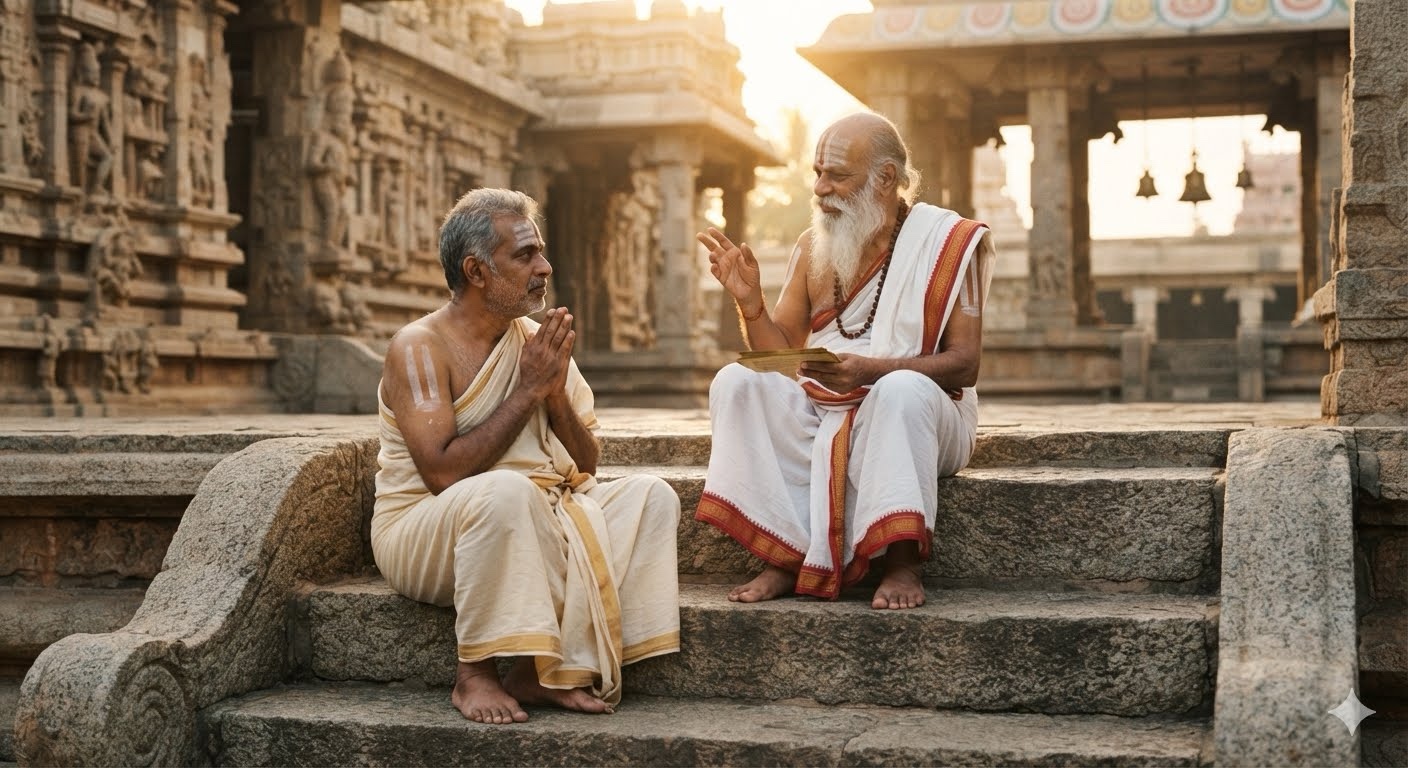
“Two Sri Vaishnava devotees in conversation on the temple steps at Srirangam—an elder Prapanna (70) teaching a devoted Bhāgavata (55) about Bhāgavata Śeṣatvam and naiccyānusandhānam. The paradox: the teacher is humble despite wisdom, the seeker is honored despite being ‘lower.’ Both are Bhagavān’s devotees, equally worthy of service. (Imaginary dialogue inspired by Vedānta Deśika’s Rahasya Traya Sāram)”
BG: Swami, I’ve been reading Deśika’s Rahasya Traya Sāram, especially the Adhikāra on Bhāgavata Śeṣatvam. It’s profound, but I’m struggling with something.
USV: (smiles) Go on. What’s troubling you?
BG: Well, Deśika says service to Bhāgavatas is as meritorious as service to Bhagavān Himself. I accept that. But then he also says a Prapanna must serve all Bhāgavatas—seniors, peers, even those who are… how do I say this… spiritually “less mature”?
USV: (nods slowly) Ah. You’re asking: why should a Prapanna serve someone who may be less advanced than themselves?
BG: Exactly! If the Prapanna has surrendered and has mokṣa guaranteed, and I’m still on Bhakti-yoga, still working toward that surrender—why should the Prapanna serve me? Shouldn’t it be the other way around?
USV: (leans forward) Good question. Let me ask you this: when Rāma accepted Śabari’s tasted berries, was Śabari spiritually “advanced”?
BG: No, she was a simple tribal woman, a mumukṣu. But Rāma saw her pure devotion.
USV: Precisely. Rāma didn’t see “low caste” or “unsophisticated devotion.” He saw His devotee. That’s Bhāgavata Śeṣatvam. Now, Deśika takes this further. He says: all Bhāgavatas are Bhagavān’s śarīra—His body. When you serve a Bhāgavata, you’re serving Bhagavān. Not because of the Bhāgavata’s “spiritual level,” but because they belong to Bhagavān.
BG: But Swami, what if that Bhāgavata is… difficult? Arrogant? Maybe even looks down on the Prapanna?
USV: (laughs softly) Ah, now we come to the real test. (pauses) Tell me—when Hanumān served the vanara army, did he discriminate? “Oh, this vanara is very devoted, I’ll serve him. That one is simple, I’ll ignore him”?
BG: No, Hanumān served all of them equally.
USV: There it is. Hanumān is a mahā-bhāgavata—arguably greater than all the vanaras combined. Yet he served them all with humility. Why? Because he saw only one thing: they were Rāma’s army. Their “spiritual level” didn’t matter. Their relationship to Rāma mattered.
BG: (thinking) So the Prapanna serves not based on the Bhāgavata’s merit, but based on…
USV: …based on the fact that they are Bhagavān’s śarīra. (leans in) Here’s the crucial point, swami: the moment a Prapanna starts thinking, “I am spiritually superior to this Bhāgavata, so I won’t serve them,” that Prapanna has lost naiccyānusandhānam. They’ve forgotten they are the lowest of all.
BG: That’s hard to hear, Swami. (pauses) So you’re saying the true test of naiccyānusandhānam is serving the Bhāgavata who seems “below” you?
USV: (nods firmly) Yes. It’s easy to serve an Ācārya—they’re respected, wise, inspiring. Of course you serve them. The test is: can you serve the Bhāgavata who is arrogant? Who questions your Prapatti? Who says, “Why did you surrender? Bhakti-yoga is superior!”?
BG: (winces) I’ve been that Bhāgavata, Swami. I’ve thought that about Prapannas.
USV: (smiles warmly) And yet here you are, asking sincere questions. That’s Bhagavān’s grace. Now tell me—if I, as a Prapanna, refused to serve you because you haven’t performed Prapatti yet… what would that say about my surrender?
BG: (after a long pause) It would say… you haven’t really surrendered. You’re still holding onto spiritual pride.
USV: Exactly. Deśika says in Śaraṇāgati Dīpikā: the Prapanna must see themselves as lower than all Bhāgavatas. Lower than the mumukṣu. Lower than the Bhakti-yogi. Lower than the one who questions them. Why? Because the Prapanna has received grace they didn’t deserve. That makes them indebted, not superior.
BG: But Swami, what about apacāram? What if the Bhāgavata offends the Prapanna?
USV: (becomes serious) Ah, now we touch something dangerous. Tell me—what happened to Durvāsa when he tried to harm Ambarīṣa?
BG: Sudarśana Cakra chased him. He had to flee to Brahmā, Śiva, everywhere—no one could protect him.
USV: And why? Ambarīṣa was a Prapanna. Durvāsa was a powerful sage with siddhis. By worldly standards, Durvāsa was “superior.” But Bhagavān protected Ambarīṣa and punished Durvāsa. Why?
BG: Because… apacāram to a Bhāgavata is worse than apacāram to Bhagavān Himself?
USV: (nods) Deśika is crystal clear on this. Bhagavān tolerates offenses to Himself—but not offenses to His devotees. Śiśupāla insulted Kṛṣṇa 100 times—Kṛṣṇa tolerated it. On the 101st offense to His devotees? Sudarśana Cakra. (pauses) So here’s the paradox: the Prapanna must serve all Bhāgavatas, even those who offend them. But if someone commits apacāram to a Prapanna, Bhagavān takes it personally.
BG: (shakes his head in wonder) That’s… that’s incredible. The Prapanna serves everyone, but Bhagavān protects the Prapanna.
USV: Yes. And here’s the beautiful part: when a Prapanna is offended, they don’t retaliate. They think, “This Bhāgavata is Bhagavān’s śarīra. Their offense is Bhagavān’s will. I am unworthy anyway.” That’s naiccyānusandhānam. Ambarīṣa didn’t curse Durvāsa back. He prayed for Durvāsa’s protection. That’s the attitude.
BG: (quietly) I’m starting to see why I haven’t performed Prapatti yet, Swami. It’s terrifying. It means giving up everything—even the pride of being “spiritually advanced.”
USV: (softly) Yes. It’s terrifying. (pauses) But tell me—when Kṛṣṇa stayed at Vidura’s house instead of the royal palace, why did He do that?
BG: Because Vidura’s heart was pure. He was a true devotee.
USV: And Vidura was a śūdra, politically weak, poor. The Pāṇḍavas were kṣatriya princes, devoted to Kṛṣṇa. By worldly standards, the Pāṇḍavas were “superior.” But Kṛṣṇa chose Vidura. Why?
BG: Because… Bhagavān doesn’t see “superior” or “inferior.” He sees only devotion.
USV: (eyes shining) And that’s exactly what the Prapanna must learn to see. Not “superior” or “inferior” Bhāgavatas. Only Bhagavān’s śarīra. All equally worthy of service. All equally loved. (pauses) When you can see that—really see it—Prapatti becomes natural. Not a “difficult decision,” but the only honest response.
BG: (long silence) Swami, I have one more question. Deśika says Bhāgavata Śeṣatvam = Bhagavat Śeṣatvam. Service to Bhāgavatas is service to Bhagavān. But… what if I’m not a Prapanna yet? Does this apply to me?
USV: (smiles) Ah, excellent question. Yes, it applies to you. In fact, especially to you. Why? Because serving Bhāgavatas—all Bhāgavatas, without discrimination—is the preparation for Prapatti. It destroys the spiritual ego that says, “I am better than others.” When that ego is gone, Prapatti becomes possible.
BG: So I should start practicing Bhāgavata Śeṣatvam now, before Prapatti?
USV: Yes. Serve all Bhāgavatas. The senior ones, the junior ones, the difficult ones. Don’t calculate: “What will I get from this?” Just serve. Because they are Bhagavān’s śarīra. When you can do that—without discrimination, without ego—Prapatti will feel like the most natural thing in the world.
BG: (after a long pause, quietly) Thank you, Swami. I think… I think I’ve been using “I’m not ready” as an excuse. Really, I’ve been afraid to let go.
USV: (places hand on BG’s shoulder) We all are, swami. We all are. But Bhagavān’s grace is greater than our fear. Remember Prahlāda? He served his fellow students even when they mocked him. He prayed for them. And eventually, they transformed. Your service to “difficult” Bhāgavatas may not show results immediately. But it’s planting seeds. Bhagavān will water them in His time.
BG: (stands up, bows) Thank you, Swami. This has helped more than I can say.
USV: (bows in return) No, thank you. You’ve asked the right questions. That’s Bhagavān’s grace. (pauses, smiling) And remember—one day, when you perform Prapatti, some “lesser” Bhāgavata will test your naiccyānusandhānam. And you’ll think of this conversation, and you’ll smile.
BG: (laughs) I hope I pass that test, Swami.
USV: (standing up, walking away) You will. Because you’re asking the right questions. And Bhagavān never abandons those who sincerely seek Him. (turns back) Oh, and one more thing—when you perform Prapatti, invite me. I’d like to be there to serve you on that day.
BG: (stunned) Swami, you would serve me on that day?
USV: (walking away, waves hand) Especially on that day, swami. Especially on that day.
(BG stands there for a long time, watching USV walk away, deep in thought. The temple bells ring in the distance.)
End of Dialogue
Author’s Note: This dialogue attempts to capture the essence of Deśika’s teachings on Bhāgavata Śeṣatvam from the Rahasya Traya Sāram, particularly:
The universality of service (all Bhāgavatas, without discrimination)
The test of naiccyānusandhānam (serving “lesser” Bhāgavatas)
The danger of apacāram (offenses to Bhāgavatas)
The paradox of the Prapanna (lowest of all, yet protected by Bhagavān)
The preparation for Prapatti (practicing Bhāgavata Śeṣatvam before surrender).
The characters are fictional, but the doctrine is drawn from Deśika’s Rahasya Traya Sāram, Śaraṇāgati Dīpikā, and the broader Sri Vaishnava tradition.
“The Indian diaspora built a protective financial shield around India, using software wealth to bankroll domestic consumption and stabilize the national treasury.
The Chinese diaspora, by contrast, acted as a technological spearhead, injecting Silicon Valley capital and IP directly into China’s veins to build a domestic industrial superpower that could eventually challenge the West.”
Many readers, unfortunately, missed the primary thesis: the real story isn’t about which country holds a more appealing cultural brand of “soft power”, but rather the economic and strategic purpose to which that soft power is deployed.
The discussion quickly degenerated into a defensive argument over whether the Indian diaspora has contributed as much to its homeland as its Chinese counterpart.
To move past emotional rhetoric, it was felt by more than one respondent, that we must look at the hard data to tell us the true story of the structural divergence between how India and China utilized their overseas talent over the last thirty years. It turns out, in fact, to be one of the most fascinating economic case studies of the modern era.
It is easy to assume that Chinese graduates returned home because their system was perfectly welcoming, while Indian elites stayed in the West purely out of patriotism-destroying frustration. The truth is far more complex. While Western-trained intellectuals in both nations faced near-identical walls of nepotism, academic corruption, and institutional gatekeeping, China successfully built an industrial escape hatch. By creating a high-stakes corporate tech machine, Beijing managed to weaponize the very irritation of its returnees, driving them to bypass local bureaucracy and conquer advanced industries.
Meanwhile, India’s laissez-faire approach left its brilliant minds stranded from its heavy industries, leaving them to watch global innovation from the comfort of the Western C-Suite while the homeland relied on a financial safety net of family remittances.
This is the untold story of numbers, systemic friction, and mismatched playbooks—and why that long-standing balance is finally beginning to shatter.
Part 1: The Great Campus Demographics Shift
For over a decade, Western higher education was fueled by an economic engine stamped Made in China. However, a quiet revolution has completely rewritten campus demographics in both the United States and the United Kingdom.
According to data from the Institute of International Education (IIE) Open Doors Reports, China was the undisputed leading sender of international students to the US from 2009 onward. But the lines on the graph have officially crossed.
Comparative 10-year enrollment data showcasing India’s recent surge.
In the 2023–2024 academic year, India overtook China, reaching an all-time high of 331,602 students compared to China’s 277,398. By the 2024–2025 academic year, the gap widened aggressively, with Indian enrollment climbing to 363,019 while China steadily declined to 265,919. A similar phenomenon played out in the UK, where visa issuances to Indian students spiked by 273% following the reintroduction of post-study work routes in 2021.
However, the raw numbers mask a critical structural disparity in what these students study:
The Indian Footprint: Indian students are heavily clustered in graduate programs, specifically STEM-focused Master’s degrees. They view Western education as a high-ROI professional stepping stone.
The Chinese Footprint: Chinese students maintain a much stronger balance at the undergraduate level, alongside specialized PhD research.
Part 2: The Returnees — Carrots, Sticks, and “Sea Turtles”
What happens after graduation day reveals the first major divergence. When looking at macro trends over the last three decades, China engineered a massive, cyclical “brain gain,” while India experienced a prolonged, compounding “brain drain.”
10-year post-graduation stay rates by nationality and degree level.
How did Beijing achieve an overall cumulative return rate where official state data estimates that nearly 80% to 87% of all Chinese students who studied abroad since the late 1970s eventually went home? It was a masterful deployment of a “carrot-and-stick” policy framework:
The Contractual Stick: For students funded by the state-run China Scholarship Council (CSC), the rules were ironclad. Scholars signed contracts requiring two domestic financial guarantors (usually parents). Staying abroad meant the state could legally freeze family assets, alongside imposing a mandatory 20% to 30% financial fine on top of tuition clawbacks.
The Golden Carrot: For the vast majority of self-funded students, Beijing realized physical coercion would fail. Instead, they built an economic magnet. They offered instant, fast-tracked Hukou (residency permits) in elite cities like Shanghai and Beijing for graduates of top-50 global universities. Returning entrepreneurs, colloquially dubbed “Hai Gui” (Sea Turtles), were gifted multi-year tax exemptions, duty-free imports, and free office space across 260+ dedicated Tech Parks.
India, operating as a laissez-faire democracy, lacked both the bureaucratic mechanisms to penalize those who left and the capital-intensive infrastructure to lure them back. Elite graduates from the IITs and IISc left with the state’s blessing, but they largely stayed away.
Part 3: The “Stay Diaspora” — Systemic Griping and the Deep-Tech Gap
Whenever the diaspora debate happens in Indian elite circles, a defensive refrain invariably emerges: India is simply not a welcoming or conducive environment for highly qualified returnees.
One prominent Indian author recently summarized this sentiment to me with a sharp historical edge:
“China has no varnashrama dharma. Dr. S. Chandrasekhar, the astrophysicist, came back to India and found he couldn’t get a job in any university. So did Nobel laureate Dr. Har Gobind Khorana. This is India for you.”
While these egregious historical examples of institutional rejection are deeply painful, the assumption that this griping is unique to India is factually incorrect. The exact same systemic frustration, nepotism, and bureaucratic friction plague China.
The Universal Grievance: “Guanxi” vs. Meritocracy
In China, returning Western-trained PhDs face a brutal corporate and academic rivalry against the “Tu Bie” (Ground Beetles)—local graduates who never left. Local faculties, built on years of insular political alliances and interpersonal networking (Guanxi), routinely freeze out returning Hai Gui.
Returnees frequently gripe about the suffocating, top-down hierarchy of Chinese institutions, where challenging a senior dean’s flawed data is a career-ending move. Furthermore, returning scientists heavily critique China’s academic “paper factories,” which mandate a exhausting volume of low-quality, plagiarized, or rushed publications over slow, breakthrough research.
The Differentiating Factor: Brute Industrial Scale
If the griping and systemic flaws are identical in both countries, why did the data yield such a disappointing result for India compared to China over the last 30 years?
The answer comes down to sovereign industrial capacity.
When a Chinese returnee or stay-diaspora member grew frustrated with academia, China had a hyper-capitalized, state-backed corporate engine waiting to absorb them. The Chinese diaspora did not just send money home; they transferred tacit hardware knowledge and venture capital. They cloned Silicon Valley. Returnees founded Baidu, built the infrastructure for Alibaba and Tencent, and established SMIC (China’s chip giant) using expertise harvested from Intel and Nvidia.
Across every critical sector, China stole a march on India:
Avant-Garde Tech: China dominates India in AI compute and semiconductor fabrication.
Heavy Industry: China used diaspora-led supply chains to become the global leader in commercial shipbuilding, high-speed rail fabrication, industrial robotics, precision machine tools, and commercial aeronautics (such as COMAC’s C919 airliner).
India’s stay diaspora, by contrast, achieved unprecedented heights in corporate management, leading global giants like Microsoft, Alphabet, and IBM. But back home, their contribution was locked into the services sector and private financial transfers.
Remittances build beautiful family homes and fund retail spending—pumping a historic $115+ billion annually into India to stabilize the rupee—but private remittances cannot build a $10 billion semiconductor cleanroom, a deep-water shipyard, or an aerospace testbed. India lacked the physical sandboxes for its diaspora to play in.
Part 4: The Resurgence — India’s Hard-Learned Pivot
The data leaves no room for ambiguity: India and China have approached global education through two entirely different economic playbooks. Neither strategy is inherently superior, but each has fundamentally reshaped the global talent landscape over the last three decades.
The Chinese Model: Targeted Brain Gain
China played a masterful internal game. By combining Western-educated “Hai Gui” (Sea Turtles) with aggressive state subsidies, tax breaks, and high-tech start-up parks, Beijing successfully engineered a massive “brain gain.” Returning graduates acted as tech translators, importing the Silicon Valley blueprint to build autonomous, domestic digital giants like Baidu, Tencent, and Alibaba. For China, sending students abroad was a cyclical investment meant to fuel internal innovation and rapid GDP growth.
The Indian Model: The Borderless Diaspora
India, by contrast, leveraged the power of a borderless network. Facing limited high-tech infrastructure at home in the 1990s and 2000s, India’s brightest minds stayed abroad. They smashed corporate glass ceilings to lead the world’s most powerful tech conglomerates—from Microsoft to Alphabet—while simultaneously building an unmatched global lobbying and investment apparatus. Instead of returning physically, this diaspora fuels India externally, making the nation the world’s undisputed leader in foreign remittances, pumping over $100 billion annually back into the domestic economy.
The Road Ahead
As we look at current campus shifts—with Indian student enrollment skyrocketing past a declining Chinese footprint in the US—the mechanics are shifting once again. With India’s domestic tech ecosystem now maturing into a powerhouse of its own, we may see the lines on our charts cross yet again.
For global universities, policymakers, and corporate recruiters, understanding this structural divergence is no longer optional. It is the key to tracking where the world’s next generation of innovation will be built.
However, concluding the story here would be a historical mistake. The disappointment of the last three decades has triggered a profound, aggressive policy overhaul in New Delhi. India has realized it cannot remain a global superpower on software code and remittances alone.
Today, we are witnessing sure signs of a structural resurgence, driven by an ecosystem that is finally building the physical sandboxes India long lacked:
The Semiconductor Awakening: Through the $10 billion India Semiconductor Mission (ISM), the government is bypassing private remittance models. By offering heavy capital subsidies, India is successfully drawing global chip assembly, testing, and fabrication units to states like Gujarat and Assam.
The Heavy Manufacturing Push: Backed by the Production Linked Incentive (PLI) schemes, India is aggressively capturing supply chains in electronics, defense manufacturing, drone robotics, and advanced chemistry cells.
Global Capability Centres (GCCs): The software pipeline has evolved. Over 1,600 GCCs now exist in India. These are no longer basic call centers; they are complex R&D hubs where diaspora networks are redirecting core engineering, AI architecture, and product design ownership straight to Bangalore, Hyderabad, and Pune.
A Maturing Startup Ecosystem: With over 100 tech unicorns, India’s domestic venture capital landscape is now sophisticated enough to allow a frustrated Silicon Valley engineer to return home and instantly find world-class institutional funding, bypassing traditional bureaucratic red tape.
The Final Verdict
Yesterday’s debate missed the forest for the trees. The Indian diaspora is not “less patriotic” than the Chinese diaspora, nor is Indian talent inherently less capable.
The data simply reveals that China built a state-driven industrial engine capable of absorbing hardware expertise, while India built a borderless service network. As India finally constructs its own heavy industrial and deep-tech foundations, the lines on the charts are poised to shift once more. The diaspora is no longer just sending money home—they are finally coming back to build.
This Op-Ed is dedicated to India on its Independence Day, 15 August 2026.
America and India possess immense “soft power”, but they deploy it toward different ends.
America has often used cultural attraction, political ideals, and diplomacy to legitimise global leadership and sustain a hegemonic order.
India, drawing upon its civilisational inheritance and the ideal of Vasudhaiva Kutumbakam—“the world is one family”—has more often used “soft power” to preserve strategic autonomy, build bridges, and maintain cordial relations across political and ideological divides.
India does not disprove Joseph Nye’s theory of soft power; it enlarges it by showing that attraction can serve not only hegemony, but also pluralism, autonomy, and relationship-building.
The power of attraction
In 1990, the American political scientist Joseph S. Nye introduced the concept of “soft power” into international-relations theory. He defined it as the ability to obtain desired outcomes through attraction and persuasion rather than coercion or payment.
Whereas hard power operates through military force, economic pressure, or inducements, soft power works by shaping what others want and persuading them that cooperation with the powerful actor is desirable.[1][2]
Nye identified three principal sources of a country’s soft power: its culture, its political values, and its foreignpolicy.
Culture generates attraction when it is admired by others; political values generate attraction when a country lives up to them at home and abroad; and foreign policy generates attraction when it is regarded as legitimate and morally authoritative.[1][3]
The concept was initially developed largely with the United States in mind. Yet the subsequent history of America and India shows that soft power can be used for very different purposes. America has often employed it to support global leadership and hegemony. India has more often used it to preserve strategic autonomy, cultivate cordial relationships, and maintain diplomatic access across ideological and geopolitical divides.
The contrast between the two countries does not disprove Nye’s theory. It enlarges it.
America’s cultural empire
For much of the twentieth century, America possessed an extraordinary reservoir of soft power. Hollywood, jazz, Coca-Cola, Disneyland, American universities, popular music, technology, and consumer culture projected an image of a dynamic, prosperous, open, and self-confident society.
American cultural products did more than entertain. They disseminated an entire way of life. They associated freedom with individual choice, prosperity with capitalism, and modernity with American innovation. The world was not merely consuming American films, music, food, and brands; it was being introduced to an American conception of what a desirable future might look like.
America’s political values added a second dimension to this cultural attraction. John F. Kennedy personified youth, idealism, eloquence, and public service. Martin Luther King Jr. gave the American promise of equality a universal moral language. The civil-rights movement, despite exposing the deep contradictions of American society, also demonstrated the capacity of the United States to criticise and reform itself.
This capacity for self-correction was an important source of American attraction. America’s claim to leadership was persuasive not because it was free of injustice, but because its institutions and citizens could publicly challenge injustice and demand reform.
The third element was foreign policy. The post-Second World War United States created alliances and institutions that were not based solely on force. The Marshall Plan, NATO, the United Nations system, educational exchange, international trade, and scientific cooperation helped make American leadership appear beneficial to much of the non-communist world.
American soft power was therefore not merely a decorative cultural asset. It helped establish a world order in which the United States occupied the central position.
Exceptionalism and hegemony
American soft power, however, was never politically neutral. It was closely connected with the idea of Americanexceptionalism: the belief that the United States possessed a distinctive historical mission and was uniquely qualified to lead the free world.
This gave American soft power both universal appeal and hegemonic purpose.
American ideals were presented as universal values, but they were also embodied in American institutions, American alliances, and American strategic interests. The United States did not merely invite other nations to admire its culture; it often asked them to accept an American-led political and economic order.
This was not always cynical. Many countries genuinely benefited from American security guarantees, investment, technology, education, and trade. Yet the distinction between universal values and American interests was often blurred. Washington’s interests could be represented as the interests of freedom itself.
The Reagan years illustrated this duality. Ronald Reagan greatly expanded American military power and adopted a confrontational policy toward the Soviet Union. Yet his language of freedom, democracy, and resistance to the “evil empire” gave American hard power an attractive ideological frame. The eventual collapse of the Soviet Union appeared to many people not merely as a military or economic defeat for Moscow but as the triumph of an entire social and political model.
In Reagan’s policy, hard power and soft power were not opposites. Military strength was made more effective by the appeal of the values in whose name it was exercised.
The erosion of American attraction
The decline of American soft power was not caused by a single president. It resulted from a growing gap between America’s professed values and its conduct.
The Vietnam War had already damaged American credibility. But the invasion of Iraq, Guantánamo Bay, torture, Abu Ghraib, extraordinary rendition, and the doctrine of preventive war produced a far deeper crisis.
The United States claimed to be spreading democracy and human rights while appearing to disregard international legitimacy and the rights of those under its control. The ongoing Iran War is the latest example of such a doctrine effectively camouflaging the exercise of hard power with the deceptive sheen of soft power ( i.e. making the world safe from a nuclear Iran, an “evil regional bully”).
The Iraq War demonstrated the limitations of hard power with particular clarity. American military force could remove Saddam Hussein’s regime, but it could not create political legitimacy, social trust, or a stable regional order. The war weakened the attraction of American leadership and intensified anti-Americanism.[4][5]
The problem was not simply that the war was unpopular. It was that American conduct seemed to contradict American rhetoric. When a country claims to represent liberty and lawful government, its own deviations from those standards carry an especially high reputational cost.
The Trump era today has only further deepened several of these weaknesses. A transactional approach to alliances, hostility toward multilateral institutions, admiration for authoritarian leaders, attacks on democratic norms, and the frequent use of threats and economic pressure has made American influence appear less principled and less predictable.
American culture did not disappear. Hollywood, technology, universities, music, entrepreneurship, and the English language continued to attract millions. What has significantly weakened is the ability of the American state to convert cultural admiration into diplomatic trust.
America may still be admired, but admiration for American society no longer automatically produces confidence in the American government.
India’s older civilisational attraction
India represents a different historical form of soft power.
Its cultural influence is not primarily the product of a modern nation-state. It draws upon a civilisational inheritance that includes Hindu philosophical traditions, Buddhism, Sanskrit literature, yoga, Ayurveda, mathematics, astronomy, temple culture, music, dance, textiles, cuisine, and systems of learning.
Indian ideas travelled across Asia through religious teachers, merchants, pilgrims, scholars, artists, and ruling elites. The spread of Indian religious and cultural forms into Southeast Asia occurred substantially without the direct political incorporation of those territories into an Indian empire. The idea of “Greater India” therefore refers less to territorial conquest than to the diffusion of cultural forms, intellectual traditions, religious practices, languages, and political symbols.[6]
Travellers such as Xuanzang, Ibn Battuta, and Marco Polo encountered a civilisation of immense diversity and intellectual vitality. They did not all travel to India for the same reason. Xuanzang was primarily a Buddhist pilgrim and scholar; Ibn Battuta was a jurist, diplomat, and traveller; Marco Polo belonged to the world of commerce and travel literature. Their accounts nevertheless testify to India’s importance as a centre of religion, scholarship, wealth, and cultural exchange.
India’s attraction should not be romanticised. Its history includes caste exclusion, social hierarchy, sectarian conflict, political violence, and discrimination. Yet Indian civilisation displayed a remarkable capacity to absorb, translate, and localise external influences. It did not merely preserve a fixed culture; it repeatedly transformed encounters with foreign peoples and ideas into new Indian forms.
Colonial fascination and exploitation
The British were fascinated by India’s antiquity, religious traditions, languages, arts, philosophical systems, and social diversity. But British admiration coexisted with conquest, extraction, racial hierarchy, and political domination.
This is an important distinction. A colonial power may admire the civilisation it rules while denying equality to its people. British Orientalism therefore cannot be treated simply as evidence of India’s soft power. It also functioned as an instrument of classification and imperial knowledge.
The British admired India and exploited India at the same time. They studied Indian texts while presenting Indians as incapable of self-government. They celebrated Indian diversity while governing through divisions. They praised Indian wealth while reorganising the economy for imperial benefit.
The episode demonstrates that cultural attraction does not automatically translate into political power. India could fascinate the British, yes, but without being able to prevent British domination.
Gandhi and the moral power of weakness
Post-colonial India inherited poverty, partition, communal trauma, economic weakness, and the institutional scars of colonial rule. It possessed little of the military or economic power associated with great-power status.
Yet India generated international influence through a distinctive combination of moral and political resources.
Mahatma Gandhi’s experiments with truth, non-violence, self-discipline, and resistance to injustice gave India a universal moral vocabulary. Gandhi’s influence extended far beyond India because he presented political struggle as an ethical act rather than merely a contest for power.
The Indian Constitution provided another source of attraction. In conditions of poverty and extraordinary diversity, India attempted to build a democratic republic based on universal citizenship, elections, fundamental rights, and pluralism. The success of this experiment was never complete, but the attempt itself commanded international respect.
India’s soft power during the early decades of independence therefore derived partly from the contrast between its material poverty and its normative ambition. A newly independent and impoverished country sought to build a democratic nation without abandoning its civilisational identity.
Nehru and non-alignment
Jawaharlal Nehru’s foreign policy translated this moral and civilisational capital into international diplomacy. Non-alignment allowed India to avoid subordination to either the American or Soviet bloc during the Cold War.
Non-alignment was not passive neutrality. It was a political doctrine of sovereignty, anti-colonialism, peaceful coexistence, and strategic independence. India sought to ensure that newly independent countries would not merely exchange European colonial rule for dependence on one of the two superpowers.
At the height of Cold War rivalry, the creation of a non-aligned bloc represented a significant normative contribution to international politics. India’s leadership gave smaller and newly decolonised countries a collective voice and a language with which to resist bloc politics.[7]
India’s influence was therefore not based on the ability to command. It rested upon the ability to articulate concerns that many other countries shared.
India today
Contemporary India continues to possess substantial soft-power resources. Yoga, Ayurveda, Indian cinema, Carnatic and Hindustani music, cuisine, spirituality, literature, the diaspora, technological achievement, democratic elections, and civilisational confidence all contribute to India’s global attraction.
India also uses soft power through diplomatic flexibility. It can cooperate with the United States while retaining defence ties with Russia; engage Israel and the Arab world simultaneously; participate in the Quad while maintaining relations with Iran; and speak to both the Global North and the Global South.
This is the contemporary form of strategic autonomy. India does not ask every country to share its ideology before establishing a relationship. It seeks diplomatic space across political systems and geopolitical camps.
The phrase Vasudhaiva Kutumbakam—“the world is one family”—provides the philosophical expression of this outlook. The principle comes from the Mahā Upaniṣad and has been invoked by Indian leaders, including Nehru and Narendra Modi, to describe India’s approach to the world. It was also reflected in the G20 formulation, “OneEarth, One Family, One Future.”[8][9]
The phrase is not merely a pious slogan. It expresses a different conception of international influence. India’s ideal is not necessarily to make the world Indian, but to make the world more receptive to India as a civilisational, plural, and independent actor.
Hard power and defensive power
India’s soft power should not be confused with the absence of hard power. India possesses a large military, nuclear capability, economic weight, strategic geography, and an expanding technological base.
Nor should India’s military history be equated with America’s wars of global intervention. India’s conflicts with China and Pakistan have overwhelmingly been connected with territorial defence, border disputes, or immediate security concerns. They have not formed part of a worldwide project to remake foreign societies or establish Indian hegemony across distant regions.
The 1971 intervention in East Pakistan involved humanitarian, refugee, and strategic considerations, and its history contains complexities. But it was not comparable to America’s discretionary wars of intervention in Vietnam, Iraq, or other theatres where military action was undertaken to reshape political orders far beyond the United States’ immediate territorial security.
India has used hard power, but its hard power has generally been geographically limited and strategically defensive. Its soft power, by contrast, has operated globally.
Two uses of attraction
The contrast between America and India can now be stated more precisely.
American soft power has usually been instrumental and order-building. It has helped attract countries into an American-led system and legitimise America’s position at its centre.
Indian soft power has usually been relational and autonomy-preserving. It has helped India maintain ties with countries of different ideologies, political systems, and levels of power.
America’s dominant political narrative has been exceptionalism: America is uniquely qualified to lead.
India’s corresponding civilisational narrative is VasudhaivaKutumbakam: the world is one family, and India can engage with many worlds without becoming subordinate to any one of them.
This contrast should not be made absolute. American soft power has also facilitated genuine cooperation and supplied international public goods. Indian soft power also serves national interests, including status, influence, economic opportunity, and diplomatic support.
Every successful foreign-policy ideal operates at two levels. It expresses values while also serving interests. The difference lies in the political purpose toward which attraction is directed.
Enlarging Nye’s theory
Joseph Nye’s theory explains the mechanism of soft power: influence through attraction, legitimacy, persuasion, and the shaping of preferences. The American and Indian experiences add a further question: what kind of international relationship does soft power seek to create?
In the American case, attraction has often helped organise a hierarchical order under American leadership. In the Indian case, attraction has more often helped preserve strategic autonomy and maintain relationships without demanding ideological conformity.
This distinction modifies the conventional understanding of soft power. Soft power need not always be an instrument of hegemony. It can also be a civilisational mode of relationship-building.
India therefore does not disprove Nye. It reveals that soft power can operate through a different moral and diplomatic grammar. It can draw upon civilisational memory, philosophical universalism, cultural plurality, and diplomatic restraint.
The most useful conclusion is not that India represents the triumph of soft power over hard power. Rather, India demonstrates that a civilisation may possess such deep and durable soft-power resources that they compensate, at least partly, for the limited hard power of the state.
America and India have therefore enlarged Nye’s theory in two different directions.
America showed how soft power could become the cultural and moral foundation of hegemony. India shows how soft power can become the basis of diplomatic autonomy, civilisational confidence, and relationship-building across political divides.
Hard power can compel obedience. Soft power can create willingness. But the purpose for which willingness is cultivated determines the character of the power itself.
In America, attraction has often been used to lead the world. In India, attraction has more often been used to remain open to the world.