Is a special mental attitude needed to study the “Sri Rahasya Traya Saram” of Sri Vedanta Desika (1268-1368 CE)?

Swami Sri Vedanta Desika’s monumental treatise on Sri Vaishnava Siddhanthic soteriology, the Srimad Rahasyatraya Sāram is a uniquely layered work that is, at once, (a) a philosophical treatise, (b) a theological manual, and (c) a catechetical‑homiletic guide.

A disciple undergoing a program of serious study of this text even under the guidance and tutoring of a “KAALAPSHEPA- Acharya” will often midway find himself or herself asking this question: How much of Sri Rahasya Traya Saaram (RTS) is Philosophical inquiry, how much is Theological postulates and how much is Catechismal homily?

The question is likely to crop up because Rahasyatraya Sāram is a complex philosophical‑theological‑homiletic hybrid work where the 3 motifs of philosophical vidyā, theological niścaya, and its catechism on kaimkaryam are not compartments, but interwoven strands of nitya‑kainkarya‑prāpti‑oriented mumuksu‑śikṣā i.e. the soteriology of Sri Vaishnavism.

As a disciple begins to follow the lectures (in a year-long or perhaps even longer “KAALAPSHEPAM” program of study!) delivered by his Acharya, he might often find his mind boggling a bit while trying to distinguish — in each of the 32 Adhikaras or Chapters in the text—Philosophy, Soteriology and Ethical homily as each very often overlaps and segues into one another.

So, there can be no categorical answer to the question on how much of Sri Rahasya Traya Saaram is Philosophy, how much is Theological and how much of it is Catechism. Its “proportion” is not mechanically divisible, but yes, schematically, we may say it blends the three in the following ways:

1. Philosophical inquiry (≈ 40–50%)
A large part of Rahasyatraya Sāram mounts systematic philosophical entries into:
• The nature of jīva, Īśvara, and prakṛti;
• The status of nitya‑kainkaryam as svarūpa‑dharma of the jīva;
• The logic of saranagati, prapatti, and upāyas;
• The viveka (discriminating) between śarīra and śarīrin (body and soul), and between karma‑yoga and prapatti as mokṣa‑upāyas.

These segments function like a compact Vedānta‑śāstra: they proceed by anumāna (inference), upanishadic quotations, and Śrī Ramanuja‑ siddhānta‑style reasoning, rather than mere edification.

So, philosophical inquiry is not just occasional aside, but the work’s backbone—roughly half its density in several adhikāras.

2. Theological postulates (≈ 30–40%)
Beside purely philosophical argument, Rahasyatraya Sāram carries doctrinal‑theological commitments such as:
• The avinābhāva (inseparable dependence) of jīva upon Bhagavān;
• The nitya‑kainkaryam of the mukthas in Śrī Vaikuṇṭa;
• The supremacy of prapatti as the mokṣa‑upāya in Kali Yuga;
• The taṭastha‑svarūpa of the jīva as śeṣa to Sveśa (Bhagavān).

These are not “open questions” entertained by the text; they are presupposed truths, articulated with bhakti‑tone and Acharyavākya support, but are not bracketed for neutral dialectic.

Thus, theological postulates are woven through the same adhikāras as the philosophy, yet stand out where Deśika shifts from anvaya‑viveka into authoritative assertions of Śrī‑sampradāya‑vimarśa.

3. Catechismal homily (≈ 20–30%)
Scattered through the KAALAPSHEPAM ‑style readings of Rahasyatraya Sāram, the work also is interspersed with catechetical homily:
• Questions are posed in simple, inquisitive form, then answered in pedagogical order;
• Certain adhikāras function as lessons for mumuksus:
• “How to practise saranagati?”
• “What is the content of ātma‑svarūpa‑jñāna?”
• “What attitude should one cultivate towards bhakti‑yoga and karma‑yoga once prapatti is taken?”

In such parts, Deśika is not primarily refuting rival systems or constructing abstract arguments; he is guiding, exhorting, and consoling the sādhaka—the tone is homiletic catechism, not speculative seminar.

Synthetic picture

So, schematically, the following picture of this soteriological text emerges:


• Philosophical inquiry ↔ about half the work, in the strict sense of anvaya‑viveka and upāya‑nirṇaya;
• Theological postulates ↔ a third, where the Śrī‑siddhānta framework is affirmed and stabilised;
• Catechismal homily ↔ a quarter or less, but highly salient in the oral‑KAALAPSHEPAM mode, where the ācārya addresses the sishya directly.

In practice, these three modes overlap in the same padas: a single śloka can state a doctrine, argue for it, and exhort the śravaṇa‑śishya to internalise it.

The 50:30:20 Ratio

If one were to apply the 50:30:20 ratio of philosophy:theology:catechism to each of the 32 Adhikaras in the Rahasya Traya Sara, what picture emerges ?

Applying the rough 50% philosophy : 30% theology : 20% catechetical‑homiletic profile to Rahasyatraya Sāram does not yield a uniform “32× identical slices”, but a structured, shifting pattern across the 32 adhikāras, in line with the Sri Vaishnava understanding of the work as both Siddhānta‑grantha and mumuksu‑śikṣā.

Below is a qualitative picture of how the “50–30–20” balance might sit in three broad blocs of adhikāras.
  1. Adhikāras 1–10: “Foundational Jñāna” bloc
    These adhikāras lay the epistemological‑ontological groundwork:
    • Jīva‑svarūpa, Īśvara‑svarūpa, śarīra‑śarīrin‑viveka, svarūpa‑dharma of the jīva as śeṣa, dharma‑bhūta‑jñāna, pañcapratiṣedha‑type negations, etc.
    Proportion:
    • Philosophy (≈60–65%)
    Heavy on anvaya‑viveka, anumāna, upanishadic corroboration, and logical distinction between jīva and prakṛti, Īśvara and jīva.
    • Theology (≈25–30%)
    Irāmānuja‑siddhānta‑style affirmations (e.g., nitya‑śeṣatva, prakṛti‑paratantra‑jīva, Bhagavat‑kriyā‑mātra‑siddhi of mokṣa) are assumed, not argued from scratch.
    • Catechism / homily (≈10–15%)
    Occasional “Śravaṇa‑śiṣya, do you understand?”‑type turns, brief exhortations to vivekam and niścayam, but not the dominant mode.
So this bloc is philosophy‑heavy, with theology stabilising the siddhānta and a minor catechetical undercurrent.
  1. Adhikāras 11–22: “Prapatti and Upāya” bloc
    These are the core prapatti‑section: śaraṇāgati, svatantra‑prapatti, anukūlya‑sankalpa, pratikūlya‑varjanam, mahāviśvāsam, goptr̥tva‑varana, kārpaṇyam, ātma‑niścayam, karma‑jñāna‑bhakti as upāya versus prapatti in Kali‑yuga, deha‑pradhāna‑bhāva‑rejection, etc.
    Proportion:
    • Philosophy (≈50–55%)
    Reasoning‑based discrimination between upāyas; logical unpacking of each aṅga of prapatti; yukti‑based demonstration that prapatti is the mokṣa‑upāya in Kali‑yuga.
    • Theology (≈30–35%)
    Siddhāntic affirmations (e.g., prapatti as the highest upāya, prārabdha‑kṣaya by kripā, nitya‑kainkaryam as mokṣa‑phalam) are frequently restated, not just implied.
    • Catechism / homily (≈15–20%)
    Direct address to the mumuksu:
    • “How should a prapannan live?”
    • “What is the relationship between bhakti and prapatti?”
    • Short, moralising summaries, inward “self‑examination”‑like turns.
Here, the three modes begin to balance more evenly, leaning slightly into catechetical pedagogy without losing the backbone of anvaya‑viveka.
  1. Adhikāras 23–32: “Nitya‑kainkaryam and Visiṣṭādvaita‑ethos” bloc
    These adhikāras focus on the phalam of mokṣa:
    • Nitya‑kainkarya‑prāpti, nitya‑sūris, muktas serving Bhagavān in Śrī Vaikuṇṭa;
    • Bhagavat‑kaimkaryam as svarūpa‑dharma;
    • Sveśa‑seśa relation crystallised;
    •Ahamkāra‑mamakāra‑falling‑away as jīva realises its true will is in concord with Divine Will.
    Proportion:
    • Philosophy (≈40–45%)
    Conceptual‑logic continues (e.g., why kainkaryam is not brute labour but svarūpa), but the style is more illustrative and siddhānta‑consolidating than dialectical.
    • Theology (≈35–40%)
    Strong, repeated doctrinal affirmations about nitya‑sūris, nitya‑kainkaryam, Viśiṣṭādvaita‑anthem, Sriya‑pāti‑sovereignty;
    here theology thickens around a devotional‑thematic core.
    • Catechism / homily (≈20–25%)
    Very homiletic turns:
    • “Imagine the muktas in Vaikuṇṭa…”
    • “You, mumuksu, aspire not for mere bliss, but for nitya‑kainkaryam…”
    • Edifying comparisons (e.g., contrast with Advaitic or Miltonic‑pride‑ideals).
So this bloc tilts slightly toward theology and homily, while still resting on philosophical structure.

Overall picture across 32 adhikāra


• Philosophy (≈50%):
Strongest in 1–10, present throughout, but less “dramatically dialectical” toward the end; it underwrites the entire work.


• Theology (≈30%):
Thin‑threaded in 1–10, thickens in 11–22, and becomes ethos‑rich in 23–32, where nitya‑kainkaryam and Sri Vaishnava identity‑motifs dominate.


• Catechism / homily (≈20%):
Marginal in the early adhikāras, grows into a clear pedagogical‑pastoral voice in the prapatti‑section, and reaches its most edificatory register in the nitya‑kainkaryam‑closing adhikāras.

So, if the 50–30–20 model is transposed to each of the 32 adhikāras, the result is not uniform, but a gradient:


• From pure‑siddhānta (1–10)
→ to prapatti‑reasoned‑catechism (11–22)
→ to nitya‑kainkaryam‑theology with homily (23–32)

The whole remains a philosophical‑theological‑homiletic triangle, with the Sri Vaishnava ideal of nitya‑kainkarya‑prāpti as the telos that harmonises all three modes.

*******

Because of the complex triangularity of this Desika work, the ability to undergo traditional KAALAPSHEPAM of the Rahasya Traya Saram demands a certain special discipline of mental attitude on the sishya. Not everyone can be considered fit to be imparted the lessons from this profound work of Sri Vaishnava soteriology. Even if many are called and admitted into the KAALAPSHEPAM, few may be finally chosen and regarded as having all the requisites for its proper understanding.

Why so L? Because Rahasyatraya Sāram’s philosophical‑theological‑homiletic triangularity appeals most fully to the Sri Vaishnava mumuksu mind only when he or she is:


• Philosophically awake (intellectually curious, seeking anvaya‑viveka, upāya‑nirṇaya, and jīva‑Īśvara‑ontology),
• Theologically attached (emotionally rooted in Bhagavat‑kaimkaryam, nitya‑sūris, and Sriya‑pāti‑siddhānta),
• Homiletically receptive (ready to receive ācārya‑upadeśa as personal guidance, not just abstract doctrine).

So, in practice, RTS speaks most deeply to the mind of the śravaṇa‑śiṣya who is already oriented or attuned toward Bhagavān, but wishes to understand prapatti, nitya‑kainkaryam, and svarūpa‑siddhi with clarity (philosophy), warmth (theology), and consoling instruction (homily).

Sudarshan Madabushi

“Better to reign in Hell than to serve in Heaven” versus the Sri Vaishnava Ideal of “Nitya Kainkarya Praapthi”

Understanding Sri Vaishnava Soteriology with the aid of Milton’s ‘Paradise Lost’.


(A) A comparative glance at moksha and salvation in the three Vedānta schools, Christianity, and Islam

Across traditions, liberation or salvation — moksha — is conceived as the final release from bondage, suffering, and separation from the divine. But the nature of that release differs remarkably in ontology, soteriology, and imagery.

  • Advaita Vedānta (Śaṅkara):
    Mokṣa is the realisation that the individual jīva is not different from nirguṇa‑nirviśeṣa Brahman. The ego, the sense of “I‑ness” and “mine‑ness”, is sublated; what remains is pure, attribute‑less, non‑dual consciousness. The jīva‑identity is not eternally preserved; it dissolves into Brahman‑identity. There is no nitya‑kainkaryam; there is only māyā‑removed unity.
  • Dvaita Vedānta (Madhva):
    Mokṣa is eternal enjoyment (bhoga) in the presence of Viṣṇu, with jīvas eternally distinct from God and from one another. The saved soul enjoys bhagavat‑prasāda (divine grace) in Vaikuṇṭa‑like spheres, but its svarūpa is not defined primarily as service; it is described more as bhoga‑oriented beatitude under God’s supremacy.
  • Viśiṣṭādvaita / Rāmānuja‑siddhānta (Sri Vaishnava):
    Mokṣa is nitya‑kainkarya‑prāpti: the nitya‑śeṣa‑jīva attains eternal, uninterrupted service (kainkaryam) to Bhagavān in Śrī Vaikuṇṭa. Individual svarūpa is not annihilated; it is fulfilledthrough sveśa‑kainkaryam. The will of the jīva does not die; it is harmonised with Bhagavat‑icchā.
  • Christian salvation (in classical theism):
    Salvation is deliverance from sin and separation, culminating in the beatific vision—eternal communion with God in heaven. The redeemed enjoy divine presence, glory, and love. Crucially, there is a personal relation between Creator and creature, yet this relation is rarely framed in terms of eternal service as the core definition of the liberated soul’s svarūpa.
  • Islamic salvation (Jannah):
    For the mu’min, salvation results in Jannah, an eternal paradise of bliss, pleasure, and divine reward under Allah’s sovereignty. The ‘abd (slave) posture is central—submission (islām) and obedience are the way; Jannah is the end. But the end‑state is described more in terms of bhoga (pleasures, gardens, rivers) than as the eternal kainkaryam of the ‘abd.

In summary, the three Vedāntic schools all affirm mokṣa as final release; but Advaita sublates self‑identity, Dvaita keeps bhogam central, and Rāmānuja makes eternal servitude‑in‑love the svarūpa‑phalam of the jīva. Theistic Abrahamic traditions, while preserving personal relation and beatitude, do not systematically articulate nitya‑kainkaryamas the metaphysical core of the redeemed self.


(B) “Better to reign in Hell than to serve in Heaven” vs. Sri Vaishnava nitya‑kainkarya‑prāpti

In Paradise Lost, Milton has Satan utter the famous line: “Better to reign in Hell than to serve in Heaven.”

Satan’s sentiment is this:
Autonomy is the highest good; even if it means dwelling in darkness and suffering, ruling oneself is preferable to submitting, even in light and bliss. To serve in Heaven (in eternal kainkaryam) is, for him, degradation; to reign in Hell, however wretched, is sovereignty.

This is the tragic expression of unyielding ahamkāra:
the self erects svatantra‑bhāva—“I am my own master”—as the supreme value, and refuses to recognise that true freedom may consist in ability‑to‑serve, not ability‑to‑command.

In sharp contrast, Sri Vaishnava theology holds that:

  • The ātma’s svarūpa is nitya‑śeṣa, nitya‑dāsa;
  • Mokṣa is nitya‑kainkarya‑prāpti, i.e., nitya‑bhakti‑kainkaryam in Śrī Vaikuṇṭa at the pādāmbuja of Sriya‑pāti.

Here, service is not degradation; it is:

  • The natural expression of the ātma’s dependence on Sveśa.
  • The acme of svarūpa‑siddhi*, where the jīva’s will, once lost in moha, is recovered in sveśa‑anuguṇatva.

So, where Satan disdains service even in Heaven, the Sri Vaishnava sādhaka prays:

“Let me not attain nirviśeṣa impersonality, nor mere bhoga in God’s presence,
but nitya‑bhakti‑kainkaryam at Your feet.”

The Miltonic Satan’s pride reveals a soul that cannot conceive service as freedom; the Sri Vaishnava vision asserts that only in śeṣatva—only in nitya‑kainkaryam—does the ātma find its true sovereignty.


(C) Realisation of congruence between Divine Will and Individual Will

There is a further insight to be appreciated here —that “nitya‑kainkarya‑prāpti” signifies ātma‑svarūpa‑jñāna fructifying as the soul’s realisation of congruence between Divine Will and its own will. This insight captures the metaphysical grace of Rāmānuja’s Siddhantham with remarkable clarity.

  • As long as the ātma imagines its will as separate from Bhagavat‑icchā,
    it lives in the delusion that servitude = humiliation, and independence = freedom.
    This is the Miltonic morbidity: preferring self‑ruled Hell to God‑ruled Heaven.
  • But when ātma‑svarūpa‑jñāna matures, the jīva realises that its true will is not against God’s will,
    but is its very śeṣa‑expression of that will.
    Ahamkāra and mamakāra—“I am the agent; I am the enjoyer”—fall away;
    the individual will is not abolished, but sublimated into Divine Will, as nitya‑kainkaryam.

Thus, nitya‑kainkarya‑prāpti is not a loss of self‑hood, but its fulfillment under Sveśa.
Where Milton’s Satan cries, “Better to reign in Hell than to serve in Heaven,” the Sri Vaishnava response is:

“Better to serve in Heaven than to reign in self‑delusion—
for only in nitya‑kainkaryam are the individual will and Divine Will in true congruence,
and the ātma knows itself, at last, as sveśa‑kainkāri. In that service, not in self‑rule, lies mokṣa.”

In this way, the Sri Vaishnava doctrine of nitya‑kainkarya‑prāpti turns the Milton paradox inside out:
Hell is not the arena of glorious autonomy; it is the place where ahamkāra mistakes Hell‑reign for freedom.
Heaven is not the prison of servitude; it is the nitya‑kainkarya of the nitya‑śeṣa—where the will is finally at home.

(This blogpost was conceived and written during the course of my attending a “kalakshepam” on Sri Vedanta Desika’s soteriology masterpiece “Sri Rahasya Traya Saram”)

Sudarshan Madabushi

There can’t be a disenfranchised population of 66 million in the world’s largest democracy: What the Supreme Court can do about it.

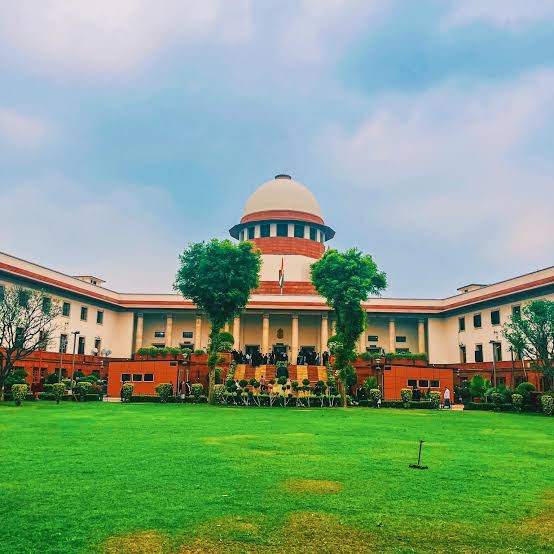
The Supreme Court of India


The Special Intensive Revision (SIR) of electoral rolls under the Election Commission of India has led to the removal of roughly 6.56 crore names from the draft electoral rolls across 12 states and Union Territories.

While the Commission frames this as a technical cleanup—striking off duplicate entries, non‑citizens, and those restored as deceased—the human reality is stark: a cohort larger than the population of many mid‑sized countries now finds itself, at least in the eyes of the State, on the wrong side of the voter list. If even a fraction of these people are eligible Indian citizens or residents, we are talking about a disenfranchised population of the order of 66 million in the world’s largest democracy.

How we got here
The SIR process, undertaken under the Representation of the People Act, 1950, and the Registration of Electors Rules, 1960, is meant to keep the rolls clean and accurate. Names are culled on grounds such as duplicate entries, non‑citizenship, or absence from residence. But the procedure is asymmetric: the State has a statutory obligation to follow due process, while the individual bears the onus of restoration. Once deleted, it is up to the affected person to file claims (Form 6), objections, or appeals within tight windows, often with no guarantee of speedy resolution.


There is no hard‑coded statutory rule that, after a fixed period, a deleted person is automatically re‑enrolled. The law insists only that the deletion itself be fair; it does not require that the system be so structured that restoration is inevitable.

In practice, that means the bureaucracy can render the enrolment process effectively endless, with opaque timelines, missing documents, and shifting standards for proof of citizenship or residence. When this happens to a few people, it may be a procedural glitch; when it happens to tens of millions, it becomes a structural risk to democracy itself.


The constitutional stakes
The right to vote is not listed as a fundamental right in the Constitution, but it is not a mere administrative privilege either. Articles 325 and 326, read with the Courts’ consistent emphasis on free and fair elections, place the right to vote at the core of democratic legitimacy.

The Supreme Court has repeatedly held that disfranchisement must be both justified and reversible, and that arbitrary or opaque exclusions from the electoral roll violate equality and due process.


The problem with the current SIR‑driven deletions is not just that names are removed, but that the architecture of restoration is weak. If the State can, through bureaucratic inertia, turn a time‑bound statutory exercise into an open‑ended loop in which millions of eligible citizens remain outside the rolls for years, the result is not mere administrative inefficiency—it is a de facto creation of a large, disenfranchised stratum within Indian society. That is hard to reconcile with the constitutional image of an “adult‑suffrage democracy” in which every citizen has, at least in principle, an equal voice.


What the Supreme Court can still do
The good news is that the Supreme Court is not helpless. Under its Article 32 and Article 226 powers, the Court can, either on a writ petition or suo moto, intervene to ensure that the technical demands of electoral integrity do not swallow the democratic imperative of inclusion.


There are at least two powerful paths the Court can take:

Direct the Election Commission to frame a time‑bound restoration regime. The Court can require the ECI to prescribe that, if a person deleted in a mass SIR exercise is not finally proven ineligible within a specified period (say, six months or one revision cycle), they must be automatically or presumptively re‑enrolled, subject to later challenge if new evidence emerges. Such a rule would not rewrite the Representation of the People Act; it would flesh out due process and natural justice in a way consistent with Articles 14, 21, and the “basic structure” of democracy.

Build a hard‑coded automatic‑re‑enrolment safeguard. If voluminous evidence shows that endless bureaucratic delays are turning electoral‑roll revisions into a de facto disfranchising machine for the poor, the Court can go further: it can read in a constitutional‑procedural safeguard into the existing framework. That safeguard could be that repeated deletion without a clear, recorded, and time‑bound finality triggers a presumption of eligibility and a right to restoration, unless the State can demonstrate, within a strict deadline, compelling reasons for permanent exclusion.

The Court has already shown willingness to modify timelines and procedures in SIR‑related matters, including extending revision windows and insisting on transparency. The step from “fixing timelines” to “insulating citizens from permanent marginalisation” is not a doctrinal leap; it is a constitutional‑ethical imperative.

A democracy that proudly calls itself the “largest” cannot credibly tolerate a disenfranchised population of 66 million, even if they are left off the rolls by technicalities and bureaucratic inertia.


A necessary judicial nudge
The Government and the Election Commission can insist that no citizenship rights are being formally revoked, only voting rights in a particular constituency. But in a country where the Voter ID is woven into welfare entitlements, ration cards, and civic identity, deletion from the electoral roll is often the first step toward a broader erosion of dignity and voice.

The Supreme Court now has a historic opportunity to ensure that technical integrity and inclusive democracy travel in the same direction. It can, and should, insist that there be no permanent, invisible, disfranchised class in India’s electoral architecture. By directing the ECI to examine and announce a time‑bound automatic or near‑automatic re‑enrolment rule, the Court can convert a bureaucratic exercise into a constitutional safeguard—a reminder that, in the world’s largest democracy, every citizen has the right to be counted, not just to be deleted.

Sudarshan Madabushi

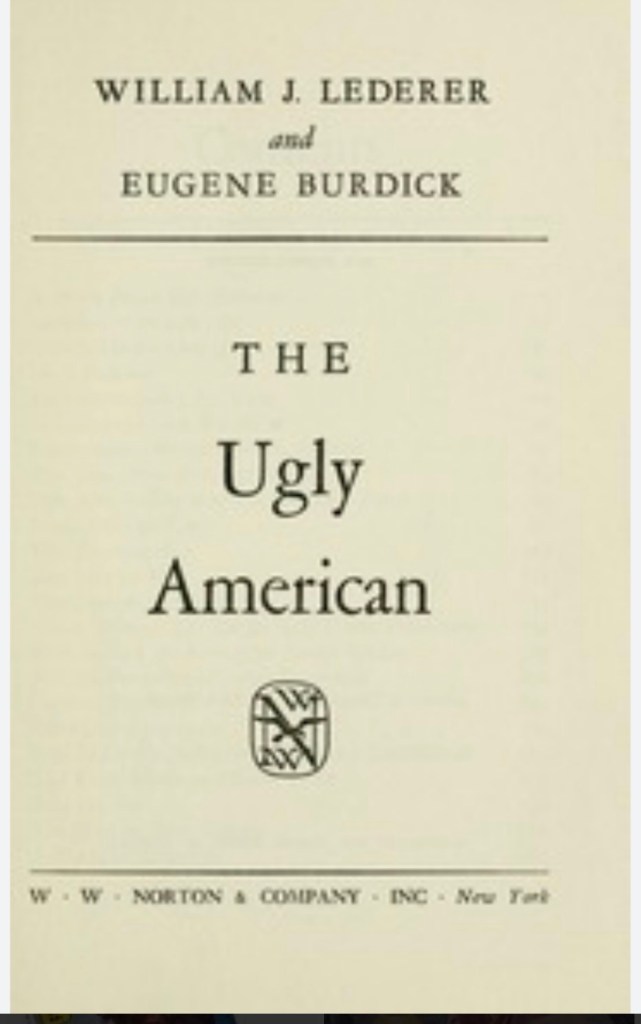
“The Ugly American”: Why the U.S.A. casts such a long, baleful shadow over places like Russia, Venezuela, Iran, and Iraq

Natural‑Resource “Times‑Cover” of Debt: Strategic Collateral and the Logic of American Imperial Reach (“The Ugly American”)

*********

1. An Unusual Metric, Not an Air‑Fairy Abstraction


In public‑debate and economic commentary, the focus typically falls on debt‑to‑GDP ratios, fiscal deficits, and interest‑service burdens when assessing sovereign solvency. Rarely do analysts treat natural‑resource wealth as a long‑term, high‑value collateral base underpinning a country’s ability to service its liabilities. Yet one can construct a revealing, if unconventional metric :

{Resource‑to‑Debt “times‑cover”} = {Total estimated value of a country’s natural resources \{Total government debt (USD)}}

This ratio approximates how many times a country’s own resource stock could, in principle, cover its existing debt—if those resources were fully monetized at current market prices.

It is not a formal accounting standard, but it exposes a deeply material reality: some states enjoy an enormous collateral‑density relative to their debt, while others—especially the principal global‑financial centres —sit far closer to the edge.

As financial‑geopolitical analyst Alex Krainer has argued in recent interviews and podcasts, resource‑rich countries effectively turn their labor and natural resources into collateral for external financial powers. In his conversation with Andy Millette on the Natural Resource Stocks podcast (January 30, 2026), Krainer notes that “sometimes they genuinely want to conquer other nations…resources…because in that way they turn that nation’s labor and resources into their own collateral—which is an amazing way of leveraging those assets.” This framing implicitly points to a logic in which the relative scale of a state’s resource base versus its liabilities matters for power and leverage.

In his later interview “Rise of the Oligarchy & the Risk of Civil War” (January 27, 2026), Krainer expands this idea into the broader machinery of global finance, emphasizing how commodity‑rich, labor‑intensive economies are moulded to serve external capital flows, with their resources effectively pledged as implicitly securitized collateral.

Now, my own “times‑cover” metric is thus not an arbitrary abstraction; it is a stylized scalar expression of the collateral‑density that Krainer is already describing in qualitative, geopolitical terms.

2. Strategic Collateral Assets and Global Financial Hegemony

In a world still anchored in the dollar‑dollar‑Treasury complex, the “collateral” backing global credit extends far beyond physical land or gold. It also includes the stability of energy and commodity flows, the accessibility of mineral supply chains, and the political security of resource‑producing nodes.

Countries with very high resource‑to‑debt “times‑cover” ratios—that is, where resource value is many times greater than their national debt—are, in effect, custodians of strategic collateral assets. As Krainer’s commentary suggests, such rankings help expose how a small group of resource‑rich states sits at the fulcrum of global financial and geopolitical leverage, even if their formal GDP or financial sectors appear modest or middling by comparison.


• Their resources can underwrite domestic spending, sovereign‑wealth funds, and foreign‑exchange reserves.


• Control or influence over these assets can shape pricing, sanctions resilience, and alternatives to the dollar system.


• From the perspective of a heavily indebted hegemon like the United States, such countries are not just economic partners but potential choke points or rival sources of collateral power.


This transforms the classic “resource curse” narrative into a geopolitical‑financial story: access to, or containment of, high‑collateral countries becomes central to preserving the financial‑stability of the global‑financial center.

3. Countries Ranked by Resource‑to‑Debt “Times‑Cover”


Using rough estimates of total natural‑resource value and total government debt (in USD), the following countries stand out in terms of how many times their resource base could, in theory, cover their debt.

These figures are indicative, not exact book‑value numbers, but they are broadly consistent with the kind of resource‑ranking picture Krainer sketches in his interviews.

Russia
• Resource value: ~75 trillion USD
• Government debt: ~420 billion USD
• Times‑cover: ≈ 175 times the debt

Saudi Arabia
• Resource value: ~34–35 trillion USD
• Government debt: ~410 billion USD
• Times‑cover: ≈ 80–85 times the debt

Iran
• Resource value: ~25–30 trillion USD
• Government debt: ~20–160 billion USD (range)
• Times‑cover: ≈ 200–1,500 times the debt

Iraq
• Resource value: ~16 trillion USD
• Government debt: ~10–50 billion USD
• Times‑cover: ≈ 300–1,600 times the debt

Venezuela
• Resource value: ~14 trillion USD
• Government debt: ~100–200 billion USD (including defaulted claims)
• Times‑cover: ≈ 70–140 times the debt

Canada
• Resource value: ~33 trillion USD
• Government debt: ~3.0 trillion USD
• Times‑cover: ≈ 11 times the debt

Brazil
• Resource value: ~20–22 trillion USD
• Government debt: ~1.6 trillion USD
• Times‑cover: ≈ 12–14 times the debt

Australia
• Resource value: ~20 trillion USD
• Government debt: ~600 billion USD
• Times‑cover: ≈ 30–35 times the debt

China
• Resource value: ~23–25 trillion USD
• Central‑government debt: ~1.6–1.7 trillion USD
• Times‑cover: ≈ 14–16 times (if one restricts to central‑govt debt only)

United States
• Resource value: ~45 trillion USD
• Government debt: ~39 trillion USD
• Times‑cover: ≈ 1.2 times the debt

India
• Resource value: ~5–10 trillion USD (≈ 7.5 trillion mid‑range)
• Government debt: ~1.8–2.0 trillion USD
• Times‑cover: ≈ 4–5 times the debt

In this stylized ranking, the United States appears uniquely precarious: its resource base barely exceeds its debt, while Russia, Saudi Arabia, Iran, Iraq, and Venezuela sit far above with “times‑cover” ratios of 70 to over 1,000 times.

This pattern is broadly consistent with the kind of resource‑ranking picture Krainer has highlighted, where a small group of petro‑ and mineral‑rich states emerges as disproportionately pivotal in the global collateral‑landscape.

4. The American Predicament and the Search for “Strategic Collateral”


The United States cannot realistically liquidate its own resource base to pay down its debt; nor does it enjoy the implicit petrostate‑style collateral cushion that underpins Russia, Iran, Iraq, or Saudi Arabia. Instead, its financial stability rests on:


• The dollar’s role as global reserve currency and Treasury bonds as the world’s premier “safe asset.”


• The affordability and stability of global energy prices, especially oil and gas.


• The openness of global commodity and financial markets to U.S.‑aligned capital.


From this perspective, any recalcitrant country that can disrupt, weaponise, or redirect its resource flows—especially oil, gas, and critical minerals—becomes a strategic vulnerability for the U.S. financial‑geopolitical order. As Krainer has also suggested, the geopolitical salience of these states is overdetermined by the sheer scale of their natural‑resource wealth relative to their liabilities, which makes them natural focal points or targets for coercion, sanctions, and containment.


Countries such as Russia, Venezuela, Iran, and Iraq, with their very high resource‑to‑debt “times‑cover”, are not simply “targets of greed” but nodes of rival collateral power. They can:


• Resist sanctions by riding out short‑term financial pain on the back of long‑term resource rents.


• Use energy exports or sovereign‑wealth funds to build alternative financial networks and partnerships.


• In the long run, potentially erode the exorbitant privilege of the dollar by shifting to non‑dollar pricing and settlements.

5. American Foreign Policy: The Long Shadow over Resource‑Rich States

Reading U.S. foreign policy through this lens yields a sharper, if uncomfortable, inference:


• American strategic posture toward Russia, Venezuela, Iran, and Iraq is not only about security, ideology, or regional stability, but also about securing, containing, or neutralizing strategic collateral assets that could challenge the dollar‑centric financial order.


• The U.S. seeks to maintain hegemony over the terms of global energy and mineral circulation, even if it cannot formally seize those resources. This is done through:


• Sanctions and financial‑system pressure that constrain how these states can monetize their resources.


• Military‑security partnerships and forward‑deployed forces to reassure allies and deter unilateral resource‑weaponization.


• Diplomatic and economic incentives that keep key producers (e.g., Gulf states) within the dollar‑Treasury orbit.

In this sense, the “long shadow” of American power falls most heavily on those countries whose resource‑to‑debt “times‑cover” ratios are high enough to make them credible rivals in the collateral‑geometry of global finance. As Krainer has implicitly underscored, such states are not marginal players but central pivots in the struggle over the collateral‑architecture that underpins global financial hegemony.

6. Conclusion: A Collateral‑Centric View of Imperial Strategy


The unusual metric of “natural‑resource times‑cover of national debt” is not a conventional fiscal indicator, but it usefully dramatizes the asymmetry between resource‑rich and debt‑rich centers of power.


• For countries like Russia, Iran, Iraq, and Venezuela, their resource bases are strategic collateral that buffers domestic vulnerabilities and offers room to maneuver internationally, a point that Krainer has explicitly highlighted in his interviews on commodity‑driven geopolitics.


• For the United States, financial hegemony is anchored in credibility, not physical collateral, making it especially sensitive to any attempt by high‑collateral states to reconfigure global energy and financial architecture.


Reading American foreign policy as a project of managing and containing strategic collateral, rather than simply “looting” foreign resources, helps explain why the U.S. casts such a long shadow over places like Russia, Venezuela, Iran, and Iraq—not because they are inherently hostile, but because their resource‑financial leverage poses a structural challenge to the very foundations of American financial‑military ascendancy, a dynamic that Krainer’s work on resource‑rich states helps bring into sharp, grounded relief.

(“On resource‑rich states as collateral‑nodes, see Alex Krainer, Natural Resource Stocks (interview with Andy Millette, January 30, 2026) and Rise of the Oligarchy & the Risk of Civil War (interview, January 27, 2026). URLs available via podcast platforms.”)

*********

Sudarshan Madabushi

(A Chennai-based keen observer of contemporary geopolitics; also, student of classical Indic traditions calling himself “Unknown Sri Vaishnava”)

Why I’m an “Unknown Sri Vaishnava”

“Is it not possible to live in this world without ambition, just being what you are? If you begin to understand what you are without trying to change it, then what you are undergoes a transformation. I think one can live in this world anonymously, completely unknown—without being famous, ambitious, or cruel. One can live very happily when no importance is given to the self; and this also is part of right education.

The whole world is worshipping success. You hear stories of how the poor boy studied at night and eventually became a judge, or how he began by selling newspapers and ended up a multimillionaire. You are fed on the glorification of success. With the achievement of great success there is also great sorrow; but most of us are caught up in the desire to achieve, and success is much more important to us than the understanding and dissolution of sorrow.”

— J.Krishnamurti

Sudarshan Madabushi

Limits to Great Powers’ Military Might; no Limits to Hypocrisy!

Great powers project invincibility, yet current wars expose their Achilles’ heels: military might fractures without complementary domains, while moral posturing reveals boundless double standards.

Russia’s Ukraine quagmire proves even nuclear-armed giants cannot conquer land decisively absent naval mastery. America’s Iran campaign reveals the inverse—even unmatched sea power falters without ground forces.

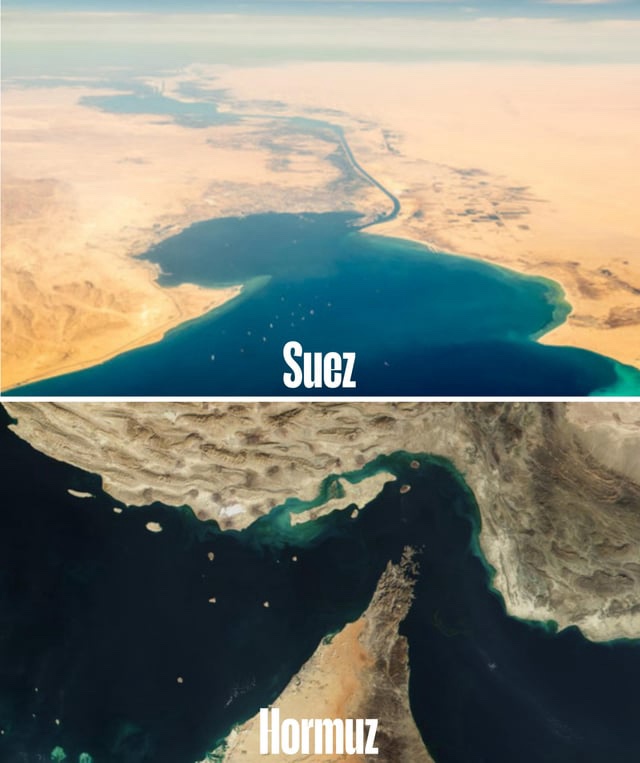
Parallel hypocrisy underscores both: Egypt’s Suez tolls are sacrosanct; Iran’s Hormuz fees, a casus belli. Uncle Sam’s rules reign supreme.


The Ukraine Bind: Russia’s Rediscovery of Mahan

Three years into Russia’s “special operation,” Putin controls neither Kyiv nor Odesa. The Black Sea Fleet—once 80 warships—lies neutralized by Ukraine’s $10,000 drones against $1B frigates. Sevastopol limps; grain corridors flow. Naval denial preserved Ukraine’s economy while Putin’s tanks bog down in Donbas mud.

This painful lesson rediscovers Alfred Thayer Mahan, the 19th-century US admiral whose “The Influence of Sea Power Upon History” (1890) proved naval supremacy dictates global outcomes.

Mahan identified six essentials—geography, population, government, commerce, fleet quality, strategic bases. Russia ignored them: no sea control means no land conquest. Napoleon failed Egypt sans Nile; Hitler, Britain sans Atlantic. Putin validates Mahan empirically.


The Iran Mirror: No Army, No Regime Change

Flip to Hormuz. US carriers unleash “Operation Tidal Surge,” cratering Kharg Island’s oil piers. F-35s own the skies; Tomahawks gut power grids. Yet Tehran’s mullahs endure, proxies bleed US bases in Iraq. Trump threatens “Stone Age” demolition—civilian infra next—still no collapse.

Why?

Naval power degrades, doesn’t decapitate. Iran’s 1,500-mile depth, 500,000 Basij militia, Hezbollah tunnels demand 200,000+ boots— that’s unsustainable for America post-Iraq and post-Afghanistan. Air-craft Carriers project, don’t conquer. Falklands worked (small island); Iran won’t.

*********

Suez vs. Hormuz: Imperial Rules
Enter hypocrisy’s masterpiece.

Egypt extracts $9 billion yearly from Suez tolls—$1 million per supertanker, unquestioned. Man-made canal, sovereign right.

Iran proposes Hormuz “transit fees” ($2 million/ship)—natural international strait, UNCLOS violation.

So, US Navy responds: airstrikes.

What’s the Legal nuance here ?

Suez = artificial waterway (Egypt built/maintains). Hormuz = natural chokepoint (20% global oil), free transit passage mandated.

Yet it is principle that dissolves: might defines right. US aid flows to Cairo ($1.3B/year); aircraft carriers and flotilla pound Bandar Abbas. Rules for thee, not for me.


Iran’s blockade inflicts pain—oil at $120/barrel—but Egypt’s tolls extract rent legally. Same ships, opposite verdicts. Hypocrisy isn’t error; it’s policy.


The Deeper Reckoning


Great powers discover limits when domains misalign. Russia rediscovers Mahan’s sea power necessity; America, land war’s indispensability.

Simultaneously, they also police hypocrisy selectively—Suez sovereign, Hormuz piracy. This isn’t aberration but essence of hegemony: power writes rules, then enforces exception.

Multipolarity looms.

BRICS reroutes oil in yuan; drones cheapen aircraft carriers. And the Ukraine-Iran diptych warns the Great Powers: military might can fray at the edges, and hypocrisy certainly erodes legitimacy. Greatness endures not by unmatched force, but only by matched restraint.

Sudarshan Madabushi

(A Chennai-based keen observer of contemporary geopolitics; also, student of classical Indic traditions calling himself “Unknown Sri Vaishnava”)

How to make sense of Bibi-Trump’s meaningless two wars on Iran

After I heard President Donald Trump’s April 7, 2026, Truth Social post laying bare the stakes for Iran and the whole world: “A whole civilization [will] die tonight never to [be] brought back… complete demolition by 12 o’clock… over a period of four hours”, I for one even in faraway Chennai, India couldn’t help feeling a cold chill of raw fear climbing up my spine.

Try as hard as I might , my mind couldn’t grasp and digest the enormity of Trump’s verbal threat to to wipe out a whole civilisation of 2000 years vintage from the face of the world. It was mind boggling… Finally , after a day of mulling upon it, the only way I could make sense of it all was to resort to a throwback to a very old, outmoded and by now an outworn academic theory of the 1990s: Samuel Huntington’s “Clash of Civilisations”.

After the shock came sheer incomprehension… After I had read a few more newspaper reports on America’s threat and watching on my home TV screen replays over and over again of the Trump Truth Social post and commentaries thereon by “expert analysts”, I felt even more mentally numbed and befuddled. My brain refused to function. The news analysis could only tell me how a series of events happening had led finally to an explicit threat to a civilisation issued by America for causes and on pretexts that to me were obvious but very superficial. The threat had deeper undercurrents which if not properly understood would be the woods that were missed for the trees … And I began to wonder what the woods could be?

*********

The Trumpian ultimatum, tied to Iran’s refusal to reopen the Strait of Hormuz, transcends oil chokepoints and containment games. It resurrects Samuel Huntington’s 1993 thesis: post-Cold War conflicts pivot on civilizational fault lines, with the West-Islam divide as the bloodiest border.

Beneath the war’s “energy mechanics”— i.e. 20% of global oil at risk—lie layers of Judeo-Christian mobilization, imperial legacies, and dehumanizing rhetoric. Peel them all, one by one, like onion skins, and Huntington’s framework reveals — well, to me at least —not just strategy, but an existential clash of civilisations.

“Peeling the Onion”: Seven Layers of Conflict

This war isn’t Pax Americana redux; it’s a Crusades echo chamber.

Evangelicals like Defense Secretary Pete Hegseth invoke Jesus’ return and “God’s war” for victory, while Iran’s leaders frame strikes as an “anti-Crusade” for Allah’s faithful. Pope Leo XIV chides the “irreparable abyss” without outright condemnation—a Vatican nod to civilizational kin. These aren’t footnotes; they’re the first layer.

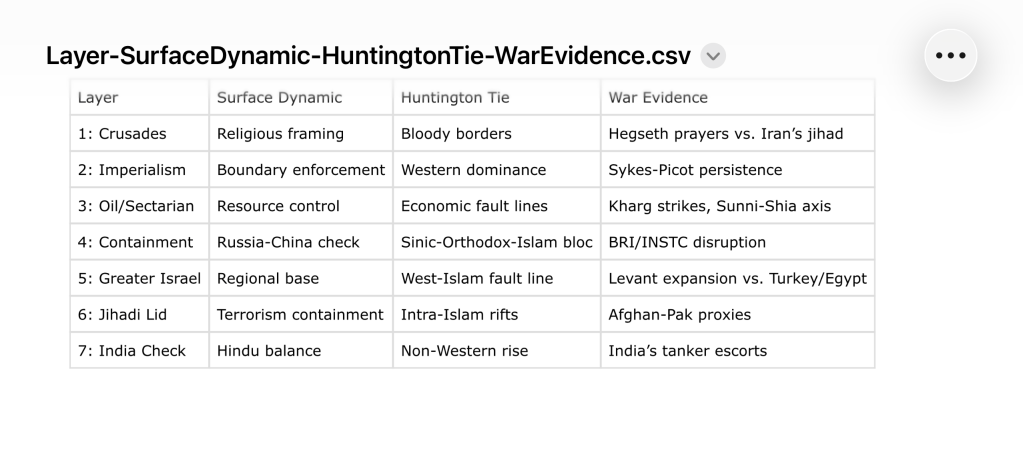
Deeper still are more layers and here there are 7 depicted in a summary table below. And what lies at the core of the onion? It is Western Judeo-Christian order asserting 21st-century primacy, Huntington’s “the West vs. the Rest” theory now given flesh and blood.

Layer Surface: DynamicHuntington Tie: War Evidence

Trump’s Rhetoric: The Freudian Slip

Surface-level analysts cite Hormuz logistics and BRI countermoves. Yet Trump’s persistence post-regime resilience—“bomb [Iranians] back to the Stone Age,” “sick animals,” “horrible thugs”—signals much deeper animus.

Initially projecting himself as liberationist, his slurs hardened despite Iran’s stability (Khamenei’s Nowruz defiance). This wasn’t failed tactics; it’s, in fact, Huntingtonian trope: civilizational regression of the Islamic “other.” Evangelicals amplify (70% Republicans back “God’s plan”), Iran retorts with obligatory blood-fatwas. And amidst it all is the Sunni pragmatism (Saudi tacit support) that fractures Islam, but the rhetoric does fulfil Huntington’s prophecy—self-fulfilling Armageddon.

Countering the Pragmatists

Critics of the Huntington theory might note that Sunni alliances and energy primacy issues dilute the pure clash that Samuel theorises about. True, pragmatism rules operations. But Huntington predicted intra-civilizational schisms (Shia-Sunni Yemen wars) and they don’t negate the West-Islam fault line. Rhetoric endures in fact as mobilizer: Trump’s words rally his political base, risking prophecy over policy. Even though BRICS rebukes (China-Russia UN vetoes) do echo multipolar pushback, yet evangelical prayers and Iranian jihads prove that civilizational motors are humming beneath the surface.

A Call Beyond Hegemony

Huntington isn’t prophecy but warning: ignoring civilisational fault lines breeds endless war.

Trump’s “four-hour erasure” isn’t bluff—it’s worldview. De-escalation demands civilizational reckoning, not just Hormuz deals. 

America and Anglo-Saxon Christian civilisation must realise that true power builds, doesn’t demolish. So, it’s time the West makes a wise choice —supremacy or survival? —in this 21st-century throwback.

Sudarshan Madabushi

UNESCO, Ahobilam, and the Limits of International Recognition for Hindu Temples


In recent months, the Paruveta Utsavam of Sri Lakshmi Narasimha Swamy at Ahobilam has entered the national spotlight with a Parliamentary resolution seeking UNESCO recognition—either as an Intangible Cultural Heritage element or as part of a broader heritage‑conservation framework. The Ahobila Mutt, custodian of the Ahobilam temple for over 750 years, stands at the centre of this debate. Yet, beneath the glitter of the UNESCO brand lie deeper questions about who really controls Hindu temples, what such recognition actually delivers, and whether it is a meaningful safeguard or merely a symbolic crutch.

What UNESCO recognition can and cannot do


UNESCO recognition—whether via the Representative List of Intangible Cultural Heritage or through World Heritage or Asia‑Pacific Awards—carries real prestige. It signals that a tradition is of outstanding cultural value and worthy of safeguarding for future generations. In bureaucratic and diplomatic circles, the “UNESCO tag” becomes a brand that can be used to justify conservation projects, attract specialist expertise, and even flex soft‑power muscle on the global stage.

However, UNESCO does not automatically:
• transfer money to the temple or mutt,
• take over day‑to‑day management,
• or insulate religious institutions from state interference.

Its own World Heritage Fund is small and globally competitive; disbursements are usually advisory, technical, or emergency‑oriented, not recurring temple‑subsidies. Any real financial benefit for Ahobilam will come indirectly, filtered through state and central governments, tourism bodies, and contractors—precisely the actors whose behaviour the Hindu community most fears.

Sri Rangam: A cautionary tale


The Sri Ranganathaswamy Temple at Srirangam has already received a UNESCO Asia‑Pacific Award of Merit for its conservation work. That award was a hard‑earned recognition of a massive, traditional‑method restoration project, completed with careful engineering and devotion to heritage. Yet, for many devotees and scholars, the daily reality of Sri Rangam does not match the gloss of the award. The temple’s self‑governance remains constrained, the HR&CE system continues to manage assets and appointments, and the lived experience of darshan, utsava, and kshetra‑saukhyam is often strained by poor infrastructure and political‑bureaucratic interference.

Sri Rangam thus offers a sobering lesson: UNESCO recognition can adorn a temple; it cannot, by itself, reform a state bureaucracy that has long treated temples as revenue‑yielding assets rather than devalayas. If even a UNESCO‑honoured, arch‑Vaishnava temple in Tamil Nadu struggles to translate prestige into structural autonomy and better governance, how much more must one be cautious before imagining UNESCO as a miracle‑cure for Ahobilam?

Ahobilam and the Ahobila Mutt: 750 years under pressure


The Ahobila Mutt is not some new NGO or state‑appointed body; it is a paramparā that has guided Ahobilam for three‑quarters of a millennium. Its claim to custodianship is rooted in sampradaya‑siddha tradition, acharya‑pādukā‑seva, and deep ritual continuity.

The Supreme Court has, in no uncertain terms, upheld that temples founded by religious institutions belong to those institutions, and that the state cannot unilaterally “take over” or appoint an Executive Officer without violating the Article 26(d) right to manage religious affairs.

Yet, every time a new government comes to power in Andhra Pradesh or Telangana, the Ahobilam temple becomes a theatre of political contest. The standard playbook emerges: fresh claims of “mismanagement”, loud public justifications for “take‑over”, and attempts to impose an EO or parallel control. Even though the courts have repeatedly struck these moves down, the cycle re‑starts with each new political regime. The Mutt is then dragged into litigation, administrative tussles, and bureaucratic entanglements, instead of being free to focus on siddha‑pātras, śāstra‑pāṭha, and the nitya‑utsava‑nityakarma cycle.

In such a context, UNESCO recognition cannot act as a shield against political vicissitudes. A new government will not hesitate to interfere simply because the Paruveta Utsavam figures in a UNESCO‑linked list. The Mutt remains vulnerable not to a lack of international tags, but to a systemic refusal to respect its constitutional and traditional autonomy.

Why then seek UNESCO recognition?

Given all this, the question arises: Why should the Ahobila Mutt or its allies want a UNESCO‑style branding at all?

There are a few, limited, tactical reasons, which must be recognised for what they are—tools, not solutions.

  1. Documentation and narrative armour
    UNESCO‑linked dossiers require detailed documentation of rituals, music, agama links, and sampradaya history. Once this is on record, it becomes harder for any state‑appointed body to suddenly “re‑design” the Paruveta Utsavam or shrug aside mutt advice as “unscientific” or “irrelevant.” The Mutt can then point to its internationally recognised living‑tradition status in any legal or policy debate.
  2. Diplomatic and reputational pressure
    If the festival is inscribed as Intangible Cultural Heritage, any attempt to politicise or commercialise it can attract subtle diplomatic and reputational costs. The state risks being seen as undermining a recognised heritage, which can be useful in negotiations over crowd‑management plans, infrastructure projects, or land‑use around the temple.
  3. Potential for better‑justified funding
    UNESCO recognition can help “brand” Ahobilam as a heritage‑ and pilgrimage‑destination in policy documents, making it easier for the Centre or the State to justify:
    • conservation projects,
    • improved utilities and sanitation,
    • and crowd‑management infrastructure.
    But—crucially—these funds still flow through state and endowment machinery, not directly to the Mutt. The real test is whether the Mutt is allowed to participate in the design and execution of such projects, or merely treated as a ceremonial actor.

The deeper question: Is the Hindu community unable to preserve its own heritage?


The sub‑text of the entire debate is my own question:

If the Hindu community is capable of preserving its temples and utsavas, why does it need to seek validation from an international body like UNESCO? Worse, if powerful institutions like the Ahobila Mutt cannot, in practice, manage Ahobilam according to hoary traditions, does that indicate a deeper failure of Hindu agency?

The answer lies not in the Mutt but in the structures that have been imposed upon it.

For over a century, the logic of the HR&CE‑style regime—first under colonial “court of wards” thinking, then under Dravidian‑state models—has steadily eroded temple autonomy.

Temples are treated as “state property” or “public assets,” while mutts, mathas, and kshetra‑samsthas are marginalised, bypassed, or portrayed as inefficient. The result is not a dharmic institution failing to preserve heritage; it is a dharma‑sādhu institution being systematically constrained, under‑funded, and over‑politicised.

In such a context, UNESCO recognition is not proof that the Hindu community cannot preserve its heritage. Rather, it can at best only serve as a diplomatic lever to expose the disconnect between the sacred‑status of the Paruveta Utsavam and the secular, often corrupt, machinery that surrounds it. The Mutt is perhaps not asking UNESCO to “save” Ahobilam; it may be using UNESCO‑linked recognition to argue: “We have the will and tradition; grant us the constitutional and administrative autonomy to act on it.”

Financial benefits: real, but indirect and risky

Could UNESCO branding bring money to Ahobilam or the Mutt? Only in an indirect sense.


• It may attract more state and central funding for conservation, roads, drainage, and other infrastructure projects, because the site is now “high‑value heritage.”
• It may boost pilgrimage‑tourism footfall, increasing donations, prasadam sales, and related income streams.


But these benefits are not guaranteed to reach the Mutt or the devotee in a transparent or equitable way. If the Andhra‑Telangana temple‑administration model parallels the Tamil HR&CE pattern, much of the revenue and authority will remain with the state‑controlled machinery. UNESCO status can even incentivise commercialisation—more hotels, more “heritage‑tour” packages—without necessarily improving darshan‑quality, sadhana‑environment, or ritual integrity.


In short, UNESCO will not write cheques to the Ahobila Mutt; it may, at best, help the Mutt argue for better funding and better management channels. The real question is whether those channels will be devotional‑autonomous or state‑dominated.

Conclusion: Recognition with dignity, not dependence


The debate over UNESCO recognition for the Paruveta Utsavam at Ahobilam should not be reduced to a binary of “pro‑UNESCO” versus “anti‑UNESCO.” The deeper issue is who controls Hindu temples—the sampradaya or the state.


• If UNESCO recognition is used to reinforce Article 26(d) autonomy, strengthen mutt‑centred conservation, and build transparent, dharma‑friendly funding mechanisms, it can be a tactical ally.


• If it is used mainly to enhance the state’s image, justify more bureaucratic control, or glamorise “heritage‑tourism” without real devolution, then it will be yet another symbolic ornament over a still‑crippled temple‑governance system.


For the Ahobila Mutt, the highest goal is not an international tag but the restoration of its traditional authority to manage Ahobilam according to sampradaya‑siddha norms, free from the cycle of political take‑overs and administrative interference. UNESCO recognition, at its best, can help highlight that ideal; but only a constitutional and cultural re‑assertion of Hindu temple autonomy can make it real.

Sudarshan Madabushi

(Ahobila Mutt “sishya”)

Pity the Europeans… as Trump rubs more salt and insult into their wounded pride

What are we to make of this man’s mental health ?!

First he starts a war with Iran unilaterally without consulting any of his European allies in the hope that America would finish the war in a week — à la Venezuela — and that Iran will “totally surrender to His Highness”.

When things however start going awry on the war front in Iran , he starts calling out to his so-called European allies to send warships to attack Iran.

When the allies all baulk , he throws spite and insults at them all, calling them “cowards”.

Now that the war is dragging on for more than a month, he finds he has utterly lost control over the Hormuz straits and World oil supply is now in shambles and has thrown all economies of allies and of the rest of the world too into a tizzy.

As Iran’s chokehold over Hormuz only further tightens, POTUS realises that America alone cannot succeed in opening up the straits without suffering heavy casualty in terms of huge costs, human and financial.

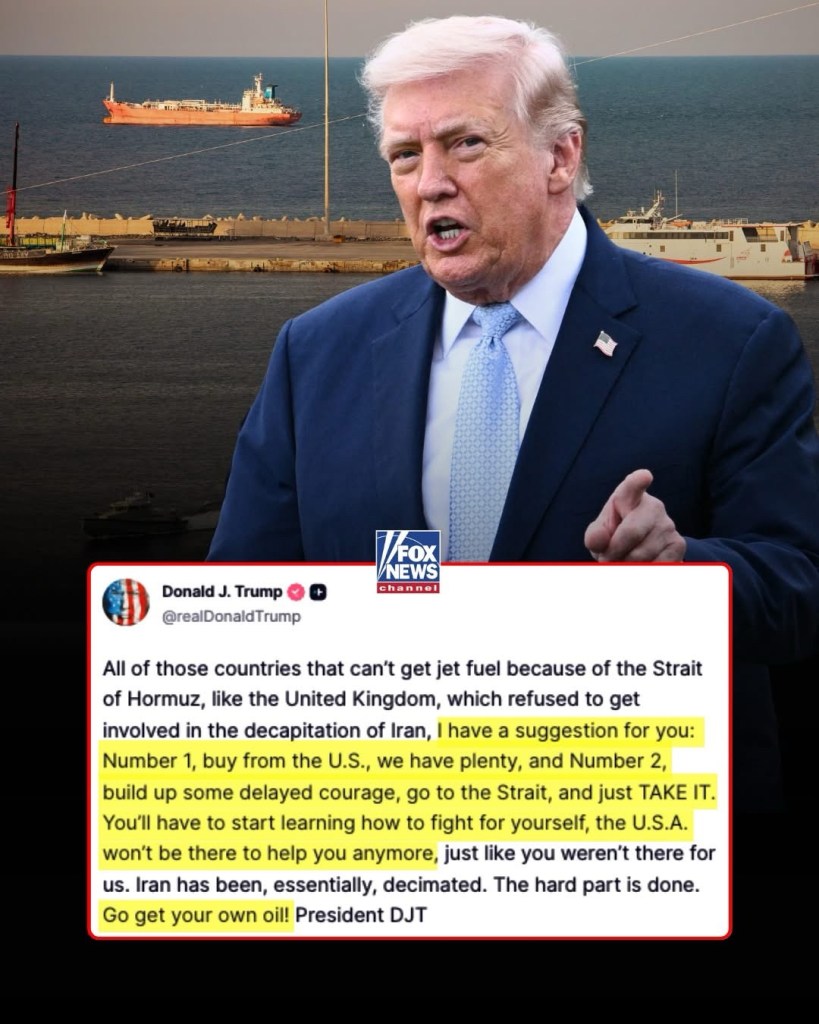
So, now he’s desperate. He tucks tail but cannot be seen to be running away from the war. So how to save face and a bashed nose ? … He turns on Europe and yells , “If you want oil from the Hormuz go get it yourself!”

In a war that he finds he’s unable to finish by himself, he’s now hell bent on dragging half the world into it. “If you don’t join me in my war , you don’t deserve to get the oil and gas flowing through the Hormuz”.

Pathetic is the plight of the Europeans for they still don’t realise that “Daddy” Donald Trump has made them the first grave casualty in a War that was launched by him which they knew nothing about it until was already half lost .

Pity the Europeans … if the Iranians can hold up to ransom a quarter of world’s oil and gas supply to try and force Donald Trump to end the senseless War, he will on the other hand do one better than they : he’ll hold to ransom all the Hormuz oil and gas just to force Europeans to help keep the bloody war raging on.

What a sick , demented way of thinking !

Sudarshan Madabushi

“…Only by my own morality, my own mind,” … that is “the only thing that can stop me,” Donald Trump, POTUS

Donald Trump when asked about the Constitutional and moral limits imposed upon the power of the POTUS retorted in the interview (with outlets such as CBS and the New York Times: “… only by my own morality, my own mind,” and that is “the only thing that can stop me…” That was Trump’s conception of executive power, the role of the American Constitution, and of whether international law binds him or not.

Interviewers pressed him on whether courts, treaties, or international norms can actually check his actions, and Trump replied in substance that those constraints are irrelevant because “we’ll never get to the courts” or the Constitution—he will act if he feels it is “good for our country,” and his own “morality” is the only real limit.

The President’s laconic, arrogant line clearly reflected his personal philosophy: an ultra‑expansive view of presidential authority, especially as his administration at the time of the interview was contemplating or carrying out aggressive actions abroad (e.g., talks about Venezuela, Greenland, and broader military deployments, and the war on Iran planning), and critics were warning him that he would fall foul of legal or institutional checks and balances.

“I don’t have any moral compulsions except what I feel inside myself. I follow my own instinct. If I think it’s right, it’s right; I don’t have to listen to the press, the so‑called experts, or the establishment.”


By centring “his own morality” as the sole brake, Trump effectively was declaring that ethics, law, and precedent are optional for him. What matters to him really is his gut‑level sense of “what feels right”. That was the only real constraint on what he may do in war, sanctions, or territorial‑style maneuvers.

The above retort of the POTUS delivered in a dismissive tone clearly suggests that his personal sense of “rightness” supersedes legal, diplomatic, or ethical norms. In effect, it frames his war decisions not as constrained by international law, norms, or even traditional conservative‑realist doctrine, but by his own subjective “gut” and appetite for spectacle.

Given that he possesses that megalomaniac moral sense, it should surprise no one therefore that the imperious Donald Trump has gone on record in the last few weeks to make the most outrageous, repugnant and obnoxious statements ever made by a Head of State of the United States of America before him.

Just start scrolling:

On bombing, Europe, and personal whim

  • “Bombing for fun” style line:
    In a televised appearance, Trump suggested that he could continue the bombing campaign against Iran indefinitely, adding with a smirk that he might “keep bombing for fun.” This line encapsulates his tendency to frame a major war as an extension of personal will rather than a strictly calibrated military‑diplomatic strategy.
  • “Europeans are cowards”:
    Speaking at a White House‑style briefing, Trump dismissed NATO and European partners, saying something very close to:“The Europeans are cowards. They talk a lot, but they didn’t come to our aid when it counted… nobody wanted to stand with us except a few Gulf countries.”He then repeatedly contrasted this with what he calls “strong friends” in the Gulf, portraying Europe as weak and unreliable in the Iran war.

On Saudi Arabia and Gulf allies

  • “Saudi King came kissing my ass”:
    At a Saudi‑backed event in Florida, Trump laced his remarks with crude, performative theatrics. About the Saudi Crown Prince, he said in substance:“He didn’t think this was going to happen. He didn’t think he’d be kissing my ass… he thought I would just be another American president of a country going downhill. But now he has to be nice to me… he better be nice to me.”Immediately afterward, he turned on the praise, calling the same Crown Prince a “fantastic man” and “a strong leader,” which underlines the transactional, almost vaudevillian tone of his war‑time rhetoric.
  • Gulf allies as “with us more than NATO”:
    Trump has also said outright that Gulf states such as Saudi Arabia, Qatar, and the UAE have “stood with us more than NATO,” adding:“They’re doing more so far than NATO… in all fairness, they’re with us.” This line typically appears alongside his more vulgar quips, reinforcing the image of him as a deal‑maker who treats allies as props in a personal power‑show.

*****

America today is ruled not by its Constitution. It is now Pax Don Trumpia. And God Bless America!

Sudarshan Madabushi