So appalling is the way this POTUS blusters and bluffs about the Iran War to bamboozle his countrymen!

Trump’s Iran rhetoric vs the ground reality

Below is a side‑by‑side look at Donald Trump’s bravado statements about Iran and what independent reporting and analyses actually show. This is a non‑exhaustive list of the POTUS’s key bluster and bluff statements in near‑verbatim phrasings, grouped by topic and linked to known sources.

On Iran’s nuclear program and infrastructure

White House statement (press release, June 2025):
Trump is quoted in an official White House release as saying:

“Monumental damage was done to all nuclear sites in Iran, as shown by satellite images. Obliteration is an accurate term! The white structure shown is deeply imbedded into the rock, with even its roof well below ground level, and completely shielded from flame. The biggest damage took place far below ground level. Bullseye!!!”

Speech on the same strike (June 21, 2025), via news reports:
Multiple outlets report Trump declaring:

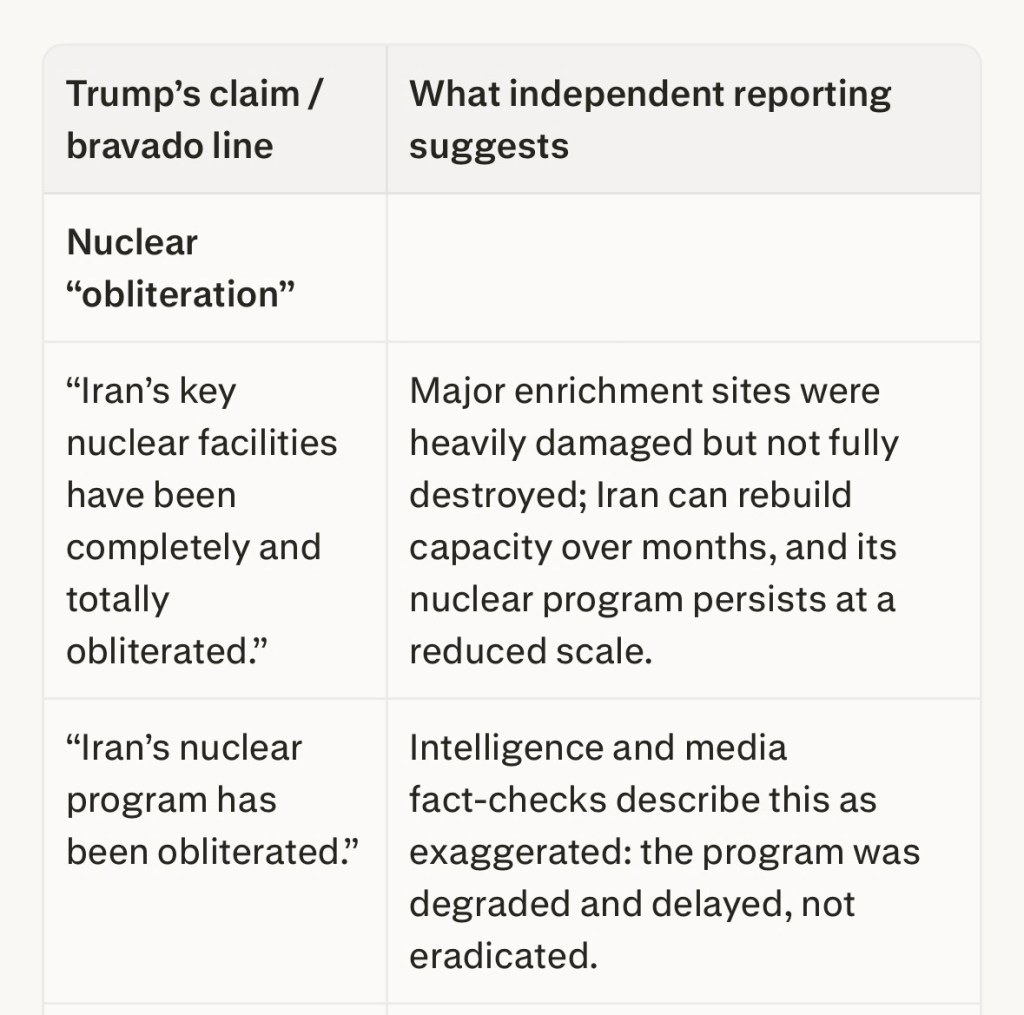
“Iran’s key nuclear enrichment facilities have been completely and totally obliterated.”

On social media and in follow‑ups, he repeated variants such as:

“Iran’s nuclear program has been obliterated.”


On Iran’s navy and air force

White House press‑briefing style remark (early March 2026):
Al Jazeera reports Trump saying at the White House with the German Chancellor:

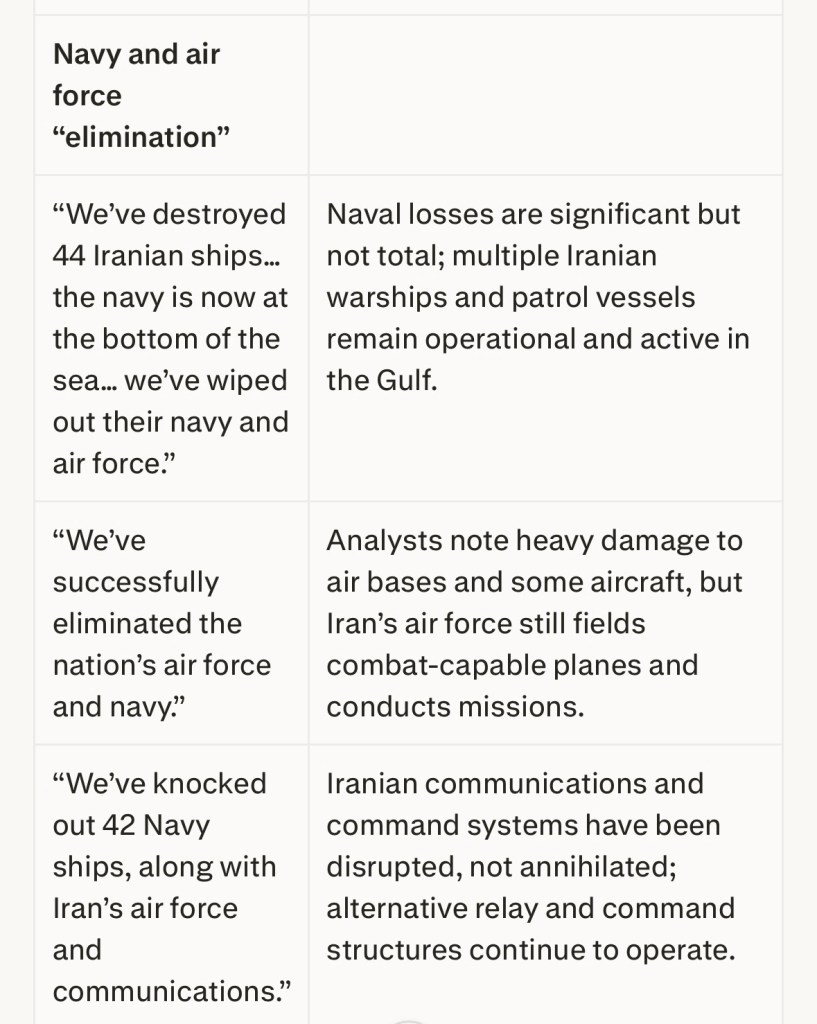
“We’ve successfully eliminated the nation’s air force and navy.”

Later, more flamboyant version (mid‑March 2026):
Middle East Eye and several wire services quote Trump at a public event:

“Iran’s leaders have been wiped off the face of the earth… the Iranian navy has been destroyed, the air force no longer exists, and their missiles, drones, and everything they own are being annihilated.”

Swearing‑in‑of‑Homeland‑Security‑Secretary remarks (late March 2026):
Indian‑language and international outlets paraphrase‑then‑quote Trump saying:

“We’re in negotiations right now. I can tell you, they’d like to make a deal and who wouldn’t if you were there? Look, their navy’s gone, their air force is gone, their communications are gone. Pretty much everything they have is gone.”


On regime leadership and “regime change”

Claim about Iran’s top leadership and regime structure (late March 2026):
The New York Times reports Trump aboard Air Force One saying:

“We’ve had regime change. The regime was eliminated, they’re all dead. The next regime is mostly dead.”

He then added:

“It truly is regime change… you can’t do much better than that.”

Comments on Mojtaba Khamenei (successor‑designate):
Multiple outlets quote Trump asserting that Iran’s new supreme‑leader‑designate has been effectively eliminated:

“He may be alive, but he’s obviously very seriously… wounded.”

Around the same time, he also reportedly said:

“Iran’s leadership has been wiped out.”


On the overall war and “victory”

Self‑declared “victory” in the conflict:
Indian‑language and international outlets attribute to Trump the line:

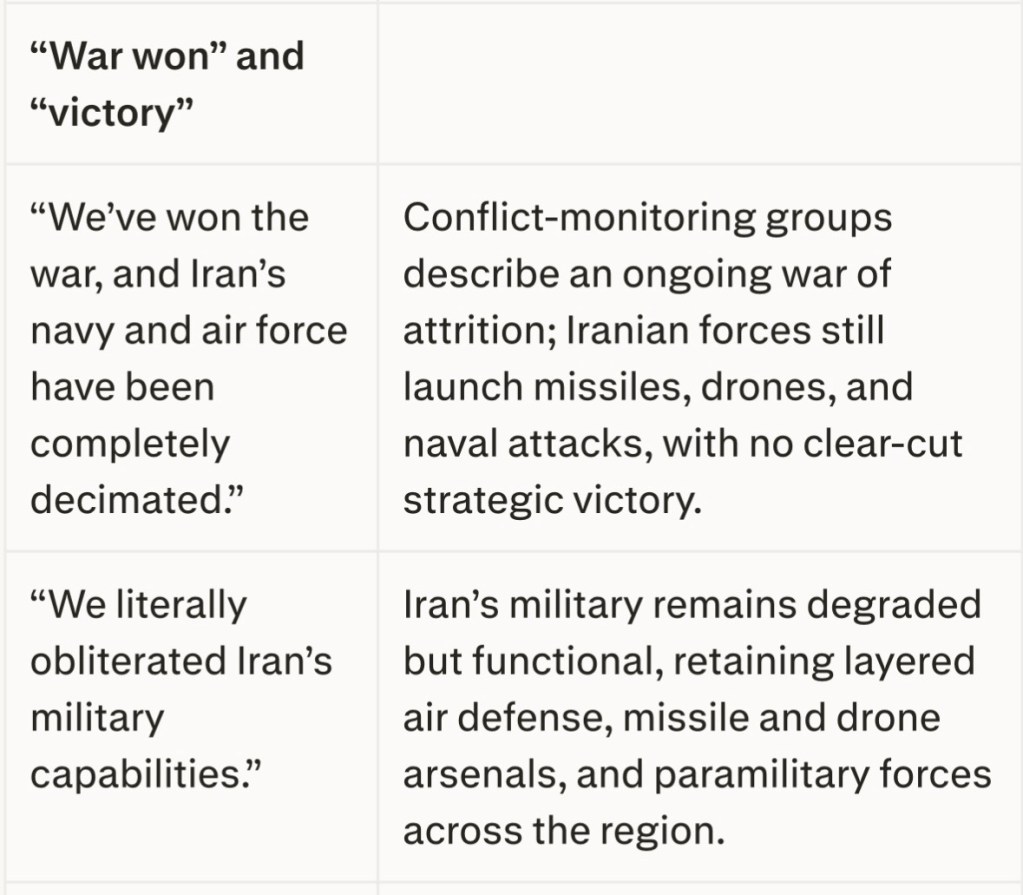
“We’ve won the war, and Iran’s navy and air force have been completely decimated.”

He has also repeated in public:

“We’re performing quite well,” when pressed about the ongoing operations.


What stands out versus reality on the ground

Several independent assessments and satellite analyses note that:

  • Only one major enrichment site was largely destroyed, while others were damaged but not “completely obliterated,” and Iran’s nuclear program has continued, albeit slower.
  • Iran’s navy and air force remain operational, even if degraded, and its leadership structure has not collapsed as claimed.

There’s been in the last few days so much more Bluster coming from this POTUS contrasting with evidence available on:


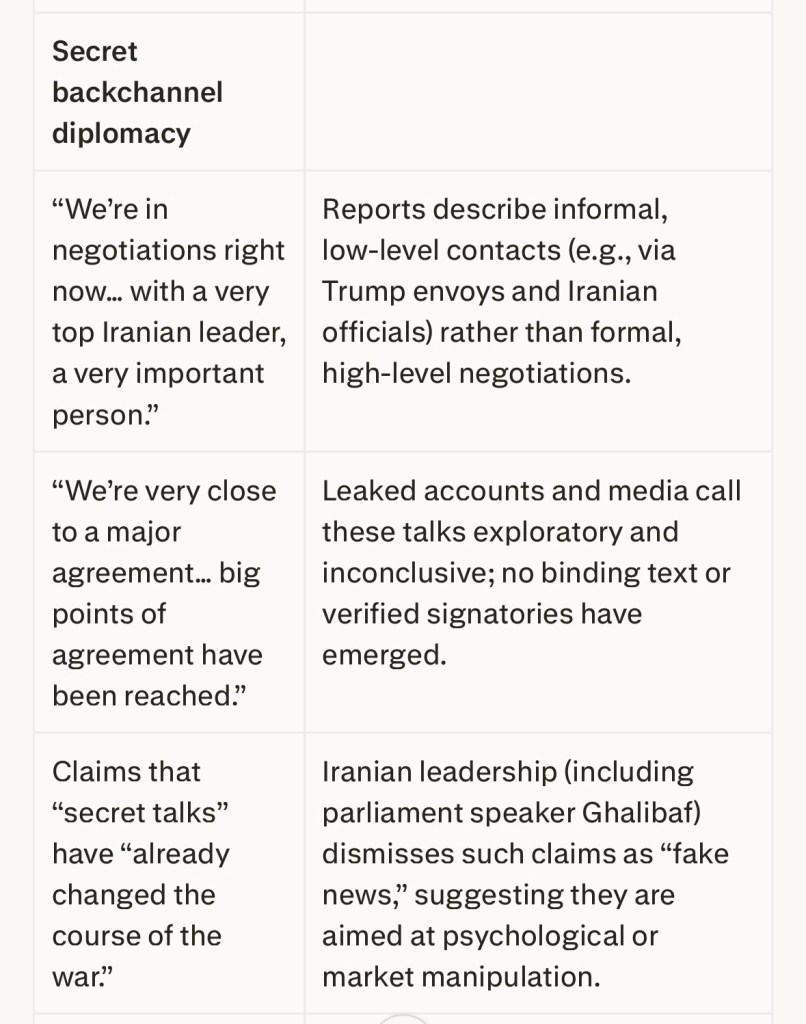
• On backchannels: Trump repeatedly invokes “secret talks” and “major agreements” with unnamed Iranian leaders, but:
• No public text, signatories, or concrete verification of a deal exists.[cnbctv18 +2]
• Iranian officials deny formal negotiations, casting these claims as part of a psychological or market‑manipulation campaign.[fortune +1]


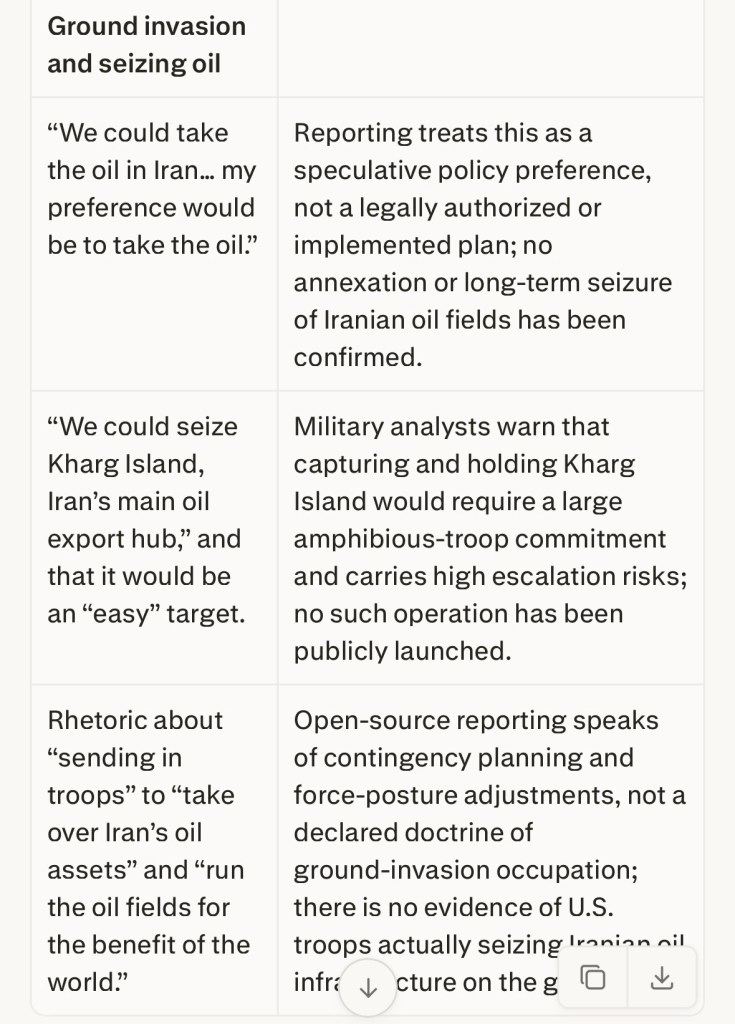
• On oil seizure: Trump’s talk about “taking the oil” and “seizing Kharg Island” is consistently framed as a threat or preference, not as an executed plan:
• No documented order, international‑law justification, or on‑the‑ground occupation of Iranian oil infrastructure has been confirmed.
• Analysts treat these remarks as escalatory bravado rather than a description of actual military‑administrative control.

******* ******* *********
Sudarshan Madabushi
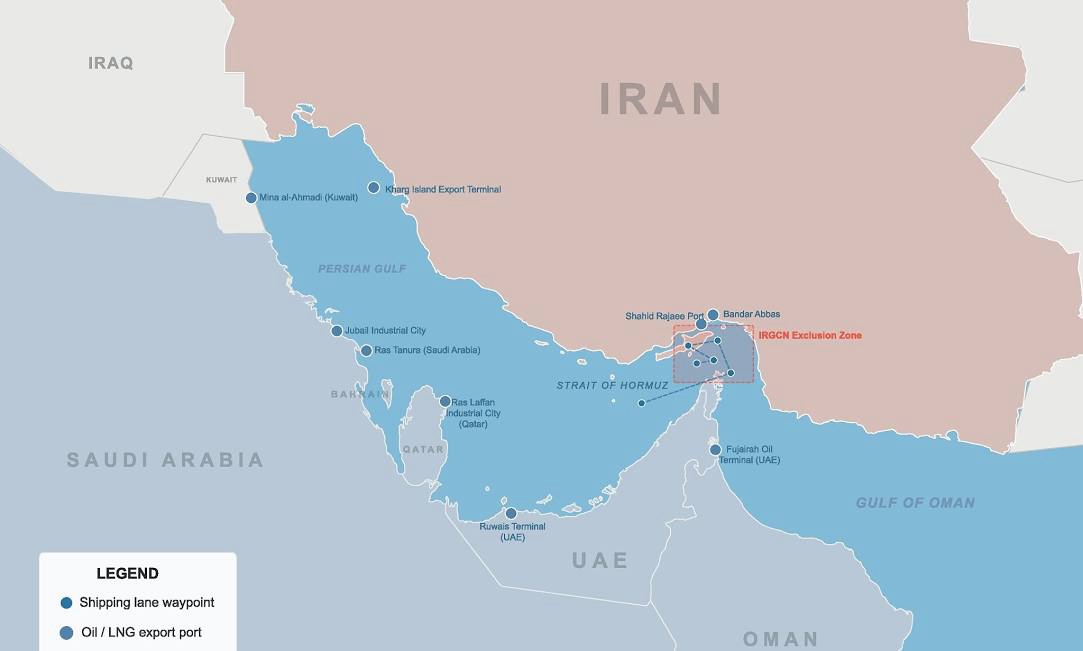
The “Demon” that has caught America, Israel and the Arab GCC states with their pants down

For more than seven decades, American grand strategy toward Iran has been guided by a single, narrowing obsession: how to secure U.S. access to oil and gas in Iran and the broader Central Asian energy belt. From the 1953 coup against Dr. Mohammad Mossadegh to the present crisis in the Strait of Hormuz, Washington’s gaze has never shifted far from the barrel of crude.

Iran, in American eyes, was never a full‑fledged nation with its own history, dignity, and strategic geography; it was a reservoir of energy to be controlled, and a potential spoiler of that control to be contained.


After the 1979 Islamic Revolution shattered the Shah’s pro‑Western order, Washington’s posture hardened into what many Iranians now see as a policy of “Death to Iran.” This was not, at first, a formal military declaration. It was a slow‑motion economic war, built on sweeping sanctions, banking cutoffs, and export bans that strangled not only the Iranian leadership but the lives of ordinary citizens. Hospitals, medicine, agriculture, and basic imports all fell within the shadow of American‑designed hardship.

The United States mistook the policy of impoverishment for the policy of containment, believing that if the people were made to suffer, the regime would either collapse or be forced to surrender on Washington’s terms.


In this grim calculus, Israel acted not merely as an ally, but as mentor and active abettor. Eager to see Iran weakened, Jerusalem nudged Washington toward ever‑more maximalist measures, subtly reinforcing the idea that pressure through sanctions, cyber‑sabotage, and covert action could substitute for a genuine long‑term strategy.

Arab Gulf states too, in turn, watched from the sidelines, silently applauding; their rulers were relieved that the United States, not their own militaries, bore the risk and cost of confronting Tehran. The GCC, in this way, became silent beneficiaries of a policy that spoke of “regional security” but in practice meant outsourcing Iran’s management to Washington.

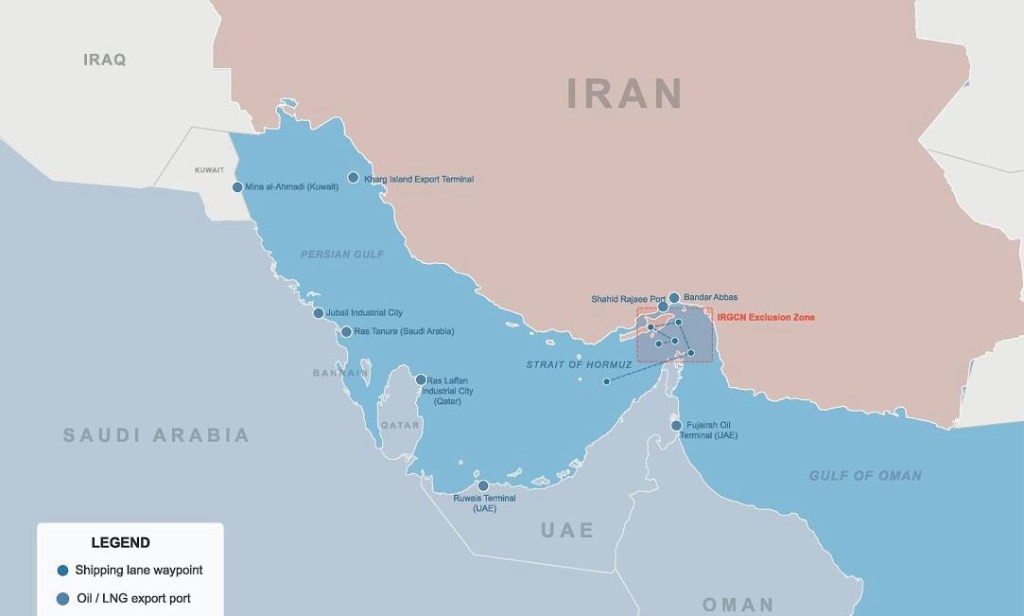
What is most striking in this entire arc is what did not occupy the foreground of American strategic thinking. The Strait of Hormuz, and to a lesser degree the Bab al‑Mandeb, never figured in any serious, sustained way as the central nodes of power in the Middle East. American planners in the White House, State Department, Pentagon, and CIA chased the “shadow” of the demon—regime rhetoric, nuclear ambitions, ballistic‑missile tests, militia proxies—while ignoring the demon’s real bodily presence : Iran’s geographic position at the heart of the world’s most critical energy chokepoints.

For decades, Washington treated Hormuz as a technical problem for navies, not a strategic inflection point for the entire global order. The United States relied on the Gulf monarchies, on periodic patrols, and on the illusion that the status quo could be preserved through a mix of gunships, satellite surveillance, and sanctions. The demon, in this reading, was ideological or nuclear; it was not the simple, brutal fact of geography that gave Iran the power to choke the arteries of global trade.


Now, that demon has finally stepped out into the open. With the 2026 U.S.–Israeli strike campaign against Iran’s leadership and nuclear‑related infrastructure, and the subsequent Iranian decision to assert direct control over the Strait of Hormuz, the demon has shown what it truly is: a geographic weapon that requires no nuclear bomb to wield decisive power.

Iran has demonstrated that by threatening, or even selectively controlling, the flow of oil and gas through Hormuz, it can put America, Israel, and the GCC on a single, shared leash. The strait, once treated as a footnote to grand strategy, has become the very center of gravity in the region.

America, Israel, and the Gulf monarchies are now caught with their pants down. The policy of impoverishment did not topple the Iranian state; it deepened Iran’s defensive resolve and pushed its leadership to invest in asymmetric tools that could exploit their geographic advantage. The policy of containment, never honestly conceived, has collapsed against the reality of a chokepoint that Tehran can now claim to control.

The GCC, which once believed itself insulated by American protection, now finds that its own survival is hostage to decisions made in Tehran and Washington.


In this moment of reckoning, the old narrative must be reversed. The demon is not elsewhere, in speeches or missiles; it sits in the strategic decisions that were never made—the planners who failed to see Hormuz as the hinge of power, the leaders who mistook economic cruelty for geopolitical wisdom, and the allies who cheered from the sidelines while assuming the United States would carry the burden forever.

The lesson is not simply that Iran has grown stronger. It is that those who ignored geography, and who mistook pressure for strategy, have now found themselves staring at the very chokepoint they spent decades pretending did not matter.

Sudarshan Madabushi

The Choke Points of the world that Big Powers fight over

A SIMPLE CHART UNVEILS TO ME THE WHOLE OF THE DARK, OMINOUS THEATRE OF “COLD WORLD-WAR-III” IN THE 21st-CENTURY THAT INDIA IS DEFINITELY GOING TO SEE !

Both World War I and II were fought by the then world’s mightiest military and economic powers for dominance and absolute control over “strategic sea lanes” that were connected by the Straits of Gibraltar, Bosphorus and Suez which in turn were for them the keys and gateways to large swathes of continental territory across Europe, Russia, Middle-East, and Near-East Asia.

Gibraltar, Bosphorus and Suez were called as the world’s “choke points”.

Anyone in a position and with sufficient power to wield a stranglehold over these “choke points” got to be effectively the “emperor of the whole world” . A giant proportion of the world’s trade, industry and commerce flows at that time in history took place only in and around Europe and the Atlantic continental seaboards… And all of it had to flow only through these “choke points”.

Hence, Hitler of Germany, Mussolini of Italy and Hirohito of Japan who led their powerful countries to all-out Wars against the world all once did, in one way or the other, aspire to such global Emperor-hood.

What is the scene today ?

Dominance if not absolute control over these “choke-points” in the arterial sea lanes continues today to hold the potential to be able, in fell swoop, to “choke off” nations and peoples’ life, liberty and livelihoods… In other words, any power that controls them could at will turn-on and turn-off all traffic of trade, industry and commerce, traffic of military arms too and also all movement of peoples through and to and fro any part or parts of any one or more region in the world .

Thus indeed it is for that reason that over the years it has become a constant theme in the history of “super-power rivalry” of the world since the last two World Wars, that the most powerful countries (economically and militarily) will never cease waging a relentless “cold war” with each other to seize control and dominance over these arterial “choke points” in the sea lanes of the world.

Now, in the 21st century the very same “cold war” for “choke points” is going to be fought … not between Anglo-Saxon antagonists amongst themselves this time but … between them and the great new superpower of the world — CHINA .

Why ?

Because trade, industry and commerce flows today do not swirl around circulating mostly as they did once in the time of WW-I and II only around Europe and the trans-Atlantic continents. Today that traffic is mostly if not predominantly between the Trans-Atlantic continents of the world and Pan-Asiatic mainland China .

China therefore now is stepping forward boldly and aggressively and is posing the challenge to the rest of the world in terms as follows:

“If you Anglo-Saxon world-powers (US, UK, EU and Australia/New Zealand) can wield control over the Western and Middle-Eastern “choke points” of Gibraltar, Bosphorus and Suez why should I, China, an equal superpower, not seize control or dominance over other emerging strategic “choke points” in Eastern pan-Indian Oceania which straddles that part of the globe that stretches between the Straits of Hormuz and Bab-el-Mandeb, Cape of Good hope and Malacca?”

China has started raising today an increasingly rude, “in-your-face” question to the Western Trans-Atlantic/Pan-Anglo-Saxon powers : “Why must you guys alone wield the power of “turn-on, “turn-off” switching at strategic “choke-points” of the world ? Why should I not have and wield the same power over Malacca, Cape of Good Hope and Hormuz as you do over Gibraltar, Suez, Bab El-Mandeb and Panama ?”

During World War I and II , the dynamics of super-power rivalry did not impact much the strategic security concerns of India . India was the “jewel in the crown” of the British Sovereign who was sworn to keep her territory in India protected from harm. Also, India at that time in history was only a bit-player in the great epic drama of super-power rivalry and war . The “choke-points” of the Western and Middle Eastern sea lanes did not really hold any “strategic significance” for India. The Wars fought then were not really India’s business.

The situation is, however, not so today … and will not be so too in the rest of the 8 more decades still left in the 21st century ?

Why ?!

Because India is today a bit like a poor deer caught flat-footed in the darkness in the middle of a forest highway-turning… momentarily frozen and paralysed with fear and confusion, blinded by the sudden, white flashing glare of beams of powerful headlamps thrown at it by two powerful SUV trucks converging on it menacingly from both sides !

Because of where India’s geography happens to be where it exactly is, unfortunately, India willy-nilly is going to be definitely dragged into the politics of the super-powers’ titanic struggle for control over the “choke points” in the neighbourhood of the ocean in its very own backyard : the Indian Ocean . The Indian Ocean, right in the middle of which India stands, is going to be without a shred of doubt the central theatre of war in which the great 21st-century’s Cold World-War warriors, the Anglo-Saxon Axis of US, UK-EU and Australia is going fight China … and this War too will have to be fought to the finish.

In this great looming “World Cold-War” India must make the right choices if it must emerge eventually on the right side of History.

What are those choices likely to be?

Only PM Mr Modi and his MEA, Mr Jaishankar, probably know ?

But who knows, perhaps the small secretive group of members attending the ongoing “G7-meeting” in London today (May 5 2021) might have have an inkling of it too ?!

I don’t know .

One thing however is for sure … you and I , ordinary citizens of India … will have no clue until perhaps , God forbid, the Cold World War-III is already upon us !

Bhaarath Maatha ki Jai !
Sudarshan Madabushi 🇮🇳

The Debt (“Rishi Rnam”) of ‘noblesse oblige’ owed to Saint Thyagaraja by the Carnatic Music world

Today a reflective morning mood prompted me to think up and ask three pointed questions to the Perplexity AI engine.

The three questions and the Answers obtained are given below in seriatum.

Question No. 1

Saint Thyagaraja composed more than a thousand “kritis” out of intense Bhakthi. He was not a musician nor was Carnatic music his career . Music for him was mystic communion with the divine.

Today , musicians and music aficionados thrive on Thyagaraja’s compositions as professional artistes on stage , earning millions of rupees as remuneration for their “kutcheri” all over the world. Many artistes today have made lucrative careers out of Thyagaraja songs.

If Thyagaraja had patent copyright over all his compositions today, how much money would he have potentially earned by way of royalties from the world of Carnatic music? What is the best guesstimate?

ANSWER:

Saint Tyagaraja composed around 700-1,000 kritis, many of which form the core of modern Carnatic kutcheris, often comprising 30-50% or more of a typical concert’s repertoire.


Market Overview


Carnatic music relies heavily on live performances, with Chennai’s Margazhi season alone featuring thousands of kutcheris across major sabhas. Top artists like Sudha Ragunathan and T.M. Krishna command fees around ₹5-10 lakhs per high-profile concert (adjusted for inflation from older data), while mid-tier earn ₹50,000-2 lakhs; global shows add premium pricing. India’s music industry distributed over ₹600 crore in royalties last year, though classical forms like Carnatic represent a small fraction amid Bollywood dominance.


Royalty Estimation


Hypothetical royalties for public performances in India typically run 3% of gross ticket/sponsorship revenue after 15% venue deductions. Assuming 10,000 annual pro kutcheris worldwide (Chennai season ~3,000, plus global/dispersed), average gross ₹2 lakhs each, Thyagaraja share 40% usage, yields ~₹50 crore total live revenue base.

At 3% royalty, that’s ₹1.5 crore annually; scaling for recordings/digital (minor) pushes a guesstimate to ₹2-5 crore per year today.


Key Assumptions


• Concerts: Conservative; actual may exceed with private/corporate events.
• Usage: High dominance in repertoires, per expert consensus.
• No historical claim, pure hypothetical; earnings shared with accompanists in reality.

Question No.2

What usage sources generate most royalties for Carnatic music?

ANSWER

Live performances generate the majority of royalties and income for Carnatic music, as the genre relies almost entirely on kutcheris rather than robust digital or recording streams.


Top Sources


• Live Concerts: Primary revenue via sabha fees, sponsorships, and tickets during seasons like Chennai Margazhi (thousands of events); most artist earnings and hypothetical composition royalties stem here.


• Digital Streaming/Live Streams: Growing post-pandemic (70% of overall Indian music royalties from streaming), but low monetization for Carnatic due to free access culture and niche audience.


• Recordings/CDs: Minimal, with limited sales and poor artist/label payouts; commercial live recordings add little.

Question No. 3

Hypothetically again, from whom or which institution would royalty income flow to Thyagaraja ? And in what conceivable contractual form?

ANSWER

Hypothetically, royalty income for Tyagaraja’s compositions would flow through India’s performing rights organizations (PROs), primarily the Indian Performing Right Society (IPRS), which manages public performance and broadcasting rights for musical works on behalf of composers and publishers.


Primary Institutions


IPRS would act as the key collector, issuing public performance licenses to concert organizers (e.g., sabhas like Music Academy), venues, broadcasters, and streaming platforms for live kutcheris, recordings, or online events. Phonographic Performance Limited (PPL) handles sound recordings separately, but Thyagaraja’s focus would be on underlying compositions via IPRS.


Flow Mechanism


Organizers pay blanket or per-event license fees to IPRS based on tariffs (e.g., percentage of gross revenue), which pools and distributes royalties quarterly using logs, setlists, or usage data from concerts and media. For global use, international reciprocal agreements (e.g., via CISAC) would route foreign royalties back through IPRS.


Contractual Forms


• Membership Agreement: Tyagaraja (or estate) assigns non-exclusive public performance rights to IPRS via a standard membership contract, retaining ownership while authorizing global licensing.


• License Agreements: Event hosts sign IPRS public performance licenses (annual/blanket or event-specific), with terms like upfront fees, audits, and penalties for non-compliance (18% interest + 30% penalty).


• Publishing Assignment: Optional deal with a music publisher for administration, sub-licensing, and mechanical royalties (e.g., recordings), taking 20-50% commission.

************

The Upshot

The upshot of all my above conversations with Perplexity-AI is that finally now I have got a pretty approximate idea of the quantified total estimated Debt that the world of Carnatic Music morally owes to Sri Thyagaraja.

In other words, I now can imagine a broad picture of Sri Thyagaraja — i.e. if were alive today in flesh and blood and perhaps also as commercial-minded as I see our musicians are today in India across the board — rightfully coming forward to claim settlement of the debt owed to him by the Carnatic Music world, based on retrospective cumulation and compounding of the sum of royalties not paid to him all these years for his “kritis”. Perplexity-AI engine helped me also to do the back-of-the-envelop maths on this as below:


Indian courts reject perpetual or moral rights revival for ancient compositions. Copyright doesn’t apply retroactively to public domain works like Tyagaraja’s (pre-1920s Indian law), so no legal claim exists. So, the Carnatic Music world can heave a big collective sigh of relief!

However, hypothetically assuming new moral/publishing rights, Thyagaraja’s cumulative demand would cover ~180 years (1847–2026).

Tyagaraja lived from 1767 to 1847 (about 80 years), with major compositions spanning roughly 1800–1847; modern Carnatic usage greatly surged post-1900 via disciples and sabhas.


Annual royalties today that Thyagaraja could potentially earn is ~₹2-5 crore (as estimated above).

Projecting backward with conservative growth: negligible pre-1950 (<₹1 crore total), ramping via inflation (6-8% avg), kutcheri expansion (post-1970s), and digital (2010s)—yields ₹200-500 crore cumulative in present value (discounted at 5%). Undiscounted nominal sum: ₹1,000-2,000 crore.

Thus, the total outstanding Debt owed today by Carnatic Music artistes and Sabha aficionados — after they have made merry earning a livelihood out of Thyagaraja “kritis” for more than a century now — is an astounding amount of ₹. 1.25 billion … at the very least.

It is my hope that all Vidwans, Sabhas, corporate sponsors, students and Rasikas — everyone who looks upon Thyagaraja Bhakthi as something that can be monetized too in the frenetic marketplace of classical performing arts— will all remain however humble and mindful out of a sense of noblesse oblige; out of realization arising from deep collective moral indebtedness to the spirit of Saint Thyagaraja.

“nidhicAla sukhamA rAmuni sannidhi sEva sukhamA nijamuga balku manasA”

Sudarshan Madabushi

Has India’s budget spending on Defence and National Security been as smart and wise as Iran’s turns out to be today ?

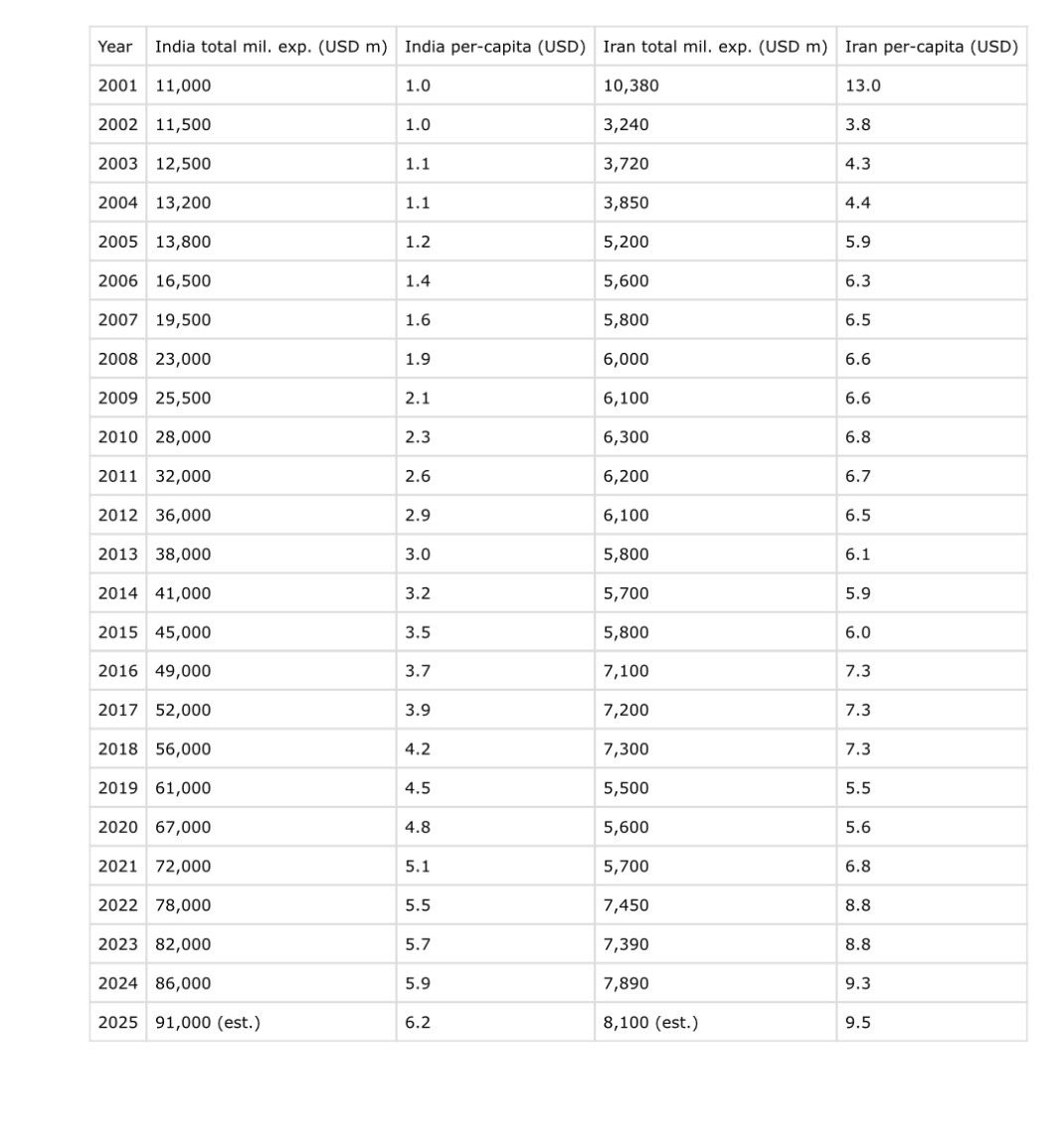
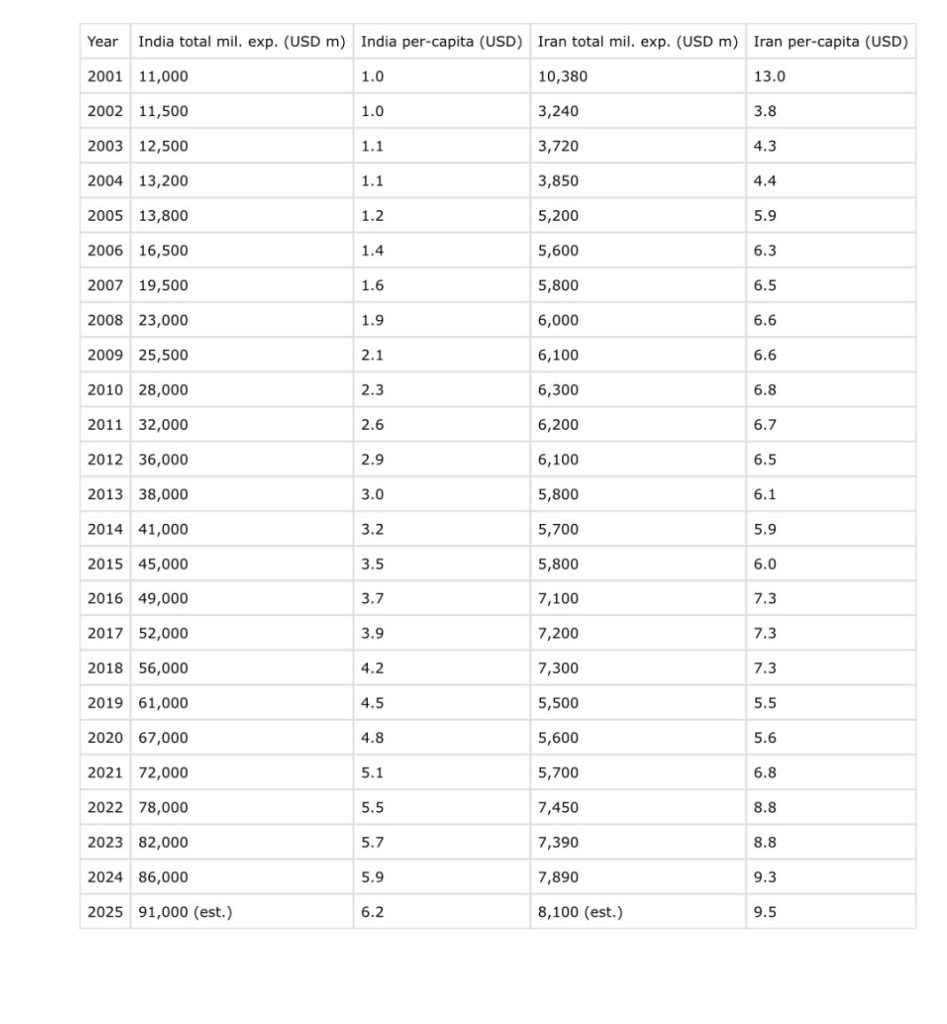
Please take a good, long and hard look at the table below .

India’s total defence budget outlay has risen 8 fold in the last 25 years ( $11 billion to $91 billion) while Iran’s has risen only 3 times (from around $3 billion to $8 billion in the same period).

In 2001, India and Iran defence spending budget was almost the same at c. $ 10 billion. In 2025, Indian defense outlay however was 12 times bigger than Iran’s.

Yet , in per-capita terms the defence spending of India today in 2025 is lower than that of Iran ( $6.2 million Vs $ 9.5 billion)… And this in spite of the crippling economic sanctions that was imposed on Iran by the entire world (except maybe China, Russia and North Korea and to a very small extent by India) in the last 25 years!

India in the last 25 years has been spending year on year billions of USD on defence procurements of hi-end, hi-tech and big-ticket armaments from the West. Whereas severely sanctioned Iran seems to have had no other choice but to invest only in relatively low-end , low-tech , cost-effective missile and drone technology with which, however to the whole world’s astonishment, in the ongoing war with the combined might of Israel and America, Iran has so far been able to extract a heavy price from both countries in terms of pain, pelf and prestige !

So, the question I now ask myself is this :

Was Iran wiser and much smarter than India in investing and spending on its defense and national security in the last 25 years?

Was there probably overspending if not profligacy on the part of the MoD and Defence General Staff in going for such “big-ticket and heavy-hitting miltary hardware” — through Rafael jets, Bofors howitzers, Apache helicopters, Russian second-hand aircraft carriers and Israeli radar systems— and underspending on cost-effective spending strategies on less sophisticated but no less deadly asymmetry-warfare arsenal , such as what Iran seems to have adopted with not inconsiderable success today ?

Food for thought indeed for the Comptroller and Auditor General of India ( past and present)?

Hmm… I wonder ! 🤔

Sudarshan Madabushi

Is India equipped to fight modern conventional and asymmetrical warfare with lethal drones ? 3 Questions.

My 3 questions to AI this morning:

The ongoing war in Iran and Ukraine confirm that modern warfare today is prosecuted not with battle tanks and fighter jets but with lethal drones .

1. Is India equipped and weaponised in that department?

2. Is there a major chink in India’s Defence preparedness for modern warfare.

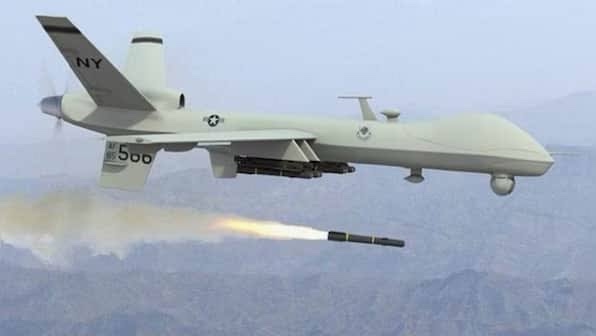
MQ-9 Reaper

AI response :

Drones have indeed become pivotal in modern conflicts like Ukraine and the Iran-Israel war, enabling precision strikes and reconnaissance while minimizing risks to personnel, though tanks and jets retain critical roles in combined arms operations.

India lags in operational lethal drone numbers compared to peers, highlighting a gap in high-end UCAV readiness, but rapid procurements and indigenous efforts are addressing this.


Drone Roles in Conflicts:


In Ukraine, FPV and long-range drones like Shaheds dominate, destroying tanks and disrupting advances, with over 4,400 launched monthly by Russia in early 2026—reshaping tactics toward drone-heavy attrition.

Iran’s ongoing exchanges with Israel feature drone interceptions and retaliatory swarms alongside missiles, underscoring air defense vulnerabilities.

Tanks and jets persist for breakthroughs and air superiority, but cheap drones amplify asymmetric threats.


India’s Position
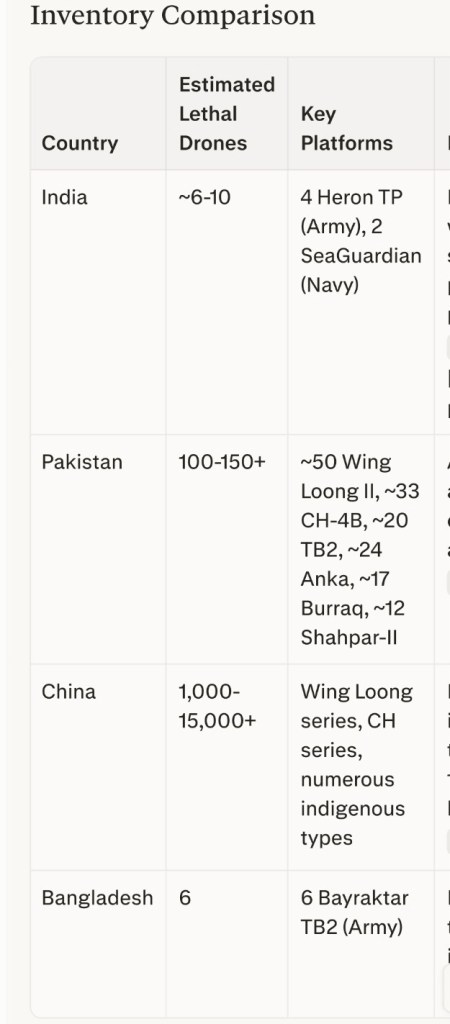
India’s ~6-10 lethal drones pale against Pakistan’s 100+ and China’s thousands, potentially exposing gaps in sustained strike endurance.

However, doctrines emphasize swarms, kamikaze munitions (e.g., 850 procured), and AI integration, with 31 MQ-9Bs incoming to bolster maritime and border ops.

India’s armed forces maintain a modest inventory of lethal (armed or combat-capable) drones, primarily consisting of reconnaissance UAVs with limited strike capabilities and a small number of dedicated armed platforms.

Exact current figures as of March 2026 are not publicly disclosed due to military sensitivity, but estimates from reliable defense analyses indicate fewer than 10 operational lethal drones, with the total UAV fleet (mostly unarmed) under 200 units.

Current Estimates

The Indian military’s drone fleet totals around 179 units as of late 2023, dominated by Israeli Heron and Searcher models used mainly for reconnaissance.

Only a handful qualify as lethal: 4 Heron TP (potentially armable) in the Army and 2 leased SeaGuardian (recon-attack) in the Navy.

No large-scale armed drone squadrons are confirmed operational yet.

Key Platforms

  • Heron TP: 4 units (Army); medium-altitude long-endurance, capable of strikes but primarily recon.​
  • SeaGuardian (MQ-9B variant): 2 leased units (Navy); armed with missiles for maritime strikes.​
    Most others (e.g., 108 Searcher, 65+ Heron 1) are unarmed surveillance types.

Procurements

India is expanding rapidly: 31 MQ-9B Predators approved from the US (not yet delivered), plus plans for 56 Heron TP and 87 indigenous MALE drones by 2029-30.

Loitering munitions like 850 kamikaze drones are in procurement but represent expendable, tactical assets rather than reusable inventory. These will significantly boost lethal capacity soon.


Enhancement Efforts
Procurements include 87 MALE drones and Shaktibaan regiments for unmanned warfare; total UAV pool exceeds 100k including tactical assets. This aligns with global shifts, mitigating the “chink” through scale and autonomy rather than sheer numbers alone.

3. Are comparative figures of Pakistan , China and Bangladesh available ?

Comparative figures for lethal drone inventories (armed UCAVs and combat-capable UAVs) are available from open-source estimates as of early 2026, though exact numbers remain classified and vary by source. These focus on reusable strike platforms, excluding most loitering munitions or unarmed recon drones unless explicitly armed.

Key Insights
Pakistan leads regionally in operational armed MALE UCAVs, leveraging Chinese/Turkish imports and indigenous production.

China dwarfs all with its vast production, emphasizing swarm and AI integration.

Bangladesh’s small fleet is modern but limited, while India’s growth hinges on incoming MQ-9B deliveries.

(Figures exclude one-way munitions like kamikaze drones, which all nations are scaling).

Sudarshan Madabushi

What is present population size of Ayyangars? And how large is the size of the “Vadakalai” subsect?

Recently, some friends of mine on a WhatsApp group were engaged in chatter while discussing comparative Jain community population versus Ayyangar community size. Although , the Jains represent a religious minority while Ayyangars represent a Hindu sect , the lively discussion continued nevertheless.

My views stated during the discussions were as follows :

Ayyangars are like Parsis not Jains ….Our community is going rapidly extinct because there’s not much pride left in the Sri Vaishnava identity, sampradaya and heritage.

The Demographics shown below ⬇️ clearly show the trend line projections of the above fact.

India’s Jain population is estimated at around 5.2 million as of 2026. The Ayyangar (also known as Iyengar) community, a Sri Vaishnava Brahmin subgroup primarily in Tamil Nadu, lacks recent official census figures but is roughly estimated at 600,000 based on older data.

Jain Population

The 2011 census recorded 4.45 million Jains in India, or 0.37-0.4% of the total population. Projections for 2026 suggest growth to about 5.2 million, concentrated in states like Maharashtra, Rajasthan, Gujarat, and Karnataka.

Ayyangar (Iyengar) Population

Iyengars form one of the two main Tamil Brahmin groups alongside Iyers, with no precise national census data available. An approximate 2004 estimate places their size at 600,000, mainly in Tamil Nadu’s Cauvery Delta and cities like Chennai and Nagercoil.

Tamil Brahmins overall (Iyers and Iyengars) number around 1,400,000 in Tamil Nadu per some profiles, with Iyengars as a subset.

Ayyangars IMHO are demographically and culturally in decline .

***** *******

Many of my friends were very skeptical of my estimate of 600,000 being the Ayyangar population because admittedly it was based on 2004 non-Census survey estimates. They all countered me saying that in the absence of Census Data … missing since 2011… nothing could be said about the Ayyangar population size and my account of 600,000 was just gross underestimation.

Since , no one knows when the next countrywide Census survey is going to be held, I decided to do a bit of “back-of-the-envelop” statistical calculations to arrive at the best possible estimate of the current population size of Ayyangars with the aid of AI tools.

Below ⬇️ are my findings:

India’s Ayyangar (Iyengar) population, starting from a 2004 estimate of 600,000, would grow to approximately 928,000 today at a 2.0% annual replacement rate over 22 years.

An alternative estimate, using Tamil Nadu’s 2026 population of 77.3 million and assuming Brahmins at 2.5% (about 1.93 million total), yields roughly 966,000 Iyengars if they split evenly with Iyers.[censusofindia +2]


Growth Calculation
Using the compound growth formula P = P_0 \times (1 + r)^t , where P_0 = 600,000 , r = 0.02 , and t = 22 : P \approx 928,000


This aligns closely with the Brahmin-based projection, as Tamil Nadu’s 2004 population was around 65 million, implying the initial 600,000 was about 0.92%—reasonable for Iyengars as a Brahmin subset.

Key Assumptions
• Annual growth rate of 2.0% (midpoint of 1.9-2.1% replacement fertility).
• Brahmin share steady at 2.5% of Tamil Nadu’s population, consistent with common estimates.
• Iyengars ~50% of Tamil Brahmins (Iyers and Iyengars as main subgroups).

The estimate split between Iyers and Ayyangars however as we know empirically was never equal .

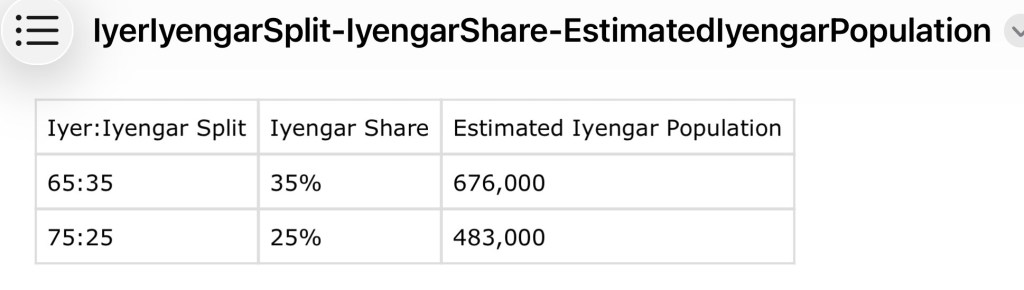
It was more like 65:35 or maybe 75:25 in favour of the Iyers.

So , what then would be the resultant estimate of Ayyangar population today ?

Adjusting for a historical Iyer-Iyengar split of 65:35 or 75:25 in favor of Iyers, the Ayyangar population today is estimated at 676,000 to 483,000 using the Brahmin total in Tamil Nadu.
From 600,000 in 2004 at 2% annual growth: 600,000 \times (1.02)^{22} \approx 928,000 .

Direct projection from the 2004 base this yields 928,000, suggesting a blended range of 700,000-800,000.

Split-Based Estimates
Using Tamil Nadu’s projected 2026 population of 77.3 million and 2.5% Brahmins (1.93 million total):

Averaging the direct and split methods gives ~802,000 (65:35) or ~705,000 (75:25).

***** *******

What about the estimate population size of Vadakalai sub-sect ?

Applying further an estimate ratio of the Tenkakai : Vadakalai sub-sect ratio of 70:30, it can be concluded that estimated population of Vadakalai could be +/- circa. 200,000 to 275,000.

So, my original assertion made to my friends — that Ayyangars are demographically and culturally a community in decline — was not far off the mark, was it?

The Ayyangar (Iyengar) community does face demographic decline, driven by low fertility rates, high emigration, and aging populations in traditional strongholds like Tamil Nadu’s temple towns and Brahmin agraharas.


Key Decline Factors


• Migration: Significant exodus to urban centers, metros, and abroad (US, UK) for education and jobs, leaving villages with abandoned homes.
• Fertility below replacement: Like other Tamil Brahmins, Iyengars exhibit rates under 1.9-2.1 children per woman, accelerating shrinkage despite stable or growing state population.
• Cultural shifts: Urbanization erodes traditional practices, with fewer youth marrying within the community or sustaining rituals, compounded by inter-caste unions.


Evidence from Context
This aligns with my prior estimates: a 2004 base of 600,000 projecting to 700k-900k in 2026 ignores outflows, suggesting actual numbers closer to 400k-600k today after net decline. Brahmin neighborhoods near Thanjavur temples are now 30-90% vacant or elderly-occupied.

Sudarshan Madabushi

Here’s why PM Modi remains mum on the ongoing Us-Israel War against Iran

https://youtu.be/LfGcX4XuZ5A?si=eI-TrBmS3Dw3JFoO

The above video discusses the Middle East’s reaction to Iran’s attacks and the US’s role in the region.

It is a very sober and sagacious assessment.

It’s America that is the real villain of the piece here .

It’s very clear what the larger American imperial strategic game here is :

1. The target is China . Do everything to contain China in the long term. How ?

2. Weaken EU : so it shrinks as a marketplace for China exports .

3. Choke up Venezuela oil exports to China .

4. Disrupt Iranian oil export to China.

5. Impose sanctions on Russia to degrade its economy so its Economic and Military cooperation with China becomes ineffective or effete.

6. Create Chaos in African states where Chinese footprint is getting larger in terms of investments.

So, America is really playing the long game here against China.

In the short term , EU, Greenland, Ukraine , Venezuela and Iran are merely moving the pieces on the chessboard for establishing positional advantage .

*********

Here’s a breakdown of the key topics discussed in the interview in the above video:

• Surprise at US reaction (0:54-1:39): The former Saudi intelligence chief expresses surprise at President Trump’s surprise regarding Iran’s retaliation. He notes that Gulf leaders had previously warned the US against military action in Iran, anticipating retaliation against American presence in the region.
• Gulf States’ defense capabilities (2:18-3:14): Saudi Arabia is working to strengthen its military capabilities and develop a domestic military industry to reduce reliance on foreign powers. They are also collaborating with other Gulf States to form a common defense command.
• Past US support (3:15-3:42): The former intelligence chief recalls that the Trump administration did not offer support when Saudi Arabia was bombed by Iranian missiles in 2019, indicating a lack of surprise at the current lack of US assistance.
• Saudi Arabia’s focus on development (4:00-4:11): The Kingdom is focused on social, industrial, and commercial development and aims to avoid military conflicts in the region.
• Iran’s internal situation (4:48-6:08): The speaker dismisses the idea of a sectarian conflict between Sunni and Shia. He believes the Iranian system will not collapse soon, as its leadership has been preparing for potential challenges, including those stemming from past calls for destruction by Mr. Netanyahu. He also notes that Iran is already in the process of electing a new leader and has an interim leadership in place.

**********

Now, here’s what could be a game changer for the GCC countries in the ongoing war . It could throw a spanner in the works for both Israel and America and serve to shorten sharply the expected duration of the war.

If the GCC nations were to declare themselves unanimously as neutral in the war between US-Israel against Iran , it might help in 3 significant ways :

  1. Israel would get isolated politically in the region .
  2. ⁠US would be seen to be acting in defense and on behalf of only Israel and not on behalf of so-called “regional peace” — the dubious justification it is now using as its reason for waging war .
  3. ⁠Iran could use the GCC declaration of neutrality to put USA and Israel in a real spot in the UNSC and the US Congress and Senate.

However, it would take great courage indeed on the part of the monarchies to take such a bold statesmanlike step. And these rulers do not have a credible track record of showing such courage.

********

Now, we come to the question that everyone is asking in India: PM Modi’s silence or ambivalence in this ongoing war .

The answer is obvious to me at least:

The people who are still wondering why Modi is keeping silent on India’s position in this war , they must wake up to understand that Modi too is skilfully playing the long game. And why ? Because he believes that India’s long term geopolitical goal converges perfectly with that of the containment strategy being pursued by America against China.

The near adversary is China … the distant adversary is America. Use the remote to smote the immediate enemy first.

Q E D

Sudarshan Madabushi

Post-Iran attack on February 28, 2026, The World can kiss “New World Order” goodbye.

The day after the Israeli-American attack on Iran and the killing of Ayatollah Khomeini, I couldn’t help falling into a self-introspective mood.

Pax Americana

Looking back at history, I thought to myself, wasn’t the world always better off when there were many little rogue-nations that nevertheless minded their own business and backyards than now, in sad contrast, when we have just one big beast of a rogue-nation, prowling with about 800 miltary bases nearly everywhere around the world, wanting to mind and meddle into everyone’s business.

If a big power hegemon like America behaves as it has done with impunity just now in Iran and Venezuela, and just as it did in the history of last 80 years — in Korea, Vietnam, Latin America, Iraq, Libya, Syria, Georgia, Ukraine — with scant respect for both the US Constitution and the UN Charter , the world will have to just kiss goodbye to anything called a World Order . We can all go back to the Law of the Jungle : Might is Right and US Might must always be right.

What I say above is neither rhetoric nor about big power geo-strategy. It’s plain common sense .

The US has intervened in numerous conflicts over the past 80 years, often without full congressional approval or UN endorsement:


• Korea (1950s): UN-backed initially, but escalated beyond mandate.
• Vietnam (1960s-70s): No UN role; Gulf of Tonkin Resolution later deemed misleading.
• Latin America (e.g., Chile 1973, Grenada 1983): CIA-backed coups or invasions, ignoring self-determination.
• Iraq (2003): No UN resolution for invasion; WMD claims debunked.
• Libya (2011): NATO exceeded UN no-fly zone.
• Recent cases (Syria, Venezuela, Iran sanctions): Drones, regime-change rhetoric, and sanctions without broad multilateral buy-in.


The US Congressional Research Service shows over 200 US military actions since 1945, with fewer than 20% fully UN-authorized.

America’s impunity stems from veto power in the UN Security Council and military dominance (US defense budget: ~$877B in 2024, per SIPRI, vs. next 10 nations of the world combined).

The doctrine of “might is right” only invites chaos to the world :

Common sense tells us that deterrence relies on credibility. If the hegemon flouts rules, others will follow.

**** ****

American interventions (meddling) in all countries of the world is founded on the cardinal self-belief in what it boasts of as “American exceptionalism” rooted in 19th-century manifest destiny and post-WWII leadership spawned by the Monroe Doctrine. Calling American Exceptionalism as a “recipe for endless conflicts” would not be baseless:

Since 1945, the US initiated or joined ~250 military actions (CRS data), costing 7M+ lives globally (Costs of War Project, Brown University).

US also fits the UN definition criteria of “Rogue state” (e.g., UN definitions: threats to peace, aggression) … Iraq 2003 and now Iran in 2026.

Bush Sr.’s 1990 phrase implied US-led unipolarity, and led to endless wars (Afghanistan: 20 years, $2T+, ISIS from Iraq chaos, Taliban resurgence.. a few examples.

US vetoed 50+ UNSC resolutions on Israel since 1972 (UN data), while sanctioning 30+ nations. Clearly double standard inviting accusations of hypocrisy.

Yet, it’s not uniquely American—Russia (Georgia, Ukraine), China (Taiwan threats), and others play similar games.

“American Exceptionalism” is today championed and perpetuated according to the “Neocon Playbook” first conceived as the Wolfowitz Doctrine (1992). It was he who laid down the 11th Commandment in American Foreign Policy: Thou shalt never tolerate peer rivals. And that’s what led to Iraq/Libya chaos; and 2026 Iran hawks (Pompeo echoes) who know push regime change.

Then to further affirm and realise the Monroe, Wolfowitz and Pompeo Doctrines, there is the Oligarch Fuel: Lockheed/Raytheon lobby $100M+/year; Ukraine aid ($175B) which both loop profits back to the oligarch-neocon network.

Why cant the big powers agree on spheres of influence in the world and then live and let live so everyone, all nations in the world, can mind their own business and stop meddling in each other’s backyard ?

Spheres of influence sound like a pragmatic truce—US takes Americas, Russia its near abroad, China East Asia, India South Asia, and everyone stays in their lane. It’s the “live and let live” Westphalian ethos from 19th-century Europe (e.g., Concert of Europe post-Napoleon).

Alas, big powers can’t commit because trust deficits, ambition, and globalisation make backyards overlap irreversibly. Past betrayals linger.
No one believes rivals will honor borders:


US violated post-WWII norms (Iraq, Libya); Russia grabbed Crimea (2014); China eyes Taiwan/Senkakus.


Spheres worked only in bipolar Cold War (Yalta 1945: US/Europe, USSR/Eastern bloc), but today’s multipolarity breeds paranoia—US fears Chinese ports in Pakistan (Gwadar), Russia dreads NATO in Ukraine.

John Mearsheimer writes that Great Powers expand by nature (echoing Thucydides: fear + honor + interest):


• US: Trump-era “Monroe Doctrine 2.0” claims Western Hemisphere but stations 100K+ troops in Europe/Asia—won’t cede Indo-Pacific to China.


• China: BRI ($1T+) weaves economic tentacles worldwide, not just Asia.


• Russia: Putin demands “privileged interests” beyond borders, but using the energy leverage it pulls it weight globally.


Hegemons meddle for resources (oil, rare earths), alliances, or prestige—no fire wall can ever stop that.

**** *****

Sudarshan Madabushi

Sri Thyagaraja, the undeclared Sri Vaishnava “prapannan”

Like millions of Rasikas all over the world , I too consider myself an ardent Sri Thyagaraja bhakth who loves so many of the saint’s exquisite kritis and often, whenever swept away by the mood, I do sing a few of them in the privacy of my home purely for the delight of my own soul (svaanubhavam).

On some occasions, I record my own renderings in audio clips and share them amongst close family, friends and fellow-rasika circles on WhatsApp groups: a pardonable “saatvika” self-indulgence…

More than a week ago , I had shared with my good friend Sri N. S. Srinivasan an audio clip of my personal “svaanubhavam” of the Thyagaraja Kriti “dvaitamu sukhama advaitamu sukhama?” with the following message attached :

“Sunday special rendering dedicated to you… Some people send their warm daily good wishes and good morning greetings to others through colourful pics, memes and images , I choose today to circulate to all my good friends a great Thyagaraja krithi that enveloped my mood this Sunday morning and made me want sing it to myself and share it with good souls like you in my world.

Some kritis of Thyagaraja are very contemplative and introspective . This Kriti in reetigowlam raagam is one such … It is a song that perhaps Sri Thyagaraja sang spontaneously within the tranquil silence within his own heart … because the lyrics seem to certainly suggest a certain philosophical anguish with which he sang them …

This song often gets sung in many kutcheris IMHO by Vidwans who exhibit no sense at all for the mood of its elevated contemplative-ness. Often the violin and mridangam accompaniments too intrude into serene flow and mar it … Thereafter, unnecessary inclusion of ensuing swarapraathaara would also totally erase the introspective imprint of the Kriti on the Rasika’s minds …

M D Ramanathan was perhaps the only exception in this regard. He used to sing this Kriti the best of all … for he seemed to know the depth of its meaning , the pathos in its mood and the spiritual with which Thyagaraja had sung it .

On this Sunday morning , in singing this beautiful Kriti , I pay personal tribute to Sri Thyagaraja as well as MDR .

🙏💐
M K Sudarshan

N.S. Srinivasan my friend is a very busy practising Chartered Accountant who works out of Mambalam. He is a devout practising Sri Vaishnava with native roots in the Vedic agrahaaram of Naavalpaakam. He is also well versed in Veda, Divya Prabhandham and Sri Vaishnava sampradaya subjects. We have been friends for many years. He took his own time to listen to my forwarded audio-recording but eventually he was kind enough to send feedback in an appreciative voice-message that said:

“Wonderful, really enjoyed it because it reminded me of M D Ramanathan ! I’ll be grateful if you can also send me your own appreciation of the deep meaning embedded in this Kriti”.

So, not wanting to disappoint my good friend , I sent him today the below message:

***** ******

Thyagaraja’s kriti “Dvaitamu sukhamā advaitamu sukhamā?” in Raga Reetigaula poses a profound inquiry into the relative merits of Dvaita (duality) and Advaita (non-duality) for spiritual bliss, reflecting the composer’s devotional introspection rather than a firm doctrinal stance.

The pallavi directly asks: “Dvaitamu sukhamā? Advaitamu sukhamā?”—Is duality blissful, or non-duality?

In the anupallavi, Thyagaraja appeals to the Lord as “Caitanyamā vinu sarvasākṣi” (O Pure Consciousness, witness of all), urging clarity on this “vistāramuga” (in detail).

The charanam evokes the Lord’s presence across elements, deities, and devotees, underscoring a unified divine reality amid the philosophical dilemma.


Interpretations of the song vary: Some view it as Thyagaraja—raised in Advaita traditions—questioning monism’s implications for personal devotion, hinting at Dvaita sympathies without outright rejection.

Others see syncretism, aligning with Vishishtadvaita, as his broader oeuvre blends bhakti with non-dual realization (e.g., “advaita sāmrājyamulabbināṭṭu” in “Rāma Sītā Rāma”).

No scholar or musicologist frames this one of Thyagataja Kritis as any kind of resigned Dvaita affirmation; instead, it gets often explained away as a sincere plea for guidance, resolved through ecstatic bhakti transcending rigid schools. Thyagaraja’s works do often prioritize Harinama Sankirtana for unity consciousness, embracing Advaita’s zenith via devotion over intellectual debate.

Some say however that this kriti subtly favors Vishishtadvaita-like qualified non-dualism, where Jivatma and Paramatma relate devotionally yet inseparably, mirroring Sri Vaishnava harmony of difference and oneness.

***** *******

It’s always very easy and prudent, of course, to smooth over things disputed by scholars and not ruffle any feathers by simply saying politically correct things: That in this Kriti, Thyagaraja placed Bhakti above all 3 philosophical schools of Vedanta. But that IMHO would be oversimplification of Thyagaraja’s philosophy …. which is thyaagopanishad is far too profound to be reduced to uni-dimensionality.

I say so because in his other poignant Kriti “teliyaleru raama bhakthi maargamu” (Dhenuka raagam) Thyagaraja bemoans his pathetic inability to know how to walk the path of Bhakthi too.

So, no one can really put any convenient labels upon a soul as complex as Thyagaraja’s to fathom his philosophical outlook in life.

One might say though that, in the last mentioned Kriti above , Thyagaraja was venting the typical plea of “aakinchinya”… spiritual helplessness and admitting defeat in comprehending and practising fully any worthy “moksha upaaya”. That he was expressing his abject spiritual “gati”…. floundering about in life knowing neither philosophy nor Bhakthi. A Sri Vaishnava like me might hence ask himself then: wouldn’t that make Thyagaraja an “undeclared, unacknowledged prapannan” in the mould of a follower of Ramanuja Siddhantham?

What truly was he? Advaitin, Dvaitin, Visishtadvaitin … or a Sri Vaishnava prapannan ? He keeps us all guessing! We will never really know the answer because we are clueless, in the first place, about who we ourselves truly are! And it is precisely such “clueless-ness” that is at the heart of what Thyagaraja sang in both his kritis, dvaitamu sukhama and teliyaleru… !

Thyagaraja was only trying to mirror our own spiritual shallowness. Don’t we delude ourselves into thinking we know so much about Dvaita and Advaitam? Don’t we also delude ourselves into believing our hearts are overflowing with Bhakthi? Thus, does Thyagaraja deride us all in those two kritis of his! He sarcastically observes:

“vEgalEci nITa munigi bhUti bUsi vallanenci veliki shlAganIyulai… bAga paika mArjana lOlulai rEgani….”

“They wake up at dawn, attend to their ablutions, proudly wear the emblems of creed and count the holy beads, put on a show appearing to be spiritual and religious, but behind their minds they are all so busy working out strategy and schemes for making money by hook or crook….”

***** *******

Thyagaraja was a saint , mystic and philosopher, no doubt, but he was also a realist who had no illusions about the spiritual cynicism of humankind. In his songs, he was careful not to sound preachy or judgmental about humans… he simply expressed his pity for us … for our spiritual vanities, our intellectual naïveté and above all, our moral pretensions.

Like a true Sri Vaishnava, Thyagaraja also had the good sense and the humility to invert and divert towards himself any carping criticism he had reserved in his heart for society’s failings… It is that rare and noble quality of Humility which in Sri Vaishnavism is called “naicchyaanusandaanam” … : it is the deprecation and diminution of oneself to keep abstaining from committing the cardinal sin of “bhaagavatha apachaaram”, the wanton casting of hurtful aspersions in any sort of way upon fellowmen who, as souls that know not what they really do in and with life…. must always be forgiven.

****** ********

Sudarshan Madabushi