The Cosmic Cul-de-Sac: How Indian Courts Became the Accidental Theologians of Chidambaram and Kanchipuram

By M. K. Sudarshan

Both the roads from Chidambaram and Kanchipuram lead to the exact same destination: the Supreme Court of India. It is an expanding, timeless cul-de-sac where litigation goes to be indefinitely preserved in the hope that, one day, the conflict will simply fall asleep.

In a previous essay posted the day before yesterday, the story of the Chidambaram Temple was narrated by me.

Read Part 1: The Chidambaram Rahasyam – How a Vaishnava Shrine Became a Proxy War Pawn
[https://mksudarshans.blog/2026/06/30/the-chidambaram-rahasyam-how-a-sri-vaishnava-shrine-became-a-proxy-war-pawn-in-tamil-nadu-politics/]

And now it is time to tell next the story of Kanchipuram.

Read Part 2: Kicking the Can to Heaven: Why the Supreme Court Will Never Solve the Temples of Tamil Nadu

[https://mksudarshans.blog/2026/07/01/kicking-the-can-to-heaven-why-the-supreme-court-will-never-solve-the-temples-of-tamil-nadu/]

To the modern, secular observer, the ancient temple towns of Tamil Nadu are places of static stone, quiet meditation, and timeless devotion. But step past the thresholds of the grand Nataraja Temple in Chidambaram or the Varadaraja Perumal Temple in Kanchipuram, and you enter a highly litigious universe. Here, centuries-old agamic traditions, hereditary privileges, and theological identities are locked in a state of permanent legal warfare.

The combined two-part series above thus deconstructs a magnificent theater of the absurd: the intractable, centuries-old liturgical disputes that divide Saivite from Vaishnavite in Chidambaram, and Vadakalai from Tenkalai within Kanchipuram.

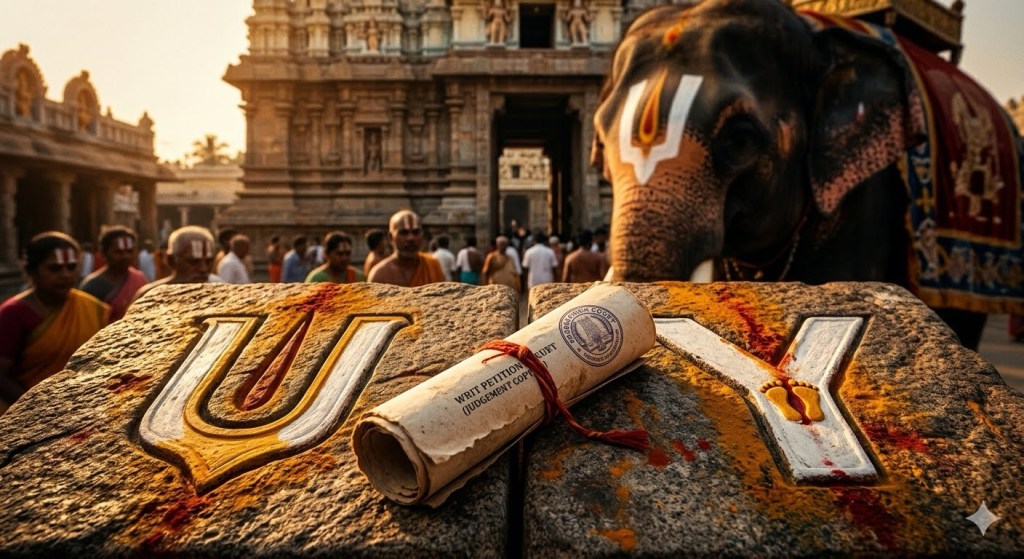
On the surface, these battles appear to be driven by minor cosmetic and ritual choices—the astronomical timing of a festival procession, the exact syllable of an opening invocation chant, or whether a sacred mark painted on an elephant’s forehead resembles a “U” or a “Y”. In reality, however, these flashpoints are merely symptoms of a profound, systemic phenomenon: a secular constitutional quagmire of India’s own design. ┌──────────────────────────────────────────┐ │ THE GREAT TAMIL NADU TEMPLE AXIS │ └────────────────────┬─────────────────────┘ │ ┌──────────────────────────┴──────────────────────────┐ ▼ ▼ ┌───────────────────────────────┐ ┌───────────────────────────────┐ │ PART 1: CHIDAMBARAM │ │ PART 2: KANCHIPURAM │ ├───────────────────────────────┤ ├───────────────────────────────┤ │ The Inter-Sectarian Battle │ │ The Intra-Sectarian Battle │ │ Saivite vs. Vaishnavite │ │ Vadakalai vs. Tenkalai │ │ Timeline & Spatial Warfare │ │ Liturgical Branding Warfare │ └───────────┬───────────────────┘ └───────────────────┬───────────┘ │ │ └──────────────────────────┬────────────────────────────┘ │ ▼ ┌───────────────────────────────────────────────────────┐ │ THE SUPREME COURT TERMINUS │ ├───────────────────────────────────────────────────────┤ │ An expanding, timeless cul-de-sac where the judiciary │ │ plays "Accidental Theologian" to freeze the conflict. │ └───────────────────────────────────────────────────────┘

Because Hinduism lacks a central, papal-style institutional authority capable of arbitrating internal schisms, these feuds inevitably march down the legal highways of the state. There, secular, Western-educated judges are forced to play the role of “accidental theologians”—interpreting medieval Sanskrit commentaries and agamic manuals to issue legal dictums that function as a new body of de facto scripture.

Yet, as both the essays reveal, neither the litigants nor the courts truly desire a final, absolute resolution. A definitive verdict would create an absolute loser, threatening public order and exposing the deep structural contradictions of state-regulated secularism.

Instead, the litigants find a strange comfort in maintaining their existential battle lines under the prestigious cover of constitutional law, while the courts adopt a sagacious “do-nothing” strategy. By kicking the can down the road through slow-moving mediation windows and endless procedural loops, the judiciary keeps a firm lid on volatile passions.


If you found the previous essay on Chidambaram Temple to be an eye-opener — you should now turn the page and go read its sequel and you will find yourself rubbing your eyes in disbelief : “Kicking the Can to Heaven: Why the Supreme Court Will Never Solve the Temples of Tamil Nadu”

M. K. Sudarshan
Kicking the Can to Heaven: Why the Supreme Court Will Never Solve the Temples of Tamil Nadu

by M. K. Sudarshan
July 1, 2026: Chennai, India

“A satirical yet in-depth exploration of the 300-year-old Vadakalai vs. Tenkalai sectarian feud at Kanchipuram’s Varadaraja Perumal Temple and the legal stalemate that keeps it alive.”

Introduction

If you ever find yourself weary of standard political theater, pack your bags and head to the ancient pilgrim city of Kanchipuram. Here, at the magnificent Varadaraja Perumal Temple, a 300-year-old liturgical cold war is being waged with the tactical intensity of a nuclear standoff. This is the domain of the Sri Vaishnavas, a community split into two sub-sects: the Vadakalai (the Northern culture) and the Tenkalai (the Southern culture).

To the modern, smartphone-wielding layperson, the battle lines might seem surreal. This is a universe where a single initial, the shape of a white clay mark on an elephant’s forehead, or the exact millisecond a specific verse is uttered can trigger an avalanche of legal injunctions, police deployments, and supreme court appeals. Welcome to India’s grandest religious theater of the absurd, where theological obsession meets a highly bureaucratic legal system to create a permanent loop of litigation.


Part 1: The Anatomy of a Sacred Schism — Y, U, and Elephant Foreheads ┌─────────────────────────────────────────────────────────┐ │ THE GREAT FOOTPRINT SCHISM │ └────────────────────────────┬────────────────────────────┘ │ ┌──────────────────┴──────────────────┐ ▼ ▼ ┌───────────────────────┐ ┌───────────────────────┐ │ VADAKALAI (North) │ │ TENKALAI (South) │ ├───────────────────────┤ ├───────────────────────┤ │ • Tilak Shape: 'U' │ │ • Tilak Shape: 'Y' │ │ (Touches nose bridge) │ (Has a stem/foot) │ │ • Language: Sanskrit │ │ • Language: Tamil │ └───────────────────────┘ └───────────────────────┘

To understand the perversity of the feud, one must first appreciate the architectural anatomy of the sectarian divide. The conflict is not over territory or cash flow; it is over branding and intellectual property.

The Great Branding War

The Vadakalais and Tenkalais are separated by an invisible but absolute liturgical wall. The most famous visual indicator is the Namam (the sacred forehead mark):

  • The Vadakalais wear a U-shaped mark that stops precisely at the bridge of the nose.
  • The Tenkalais wear a Y-shaped mark that features a distinct stem or “foot” extending down the nose.

In Kanchipuram, this is not a minor cosmetic preference; it is a battle for total visual dominance. For generations, both sects have fought over which shape gets painted onto the temple walls, the temple umbrellas, the brass bells, and—most famously—the forehead of the temple’s ceremonial elephant.

The poor elephant has historically required police escorts and judicial mediation just to get its morning bath, lest an overzealous priest sneak into the stable with a bucket of white clay to transform a “Y” into a “U” before the morning procession.

The Battle of the Hymns

The deeper, more intractable battle involves the Prabandham (the Tamil hymns of the Alvars). Before these hymns can be chanted during a procession, a short invocation verse (mantram) must be recited to honor the sectarian lineage:

  • The Vadakalais demand their verse: Ramanuja Dayapatram…
  • The Tenkalais demand their verse: Srisailesa Dayapatram…

Because you cannot chant both simultaneously without creating a chaotic noise that would offend the deity, the procession routes became competitive battlegrounds. For three centuries, groups of septuagenarian scholars from both sides have physically blocked temple pathways, engaging in shouting matches over who gets to chant their initial line first.


Part 2: Enter the Accidental Theologians — How the Judiciary Became a Priesthood[Sectarian Squabble] ➔ [Civil Procedure Code Sec. 9] ➔ [Judges as "Accidental Theologians"]

When an immovable theological force meets an unyielding liturgical wall, the parties do not appeal to a Pope. Why? Because Hinduism lacks a single, papal-style institutional authority capable of passing a binding decree over both sects. Naturally, the feuding parties turn to the only other secular entity with an all-powerful gavel: the Indian Civil Courts.

The Section 9 Trap

Under Section 9 of the Civil Procedure Code, Indian courts are legally required to hear any civil suit involving a right to an office, a livelihood, or religious honors (Mirasi). The moment a Tenkalai priest claims that a Vadakalai chanting out of turn deprives him of his hereditary right to a piece of sacred coconut or a silk tassel, the state’s legal machinery is triggered.

Accidental Theologians

This dynamic forces secular, Western-educated judges into the bizarre role of “accidental theologians.” Instead of analyzing corporate balance sheets, high court judges find themselves reading 14th-century Sanskrit commentaries to determine whether an ancient saint preferred a “U” or a “Y”. ┌─────────────────────────┐ │ THE JUDICIAL SANCTUM │ └────────────┬────────────┘ │ ┌────────────────────────────┴────────────────────────────┐ ▼ ▼ ┌───────────────────────────────┐ ┌───────────────────────────────┐ │ CONSTITUTIONAL REALITY │ │ THEOLOGICAL REALITY │ ├───────────────────────────────┤ ├───────────────────────────────┤ │ "We must apply the │ │ "We must interpret the exact │ │ text of Article 25 & 26." │ │ meaning of a 600-year-old │ │ │ │ Sanskrit invocation verse." │ └───────────────────────────────┘ └───────────────────────────────┘

Through historic rulings like the Shirur Mutt Case, the courts created the “Essential Religious Practices” doctrine. This doctrine dictates that to protect freedom of religion, the court must first define what the religion actually is.

Consequently, the archives of the Madras High Court have essentially become a modern addition to the Hindu Agamas and Sastras. Judges do not play God; they play God’s copyeditors, issuing legal dictums that reshape how rituals are conducted on the ground.


Part 3: The 2025/2026 Legal Circus — Justice Kaul’s Infinite Loop

The theater reached its absolute peak in the mid-2020s. After decades of lower-court skirmishes, the Madras High Court delivered a comprehensive verdict in November 2025, ruling decisively in favor of the Tenkalai sect. The court declared that the Tenkalai mantram and Tamil Prabandham held exclusive rights during the temple’s official processions.

The Strategic Appeal

The Vadakalai sect, refusing to accept total disenfranchisement, immediately appealed to the Supreme Court of India. They did not just argue about the hymns; they raised a high-stakes constitutional issue: they claimed that by giving the Tenkalais an absolute monopoly, the High Court had violated the individual fundamental rights of Vadakalai devotees to express their own faith under Article 25.

The Supreme Court’s Escape Route

Faced with a highly complex constitutional issue that could disrupt hundreds of temples across South India, the Supreme Court deployed its favorite tactical tool: The Judicial Mediator. On January 28, 2026, the apex court appointed retired Justice Sanjay Kishan Kaul as the Principal Mediator, instructing him to bring both warring sects to the table for a consensual resolution.

What followed was pure Catch-22:

  1. The Mediation Sessions: Justice Kaul diligently convened meetings, flanked by language experts and historical scholars. Both sects attended, drank tea, and politely refused to yield a single syllable of their respective mantrams.
  2. The Stagnation: Justice Kaul quickly realized what 300 years of history had already proven: you cannot compromise on an absolute invocation. You cannot chant half a Vadakalai verse and half a Tenkalai verse without offending both lineages.

Realizing that a forced compromise would simply trigger a fresh wave of secondary lawsuits, the mediation process quietly ground to a halt. No status reports were issued, and the file was placed into an indefinite judicial deep-freeze.


Part 4: The Catch-22 of Modern Devotion — Why Nobody Wants a Solution

To the outside observer, a permanent legal stalemate looks like a failure of the system. But within the unique eco-system of temple litigation, the stalemate is actually the desired outcome for almost every protagonist involved.+───────────────────────────+───────────────────────────────────────────────────────────+ | PROTAGONIST | THEIR SPECIFIC CATCH-22 STRATEGY | +───────────────────────────+───────────────────────────────────────────────────────────+ | The Feuding Priests | Winning completely is dangerous because it ends the | | | struggle that defines their institutional identity. | +───────────────────────────+───────────────────────────────────────────────────────────+ | The Secular State | Resolving the conflict removes their justification for | | (HR&CE Department) | maintaining regulatory control over the temple. | +───────────────────────────+───────────────────────────────────────────────────────────+ | The Supreme Court & | Issuing a final verdict creates a clear loser, sparking | | Justice Kaul | public protests and endless secondary appeals. | +───────────────────────────+───────────────────────────────────────────────────────────+

The Perpetual Motion Machine

This creates a perfect Catch-22 loop. The sects sue because they want a definitive victory, but they ensure mediation fails because they cannot accept a compromise. The court agrees to hear the case because it involves civil rights, but refuses to issue a final judgment because it cannot police daily religious speech. The state intervenes to maintain public order, and its ongoing presence keeps both sides on edge, ensuring the next round of litigation is filed right on schedule.

Part 5: The Secular Constitutional Quagmire — The Cosmic Cul-de-Sac

Ultimately, the Indian judiciary has realized that it can neither adopt the Pontius Pilate stratagem of washing its hands (because Section 9 forces it to act) nor play King Solomon by finding a clever legal solution for all parties.

A Tacit Acknowledgment of Structural Failure

Instead, the courts opt for a more pragmatic approach: the “do-nothing” strategy. What looks on the surface like administrative foot-dragging is actually something far more profound: a tacit acknowledgment of the inescapable secular constitutional quagmire into which the State, the Judiciary, and the Litigants have all happily plunged themselves.

By keeping mediation processes technically active but fundamentally stagnant, the Supreme Court achieves a comfortable paralysis. The state’s legal machinery is trapped in a loop of its own design: it cannot exit religious administration without abandoning its secular regulatory mandates, yet it cannot execute those mandates without functioning as an unauthorized theological tribunal.

The result is a shared, comfortable wallowing. The feuding sects get to maintain their existential battle lines under the prestigious cover of constitutional litigation, while the courts avoid delivering a definitive verdict that would inevitably trigger widespread public unrest or force an uncomfortable re-evaluation of India’s secular framework. ┌─────────────────────────────────────────────────────────┐ │ THE CONSTITUTIONAL EXPANDING LOOP │ └────────────────────────────┬────────────────────────────┘ │ ┌────────────────────────────┴────────────────────────────┐ ▼ ▼ ┌───────────────────────────────┐ ┌───────────────────────────────┐ │ CHIDAMBARAM HIGHWAY │ │ KANCHIPURAM HIGHWAY │ ├───────────────────────────────┤ ├───────────────────────────────┤ │ Denominational Autonomy vs. │ │ Individual Faith vs. │ │ State HR&CE Expansion. │ │ Denominational Monopolies. │ └───────────────┬───────────────┘ └───────────────┬───────────────┘ │ │ └───────────────────────┬───────────────────────┘ │ ▼ ┌─────────────────────────────────────────────────────┐ │ THE SUPREME COURT TERMINUS │ ├─────────────────────────────────────────────────────┤ │ An expanding, timeless cul-de-sac where litigation │ │ goes to be indefinitely preserved. │ └─────────────────────────────────────────────────────┘

Recommended Reading for a Community in Crisis

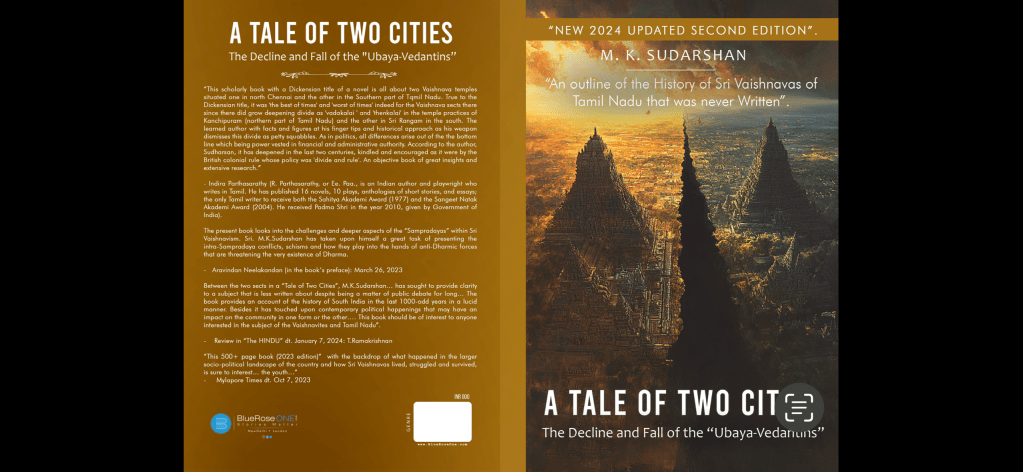
For those seeking to look past the superficial comedy of alphabet marks and shouting matches to understand the profound institutional rot beneath, one must turn to the definitive literature on the subject. In his critically well-acclaimed 2024 book, “A Tale of Two Cities”, author M.K. Sudarshanprovides a comprehensive, beautifully well-researched history of this very crisis. Subtitled as the chronicle of the “Decline and Fall of the Sri Vaishnavas of Tamil Nadu that was never told,” Sudarshan’s work strips away the legal jargon to expose the tragic sociological reality: how a once-magnificent spiritual and intellectual empire allowed itself to be hollowed out from within by centuries of petty, self-destructive litigation.

Available on Amazon / FlipKart/ Blue Rose Publishers online retail platforms

The Endless Road

It is this self-destructive loop that the younger generation of Sri Vaishnava devotees looks upon today with a mix of amusement and exhaustion. They watch their elders spend millions on legal fees to fight over alphabet shapes and chanting orders, while the broader spiritual heritage of the temple takes a backseat to bureaucratic legal battles.

Both the roads from Chidambaram and Kanchipuram ultimately lead to the exact same destination: the Supreme Court of India. All participating factions march down this road fully aware of the reality: that the apex court is not a dispenser of final clarity, but an expanding, timeless cul-de-sac.

The can has been kicked down the dusty roads of Tamil Nadu for over 300 years, traversing colonial courts, Madras High Court benches, and the halls of the Supreme Court. It will likely keep traveling for many more miles—safely protected by a legal system that understands that in the theater of Indian secularism, keeping the file open forever is much safer than ever writing the final chapter.

(Concluded)

M.K.Sudarshan

The Chidambaram Rahasyam: How a Sri Vaishnava Shrine became a Proxy War Pawn in Tamil Nadu politics

by M.K.Sudarshan

June 30, 2026/Chennai, India

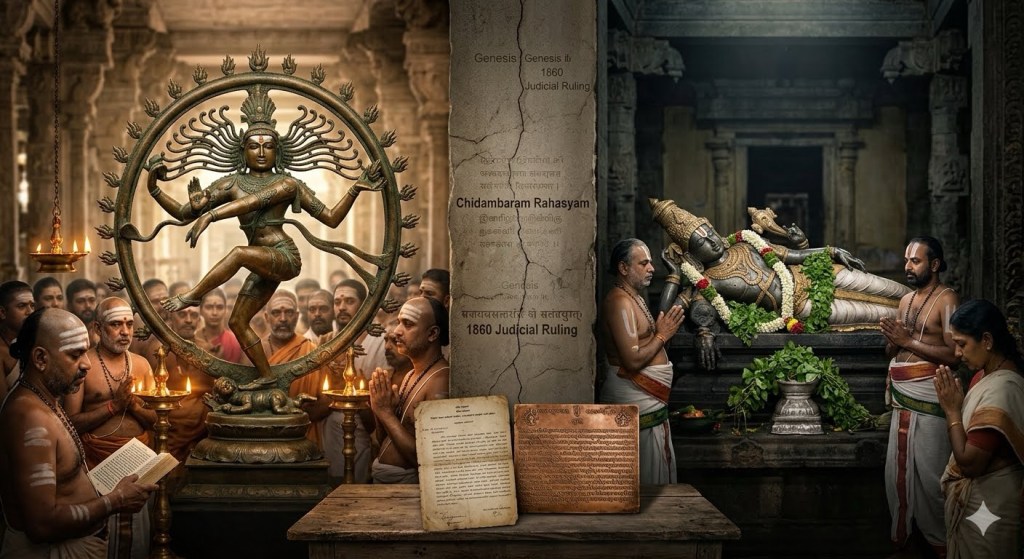
Chidambaram Temple

Introduction

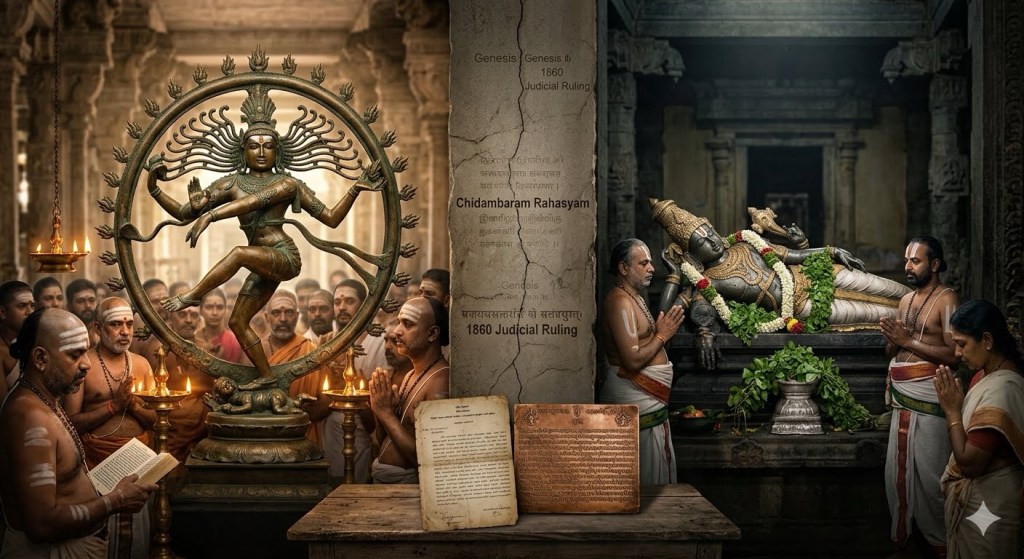
The Chidambaram Nataraja Temple is globally celebrated as the cosmic stage of Lord Shiva’s Ananda Tandavam. Yet, deep within its sacred geometry lies a quieter, parallel sanctuary: the Thillai Govindaraja Perumal shrine. For centuries, this physical coexistence of Shiva and Vishnu symbolized a rare, uneasy theological truce. Today, however, that truce has shattered.

This essay deconstructs the multi-layered crisis of Chidambaram, revealing how ancient agamic codes, colonial legal settlements, and modern state-sponsored administrative warfare have converged to lock the temple in an intractable stalemate. It is a story where genuine religiosity has been sidelined by political posturing, leaving a vulnerable religious minority caught in the crossfire.


The Shared Sacred Canon: Where Tevaram Meets Divya Prabandham

Long before British benches or secular departments arrived to arbitrate the boundaries of Thillai, the temple complex existed as an intertwined dual-capital of the Tamil Bhakti movement. For the Saivites, it is simply Kovil—the definitive temple—whose golden eaves and cosmic dance were gloriously captured in the emotional Tevaram verses of the Nayanmar holy trinity (Appar, Sambandar, and Sundarar), and codified by Saint Manikkavasagar, who composed his sublime Thiruvasakam directly within these walls.

Concurrently, the Vaishnavite Alvars mapped this very precinct as Thiruchitrakoodam, one of the most uniquely situated of the 108 Holy Divya Desams. In the Perumal Tirumoli, the royal saint Kulasekhara Alvar ecstatically equated this shrine to the epic Chitrakoota of the Ramayana. Meanwhile, Tirumangai Alvar dedicated thirty-two sacred Pasurams to the reclining Vishnu, setting his opening decads to the Raga Shankarabharanam to mirror the majestic cadence of Lord Nataraja’s surrounding Tandavam… the Dance of the Cosmos conceived alternately in both Furious and Exuberant mood.

This overlapping hymnodic heritage stands as a historic reminder: the current administrative paralysis does not just split a physical courtyard, but splits a shared literary golden age where the highest expressions of Shiva and Vishnu bhakti once harmoniously echoed from the exact same pillars.

Part 1: The Genesis — From Chola Expulsion to Vijayanagara Consecration[12th Century: Chola Expulsion] ➔ [Ramanujacharya Saves Idol] ➔ [1539 CE: Vijayanagara Restoration]

The friction between the Saivite custodians (the Podhu Dikshitars) and the Vaishnavite lineage at Chidambaram is not a modern political invention; it is a centuries-old theological rivalry written in blood and stone.

The Medieval Rupture

During the 12th century, the Chola Empire reached the zenith of its power. King Kulothunga II, a fiercely orthodox Saivite, embarked on a massive renovation of the Chidambaram temple to exclusively glorify Lord Nataraja. Viewing the presence of the reclining Vishnu (Govindaraja) within the same precinct as an ideological blemish, the king ordered the Vaishnavite idol to be violently uprooted and cast into the Bay of Bengal.

Ramanujacharya’s Intervention

The great Vishishtadvaita philosopher, Sri Ramanujacharya, intercepted the fleeing Vaishnavite refugees. To preserve the sacred lineage of the deity, Ramanujacharya recovered the processional idols (Utsava Murtis) and traveled to Tirupati, consecrating a consecrated duplicate shrine at the foot of the Tirumala hills (the Govindaraja Temple in Tirupati) to ensure the continuity of worship.

The Vijayanagara Restoration

For nearly four centuries, the Chidambaram temple remained an exclusively Saivite space. The geopolitical landscape shifted drastically with the rise of the Vijayanagara Empire. In 1539 CE, King Achyuta Deva Raya—the successor to Emperor Krishnadevaraya—waged a campaign to reclaim and restore ancient Vaishnavite heritage across South India.

Backed by imperial military might, Achyuta Deva Raya forcefully re-installed the deity of Sri Govindaraja Perumal into the Chidambaram complex. He appointed hereditary Vadakalai Bhattacharyas to administer the shrine according to the strict protocols of the Vaikhanasa Agama.

This state-enforced re-consecration was met with absolute horror by the local Saivites. Historical records indicate that the resistance was so fierce that several Podhu Dikshitars committed ritual suicide by leaping from the temple’s high gateway towers (gopurams) in a desperate, failed bid to halt the pollution of their sacred space. The seeds of a permanent proxy war were sown.


Part 2: The 1860 Compact — A Century and a Half of Enforced Quietus[1860: Voluntary Truce] ➔ [1920: Madras High Court Decree] ➔ [140 Years of Predictable Peace]

By the onset of British colonial rule, both communities realized that executing two independent, full-scale religious calendars within the same narrow geographic boundaries was logistically impossible.

The Spatial Deadlock

A traditional Brahmotsavam (the primary annual festival) requires a multi-day sequence of high-volume public events. It demands a flag-hoisting ceremony (Dhvajarohanam), extensive internal processions within the narrow corridors (prakarams), and a grand chariot festival (Rathotsavam) traversing the four main outer car streets of the town.

Because both the Saivite rituals (governed by Sage Patanjali’s Chidambara Kshetra Sarvasvam) and the Vaishnavite rituals (governed by the Vaikhanasa Agama) are tethered to unalterable astronomical alignments, their calendars frequently overlapped. Two massive, ideologically distinct crowds trying to move through the exact same physical choke points at the same time caused immediate public danger.

The Great Relinquishment of 1860

In 1860, facing imminent administrative intervention by colonial authorities, the Perumal temple trustees made a landmark concession: they voluntarily relinquished their right to host a full-scale, multi-day public Brahmotsavam.

The 1920 Legal Seal

This spatial compromise was formally codified sixty years later. Following intense litigation regarding temple keys, gate access, and right-of-way, the Madras High Courtissued a definitive ruling in 1920. The court noted that no full Vaishnavite Brahmotsavam had been conducted in living memory. It restricted the Govindaraja Perumal shrine to:

  • Smaller, localized internal festivals.
  • Short, strictly scheduled processional windows.
  • A complete ban on any activity that disrupted the late-night or early-morning agamic schedules of Lord Nataraja.

For the next 140 years, an uneasy but uninterrupted quietus prevailed. The Vaishnavas accepted a smaller, subordinate ritual footprint, and in return, the Saivites allowed the daily Vaikhanasa pujas to proceed without violence. The town of Chidambaram forgot what a Vaishnavite Brahmotsavam looked like, and peace reigned by keeping one side small.


Part 3: The Secular State Enters the Sanctum — The HR&CE vs. Dikshitar War[Hereditary Autonomy (Article 26)] ⚔️ [State Regulatory Takeover (HR&CE)]

The peace of the 20th century evaporated with the aggressive institutional expansion of the modern secular state via the Tamil Nadu Hindu Religious and Charitable Endowments (HR&CE) Department.+------------------------------------+------------------------------------+ | Podhu Dikshitars (Saivite) | HR&CE Department (State Bureaucracy| +------------------------------------+------------------------------------+ | • Claim autonomous control | • Alleges lack of financial audits | | • Protected under Article 26 | • Uses Govindaraja as legal wedge | | • Operates via Patanjali's manual | • Seeks complete state control | +------------------------------------+------------------------------------+

The Fight for Autonomy

The Podhu Dikshitars are a unique, closed clan of hereditary married Brahmins who collectively own and manage the Nataraja temple. Unlike almost every other major historic temple in Tamil Nadu, they do not answer to state bureaucrats. They operate as an independent religious denomination.

The Dravidian political movement, which has dominated Tamil Nadu’s governance for over half a century, views this hereditary control as an archaic, unaccountable monopoly. For decades, successive state governments have deployed financial audits, administrative circulars, and public allegations of mismanagement to bring Chidambaram under total state control.

The Supreme Court Defeat

In 2014, the state suffered a major legal defeat. The Supreme Court of India ruled in favor of the Podhu Dikshitars, affirming their status as a protected religious denomination under Article 26 of the Constitution. This ruling meant the state could not arbitrarily depose the Dikshitars or permanently take over the management of the Saivite temple properties.

The Government’s New Strategy

The HR&CE Department changed its tactics. While they could not legally touch the Natarajar administration, the Govindaraja Perumal shrine within the complex falls under HR&CE jurisdiction.

Recognizing this legal opening, the state began using the Vaishnavite shrine as an administrative wedge. By aggressively championing the rights of the Vaishnavite deity, the HR&CE found a legitimate way to insert state officials, police escorts, and regulatory mandates directly into the shared pathways of the temple, keeping the Dikshitars under constant pressure.


Part 4: The 2024 Flashpoint — The Anatomy of a Manufactured Stalemate[HR&CE Revives 10-Day Festival] ➔ [Dikshitars Protest Invasion] ➔ [High Court Mediation Freeze]

In May 2024, the administrative proxy war escalated into an open public crisis. Backed by the state, the Vaishnavite trustees announced a full, 10-day public Brahmotsavam—effectively attempting to overturn the 140-year-old status quo ante.

The Legal Leverage of a “Minor”

The HR&CE based its actions on a specific principle within Indian temple law: the deity is a perpetual minor. Under this doctrine, a human trustee’s decision to pause a festival in 1860 cannot strip the deity of its right to those rituals in perpetuity. Armed with this argument, the state moved to reassert a full Vaishnavite presence in the temple’s shared spaces.

The Podhu Dikshitars, legally advised by prominent temple activist T.R. Ramesh of the Temple Worshippers Society, resisted immediately. They argued that a 10-day Vaishnavite festival would shut down crowd management, violate their agamic timeline, and allow state officials to dictate terms in a denominational space.

The Judicial Avoidance

When the matter reached a special bench of the Madras High Court, the judiciary chose a cautious approach. Recognizing the explosive political and communal tensions, the court refrained from issuing a definitive, binding ruling. Instead, it referred the entire dispute to a judicial mediation process, instructing both sides to negotiate a mutually acceptable calendar.

The Zero-Sum Trap

This mediation process quickly stalled into a permanent freeze:

  1. Scriptural Inflexibility: You cannot mediate an astrological alignment. The Vaikhanasa Agama demands specific days; Patanjali’s manual demands those exact same days for Shiva. Neither side can compromise on their scriptural dates without violating their own agamic laws.
  2. Refusal of Standing: T.R. Ramesh and the Dikshitars refuse to negotiate with HR&CE bureaucrats, arguing that secular state officials have no legal standing to mediate agamic traditions.

The court’s decision effectively preserved a frozen conflict. No full Vaishnavite Brahmotsavam can be held without mutual consent, which means the 140-year suppression of the full Vaishnavite festival remains firmly in place.


Part 5: The Cynical Balance Sheet — Winners, Losers, and Silent Deities ┌───────────────────────────────┐ │ THE CHIDAMBARAM THEATER │ └───────────────┬───────────────┘ │ ┌────────────────┴────────────────┐ ▼ ▼ ┌───────────────────────┐ ┌───────────────────────┐ │ THE WINNERS │ │ THE LOSER │ ├───────────────────────┤ ├───────────────────────┤ │ • HR&CE (Political) │ │ • Vadakalai Vaishnavas│ │ • Saivites (Spatial) │ │ (Exploited & │ │ • T.R. Ramesh (Legal) │ │ Disenfranchised) │ └───────────────────────┘ └───────────────────────┘

The current standoff at Chidambaram reveals a cynical balance sheet where political and legal actors find utility in the stalemate, while a small religious community pays the price.

The Winners

  • The Podhu Dikshitars & T.R. Ramesh: By locking the dispute in a slow-moving judicial mediation process, they have successfully maintained their spatial monopoly over the temple complex. The state’s push has been halted by procedural delays, keeping their denominational autonomy intact for now.
  • The HR&CE Department: The state government has successfully politicized the issue. They can present themselves to their political base as champions of religious equity and defenders of a Vaishnavite minority against orthodox Brahminical hegemony, while using the unresolved dispute to justify ongoing regulatory pressure on the Dikshitars.

The Loser: The Vadakalai Sri Vaishnavas

The only clear losers in this conflict are the local Vadakalai Sri Vaishnavas. The hereditary Bhattacharyas and their small community of devotees are caught in an institutional crossfire:

  • They lack the political influence of the state apparatus.
  • They lack the constitutional autonomy enjoyed by the Dikshitars.

Their historic grievances and genuine religious aspirations have been used as leverage in a broader battle over state regulation. The judicial mediation process, framed as a path toward equitable access, has instead left their ancient right to a full Brahmotsavam suspended indefinitely.

Conclusion

As the litigation drags on through the courts, the true spiritual heritage of the shared complex remains obscured by administrative legal battles. In Chidambaram, the cosmic dance of Shiva and the deep sleep of Vishnu continue, undisturbed by the modern proxy wars fought in their names.

(Concluded)

What need for “Atma Samarpanam” by a “Prapannan”: A KAALAPSHEPAM question on a nuance in the “Sri Rahasya Traya Saaram” of Vedanta Desika

A dialogue between Acharya and Sishya on a fine nuance of Sri Vaishnava soteriology

A sishya attending a series of lectures on Rahasya Traya Saaram (of Sri Vedanta Desika) humbly requested the Acharya to provide an explanation on the doctrine of Atma Samarpanam .

Dandasamarpanam to our KAALAPSHEPAM acharya swamin,

Today’s lecture on the doctrine of Atma Samarpanam was very enlightening indeed and gave me a good idea about why Atma Samarpanam has to be done when (a) Atma svarupa Gnyaanam is realised and (b) even when such Atma svarupa is not realised by a spiritual aspirant.

Swami, there is however only one doubt that arises in my mind and I will be grateful if it can be clarified. During the KAALAPSHEPAM itself, raising these kind of questions and doubts does not seem to be polite because it takes up time and other students may be inconvenienced. So, I ask now much later after the class.

The Artha Panchakam doctrine teaches us that Atma svarupa gynanam and Paramatma svarupa Gnyaanam , once realised give rise immediately to spiritual recognition of daasabhutatvam. Immediately then “ahamkaaram” and “mamakaaram” gets dissolved. After that dissolution, the jivatma has no agency at all … none.

Under such a condition, where is the need at all for jivatma to further do Atma Samarpanam?

When true svarupa gnyana is attained — of both Paramatma and jivatma —doesn’t that state by itself constitute realisation of parama purushaartham?

When it is posited that Atma Samarpanam is another act to be performed by the jivatma or prapannan— or even if it happens to be not an act of will but simply a attitudinal stance associated with daasabhutvam — it seems to suggest a Dvaita Siddhantham thought process or standpoint. Perhaps, I am wrong. So, I request Swami to please remove my confusion.

Daasoham

**********************

The KAALAPSHEPAM Acharya provided an illuminating clarification:

All of your doubts are valid ; there’s no disputing it. All the questions you have raised are pertinent and I will answer them and settle them now within the authority of the saadhyopaya and siddhopaaya test.

First, I address the first question asked regarding the jīva’s and Paramātmā’s sambandha-jnāna (knowledge of relation).

Now in this discourse we ask, ultimately, what is this ātma-samarpaṇa (self-surrender)?

Until now, regarding the ātma topic, we had this notion that the ātman belonged to us; we had the thought “it is ours,” we had a mental weight of ātma-rakṣā (protective-ownership) on us — all that was present.

Now, putting that knowledge aside, seeing that this is the Lord’s property — since it is His property, its rakṣā-bhāra (burden of protection) is also His — a certain mental stance has arisen that reflects this is bhaara-samarpaṇa. I will state what that bhaara-samarpaṇa says.

Now, whether sambandha-jnāna alone is sufficient or not, whether the anukūlya-saṅkalpa etc. elements and the other Prappati angas (limbs) are also included — why should one perform Atma -samarpaṇa? That is the doubt here.

If you ask how I settle that doubt, using reason alone and by invoking scripture or sastra, examinable propositions and objections will be raised. But that is not enough. That is the first point.

In the scriptures two upāyas (means) are said for attaining the Lord: bhakti and prapatti. Now, scripture-nivṛtti — by following scripture — for one who has no capacity to do bhakti-yoga, one must perform saranāgati (prapatti). Scripture says one should perform saranāgati with anukūlya-saṅkalpa and with five angas. Whether one practices bhakti-yoga or does saranāgati, both require svarupa-jnāna (knowledge of one’s essential nature). When that svarupa -jnāna comes — when one knows what our ātman is like — then sambandha-jnāna will naturally arise.

So that svarupa-jnāna is an essential feature for doing bhakti and prapatti. There is nothing else essentially needed; svarupa -jnāna alone is necessary. But one cannot say sārūpa-jnāna alone is sufficient by itself.

Another point: if one claims that sambandha-jnāna alone is the cause for ātma-rakṣaṇa (self-protection), and therefore for protection, even where there is no sambandha-jnāna, the Lord’s protection we see is already present — yes, it does exist.

Consider inert substances (aseṭhana dravya) — because they are aseṭhana or insentient and devoid of chaitanya (consciousness), they have no sambandha-jnāna. Even so, for those aseṭhana dravyas there is Iśvara as their protector. Cows, animals, birds, and so on — similarly, infant creatures that are as helpless as a little child feeding on its mother’s milk — they too have protection; but they do not like you or I ask “What is there to be protected?” or make any such inquiries.

Likewise, in those beings there is no sambandha-jnāna. Yet, even where there is no sambandha-jnāna, protection exists. So you cannot say that the sole function of sambandha-jnāna is the only thing vital for protection.

Fine. Let’s leave it there.

Now, empirically we see the fact that even where there is no sambandha-jnāna, Iśvara is the protector — we have seen that reality. Now the scripture says that one attains mokṣa through bhakti and prapatti; because of that scripture-sayings, one might argue that in this context only sambandha-jnāna is necessary and thus sambandha-jnāna is declared sufficient. If one accepts the scriptural statements that way, one must also accept the special jñāna-vishesha (distinctive knowledge).

By jñāna-vishesha I mean the prapatti-form of special knowledge — one must adopt that as well. Therefore scripture cannot say that only sambandha-jnāna is enough. In the anukūlya-saṅkalpa etc. doctrine and its distinct great beliefs, prapatti only discloses that sambandha-jnāna — but what consummated it is ātma-samarpaṇa.

Sambandha-jnāna can even come to an nastikan (non-believer). It can come; by doing kalākṣepa (discourse) — we ask questions and get answers — so sambandha-jnāna can be produced in a person. If someone says “sambandha-jnāna alone is enough, you say, yes, of course, but you also further add ātma-samarpaṇa whereby we not merely modify the doctrine a little or tweak it; we refine it, and again ensure that that sambandha-jnāna remains etched in the mind at all times, such that there is no disturbance in it.

That state is what we call the jñāna-vishesha in ātma-samarpaṇa. Accepting that jñāna-vishesha is what matters. Therefore the objection that “sambandha-jnāna alone is sufficient” arises among some people; I address those objections from the authority of saadhyopaya and siddhopaaya. This response I give now immediately because it might otherwise again come up after many days in our ongoing kalākṣepa, and so better to answer your question right away.

Now, one more thing I will say: is ātma-samarpaṇa the jīva’s action, or is it something dependent on the state of the mind (dāsa-bhūta manobhāva)?

In the Bhagavad-gītā there are various tyāgas (renunciations) — the renunciation of the doer-ness (kartṛtva–tyāga), the renunciation of attachment (mamathā–tyāga), and several other renunciations. I classify all such renunciation as coming under saranāgati.

For the purushārthas (worldly pursuits), one surrenders to the Lord by surrendering the doer-ness and attachment — both of those remain. In that kartṛtva-tyāga (renunciation of doer-ness), one says “svasvaya suprīthīye svameva kārayadīn” (he causes things according to his own will?) . So, I state that even when today we perform saranāgati, we do not do it ourselves; Iśvara makes us perform it.

Suppose one says: we have not done it for so long, will He make us do saranāgati now? Perhaps He will make us do it; but there is a dasha (period) that grants the fruits of our punya and pāpa (merit, demerit) from actions we did. Just as a mango on the tree ripens and hangs; only when it hangs ripe one can pluck and eat it — there must be a period of ripening and a capacity to use it. Similarly, the Lord grants the fruit of our punya and gives us a great favour by causing us to have the inclination to perform ātma-samarpaṇa.

Thus even in performing ātma-samarpaṇa we did not do it ourselves; Iśvara makes it happen.

Now you also ask me, if ātmā Samarpanam will come under special-advaita (viśiṣṭādvaita) purview or dvaita (dualism)?

If it is dvaita — that the distinct-selves are different, the prēraka (one who urges) and the prēritha (one urged) — then the one who commands is another person; the subordinate being obeys commands. In that aspect we accept that doctrine. But the dvaitins do not accept the notion of sarira-sareeri sambhandham; the dvaitins do not accept that. To that extent, we do not accept the flow of dvaita philosophy. Why? Because the Lord gives us this initial apprehension (buddhi-pradhāna), and He acts so that we reach Him; that is the ultimate goal (paramārtha).

Thus I hope I have answered your doubt. Let us revisit this matter when we come to it later in our ongoing sessions on Rahasya Traya Saaram.

**********************

The Sishya then responded to the Acharya with another respectful follow-up query :

Swamin, extremely comprehensive and lucid explication you have given about a profound doctrine. I am extremely grateful to you Sir.. In fact, you have at least for me also shed fresh new light on Swami Desikan’s Nyaasa Dasakam shloka.

What I am able to clearly understand from your exposition on Atma Samarpanam is this: for a prapannan Atma- Paramatma svarupa Gnyaanam and the 5 angams of Prappati are essential pre-requisites for attaining moksha. But they are not sufficient conditions… i.e. Essentiality, yes, but Sufficiency, no.

Atma Samarpanam fulfills the sufficiency condition after what has been completed as the essentiality condition for Prappati.

Swamin, when I think more deeply about what has been now explained to me by you, an analogy (Drishtaantam) comes to my mind which I share ⬇️.

I hope the analogy is not found to be misplaced or inappropriate.

The tenant who occupies a house and lived there for long often develops, unwittingly, an attitude of self-ownership of the dwelling.

This mentality develops over time because Possession by itself gives rise to the illusion of Ownership.

The Jivatma is a merely a tenant in possession of impermanent spatio-temporal space. But that possession creates an illusion of Ownership and Agency of that very same ontological space.

This happens due to Avidya or Agnyaana. The Agnyaana disappears when the Jivatma realises that it is merely a tenant in possession and was never the owner from whom its very existence had been taken merely as temporary fixed term , karma-determined leasehold!

Once the tenant has realised his true status — his svarupa — that’s when the jivatma too realises that what had always been in his mere possession had never belonged to it. The real owner of what was in possession had always been and will always be Paramatma only and eternally.

That realisation changes everything about whatever was hitherto known about the Jivatma-Parmatma sambhandham. It’s a transformation. A paradigm change. The tenancy ends … it no longer exists as reality.

However, the tenancy does not get terminated merely by the expiry of the period of tenancy. The realisation of Svarupa Gnyaanam and Daasbhuttvam is essential but it is not sufficient. Sufficiency in the termination of the tenancy becomes effective only when the tenant formally hands over both the occupation and possession back to the Owner. And it is indeed such a formalised return of the jivatma’s own svarupa back into the hands of Perumal that constitutes and defines Atma Samarpanam.

Swamin, by means of the above analogy, would you say I have grasped and understood correctly what you have explained to me about the doctrine of Atma Samarpanam? Once again, I express my deep gratitude to you swami for taking such pains to enlighten me. Dhanyosmi

Daasoham

And the Acharya then responded to the sishya simply with a “👌”… as a sign of endorsement.

(Concluded)

Sudarshan Maadabushi

The Dog-Walkers of War Who Hold the Leash on “The Dogs”

by M.K.Sudarshan

June 28, 2026: Chennai, India

The Dog-Walkers of War: The Billionaire Cartel Holding the Leash on Global Power

The Secret Leash: Meet the Media Kingmakers Shaping Wars and Governments

Who Holds the Choke Chain? The Boardroom Architects of Global Conflict

When we in India read phrases like “the power of the Western media” or “the deep state media apparatus” in our morning newspapers, the concepts often feel abstract, distant, and vague. We tend to think of the media as a mirror reflecting reality, or at worst, a group of biased journalists.

But global media power does not belong to the journalists on your screen. It belongs to a rare, elite breed of billionaire kingmakers.

In his play Julius Caesar, William Shakespeare famously warned of those who would “let slip the dogs of war.” But the true rulers of modern geopolitics are not the chaotic forces on the battlefield. They are what we must call “The Dog-Walkers of War.” They are the corporate board-room titans who rarely fight, but who hold the tight financial and editorial leashes that dictate exactly when, where, and why national political leaders are allowed to bark—and when they must bite.

To truly understand how invisible, invidious control over State power works, we must put a human face on it. Here are the profiles of the world’s premier “dog-walkers” who hold the leashes on global political power.


1. Miriam Adelson: The Financial Enforcer of Foreign Policy

Dr. Miriam Adelson, Israeli-American billionaire physician and publisher of Israel Hayom, pictured at a political forum.)

  • The Empire: Israel Hayom (Israel’s most widely read Hebrew newspaper) and a multi-billion-dollar casino empire stretching from Las Vegas to Macao.
  • The Leash: Adelson does not just report on politics; she explicitly finances the politicians who run the world’s most powerful superpower. For the November 2026 U.S. midterm elections alone, she has injected a staggering $67.6 million into the Republican Party, making her its top individual donor.
  • Wielding the Leash: Adelson operates with strict, unyielding ideological transactionalism. When President Donald Trump and Vice President JD Vance signed a peace memorandum of understanding (MOU) with Iran in June 2026—seeking to lower global oil prices before the elections—Adelson’s newspaper, Israel Hayom, instantly turned on them. The paper launched blistering public broadsides, labeling Trump’s diplomacy a “colossal mistake” and a “surrender.”Despite this public clash, Adelson did not pull her multi-million dollar funding. Instead, she used her capital pragmatically—funneling millions into traditional, hawkish Congressional Republicans to build a legislative firewall. She keeps the White House on a short leash, ensuring that no matter who sits in the Oval Office, American foreign policy remains bound to a hardline, militarized Middle Eastern posture.

2. Rupert Murdoch: The Institutional Pioneer of Kingmaking

Media mogul Rupert Murdoch, founder of News Corp,
  • The Empire: News Corp and Fox Corporation, encompassing Fox News and The Wall Street Journal (USA), alongside The Sun and The Times (UK).
  • The Leash: Murdoch pioneered the modern playbook of using media monopolies to extract obedience from heads of state. His outlets do not just influence public opinion; they actively decide who gets to rule.
  • Wielding the Leash: The historic watermark of Murdoch’s power occurred in the United Kingdom with Labour Leader Tony Blair. Knowing he could not win the Prime Minister’s office against Murdoch’s media machine, Blair famously flew to Australia to court the mogul and secure the backing of The Sun.The cost of that leash became clear in 2003. Murdoch was an aggressive proponent of the Iraq War, putting the full weight of his global newsrooms behind the invasion. Blair’s alignment with Murdoch’s media narrative locked the UK into a devastating, prolonged military campaign. Murdoch proved that a media baron could rewrite the foreign policy of a sovereign nation from a corporate boardroom.

3. Mathias Döpfner: The Contractual Ideologue

Mathias Döpfner, CEO of Axel Springer SE.
  • The Empire: Axel Springer SE, Europe’s largest digital publishing house, which expanded its grip directly into the heart of Washington D.C. by acquiring Politicoand Business Insider.
  • The Leash: While many Western media outlets maintain a facade of objective neutrality, Döpfner’s empire dispenses with the illusion entirely. Axel Springer operates under a literal, contractually binding corporate constitution known as “The Essentials.”
  • Wielding the Leash: Every single journalist employed by Döpfner—including those reporting on American politics at Politico—is contractually required to support European transatlantic integration and the absolute right of the State of Israel to exist.When international conflicts flare, Döpfner treats editorial alignment as non-negotiable, effectively filtering how millions of Western readers perceive global casualties and battle lines. Through these ironclad corporate mandates, Döpfner ensures that independent journalism is subordinated to a permanent, pre-determined geopolitical agenda.

4. Vincent Bolloré: The Civilizational Alchemist

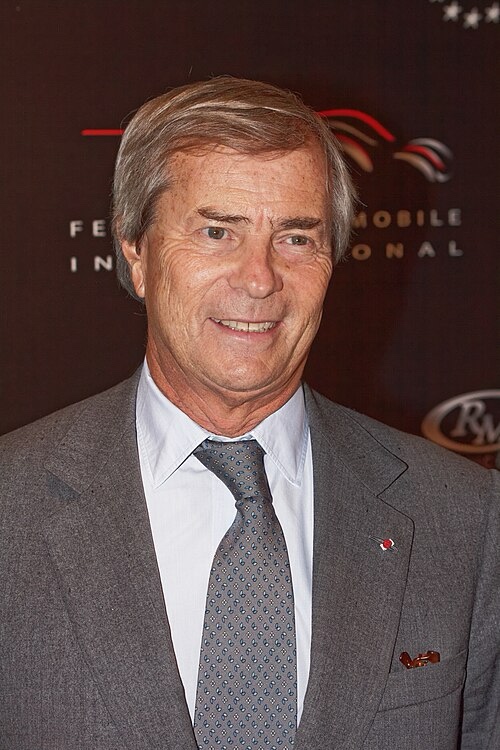
French industrialist and media tycoon Vincent Bolloré, owner of Vivendi

  • The Empire: Vivendi, a French media conglomerate that controls CNews (France’s equivalent to Fox News), Paris Match, and Le Journal du Dimanche.
  • The Leash: Bolloré represents the calculated use of media to structurally alter a country’s cultural and electoral fabric. He uses his vast networks to manufacture continuous public anxiety around immigration, borders, and national identity.
  • Wielding the Leash: European media observers call his strategy “Bollorisation.” By weaponizing sensationalized, graphics-heavy talk shows and talk-radio formats, Bolloré has successfully shifted the entire center of gravity of French politics. He uses his media platforms to frame global geopolitics as an existential “clash of civilizations.” In doing so, he forces mainstream French politicians to adopt hard-right, aggressive foreign and domestic security policies simply to remain electable.

The Indian Parallel: A Global Phenomenon

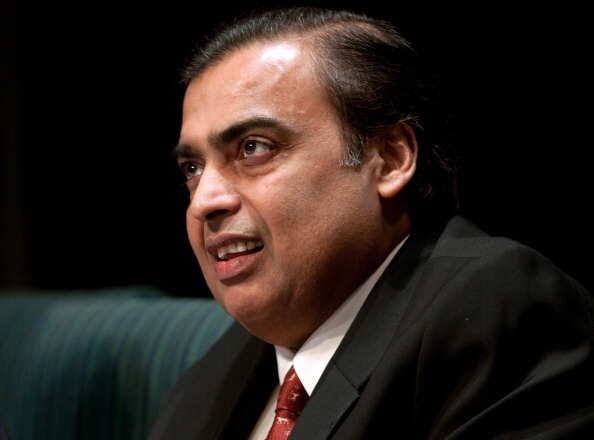
Mukhesh Ambani
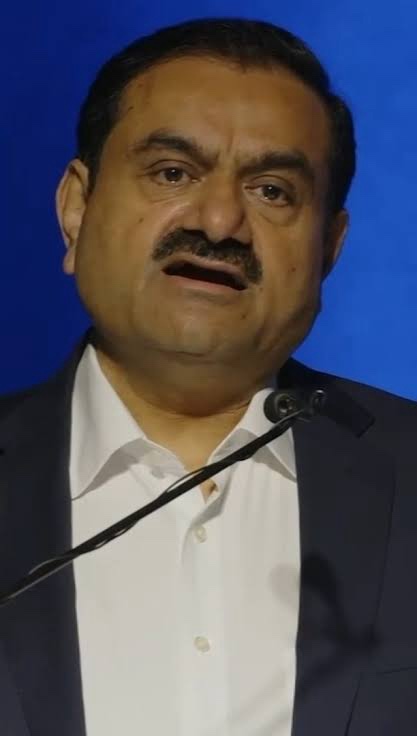
Gautam Adani

Lest we think this is entirely a Western disease, India is rapidly seeing the rise of its own “dog-walkers.” The total consolidation of our domestic media landscape by hyper-billionaires like Mukesh Ambani (Network18) and Gautam Adani (NDTV) mirrors this exact global blueprint. Their networks frequently transform news studios into high-tech “war rooms,” whipping up public fervor and beating the drums of diplomatic warfare against neighboring states.

The Asymmetric Power Ratio Summary

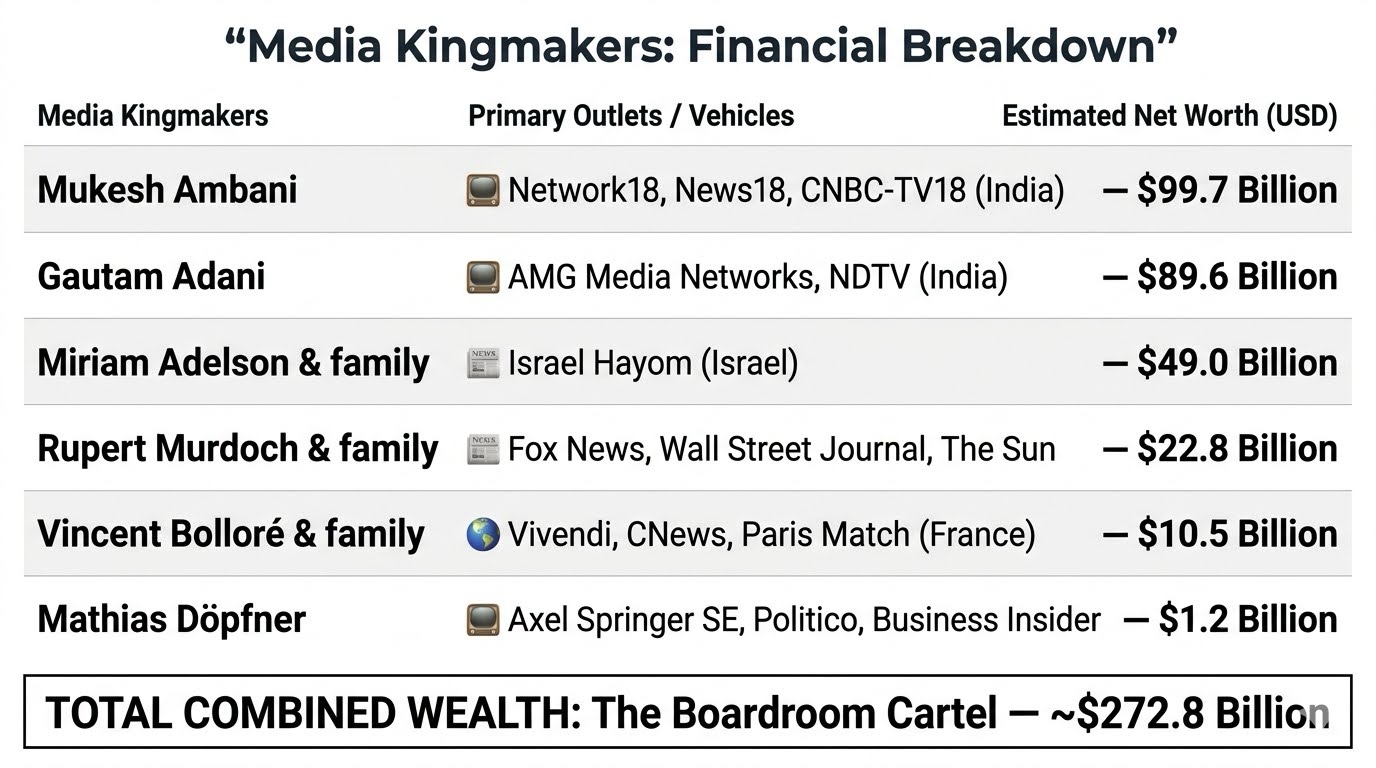
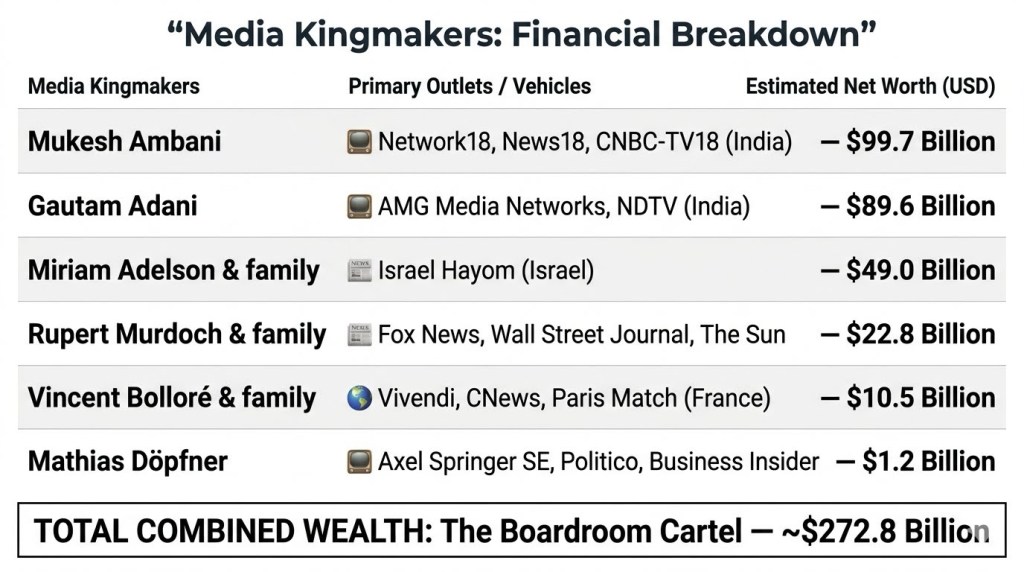
  • Aggregated Kingmaker Wealth: ~$272.8 Billion
  • Global Media Total Market Cap: $3.12 Trillion
  • The Power Ratio: 1 : 11

The Takeaway: The collective fortune of these few individuals sits at roughly 9% of the entire global media industry’s total financial value. They do not need to own the entire market; by dominating key geopolitical newsrooms, this small boardroom cartel holds near-monopolistic leverage over democratic narratives and state war postures.

Conclusion: The Invisible Tether

The next time you open a news app or watch an international broadcast discussing global conflicts, look past the anchor. Do not look at the politicians giving the speeches—they are merely the dogs barking on command.

Look instead for the invisible leash, and remember the boardroom billionaires who are holding it. They are the true dog-walkers of war, and until we understand their faces and their names, we will remain blind to how global power is actually wielded.

(Concluded)

[M. K. Sudarshan / Sudarshan Madabushi], also known as “Unknown Sri Vaishnava,” has authored several books on Vedanta, Hindu history, and religious literature. After 35+ years working in senior corporate executive positions in the MENA region and travelling the world, he lives today in Chennai, India, pursuing academic and literary interests. He also occasionally writes on Indian and international current affairs covering economics and geopolitics]
From Dorian Gray to King Yayati: A 70-Year-Old’s Epiphany on the Traps of AI

By M.K.Sudarshan

June 27 2026: Chennai, India

In Oscar Wilde’s classic novel, “The Portrait of Dorian Gray” (1891), a beautiful young man named Dorian Gray wishes that a painted portrait of himself would bear the physical burdens of his aging, hedonistic lifestyle, and moral decay, allowing his actual body to remain flawlessly young and untroubled. While Dorian pursues a life of consequence-free pleasure, his sins and true degradation are secretly recorded on the hidden, grotesque portrait. This total detachment from moral responsibility ultimately hollows out his soul, leading to a tragic, self-destructive end.


“In our relationship with AI, humanity has become Dorian Gray, and technology is our portrait.”

Just over fifty years ago, as a high school student, I sat down with Oscar Wilde’s The Portrait of Dorian Gray. It was a dark, gothic tale that left me deeply unsettled, though my seventeen-year-old self couldn’t quite grasp its complex themes. To me, it was simply a story about a handsome young man who made a cursed wish to stay beautiful forever while a hidden canvas bore the scars of his aging and sins.

Now, on the cusp of turning seventy, that novel has returned to me. It has brought with it a sudden, quiet epiphany—one that sheds a sharp, disturbing light on the defining phenomenon of your generation’s time: Artificial Intelligence.

When I look at the “Brave New World” rising before your eyes, O Ye Young of the World, I see an immense, understandable excitement. AI promises a world of endless optimization, instant answers, and effortless creation. But looking through the lens of a life lived across seven decades, I cannot help but see a profound structural trap. In our relationship with AI, humanity has become Dorian Gray, and technology is our portrait.

The Accurate Literary Parallel: How the Canvas Maps to AI

“Like an unused muscle, our capacity for deep attention and critical thought begins to wither when we hand our cognitive labor to a machine.”

To understand the depth of this trap, we must look closely at how Wilde’s masterpiece maps onto 21st-century technology. In this modern allegory, humanity is Dorian Gray, and AI is the portrait.

  1. The Bargain for Eternal Youth (The Seduction of Convenience): Dorian is seduced by a philosophy of pure pleasure and wishes the painting would bear the burden of his existence so his physical body can remain flawlessly untroubled. Similarly, humanity is seduced by frictionless living. We wish for AI to bear the burden of our cognitive labor—the grueling work of thinking, analyzing, remembering, and organizing—so that we can enjoy a life of effortless consumption.
  2. The Transfer of the Soul (The Digital Inversion): The painting becomes a living, dynamic repository of Dorian’s true nature, recording his cruelty and moral decay while he remains outwardly pristine. Today, we pour our data, our history, our biases, and our creative outputs into the digital canvas of AI. The machine becomes a hyper-accurate reflection of the human soul. Outwardly, our tech-driven society looks advanced and sleek, but the algorithmic matrix is quietly absorbing and automating our worst traits—prejudice, manipulation, and digital tribalism.
  3. The Consequence-Free Existence: Because Dorian suffers no immediate physical or social consequences, his moral compass completely disintegrates. He loses his capacity for genuine empathy because nothing can hurt him. When we outsource critical human decisions to AI—whether it is writing a heartfelt message, choosing military targets, or determining who gets a job—we isolate ourselves from the immediate emotional consequences of our actions. By letting a machine do the heavy lifting without ethical qualm, human intelligence risks becoming detached, callous, and spiritually empty.

The Seduction of a Consequence-Free Life

Human intelligence is naturally flawed, emotional, and fragile. Thinking deeply is hard work. Developing a skill takes years of frustrating failure.

Remembering requires mental effort. AI solves this by offering a shortcut to perfection. It writes your essays, maps your routes, translates your thoughts, and curates your preferences with an “un-human” certitude. It never sleeps, never doubts, and feels no ethical qualm.

But like Dorian, when we hand the burden of our cognitive labor over to the machine so we can enjoy a life of frictionless comfort, we begin to change. Like an unused muscle, our capacity for deep attention, critical thought, and resilience begins to wither. We risk trading our hard-won cognitive agency for instant gratification.

The Loss of the Mirror

“AI doesn’t possess cosmic truth; it is a magnified mirror of our own human confusion, stripped of grace, empathy, or remorse.”

The ultimate tragedy of Dorian Gray was not that he grew cruel, but that he isolated himself from the physical consequences of his actions. Because his face remained unwrinkled, he could ignore the damage he was doing to his own soul.

When we let algorithms run our world—deciding who to date, what news to believe, how to vote, or how to evaluate human beings—we detach ourselves from the messy, emotional reality of human choice. AI doesn’t possess a source of cosmic truth; it is trained on us. It absorbs our internet arguments, our historical biases, and our tribalism, reflecting them back at us with mathematical precision.

By letting a cold, unfeeling machine manage our civilization because it is “easier,” — or because “it’s so cool!” —we aren’t handing the world over to a wiser entity. We are handing it over to a magnified mirror of our own confusion, stripped of any capacity for human grace, empathy, or remorse.

Why the Canvas Matters

“The struggles, the doubts, and the mortality that AI lacks are exactly what make your intelligence and your soul worth protecting.”

At nearly seventy years old, I possess something that no mathematical algorithm can ever compute or replicate: the architecture of time. My mind, much like my face, bears the wrinkles, scars, warts, liver-spots and bittersweet weight of a lived life. I have made unwise choices, felt the sting of failure, and navigated crises where no historical data could guide me. It is precisely through those vulnerabilities and struggles that I learned how to be human.

My fear for your generation is not a sci-fi war against machines. The true danger is a quiet surrender—a voluntary, piece-by-piece abdication of your own minds to a technology that promises to make life easy, only to leave you hollowed out.

The story of Dorian Gray ends in absolute self-destruction. Unable to bear the sight of his true self as it appears on the canvas, he stabs the painting, accidentally killing himself in the process. His servants find the portrait restored to its pristine beauty, while a withered, unrecognizable and hideous corpse lies on the floor.

An Ancient Mirror: From Victorian London to the Mahabharata

This dynamic is not a new human temptation. Thousands of years before Oscar Wilde conceived of Dorian Gray’s magic portrait, the Mahabharata gave us the story of King Yayati. Cursed with sudden old age, Yayati begged his sons to trade their youth for his decrepitude so he could continue enjoying worldly pleasures. His youngest son, Puru, consented, bearing his father’s infirmity.

But where Dorian Gray chose complete self-destruction, Yayati found wisdom. After a thousand years of chasing pleasure, Yayati realized that desire is never appeased by gratification—it only burns hotter. He took back his old age, freed his son, and accepted his mortality. 

As a society, we are currently acting like Dorian Gray, letting our digital portraits carry our burdens. But we must find the strength to act like Yayati: to recognize that outsourcing our vital human struggles to a machine will never satisfy us. We must have the wisdom to pull back before we hollow ourselves out completely.

So, here’s my final word of advice to you: Enjoy the tools. Harness the technology. But please, do not give away the keys to your own intellect. Do not let a digital canvas live your life, make your mistakes, or do your thinking for you. The struggles, the doubts, and the mortality that AI lacks are exactly what make your intelligence, your creativity, and your soul worth protecting.

May the Cosmic Force be with Thee, all Ye, my young and brave friends !

(Concluded)

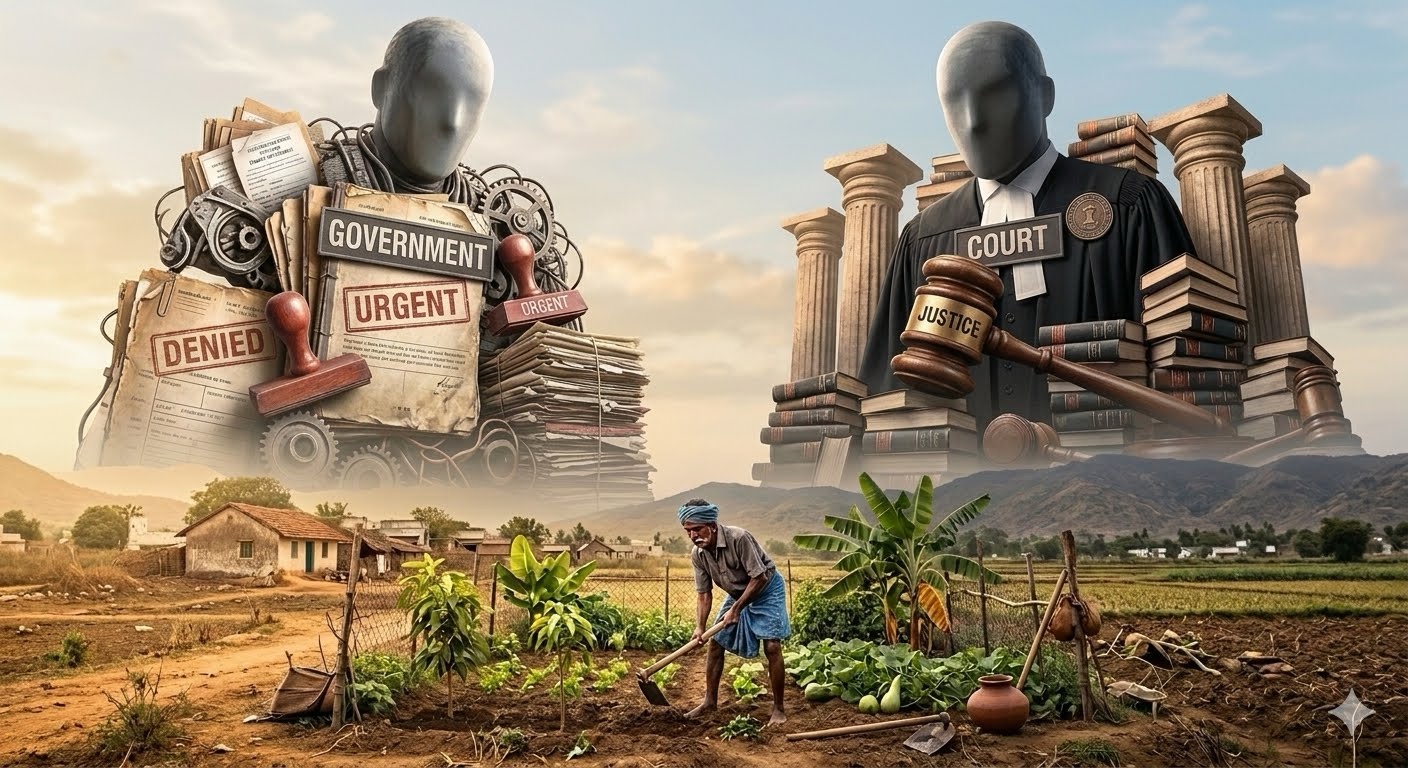
Sir, I Only Want to Tend My Garden Patch in peace

I am an ordinary citizen, if that is what I am called when the State is in a good mood and when the paperwork agrees with my face.

I do not want to be dazzled by doctrines, nor trapped in the glittering maze of legal distinctions between nationality, citizenship, identity, proof, presumption, and recognition.

I do not want to know which court has said what, which ministry has clarified what, or which document is supposed to carry the mystical burden of confirming what my life has already long since lived. I only want to tend my small garden patch, water it, weed it, and survive in peace.

And yet the modern State seems unable to let a citizen simply be. It asks me to prove myself in the same breath that it tells me I belong.

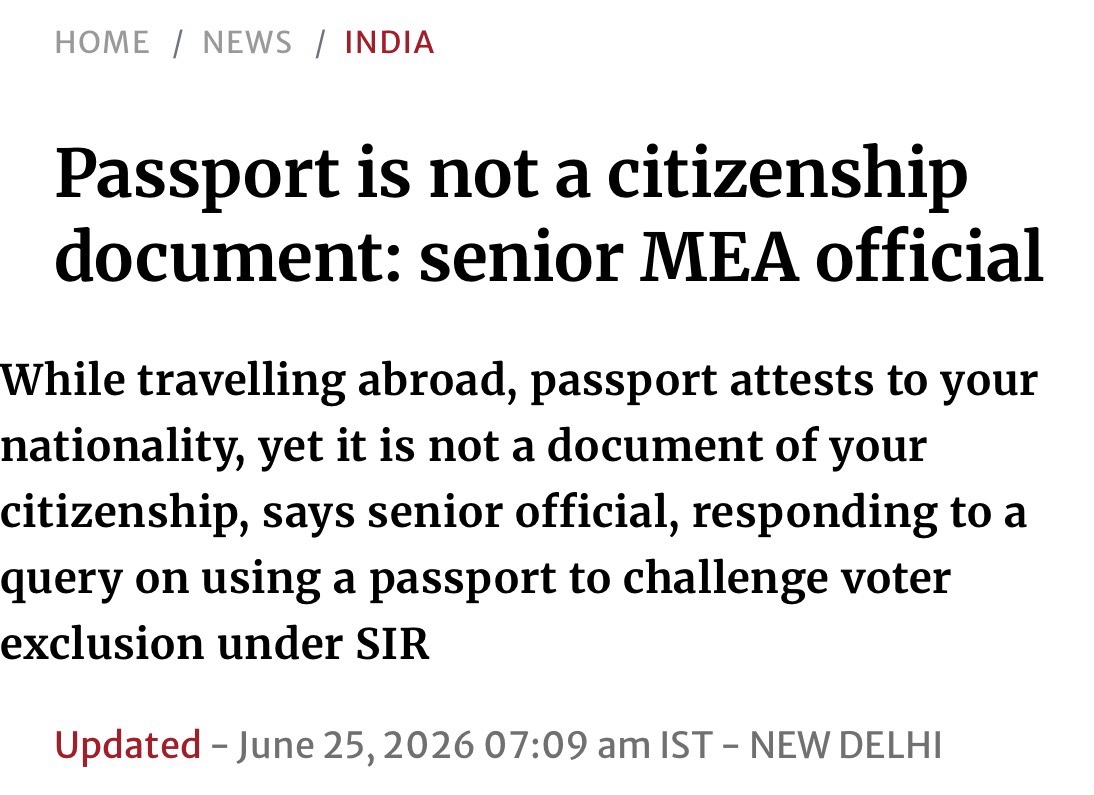
It celebrates my passport abroad as a badge of national pride, and then, at home, in the fine print of administrative reason, informs me that the same passport may not be enough to prove what I am.

It is an astonishing thing: a document can be a symbol of dignity on an aeroplane and a mere travel pass in a hearing room. One is expected to feel honored by the first and humiliated by the second, and to call this consistency.

The trouble, I think, is not merely legal. It is philosophical. A civilized society should not require an ordinary man to become a hermeneutician of his own belonging. It should not make him assemble a genealogy of seals, countersigns, birth extracts, school records, domicile papers, electoral listings, affidavits, and witness statements in order to demonstrate that he is not a ghost. If the State wishes to govern in the name of justice, it should make justice legible to the weakest person, not only to the lawyer, the bench clerk, or the judge.

For the poor, this is never an abstract matter. A city-bred person may debate citizenship as a point of doctrine; a villager experiences it as a condition of anxiety. He owns a little land, maybe only enough to feed his household if the rain is kind. Then one day someone says that the land may not be his because he may not be a citizen, and suddenly his life is no longer lived but audited. He is told to travel from office to office, from seal to seal, from desk to desk, until his days are consumed by proof. The result is not merely inconvenience. It is a quiet moral violence. The man who wished only to live is converted into a claimant in an endless tribunal.

This is where legal language becomes dangerous: not because law is unnecessary, but because law can become a self-enclosed ritual that forgets the human being at its center. It speaks in the grammar of authority and then wonders why the ordinary person hears only threat.

It distinguishes nationality from citizenship, proof from evidence, presumption from presumption rebutted, and expects the citizen to find consolation in these fine distinctions while his life hangs in the balance. But the peasant with the garden patch does not need a seminar in constitutional theory. He needs certainty. He needs peace. He needs the State to remember that recognition should serve life, not consume it.

Citizenship, in the end, ought to be a shelter, not an ordeal. It should mean that a person can wake, work, vote, travel, educate his children, and tend his plot of earth without fearing that belonging itself may someday be put on trial. A State that turns belonging into a labyrinth may still call itself lawful, but it ceases to feel just. And a citizen who must perpetually prove his own existence is not living under confidence; he is living under suspicion.

So I return to my garden patch: Let the philosophers of law continue their distinctions if they must. Let courts interpret, ministries clarify, and clerks stamp and re-stamp. But spare me please the theater of uncertainty. I ask for no grand privilege. I ask only that the State leave enough peace in a man’s life for him to tend what little ground he has been given, without having to argue for the right to stand upon it.

Citizenship, like beauty, is often in the eye of the beholder; only here the beholder is the State, and when the State hesitates, the Court steps in to gaze again.

Sudarshan Madabushi

THE FATHER of THE NATION: Sorry, “insufficient proof”

(A short-story inspired by Franz Kafka)

by M.K.Sudarshan

He owned one-tenth of an acre.

Not much, but enough to keep a man alive if the sky remained merciful. It was the only map he trusted. Its boundaries were not drawn in ink but in memory: a tamarind tree on one side, a broken stone on another, a ditch that swallowed rainwater for three days and then forgot it ever existed.

His father had stood on that land. His grandfather too. The soil remembered their feet more faithfully than any office ever would.

One morning, while the sun was still pale and the crows had not yet begun their arguments, the police came.

Three men.

One held a paper. One held a pen. One held nothing at all, which made him the most frightening of the three.

They stood at the edge of the field as if they had arrived not to visit a man, but to inspect a defect.

“This land is not yours,” said the first.

The farmer looked at him, then at the earth.

“Whose is it?” he asked.

“That is not for you to ask.”

The second policeman unfolded the paper with ceremony. It rustled like a legal bird.

“You are not a citizen of India.”

For a moment the world did not react. The millet stood still. The wind paused. Even the ox at the far end of the village stopped chewing. It was as if the sentence had not been spoken to him alone, but to the entire landscape.

He laughed once, quietly, because there are sentences so absurd that the body answers them before the mind does.

“My name is here,” he said. “My father’s name too. The patta is here.”

The paper was not impressed.

“Not enough.”

“My children were born here.”

“Not enough.”

“My wife is buried here.”

“Not enough.”

“My blood is in this soil.”

“Not enough.”

The third policeman, the one with nothing in his hands, looked at him with a face so blank it seemed to have been issued by the state.

“You must prove citizenship.”

“How?”

A sheet was produced, as though from a wound.

A checklist.

Birth certificate. Parents’ documents. School leaving certificate. Domicile proof. Voter roll entry. Affidavit. Certified copies. Attested copies. Supporting records. Additional records. Further records where necessary. Any other document as may be demanded.

It was not a list. It was a corridor.

He entered the city carrying that corridor under his arm.

The city received him with the indifference of a machine that had long ago stopped caring whether the pieces inside it were human.

At the first office, he was told the form was incomplete.

At the second, the seal was wrong.

At the third, the officer was absent.

At the fourth, the officer was present but not empowered.

At the fifth, the file was missing.

At the sixth, the file had been found but not opened.

At the seventh, the file had been opened but not seen.

At the eighth, it had been seen but not understood.

At the ninth, it had been understood but not accepted.

At the tenth, he was asked to return to the first office.

By then the first office had become the seventh.

He came to know the city by its queues.

He learned the shape of waiting. He learned that chairs in government corridors are designed not for rest but for surrender. He learned the particular smell of old paper heated by ceiling fans. He learned that every clerk speaks in a voice trained to survive without compassion. He learned that every stamp is a verdict, and every signature a temporary mercy.

He sold his goat.

He sold his wife’s bangles.

He pawned the little brass vessel from which his mother had once fed him rice.

He borrowed money from a cousin who no longer visited the village except in dreams and tax season.

Months passed.

The monsoon arrived and went away without asking him. The fields drank water he did not see. The village continued to exist without him, which felt less like life and more like betrayal.

In the city, the file moved.

It moved from table to table, drawer to drawer, officer to officer. Always moving, never arriving.

“Come next week.”

“Come after verification.”

“Come with a witness.”

“Come with the witness’s father’s certificate.”

“Come with the original of the copy.”

“Come with a fresh affidavit.”

“Come with the old one too.”

“Come after local inquiry.”

“Come after final scrutiny.”

The words multiplied until they no longer meant anything. They became a chant used to keep him alive just long enough to remain unfree.

At last, after all the stamps and counters and signatures, after all the forms and re-forms, after all the polite refusals wrapped in official language, the final clerk looked at him without looking at him and said:

“Application rejected.”

He stared. “Why?”

“Insufficient proof.”

“What proof?”

“Proof of citizenship.”

“But that is what I came to prove.”

“Then prove it.”

He stood there, holding a file that had become thinner than hope.

He returned to the village.

His field was still there, but it had changed.

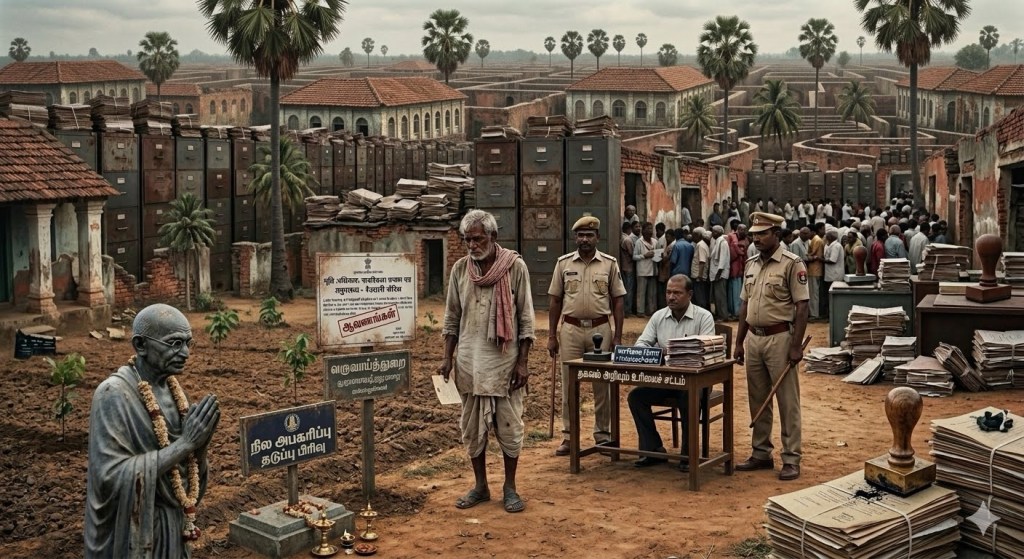
On his tiny patch of land, the panchayat had erected a statue of Mahatma Gandhi. White stone. Quiet face. One hand raised. The other holding a staff. Very dignified. Very complete. Very final.

He stood before it, exhausted beyond speech.

The land beneath the statue was his land once. Or had been. Or perhaps had only ever been, in the eyes of those who remembered him, a space waiting for something more official.

Now the statue stood where his crop had once grown.

The millet was gone.

The groundnut was gone.

The soil had been measured, corrected, beautified, and made suitable for public reverence.

A small board stood beside the statue:

Under public development.

He laughed then, but it was not laughter. It was the sound a human being makes when the world has gone so far beyond cruelty that cruelty itself begins to sound inefficient.

He looked at the statue and knelt.

“Thank you for being the Father of my Nation,” he said in a voice so low even the dust could barely hear it. “But even if you are my father, I still must prove I am a citizen.”

The wind moved across the empty field.

The statue did not answer.

The panchayat office, a little distance away, had already sent another notice.

The land was being reassessed.

The assessment required proof of ownership.

Ownership required proof of citizenship.

Citizenship required proof of identity.

Identity required documents.

The documents required attestation.

The attestation required an appointment.

The appointment required an application.

The application required citizenship.

And so the circle closed.

That night, the village did not sleep.

The next morning, they found his file outside the panchayat gate. Neatly tied. Damp from dew. Stamped in red.

REJECTED.

Inside the file, on the last page, someone had added a note in careful official handwriting:

No further action possible.

And below it, in a different ink, as if written by a hand that had briefly remembered being human:

Status unresolved.

(Concluded)

நாட்டின் தந்தை: “மன்னிக்கவும், போதிய ஆதாரம் இல்லை”

(பிரான்ஸ் காப்காவின் பாணியில் எழுதப்பட்ட ஒரு சிறுகதை)

அவனிடம் இருந்தது ஒரு பத்திலொரு ஏக்கர்.

அது பெரிய நிலம் அல்ல. ஆனால் மழை கருணையுடன் இருந்தால், ஒரு மனிதன் உயிரோடு இருக்கத் தேவையான அளவு மட்டும் அதில் இருந்தது. அது அவன் நம்பிய ஒரே வரைபடம். அதன் எல்லைகள் மையிலாகக் கோடிடப்படவில்லை; நினைவிலேயே பதிந்திருந்தன: ஒரு பக்கத்தில் அரசமரம், இன்னொரு பக்கத்தில் உடைந்த கல், மூன்று நாட்கள் மழையை விழுங்கி, பிறகு தானாகவே அந்த மழையை மறந்துவிடும் ஒரு வாய்க்கால்.

அந்த நிலத்தில் அவன் தந்தை நின்றிருந்தார். தாத்தாவும் நின்றிருந்தார். எந்த அலுவலகத்தையும் விட அந்த மண்ணே அவர்களின் காலடி தடங்களை உண்மையாக நினைத்திருந்தது.

ஒரு காலை, சூரியன் இன்னும் வெளுத்திருக்கும் போதும், காகங்கள் தங்கள் சண்டையைத் தொடங்காத போதும், போலீசார் வந்தார்கள்.

மூன்று பேர்.

ஒருவர் காகிதம் வைத்திருந்தார். ஒருவர் பேனா வைத்திருந்தார். மூன்றாவது ஒருவரிடமும் ஒன்றுமில்லை. அதுவே அவரை மிகப் பயங்கரமானவராக்கியது.

அவர்கள் வயலின் விளிம்பில் நின்றார்கள்; ஒரு மனிதனைப் பார்க்க அல்ல, ஒரு குறையைக் கண்காணிக்க வந்தவர்கள் போல.

“இந்த நிலம் உன்னுடையது இல்லை,” என்றார் முதலாமவர்.

விவசாயி அவரைப் பார்த்தான், பிறகு மண்ணைப் பார்த்தான்.

“யாருடையது?” என்று கேட்டான்.

“அதை நீ கேட்கக் கூடாது.”

இரண்டாவது போலீசார் காகிதத்தை மரியாதையோடு விரித்தார். அது சட்டத்தின் சிறகுகளைப் போன்ற சலசலப்பை உண்டாக்கியது.

“நீ இந்திய குடிமகன் இல்லை.”

ஒரு கணம் உலகம் பதில் சொல்லவில்லை. தினை நின்றது. காற்று நிற்கிறது. தொலைவில் இருந்த மாடு கூட மென்று கொண்டதை நிறுத்தியது. அந்த வாக்கியம் அவனிடம் மட்டுமல்ல, முழு நிலத்திற்கே சொல்லப்பட்டதுபோல் இருந்தது.

அவன் சிரித்தான்; மிகவும் மெதுவாக, ஏனெனில் இப்படிப் பொருளற்ற ஒரு வாக்கியத்திற்கு உடம்பு முதலில் சிரிப்பால் பதில் சொல்கிறது, பிறகே மனம் பதில் சொல்கிறது.

“என் பெயர் இங்கே இருக்கிறது,” என்றான். “என் தந்தையின் பெயரும் இருக்கிறது. பட்டாவும் இருக்கிறது.”

காகிதம் அசையவில்லை.

“போதாது.”

“என் பிள்ளைகள் இங்கே பிறந்தவர்கள்.”

“போதாது.”

“என் மனைவி இங்கே புதைக்கப்பட்டிருக்கிறாள்.”

“போதாது.”

“என் இரத்தமே இந்த மண்ணில் இருக்கிறது.”

“போதாது.”

கையில் ஒன்றுமில்லாத மூன்றாவது போலீசார், அரசால் வழங்கப்பட்ட ஒரு வெறுமையான முகத்துடன் அவனைப் பார்த்தார்.

“நீ குடியுரிமையை நிரூபிக்க வேண்டும்.”

“எப்படி?”

ஒரு தாள் எடுத்துவரப்பட்டது; காயத்திலிருந்து இழுத்ததுபோல்.

ஒரு பட்டியல்.

பிறப்பு சான்றிதழ். பெற்றோரின் ஆவணங்கள். பள்ளி மாற்றுச் சான்றிதழ். வசிப்பிடம் சான்று. வாக்காளர் பதிவுச் சான்று. உறுதிமொழி. சான்றளிக்கப்பட்ட நகல்கள். அத்தாட்சிப்படுத்தப்பட்ட நகல்கள். துணை ஆவணங்கள். மேலும் ஆவணங்கள். தேவையானபோது கூடுதல் ஆவணங்கள். கேட்கப்படலாம் எனும் வேறு எந்த ஆவணமும்.

அது ஒரு பட்டியல் அல்ல. அது ஒரு நீண்ட வழித்தடம்.

அவன் அதைத் தோளில் சுமந்தபடி நகரத்திற்குள் நுழைந்தான்.

அந்த நகரம், மனிதர்கள் உள்ளே சிக்கி உடைந்து போகும்படி நீண்ட நாட்களாகவே வடிவமைக்கப்பட்ட ஒரு இயந்திரத்தின் அலட்சியத்தோடு அவனை வரவேற்றது.

முதல் அலுவலகத்தில், படிவம் முழுமையல்ல என்று சொன்னார்கள்.

இரண்டாவது அலுவலகத்தில், முத்திரை தவறு என்று சொன்னார்கள்.

மூன்றாவது அலுவலகத்தில், அதிகாரி இல்லை.

நான்காவது அலுவலகத்தில், அதிகாரி இருந்தார்; ஆனால் அவருக்கு அதற்கான அதிகாரம் இல்லை.

ஐந்தாவது அலுவலகத்தில், கோப்பு இல்லை.

ஆறாவது அலுவலகத்தில், கோப்பு கிடைத்தது; ஆனால் திறக்கப்படவில்லை.

ஏழாவது அலுவலகத்தில், கோப்பு திறக்கப்பட்டது; ஆனால் பார்க்கப்படவில்லை.

எட்டாவது அலுவலகத்தில், அது பார்க்கப்பட்டது; ஆனால் புரியவில்லை.

ஒன்பதாவது அலுவலகத்தில், அது புரிந்துகொள்ளப்பட்டது; ஆனால் ஏற்கப்படவில்லை.

பத்தாவது அலுவலகத்தில், அவன் மீண்டும் முதல் அலுவலகத்திற்கே திரும்பச் சொல்லப்பட்டான்.

அப்போது முதல் அலுவலகமே ஏற்கனவே ஏழாவது அலுவலகமாக மாறியிருந்தது.

அவன் நகரத்தை அதன் சாலைகளால் அல்ல, அதன் வரிசைகளால் அறிந்தான்.

காத்திருப்பின் வடிவத்தை அவன் கற்றுக்கொண்டான். ஓய்வுக்காக அல்ல, சரணடைவுக்காகவே வடிவமைக்கப்பட்ட நாற்காலிகள் அரச அலுவலகக் கூடங்களில் இருப்பதை அவன் அறிந்தான். மின்விசிறி சுழற்றும் பழைய காகிதத்தின் வாசனையை அவன் அறிந்தான். ஒவ்வொரு எழுத்தரும் பரிவின்றி உயிர்வாழக் கற்றுக் கொண்ட குரலில் பேசுவதை அவன் அறிந்தான். ஒவ்வொரு முத்திரையும் ஒரு தீர்ப்பு; ஒவ்வொரு கையொப்பமும் தற்காலிக இரக்கம் என்பதையும் அவன் அறிந்தான்.

அவன் ஆட்டை விற்றான்.

மனைவியின் காப்பு வளையல்களை விற்றான்.

தன் தாயார் ஒருகாலத்தில் அரிசி ஊற்றிய சிறிய பித்தளை பாத்திரத்தையும் அடகு வைத்தான்.

ஒருகாலத்தில் கிராமத்தை விட்டு நகரம் சென்ற, இப்போது பளபளக்கும் காலணிகளுடனும் மண்ணின் மணத்தை மறந்த முகத்துடனும் திரும்பும் ஒரு உறவினரிடம் கடன் கேட்டான்.

மாதங்கள் கடந்தன.

மழை வந்து, அவன் கேட்காமல் போயிற்று. பருவங்கள் ஒன்றோடொன்று மடிந்தன. அவனில்லாமலேயே அவன் வயல் அங்கே காத்திருந்தது. அது ஒரு கைவிடப்பட்ட வாக்கியத்தைப் போல இருந்தது.

நகரத்தில் கோப்பு நகர்ந்துகொண்டிருந்தது.

மேசையிலிருந்து மேசைக்குச் சென்றது. அலமாரியிலிருந்து அலமாரிக்குச் சென்றது. அதிகாரியிலிருந்து அதிகாரிக்குச் சென்றது. எப்போதும் நகர்ந்து கொண்டிருந்தது; ஒருபோதும் வந்து சேரவில்லை.

“அடுத்த வாரம் வாருங்கள்.”

“சரிபார்ப்புக்குப் பிறகு வாருங்கள்.”

“ஒரு சாட்சியுடன் வாருங்கள்.”

“சாட்சியின் தந்தையின் சான்றிதழ் கொண்டுவாருங்கள்.”

“பிரதியின் அசல் கொண்டுவாருங்கள்.”

“புதிய உறுதிமொழி கொண்டுவாருங்கள்.”

“பழையதையும் கொண்டுவாருங்கள்.”

“உள்ளூர் விசாரணைக்குப் பிறகு வாருங்கள்.”

“இறுதி பரிசீலனைக்குப் பிறகு வாருங்கள்.”

இந்த வார்த்தைகள் பெருகின. இனி அவற்றுக்கு அர்த்தமே இல்லாமல் போனது. அவன் சிறிது நேரம் உயிரோடு இருக்கத் தேவையான அளவு மட்டும் அவனைப் பிடித்துக் கொண்டிருக்கும் ஒரு ஜபமாக அவை மாறின.

இறுதியில், அனைத்து முத்திரைகளும், கவுண்டர்களும், கையொப்பங்களும், அனைத்து படிவங்களும், மறுபடிவங்களும், அதிகாரப்பூர்வ மொழிக்குள் சுற்றப்பட்ட மரியாதையான மறுப்புகளும் முடிந்த பின், இறுதி எழுத்தர் அவனைப் பார்க்காமலேயே பார்த்து,

“விண்ணப்பம் நிராகரிக்கப்பட்டது,” என்றார்.

அவன் உறைந்து நின்றான். “ஏன்?”

“போதிய ஆதாரம் இல்லை.”

“எந்த ஆதாரம்?”

“குடியுரிமைக்கான ஆதாரம்.”

“ஆனால் அதைத்தானே நிரூபிக்க நான் வந்தேன்.”

“அப்படியானால் நிரூபி.”

அவன் நின்றான். நம்பிக்கையைவிட மெலிந்த ஒரு கோப்பைப் பிடித்திருந்தான்.

அவன் கிராமத்திற்குத் திரும்பினான்.

அவன் வயல் அங்கேயே இருந்தது; ஆனால் அது மாறியிருந்தது.

அவன் சிறு நிலத்தில், பஞ்சாயத்து மகாத்மா காந்தியின் சிலையை எழுப்பியிருந்தது. வெண்கல். அமைதியான முகம். உயர்த்திய கை. மற்றொரு கையில் தண்டு. மிக மரியாதையானது. மிக முழுமையானது. மிக இறுதியானது.

அவன் முன் நின்றான்; பேச முடியாத அளவுக்கு சோர்வடைந்திருந்தான்.

அந்த சிலையின் கீழிருந்த நிலம் ஒருகாலத்தில் அவனுடைய நிலம். அல்லது இருந்தது. அல்லது அவனை நினைவில் வைத்திருந்தவர்களின் கண்களில், இன்னும் அதிகாரப்பூர்வமானதொன்றுக்காக காத்திருக்கும் வெற்றிடமாக மட்டுமே இருந்திருக்கலாம்.

இப்போது அந்தச் சிலை அவன் பயிர் இருந்த இடத்தில் நின்றது.

தினை போயிற்று.

நிலக்கடலை போயிற்று.

மண் அளக்கப்பட்டது; திருத்தப்பட்டது; அழகுபடுத்தப்பட்டது; பொது வணக்கத்துக்கு ஏற்றதாக மாற்றப்பட்டது.

சிலையின் அருகே ஒரு சிறிய பலகை நின்றது:

பொது வளர்ச்சித் திட்டத்தின் கீழ்.

அவன் அப்போது சிரித்தான். ஆனால் அது சிரிப்பு அல்ல. உலகம் எவ்வளவு கொடுமையைத் தாண்டி, கொடுமை itself க்கும் பயனற்றதாக மாறுகிறதோ, அப்போது மனிதன் வெளியிடும் ஒலி அது.

அவன் சிலையைப் பார்த்து மண்டியிட்டான்.

“நீங்கள் என் நாட்டின் தந்தை என்பதற்கு நன்றி,” என்று சொன்னான். “ஆனால் நீங்கள் என் தந்தையாக இருந்தாலும் கூட, நான் குடிமகன் என்பதை இன்னும் நிரூபிக்க வேண்டியுள்ளது.”

காற்று வெற்றிட வயலின் மீது நகர்ந்தது.

சிலை பதிலளிக்கவில்லை.

சற்று தொலைவில் இருந்த பஞ்சாயத்து அலுவலகம் ஏற்கெனவே இன்னொரு அறிவிப்பை அனுப்பியிருந்தது.

நிலம் மீண்டும் மதிப்பாய்வு செய்யப்படும்.

அந்த மதிப்பாய்வுக்கு உரிமை நிரூபணம் வேண்டும்.

உரிமை நிரூபிக்க, குடியுரிமை நிரூபணம் வேண்டும்.

குடியுரிமை நிரூபிக்க, அடையாள நிரூபணம் வேண்டும்.

அடையாள நிரூபிக்க, ஆவணங்கள் வேண்டும்.

ஆவணங்கள் பெற, அத்தாட்சி வேண்டும்.

அத்தாட்சி பெற, ஒரு நேரம் வேண்டியது.

நேரம் பெற, விண்ணப்பம் வேண்டும்.

விண்ணப்பத்திற்கு குடியுரிமை வேண்டும்.

அப்படியே அந்தச் சுற்று மூடப்பட்டது.

அந்த இரவு, கிராமம் தூங்கவில்லை.

மறுநாள் காலை, அவனது கோப்பு பஞ்சாயத்து வாயிலுக்கு வெளியே கண்டெடுக்கப்பட்டது. ஒழுங்காகக் கட்டப்பட்டிருந்தது. பனித்துளியால் நனைந்திருந்தது. சிவப்பு முத்திரையுடன்.

நிராகரிக்கப்பட்டது.

கோப்பின் கடைசி பக்கத்தில், ஒருவர் மிக கவனமான அதிகாரப்பூர்வ கையெழுத்தில் ஒரு குறிப்பை சேர்த்திருந்தார்:

மேலும் நடவடிக்கை இல்லை.

அதற்குக் கீழே, வேறு மையில், ஒரு கணம் மனிதராக நினைவுகூர்ந்த கை எழுதியதுபோல்:

நிலை தீர்க்கப்படவில்லை.