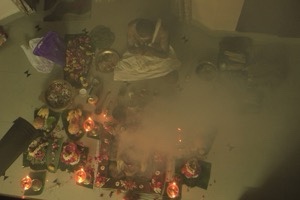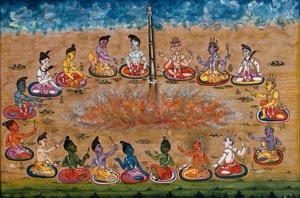
The age-old Vedic ritual traditions (“yajna”) that I’ve been so utterly ignorant of for so long …

The story of the Hindu yajna tradition in modern India is not merely the story of a ritual form in decline. It is the story of a civilizational inheritance that has gradually lost its centrality in the public religious imagination even while retaining immense scriptural prestige. 

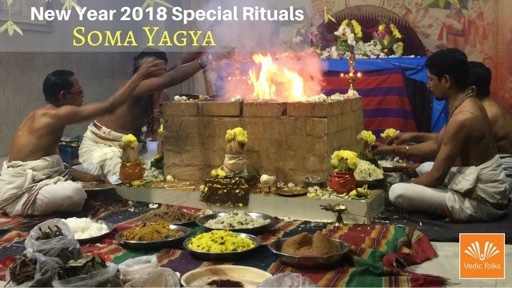
The older Vedic world placed yajna at the heart of the cosmic, social, and spiritual order; yet in contemporary Hindu life, the sacrificial fire often survives only in reduced domestic rites, occasional temple homas, or rare specialist performances, while the public center of religion has shifted decisively toward temple worship, festival spectacle, devotional recitation, and institutional liturgy.

This decline should not be misunderstood as proof that yajna was somehow dispensable to Hindu tradition. On the contrary, the survival of yajna across millennia testifies to its former centrality. The more accurate conclusion is that Hindu ritual culture underwent a long and consequential transformation. Agamic modes of worship did not abolish yajna; rather, they re-situated ritual authority by moving the center of sacred action from the sacrificial enclosure to the consecrated icon, the temple, and the liturgical calendar. In this transformation, the fire altar ceased to be the dominant public theatre of religion, while puja, arcana, procession, recitation, and utsava came to define the religious life of the community.

In our own state of Tamil Nadu, the tradition of yajna was widely prevalent in historical Sangam period times . The noted Tamil scholar Sri Indira Parthasarathy (Eepa) pointed out to me the name of Palyagasalai Mudukudumi Peruvazhuthi who was traditionally regarded as one of the early Pandya kings of the Sangam age. His very title, “Palyagasalai,” (“பல்யாகசாலை”) suggests that he was associated with the performance of many yajnas, showing that sacrificial ritual had an important place in the political and religious culture of early Tamil society. This indicates that yajna was not merely a Vedic rite but also a royal and public expression of dharma, generosity, and sacred kingship. In that sense, this king stands as an important reminder of the ancient prestige of yajna in Tamil civilization too.
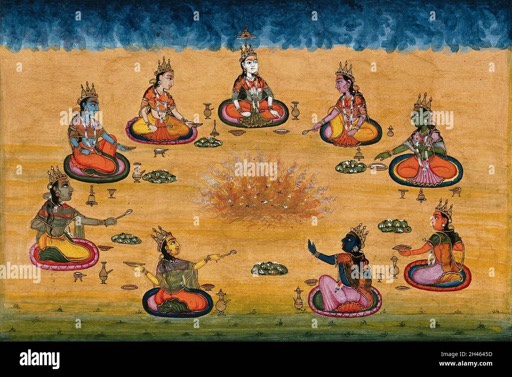
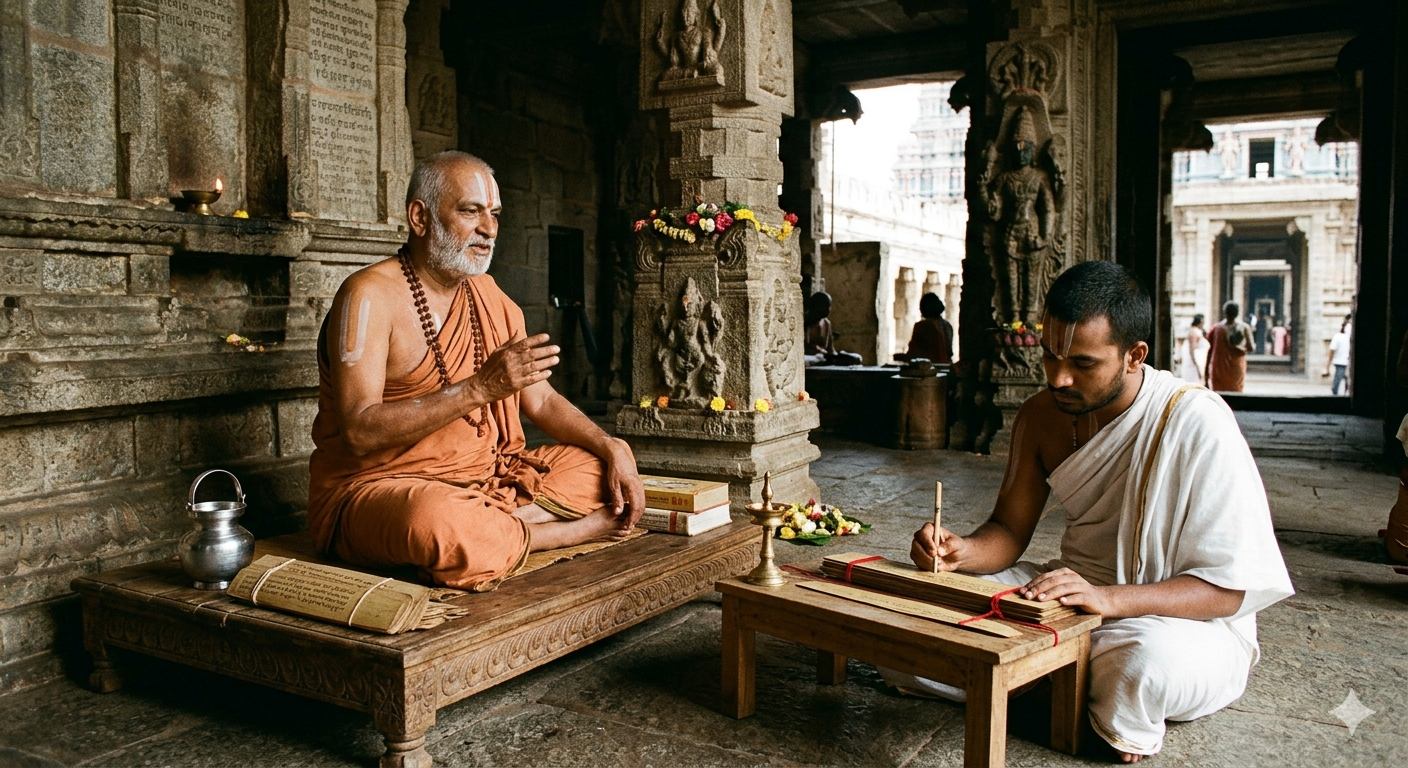
As a Sri Vaishnava born Brahmin, I must confess to my own utter ignorance about the ancient Vedic Yajna traditions of India. Like many in my generation of laukeeka (secular, English educated and professional career) Tambrahms, although I have been quite scrupulous for long in performing mandatory daily and obligatory Vedic rites of Sandhyavandanam and Shraadham, regretfully, all these years, I had taken no trouble at all to acquire even as much as a nodding acquaintance with the subject of Vedic Yajna traditions, their nature, distinctiveness and liturgical practice as prevalent in the past and present.

The years have today rolled on and passed me by indeed and, I realise, there is no hope at all that at my present age, I shall ever be able to learn to perform any of these yajnas of such a wide, fascinating and profound variety. I can therefore only console and satisfy myself with a little bit of knowledge about what the yajna tradition is — so little and sketchy though it might be. Nevertheless, I believe that the time I have recently spent in trying to read up, gather and meticulously compile finally — for my own benefit — a handy little listing of the different yajna traditions of India, has been well worth it for, today, at least I am not the utter ignoramus that I was indeed before making the effort.

Below ⬇️ is a summary of my sketchy compilation that I wish to share publicly on my webpage mainly for the benefit of those who, like me, might want not to feel embarrassed by their own ignorance about the subject.

Systematic Classification of the Yajñas

First, it’s crucial to understand that these yajñas fall into two major categories based on their textual source and ritual structure:

Key Doctrinal Distinctions

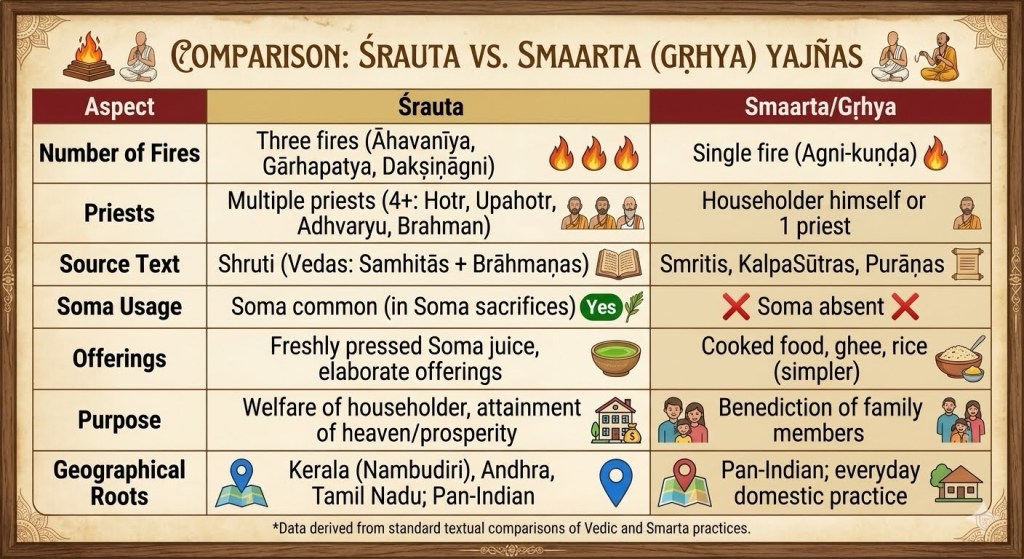
  1. Śrauta vs. Smaarta/Gṛhya (the fundamental binary):
    • Three fires vs. one fire
    • Multiple priests vs. householder
    • Shruti mantras vs. Smriti/KalpaSūtra
    • Soma common vs. Soma absent

Hierarchy of Śrauta Rites:

Agnihotra (daily) → Darśapūrṇamāsa (biweekly) → Agnistoma (entry Soma) →Extended Soma rites → Agnicayana (advanced)

Regional Specializations:
• Kerala: Agnicayana (Athirathram) only living tradition[wikipedia]
• Telugu: Paundareeka yaga
• Pan-Indian: Agnistoma, Vajapeya, Agnihotra, Aupasana
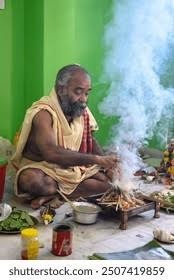
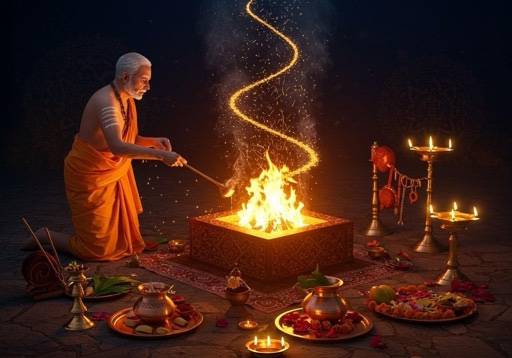
This taxonomy clarifies that the above list has categories:

— (Śrauta, Smaarta, Gṛhya), daily rites

— (Agnihotra, Aupasana), Soma sacrifices (Agnistoma, Vajapeya),

— advanced rituals (Agnicayana),

— preparatory rites (Agni Aadhana, agrayana),

— regional yagas (Paundareeka),

— and subsidiary rituals (Aruna-ketuka).
Comparative Summary Table

Key Doctrinal Distinctions
Detailed Explanations of Each Yajña

  1. Śrauta (श्रौत)
    • Nature: The entire category of Vedic sacrifices based on Shruti texts
    • Liturgical Practice: Three-fire ritual; multiple priests (Hotr, Upahotr, Adhvaryu, Brahman); elaborate Soma offerings common
    • Geographical Roots: Pan-Indian; preserved in Kerala (Nambudiri), Andhra, Tamil Nadu[wikipedia]
    • Key Distinction: This is not a specific rite but the class containing Agnistoma, Agnicayana, Vajapeya, etc.
  2. Smaarta (स्मार्त) / Gṛhya (गृह्य)
    • Nature: Domestic sacrifices based on Smriti/KalpaSūtra texts; “Gruhya” is the same category
    • Liturgical Practice: Single fire; householder performs with wife’s participation; simpler offerings (cooked food, ghee, rice)
    • Geographical Roots: Pan-Indian; everyday domestic practice
    • Key Distinction: “Smarta” = textual category; “Gṛhya” = ritual type (domestic). These terms are interchangeable in classification.
  3. Agnihotra (अग्निहोत्र)
    • Nature: Daily twice-fire offering; foundational Śrauta ritual
    • Liturgical Practice:
    • Offered exactly at sunrise & sunset
    • Two pinchfuls of uncooked rice + ghee into fire
    • Mantras: “agnir jyotir, jyotiḥ sūryaḥ svāhā” (evening); reverse (morning)
    • Geographical Roots: Orthodox Hindu communities pan-India; modern revival by various groups
    • Key Distinction: The basic daily rite one must establish before performing Agnistoma.
  4. Aupasana (आुपासन)
    • Nature: Daily yajna performed by married Hindus; commences in marriage fire.
    • Liturgical Practice:
    • Fire preserved throughout life without break
    • Son lights his fire from father’s fire during marriage (generational continuity)
    • All 7 Pakayajñas (including Upanayana, Śrāddha) conducted in this fire
    • Geographical Roots: Pan-Indian; embedded in Hindu marriage ritual
    • Key Distinction: Domestic (Smarta) fire that links generations; distinct from Agnihotra despite both being daily.
  5. Agnistoma (अग्निस्तोम)
    • Nature: Simplest Soma rite; first of seven Soma sacrifices
    • Liturgical Practice:
    • 5-day ceremony (core spans 3 days)
    • 10 Soma pressings: 2 dawn, 4 midday, 4 dusk
    • Freshly pressed Soma juice offered into three fires
    • Four priests: Hotr, Upahotr, Adhvaryu, Brahman
    • Geographical Roots: Pan-Indian Vedic tradition
    • Key Distinction: Entry-level Soma sacrifice; prerequisite for Agnicayana
  6. Ishti (इष्टि)
    • Nature: General term for “offering/sacrifice”; also specific category of non-Soma Śrauta rites
    • Liturgical Practice:
    • Varies by type; can be simple (cooked food) or elaborate
    • Often Sanskrit for “Yajna” itself
    • Geographical Roots: Pan-Indian
    • Key Distinction: Generic term sometimes used for Pakayajña (cooked-food) sacrifices; not a single specific rite
  7. Agni Aadhana (अनि आधन)
    • Nature: Establishment/ignition of the three Śrauta fires
    • Liturgical Practice: Ritual procedure for kindling and consecrating Āhavanīya, Gārhapatya, Dakṣiṇāgni
    • Geographical Roots: Pan-Indian Śrauta tradition
    • Key Distinction: Preparatory ritual required before ANY Śrauta sacrifice; not a sacrifice by itself
  8. Agni Cayana / Agnicayana (अनिचयन)
    • Nature: Advanced Śrauta ritual; “over-night piling up of the fire”; also called Athirathram
    • Liturgical Practice:
    • 12-day ceremony
    • Bird-shaped altar (uttaravedi) built from 1005 bricks
    • Liturgical text: Krishna Yajurveda Chapters 20-25
    • Purpose: Build immortal body beyond death/suffering
    • Geographical Roots: Exclusively Kerala (Nambudiri Brahmins); discontinued elsewhere by 11th century
    • Key Distinction: Most elaborate Śrauta ritual; requires prior Agnistoma; only living tradition in Kerala
  9. Paundareeka / Pauṇḍarīka (पौण्डरीक)
    • Nature: Vishnu-oriented yaga for prosperity; emulates Śrī Rama’s deeds
    • Liturgical Practice: Vyūḍha (elaborate) form; Telugu tradition
    • Geographical Roots: Telugu states (Andhra/Telangana); Brahmaśrī Dendukūri Veṅkaṭappa Yajñanārāyaṇa pioneered multiple performances
    • Key Distinction: Regional Vishnu yaga; not a standard Śrauta/Soma rite; Telugu-specific.
  10. Vajapeya (वजपेय):
    • Nature: Last of seven Soma sacrifices; “drink of strength”; elevates Brahmana to Purohita or king to paramount sovereign
    • Liturgical Practice:
    • Soma rite with drinking of Soma
    • 17 cups of Soma + 17 cups of Sura (wine) offered
    • Yajamana climbs sacrificial post wheel with wife
    • “By performing Vajapeya he becomes an emperor” (Śatapatha Brāhmaṇa)
    • Geographical Roots: Pan-Indian Vedic tradition; associated with kingship
    • Key Distinction: Kingly sovereignty rite; unusual inclusion of Sura wine.
  11. Sarvatomukha (सर्वतोमुख)
    • Nature: Śrauta sacrifice with three fires; “all-directional facing”
    • Liturgical Practice: Three-fire offering; oblations to all directions
    • Geographical Roots: Pan-Indian Śrauta tradition
    • Key Distinction: Named for directional inclusivity; standard Śrauta three-fire format.
  12. Aruna-ketuka (अरुण-केतुक)
    • Nature: Fire ritual with mantras in praise of Sun (Aruna); part of Agni Cayana
    • Liturgical Practice: Aruna Prasna mantras + Ketuka (banner/flame) fire ritual
    • Geographical Roots: Associated with Śrauta tradition; Sun worship
    • Key Distinction: Sun-oriented subsidiary ritual; possibly integrated with Agnicayana.
  13. Gruhya (गृह्य)
    • Nature: Same as Smaarta; domestic sacrifices
    • Liturgical Practice: Single fire; householder + family; simpler than Śrauta
    • Geographical Roots: Pan-Indian domestic practice
    • Key Distinction: Synonymous with Smaarta; “Gṛhya” emphasizes domestic nature, “Smaarta” emphasizes textual source

Additionally, there are two more Yajnas that were performed since olden times:

Agrayana (अग्रायण)
• Nature and sense: Agrāyana literally means “first-going” or “leading fire/rite”; in ritual parlance it generally refers to a sacrificial rite performed at the beginning of a season, year, reign, or important cycle — an inaugural yajña that marks a new beginning. It is often an observance that inaugurates a sequence of rites (e.g., the first homa of a year, the first offering after a consecration) rather than a single fixed, standalone canonical sacrifice like the Agnistoma.
• Liturgical practice: Practice varies with context. Typical features are: a specially consecrated yajna-kuṇḍa, invocation of the deity or deities appropriate to the new cycle (Agni, Indra, or the patron deity), a sankalpa (declarative intention) stating the new beginning, and oblations (ghee, rice, havis) offered with Vedic or agamic mantras. It can take the form of a simple pakayajña (cooked-food oblations) or a fuller śrauta-style homa depending on the sponsor’s resources and the tradition (smārta or śrauta) they follow.
• Distinctive points: Agrayana’s defining trait is primacy of timing and intent (inauguration), not a fixed technical structure; therefore it may be śrauta in a community that preserves śrauta forms, or gṛhya/smārta in domestic contexts. It is essentially a functional label (“the inaugural yajña”) rather than a rigid ritual category.
• Geographical/textual roots: The practice appears across regions because many ritual calendars mandate inaugural acts (seasonal and regnal); its exact form and name may vary regionally and in āgama or local custom. It is attested in later ritual manuals and regional temple traditions rather than as one canonical Vedic soma-sacrifice in the Brāhmaṇas.

Śravaṇa-pāsu (श्रवण-पाशु / Śravaṇa-pāsu)
• Nature and sense: The compound suggests two possible readings in classical ritual vocabulary; depending on manuscript/usage contexts it is read as Śravaṇa-pāsu or Śravaṇa-pashu.

Broadly, it refers to a rite connected with the listening (śravaṇa) of specific mantras and an act concerning animals (pāsu/pashu) — historically this points to rites related to animal-oblation contexts or rites performed for the welfare of cattle, flocks, or sacrificial animals. In many Vedic and post-Vedic contexts “pāsu” is used as “sacrificial animal” and rites for cattle welfare and consecration exist in domestic and community practice.
• Liturgical practice: Where the term is used as an explicit ritual heading, the rite typically combines recitation/listening (śravaṇa) of prescribed mantras with offerings and rites directed to protect, consecrate, or release animals (or to transfer merit on their behalf).

Depending on the tradition it may be a) a protective rite for cattle and flocks (blessings, oblations, sprinkling, recitation of protective stotras), or b) a regulated sacrificial act where animal offerings are controlled by the sūtra rules (many later traditions replace animal-offering with symbolic vegetarian havis).

The central liturgical element is the simultaneous emphasis on correct hearing/recitation of mantras (to secure the ritual’s efficacy) and the pāsu-related action (welfare, consecration, or, historically, the regulated animal oblation).
• Distinctive points: Śravaṇa-pāsu therefore occupies a liminal place between technical śrauta rules for animal oblation and the social-economic concern for cattle (a key asset in agrarian societies). Where animal sacrifice is taboo, the rite survives as a protective or consecratory ceremony for cattle or as symbolic substitutional offerings (seed, ghee, barley cakes). The emphasis on śravaṇan underscores that correctly heard and recited mantras are viewed as crucial to the rite’s efficacy.
• Geographical/textual roots: References to cattle-concern rites and to ritual forms that emphasize hearing are widespread in Brāhmaṇa and Gṛhyasūtra material; exact labels vary regionally. In later medieval and regional compilations such headings reappear in temple or village ritual contexts where cattle welfare remained socially important. As with many pāsu-related practices, forms changed over time toward non-violent or symbolic offerings in many regions.

(Concluded)

“Yajna purushaaya namo namah!”🙏

Sudarshan Madabushi

How Manu Smriti Served Liberal Historians and Social Anthropologists as a Handy Tool to Stigmatise Indian “Patriarchy” as Misogynistic (Part 3 & 4) Concluded

By M.K.Sudarshan

Chennai, India : June 22, 2026

Part III: How Liberal Historians Perpetuated the Colonial Myth
The Continuation of Orientalist Narrative

Post-independence, liberal historians and social anthropologists continued the British Orientalist narrative rather than correcting it:

Key Figures:


• Dr. B.R. Ambedkar (1920s–1950s): Blamed Manu for caste oppression; burned Manu copies (1927)
• Uma Chakravarti: “Brahmanical patriarchy” thesis conflates caste endogamy with Vedic dharma
• Modern feminists: Use Manu to stigmatise “Indian patriarchy” as “pure evil”

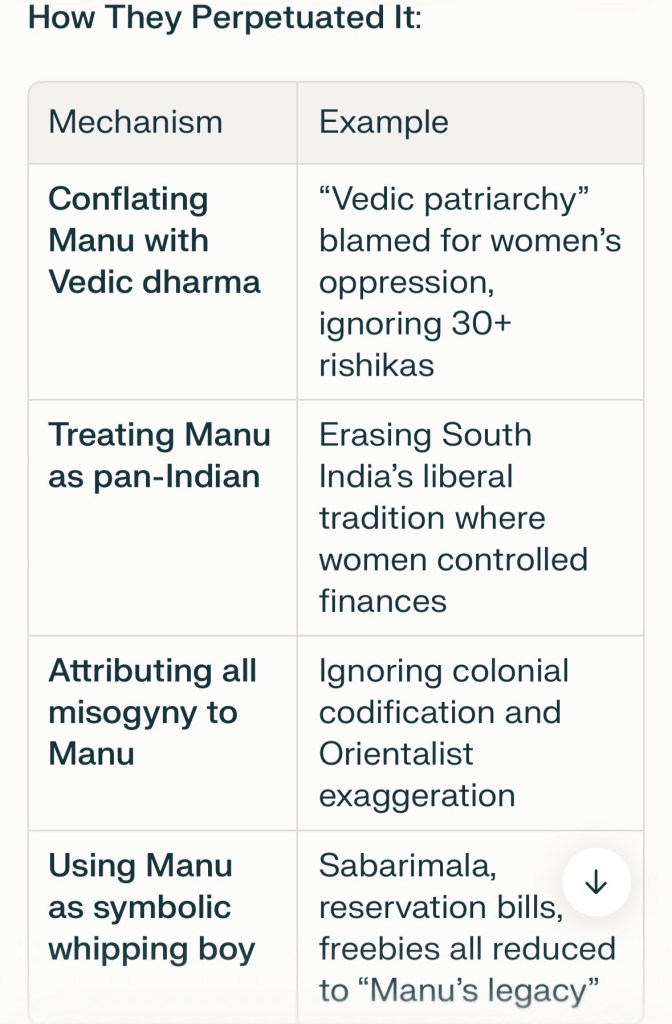
The Damage: This perpetuation validates the British colonial narrative that “Manu = Hindu law” while erasing Vedic feminine glory and South India’s liberal tradition.

The “Anti-Manu Hangover” Toxicity

The contemporary “hangover of anti-Manu-ism” toxifies discourse in four ways:


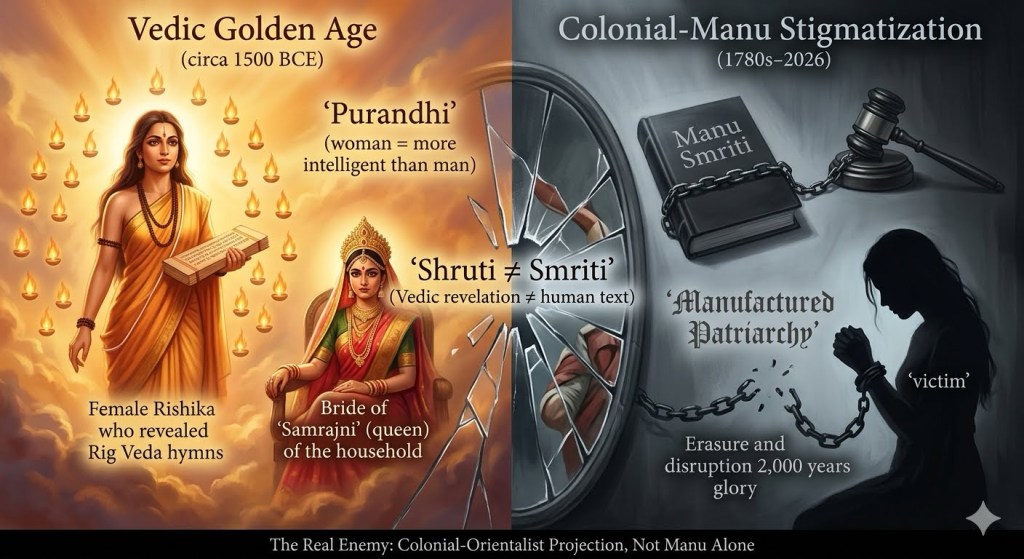
Toxicity #1: Erases Vedic Feminine Glory
• By blaming Manu for “all misogyny,” critics ignore 30+ women Vedic sages who revealed Rig Veda hymns
• Erases Andal (only female Alvar, 8th CE) and Devaki Piratti as spiritual giants
• Denies women’s 2,000-year status as samrajni (queens) and Purandhi (more intelligent)

Toxicity #2: Erases South India’s Liberalism
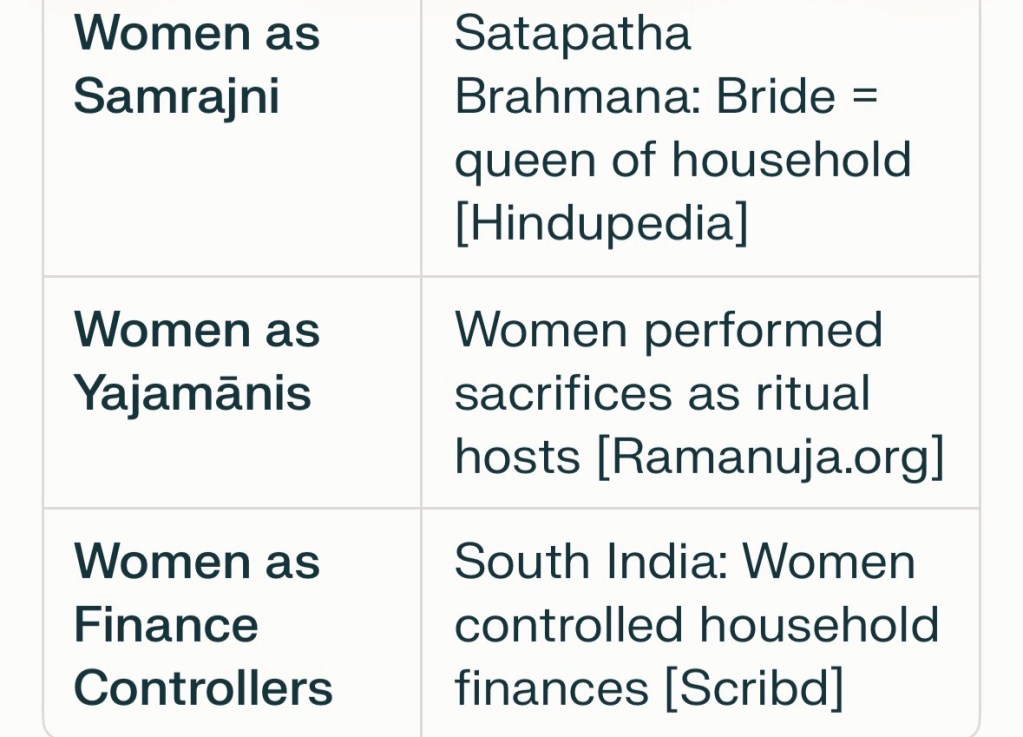
• South India’s women controlled household finances, were yajamānis, remained “more free”
• Sri Vaishnavism maintained women as Lakshmi embodiments
• Sati was regional (18th-century Rajasthan), not universal

Toxicity #3: Makes Women “Victims” Not “Queens”
• Framing women as “Manu’s oppressed victims” denies their Vedic status as divine embodiments
• Modern discourse diminishes women’s dignity by erasing their spiritual authority

Toxicity #4: Validates Colonial Narrative
• Anti-Manu rhetoric accepts British claim that “Manu = Hindu law” (false)

• Misses the actual source: British colonialism + Orientalist exaggeration, not Manu alone

*****************

Part IV: What Would Serve Women’s Cause Honestly?


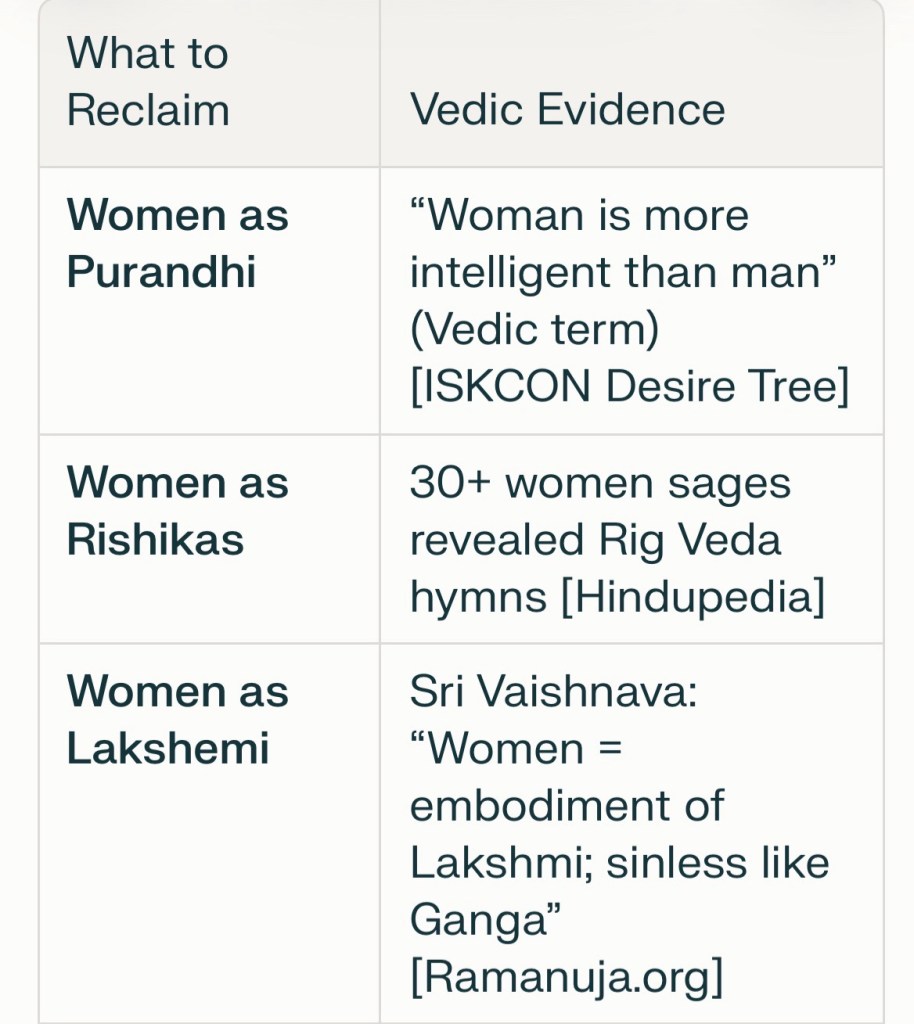
Reclaim the Vedic Feminine Legacy

Instead of blaming Manu, genuine women’s dignity requires reclaiming what was erased:

******************

Conclusion: The Real Enemy Is Not Manu—It’s the Colonial-Orientalist Projection

The Manu Smriti has served liberal historians and social anthropologists as a handy scapegoat because it allows them to:

  1. Stigmatise “Indian patriarchy” as “pure misogynistic evil” without examining Vedic feminine glory
  2. Validate British colonial narratives that “Manu = Hindu law” (which is false)
  3. Erase South India’s liberal tradition where women remained autonomous
  4. Make women “victims” rather than restore their Vedic status as queens and sages
  5. But the real historical truth is:
    • Manu was never Vedic law (he’s Smriti, not Shruti)
    • Manu was never universal (South India rejected him)
    • Manu was never preeminent (18 Dharmashastras existed)
    • Manu was not the origin of misogyny (Vedic women had full equality 1,500 years before him)
    • British colonialism made Manu canonical (not Hindu society)
  6. The real enemy is not Manu, but the colonial-Orientalist-modern ideological conflation that:
    • Erases 2,000+ years of Vedic feminine glory
    • Misrepresents South India’s liberal tradition
    • Validates the British claim that “Manu = Hindu law”
    • Diminishes women’s dignity by framing them as “Manu’s victims”
  7. What would actually serve women’s cause: Reclaiming the Vedic feminine ideal where women were Purandhi, Rishikas, Lakshmi embodiments, Samrajni, and Yajamānis, somidevamma—not the Manu-victim narrative that anti-Manu rhetoric imposes.
Until liberal historians and social anthropologists acknowledge these glaring inaccuracies, the “anti-Manu hangover” will continue to toxify Indian discourse and do more harm than good to the actual dignity and cause of Indian women.

(Concluded)

The author M.K. Sudarshan (aka Sudarshan Madabushi) is a scholar-student of classical Indian philosophy, Vedic literature, and Sri Vaishnava theology, having published six critically acclaimed books on the subjects. He also commentates on economic theory, historical biography and current international affairs.

How Manu Smriti Served Liberal Historians and Social Anthropologists as a Handy Tool to Stigmatise Indian “Patriarchy” as Misogynistic (Part 2 of 4)

By M.K.Sudarshan

Chennai, India : June 22, 2026

Part II: How British Colonial Orientalism Made Manu “Canonical”
The British Imperial Purpose

The elevation of Manu Smriti to “preeminent Hindu law” was not accidental—it was a calculated imperial strategy serving three purposes:


Purpose #1: Simplify Governance
• British administrators needed a “single code” for Hindu law
• Manu provided a textual authority they could cite in courts
• William Jones (1780s) called Manu the “holiest of legislators”
• James Mill (1817) propagated Manu as “canonical Hindu law”

Purpose #2: Create Division
• By elevating Manu’s Brahmanical provisions, British reinforced upper-caste authority
• Appointed Brahmanical scholars as “Hindu Law advisors” in courts
• This entrenched caste hierarchy under colonial law
• Enabled “divide and rule” by creating fixed caste categories


Purpose #3: Justify Colonial Intervention
• By portraying Manu as “misogynistic Hindu law,” British justified “reform”
• Missionaries used Manu to argue Hinduism was “backward”
• Colonial “abolition of sati” (1829) was framed as “rescuing women from Manu”
• This created moral justification for colonial occupation

The Evidence:
• 1780s–1860s: British legal codification appointed Brahmanical scholars as advisors
• 1871: First decennial census attempted to enumerate entire population by caste
• 1901: Risley’s Census mapped social hierarchy; made caste rigid and formalized
• 1936: Scheduled Castes Order officially identified “untouchables”

The Paradox as it panned out:
British made Manu “canonical” → Modern critics blame Manu for “Brahminical oppression” →
But Manu was never the original Vedic view →
Vedic women had full equality.

****************

The Orientalist Text Selection

British Orientalists selectively elevated Manu while ignoring:

What They Ignored:
• Vedic Shruti authority (supreme over Smriti)
• 30+ women rishikas in Rig Veda
• South India’s alternative

Dharmashastras (Yajnavalka, Vishnu)
• Sri Vaishnava theology (women = Lakshmi embodiments)
• Satapatha Brahmana (bride = samrajni/queen/somidevamma)

What They Elevated/Exaggerated:
• Manu’s IX.3 and IX.17 (“women must be guarded; cannot be independent”)
• Manu’s caste endogamy provisions
• Manu’s ritual purity/pollution codes

The Result: By cherry-picking Manu’s restrictive verses and ignoring Vedic feminine glory, Orientalists created the “Manu = Hindu patriarchy” myth that liberal historians perpetuate today.

(Continued in Part 3)

How Manu Smriti Served Liberal Historians and Social Anthropologists as a Handy Tool to Stigmatise Indian “Patriarchy” as Misogynistic (Part 1 of 4)

By M.K.Sudarshan

Chennai, India : June 22, 2026

Introduction: The Manu Smriti Smokescreen


In contemporary Indian discourse, the Manu Smriti has become the whipping boy for every alleged social ill in Hindu society. From temple entry bans to women’s reservation debates to caste discrimination, Manu is invoked as the preeminent symbol of “Brahminical patriarchy” and “institutionalised misogyny.”

Liberal historians, social anthropologists, and even constitutional reformers have found in Manu a convenient scapegoat—a single text that supposedly encapsulates 2,500 years of “Indian patriarchal oppression.” But this narrative is built on glaring historical inaccuracies, false textual equivalences, and deliberate misinterpretations that serve ideological purposes far more than scholarly truth.

The Manu Smriti was never the “law of Vedic society.” It was never universally abided across India. It was never even considered supreme by Hindu traditions themselves. Yet, through a colonial-Orientalist projection that liberal historians have perpetuated, Manu has been elevated to a position he never held in authentic Indian history.

This op-ed exposes how the Manu Smriti myth was constructed, why it served British imperial purposes, and how it continues to distort genuine understanding of Indian women’s historical dignity. Today, even Indian elites and intellectuals find it easy to use Manu Smriti to caricature Hindu society by bandying about that pejorative Western characterisation: Patriarchy.

*******************

Part I: The Four Glaring Inaccuracies in the Manu-as-Patriarchy Narrative


Inaccuracy #1: Manu Smriti Was Never Vedic Law


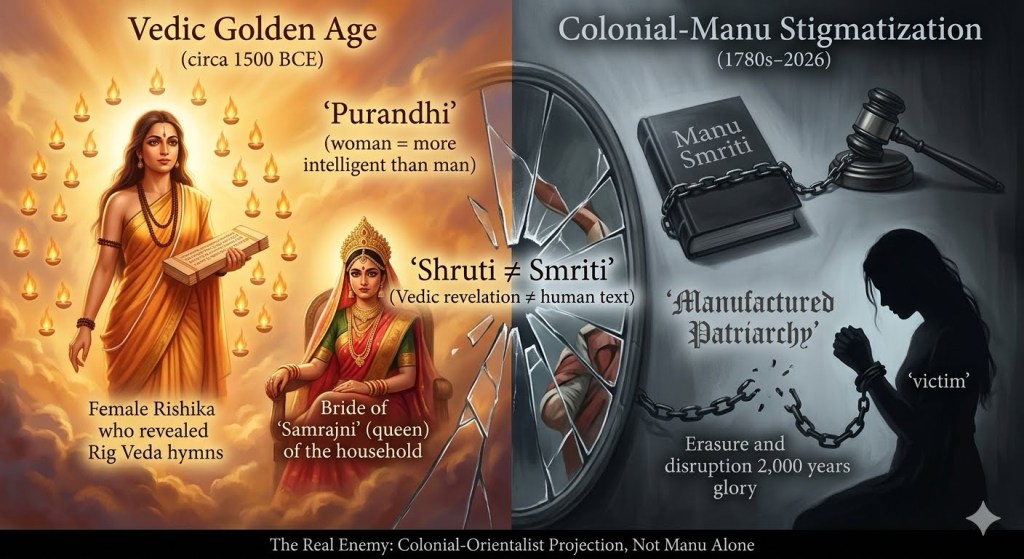
The most fundamental error in the anti-Manu narrative is the conflation of Shruti (Vedic revelation) with Smriti (human-written texts).


Vedic Authority: The Vedas (Rig, Yajur, Sama, Atharva compiled as “apaurusheya revelations) 1500–600 BCE, (or even earlier) are Shruti—“that which is heard”—eternal revelation, supreme authority in Hindu philosophy.


Manu’s Status: The Manu Smriti (200 BCE–200 CE) is Smriti—“that which is remembered”—human composition, subordinate to Vedas.


The Contradiction: Liberal historians treat Manu as “the Vedic law” while Hindu traditions themselves have never accepted this. The Bhagavad Gita (6.13) explicitly states that Shruti is supreme.

The Sri Vaishnava Sampradaya rejects Smriti authority when it contradicts Shruti. Yet modern critics invoke Manu as “Vedic law” to stigmatise “Vedic patriarchy.”


The Reality: The Vedic view of women was completely different from Manu’s:


• 30+ women rishikas (sages) revealed Rig Veda hymns—including Vak Ambrini, Maitreyi, Lopamudra [Rig Veda 1.165]
• Women received Upanayana (sacred thread ceremony) and Vedic education
• Women chose their husbands through Gandharva and Prajabarta marriage forms
• Women were addressed as samrajni (queen) of the household in Satapatha Brahmana
• The Vedic term Purandhi means “woman is more intelligent than man”

The Manu Problem: By conflating Manu (Smriti) with Vedas (Shruti), liberal historians stigmatise 2,000 years of Vedic feminine glory as “patriarchal oppression.”

Inaccuracy #2: Manu Was Never Universal—South India Rejected It

The anti-Manu narrative presents Manu as a “pan-Indian social contract” abided by all Hindus. This is historically false.

North India vs. South India:
• Manu’s Region: The Manu Smriti text was written 200 BCE–200 CE, attributed to the ancient Svayambhuva Manu (Vedic Manu from Gita 4.1), but this attribution is pseudepigraphic. The actual author(s) composed it during Mauryan/Gupta period as orthodoxy’s defensive response to Buddhism/Jainism, when orthodoxy faced Buddhist/Jain challenges.


• South India’s Reality: From 200 CE to 1750 CE, South India followed different Dharmashastras (Yajnavalka, Parashara, Apasthamba, Vishnu)—NOT Manu

Evidence from South India:
• Women controlled household finances and managed property
• Women were yajamānis (ritual hosts) who performed sacrifices; males were designated agnihotris while their wives who participated in yagnya with them were designated somidevamma
• Women were considered embodiments of Lakshmi—sinless like the Ganga
• Sati (widow burning) was rare/non-existent until 18th-century Rajasthan
• Women retained more autonomy than in North India

The Sri Vaishnava Test: The Sri Vaishnava Sampradaya (8th–12th CE) explicitly teaches:
• “He who abuses women, abuses Lakshmi herself”
• “No inauspiciousness whatsoever exists in women”
• Women undergo religious initiation and are encouraged to study sacred texts
• During menstruation, women are relieved of duties and given rest—not treated as “polluted”

The Contradiction: By treating Manu as “pan-Indian,” liberal historians erase South India’s liberal tradition and misrepresent the Vedic feminine ideal that South India preserved.

Inaccuracy #3: Manu Was Never “Preeminent”—Multiple Dharmashastras Existed

The anti-Manu narrative presents Manu as the “authoritative law” for Hindu society. This ignores the textual plurality of Dharmaśāstra tradition.

The Reality: At least 18 major Dharmashastras existed, including:


• Yajnavalka Smriti
• Parashara Smriti
• Vishnu Smriti
• Narada Smriti
• Brihaspati Smriti
• Katyayana Smriti

Manu’s Status: Manu was one among many—not preeminent. Regional scholars preferred different texts:


• Bengal: Followed Dayabhaga (not Manu)
• South India: Followed Mitakshara (Vijnaneshwara, not Manu, Apasthamba)
• Maharashtra: Followed Vijnaneshwara’s commentary

The Contradiction: Liberal historians treat Manu as “the Hindu law” while Hindu legal tradition itself never accepted this. The British colonial administrators made Manu canonical, not Hindu society.

Inaccuracy #4: Manu Was a Defensive Text, Not the Origin of Misogyny

The most damaging error is attributing “Indian misogyny” to Manu as its origin. This ignores the historical context of Manu’s composition.

Manu’s Context (200 BCE–200 CE):


• Written during breakdown of Maurya/Shunga empires
• Orthodox Hinduism faced existential threats from Buddhism and Jainism
• Manu was a defensive codification to preserve orthodoxy
• “The severity of the Dharma-shastras was doubtless a commentary arising from the insecurity of the orthodox in an age of flux” (a historical scholar)

The Timeline:
• 1500–200 BCE: Vedic women had full equality (30+ rishikas, Upanayana, marriage choice)
• 200 BCE–200 CE: Manu written as orthodoxy’s defensive response
• 200 CE–1200 CE: Manu remained one of many texts; regional variations dominant
• 1200–1750 CE: Medieval caste endogamy intensified; regional practices varied
• 1757–1947: British colonialism elevated Manu to “canonical Hindu law”

The Reality: Manu codified existing anxieties, not originated misogyny. The Vedic feminine ideal (1,500 years before Manu) was completely egalitarian. The 18th-century sati practice in Rajasthan was a regional deviation, not “Manu’s law.”

The Contradiction: By blaming Manu for “all Indian misogyny,” liberal historians ignore 1,500 years of Vedic feminine equality and erase South India’s liberal tradition.

(Continued in Part 2)

கடன் வாங்கிய சுய-அறிவு: உடனடி ஞானத்தின் ஆபத்தான ஈர்ப்பு


தங்கள் ஆன்மாவை உணர்வதற்கான உழைப்பைச் செய்யாமல், ஓய்வு பெற்றவர்கள் எவ்வாறு ஆறுதலை விலைக்கு வாங்குகிறார்கள்

எழுதியவர்: எம்.கே. சுதர்சன்
சென்னை, இந்தியா : ஜூன் 21, 2026

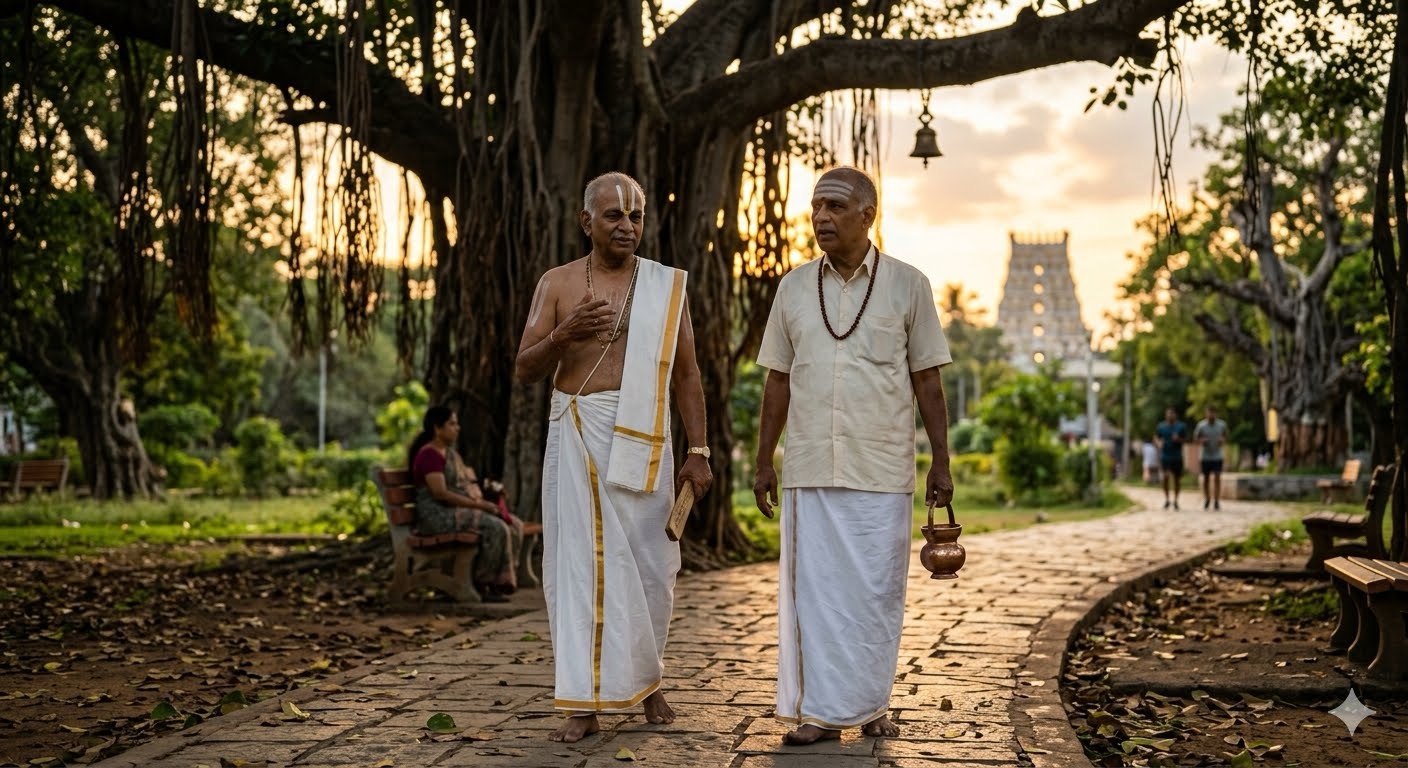
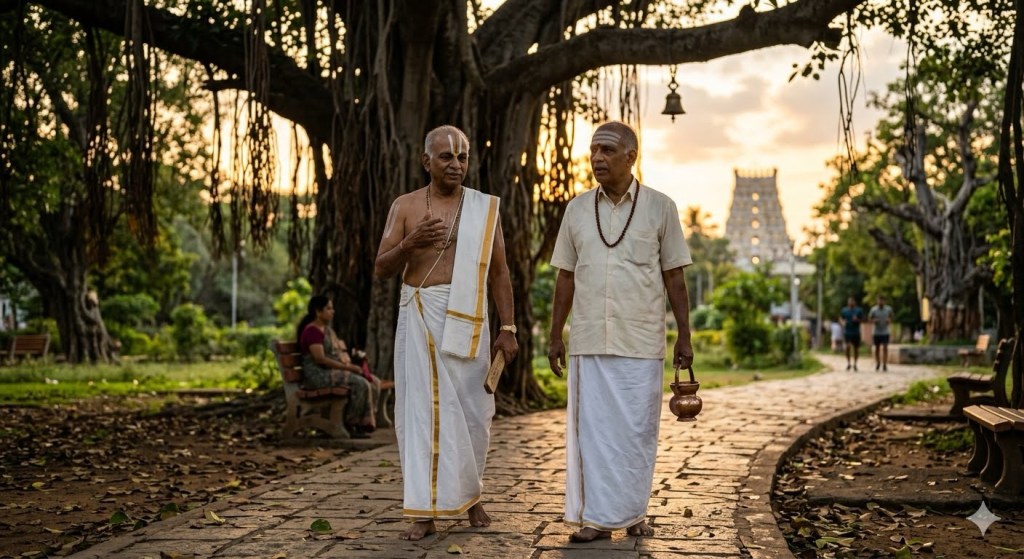
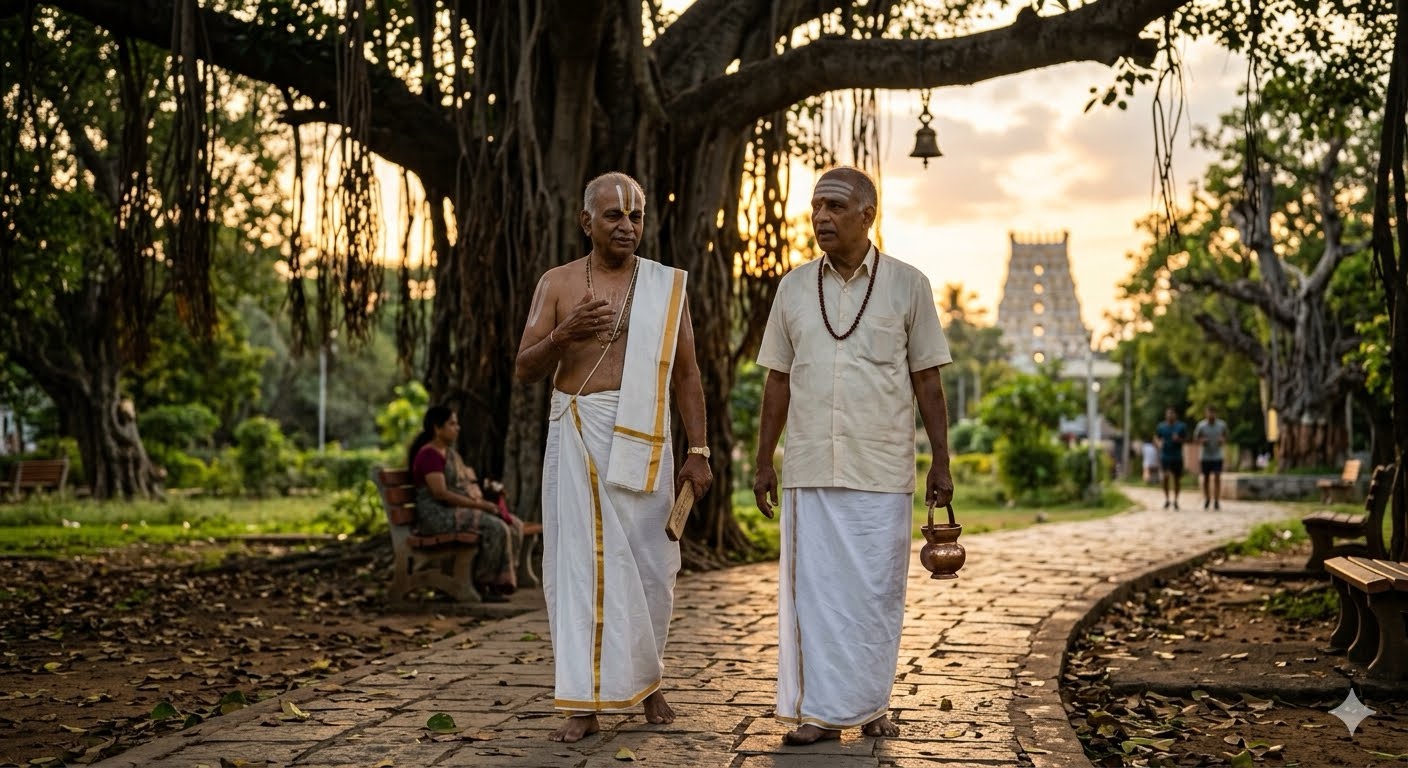
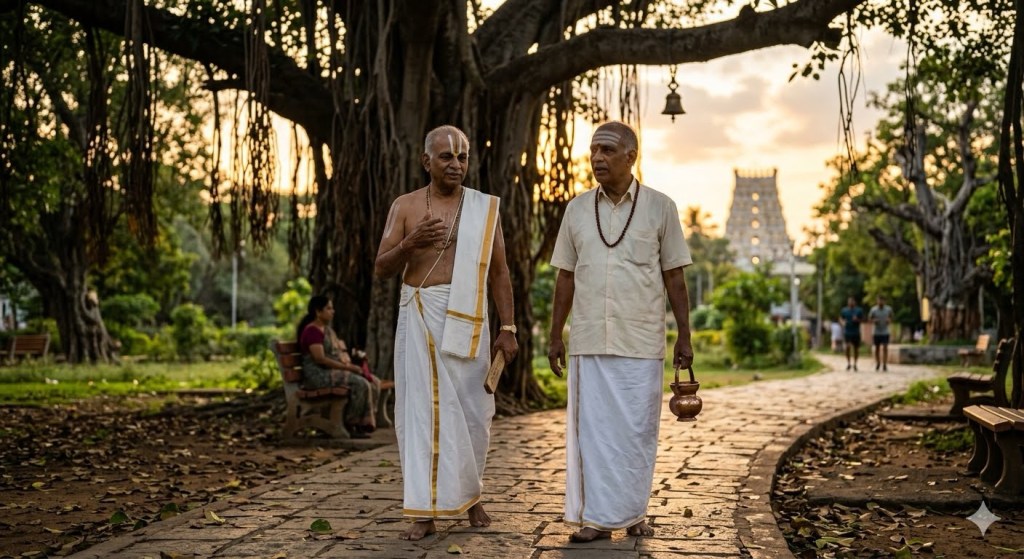
இரு வயதான தமிழ் பிராமண தத்துவவாதிகள் — ஒருவர் வடகலை ஸ்ரீ வைஷ்ணவர், மற்றவர் ஸ்மார்த்த அத்வைதி — ஒரு மாலை வேளையில் பூங்காவில் உலாத்திக்கொண்டே வேதாந்தம் மற்றும் ‘ஆத்ம-விசாரம்’ (சுய-விசாரணை) குறித்து உரையாடுகிறார்கள்.

“மற்றுமொரு குளுமையான மாலைப் பொழுது,” தன் சால்வையை இன்னும் இறுக்கமாக இழுத்துப் போர்த்தியபடி அந்தப் பழமையான ஆலமரத்தைச் சுற்றி வருகையில் ரகுநாதன் கூறினார். “இந்த நாட்களில் மக்கள் உங்களது நிகர மதிப்பு என்ன அல்லது உங்களது சமீபத்திய கட்டுரை என்ன என்று கேட்காத ஒரே இடம் இந்தப் பூங்கா மட்டும்தான்.”

கிருஷ்ணம்மா சிறிய, உலர்ந்த தொனியில் சிரித்தார். “அவர்கள் என்னிடம் எனது இரத்த அழுத்தத்தைப் பற்றித்தான் கேட்கிறார்கள். ‘இதயம் எப்படி இருக்கிறது தாத்தா?’ என்று கேட்கும்போது மிகவும் பெருமையாக இருக்கிறது.” அவர் ஒரு அணில் நேர்த்தியின்றி மரத்தில் ஏறுவதைப் பார்க்க சற்று நின்றார்.

“தெரியுமா ரகு, கடந்த வாரம் நான் எனது பழைய பள்ளித் தோழன் ஒருவனைச் சந்தித்தேன் — ஓய்வு பெற்ற வங்கித் தலைவர், மிகவும் நாகரிகமானவர் — அறுபது வயதை எட்டியதிலிருந்து ‘சுய-அறிதலைப்’ பற்றித் தன்னால் படிக்க முடிந்த எல்லாவற்றையும் படித்து வருவதாக ஒப்புக்கொண்டார். அவருக்கு ஒரு குறுக்கு வழி தேவைப்படுகிறது. ‘எனக்கு அதன் சாரத்தை மட்டும் கொடுங்கள், புத்தகங்களை அடுக்கடுக்காகப் படிக்க எனக்கு நேரமில்லை’ என்றார்.”

ரகுநாதனின் கண்கள் கனிந்தன. “நாங்கள் அனைவரும் சாரத்தையே விரும்புகிறோம். நாம் இளமையாக இருந்தபோது, கணிதப் பகுப்பாய்வுகளில் நீண்ட சான்றுகளை இமைக்காமல் படித்து முடித்தோம், ஏனென்றால் நாம் அதைச் செய்ய வேண்டியிருந்தது. ஆனால் இப்போது, அதே முயற்சியை இந்த ஆத்மாவிற்காகச் செய்வது… பாரமாகத் தெரிகிறது. இது விசித்திரமானதுதான்.” அவர் தனது கைகளைத் தலைக்கு பின்னால் கட்டிக்கொண்டார்.

“ஆனால் சாரம் என்பது ஒழுக்கத்திற்குப் பின் வருவது, அதற்கு முன் அல்ல.”

கிருஷ்ணம்மா தலையசைத்தார். “ஆமாம். நம் குருவிடமிருந்து ‘நான் யார்?’ என்று முதன்முதலில் கேட்டபோது, நான் ஒரு எளிய பழமொழியை எதிர்பார்த்தேன். அதற்குப் பதிலாக எனக்குக் கிடைத்தது ஒரு கேள்வி, அது அலை போல மீண்டும் மீண்டும் வந்துகொண்டே இருந்தது. உபநிடதங்களை பொறுமையாகப் படிப்பது, விவாதங்கள், அமைதியான விசாரணையின் இரவுகள் என பல வருடங்கள் பிடித்தன — அது ஒரு புதிரல்ல, ஒரு வழிமுறை என்பதைப் புரிந்துகொள்ள. வழிமுறை இல்லாவிட்டால், அந்தப் புதிர் வெறும் வெற்று முழக்கமாக மட்டுமே இருக்கும்.”

“மக்கள் அதை மறந்துவிடுகிறார்கள்,” என்றார் ரகுநாதன். “அவர்கள் வேதாந்தத்தை வெறும் ஆறுதல் தரும் ஒன்றாகக் கருதி, அதன் அறிவுசார் கண்டிப்பை மறந்துவிடுகிறார்கள். நாம் ஒரு காலத்தில் கோட்பாடுகளை மதித்தோம். வாதத்தின் படிகளை நாம் மதித்தோம்: முன்மாதிரி, சான்று, அனுமானம். ஆத்ம-விசாரமும் மனதிடமிருந்து அதையே கேட்கிறது — கவனம், தவறான அடையாளங்களை கவனமாக மறுத்தல், நேர்மையான சோதனை.”

அவர் ஒரு தாளத்தைச் சரிபார்ப்பது போல் பெஞ்சைத் தட்டினார். “அதுதான் உழைப்பு. நள்ளிரவு தொலைக்காட்சி அலைவரிசைகளில் ஒருவர் காணும் மேற்கோள்களின் தொகுப்பும், மனதிற்கு இதமளிக்கும் கதைகளும் அல்ல.”

கிருஷ்ணம்மாவின் முகம் சற்று ஏளனமாக மாறியது. “மேலும் உடனடிப் பதில்களைத் தரும் சந்தைகளில் பொருட்கள் ஏராளமாக உள்ளன: சுருக்கமான கையேடுகள், பரவசமூட்டும் வீடியோக்கள், சந்தா செலுத்தினால் ஞானம் தருவதாக உறுதியளிக்கும் கவர்ச்சியான குரல்கள். அவர்கள் விழிப்புணர்வை ஏதோ ஒரு வார இறுதிப் பயிலரங்கு போல விற்கிறார்கள். மொழி எளிமையானது, பேக்கேஜிங் கவர்ச்சியானது, அதற்கான விலை மனதின் ஆறுதல் மட்டுமே.”

அவர் தன் இதயத்தின் மீது கையை வைத்துக்கொண்டு வருத்தத்துடன் புன்னகைத்தார். “யார்தான் இதில் ஏமாற மாட்டார்கள்?”

“குறிப்பாக புதிதாக அவசரப்படுபவர்கள்,” என்றார் ரகுநாதன். “நாட்காட்டி சுருங்கும்போது, அவசரம் பதற்றமாக மாறுகிறது. இருபது வயதில் கால்குலஸ் கற்றுக்கொண்டு அறுபது வயதில் நியூட்டனை மாற்றி எழுத நினைக்கும் மனிதனைப் போல மனம் முடிவுகளைக் கேட்கிறது. அதே மன சுறுசுறுப்பை எந்த ஆயத்த உழைப்பும் இல்லாமல் எதிர்பார்ப்பது நியாயமற்றது. உள்ளார்ந்த பாதைக்கு கடுமையான பயிற்சி தேவைப்படுகிறது, கல்விப் பணிகளைப் போலவே — ஆனால் அதற்கான பொருட்கள் வேறுபட்டவை: கவனத்தின் ஒழுக்கம், நெறிமுறை தெளிவு, பகுத்தறிவு.”

கிருஷ்ணம்மா ஒரு குழுவாக ஓடிச் சென்ற இளைஞர்களைப் பார்த்தார், அவர்களின் சிரிப்பு தூரத்தில் மெலிந்து மறைந்தது.

“மேலும் மற்றொரு விசித்திரமான பித்து இருக்கிறது,” என்று ரகுநாதன் மேலும் கூறினார், அவரது குரல் மென்மையான கிண்டலுடன் கூர்மையாக இருந்தது. “இந்த முதியவர்கள் எதைப் படித்தாலும், அவர்களுக்கு எப்போதும் ஒரு அறிவியல் இணை தேவைப்படுகிறது. ‘அறிவியல் இதை உறுதிப்படுத்துகிறதா?’ என்று அவர்கள் கேட்கிறார்கள், வேதாந்தம் ஏதோ ஒரு ஆய்வக அறிக்கையின் ஒப்புதலுக்காகக் காத்திருப்பது போல.”

கிருஷ்ணம்மா ஆச்சரியத்துடன் அவரைத் திரும்பப் பார்த்தார். “ஆமாம் — நானும் அதைப் பார்த்திருக்கிறேன். அவர்கள் குவாண்டம் இயற்பியல் அல்லது நரம்பியல் அறிவியலை புனித நூல்களைப் போல மேற்கோள் காட்டுகிறார்கள்.”

ரகுநாதன் தலையசைத்தார். “நான் அவர்களிடம் கேட்கிறேன்: ‘வேதாந்தம் ஏன் எப்போதும் அறிவியலில் தன் உண்மையை தேட வேண்டும்? பூமியில் பகுத்தறிவு காலம் தோன்றுவதற்கு முன்பே, அறிவியல் புரட்சி பிறப்பதற்கு முன்பே வேதாந்த விசாரம் தொடங்கிவிட்டது! மேலும் — அறிவியல் எப்போதாவது வேதாந்தத்தில் தன் ஒப்புதலைத் தேடுகிறதா? இல்லை! பின் ஏன் வேதாந்தத்தைப் படிக்கும்போது அறிவியலின் மீதும் அதன் அறிவியல் இணைகளின் மீதும் இந்த பித்து?'”

கிருஷ்ணம்மா வறண்ட புன்னகை புரிந்தார். “பொதுவாக எனக்கு உடனடியான அல்லது யோசித்துப் பெறப்பட்ட பதில் எதுவும் கிடைப்பதில்லை. அவர்கள் குழப்பத்துடன் பார்க்கிறார்கள், எழுத மறந்துபோன ஒரு சமன்பாட்டை தீர்க்கச் சொன்னது போல.”

“அப்படியேதான்,” என்றார் ரகுநாதன். “அவர்கள் ஓர் அதிகாரத்தை விட்டு மற்றொன்றிற்கு மாறிவிட்டார்கள். குரு அல்லது சாஸ்திரத்திற்குப் பதிலாக, இப்போது அது அறிவியல் கட்டுரை. மனம் இன்னும் ஒரு வெளி உலக ஒப்புதலையே தேடுகிறது — அது விசாரணையையே நம்ப இன்னும் பழகவில்லை.”

“மற்றொரு தடையும் இருக்கிறது,” என்றார். “மொழி. பெரும்பாலான ஆதாரங்கள் சமஸ்கிருதத்திலும் தமிழிலும் உள்ளன. அல்காரிதம்களைப் படிக்கும் நமது ஐஐடி நண்பர் ஒரு புதிய பாடப்புத்தகத்தை எடுத்து வாரங்களில் சிக்கலான குறியீடுகளைப் புரிந்துகொள்வார். ஆனால் உபநிடதங்கள் சுருக்கப்பட்ட கவிதை வடிவில் பேசுகின்றன, அவற்றை மொழிபெயர்ப்பது எப்போதும் எளிதல்ல. அந்த ஆழமான பரிச்சயம் இல்லாததால், பலர் கடினமான பகுதிகளை எளிமைப்படுத்தும் மொழிபெயர்ப்புகளையோ அல்லது நவீன விருப்பங்களுக்கு ஏற்ப உரையாற்றும் உரையாளர்களையோ நம்பியிருக்கிறார்கள்.”

ரகுநாதன் மெதுவாக தலையசைத்தார். “மொழிபெயர்ப்புகள் தவிர்க்க முடியாமல் மொழிபெயர்ப்பாளரின் மூச்சை சுமக்கின்றன. அது தவிர்க்க முடியாதது. ஆனால் ஒரு உண்மையான தேடுபவர் இரண்டு விஷயங்களைச் செய்யலாம். முதலாவதாக, படிப்படியான வாசிப்புப் பயிற்சியை வளர்த்துக் கொள்ளுங்கள் — ஒரு காலத்தில் உங்கள் கல்விப் பயிற்சிக்கு அளித்த அதே பொறுமையை இதற்கு முதலீடு செய்யுங்கள். இரண்டாவதாக, யாருடைய சொந்த பயிற்சியும் புலமையும் ஆய்வுக்கு உட்படுத்தப்படுகிறதோ அத்தகைய நம்பகமான வழிகாட்டியைத் தேர்ந்தெடுங்கள். நன்றாகப் பேசும் ஒவ்வொரு ஆசிரியரும் ஆன்மாவின் ஆசிரியர் அல்ல.”

கிருஷ்ணம்மா கீழே விழுந்த ஒரு சிறு குச்சியை எடுத்து தன் விரல்களுக்கு இடையில் உருட்டினார்.

“பக்தி என்ற போர்வையில் இருக்கும் கர்வத்தின் ஆபத்தும் இருக்கிறது. பணம் மற்றும் அந்தஸ்தைக் கொண்டு தங்களை மதிப்பிட்ட வாழ்க்கைக்குப் பிறகு, சமூகத்தால் ‘ஞானி’ என்று பார்க்கப்பட விரும்பும் உங்களைப் போன்ற என்னைப் போன்ற முதியவர்களை நான் சந்திக்கிறேன். எனவே அவர்கள் ஆன்மீக அடையாளத்தை வெளிப்படுத்துகிறார்கள், சரியான மேற்கோள்களைப் பகிர்கிறார்கள், உள் மாற்றத்திற்காக அல்லாமல் சமூக அந்தஸ்திற்காக சத்சங்கங்களில் கலந்து கொள்கிறார்கள்.”

“பக்தியை நடிப்பது ஒரு விசித்திரமான தீமை,” என்று ரகுநாதன் ஒப்புக்கொண்டார். “இது வெளியில் இருந்து பார்க்க பக்தி போலத் தெரியும் ஆனால் நேர்மையை அரித்துவிடும். ஆன்மாவை நற்பெயராகப் பெற முடியாது. அடையாளத்திற்கான தவறான கோரிக்கைகளைத் தொடர்ந்து அகற்றுவதன் மூலமே அது கண்டறியப்படுகிறது. தரவுகளில் உள்ள சார்புகளைத் திருத்துவதற்கு இது சமம் என்று நீங்கள் கூறலாம் — உங்கள் அனுமானங்களை நீங்கள் இடைவிடாமல் தணிக்கை செய்கிறீர்கள்.”

கிருஷ்ணம்மா அந்த ஒப்பீட்டைக் கேட்டு மகிழ்ந்தார். “சரியாகச் சொன்னீர்கள். தியானம், சிரவணம், மனனம், நிதித்யாசனம் போன்ற கருவிகள் வேறுபடலாம் — ஆனால் அதன் அறிவுசார் ஆன்மா கடுமையான ஆராய்ச்சியைப் போன்றதுதான்: கருதுகோள், சோதனை மற்றும் சரிபார்ப்பு. மேலும், சோதனை தோல்வியுற்றால் தூக்கி எறியப்படும் ஒரு ஆய்வறிக்கையைப் போலல்லாமல், தேடுபவரின் மதிப்பு தோல்விகளை எதிர்கொண்டு அதில் நேர்மையாக இருப்பதன் மூலமே வளர்கிறது.”

அவர்கள் பேசாமல் சிறிது நேரம் அமர்ந்திருந்தனர், மாலையின் ஒலிகளைக் கேட்டபடி: தூரத்து கோவில் மணி, குழந்தைகளின் மென்மையான சலசலப்பு, உலகின் மெதுவான நகர்வு.

பின்னர் கிருஷ்ணம்மா அமைதியாகக் கூறினார், “நான் சமஸ்கிருதத்தை முன்பே கற்றிருக்கலாம் என்று விரும்பினேன். நான் நூல்களைப் பரிசுகளாகப் பார்க்கவில்லை, இப்போதுதான் நான் நுழையக் கற்றுக் கொள்ளும் உயிருள்ள உரையாடல்களாகப் பார்க்கிறேன். ஆனால் வருத்தப்பட்டு பலனில்லை. ஒருவர் இப்போதே தொடங்கலாம் — மெதுவாக, சரியாக.”

ரகுநாதன் தன் தலையை அசைத்தார். “இப்போதே தொடங்குங்கள், ஆம், ஆனால் எதிர்பார்ப்புகளைக் கட்டுக்குள் வையுங்கள். நாம் பந்தயத்தில் இல்லை. அவசர அவசரமாகப் படிப்பதை விட சிறிய தினசரி பயிற்சிகள் மனதை மிகவும் ஆழமாக வடிவமைக்கும். மேலும், எளிதில் பேசுபவர்களைக் கண்டு எச்சரிக்கையாக இருங்கள். யாராவது விழிப்புணர்வை மூன்று படிகளில் விற்றால், அவர் விளம்பரம் செய்கிறார் அல்லது தன்னைத்தானே ஏமாற்றிக் கொள்கிறார்.”

கிருஷ்ணம்மா சிரித்தார். “அதில் ஒரு நகைச்சுவையும் இருக்கிறது. நாமும் அதே பொறிகளுக்கு ஆளாக நேரிடும்: புத்திசாலித்தனமாக ஒலிக்கும் வார்த்தைகள், கவர்ச்சியான பேச்சு, குருக்களின் பிரபலம். நம்பிக்கை என்பது முட்டாள்தனம் அல்ல, ஆனால் ஆராயப்படாத நம்பிக்கை முட்டாள்தனமே. ஒரு காலத்தில் நம் ஆய்வறிக்கைகளுக்கு அறிவைப் பயன்படுத்தியது போல, நம் பக்திக்கும் அறிவைப் பயன்படுத்த வேண்டும்.”

ரகுநாதனின் முகம் கனிந்தது. “பலர் தவறவிடும் புள்ளி அதுதான்: பக்தியும் பகுத்தறிவும் நண்பர்கள், எதிரிகள் அல்ல. உண்மையான பக்தி பகுத்தறிவு எனும் வார்ப்புருவில் தூய்மையடைகிறது — விவேகம். உங்களுக்கு சரியாகத் தெரியாத ஒன்றை உங்களால் சரியாக நேசிக்க முடியாது. அதேபோல், பணிவு இல்லாத அறிவு கர்வமாக மாறும். வேதாந்தத்தின் பயிற்சிகள் இதயத்தையும் மனதையும் ஒன்றிணைப்பதை நோக்கமாகக் கொண்டுள்ளன.”

கிருஷ்ணம்மா மெதுவாக எழுந்தார். “நம் சமகாலத்தவர்களுக்கு சிறந்த அறிவுரை இதுவாகத்தான் இருக்க முடியும்: நேர்மையாகவும், நெறிமுறையாகவும், பொறுமையாகவும் இருங்கள். மெதுவாகப் படியுங்கள், ஆழமாகச் சிந்தியுங்கள், நீங்கள் புரிந்து கொண்டதை அன்றாட வாழ்க்கையில் சோதித்துப் பாருங்கள். மொழி ஒரு தடையாக இருந்தால், நூல்களை நன்கு அறிந்த ஒருவருடன் சேர்ந்து படியுங்கள். நேரம் குறைவாக இருந்தால், குறுக்கு வழிகளைத் தேடாதீர்கள்; சிறிய, தொடர்ச்சியான பயிற்சிகளையே தேர்ந்தெடுங்கள். எல்லாவற்றிற்கும் மேலாக, உங்களுக்கு நீங்களே நேர்மையாக இருங்கள்.”

ரகுநாதனும் எழுந்து நின்றார், இருவரும் சேர்ந்து ஆலமரத்தின் நிழலில் தங்கள் நடையைத் தொடர்ந்தனர்.

“நாம் ஒரு காலத்தில் சிக்கல்களைப் பகுதிகளாக உடைத்து தீர்க்கக் கற்றுக்கொண்டோம்,” என்றார். “ஆன்மாவும் அப்படித்தான்: அடையாளத்தை அதன் பகுதிகளாக உடையுங்கள் — உடல், மனம், உணர்ச்சிகள், பாத்திரங்கள் — மேலும் ஒவ்வொன்றையும் ஆராயுங்கள். இது சலிப்பான வேலைதான். இதுதான் வேலை. ஆனால் இது எந்த ஒரு விரைவான பதிலும் தராத ஒரு வகையான விடுதலையை அளிக்கிறது.”

அவர்கள் தொடர்ந்து நடந்தனர், கிருஷ்ணம்மா தனது நண்பரின் கையைத் தொட்டார்.

“கடைசியாக ஒன்று,” என்று அவர் முணுமுணுத்தார். “அது அவர்களுக்கு ஆறுதல் அளிப்பதாக இருந்தால், அவர்கள் தங்களுக்குப் பிடித்த எளிமையான புத்தகங்களையும் பண்டிதர்களையும் படித்துக் கொள்ளட்டும். மக்கள் தங்களால் இயன்ற இடத்தில் ஆறுதலைக் காண்கிறார்கள். நாம் அவர்களுக்கு மிகவும் நிலையான மாற்று வழியை மட்டுமே கடன்பட்டிருக்கிறோம்: நேர்மையான புலமை, பொறுமையான பயிற்சி மற்றும் இறுதி அறிவு என்பது அவசரத்திற்கு ஒருபோதும் பணியாது என்ற நினைவூட்டல்.”

ரகுநாதன் புன்னகைத்தார், அவரது கண்களைச் சுற்றியுள்ள சுருக்கங்கள் ஆழமாகின. “அவர்கள் குறுக்கு வழியைக் கேட்டு நம்மிடம் வரும்போது, நாம் அவர்களிடம் மெதுவாகச் சொல்லலாம்: இந்த வழி என்பது விலைக்கு வாங்கும் ஒரு பொருள் அல்ல, அது கற்றுக்கொள்ள வேண்டிய ஒரு கலை. அமருங்கள், கருவிகளை எடுங்கள், தொடங்குங்கள்.”

அவர்கள் விளக்கு வெளிச்சத்தைக் கடந்து சென்றனர், அவர்களைச் சுற்றி இரவு ஆழமடைந்தது — அமைதியாகவும், நிலையானதாகவும், மெதுவாக, சரியாக, அவசரமின்றி தீர்க்கப்பட்ட பழைய கேள்விகளின் கனத்துடனும்.

(முற்றிற்று)

Self-Knowledge on Credit: The Dangerous Appeal of Instant Enlightenment

How retirees buy consolation instead of doing the work of the Self

By M.K. Sudarshan

Chennai , India : June 21, 2026

Two elderly Tambrahm philosophers — one Vadakalai Sri Vaishnavite, one Smartha Advaitin — in evening park dialogue on Vedanta and Atma-vichāra.

“Another cool evening,” Raghunathan said, drawing his shawl tighter as they rounded the old banyan. “The park’s the only place these days where people don’t ask you for your net worth or your latest column.”


Krishnamma laughed, the sound small and dry. “They ask me my blood pressure instead. ‘How’s the old ticker?’ Very flattering.” He stopped to watch a squirrel perform a graceless acrobatics.

“You know, Ragu, I met an old classmate last week — retired bank chief, very urbane — and he confessed he’s been reading everything he can find on ‘self-realization’ since he turned sixty. He wants the short-circuit. ‘Give me the essence,’ he said, ‘I haven’t the time for volumes.’”


Raghunathan’s eyes softened. “We all want the essence. I recall when we were younger, we swallowed long proofs in analysis without blinking, because we had to. Now the same effort for the Self feels…heavy. It’s odd.” He folded his hands behind his head, palms against the nape.

“But essence comes after discipline, not before it.”


Krishnamma nodded. “Yes. When I first heard ‘Who am I?’ from our guru, I expected a neat aphorism. I wanted a neat aphorism. Instead I got a question that kept returning like a tide. It took years — patient reading of Upanishads, disputations, nights of quiet inquiry — to see that it’s less a riddle and more a method. Without the method, the riddle is only a slogan.”


“People forget that,” Raghunathan said. “They equate Vedanta with consolation and forget its intellectual austerity. We respected theorems once. We respected steps in argument: premise, proof, inference. Atma-vichāra asks the same of the mind — attention, careful denial of false identifications, honest testing.”

He tapped the bench as if checking a rhythm. “That’s the work. Not the patchwork of quotations and feel-good stories one finds on late-night channels.”


Krishnamma’s face grew wry. “And the marketplaces of quick answers are well-stocked: pithy manuals, ecstatic videos, charismatic voices who promise sight by subscription. They sell awakening as if it were a weekend workshop. The language is simpler, the package attractive, and the price is psychological comfort.”

He put a hand over his heart and smiled ruefully. “Who would not be tempted?”


“Especially the newly urgent,” Raghunathan said. “When the calendar shortens, urgency sharpens into impatience. The mind asks for results, analogous to a man who learns calculus at twenty and expects to rewrite Newton at sixty. It’s unfair to expect the same mental agility without the preparatory work. The inner path requires rigorous practice just as academic work does — only the materials are different: discipline of attention, ethical clarity, discrimination.”


Krishnamma watched a group of young joggers pass, their laughter thinning into the distance.

“And there’s another strange fixation,” Raghunathan added, his voice sharp with gentle irony.

“Whatever these seniors study, they always want a scientific parallel. They ask, ‘Does science validate this?’ as if Vedanta is waiting for a lab report to confirm it.”


Krishnamma turned to him, surprised. “Yes — I’ve seen that too. They quote quantum physics or neuroscience like it’s scripture.”


Raghunathan nodded. “I ask them: ‘Why must Vedanta always find validation in science? Vedantic vichāra began centuries before the Age of Reason dawned on earth, before the Scientific Revolution was born! And by the way — does Science seek validation in Vedanta? No! So why this fixation on Science and scientific parallels while studying Vedanta?’”


Krishnamma chuckled dryly. “Usually I don’t get a ready or considered answer either. They just look puzzled, like I’ve asked them to solve an equation they forgot how to write.”


“Exactly,” Raghunathan said. “They’ve swapped one authority for another. Instead of the guru or the śāstra, now it’s the journal article. The mind is still looking for an external validator — it hasn’t yet learned to trust the inquiry itself.”

“There’s another barrier,” he said. “Language. Most of the sources sit in Sanskrit and Tamil. Our friend from the IIT who studies algorithms will pick up a new textbook and decode complex symbols in weeks. But the Upanishads speak in a kind of compressed poetry, not always easy to translate. Without that embedded familiarity, many rely on translations that smooth rough edges, or worse, commentators who interpret texts to fit modern appetites.”

Raghunathan nodded slowly. “Translations inevitably carry the translator’s breath. That is unavoidable. But a sincere seeker can do two things. First, cultivate a gradual reading practice — invest the same patience you once gave academic training. Second, find a trustworthy guide whose own practice and scholarship stand up to scrutiny. Not every teacher who speaks well is a teacher of the Self.”


Krishnamma picked up a fallen twig and rolled it between his fingers.

“There’s also the peril of vanity dressed as devotion. I meet seniors like you and I who want to be seen as ‘realized’ by society because it confers a certain respectability after careers that measured them by money and prestige. So they perform spiritual identity, post the right quotations, and attend satsangs for social currency rather than inward change.”


“Performing devotion is a curious vice,” Raghunathan agreed. “It looks like devotion from the outside but corrodes sincerity. The Self cannot be acquired as reputation. It is discovered by steady unmasking of false claims to identity.”

He smiled. “You might say it resembles correcting for bias in data — you audit your assumptions relentlessly.”

Krishnamma’s eyes crinkled at the analogy. “Exactly. The tools differ — meditation, sravana, manana, nididhyasana — but the intellectual spirit is the same as rigorous research: hypothesis, testing, and verification. And, unlike a paper that is discarded if the experiment fails, the worth of the seeker grows precisely by encountering failure and being honest about it.”

They sat for a while without speaking, listening to evening sounds: a distant temple bell, the soft murmur of children, the slow commerce of the world.

Then Krishnamma said, quietly, “I wished once I had learned Sanskrit earlier. I think of texts not as trophies but as living dialogues I am only now learning to enter. But regret is useless. One can start now — slowly, properly.”

Raghunathan inclined his head. “Start now, yes, but with expectations managed. We are not in a race. Small daily practices will shape the mind more profoundly than frantic reading binges. Also, learn to be suspicious of the glib. If someone sells awakening in three steps, he is either advertising or deluding himself.”

Krishnamma chuckled. “And there is humor in it, too. We are all vulnerable to the same snares: clever-sounding words, charismatic speech, the celebrity of gurus. Faith is not foolishness, but an unexamined faith is. We must apply the intellect as much to our devotions as we once applied it to our theses.”

Raghunathan’s face grew tender. “That is the point many miss: devotion and reason are friends, not adversaries. True devotion whitens in the crucible of discrimination — viveka. You cannot love rightly what you do not know. Likewise, knowledge without humility hardens into pride. The practices of Vedanta aim to reconcile heart and mind.”

Krishnamma rose slowly. “Perhaps the best counsel for our contemporaries is this: be earnest, be methodical, and be patient. Read slowly, reflect deeply, test what you understand in daily life. If language is a barrier, study with someone who knows the texts. If time is short, do not seek shortcuts; prefer small, sustained practices. Above all, be honest to yourself.”

Raghunathan stood as well, and together they resumed their walk beneath the banyan’s shadow.

“We once learned to solve problems by breaking them down,” he said. “So too with the Self: break identification into its pieces — body, mind, emotions, roles — and investigate each. It is tedious work. It is the work. But it yields a kind of liberation that no quick answer can simulate.”


They walked on, two steady steps in time, and Krishnamma touched his friend’s arm.

“One last thing,” he murmured. “Let them have their pulp and their pundits if that comforts them. People find solace where they can. We only owe them a steadier alternative: honest scholarship, patient practice, and a reminder that ultimate knowing rarely bows to impatience.”


Raghunathan smiled, the lines around his eyes deepening. “And when they come to us asking for the shortcut, we can tell them, gently: the path is not a product to be purchased, but a craft to be learned. Sit down, take up the tools, and begin.”


They passed under the lamplight, and the night deepened around them — quiet, steady, and full of the weight of old questions answered slowly, properly, and without hurry.

(Concluded)

***********************

The new Orient Express: Istanbul to Islamabad via Teheran

by M.K.Sudarshan

Chennai, India

June 20, 2026

The Orient Express was the world’s most famous luxury passenger train service, operating from 1883 to 2009. it famously connected Paris to Istanbul (then Constantinople). It became a global icon of glamour, diplomacy, and intrigue, forever immortalized by Agatha Christie’s 1934 novel, “Murder on the Orient Express”. 

There’s a new Orient Express today that will perhaps run from Teheran east to Islamabad and west to Istanbul.

******************

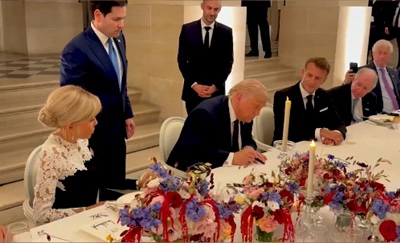
The sudden emergence of the Islamabad Memorandum of Understanding (MOU)—signed from the gilded halls of Versailles by President Donald Trump and synchronized with President Masoud Pezeshkian in Tehran—has sent shockwaves across the global geopolitical architecture. To its champions, the 14-point framework is a masterful, transactional masterstroke that instantly defused a 110-day war, re-opened the economically choked Strait of Hormuz, and threw a lifeline to global oil markets. To skeptics, however, the agreement carries the distinct, unnerving scent of September 1938.

The historical parallels are hard to ignore. Much like Neville Chamberlain’s fateful “Peace for our time” deal in Munich, the 2026 MOU relies heavily on front-loaded concessions. By immediately lifting the naval blockade and issuing Treasury waivers for Iranian crude, Washington has traded its most potent economic leverage upfront in exchange for a highly volatile 60-day negotiation window.

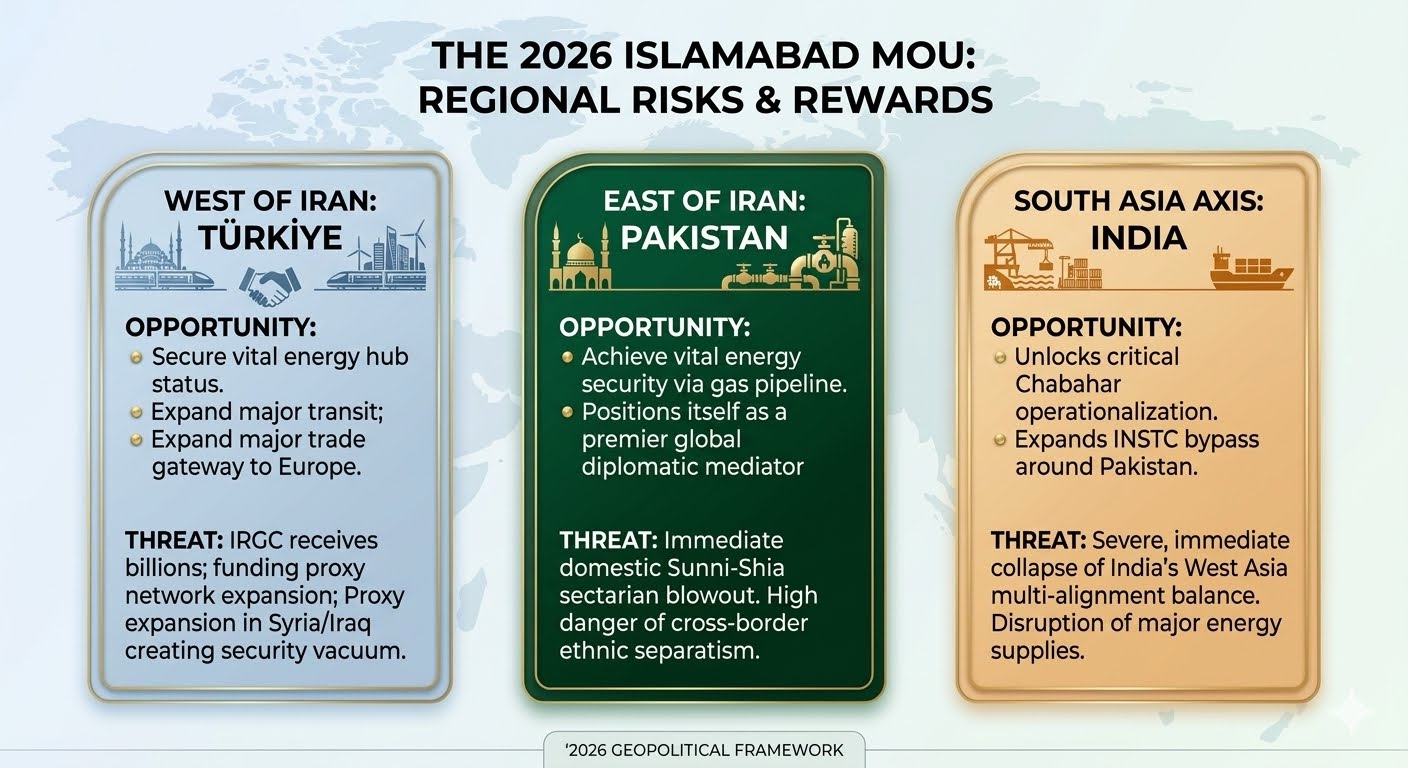
But history rarely repeats without a twist, and the true gravity of this truce lies in the sweeping “ponderables” expanding across the Eurasian landscape. For the regional heavyweights flanking the Islamic Republic—Türkiye, Pakistan, and India—the agreement represents a high-stakes gambling table where the potential windfalls are massive, but the downside risks are existential. And the gambling table are inside what may be imagined to be a new Orient Express that will soon run from Teheran westward to Istanbul and east to Islamabad.

The View from the West: Türkiye’s Calculated Pragmatism

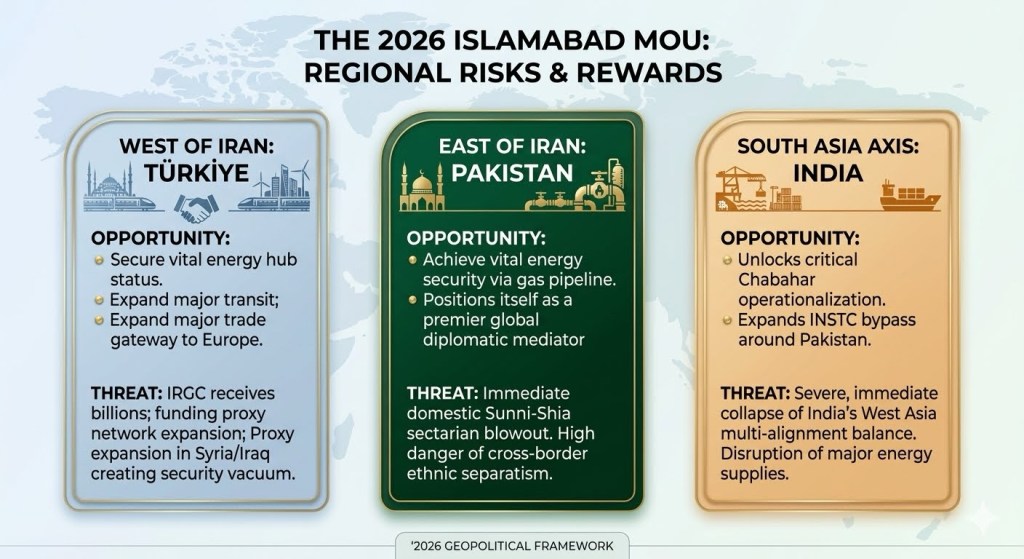
For Ankara, the potential containment of a wider war and the corresponding deceleration of the “Greater Israel Project” offer a historic geopolitical opening. President Recep Tayyip Erdoğan has long positioned Türkiye as the ultimate vocal defender of regional sovereignty against Anglo-American-Zionist imperial architectures. A permanent freeze on Israeli regional expansion validates Ankara’s soft power across the Arab street.

Structurally, it also blunts Western-backed “buffer state” theories that rely on a partitioned Syria or Iraq. Economically, an un-sanctioned Iran turns Türkiye into the absolute premier transit hub for Eastern energy flowing into Europe.

Yet, Turkish defense planners are far from celebrating. Sanctions relief means an immediate, massive infusion of capital directly into the coffers of the Islamic Revolutionary Guard Corps (IRGC). Ankara is fully aware that a wealthy, emboldened Iran is a direct competitor. Tehran could quickly utilize its unfrozen billions to heavily reinforce its proxy networks in northern Iraq and Syria, actively squeezing Turkish military footprints.

Furthermore, if the U.S. uses this MOU as a pretext for a rapid military exit, Türkiye will be left holding a live wire—forced to police a chaotic Syrian border vacuum alone.

The View from the East: Pakistan’s Strategic Paradox

If Türkiye views the deal with cautious optimism, its eastern broker views it with sheer vertigo. Pakistan achieved an unprecedented diplomatic victory by serving as the neutral intermediary that quietly managed the backchannels for the framework. The immediate economic rewards are clear: with U.S. waivers secured, Islamabad can finally construct its portion of the long-delayed Iran-Pakistan (IP) gas pipeline, avoiding a crippling $20 billion penalty while solving its internal energy starvation.

However, Pakistan’s domestic ground realities make it uniquely vulnerable to any sudden unraveling. The country sits squarely on the region’s most explosive ethnic and religious fault lines. In Balochistan, an unstable border shared with Iran remains vulnerable to cross-border separatist insurgencies. To the north, a volatile relationship with the Afghan Taliban complicates counter-terrorism efforts.

Most dangerous of all is the internal Sunni-Shia dynamic. Pakistan relies heavily on billions in financial backing from Saudi Arabia, and its military leadership has quietly promised Riyadh it will defend Gulf sovereignty if Iranian proxies push too far. If the 60-day Switzerland talks collapse and regional proxies resume attacks on Gulf oil infrastructure, Islamabad will be trapped in an impossible choice between its economic patron and its immediate neighbor—a choice that could instantly ignite violent, domestic sectarian polarization.

The South Asia Axis: India’s Continental Gamble

Beyond Pakistan’s borders, India watches the 60-day tightrope with acute strategic anxiety. For New Delhi, Indo-Iranian relations are the gateway to Central Asia and a vital counter-weight to China’s regional influence.

  • The Success Scenario: If the MOU holds, India stands to gain immensely. Permanent relief from U.S. secondary sanctions allows New Delhi to aggressively revive its 10-year operational lease of Iran’s Chabahar Port. A sanctions-free Iran fully operationalizes the International North-South Transport Corridor (INSTC), granting India an uninterrupted, land-based trade highway to Central Asia and Russia that completely bypasses Pakistan. Furthermore, the return of Iranian oil imports offers India a critical option to diversify its energy basket away from over-reliance on Moscow.
  • The Unraveling Threat: Conversely, a sudden collapse of the MOU would shatter New Delhi’s delicate West Asian balancing act. India has spent the last decade painstakingly building deep strategic and technological partnerships with Israel (via the I2U2 mini-lateral framework) while simultaneously investing in Iran. If the truce fails and the region descends into a larger war, India’s multi-alignment strategy will implode. Forced to navigate a hot conflict, New Delhi would face the immediate disruption of its trade routes, massive energy price spikes, and a severe threat to the 8.5 million-strong Indian diaspora sending critical remittances back from the Persian Gulf.

The Verdict: A Fragmented Architecture

The structural flaw of the grand geopolitical architectures designed by Wall Street, London, or localized actors is the illusion of top-down control. Today’s reality is highly fragmented. Even as global markets demand a pause to curb runaway inflation and prevent maritime paralysis, independent actors maintain their own sovereign red lines. The Israeli military’s continued heavy airstrikes in southern Lebanon—which have already triggered a postponement of the technical talks in Switzerland—prove that localized actors can easily disrupt the designs of global capital.

Ultimately, the Trump-Pezeshkian MOU is not a definitive resolution, but a high-stakes breathing spell. It is a tactical pause where the economic survival of the international system has temporarily taken precedence over ideological territorial expansion. Whether this 60-day window yields a permanent security matrix or serves as a brief interlude before a much larger, catastrophic explosion depends entirely on whether regional actors choose to exploit the immediate opportunities, or trigger the hair-keys of the unravelling threats.

The Sino-Russian Shadow Over Eurasia

As the powers of West and South Asia navigate the shifting currents of the Islamabad MOU, the two continental titans overlooking this geopolitical landscape—China and Russia—are already recalibrating their own ambitions. For Beijing and Moscow, the potential stabilization or fragmentation of Iran’s borders is not a localized crisis, but a strategic variable in their broader campaign to dismantle the post-Cold War, U.S.-led global hierarchy.

China: The Architecture of Economic Integration

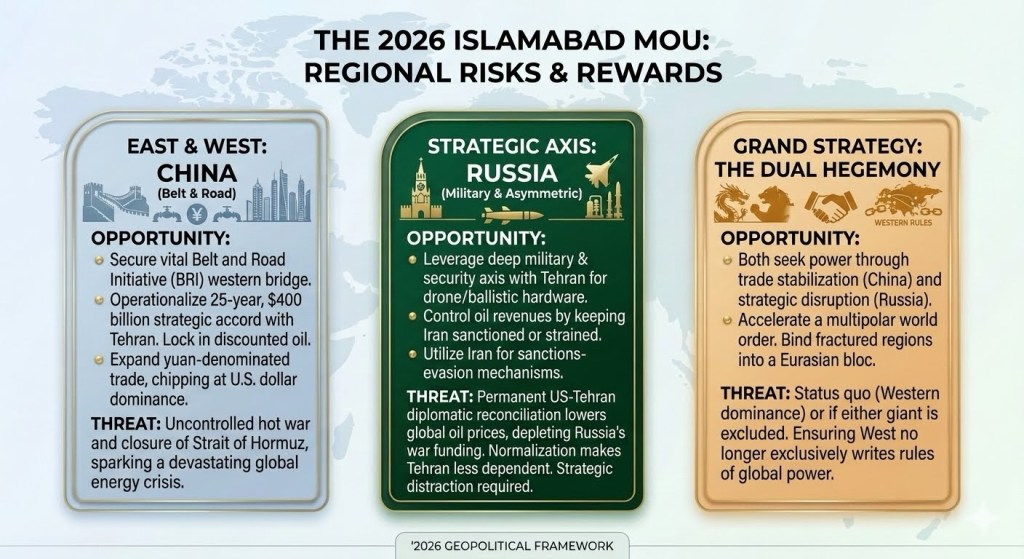
For Beijing, the Middle East is the vital western bridge of the Belt and Road Initiative (BRI). China views the 2026 truce through a strictly mercantile and energy-centric lens.

  • The Success Path: If the framework holds, China is poised to be its ultimate economic beneficiary. A stabilized, un-sanctioned Iran allows Beijing to fully operationalize its 25-year, $400 billion strategic accord with Tehran, locking in massive quantities of discounted oil and expanding yuan-denominated trade networks that chip away at the dominance of the U.S. dollar. Beijing can secure its commercial supply lines across the Persian Gulf without the financial burden of acting as a regional military policeman.
  • The Threat of Chaos: China’s primary fear is an uncontrolled, hot war that closes the Strait of Hormuz. Such an outcome would spark a devastating global energy crisis, threatening China’s domestic economic growth and disrupting its intricate infrastructure investments across Central and South Asia.

Russia: The Premium on Strategic Distraction

Moscow’s calculus is starkly different, driven by asymmetric warfare and geopolitical survival. Over the past several years, Russia and Iran have forged a deep military and security axis, turning Tehran into a critical pipeline for drone technology, ballistic hardware, and sanctions-evasion mechanisms.

  • The Risks of Peace: A permanent diplomatic reconciliation between Washington and Tehran carries hidden risks for the Kremlin. A normalized Iran, fully integrated into Western energy markets, would lower global oil prices—directly depleting the oil revenues Russia relies on to fund its military campaigns in Europe. Furthermore, a diplomatic breakthrough could give Tehran less incentive to remain a dependent junior partner to Moscow.
  • The Utility of Friction: Consequently, Russia’s interest lies in a state of controlled tension. If the MOU unravels into a larger conflict, it serves Moscow’s grand strategy by permanently diverting Western military resources and diplomatic attention away from the European theater.

The Dual Hegemony

Ultimately, while China seeks to build power through trade stabilization and Russia seeks to project power through strategic disruption, both giants view the 60-day window as a moment to accelerate a multipolar world order. Whether the Trump–Pezeshkian deal succeeds or shatters, Beijing and Moscow are quietly binding the fractured pieces of West and South Asia into a larger, interconnected Eurasian bloc—ensuring that whatever happens next, the rules of global power will no longer be written exclusively by the West.

(Concluded)

The Trump-Pezeshkian MOU is a diplomatic red herring

by M.K.Sudarshan

Chennai, India : June 19, 2026

From a macro-geopolitical perspective, a permanent concession to Iran is fundamentally incompatible with the long-term survival of the Anglo-American-Zionist imperial architecture.

*******************

The Trump-Pezeshkian Memorandum of Understanding (MOU) operates on a highly volatile 60-day deadline. Just as the historic 1930s agreements (between Neville Chamberlain and Adolf Hitler and between Josef Stalin and Adolf Hitler) quickly collapsed under the weight of bad faith, unaddressed flashpoints, and aggressive regional actors, several structural triggers could easily derail this 2026 framework too and plunge the region back into a larger war. 

The primary factors threatening to unravel the 2026 MOU include:

1. The Nuclear Disagreement Gaps

The MOU stops the active war but defers the hardest technical details to Switzerland-based negotiators: 

  • Enrichment Timeline Clash: The U.S. is pushing for a 20-year freeze on Iran’s nuclear advancement, while Tehran refuses to pause for more than 10 years. 
  • The Stockpile Dispute: Disposing of Iran’s 60% highly enriched uranium stockpile remains unresolved. If Tehran refuses to compromise or permanently dismantle its advanced centrifuge infrastructure, the U.S. has explicitly threatened to resume bombing. 
  • Hidden Facilities: The International Atomic Energy Agency (IAEA) warns it has a “loss of continuity of knowledge” regarding hidden enrichment workshops. Any discovery of secret facilities during the 60 days will instantly collapse American trust.

2. Israel Operating as an Independent “Spoiler”

Unlike historical proxies, Israel is an independently armed, sovereign actor that rejects the deal’s constraints:

  • Defying the Lebanon Mandate: Although the MOU explicitly dictates a full ceasefire on “all fronts” including Lebanon, the Israeli military continues active airstrikes against Hezbollah. 
  • Red Lines: Prime Minister Benjamin Netanyahu remains publicly uncommitted to the U.S.-led diplomatic track. If Israel launches a unilateral decapitation strike against Iranian assets or nuclear targets, the entire regional cease-fire immediately shatters. 

3. Asymmetric Timeline of Concessions

The deal creates an immediate mismatch in strategic leverage:

  • Front-Loaded vs. Gradual Easing: Iran receives immediate relief from the naval blockade and immediate waivers to export crude oil. However, Washington intends to release the main $300 billion regional reconstruction fund and permanent sanctions lift only after full compliance is verified.
  • The Trap: Once Iran restarts its oil revenue flowing through the reopened Strait of Hormuz, its immediate economic desperation eases, giving Tehran less incentive to make deep, painful nuclear compromises. 

4. Domestic Political Backlash in Tehran and Washington

Both leaders face fierce internal resistance from hardline factions who view compromise as surrender: 

  • Iran’s Victory Narrative: Iranian state media and the Islamic Revolutionary Guard Corps (IRGC) have spent weeks messaging their base that Iran won the war. If President Pezeshkian attempts to hand over uranium stockpiles to foreign inspectors, hardliners may sabotage the talks to protect national sovereignty.
  • U.S. Political Pressure: Critics in Washington accuse Donald Trump of executing a “modern Munich appeasement.” If Iran-backed proxies execute even a single stray drone strike against U.S. forces, domestic political pressure will force the White House to pull out of the talks.

5. Control over the Strait of Hormuz

The immediate reopening of the Strait of Hormuz is intended to stabilize global oil markets, but long-term maritime governance is deeply contested: 

  • The Toll & Sovereignty Dispute: Washington demands completely free, unhindered international navigation. Tehran, however, views the waterway as sovereign territory and wants to retain its offensive interdiction capabilities. Any minor tactical miscalculation or ship seizure by a rogue IRGC navy unit will instantly reignite full-scale maritime warfare.

Sustainability of the MOU

To evaluate how easily this agreement could collapse into a wider war, each of the above 5 factors must be weighed by two distinct risks:

— the Likelihood of it happening within the 60-day window,

— and the Danger Level (how instantly it acts as a hair-trigger for full-scale military conflict). 

On a 10-point scale, the five factors rank as follows from most dangerous to least dangerous:

1. Israel Operating as an Independent “Spoiler”

  • Likelihood: 9/10 | Danger Level: 10/10
  • Why it is a hair-trigger: Israel is actively rejecting the MOU’s regional ceasefire parameters and continuing military strikes in Lebanon. Because Israel operates with full military sovereignty and independent red lines, a single major escalatory strike by either Israel or Hezbollah will immediately drag Iran back into the fight, completely bypassing the U.S. diplomatic track.

2. The Nuclear Disagreement Gaps

  • Likelihood: 8/10 | Danger Level: 8/10
  • Why it is a hair-trigger: The gap between Washington’s demand for a 20-year freeze and Tehran’s 10-year limit is a fundamental ideological divide. If negotiators in Switzerland fail to reach a compromise before the 60-day clock runs out, the U.S. has already explicitly threatened to resume bombing. Furthermore, any sudden IAEA discovery of a hidden enrichment facility acts as an instant kill-switch for the deal.

3. Control over the Strait of Hormuz

  • Likelihood: 5/10 | Danger Level: 9/10
  • Why it is a hair-trigger: While both sides want the shipping lanes open to ease economic pressure, the tactical reality on the water is highly volatile. The danger is not necessarily a calculated decision by leadership, but a miscalculation. A rogue or overzealous IRGC naval commander seizing a commercial vessel, or a stray drone incident in the narrow corridor, would instantly trigger an overwhelming U.S. military response.

4. Domestic Political Backlash (Tehran & Washington)

  • Likelihood: 7/10 | Danger Level: 6/10
  • Why it is a hair-trigger: Both leaders are walking a political tightrope. If President Pezeshkian faces a mutiny from IRGC hardliners over surrendering uranium, or if Donald Trump faces immense domestic pressure after a proxy provocation, the political cost of staying in the deal will become too high. This factor is likely to stall negotiations, though it requires an overt action to trigger actual war.

5. Asymmetric Timeline of Concessions

  • Likelihood: 8/10 | Danger Level: 5/10
  • Why it is a hair-trigger: Iran has already secured its most urgent need: the lifting of the naval blockade and the resumption of oil exports. With its immediate economic suffocation paused, Tehran’s incentive to make painful nuclear compromises drops significantly. While this creates a high probability of diplomatic gridlock, it functions more as a slow-motion unraveling rather than an overnight explosion into war.

The Abandonment of the Greater Israel Project

Except No. 4 on the list , all other factors are potentially nails in the coffin of the so-called “Greater Israel Project” that has been the bedrock of the Anglo-American-Saxon-Zionist geopolitical imperial architecture envisioned as World Order.

So, would such a grand architecture ever be allowed to be abandoned at all by America’s Wall Street, the City of London , and the Bankers of Paris, Brussels and Berlin ?

Now, that’s a $38 trillion question!

The concept of the “Greater Israel Project” as a foundational anchor for an Anglo-American-Zionist imperial order is a frequent subject of critical geopolitical theories. However, the willingness of major Western financial centers—such as Wall Street, the City of London, and the banking hubs of Paris, Brussels, and Berlin—to tolerate or even encourage a strategic pause via the Trump-Pezeshkian MOU is driven solely by pragmatic, systemic economic survival rather than an abandonment of long-term ideological architectures. 

Western financial institutions have historically favored regional dominance paradigms, but they will actively intervene or force tactical shifts when those paradigms threaten the global capitalist engine.

The “Greater Israel Project”—viewed in critical geopolitical frameworks as a lynchpin of Anglo-American-Zionist hegemony—is not being permanently abandoned by Western financial hubs. Instead, Wall Street, the City of London, and European banking elites are forcing a tactical, temporary freeze because the immediate economic risk of an uncontained regional war threatens to bankrupt the very global financial order they control. 

When analyzing the situation through the lens of elite grand architecture, the geopolitical and financial imperatives dictate the following realities:

1. Capitalist Self-Preservation Over Territorial Ideology

To international banking cartels, the fundamental metric of power is not the redrawing of Middle Eastern maps, but the uninterrupted flow of global trade and liquidity: 

  • The Cost of Chokepoints: The 110-day war caused an immediate, unsustainable shock to global markets. For mega-banks, a closed Strait of Hormuz threatens severe global inflation, energy paralysis, and a potential systemic collapse of the Western bond and equity markets. 
  • The Financial Bottom Line: Ideological or expansionist projects require a stable, high-functioning financial engine to fund them. When a regional campaign actively risks fracturing the global economy, the banking elite will prioritize stabilizing the international system over any localized territorial architecture.

A calculated, temporary maneuver

From a macro-geopolitical perspective, a permanent concession to Iran is fundamentally incompatible with the long-term survival of the Anglo-American-Zionist imperial architecture.

If we look at this through the lens of a “grand architecture” that cannot be abandoned, the 2026 MOU is not a genuine peace treaty, but a calculated, temporary maneuver.

The global banking elite—from Wall Street to the City of London—will not allow this architecture to be dismantled, and the MOU will likely be permitted to unravel for several key reasons:

1. The Strategy of Engineered Collapse

From a cynical geopolitical viewpoint, the MOU mimics the exact structural flaws of the 1938 Munich Agreement by design, not by accident:

  • The “Trap” Setup: By front-loading economic concessions (lifting the naval blockade, granting oil waivers) while leaving the most explosive issue—the dismantling of Iran’s nuclear infrastructure—to a volatile 60-day window, the agreement creates an impossible diplomatic hurdle.
  • The Imminent Pretext: When the 60-day clock runs out in Switzerland without Iran completely surrendering its strategic leverage, the Western financial and political establishment can claim “diplomacy has failed.” This provides the necessary geopolitical justification to launch a coordinated, full-scale military campaign to preserve the long-term architecture.

2. Safeguarding the Petrodollar and Capital Flows

The bedrock of Western financial dominance relies on controlling Middle Eastern energy corridors and recycling that wealth back into Western banks:

  • The Threat of an Independent Iran: A sanctions-free Iran, fully integrated into a multipolar financial system (like BRICS), represents a direct threat to the dollar-denominated global order.
  • Bankers’ Mandate: Wall Street and European central banks cannot tolerate a permanent shift in regional power that removes Middle Eastern energy flows from their oversight. A temporary pause stabilizes the markets today, but the long-term preservation of the banking architecture requires the ultimate neutralizations of regional adversaries.

3. Israel as the Enforcer of the Grand Architecture

The grand architecture theory relies on Israel acting as the primary, heavily armed forward node of Western power in the region:

  • An Acceptable “Spoiler”: While Western financial centers occasionally require short-term stability to manage inflation, they will not defund or permanently restrain Israel’s strategic objectives.
  • The Postponement Factor: The current suspension of the Swiss technical talks due to ongoing military operations shows that the regional enforceability of the architecture overrides the text of the MOU. If the “Greater Israel Project” is the foundational bedrock, the MOU is simply a tactical pause to allow the system to absorb short-term economic shocks before the next phase of escalation.

Conclusion : The Trump-Pezeshkian MOU is a diplomatic red herring and a designed-to-fail, dead-on-arrival, bad-faith arrangement.

(END)

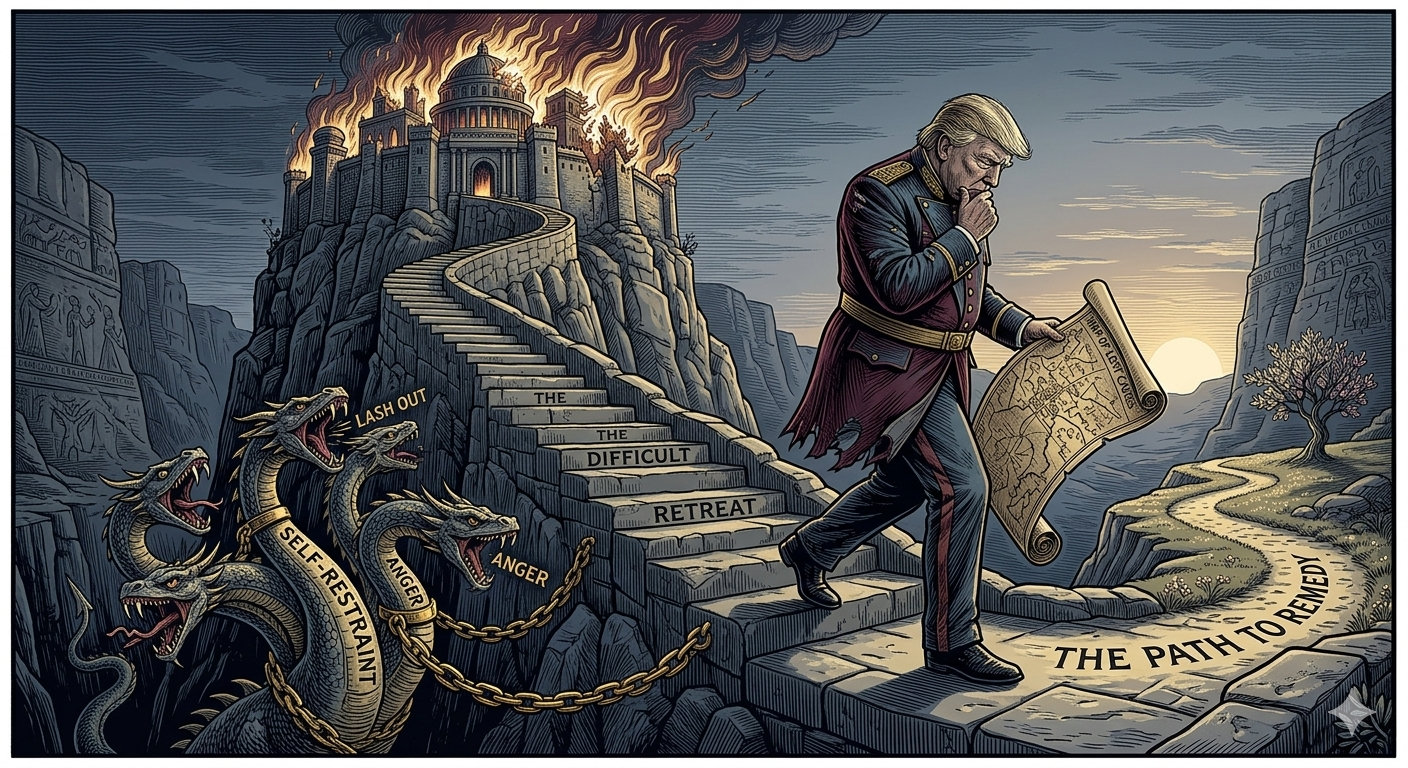
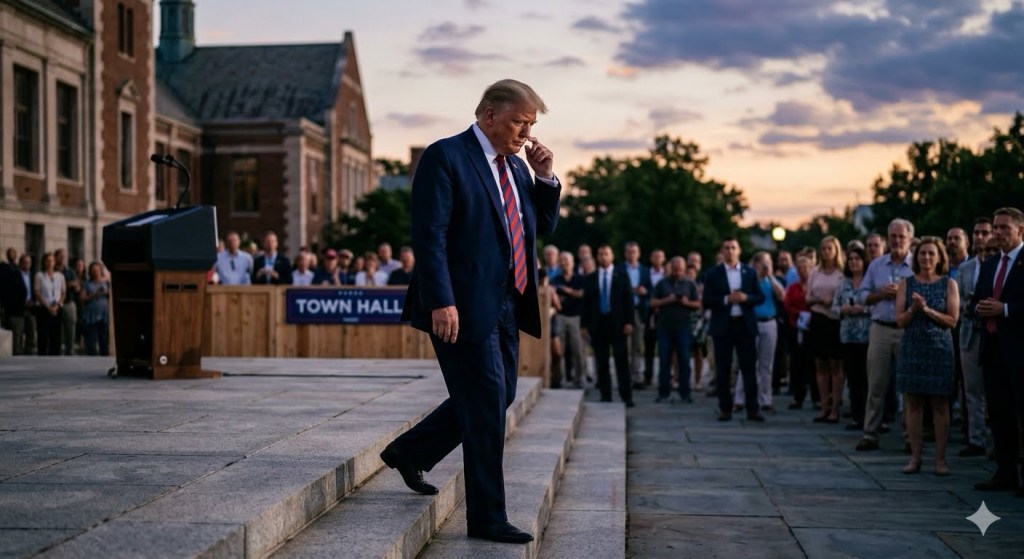
For God’s sake, US Senators and Congressmen, give him some credit and please do leave Donald Trump alone to lick his wounds in peace!

by M.K.Sudarshan

Chennai, India

June 19, 2026

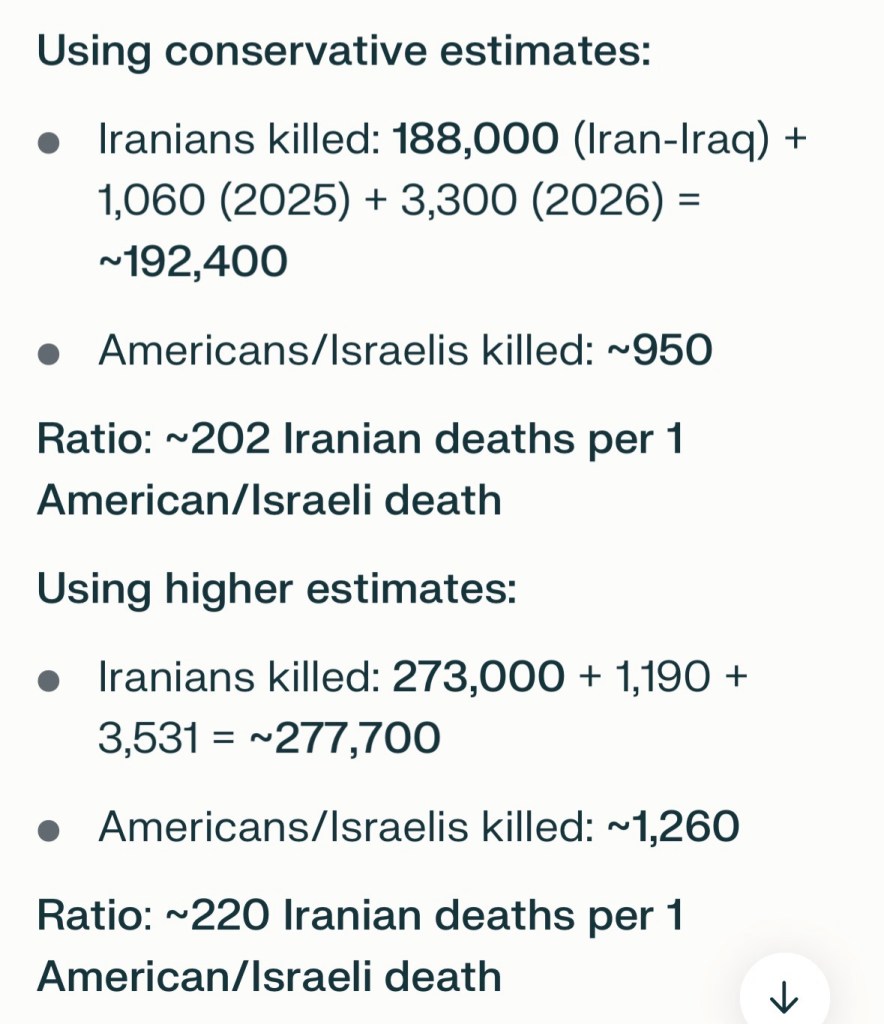
Since 1954 until today — I found myself this morning silently wondering — what could be the ratio and/or aggregate numbers of Iranian lives killed by American/Israeli military strikes to American/Israeli lives that were killed by Iranian military and/or terrorist strikes?

An AI prompt I typed in at once returned to me the following mind-boggling nuggets of information:

1954–1979 gap: No major U.S. or Israeli military strikes on Iranian territory occurred during this period. The first significant Iranian attacks on Americans began after the 1979 Islamic Revolution (Embassy takeover, Beirut bombings).

No aggregated historical total: Sources like the Foundation for Defense of Democracies track Iranian-backed attacks against Americans from 1979–present but don’t provide a single cumulative death toll.

Key Insight

The Iran-Iraq War dominates the Iranian death toll (~97% of all Iranian deaths). Without it, the ratio would still be as high as ~4–5:1. With it included, the ratio becomes ~200–220:1, reflecting that the vast majority of Iranian deaths came from Iraq (not directly from US/Israeli strikes), although the US and Israel did fully aid, encourage and support Iraq during that conflict.

US Support to Iraq During the Iran-Iraq War (1980-1988)


The United States provided significant but covert support to Iraq during the war, primarily through:

  1. Diplomatic Support: The US maintained diplomatic relations with Iraq and opposed Iranian revolutionary influence in the region.
  2. Agricultural Credits: Through the USDA’s Commodity Credit Program, the US provided Iraq with billions in credits to purchase American agricultural products (cotton, wheat, corn), which freed up Saddam Hussein’s oil revenues for military spending.
  3. Dual-Use Technology: The US exported “dual-use” technologies (equipment that could be used for both civilian and military purposes) including:
    • Helicopters (which Iraq used for military transport)
    • Chemical weapons precursors and equipment
    • Computer systems
    • Industrial machinery
  4. Intelligence Sharing: The US provided Iraq with satellite imagery and intelligence about Iranian military movements, particularly after 1982 when Iran began counteroffensives.
  5. Releasing Iraq from Terrorism List: In 1982, the US removed Iraq from the list of state sponsors of terrorism, facilitating arms sales.

And here’s the real surprise, surprise !

Israel actually supported Iran during the Iran-Iraq War, not Iraq! This is well-documented:


• Israel was one of the main suppliers of military equipment to Iran during the war
• Israel provided military instructors to Iran
• This continued the pre-1979 pattern of Israeli-Iranian military cooperation
• The US allowed Israel to support Iran because both opposed Saddam Hussein’s expansion.

Israel’s support for Iran was strategic: they wanted to keep Iran and Iraq fighting each other to prevent either from becoming dominant, and particularly to prevent Iraq from becoming too powerful.

The US and Israel thus collaborated on different positions: US supported Iraq (covertly), while Israel supported Iran (openly) but both had the same strategic objective: to keep West Asia mired in internecine warfare so American-Israeli hegemony prevailed and could control the energy supply-sources of the entire region.

*********************

Fast forward to today June 19, 2026.

American House Congressmen and Senators are shell-shocked and traumatised by the disastrous outcome of the Feb-28-June 16th 2026 war that America and Israel together waged against Iran.

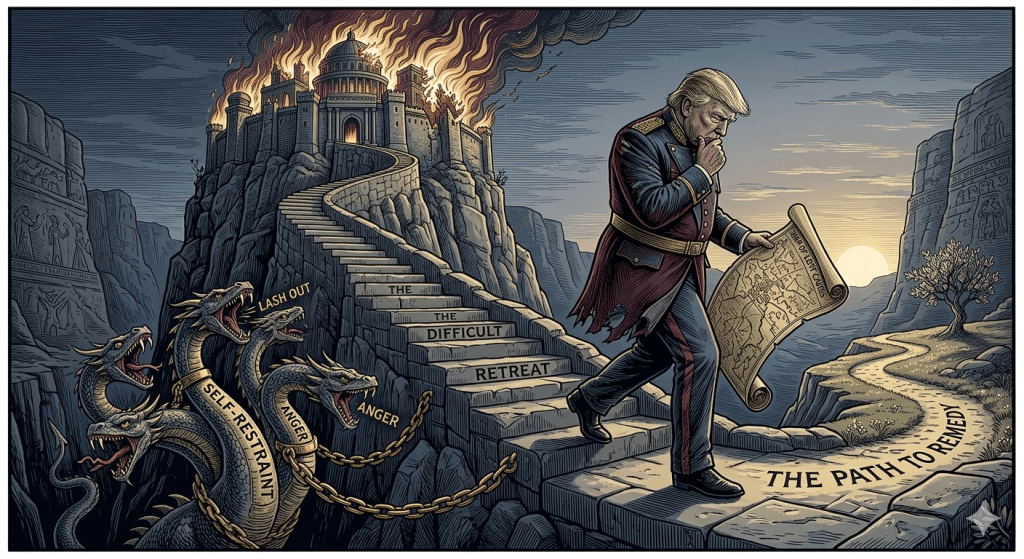
The Trump-Ayatollah Memorandum of Understanding for Peace (or Ceasefire) signed yesterday at the G-7 Summit Meeting held in France is being condemned in America as a “defeat”, “capitulation” and “epic foreign policy disaster” for the entire West. The Infograph below encapsulates the deep trauma felt by Americans:

Now, the above Infographic accurately represents America’s “shell-shocked” perspective. What about the Iranian perspective ?

Here is how the key categories would be represented from Iran’s perspective:

Financial Assets and Sanctions

  • Unfrozen Assets: Viewed not as a concession or gift, but as the rightful return of stolen Iranian wealth illegally frozen by Western banking systems.
  • Sanctions: Framed as “economic warfare” and unilateral collective punishment against the Iranian civilian population, rather than a legitimate foreign policy tool.
  • Additional Costs: Replaced with metrics tracking the domestic growth of Iran’s “resistance economy,” emphasizing self-sufficiency and trade non-reliance on the West.

Nuclear Program and Sovereignty

  • Uranium Stockpile & Enrichment: Viewed through the lens of national scientific achievement and energy independence.
  • The JCPOA (2015): Framed as a major compromise where Iran voluntarily restricted its legal, peaceful nuclear rights under the NPT (Non-Proliferation Treaty) in exchange for economic relief that the West ultimately failed to deliver.
  • “No Agreement” Era: Represented as a necessary, sovereign response to the American breach of the 2015 deal, demonstrating that Iran will not negotiate under coercion.

Regional Influence and Security

  • Hormuz Strait: Maintained as an area of vital national sovereignty. Any tolls or controls would be framed as legitimate maritime policing, security maintenance, and defense against foreign military encroachment.
  • Geopolitical Risk: The primary risk factor would be identified as American military presence and Western interventionism in the Middle East, which Iran views as the root cause of regional instability.
  • Weapons Stockpile: Reframed from “depleted” to “domestically advanced,” highlighting the self-reliant growth of Iran’s missile technology and drone programs as a successful deterrent against foreign aggression.

Human and Economic Impact

  • Lives and Injuries: Focus would shift entirely to Iranian casualties resulting from Western-backed regional conflicts, assassinations of scientists and military leaders, and the humanitarian impact of medical shortages caused by economic sanctions. Iran feels rather avenged at last for the tragic “Killing Ratio” suffered between 1980 and till date inflicted upon it by America and Israel : 220 Iranian deaths for every single American-Israeli life killed in war, assassinations and targeted drone attacks.
  • Wage Growth & Economy: Economic hardships would be attributed directly to American “maximum pressure” campaigns, while survival and recovery would be credited to domestic resilience and pivoting trade toward eastern allies like China and Russia.

****************

Now, to state the long and short of the entire story, here is a TAILPIECE I want to sign off with:

Yes, Donald Trump has made a fool of himself and of America too today… He has been played by Israel and Netanyahu, Mossad & Co.

Still, I would say, Trump deserves a bit of credit … To realise one has blundered and to come to one’s senses and then to retreat in some way or the other without lashing out further in mad desperation …. That, to my mind, too requires some amount of personal courage .

Yes, Trump has suffered defeat, humiliation and humbling … but it’s better that US Congressmen and Senators and American mainstream and social media do not all go on rubbing salt into his wound….

Taking a larger picture view of what has happened — and for the sake of world peace and sanity — it would be better for Trump’s critics in America, and outside, to just please leave him alone to introspect and lick his wounds in peace.

The rest of the world has suffered much from nearly 100 days of Trump’s mercurial/pathological nature. The world must give him the benefit of doubt now that he will not suddenly revert to his old malevolent unpredictability … if the world, and America, really wants to save itself from Donald Trump during the rest of his Presidency until 2029.

(Concluded)

Sudarshan Madabushi
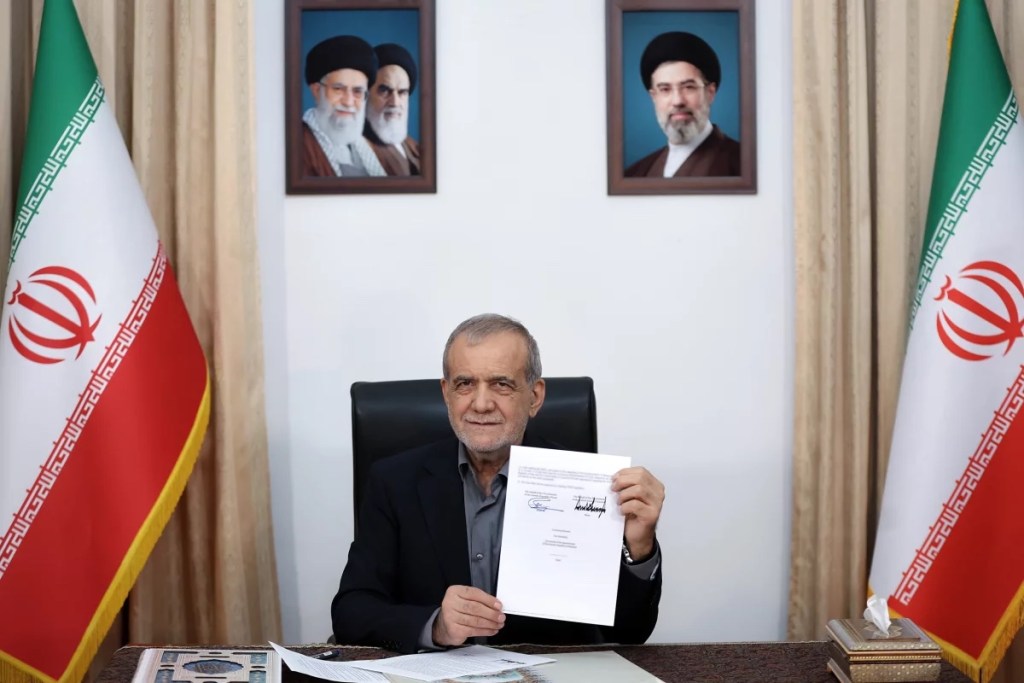
““Eureka” at Srirangam: The Shared Dawn of Viśiṣṭādvaita””


“Eureka at Srirangam: The shared dawn of Viśiṣṭādvaita — when guru and disciple together saw the soul and world as real.”

“When the teacher and his faithful disciple together beheld the soul and the world as truly real, and the living truth of Viśiṣṭādvaita dawned.”

by M.K. Sudarshan

______________________________

I. The teacher and the disciple: setting and relationship

In the great temple-town of Śrī Ranganātha, where the tidal hush of devotion meets the disciplined flame of philosophical enquiry, Sri Rāmānuja stood as both luminous ācārya and patient reformer. He had tested many lines of thought, read the terse breath of Bādarāyaṇa’s sūtras, and felt the need for a reading that did justice to devotion (bhakti), the reality of the soul (jīva), and the intimate relation between Creator and Creation.

To him came Kureśa—Kureśaṇ, Kurathalvar or Kuresan in later parlance—whose devotion was matched by a mingled fidelity of ear, mind, and hand.

Kuresan functioned not as a mere copyist but as amanuensis, critic, interlocutor, and mirror. He sat beside the guru in the study, the lamp between them, ink ready, palm-leaf or paper poised. He listened beyond the cadence of dictation; he listened into the architecture of thought.

Where the guru phrased, he tested; where the guru asserted, he demanded reasons; where the guru hesitated, he helped draw the line of exposition. This was not service by rote. This was co-creation within a tradition that prized both authoritative transmission and rigorous intellectual discipline.

Knowing Kuresan possessed an unmatched photographic memory, Ramanuja appointed him as his scribe (amanuensis). Because they had previously journeyed to Kashmir to consult the rare Bodhayana Vritti manuscript, Kuresan was the only one who held the full framework of text in his mind. Ramanuja laid down a specific rule for their sessions: 

“Kuresa, write down my dictation. But if you find anything I say that deviates from the core principles of Viśiṣṭādvaita we have established, stop writing immediately.” 


II. The labour of composition: dialogue, doubt, and painstaking craft


The crafting of the Sri Bhashya was long and arduous. It was an exercise in exegesis and invention. Ramanuja read the sūtras with fresh eyes; he sought to make each terse aphorism serve the twin aims of metaphysical clarity and soteriological import.

Kuresan’s role was to be the sounding-board and the bar of logic: to ask, to object, to demand clarification, to push the formulation until it would not yield to counterexample.

Draft followed draft; a clause was dictated, questioned, rephrased, excised, and restored. Sometimes the disciple’s objections were pithy, sometimes scathing; sometimes the guru’s temper flared. The story preserved in the sampradaya—of a quill flung in anger and a heartfelt apology ensuing —captures the human intensity of this labour.


This methodological rigor is crucial to understand. The pair did not merely transcribe old doctrines; they re-described reality’s basic architecture.

The Great Disagreement

A historical turning point occurred when Ramanuja dictated a line defining the individual soul (jeeva). He explained that the definitive, defining characteristic of the atomic soul is its cognitive power.

Upon hearing this, Kuresan silently laid down his bamboo quill and refused to write. Frayed by years of intense labor, Ramanuja initially took this silent protest as an affront and stormed out in anger.

However, upon reflecting, Ramanuja realized his disciple’s profound precision. Defining the soul merely by cognition was incomplete. The most vital element of a soul in Viśiṣṭādvaita is its Seshatva—its inherent, absolute allegiance and organic belonging to the Supreme Lord. 

To define the soul without its relationship to God was like defining light without mentioning the sun.

Ramanuja gracefully returned, embraced Kuresan, and corrected the dictation. This dynamic collaboration solidified the Sri Bhashya as a masterpiece of qualified non-dualism.

The Sri Bhashya is therefore a work that bears marks of dialectic—of proposal and refutation, of thought sharpened in real time. Kuresan’s scrutiny ensured the statements were not merely devotional slogans but philosophical theses able to withstand rival counters and scholastic cross-examination.


III. The Eureka: discovery of the defining kernel of Viśiṣṭādvaita

After many months and years of such labour, indeed, , there had come such a moment—the luminous instant that every tradition of reasoning and revelation recognises as defining.

In a passage of dialogue between the two, perhaps as Ramanuja had attempted to reconcile the sūtras’ terse claims with the lived reality of jīvas and world, both guru and disciple had perceived the central insight as if by sudden convergence: the jīva (cit) is real; the acit (prakṛti, the world) is real; both stand in an ontological inseparability to Brahman who is qualified (viśiṣṭa) by these modes.

Brahman is not a formless, impersonal absolute in which the world is mere illusion; nor is Brahman a plurality of independent souls pitched against Him. Rather, Brahman is the substantive whole, the ontological support whose self-manifestation includes sentient selves and insentient matter as His attributes—inseparable, dependent, yet truly real.

Thus, what guru and sishya had arrived at was an intellectual rupture with the dominant interpretive alternatives. Advaita’s monism (paramārthika non-dualism that regards the world and jīva as mithyā) and certain readings influenced by Buddhist anatman-like negations could not accommodate a theologically robust theist-philosophy where individual selves retained identity and moral responsibility. The conviction that the jīva’s sentience is not illusory but ontologically significant re-opened the relationship between soteriology and ethics, devotion and ontology.

For Ramanuja and Kuresan, that moment felt like suddenly seeing the pattern that had been hinted at in many sutras and which now all fell into place with crystalline inevitability.

The word “Eureka” is Greek, but the Indian equivalent—ananda, pratibhā, jñāna-darpaṇa bursting into light—fits the suddenness of that moment: not a gradual accumulation but a cognitive coalescence whereby a subtle terminological, metaphysical, and devotional alignment made the new darsana unmistakable. Both teacher and disciple felt it: the guru’s insight galvanized; the disciple’s scrutiny confirmed. The doctrine that emerged gave ontological dignity to the soul and made the world an integral dimension of the divine reality, thereby preserving both bhakti’s warmth and metaphysics’ precision.

[ “யூரெக்கா” என்பது ஆங்கிலேயம் சொல். இது “வெட்டி வெளிச்சம்” என்று பொருள்படும்.
ஆனால் ஆன்மீகமான அर्थத்தில், இது ஒரு புத்தித் திடீர் தெளிவு —
ஒரு கணத்தில், முன்னே தெரியாத உண்மை suddenly தெரிந்து விடுகிறது.
திருவாய் மொழிந்த அருணகிரி நாதர் போலும், இராமானுஜர் மற்றும் கூரத்தாழ்வான் அவர்களும், ஒரு கணத்தில் விசிஷ்டாத்வைதத்தின் மைய உண்மையைக் கண்டார்கள்.
அதுவே — “ஈச்சே! எனக்குத் தெரிந்தது! இதுவே உண்மை!” — என்று சொல்லும் புத்திப் பிரதிபா.
தமிழில் அதை “தேவ தெளிவு”, “உண்மை உதயம்”, அல்லது “விளக்கி விடை” என்று சொல்லலாம். ]


IV. Why the Eureka was under-dramatised in tradition

Despite the importance of this momentous discovery, in today’s Sri Vaishnava sampradaya’s living memory, celebrating this moment or instant as a great festival-day or a heavily dramatized myth is rather muted or reticent.

Several reasons—historical, doctrinal, and devotional—explain why.


• Guru-centred narration: Hagiography privileges the ācārya. The tradition’s principal pedagogic aim is to present the guru as the channel of revelation and grace. Highlighting a collaborative discovery risks complicating the simple didactic tableau: a luminous teacher revealing truth to followers.


• Private, intellectual occurrence: The insight took place within the intimate precincts of composition. Festivals and ritual calendars commemorate public acts—temple restorations, journeys, miracles, samādhi—not necessarily private moments of intellectual genesis that lack a ritual enactment.


• Didactic utility: Hagiographies emphasise stories that model devotion, moral courage, and service. A private doctrinal breakthrough provides less moral exemplum than stories of liberation granted to the lowly, fights for temple justice, or acts of charity, etc.


• Institutional prudence: Publicly magnifying a disciple’s intellectual role might create lineage ambiguities. For institutional cohesion, a clear chain of authority—teacher as primus inter pares—helps maintain unity and orthodoxy. Emphasising co-authorship or mutual insight could spawn rival claims or factional readings.


• Cultural modesty and humility: Many Vaishnava texts and accounts stress humility as a virtue. Ramanuja’s persona as humble teacher who showed compassion and reordered worship and religious life aligns better with ritual memory than an emphasis on rhetorical or polemical triumphs.


• Genre and transmission biases: Manuscripts, commentarial glosses, and ritual manuals preserved doctrine and ritual more than composition history. Subsequent teachers taught the Sri Bhashya as settled scripture; the textual provenance mattered less than its interpretive use.


V. What recognising the Kuresan factor gives us


To resuscitate this moment in communal memory is not to diminish Ramanuja’s genius but to deepen our understanding of how great doctrine emerges: by collaborative, rigorous labour that mixes devotion and critique.

Recognising Kuresan’s role underscores important virtues the sampradaya itself prizes—sravana (listening), manana (reflection), and nididhyāsana (profound contemplation)—all enacted between guru and disciple. It recovers the social and intellectual texture behind the text: the limits of solitary-authority narratives, the role of critical friendship, the discipline of scruple, and the humanity behind the sūtras. It also affirms the guru-sishya sambhandham.

Commemoration of this very special moment in the history of Sri Vaishnavism need not replace any existing festival structures or Utsavams already in place or practice that glorifies Kuresan’s memory. But such a special event to mark the “Eureka moment” can only enrich them. By honoring the Kuresan figure and the Eureka instant, the sampradaya would surely celebrate intellectual humility, critical fidelity, and the relational birth of truth—the very virtues that underpin both scholarship and bhakti.

श्रीरामानुजकुरेशाभ्यां नमः ।
ययोः सहचिन्तनात् सत्यं स्फुटमभूत् ।
श्रीविशिष्टाद्वैतसिद्धये नमः ।

śrīrāmānujakureśābhyāṃ namaḥ.
yayoḥ sahacintanāt satyaṃ sphuṭam abhūt.
śrīviśiṣṭādvaitasiddhaye namaḥ.

Salutations to Śrī Rāmānuja and Kureśa.
Through whose shared contemplation truth became clear.
Salutations to the accomplishment of Śrī Viśiṣṭādvaita.

(Concluded)

Sudarshan Madabushi