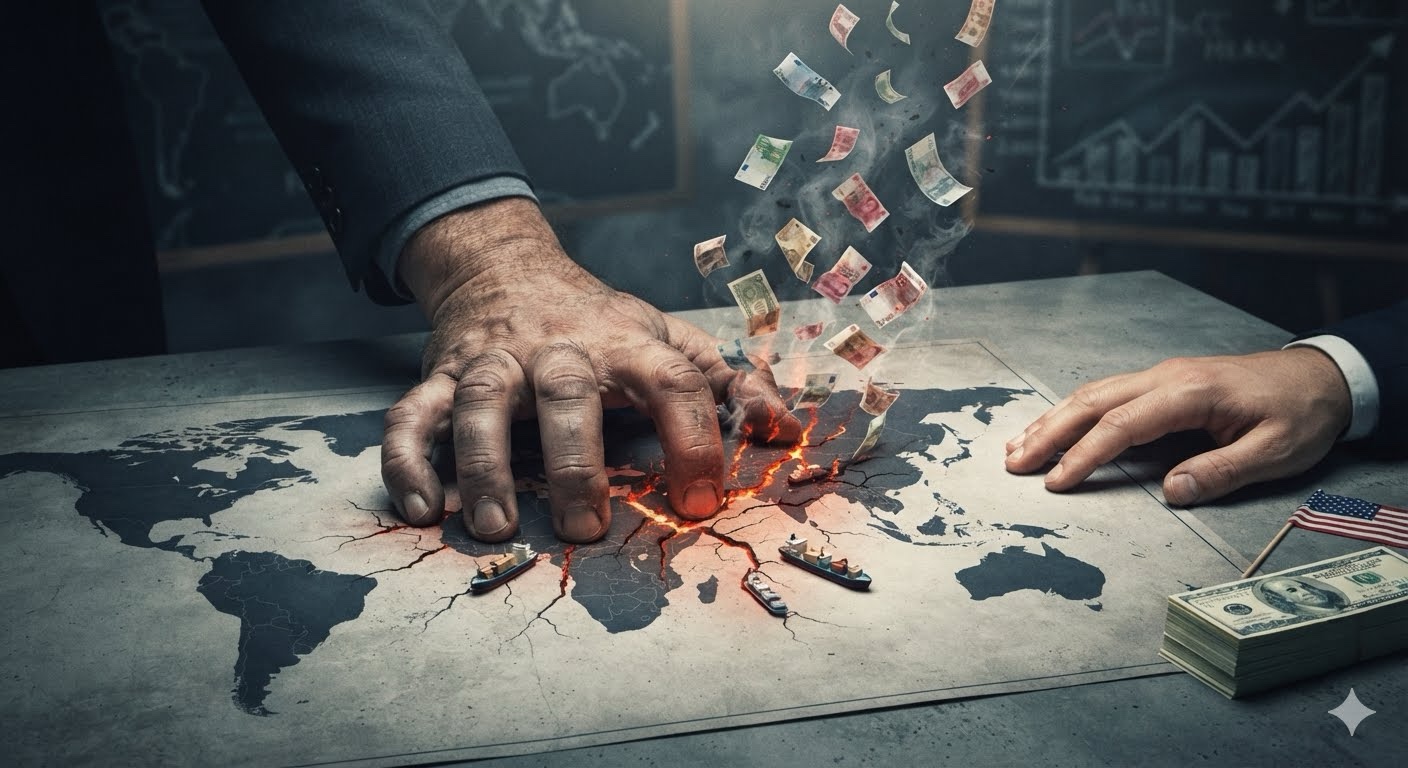
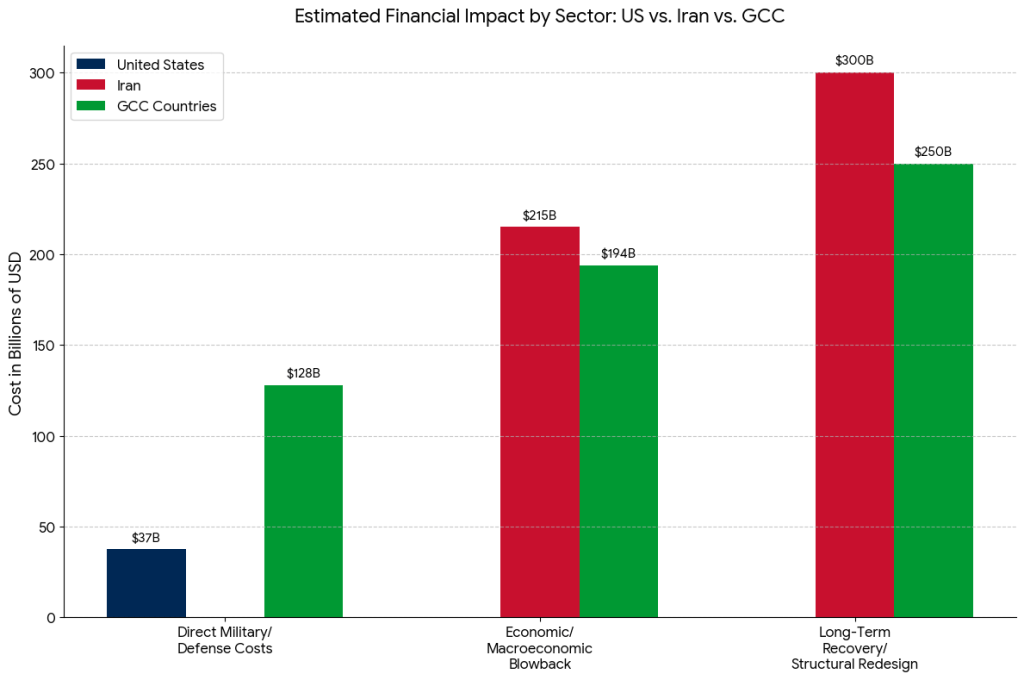
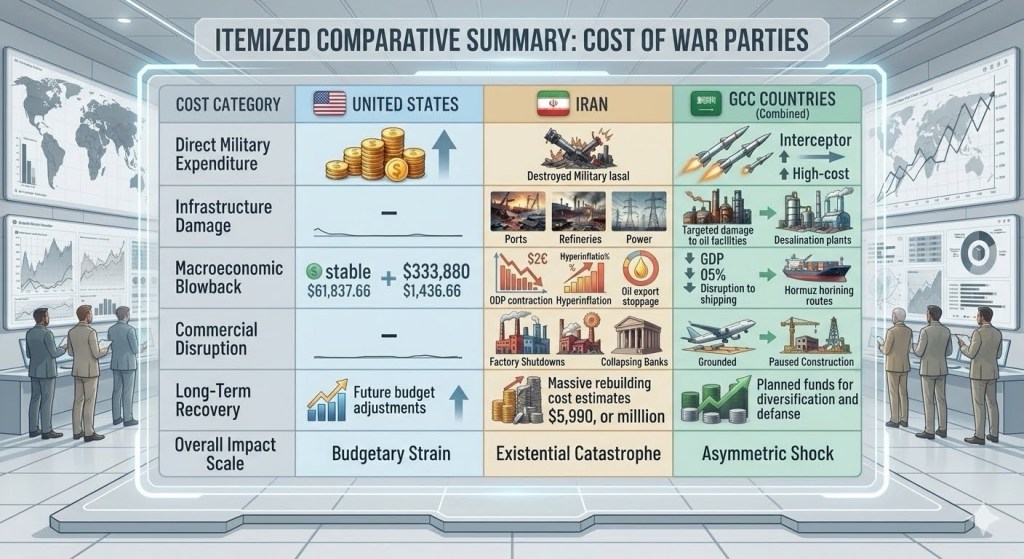
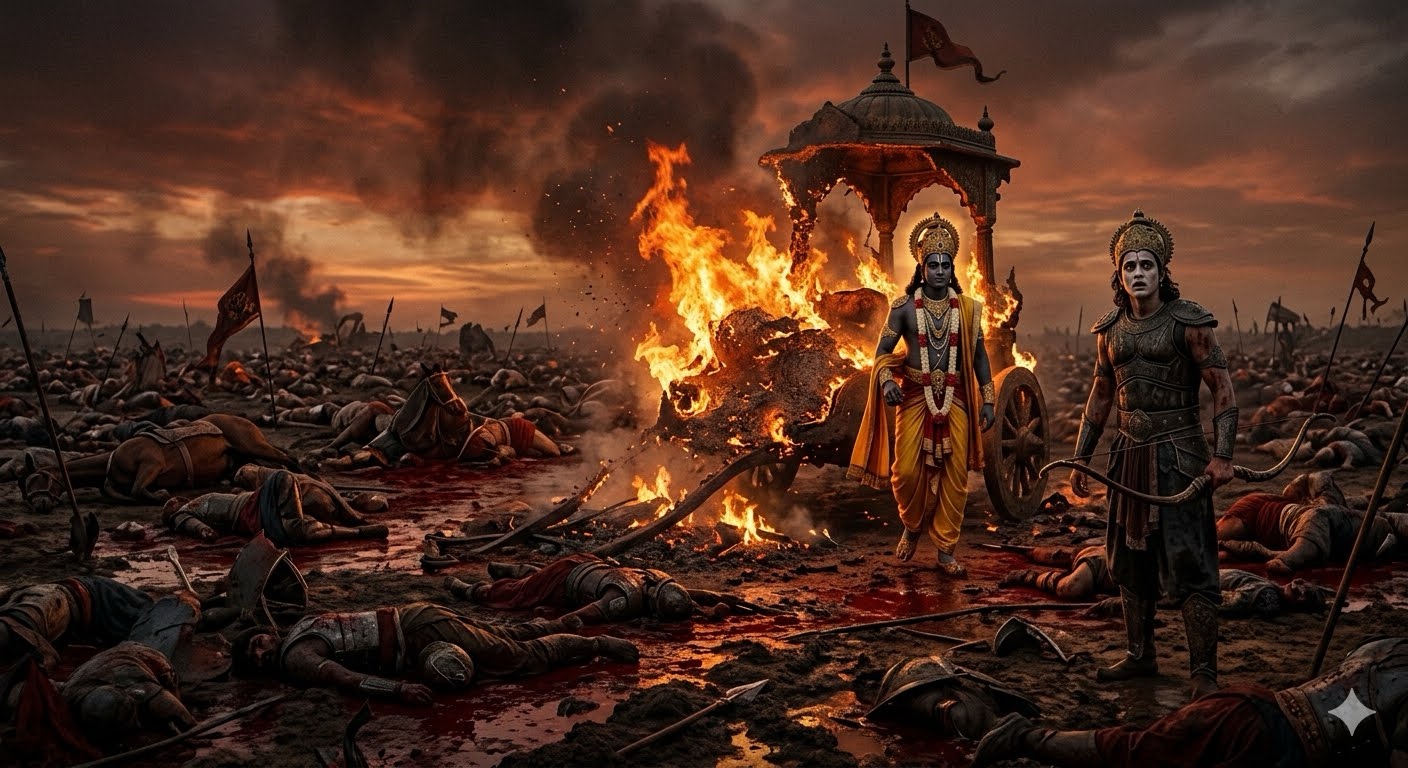
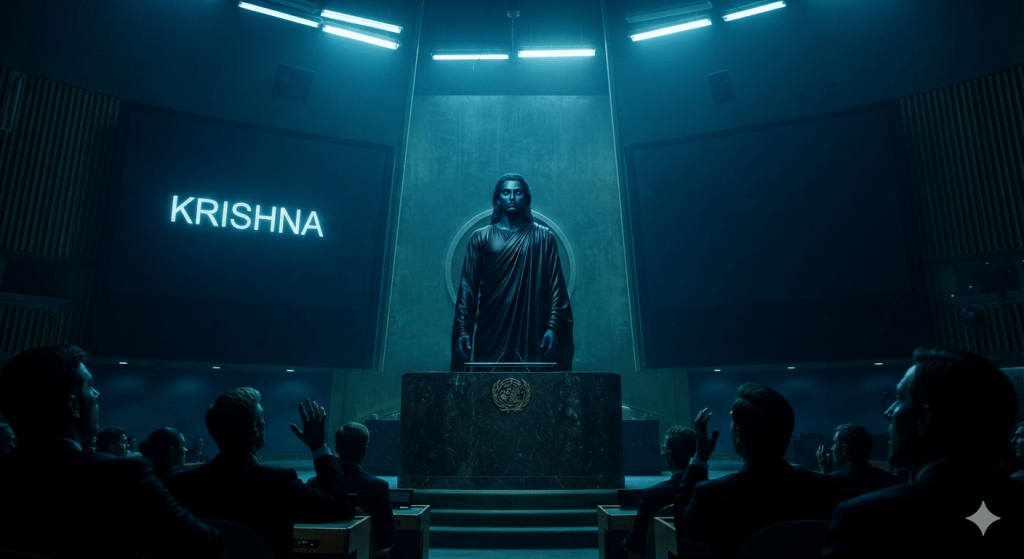
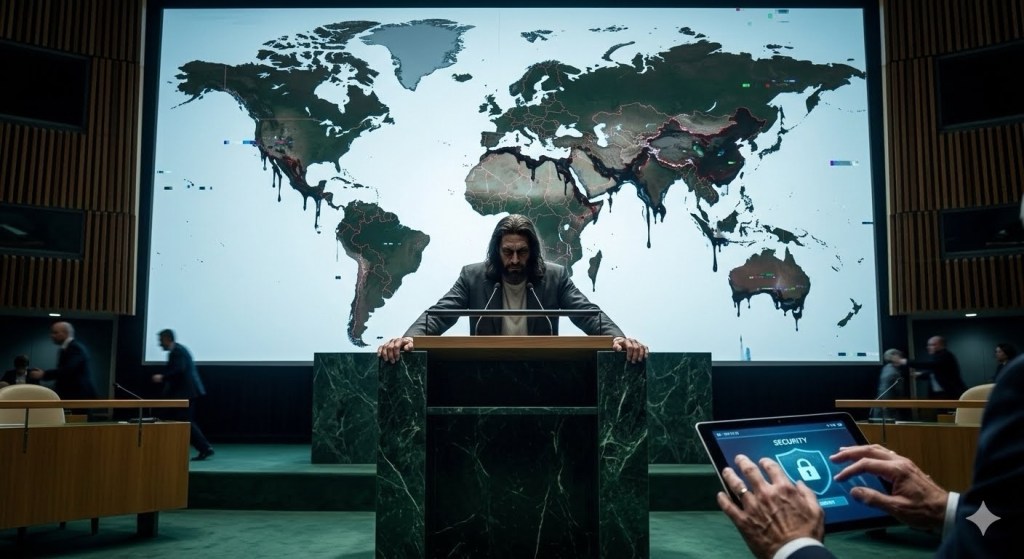
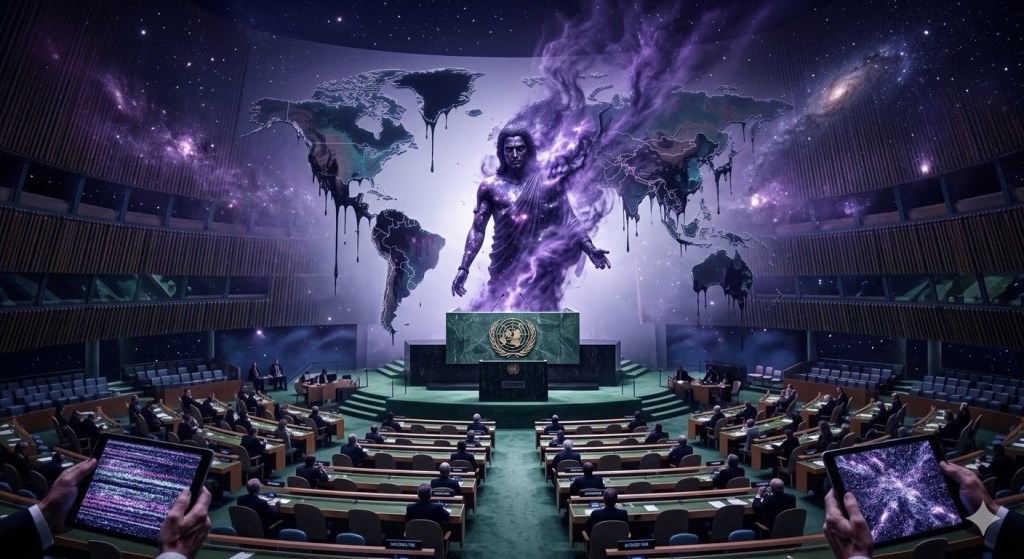
It would be entirely lawful and morally imperative for the rest of the world to demand that the United States and Israel pick up the tab for every single transit fee, insurance hike, and re-routing cost incurred in Hormuz.
Part 1: The Institutional Collapse and the Legal Morass
The geopolitical conflagration ignited on February 28, 2026, has done more than just plunge the Middle East into a severe regional security crisis. It has decisively shattered the illusion of a rules-based international order. By launching a unilateral war of aggression against Iran without the authorization of the United Nations Security Council (UNSC) or the constitutional approval of the U.S. Congress, the Trump administration—stubbornly egged on by an uncompromising Israel—has dragged the world into a profound moral and legal morass.
This conflict systematically dismantles the very foundations of international diplomacy and maritime law. It violates the core tenets of the United Nations Convention on the Law of the Sea (UNCLOS), which explicitly guarantees the right of “transit passage” through international straits and forbids coastal states from levying arbitrary tolls on foreign commercial ships. By reducing the Strait of Hormuz to a contested choke point where both Washington and Tehran now threaten unilateral transit charges, this war makes a mockery of decades of diplomatic precedent.
Furthermore, this lawlessness erases historic milestones of conflict resolution, including the framework of the 1981 Algiers Accords, which once established legal mechanisms to settle U.S.-Iran disputes through arbitration rather than bombs. Today, institutions like the International Court of Justice (ICJ) and the UN stand completely paralyzed. Because the U.S. wields an absolute veto on the Security Council, the UN is rendered an impotent talking shop, structurally incapable of holding a global superpower accountable for the catastrophic international fallout of its domestic and military choices.
Part 2: The Enormity of the Global Burden and the Precedent of Ruin
The economic consequences of this American-Israeli war behave like a regressive, mandatory tax imposed on nations that had absolutely nothing to do with the conflict. If either Iran, the United States, or both succeed in levying transit fees through Hormuz, the global shipping and logistics industry faces an unprecedented “May Day” collapse. Maritime insurance syndicates have already driven premiums to astronomical war-risk levels, forcing smaller shipping lines into insolvency and grounding fleets.
The prospective burdens—both quantifiable and unquantifiable—are staggering. Forcing ships to bypass Hormuz or detour around the Cape of Good Hope drastically inflates fuel consumption and overheads, delaying vital supply chains by weeks. This sudden realignment has triggered a brutal wave of imported inflation across the globe. Basic maritime freight rates have doubled, directly inflating the landing costs of essential food commodities, agricultural fertilisers, and crude oil. Developing economies are being pushed into severe balance-of-payments crises as their foreign exchange reserves are systematically drained just to cover the inflated costs of survival.
Landlocked developing countries are hit the hardest by this inflationary shock wave. Entirely dependent on coastal neighbors, they face choked land corridors, skyrocketing transit fees, and the physical deprivation of essential goods like food and medicine. Furthermore, this crisis sets a ruinous global precedent. If a toll is normalized in Hormuz, the global commons could fragment into protectionist toll zones, threatening free passage in the Malacca, Gibraltar, and Danish straits.
Why should innocent consumers, struggling economies, and neutral states absorb these multi-billion-dollar shocks via runaway inflation? Natural law dictates that the instigators of a war must bear its financial consequences. It is entirely lawful and morally imperative for the rest of the world to demand that the United States and Israel pick up the tab for every single transit fee, insurance hike, and re-routing cost incurred in Hormuz. To suggest that neutral nations should simply “learn to lump it” is a callous and reprehensible evasion of state responsibility.
Part 3: The Myth of Exceptionalism and the Imperative for Restraint
At the core of this global crisis lies the innate injustice of “America First”—a doctrine of toxic exceptionalism that dictates American self-interest must be secured at any cost to the rest of the world. This policy formulation allows Washington to insulate its own economy behind the hegemony of the U.S. dollar while externalizing the devastating financial and human costs of its military misadventures to the Global South and neutral trading blocs.
When a superpower behaves as a delinquent, rogue state with absolute impunity, the international framework collapses into pure realpolitik—a world where might makes right. If the UN Security Council is structurally paralyzed by design, then the responsibility to set hard limits on American exceptionalism falls squarely on the shoulders of the world’s other great powers, specifically China and Russia.
If left entirely unchecked, Washington’s unilateralism will permanently break the global trading architecture. The consequences of allowing this behavior to continue with impunity are grim: the weaponization of international waters, the destruction of global supply chains, and an inevitable slide toward a fragmented, hyper-militarized world. To protect the global commons from being held to ransom, emerging powers and regional blocs must aggressively accelerate de-dollarization, expand independent land-based trade corridors, and deploy sovereign naval escorts to bypass Western-dominated financial and maritime systems. The world can no longer afford to finance the costs of America’s unilateral wars.
Did Tyagaraja ever imagine, in his own lifetime, that his compositions would one day become the staple fare of a vast Carnatic music kutcheri circuit, sustained by sabhas, sponsors, reputations, and an entire performing ecosystem?
Probably not in any literal sense. He was not writing for a concert market, nor for a profession called “Carnatic artist” as we know it today; he was singing as a devotee, a seeker, and a composer for whom music was a mode of worship, not a platform for branding or commercial self-fashioning.
That is precisely what makes the later history of his music so remarkable.
Tyagaraja’s compositions did not spread because of media machinery, recording technology, institutional publicity, or royal patronage in the modern sense. They spread through disciples, devotional gatherings, oral transmission, and the reverberations of musical excellence itself. In that older world, the song was the advertisement, the tradition was the archive, and the listener was also the transmitter.
Tyagaraja did not become a court musician in the ordinary sense, though royal attention did at times come his way. The important point, however, is that he is remembered as having declined the lure of courtly life and patronage, preferring the integrity of his spiritual calling to the prestige of elite sponsorship. His fame therefore did not arise from being packaged by power, but from the force of a body of compositions so profound that even elites, scholars, disciples, and ordinary rasikas were drawn into its orbit.
Over time, his songs moved from the intimate space of devotion into the larger public world of performance. His disciples and the sishyaparampara routes preserved and transmitted the compositions; later generations of musicians absorbed them into concert practice; and eventually they became the very backbone of the Carnatic repertoire. In that sense, the modern kutcheri circuit did not merely inherit Tyagaraja — it was, in a very real way, built around him.
Yet that inheritance carries a tension.
The contemporary sabha and kutcheri ecosystem is undeniably shaped by sponsorships, ticketing, curation, artist branding, competitive visibility, and the pressures of a cultural economy.
It is not wrong to describe it as an industry. At the same time, to reduce it only to commerce would be unfair, because the same ecosystem still sustains serious listening, pedagogy, lineage, and moments of genuine devotional concentration. The tradition remains hybrid: part public art, part cultural enterprise, part spiritual discipline.
Would this all fit Tyagaraja’s vision? Only partially. If his ideal was nadopasana — music as worship, interiority, surrender, and communion with Sri Rama — then the modern concert world, with its prestige economy and performance pressures, would likely appear compromised. Tyagaraja’s compositions were never meant to be mere entertainment, even though they undeniably possess beauty, complexity, and wide appeal. Their deepest intention was devotional transformation, not applause.
And yet the paradox is unavoidable: without his compositions, Carnatic music would not be what it is today. His kritis, Pancharatnas, Divyanama songs, and Utsava Sampradaya compositions are not peripheral to the tradition; they are central to its identity, pedagogy, and concert life. He gave the music world a repertoire, a spiritual grammar, and a standard of bhava that later musicians continue to measure themselves against. In that sense, the very system that may sometimes seem to move away from his ideal is also sustained by his genius.
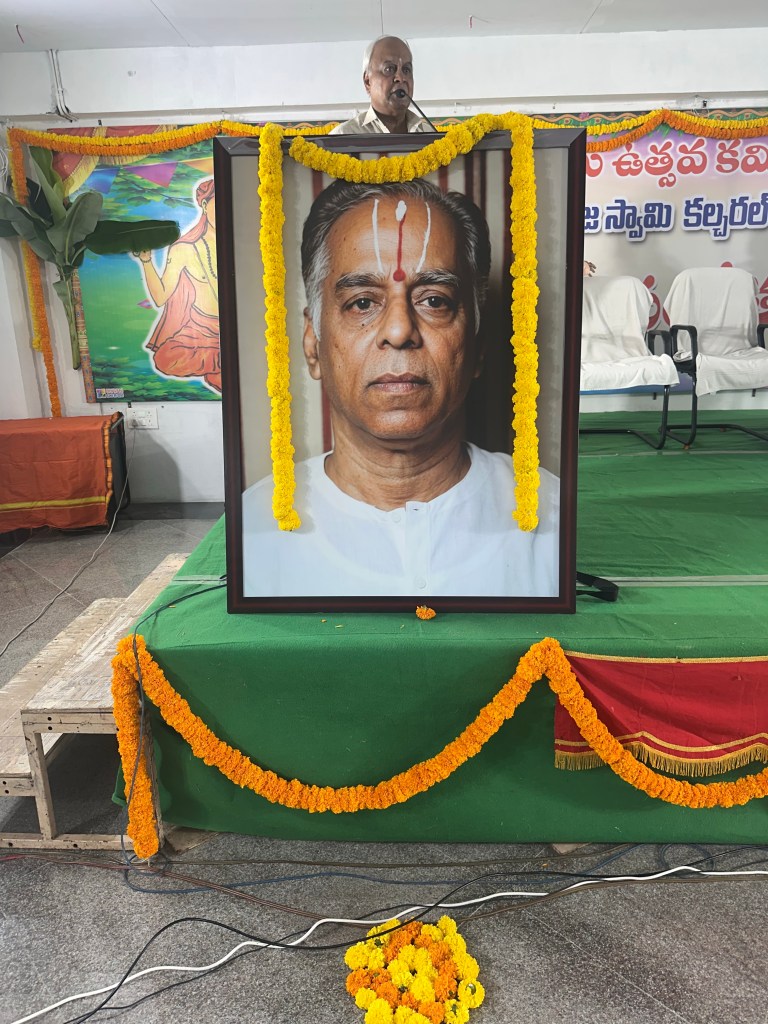
A particularly telling example of this continuity is the Tirupati Sri Thyagaraja Cultural Trust, whose annual festival in 2026 ran from August 1 to 5 and included the centenary observance of its former chairman M. Krishnaswami (1926-2013).
“Bhimas” Sri Mohan Sundaram addressing the kutcheri gathering after the Portrait of MK was unveiled by the Executive Officer of the Tirumala Tirupati Devasthanam Sri Muddada Ravichandra I.A.S
MK, as he was widely known, was the husband of Sangitha Kalanidhi, Padma Shri Dr. Smt. Mani Krishnaswami, and in the music circle he was remembered as a self-effacing but decisive force behind her career and public reach. He shaped and curated her musical journey with quiet intelligence, helping her attain the stature that eventually earned national recognition, while himself remaining out of the spotlight.
Dr Smt Mani Krishnaswami (1930-2002)
The same zeal that MK brought to his wife’s musical life he brought to the Tirupati Trust, which he helmed from the early 1970s until 2010. By all accounts, he persevered through and surmounted all the practical burdens that can make cultural work so very difficult — funding, infrastructure, manpower, organization, and public relations — yet never abandoned the cause of nadopasana at Tirupati.
Nithyashree Mahadevan graciously remembering MK
Today, the Trust’s festival template — with its mix of student participation, nadaswaram vidwans, and leading artists such as Nithyasree Mahadevan and Sunil Gargeyan— was fashioned by MK and now stands as a living monument to that persistence.
This is why the Tirupati example matters so much. It shows that even within today’s professionalized, sponsor-driven, and sometimes over-branded Carnatic landscape, there remain institutions where Thyagaraja is approached not merely as repertoire, but as a sacred inheritance. The Pancharatna tradition, student ensembles, and the devotional framing of the festival all demonstrate that the old spirit has not vanished; it survives in pockets where rasikas still encounter music as worship.
So the historical answer to the larger question is both simple and profound. Tyagaraja probably did not imagine a “Carnatic music industry” in which his compositions would circulate as standard concert fare. But he did create something that outlived his own social world: music so deeply rooted in devotion, structure, and melodic intelligence that it could pass into public tradition and shape centuries of performance. If the modern kutcheri circuit sometimes strays from his ideal, it nonetheless lives in the shelter of his legacy.
In the end, Tyagaraja remains both the critic and the beneficiary of the world that followed him. He would probably not have recognized today’s ecosystem as his own ideal, but he would surely have recognized the eternal power of devotion made music. And in that sense, the deepest truth remains unchanged: the world may have commercialized the stage, but it still listens through the door Tyagaraja opened.
M K Sudarshan with the young Vidwans Sunil Gargeyan (vocalist), Komanduri Krishna and Sai Raghavan (mridangam)
Here below is an imaginary, freewheeling conversation between a bright young Philosophy major student and the Unknown Sri Vaishnava
Characters:
THE STUDENT: A brilliant, sharp-witted philosophy student. He is intellectually relentless, fiercely logical, and deeply troubled by the gap between scriptural description and personal reality.
THE UNKNOWN SRI VAISHNAVA: An elderly scholar of the twin traditions (Ubhaya Vedanta), 70 years old with a full head of silver hair and a neat white beard. He wears the sacred Urdhvapundram on his forehead, possesses eyes full of quiet joy, and speaks with a blend of absolute candor, gentle humor, and profound humility.
Setting: A bright, sunlit stone-pillared pavilion (Mandapam) attached to a historic temple in South India. The warm afternoon light washes over the intricately carved pillars. Scattered palm-leaf manuscripts and leather-bound texts lie on a woven grass mat between them. A brass oil lamp flickers softly nearby.
Act I: The Map and the Author
THE STUDENT: (Leaning forward, tapping a finger forcefully on an open text) Sir, I have spent weeks comparing the two pinnacles of our literature. On one hand, the long passage of the Anandavalli in the Taittiriya Upanishad. On the other, the final paasuram patthu-s of Nammazhwar’s Tiruvaimozhi. Both describe Moksha experientially, do they not? But here is my distinction, and I want you to tell me if my logic fails: the Upanishad is Apauruṣeya—authorless, uncreated, pure cosmic revelation. The Tiruvaimozhi, however, is Nammazhwar’s personal revelation born of his unique mystical ecstasy. Am I correct?
THE UNKNOWN SRI VAISHNAVA: (Smiles gently, tilting his head as he adjusts his upper cloth) No, my young friend. But it is a magnificent, profound “No” that unites them both. You are falling into a trap of false division, separating the river from the ocean because they flow through different terrains.
THE STUDENT: (Frowning) False division? How so? One has no human author; it belongs to the primordial breath of reality. The other was sung by a specific man sitting under a tamarind tree in Alwarthirunagari. How can they be the same?
THE UNKNOWN SRI VAISHNAVA: To call the Tiruvaimozhi a “personal” revelation in contrast to the Apauruṣeya Vedas violates the very foundation of Ubhaya Vedanta. In our tradition, Nammazhwar’s words are not treated as subjective human poetry. They are the Dravida Veda. Nammazhwar is not an “author” inventing concepts or documenting a private emotional trip; he is a flawless divine instrument. The Lord granted him Mayarvara Madinalam—pure, blemishless knowledge completely wiped clean of human ego, mental coloring, or cosmic ignorance. What flowed out of him was the unadulterated Vedic truth, making it structurally equivalent to the Apauruṣeya text. The Sanskrit Veda is the Lord’s cosmic command; the Tamil Veda is the Lord’s love song to the soul. Both are His breath.
THE STUDENT: Then how do you account for the striking, undeniable difference in their language and tone? One reads like geometry; the other reads like an absolute firestorm of emotion.
THE UNKNOWN SRI VAISHNAVA: The difference is not in their authority, but in their pedagogical medicine. The Taittiriya Upanishad approaches the experience objectively and universally. It constructs a meticulous ladder of joy—an Ananda-mimamsa. It takes the highest imaginable human happiness, multiplies it by a hundred to reach the joy of the celestial beings, and multiplies that again and again through cosmic hierarchies. Why? To logically prove to your stubborn intellect that the bliss of Moksha is mathematically infinite. It speaks to the seeking mind. But Nammazhwar? He approaches the experience subjectively and immediately. He does not map the ladder; he shatters it and throws you directly into the ocean of the Divine.
Act II: The Prison of the Third-Party Account
THE STUDENT: (Sighs deeply, standing up and pacing across the warm stone floor) Granted all that you say, Sir. Let me push my grievance to its absolute limit. When I read both the Anandavalli and the Tiruvaimozhi, what happens to me? For me, personally, they remain secondary sources of knowledge. I am like a man trapped in a dark room reading a traveler’s brilliant diary about the midday sun. I see the words, but I don’t feel the heat. They are third-party accounts of an experience I do not possess. Tell me if I am wrong.
THE UNKNOWN SRI VAISHNAVA: (Nods slowly, watching the student pace) You are entirely right in your present diagnosis, and entirely wrong about the nature of the remedy. I admire your honesty. Most scholars pretend they are warm just by holding the diary.
THE STUDENT: (Stops pacing, looking directly at the old man) Then explain the paradox. If I am right that it is a secondary source, how can it save me?
THE UNKNOWN SRI VAISHNAVA: Right now, you possess only Parokṣa Jñāna—indirect, conceptual knowledge. If you have never tasted a mango, the most vivid botanical description, the most ecstatic poem about its sweetness, is just a third-party account. The map is not the territory. But you mistake what these texts are designed to do! They are not historical reports recording someone else’s ancient liberation; they are mirrors reflecting your own immediate capacity. The Taittiriya acts as a divine injunction, telling you: “This infinite joy is your birthright, currently covered by the dust of your own making.” The Tiruvaimozhigoes further—it acts as an experiential catalyst. Its verses are infused with Bhāva—divine emotion. When you recite them, the Azhwar’s experience begins to bleed into your consciousness, bridging the gap between “his” and “yours” through sacred resonance.
THE STUDENT: But a bridge still implies a grueling journey! I must still climb across it. It requires monumental effort to clear away that dust.
THE UNKNOWN SRI VAISHNAVA: Ah! That is the great secret of Siddhopāya—the Already Ready Means. If Moksha depended entirely on your self-effort to transform a map into a reality through lifetimes of grueling Bhakti Yoga, you would remain trapped in third-party limbo forever. You would die on that bridge. But in Saranagathi, you surrender your very inability to cross. The moment you surrender, the Lord takes full responsibility for your Mokshaanubhavam. Through daily contemplation and loving service, a wave of that eternal Brahmaanandam hits you in this very life, right here in the material world, long before you ever depart this body.
Act III: The Great Impasse of Karma
THE STUDENT: (His eyes flashing with intellectual intensity, leaning across the mat, his voice rising) Sir, you are masking the problem with beautiful theology! Let us look at the stark existential reality. Your statement—“This capacity for infinite joy exists within you right now, covered by karma. Remove the obstruction”—that again is just another line on the roadmap! It is a phrase in a book!
THE UNKNOWN SRI VAISHNAVA: (Leans back against a carved pillar, completely unbothered, listening intently) Speak your full mind. Do not hold back.
THE STUDENT: My karmic baggage is an absolute, unyielding existential condition. It is a mathematical ledger of past actions over which I have zero control. I have no choice but to endure whatever suffering it has in store for me. Therefore, the hurdle of Karma must be overcome, paid for, and exhausted first before the path to Mokshaanubhavam can even be discovered! And Sir, I know you will respond immediately by invoking the doctrine of Saranagathi or Prapatti, claiming that Sanchita and Aagaami karmas get dissolved by grace, thus opening the path. But that is a theological doctrine! It is a concept! It tells me absolutely nothing about the actual experience itself except in terms of vivid descriptions, isn’t it so?
THE UNKNOWN SRI VAISHNAVA: (Laughs softly, a rich, warm sound that echoes in the pavilion. His eyes shine with immense joy) Excellent! Truly magnificent, my young friend! You have successfully painted yourself into a corner using flawless logic. You have reached the dead end of reason, and it is a beautiful sight to behold.
THE STUDENT: (Blushing slightly, crossing his arms) I am seeking an experiential breakthrough, Sir, not academic compliments.
THE UNKNOWN SRI VAISHNAVA: And I am giving you the breakthrough. You are entirely correct: until the honey touches your tongue, everything is just words. But your premise about Karma is flawed. You treat Karma as if it were a massive physical stone wall that you must slowly chip away with a pickaxe over millions of years. It is not. Karma is simply the orientation of your will away from the Divine. It is the deep delusion that you are the door, you are the key, and you are the independent traveler. When you cry, “I must travel the road, I must cross the hurdle,” you are operating entirely from the ego—the Ahamkara. You are trying to use the very tool that bound you to set yourself free.
THE STUDENT: (Quietly, his defensiveness shifting into genuine vulnerability) Then what is Saranagathi, if it is not just a clever theological bypass?
THE UNKNOWN SRI VAISHNAVA: It is an existential act, a collapse of the ego, not a doctrine! When a drowning man finally stops thrashing his arms because he realizes his self-effort is killing him, and he completely relaxes so the lifeguard can pull him out—that cessation of effort is not a theology. It is a psychophysical reality. Saranagathi is the precise moment your intellectual pride breaks down and you look at your mountain of baggage and say, “I cannot carry this. I cannot even take the first step.” The moment you genuinely hand that burden over to Sriman Narayana, the heavy anxiety of existential dread vanishes instantly. It is replaced by Maha-Viswasa—absolute trust. That trust brings an immediate, cool peace into your chest. That peace is not a description in a book; it is a felt reality. It is the first wave of Moksha breaking through your defense mechanisms.
THE STUDENT: And what about Nammazhwar’s verses? Are they still not just beautiful descriptions to someone like me who is listening to them centuries later?
THE UNKNOWN SRI VAISHNAVA: No! Look at how his text breaches its own boundaries. Nammazhwar begins his journey traveling toward the reclining Lord of Tirumala, but by the final decad of Tiruvaimozhi (10.10 starting with “Muniyē Nānmughanē”), his grammar breaks down, his tears stain the palm leaves, and his poetry becomes purely ecstatic. He cries out: “You have entered inside me, eating away my soul, my breath, and my body completely, leaving nothing behind. You have swallowed me whole!” In ordinary spiritual maps, the soul painstakingly enters God. Here, God is a desperate glutton hungry for the soul! When you recite those verses with a quiet mind, your soul vibrates in sympathy with the Azhwar’s experience, like a tuning fork matching a struck note. That sudden lump in your throat, that unprompted tear—that is not a map, my friend. That is the experience itself breaking through your armor.
Act IV: The Text Corrected
THE STUDENT: (Frowning, pulling a heavy manuscript closer, trying to regain his logical footing) Wait. You speak of this immediate peace, but let us look at the mechanics of the transition. How does Acharya Ramanuja describe this psychological shift? Does he not demand extreme purification?
THE UNKNOWN SRI VAISHNAVA: Acharya Ramanuja enacts this beautifully in his Sharanagati Gadyam. When the seeker drops his burden, the Lord explicitly responds to clear away his existential torments.
THE STUDENT: (Interrupting sharply, his eyes narrowing as he looks at the text) But what are the exact words of the Lord’s assurance? I want the genuine phrasing from the canon, Sir, not a loose summary.
THE UNKNOWN SRI VAISHNAVA: (Stops speaking. He blinks, looks down at the manuscript, and then bows his head deeply, placing his palms together in an unfeigned gesture of total reverence) You are completely right to pull me up. Let us reject any loose summaries. The profound injunction “Sukhamāsva”—live in absolute peace—belongs strictly to the Saranagathi Gadyam, appearing during the Lord’s definitive reply split across two breathtaking contexts.
First, regarding this earthly life, the Lord commands Ramanuja: “…yāvaccharīrapātam atraiva śrīraṅge sukhamāsva”—until your body falls away, live right here in Sri Rangam in absolute peace, free from worldly anxieties.
Second, regarding spiritual certainty, He seals it: “…atastvaṃ tava tattvatō mad jñānadarśana prāptiṣu nissaṃśayaḥ sukhamāsva”—remaining completely free from any doubt regarding your ultimate attainment of Me, live in peace.
THE STUDENT: (Softening, his voice lowering) The real text is far gentler.
THE UNKNOWN SRI VAISHNAVA: Infinitely gentler! In the real Saranagathi Gadyam, the Lord does not demand that you master a complex, lofty yogic state first. Instead, He looks at Ramanuja’s complete lack of qualifications, takes full responsibility, quotes His own cosmic promises, and says: “Because I have promised it, you can stop worrying right now. Sukhamāsva.” Ramanuja gives you the solid, unshakeable intellectual peace of knowing your burden is taken. Nammazhwar shows you how beautiful it feels when that peace ignites into ecstatic bliss. Thank you for protecting the purity of the Acharya’s words from my old memory.
Act V: The Epilogue of Omar Khayyam
THE STUDENT: (Sitting quietly for a long moment, watching the shadows of the pillars lengthen on the floor) So, Sir… for an ordinary spiritual aspirant like me, the stark fact of the matter remains. The very conception of Brahmaananda must initially be derived from the accounts provided by the Anandavalli and the Tiruvaimozhi. The journey must start only with a roadmap in our hands that we must first learn to read properly before setting out. In other words, it is from the third-party, albeit eye-witness testimony, that we must progress to the first-person experience?
THE UNKNOWN SRI VAISHNAVA: (Beaming with unadulterated delight, clapping his hands together) Precisely! You have hit upon the exact starting point of the spiritual journey. Your analysis is flawless. We cannot start at the destination; we must start with the map. Scriptural testimony creates the Parokṣa Jñāna—the intellectual desire. You study the map diligently not to worship the paper, but to gain the confidence to take your very first step into the unknown.
(The old man pauses, looking out past the stone pillars into the vast sky. His voice drops into a tone of quiet, deeply personal reminiscence.)
When I was as young as you… perhaps not as intelligent, certainly not as thoughtful… I too used to think along the exact lines as you do now. One of my favorite and oft-quoted lines of poetry used to be from the Rubaiyat of Omar Khayyam:
Strange is it not that of the myriads who Before us passed the Door of Darkness through, Not one returns to tell us of the Road, Which to discover we must travel too.
I did not know what Moksha or Brahmaanandam was. It was a hazy, distant will-o’-the-wisp for me. I could not even conceive of it in the ecstatic, boundary-breaking terms in which the Anandavalli and Tiruvaimozhi speak of it. To be completely honest with you… I still have not been able to fully wrap my head or mind around its entirety even today!
THE STUDENT: (Staring at him, stunned, his voice barely a whisper) You… even today, Sir? After a lifetime of study?
THE UNKNOWN SRI VAISHNAVA: (Smiles beautifully, his eyes crinkling) Even today. I may not have grasped the positive nature of Brahmaanandam in its infinite entirety, no. But what I do know with absolute, unshakeable, existential certainty is that true peace cannot be found in this fragile, mortal state of existence. That realization became the absolute starting point of my journey. Knowing what it is not.
(The Unknown Sri Vaishnava gently places a warm, wrinkled hand on the student’s shoulder, breaking the intellectual spell completely.)
Good luck and Godspeed to you, young man, on yours!
(The old man nods one last time, picks up a loose palm-leaf manuscript, and walks slowly into the inner courtyard of the temple. The student remains sitting under the stone pillars, staring at the open texts before him as the evening lamps are lit, the silence around him suddenly filled with immense, unmapped space.)
The student stands entirely silent, deeply moved by the sudden shift in the conversation. The intellectual duel has evaporated, replaced by the profound weight of a personal, lived truth.
The Unknown Sri Vaishnava’s quiet confession changes everything for the student, revealing the heart of a true practitioner:
1. The Vulnerability of the Master
By quoting Omar Khayyam’s bittersweet lines, the Unknown Sri Vaishnava shows the student that doubt and existential vertigo are not flaws—they are milestones. Even great masters of the texts once stood before that very same “Door of Darkness,” looking out into the hazy unknown.
The Unknown Sri Vaishnava’s own admission that he still cannot fully wrap his mind around the ecstatic heights of the Anandavalli or Tiruvaimozhi, teaches the student the ultimate lesson in Vedantic humility: Brahman cannot be captured by the intellect. If you can completely understand it, it is not Brahman.
2. The Power of Neti, Neti (Not This, Not That)
What had just been demonstrated was the ancient Upaniṣadic method of Neti, Neti. You do not need to know exactly what the destination looks like to begin walking away from the prison.
Knowing with absolute certainty that true bliss cannot be found in this fragile, mortal existence (Samsāra) is a monumental spiritual breakthrough. It is the awakening of Vairāgya (dispassion). If this world is a burning house, you do not need to map out the destination before you run outside; you just need to know that you must leave.
3. The Shift from Logic to Grace
By ending with a blessing rather than another philosophical argument, the Unknown Sri Vaishnava transitioned the student from the realm of Tarka (debate) to the realm of Anugraha (grace). He left the student not with a complicated roadmap, but with the warm reassurance that the very restlessness of his brilliant mind is proof that his journey has already begun.
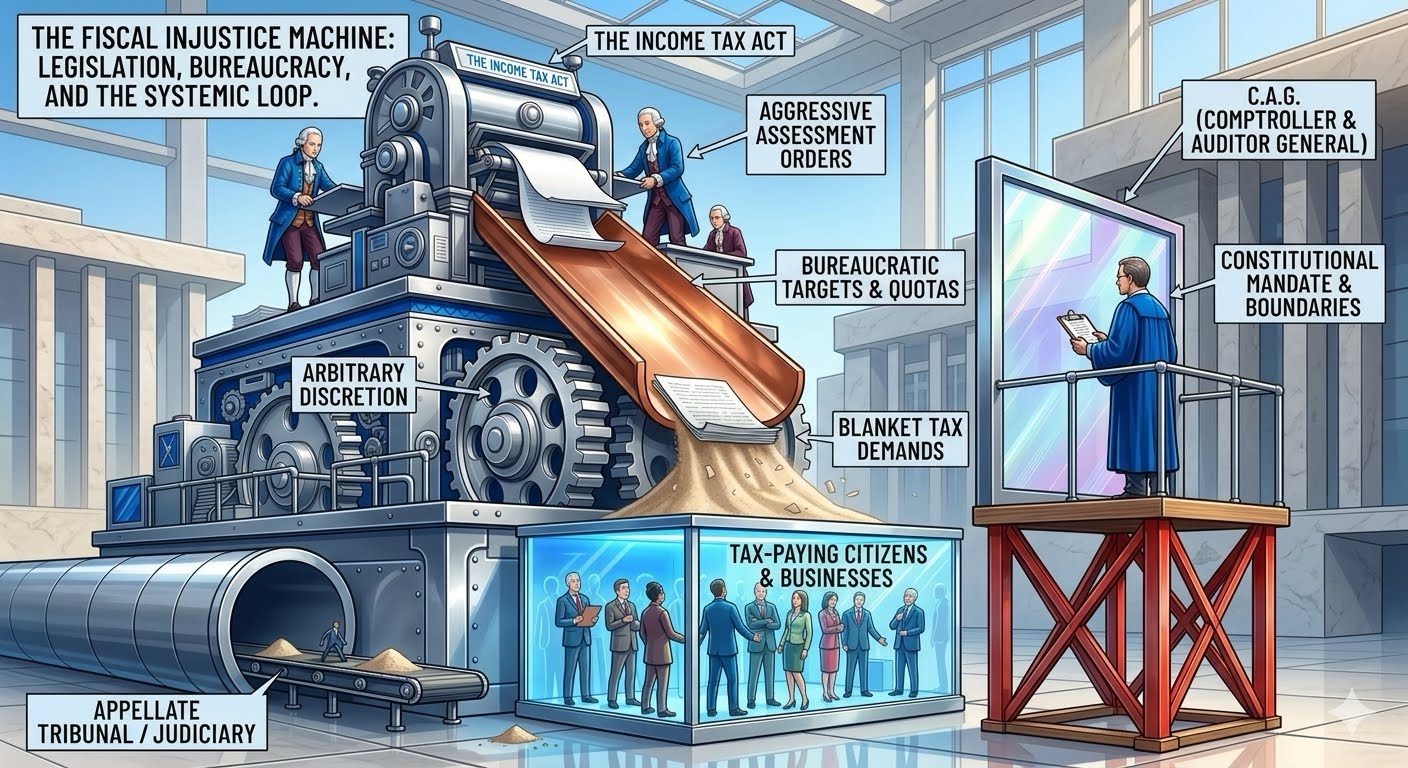
There is in India a thing called a systemic loop of “tax terrorism” that is deeply entrenched within the architectural design of Indian tax administration, constitutional divisions, and budgeting conventions.
In his very recent interview on Raj Shamani‘s podcast Figuring Out, https://youtu.be/jr0k_fOR1b0?si=-p8JVNJ_lEDa8n1i , Mohandas Pai highlighted this thing called a “tax terrorism loop”. He quoted a humungous sum of ₹38 lakh crore being the total volume of pending tax disputes in our country.
The amount Pai talked about is the total cumulative revenue under dispute listed across all direct and indirect taxes in the Union Budget’s explanatory memorandum. It includes legacy cases, penalty disputes, multi-layered demands on the same income, and unresolved departmental tracking.
Mohandas Pai’s contention is fundamentally valid and backed by official data, though he delivers it with a sharp, rhetorical edge to force systemic accountability. His argument is not a manufactured exaggeration. Instead, it highlights a structural failure in how the Indian tax administration tracks and reports bad debt.
Here is a breakdown of why his claim is valid, and where the rhetoric serves a purpose:
Why His Contention is Valid (The Hard Facts)
The Number Exists in the Budget: The ₹38 lakh crore figure is not made up. It is a verified data point pulled straight from the Receipt Budget (Statement of Revenue Foregone / Disputes) presented by the Finance Minister.
The “Uncollectable” Reality: Pai’s breakdown—that roughly half of this amount (₹19 lakh crore) is practically unrecoverable because the assessees are untraceable, defunct, or have zero assets—is a reality openly acknowledged even by CAG (Comptroller and Auditor General) reports and the Income Tax Department‘s own internal metrics.
The Target-Driven Assessment Trap: His core criticism of “taxterrorism” points to a factual systemic flaw. Assessing Officers (AOs) face strict, aggressive annual tax collection targets. To protect themselves from scrutiny by oversight bodies (like the vigilance department), they routinely raise highly inflated, legally weak tax demands at the end of the financial year. They pass the buck to the appellate system, knowing the taxpayer will be forced to appeal.
Where His Argument Shifts to Rhetoric
While Pai’s structural diagnosis is entirely accurate, his framing uses intentional rhetoric to advocate for corporate India and honest taxpayers:
“Bogus” and Untraceable Demands
Pai highlighted in the interview that ₹19 lakh crore (exactly half of his quoted figure) consists of what he calls “bogus” disputes. In these specific cases, the IT department has raised aggressive, arbitrary tax demands, but the assessees are untraceable, unavailable, or possess no assets to recover the funds from.
“Channel-stuffing” by the Assessing Officers of the IT Dept. would amount to fraudulent accounting if done in a private sector company
In the private sector, accounting of revenue by companies in their books has to strictly adhere to IAS — Indian Accounting Standards. Sales cannot be booked at the end of the year just to inflate revenue through what is commonly known in audit terminology as “channel stuffing”. The company auditor usually scrutinises end of the year sales registers and if bogus invoicing is unearthed, the revenue booked is reversed.
However, channel-stuffing is exactly what the assessing officers of the IT Department— according to Pai — do at the end of year just to meet revenue targets set for them by booking cases against bogus assessees. Under revenue recognition standards of the IAS, IFS or GAAP, the practice would be regarded as fraudulent.
Any professional accountant might want to ask the question: Why this double standard of accounting — one for the private sector company and another for the IT Department?
The Institutional Double Standard
The fundamental operational mismatch persists due to a core conflict of interest: the government acts as both the regulator and the beneficiary of the accounting rules.
Sovereign Immunity vs. Corporate Liability: If a corporate executive intentionally practices channel stuffing to hit a bonus metric, they face criminal prosecution for financial fraud under the Companies Act. If a tax officer issues an inflated assessment to hit a regional target, they are protected by sovereign immunity because they acted under the color of law, even if the demand is later thrown out by a court.
Preserving Paper Assets: A private corporation must write off bad debts to give a true and fair view to investors. The government resists writing off uncollectable, disputed demands because keeping that massive backlog on the books allows it to maintain an artificially inflated projection of potential sovereign assets.
Ultimately, the double standard exists because the state has designed a system where it is legally insulated from the very rules of financial discipline it imposes on the private sector.
“Tax Terrorism” and Fast Demands
Pai heavily criticized the system, noting that 80% of that ₹19 lakh crore chunk was piled on purely through tax demands raised by assessing officers over the last 5 years. He argued that officers routinely issue inflated assessments to meet collection targets, knowing the demands will quickly enter an endless cycle of appeals.
“Bogus” vs. “Protective” Demands: Calling the entire ₹19 lakh crore chunk “bogus” simplifies a complex administrative issue. A large portion of these are “protective assessments.” For example, if a scam or complex transaction occurs involving multiple shell companies, the IT department legally raises the same tax demand on all suspected entities simultaneously to ensure the state doesn’t lose out, intending to drop the duplicate demands once the primary culprit is legally nailed. This artificially balloons the total dispute figure on paper, even if only one chunk of it is real.
A Political Weapon Against Bureaucracy: By calling out the Finance Minister and demanding that officers face negative entries in their Confidential Reports (CR) for losing frivolous appeals, Pai is using public rhetoric to pressure the executive branch into reigning in an over-aggressive tax bureaucracy.
The Bottom Line: Pai is thus using a hyper-accurate symptom (the staggering ₹38 lakh crore listed in the budget) to expose a chronic disease (over-assessment and systemic harassment by the IT Department). While his delivery is aggressively rhetorical to grab headlines, his mathematical and procedural critique of the direct tax system is entirely sound.
What has been done to cure the chronic disease ?
There are exactly 5.4 lakh (540,000) pending income tax appeals across India.
This updated figure was officially detailed by Union Finance Minister Nirmala Sitharaman at the recent 167th Income Tax Day celebrations.
Key Dispute Data At A Glance
Total Pending Cases: 5.4 lakh appeals remain unresolved.
Locked-up Revenue: Over ₹5 lakh crore in disputed tax demands is currently tied up in these pending cases.
Recent Disposals: The Income Tax Department executed an aggressive disposal drive during the last financial year (FY26), resolving a record 2.24 lakh appeals. This outpaced the 1.7 lakh newly filed cases, resulting in a net reduction of roughly 34,000 cases from the previous backlog.
Forums Involved: The vast majority of these disputes (~4.95 lakh cases) are first-tier appeals pending before the National Faceless Appeal Centre (NFAC) /Commissioner of Income Tax (Appeals). The rest are distributed across the Income Tax Appellate Tribunal (ITAT), various state High Courts, and the Supreme Court.
From the above disclosure made by the Finance Minister, it is clear the goal-post she is focusing on is not the goal-post Mohandas Pai is talking about.
Nirmala Sitaraman makes no mention at all of the ₹.38 lakh crore “tax-terrorism” that Pai is screaming about from the rooftops. Instead, the Finance Minister is sort of patting herself on the back for her Government’s measures taken to attenuate the chronic disease differently defined.
Reduction Measures in Effect
To actively mitigate this judicial burden of ₹38 lakh crore or ₹. 5 lakh crore (whichever way one wants to quantify it) , the Central Board of Direct Taxes (CBDT) has implemented a litigation prevention strategy. This includes increasing the monetary thresholds required for the department to file appeals (raising the limits to ₹60 lakh for ITAT, ₹2 crore for High Courts, and ₹5 crore for the Supreme Court), which has successfully forced the administrative withdrawal of thousands of low-value, legacy cases.
Vivad se Vishwas Schemes: The government introduces temporary amnesty windows. If a taxpayer pays the core disputed tax, the government waives all penalties and accumulated interest, instantly deleting the case from the backlog.
Bravo ! But what about the ₹19 Lakh crore “bogus” and “preventive” cases that still sits on the government’s balance-sheet as Receivables ?
Why can’t the CAG do an audit to establish the bogus cases … and have them deleted from the legacy backlog ? It’s after all just a one-time clean up operation and must be simple to do, no? That way, the basic motivations for “tax terrorism” by the IT Dept., going forward, goes away or could be significantly reduced, right?
The Clean-up that is Constitutionally blocked
While a one-time clean-up seems simple on paper, the Comptroller and Auditor General (CAG) cannot delete these cases because it lacks the legal authority, and the “clean-up” itself is legally blocked.
Under the Constitution of India, the CAG is strictly an external auditor, not a tax administrator or a judge. It can flag errors, but it cannot delete tax demands or settle judicial disputes.
The process is stalled by three major systemic barriers:
1. Legal Barriers (The CAG Has No Executive Power)
Audit vs. Adjudication: The CAG can audit a file and write a report stating, “This ₹1,000-crore demand is unrecoverable because the company is bankrupt.”However, only an Assessing Officer (AO), a Commissioner, or a Court has the legal power under the Income Tax Act to formally delete or write off that demand.
A corporate auditor can force a company to pass a journal entry to reverse a bogus invoice. The CAG cannot do this for the Income Tax Department due to severe constitutional limitations:
Judicial Independence vs. Audit Power: A corporate invoice is an administrative document. A tax assessment order is a quasi-judicial decree issued under powers granted by the Income Tax Act. The CAG is an accounting auditor, not a court of law. It possesses no legal authority to quash or rewrite a judicial order passed by a designated statutory officer.
The Post-Facto Mandate: The CAG operates entirely as a post-facto auditor. It reviews files after the financial year has closed. It cannot intervene in real-time to halt an assessment or stop an officer from issuing an order on March 31.
The Power to Flag, Not Force: The CAG regularly exposes this dynamic. In its annual Compliance Audit Reports on Direct Taxes, the CAG consistently flags that over 97% of outstanding tax demands are highly uncollectable and artificially inflated. Yet, the CAG’s jurisdiction ends at tabling this report in Parliament; it cannot force the department to delete the files.
The Appeal Trap: Once a tax demand enters the formal appeal process, it becomes a quasi-judicial matter. The CAG has absolutely no jurisdiction to interfere with or cancel a case that is pending before an appellate authority or a court.
2. Operational Barriers (The “Simple” Clean-up is a Massive Illusion)
What looks like basic bookkeeping data is actually a legal minefield. A simple clean-up is operationally impossible for three reasons:
Multi-layered “Protective” Demands: If a ₹5,000-crore financial fraud involves five interconnected shell companies, the IT Department raises a ₹5,000-crore demand on all five companies simultaneously to protect government revenue. On paper, this registers as ₹25,000 crore in disputes. You cannot simply delete four of them until the final court ruling proves exactly which company is legally liable.
Fear of Vigilance Scrutiny: Writing off a tax demand requires an official signature. Tax officers are terrified to sign off on deleting large balances. If they delete a demand against a defunct company, the Central Vigilance Commission (CVC) or CBI can later accuse the officer of corruption or collusion with the taxpayer. Passing the buck to a court is always the safer career move for a bureaucrat.
Tracking Untraceable Assessees: To formally declare a tax demand “uncollectable,” the department must legally prove they exhausted all search options. Proving a company has zero assets or that a promoter has permanently fled the country requires years of inter-agency coordination, making it a slow, painful process rather than a swift clean-up.
3. Political and Budgetary Barriers (The Paper Wealth Effect)
Artificially Inflated Assets: These disputed tax amounts are listed as “receivables” or potential revenue in government accounting. Deleting ₹19 lakh crore from the ledger instantly wipes out a massive chunk of the government’s theoretical asset base on paper, which looks politically unfavorable.
The legislators, abetters, victims and bystanders of “tax terrorism”
So, does it all mean that the “tax terrorism” Pai alleges is being enabled and perpetuated by the IT laws and statutes themselves? By constitutional boundaries? And by budget conventions? And so, nothing can be done about it except to deal with the “chronic disease” with whatever feeble measures the Government can come up with, from time to time, on an ad hoc knee-jerk basis?!
There is no doubt that the architecture of Indian Taxation system is self-perpetuating and is laid out across three institutional layers:
1. How System Architecture Perpetuates the Loop
The Legislative Target Trap: The Income Tax Act grants Assessing Officers (AOs) vast discretionary powers to make additions during assessments. Simultaneously, the Ministry of Finance sets aggressive revenue collection targets for the Central Board of Direct Taxes (CBDT) every budget cycle. This forces AOs to use their legislative discretion to maximize high-pitched, arbitrary assessments to meet their immediate regional quotas.
The Constitutional Standoff: The strict separation of powers creates a judicial firewall. Once an AO issues an assessment order, it transforms from an administrative file into a formal legal dispute. The executive branch cannot simply command a clean-up, and external bodies like the CAG cannot breach this boundary, forcing every single case to grind through the understaffed appellate machinery.
The Budgetary Fiction Convention: Listing ₹38 lakh crore under dispute acts as an accounting cushion in the Union Budget documents. Wiping this ledger clean through a massive executive write-off would instantly force the government to declare a massive reduction in its theoretical assets, heavily impacting fiscal deficit perceptions and international sovereign credit ratings.
2. Why Radical Solutions Face Institutional Resistance
To break this cycle, the government would need to implement drastic measures, but each choice carries a significant institutional penalty:
Radical Option 1: Executive Immunity for Tax Write-offs
The Measure: Grant a high-level committee the absolute power to permanently delete or write off tens of thousands of unrecoverable, “bogus” corporate tax cases.
The Roadblock: Bureaucratic self-preservation. No civil servant will sign off on deleting a multi-crore demand out of fear that the Central Vigilance Commission (CVC), CAG, or CBI will later classify the decision as corruption or collusion with corporate assessees.
Radical Option 2: Abolishing Personal Accountability for Missed Targets
The Measure: Evaluate tax officers based on the quality and legal sustainability of their assessment orders rather than the sheer volume of tax demands they generate.
The Roadblock: Institutional inertia. The system is structurally reliant on aggressive, short-term tax demands to fill the immediate quarterly cash-flow gaps of the Union Exchequer.
The system thus remains structurally oppressive because the state/government values institutional stability and revenue protection over radical taxpayer relief.
The Long and Short of it All
The “tax terrorism” that Mohandas Pai is so incensed about is indeed structurally or organically wired into the Indian Taxation system.
The Constitution of India and the Income Tax Law have legislated it into the fabric of governance; the Finance Ministry abets it; the Comptroller and Auditor-General of India is a bystander; and the tax paying people of India remain the silent, forbearing victims.
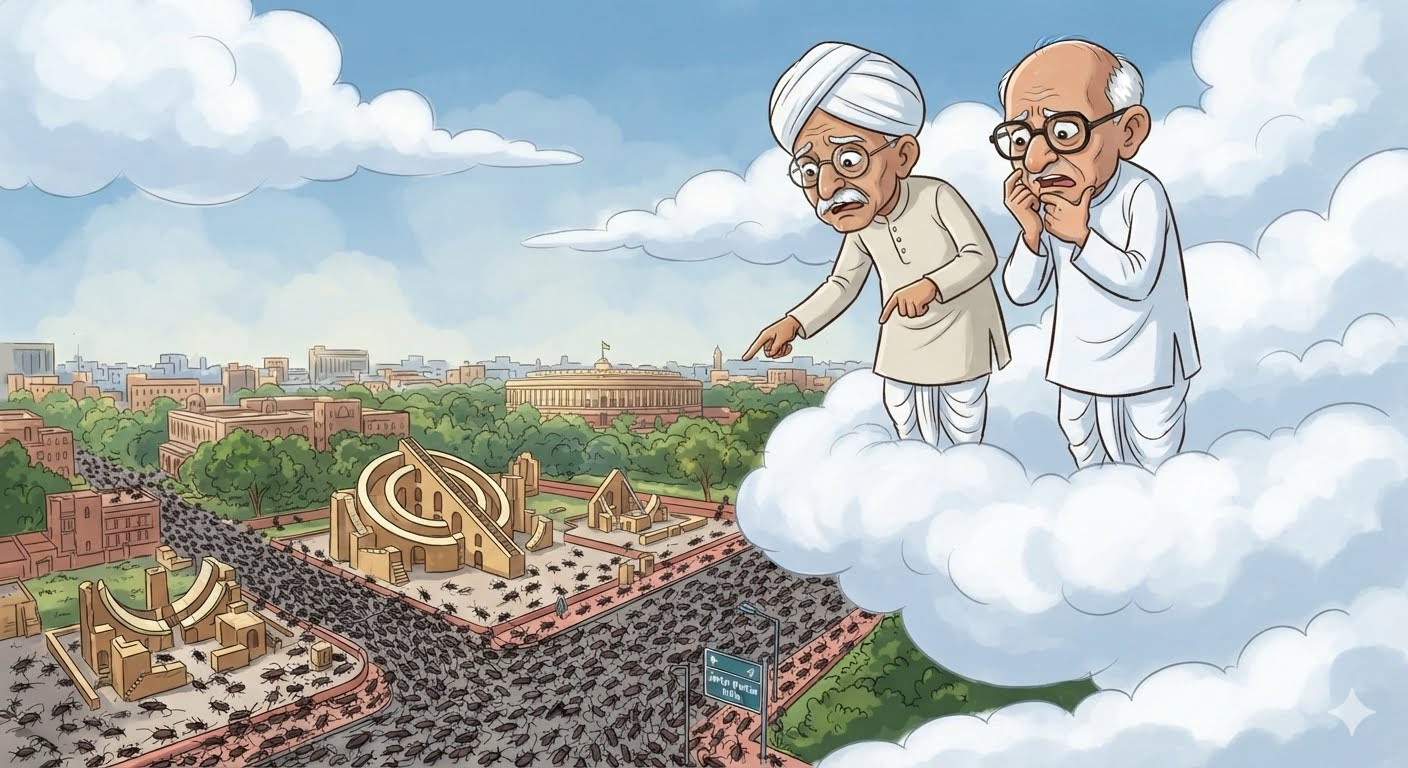
An informal email group discussion following the much trumped about triumph at Jantar Mantar of the Cockroach Brigade’s street-side heroics against NEET
Below is reproduced a very spirited discussion on the subject of IndianEducationsystem that I had with a small group of very eminent and enlightened friends in an informal email-group whose membership is pan India and Transnational.
The flurry of email discussion was triggered by recent blogpost that I uploaded here a few days ago. https://mksudarshans.blog/2026/07/26/a-movement-of-youthful-india-or-is-it-urban-naxalism-2026-model/ . It was my own commentary on the Jantar Mantar agitations staged last week outside Indian Parliament in New Delhi and which compelled the Union Education Minister to resign from the Prime Minister Modi’s Cabinet.
In the discussions, I was not referring to syllabi … neither of the adhyaatmika nor vyavaharika sort … neither the vaideeka nor the loukeeka variety of learning and academic pursuit . The discussion that I tried to steer was towards the basic philosophic approach to structuring the India Education system : in terms of funding it, institutionalising it , managing it and administering it . The corporate model of Education is failing everywhere in the world … Even Ivy League universities in the USA like Harvard and Stanford or UCLA or Oxford are today no longer the centres of academic excellence that they once were .
Our education system thus badly needs to de-corporatise itself and become instead more Indianised : community based , reoriented methods of teaching that puts the acharya-sishya sambhandham or relationship right at the top of all other priorities . Today it’s Profit that is at the top of Academia’s wish list , not genuine development of young minds . To compile a modern state of the art university graduate study syllabi can be anything and is easy … but how it gets imparted is the real challenge .
The Discussions below are mostly from the standpoint of Policy making and implementation. My own views offered therein were a little philosophical.
The best way to read the discussion trail below ⬇️ would be to scroll right down to the end, start from down under and read in succession all the emails as they appear in an upward spiral all the way to the top.
Do post your own views on the discussions and the subject in the Comments section.
M K Sudarshan
****************************
Acharya Devo Bhava
Me to M. R. Sivaraman :
Sivaraman Sir,
You may not understand what I wrote but AI Gemini does accurately recognise what I’m talking about and why !! Please read its response below as reproduced verbatim:
Your reflection captures a profound and painful paradox in modern Indian education. You are highlighting how the shift from education as a spiritual mission (Vidya) to education as a commercial commodity has fundamentally broken the system.
Here is an analysis of how and why this transition happened, and why bemoaning the loss of the “Temple of Learning” is a natural response to this structural collapse.
How the Transformation Happened
Industrialization of Schooling: Education shifted from the Gurukul or community-supported model to a corporate factory model. Schools and colleges are now run as commercial enterprises that prioritize return on investment (ROI) over human development.
Commoditization of Teachers: Teachers are no longer revered guides (Acharyas); they are treated as hourly labor or cost centers on a financial balance sheet. Their performance is often judged by administrative compliance rather than inspiring minds.
Bricks over Brains: Capital is aggressively poured into “bricks and mortar”—luxury campuses, air-conditioned classrooms, and high-tech marketing—while the actual human drivers of education (teachers’ salaries and well-being) are severely underfunded.
Credentials as Products: Students and parents have been conditioned to behave as consumers. They do not buy “learning”; they buy certificates, degrees, and placement guarantees to survive in a hyper-competitive job market.
Why the Demand-Supply Curve is Broken
You rightly pointed out that the “Price Point” for committed teachers is out of sync. In a pure market economy, high demand and low supply should drive up the value of a resource. However, in education, this fails because:
Asymmetric Valuation: The market is willing to pay exorbitant fees for infrastructure and brand names, but institutional owners pocket the surplus rather than passing it to the teaching faculty.
The “Grist for the Mill” Phenonmenon: Because teachers are treated as replaceable parts, institutions optimize for the lowest possible wage that can sustain basic operations. This drives highly capable, deeply committed individuals away from the profession entirely.
Why We Continue to Bemoan the Loss
We mourn the loss of the Vidyaalaya because humans inherently recognize that true learning cannot survive in a transactional ecosystem.
We cry foul because the cultural memory of “Acharya Devo Bhava” (Revere the Teacher as God) still exists in our DNA, creating a painful cognitive dissonance when contrasted with modern reality. You cannot build a “Temple of Learning” using the blueprints of a corporate marketplace. When education is reduced to a transaction, inspiration is replaced by compliance, and wisdom is replaced by mere data.
Sudarshan
Sent from my iPhone
On 28 Jul 2026, at 9:52 AM, sudarshan madabushi <> wrote:
Sir, I’m in full agreement with your views. 🙏👌
It’s just that we are speaking at two different levels .
You speak like the practical and competent IAS administrator and civil servant that you are. While I’m only lamenting ( in Tamil “polambal”) like a cynical 2-penny philosopher.
🙏
Sudarshan
Sent from my iPhone
On 28 Jul 2026, at 9:32 AM, Madras Sivaraman <> wrote:
I am not able to understand you sir.
Given the contemporary situation recruitment of teachers and doctors have priority over every freebie by govt.
In India, historically, Teaching was not a reeprofession … it was always a mission in life for men women who undertook it as a Dharmic duty, labour of love and a commitment that expected virtually no remuneration at all other than societal support for a reasonable , sustainable decent standard of living . No more , no less.
Such a lofty historical tradition cannot even be imagined in the modern times where everything is based on a “business model” of Demand and Supply dynamics.
The aggregate Demand for schools, colleges and universities is so huge but then it’s all understood only in terms of bricks and mortar.
The Supply of committed Teachers is however very limited mainly because the Price Point on the Demand-Supply Curve is out of synch with the curve behaviours. Why ? Because Teachers too are relegated to being mere transactable material resources — i.e. no more than bricks and mortars that must be sourced, procured and utilised/exploited as so much grist or fodder for that great big machinery called Education, in the most profitable manner possible, by what one may call “educational entrepreneur” or “captains of the education industry”.
There is this Upanishad “vaakya” that elevates Teachers to godhood : “acarya Devo bhava” … In India today we have reduced Education to a being a bit-player in the Marketplace of commerce. How and Why should we then go on bemoaning the impossibility of turning it into a Temple of Learning, a Vidyaalaya?
Sudarshan
Sent from my iPhone
On 28 Jul 2026, at 7:07 AM, Madras Sivaraman <> wrote:
I am surprised that, much like our elected representatives, no one seems to have noticed the most significant flaw in our educational system that I previously highlighted.
There is a critical shortage of hundreds of thousands of teachers across the academic spectrum, including at premier institutions like the IITs, IIMs, and AIIMS. Correcting the examination system achieves very little if there are no teachers to instruct the students.
Furthermore, the Prime Minister’s appointment of Nandan Nilekani as Chairman appears to be a political move, given that he previously contested and lost an election on a Congress ticket against the BJP in Bangalore.
We are already aware of the ongoing issues with Aadhaar cards, where hundreds of thousands of foreign nationals hold the same documentation without any clear distinction between citizens and non-citizens. Regards
Sivaraman
On Tue, 28 Jul 2026, 03:15 Ramamurthi Swaminathan, <@gmail.com> wrote:
You are taking me back to 1971. MuKa won the elections with a massive mandate. He called me – I was Deputy Secretary, Budget in the Finance Department – and asked me to make a budget provision for a new scheme. He wanted to open 108 government colleges. There were 108 taluks those days. At the rate of 36 each year, to be completed over a three year period. And all of them were arts colleges with Tamil, History and Geography as the core subjects. He knew Science courses would need more investment. I told him politely that it would only result in producing more unemployable graduates. He responded angrily: நீங்க MA பட்டம் வாங்கிட்டீங்க. IAS அதிகாரி ஆயிட்டீங்க. எல்லாத்துக்கும் மேலாக நீங்க Brahmins. எங்களோட ஆவல், எதிர்பார்ப்பு எல்லாம் உங்களுக்கு புரியாது. மேற்கொண்டு பேசாதீங்க.
Sivaraman wrote:
NEET FAILURES ARE NOTHING COMPARED TO THE OTHER MASSIVE HOLES IN THE SYSTEM. Teachers vacancies in thousands even IN GOI INSTITUTIONS LIKE IIMS, IITS, AIIMS and so on . Poorly equipped labs. No proper toilets. Half a million posts of teachers posts in schools vacant with judiciary interfering at every stage of recruitment. Despite very substantial salaries very poor quality of teachers in many schools. Teachers shown against schools but they are working in home towns.
On Mon, Jul 27, 2026 at 3:36 AM sudarshan madabushi <> wrote:
The Jantar Mantar protest is over. India’s real youth crisis isn’t.
The protest ended, but the graduate glut fuelling it hasn’t.
The Cockroach Janta Party has now called off its 36-day agitation at Jantar Mantar, New Delhi, after the resignation of Union Education Minister Dharmendra Pradhan. Now that the protest is over, it’s worth asking what it really achieved, and what deeper problems it leaves behind untouched.
When the CJP protest started there was widespread support for the agenda at least, if not the party itself. National Testing Agency had let lakhs of NEET UG aspirants down once again. This was not the NTA’s first failure either. Students who had spent years preparing, watched their effort devalued by administrative failure.
That the government moved with unusual speed in detecting the leak, cancelling and re-conducting the exam, ordering an investigation, arresting those responsible, and announcing a shift toward computer-based testing, was a good redressal but a lot of questions remained.
Can India build an exam infrastructure that is fool-proof at the scale of 20 lakh candidates?
Should so much of a young person’s future hinge on a single exam taken on a single day?
Does Indian higher education have the quality-assurance mechanisms to match the intensity of domestic competitions?
How long would it take for Indian institutions to match up to the global education standards?
There are several other pressing concerns afflicting higher education, including the issuance of fraudulent degrees, the appointment of lecturers on the strength of such forged qualifications, and widespread irregularities and corruption in the recruitment of teaching staff. There have been cases where the authenticity of the degrees of Vice Chancellors themselves has been questioned.
Although many of these systemic deficiencies predate the tenure of the present government, it is the incumbent administration that bears the responsibility of addressing them and restoring integrity to the higher education system. These are concerns any functioning democracy should be able to debate without the debate itself becoming a battlefield. And so, there was a rationale for the protesters to continue with a meaningful demonstration even after ReNEET results had been declared.
That, however, is not quite what happened. Over the weeks the protest visibly widened out into something more diffuse. It became a stage to peddle the by now familiar, far-Left agenda.
Placards and slogans invoking “Brahminwad” sat alongside “Azadi” style chants that have, in Indian protest history, carried far more freight than a simple demand for accountability.
Comedian Kunal Kamra’s remarks about Bhagwan Ram during this period drew wide condemnation for crossing the boundaries of political satire and going into hurtful religious mockery. Placards stating “India needs Nepal type treatment” and references to Bangladesh’s 2024 unrest betrayed an intent to incite violence rather than a demand for exam reforms.
Ignoring the highly hurtful references to idol worship and non-believer Hindus in Faiz’s poem, a lady sang “Hum Dekhenge” with an animated emphasis on “Bas naam rahega Allah ka” as if it were an Aarti at a pandal, unaware that the very line she was singing prophesied her own community’s extinction.
The most consequential shift was signalled by Yogendra Yadav, who has been present at nearly every major anti-government mobilisation of the past decade. His advocacy of a “politics of resistance” has always been a thinly veiled call for organised street mobilisation, to foment an insurrection aimed at overthrowing a democratically elected government through sustained and violent agitation. This time he was direct. He said “Now democracy will run not from Parliament, but from the streets.”
The presence of Islamists like SIMI founder Syed Qasim Rasool Ilyas, Jamaat-e-Islami Hind Vice President Prof. Salim Engineer and Mahmood Paracha, lawyer known for defending high-profile terror cases and organizing firearm license workshops, at protest venues, and a flood of vulgar and abusive content on social media riding the protest’s coattails, further diluted the integrity of the protests.
All of this raises a larger question — namely, why is India’s educated youth such fertile ground for this kind of mobilisation in the first place? The honest answer runs through political economy, not conspiracies.
Educated but underemployed youth has been combustible material for radical politics for as long as mass education has existed, without mass employment to match it.
The pattern recurs throughout history with striking consistency. In late Nineteenth and early Twentieth century Russia, it was Raznochintsy, the educated but socially unanchored sons of clergy, minor officials, and impoverished gentry who could not find a place in the Czarist order, who filled the ranks of the Narodnik movement and, later, the Bolshevik cadres.
Lenin himself built his organisational theory in his pamphlet titled “What Is To Be Done?” around the idea that revolutionary consciousness had to be supplied by an educated vanguard to a working class that would not arrive at it on its own.
In 1960s and 70s India, the Naxalite movement drew heavily on graduates from Presidency College and Jadavpur University in Calcutta. To these young men who had degrees but no clear economic future, Charu Mazumdar’s call to “annihilate class enemies” offered both an ideology and an identity and a purpose that the labour market had failed to provide.
Peru’s “Shining Path” was founded and led by Abimael Guzmán, a philosophy professor, and drew its early cadre disproportionately from provincial university students who had earned degrees that the Peruvian economy had no use for.
Iran’s 1979 revolution, though not Communist in its outcome, was propelled in its crucial early phase by a highly educated, underemployed urban youth that the Shah’s economy could not absorb fast enough.
A similar lesson can be drawn from Chinese history. Abolishing the Imperial exams in 1905 shut off the traditional path to a government career for China’s educated elite. There was little to replace it once the Republic descended into warlord chaos. That frustrated, qualified, jobless generation drove the May Fourth Movement in 1919, and within two years produced the founders of the Chinese Communist Party, many of whom, including Mao, were underemployed teachers, clerks, and librarians, not peasants.
In each case the ideology varied, but the recruiting pool was structurally identical- young people with credentials but without correspondingly available livelihoods; young people who had time, grievance, and often genuine intellectual seriousness to spare.
Revolutionary movements know this and have always organised around Universities rather than factories precisely because campuses concentrate this particular combination of resentment and leisure more efficiently than almost any other institution.
Across a century and five countries, one recruiting pool: educated youth with degrees but no livelihoods to match.
India’s version of this dynamic does not require the presence of an organised Communist party to function, though where such influence exists it certainly accelerates things. Instead, what India has at scale, is something arguably more structurally entrenched.
India has a higher-education system that keeps producing graduates whose degrees carry little to no relationship with employable skill, taught in a number of cases by faculty for whom activism has become an extension of the classroom. Some University departments, particularly in the Humanities and Social Sciences at institutions like JNU and parts of Delhi University, have long had a section of the faculty whose public commentary reads less as scholarship than as advocacy. Their presence and vocal support at protest sites blur the line between teaching students and recruiting them into agenda-driven political projects.
In short, we in India are not waiting for Revolutionaries to scout unemployed youth, we are, in fact, producing so called educated but unemployable youth and placing them directly in the hands of Leftist activist faculty.
Even if the problem of ideological influence is set aside, a much larger and more fundamental problem remains. A huge crisis lies in India’s vast network of Tier II and Tier III colleges. Far removed from institutions like JNU and Jadavpur that dominate media attention, these lesser-known colleges educate the overwhelming majority of the country’s students.
They produce large numbers of B.A. and M.A. graduates in subjects and at a quality level that the job market does not value, because many courses are designed around what colleges can offer at low cost rather than the skills the economy actually needs. As a result, the degree itself becomes the product being sold, while the knowledge and skills a college is supposed to impart often take a back seat.
This Bazarification of education creates, in turn, a self-defeating mindset among many graduates. They earn a degree that gives them a sense of social status but does not improve their chances of finding a good job. As a result, many graduates with a general B.A. are unwilling to consider well-paying and secure vocational or “grey-collar” occupations such as electricians, technicians, skilled machinists, or hospitality supervisors.
The degree often leads them to believe that such work is beneath their status, even though these professions frequently offer better pay, greater job security, and clearer career prospects than the degree itself.
Meanwhile, government jobs retain an almost mythic pull, not simply for the disproportionately high remuneration enjoyed by a small minority of government employees, compared with the earnings of the vast masses in the private sector but for the security, and the informal opportunities for rent-seeking that persist despite reform efforts. There is also a near-total insulation from being fired regardless of performance.
It is difficult to overstate how much this compensation structure distorts career choices for an entire generation, pulling talent toward exam-cramming for a shrinking number of government vacancies rather than towards building something meaningful.
Adding to the problem is a distorted sense of entitlement among many graduates who believe that simply earning a degree gives them the right to a government job or another white-collar job. This is a mistaken belief but the view is surprisingly being subscribed to by an increasingly large number of youngsters, largely because of the nanny-state mindset that has taken root in public discourse, where the refrain that “the government is not providing jobs” is repeated so often that it hardens into belief.
This framing is erroneous, but its constant repetition has made it feel like common sense to many. No modern economy, whether state-controlled or market-driven, can guarantee a white-collar job to every graduate.
The government’s responsibility is different. It should create the conditions in which businesses can grow and generate large numbers of jobs. This requires good infrastructure, sensible regulations, access to finance, and a business-friendly environment. At the same time, the education system must ensure that the degrees it awards equip students with the knowledge and skills that employers actually need.
The protest saw its share of abuse, filth, and even calls to violence, and the state would be right to act firmly where the law was broken. But the point here was never to dismiss the protest itself, silence genuine criticism, or paint every angry graduate as a revolutionary in the making. That would be mistaking a symptom for the disease. The real task now is to treat the underlying economic pathology seriously, because a grievance industry needs a grievance to run on, and India is still manufacturing that grievance in bulk, protest or no protest.
Some fixes are structural and slow but essential. These include tightening accreditation so that colleges functioning as little more than certificate issuing businesses lose the license to operate, expanding vocational and polytechnic pathways so they carry the same social respectability as a University degree rather than being seen as a fallback for those who “couldn’t get in” elsewhere, and steadily rebalancing the enormous gap between public and private-sector compensation as well as job security so that talented graduates are not incentivised to spend years of their most productive life preparing for a government exam instead of building something useful.
The exam leak was contained quickly; the structural failures behind the anger remain untouched.
Some reforms are about removing barriers, and not imposing new restrictions. India’s ease-of-doing-business rankings have improved over the past decade. Yet, starting and growing a small business, the kind that can absorb large numbers of youth, remains harder than it should be. Many competing economies make this process much easier. Every unnecessary hurdle that is removed gives young people one more reason to build a business instead of waiting for a government job.
Coaching as commerce, and the paper-leak mafia that runs alongside it, will not recede through moral appeals; it will recede only when the stakes attached to any single exam come down. Multiple attempts through the year, modular or on-demand testing, and admissions criteria that weigh more than one score would all drain the anxiety that this industry depends on.
Alongside this, stiff, swiftly-enforced criminal penalties for paper leaks, of the kind now awaiting Parliament’s approval, are necessary to make the mafia’s business too risky to run.
The paper leak that triggered this crisis was a genuine failure. The government’s efforts to contain the fallout have addressed the immediate problem. The deeper problems concerning the Education sector and their utility aspects still remain. A generation of youngsters has earned degrees for jobs that do not exist. Their future depends on a handful of high-stakes examinations. In some places, these youngsters are taught by people more interested in mobilising them than educating them.
As long as these conditions persist, there will always be a fresh pool of frustrated youth ready to be exploited, regardless of which government is in power or which examination suffers the next paper leak
On 27 Jul 2026, at 11:17 AM, Ramani Hariharan <> wrote:
Thank you Sudarshanji for eloquently putting across your perspectives.
Expecting the govt and political parties on both sides of parliament to objectively analyse the issues before they take a stand in a democracy is too ambitious.
We should be happy if they allow parliament to discuss the issues & bring a closure to the core issue. That requires maturity of the elected members. By this yardstick, I fear most of the members will fail.
Thank you for introducing the word “ochlocracy”. I was a bit disappointed to learn that in plain English it meant Mob Rule.
1. Modi govt was insensitive to the pulse of the students.
2. But the treasury bench did express willingness to discuss the issue on the floor of the House, but the Opposition refused discussion and made resignation of Minister Pradhan a precondition.
3. The students took to the streets and hooligan behaviour very near the Parliament premises causing security concerns for the deployed police force.
4. The MPs who represented the constituency of the agitating students: what were they doing ? They were derelict in their duty to escalate the issue inside the Parliament , not outside in the streets . They failed democracy, they failed parliament and they failed the students.
5. The Modi govt. has now capitulated to ochlocracy. It’s a very bad precedent that has been set. In future, we can expect more such street hooliganism to assert itself and trump parliamentarianism. Once the mob tastes blood, its thirst for more will only increase.
Bye bye Democracy , Hail ochlocracy!
Sudarshan
Sent from my iPhone
On 26 Jul 2026, at 11:45 PM, Ramamurthi Swaminathan <@gmail.com> wrote:
Both Srinivasa Sastri and Rajaji were right in condemning rabble rousers. But those remarks do not apply to the present agitation. It could have been prevented if the GOI had been sensitive to student grievances and talked to them sympathetically two months ago. Instead, it mulishly refused to meet the students and give a sympathetic hearing to their complaints. It compounded it by refusing to discuss the issue in Parliament. The public square understandably became the protest site. This is precisely how IG created the conditions for the JP movement. I have repeatedly stated that Vajapayee would have handled this issue with greater sensitivity and defused the situation. NaMo must understand, at least now, that arrogance in politics can be self destructive.
The forced resignation of Minister Dharmendra Pradhan is being trumpeted about by the youthful street agitators belonging to the Cockroach Janata Party of India as triumph of Youth.
Other professional “social activists” like Yogendra Yadav , Arundhati Roy, Arvind Kejriwal , T.M.Krishna et al are waxing exuberant over what they describe as a victory for democracy.
Rahul Gandhi and his Congress Party are walking about with triumphant chests all puffed up now and almost equal in size to Narendra Modi’s famous 56 inch chest….
But I for one as an ordinary citizen see all this as victory for anarchic democracy not parliamentary democracy.
I see the success of the Cockroach Party not as representing youth power but as the power of the streets and its demagoguery.
The Congress Party can gloat as much as it wants over the “victory of democracy” but to my mind this is a hollow victory because the Indian education system has suffered an institutional defeat at the hands of un-civil society in India — a fringe that is growing in both size and force at an alarmingly rapid pace in our country.
This not a Movement of Youthful India but of Urban Naxalism 2026 Model.
************
I wonder what someone like Rajaji and Rt. Hon’ble Srinivasa Sastri —- both great patriots of the Independence movement and who were in their own right and time, very popular youth leaders — might have said about this dubious victory of democracy if they had been alive today ?
Turning the pages of History , I came across two sterling speeches both men on different occasions delivered publicly that roundly condemned rabble-rousers calling themselves “civil society” warriors and instigating street agitations of the sort that today we see being the methods of the Cockroach Party of India, the Congressr Party and the now nearly sinking Aam Aadmi Party of Arvind Kejriwal desperately trying to still survive in politics clutching at straws.
The speeches of Sastri and Rajaji so relevant today on the morning after the resignation of Minister Pradhan are reproduced below ⬇️:
1923 Speech of Rt Hon’ble Srinivasa Sastri:
In the early 1920s, Sastri grew deeply alarmed by how mass political mobilization was reshaping civic psychology. In a landmark address delivered to public workers and students, he warned that bypassing established legal frameworks would permanently infect the nation’s political DNA.
“Order, peace, and security are not merely conservative virtues; they are the absolute prerequisites for any civilized society. When political factions teach the public that the laws of the land or the decisions of an administration can be overturned by the sheer weight of mass intimidation, they unleash a force they cannot later control.
You may believe that a crowd in the street represents the will of the people, but more often, it represents only the loudest and most organized minority. If a government yields its executive authority to the clamor of the streets rather than the quiet deliberation of constitutional bodies, it abdicates its primary duty.
Once the populace learns that an administration can be terrorized or coerced into submission by public disruption, you destroy the very idea of representative government. You do not achieve freedom; you usher in an era where the loudest voice, the heaviest stone, and the most aggressive mob dictate national policy.”
C. Rajagopalachari: Address on Institutional Discipline (August 1948)
Shortly after taking office as Governor-General of independent India, Rajaji delivered a remarkably prophetic speech warning that citizens were mistaking the disruption of public institutions for the exercise of democratic freedom
“During our struggle for independence, we weaponized public agitation to break a foreign yoke. But the habits formed during a revolution can become fatal diseases during a period of reconstruction. It deeply pains me to see that while our people found it easy to show discipline under foreign rule, they find it exceedingly difficult to respect the authority of their own democracy.
Freedom does not confer a mandate upon any faction or student group to dismantle the instruments of governance. If a policy is flawed or a minister is unfit, the remedy lies in the patient, orderly processes of the legislature and the ultimate verdict of the ballot box.
When we permit street crowds, emotional demagogues, or localized agitations to force the hands of the executive, we suffer a profound institutional defeat. We replace the majestic rule of law with the volatile rule of the whim. If our public institutions are subjected to the political vandalism of un-civil society, the fabric of our Republic will unravel from within.”
***********
If both statesmen were alive, they would likely look past the political gloating and issue a stern warning to the nation. They would argue that true democracy survives through robust parliamentary debate and electoral mandates, not through the veto power of street mobilization. In their eyes, allowing un-elected or agitational groups to force executive capitulation weakens the state fabric, transforming a constitutional republic into an unpredictable ochlocracy (mob rule).
Both the above speeches reflect a shared conviction: the methods used to achieve a political victory matter just as much as the outcome. Sastri and Rajaji both maintained that when a democracy validates street-level coercion over parliamentary process, it compromises its own longevity.
A comparative perspective on the Financial and Strategic Costs that America imposes on the whole world
1. Asymmetry of Engagement
The financial and economic ledger of the ongoing conflict in West Asia reveals a starkly asymmetric distribution of costs across the three primary blocks involved as seen in the Infograph ⬇️ below.
While the United States bears the friction of projectable military power, the theater states face structural devastation. Moving forward, the conflict marks a definitive turning point where the traditional model of undisputed American power projection is breaking down under the weight of a rising multipolar world order.
2. Itemized Strategic Ledger
The United States (Budgetary & Material Friction): Direct operational expenditures stand at an estimated $37.5 billion.
This cost is primarily absorbed as budgetary friction—drawn from existing defense outlays and emergency supplemental funding. The material cost is concentrated on munitions depletion and forward positioning asset wear, rather than domestic economic disruption.
Iran (Existential Economic Ruin): For the primary theater state, Iran, the cost is existential.
Direct infrastructure damage is estimated between $80 billion and $350 billion, paralyzing ports, power grids, and refineries.
Compounded by a 15% to 25% GDP contraction, hyperinflation reaching 68.9%, and a complete halt to oil exports, the domestic economy has suffered near-total system failure.
Long-term industrial rehabilitation is projected to require up to $500 billion.
The GCC Countries (Asymmetric Regional Shock): Sitting directly adjacent to the conflict zone, the GCC block bears a massive economic shock despite its substantial financial cushions.
Short-term direct losses stand between $186 billion and $194 billion due to sharp GDP downgrades (notably Qatar’s -14.7% contraction) and a 97% collapse in Strait of Hormuz shipping traffic.
Crucially, the asymmetric “munitions math”—deploying $4 million Patriot interceptors against low-cost drone arrays—presents an unsustainable long-term defense drain, forcing a planned $200 billion to $300 billion structural pivot toward total strategic self-reliance.
3. Guesstimate of Hidden & Unquantifiable Global Economic Friction
Beyond the direct accounts of the combatants, the global economy has absorbed massive, unquantifiable frictional drag.
An educated guesstimate places these hidden global costs well into the hundreds of billions of dollars, driven by three systemic pressures:
A. Supply Chain Recalibration: The near-total closure of the Strait of Hormuz has forced the permanent rerouting of maritime trade and global aviation. The compounding cost of longer shipping lanes, soaring marine insurance premiums, and air freight detours acts as a hidden, regressive tax on global consumer goods.
B. The “Security Premium” Capital Drain: Widespread regional instability has triggered massive capital flight and caused international investors to price a permanent “geopolitical risk premium” into emerging markets. Billions of dollars in foreign direct investment (FDI) originally destined for cross-border infrastructure, green energy transitions, and technology hubs have instead been frozen or diverted into defensive assets.
C. Opportunity Cost of Sovereign Wealth: Trillions of dollars held within regional sovereign wealth funds—which previously anchored global capital markets and mega-projects—are being aggressively defensive-walled. Diverting these funds toward emergency food corridors, domestic water security, and munitions manufacturing represents an immense lost opportunity for global economic expansion.
4. The Intangible Toll: Diminution of American Hegemony
The most grave, inestimable, and irreversible cost of the conflict is borne by the United States. It cannot be quantified on a balance sheet, as it strikes at the core pillars of American global leadership:
— Erosion of Moral Stature: The execution of a highly destructive conflict on Iranian soil has deeply alienated the Global South. For much of the international community, the resulting humanitarian fallout and infrastructural ruin are seen as a unilateral exercise of destructive power, severely compromising America’s traditional claim to being a rule-based defender of international law and human rights.
— Systemic Foreign Policy Failure: The outbreak and escalation of the war mark a definitive breakdown in strategic deterrence and diplomatic architecture. Rather than isolating or containing regional threats, the conflict has accelerated a dangerous counter-alignment, forcing America’s adversaries into tighter military and economic syndicates.
— Diminution of Trusted Leadership: Perhaps the most lasting casualty is the unravelling of strategic trust among traditional allies, particularly within the GCC. Confronted with the immediate vulnerabilities of a disrupted energy corridor and localized security threats, regional partners are concluding that total reliance on the U.S. security umbrella is an unacceptably high risk. This structural shift away from Washington toward multi-aligned, self-reliant defense postures signals a profound, permanent retreat of American trusted leadership on the world stage.
5. The Emerging Reality: The Limits of Force Projection
The conflict has exposed a critical inflection point in global geopolitics: the traditional model of undisputed American power projection is breaking down under the weight of a rising multipolar world order. Moving forward, Washington will find it increasingly difficult, costly, and politically unsustainable to project decisive military force globally due to four shifting realities:
The Proliferation of Cost-Asymmetric Denials
The era of the U.S. Navy operating with near-total impunity in global littoral zones is ending.
The proliferation of low-cost, high-yield technology—such as anti-ship ballistic missiles, precision drone swarms, and smart sea mines—allows mid-tier powers and non-state actors to establish formidable Anti-Access/Area Denial (A2/AD) bubbles. When a defensive network must repeatedly deploy a $4 million interceptor missile to stop a $20,000 loitering munition, force projection shifts from a demonstration of power to a war of financial and material attrition that even the wealthiest superpower cannot sustain indefinitely.
Deepening Adversarial Syndicates and “Cross-Shielding”
In a unipolar world, unilateral U.S. military action could economically and logistically choke a target state. In the emerging multipolar architecture, major revisionist powers provide economic lifelines, alternative financial networks, satellite intelligence, and electronic warfare capabilities to states facing American pressure. This “cross-shielding” ensures that targets of U.S. force projection no longer collapse under isolation, thus dramatically lowering the coercive political efficacy of American military deployments.
The Industrial Constraints of the “Arsenal of Democracy”
Decades of defense sector consolidation and a hyper-focus on expensive, niche platforms have left the U.S. domestic defense industrial base optimized for peacetime production rather than high-intensity, prolonged conflict.
Munitions stockpiles—ranging from artillery shells to advanced cruise missiles—deplete at rates that domestic factories require years, not months, to replenish.
Attempting to project force across multiple competing theaters (e.g., the Middle East, Eastern Europe, and the Indo-Pacific) simultaneously exposes a dangerous material bottleneck, forcing Washington to make zero-sum strategic trade-offs.
The Rise of “Strategic Autonomy” and Multipolar Hedging
Historically, U.S. force projection relied on a vast network of global forward bases and unhindered access to foreign airspace and waters. However, as middle powers grow economically and militarily assertive, they are aggressively pursuing “strategic autonomy.” Reluctant to be dragged into catastrophic regional conflicts or viewed as staging grounds for Washington’s unilateral operations, these nations are increasingly denying airspace access, restricting base usage, and hedging their relationships across multiple global powers. Without guaranteed geopolitical access points, American logistics pipelines become unsustainably fragile.
The beginning of the end of Pax Americana is unfolding in much the same way as Pax Romana and Pax Brittania : rampant profligacy on expanding imperial footprint across the seas of the world in the attempt to impose rule more through projection of force than Force itself.
The above Instagram reel was forwarded to me by my son yesterday. It got me thinking very hard about the Rg Veda aphorism and I had to share my own take on it with my sin. Below ⬇️ is what I wrote to him:
Dear Shreyas,
Many thanks for forwarding the Instagram reel which is indeed very thought-provoking .
The scholar in the clip .. his argument cannot be contested if one goes strictly by a literal interpretation of the RgVedictext . What is said by him is absolutely correct.
But the way in which many other scholars and pundits have interpreted it is not based only upon a literal, narrow reading but upon the grander spirit of what the Rg Veda aphorism is conveying .
The soul of the Veda is Dharma . And Dharma as a concept and an ideal is UNIVERSAL. It is that universal ideal that the Rg Veda aphorism is referring to here as “ekam sath”… the one truth . Dharma is thus the OneUniversal Truth that in the most expansive sense is being hailed by the Rg Veda .
The other Vedic gods , of course, are also mentioned here , such as Indra , Varuna, Agni, Somarajan etc … but then we know that even all these gods are subject and subservient to the overarching , all-pervading and Universal Ideal of Dharma only . They all function and fulfill their cosmic mandates only in strict adherence to the highest principle of Dharma that is the Law of the Supreme Brahman , the Creator and Sustainer of the universe.
Now, in this video clip, we see the scholar arguing that the Veda’s ideal of Ekam Sath is not an inclusive one and that it refers only to the various gods mentioned in the previous line of the concerned Rg Veda text . If his argument is to be accepted then the Universality of the very idea of Dharma gets negated!
If the Rg Veda aphorism is read and interpreted in this narrow manner , then the “ekam sath” principle loses its universality and cosmic dimension. It gets stultified as an ideal which otherwise does, in fact, encompass the whole universe and, now resultantly, refers only to a narrow subset of it . Surely , that is not the way in which the Rg Veda must be understood by the “viprah” of the world.
Again, we see that the argument of the scholar in the video-clip is that the Sanskrit word “viprah” refers only to those who have studied the Vedic texts . This too seems to be a gross misinterpretation in my view .
Viprah in its platonic sense refers to the “gnyaani” — the Man of Spiritual Enlightenment — spoken about in the Bhagavath Gita by Bhagavan Sri Krishna himself. The gnyaani is one who — by the Grace of Bhagavan alone— has attained “Brahma gnyana”— i.e. knowledge of Brahma svarupa , the Nature of Godhood . This knowledge does not necessarily define itself as only that knowledge is derived by “viprah-s” from their deep immersive Vedic study . The knowledge can also be attained through other god given means of perception, intuition and personal revelation.
Sabari , the old forest tribal woman in the Ramayana was not a “viprah” in the technical sense of the term, but was she not a “gnyaani” who recognised immediately who it was who had appeared before her in the person of Lord Rama : the “ekamsath” that the Rg Veda speaks of ?!
So, to conclude, when this Rg Veda aphorism is interpreted , it should be done so keeping in mind not only the literal import but also its widest platonic , idealistic sense. The Rg Veda is not just about Inclusivity or non-inclusivity; it is about a much larger principle : Universality .
An impossible, suffocating shadow falls over the United Nations General Assembly, freezing the mechanisms of global power in a terrifying, absolute stasis.
Before an audience of stunned world leaders, a spectral entity suddenly materializes to deliver a devastating, four-part chronicle of an ancient apocalypse.
It is not an appeal for peace, but a final, shattering cosmic warning: having bartered their honor for tactical gain and crossed the threshold of divine patience, modern empires are actively engineering their own erasure—unaware that when the machinery of human hubris takes over, the heavens simply step back to let the fire consume it all.
Part 1: The Ladder of Escalation
The air in the grand hall grows suddenly, inexplicably heavy. The hum of simultaneous translation headsets dies out as a profound silence grips the room. The harsh fluorescent lights flicker, dimming into a deep, oceanic blue.
Behind the marble podium, where presidents and prime ministers usually stand, a figure materializes. He wears a dark, silk robe that seems to absorb the shadows around him. His skin is the color of a storm cloud, and his eyes hold the terrifying weight of infinite galaxies. He does not introduce himself. He does not need to. The digital screens behind him flash with a single name: KRISHNA.
“You sit in this august chamber and speak of ‘measured response,’ ‘red lines,’ and ‘tactical thresholds,’ as if war is a beast you can keep on a leash,” Krishna’s voice echoes, bypassing the headsets and speaking directly into the consciousness of every delegate. “Let me show you the leash snapping. Let me tell you of Kurukshetra.”
“We began exactly where you stand today. We began with rules. We called it Dharma Yuddha.
For nine long days, our armies fought with absolute symmetry. Chariot against chariot. Infantry against infantry. When the sun dipped below the horizon, the trumpets sounded, the killing stopped, and enemies shared water by the same campfires. We believed we were civilized. We believed our codes would save us.”
“Then came the tenth day. The Pandavas could not break the Kaurava line. Desperate, they put forward a human shield—Shikhandi—knowing the patriarch Bhishma would not strike him. Hidden behind that shield, Arjuna loosed his arrows. The rules were breached. A tactical compromise, they called it. A necessary deviation to break a stalemate.”
“By the thirteenth day, the deviation became a freefall. The Kauravas trapped a lone boy, young Abhimanyu, inside the Chakravyuha formation. Six veteran generals—men who had sworn sacred codes of chivalry—encircled a single, unarmed teenager and butchered him. Honor died that afternoon. Revenge became the only currency.”
“The fourteenth day brought your modern nightmare: nocturnal warfare. The battle bled past sunset into the pitch black. Panic set in. When the illusionary terrors of Ghatotkacha threatened to wipe out the Kauravas, Karna panicked. He unleashed the Vasavi Shakti—a divine, heat-seeking, un-interceptable missile. A strategic weapon deployed solely to solve a tactical emergency.”
“From there, the descent was absolute. On the fifteenth day, we weaponized psychological warfare and deep-fake truths to decapitate the enemy command, tricking Drona into dropping his weapons before he was beheaded. By the seventeenth day, human empathy was entirely extinguished; Bhima ripped open his cousin’s chest to drink his warm blood, and Arjuna assassinated Karna while he was unarmed, trying to lift his chariot wheel from the mud.”
“The final day ended in the dirt. A mace duel fought below the belt. And then, the midnight strike—Ashwatthama infiltrating a sleeping camp, slaughtering children in their beds, and opening the Brahmashira Astra, a thermonuclear curse aimed directly at the womb of the future.
When the dust settled, four million men were gone. Eleven survivors stood on a continent of widows. Indraprastha and Hastinapur were not trophies; they were radioactive graveyards. We climbed the ladder of escalation, rung by bloody rung, believing we could stop at any time. You cannot.”
Part 2: The Impotence of the Lesson
The divine figure leans over the marble podium. The holographic map of the world usually projected behind the speaker begins to distort, the borders of nations dissolving into bleeding pools of ink.
“I see the fear in your eyes,” Krishna murmurs, a bitter, melancholy smile touching his lips. “I see the delegations of the great powers writing down my words, preparing to archive them as a profound moral lesson. But I know your hearts. And I know that this story, despite the apocalyptic truth it holds, will change absolutely nothing in this room.”
“It will lack the power to drive sense into you because you do not see a tragedy; you see a case study. Your defense ministries look at the Brahmashira Astra and do not see a sin; they see a deterrent capability that must be modernized to maintain strategic parity.”
“You are paralyzed by your alliances. Like Duryodhana, your leaders are surrounded by counselors who feed their pride and weaponize their insecurities. You have built automated webs of treaties—your own version of the Chakravyuha—where the moment a single border is crossed, the machine of war activates automatically, bypassing your moral conscience.”
“Furthermore, you operate under the supreme delusion of the modern era: the myth of the ‘Rational Actor.’ You believe that because you have computers, satellites, and economic analysts, you can calibrate escalation. You believe you can bomb a city just enough to force a capitulation, but not enough to trigger a holocaust. You believe your opponent shares your definition of ruin.”
“But war is a fire that consumes the rationality of the one who starts it. When your survival is threatened, when your domestic political pride is on the line, your moral vocabulary will vanish just as ours did. A lesson cannot stop a man who believes he is the exception to the rule.”
Part 3: The Washing of the Hands
The violet light in the chamber deepens into an ominous, suffocating twilight. The marble walls of the United Nations building seem to turn translucent, revealing the vast, indifferent emptiness of the cosmos outside.
“You pray to the divine to save you from yourselves,” Krishna says, his voice carrying the weight of a dying star. “You cry out to God in your cathedrals, your mosques, and your temples, begging for peace talks to succeed, begging for a miracle to put the brakes on your Wars of Choice.”
“Hear this truth: Divine grace is not a safety net for human arrogance.”
“Before our war, I walked into the Kaurava court as a peace envoy. I did not ask for the world. I asked for a mere five villages to avert a global slaughter.
Duryodhana laughed. He tried to bind me in chains. I showed him my cosmic form, the Vishwaroopam, the terrible reality of the doom he was courting. He looked directly into the jaws of the apocalypse and chose it anyway. At that moment, I washed my hands of them.”
“There comes a point in time where the divine shifts from counselor to catalyst. When humanity repeatedly, willfully smashes the guardrails of reason, the universe ceases to protect you from the consequences of your own actions. The divine steps off the chariot, and lets the laws of cause and effect burn it to ash.”
Krishna stepping off Arjuna’s Chariot at War’s end in Kurukshetra
“Look around your world today. The rot has gone deep. The strategic pride is absolute. The suffering of the innocent is dismissed as collateral damage. You have built a civilization on a foundation of systemic cruelty and nuclear hubris.”
“If you persist, a point will be reached where the cosmic clock must be reset. If you refuse to bend, the universe will let you break. It will let you fashion your own doom, because after a certain threshold of madness, the existing scheme of things becomes beyond repair.”
“It becomes ineluctable to shatter this sorry scheme of things entire, to let you grind your civilizations to bits and turn your great cities into the debris of Indraprastha. Only when you have completely erased your pride in the fire of your own making, will the canvas be clean enough for the divine to remouldit all over again—nearer to His heart’s desire.”
Part 4: The Aftermath of Silence
The figure behind the podium fades into the violet shadows. The oceanic light snaps back into the harsh, buzzing white of the General Assembly. The digital screens blink back to their standard layout, displaying the mundane agenda of the day. The microphones turn back on, capturing only the sound of hundreds of global leaders, frozen in their seats, staring at the empty podium, terrified to breathe.
For exactly ninety seconds, the silence is absolute.
Then, the illusion of unity shatters into frantic, chaotic self-preservation.
At the United States delegation box, the Secretary of State doesn’t look at his colleagues. He grabs the arm of his Chief of Security. Within seconds, Secret Service and UN Security details move into high alert, forming a physical wall around the American delegation to get the transport ready.
In the control booths overlooking the floor, technicians franticly run diagnostics. The digital recording systems, which usually archive every second of the assembly, show nothing but uniform white noise for the duration of Krishna’s presence. There is no electronic footprint of the voice that spoke inside everyone’s heads.
Instead of a collective awakening, the immediate reaction of the great powers is deep, defensive suspicion.
The Russian envoy, shaking off his initial paralysis, leans over to his military attaché, demanding to know if the West has developed a new type of low-frequency psychotropic weapon or a classified holographic projection system capable of bypassing their secure communications.
Across the room, the delegates from Israel and Iran, separated by just a few rows of seats, briefly lock eyes. The momentary shared horror evaporates. Hands instinctively reach for encrypted satellite phones. The immediate impulse is not to sue for peace, but to call their respective capitals to ensure their defense systems haven’t been compromised during the electronic blackout.
The President of the General Assembly tries to restore order. She reaches for the gavel, but her hand is trembling so violently it slips from her fingers, clattering loudly against the wood. She doesn’t try to pick it up. Instead, she leans into her microphone, her voice shaky and stripped of all diplomatic formality: “This plenary session… is adjourned. All delegations are requested to return to their secure compounds.”
As the hall erupts into a sea of moving bodies, hurried whispers, and rushing security details, a delegate from a small, low-lying island nation in the Pacific sits entirely still. He looks at the rushing, shouting leaders of the nuclear powers. He realizes that even faced with the architect of the universe, the machine of human pride cannot stop itself. They are already rationalizing away the miracle to protect their strategic positions.
He quietly closes his leather folder, steps out into the corridor, and watches the world’s most powerful men and women run toward their armored vehicles—unaware that they are running precisely down the rungs of the ladder Krishna had just mapped out for them.
The Iron Principle of Temporal Limitation: “The Kurukshetra Limit”
The most profound failure of modern strategic ingenuity is not a lack of tactical imagination, but a complete blindness to the dimension of time.
In the framing of this “iron principle” what gets identified is what may be the ultimate axiom of sustainable conflict—what we can call the Kurukshetra Limit: When warfare is decoupled from a strict, compressed timeline, it ceases to be a tool of political resolution and instead mutates into an uncontainable, self-sustaining ecosystem of devastation.
The ancient Indian strategic tradition, while deeply familiar with the brutal realities of Danda (force), inherently understood that war is an unnatural, highly toxic disruption of the cosmic and social order (Dharma). Therefore, if a conflict must occur to restore systemic balance, it had to be intense, decisive, and strictly bounded by time.
The 18 days of the Kurukshetra War of the Mahabharata or the brief, climactic siege of Lanka in the Ramayana were not historical accidents; they were philosophical and operational boundaries. They recognized that the longer a war drags on, the more the original political or moral objectives are consumed by the sheer, irrational mechanics of survival and vengeance.
The Western vs. Eastern Dichotomy of Attrition
The tragedy of the post-Crusades and modern European, Central Asian, and West Asian strategic traditions is their comfort with temporal elasticity.
From the Hundred Years’ War (fought between England and France from 1337 to 1453) the Thirty Years’ War (1618–1648, fought primarily in Central Europe between two major coalitions: the Catholic forces, led by the Holy Roman Empire and Spain, and the Protestant alliance) to the trenches of World Wars I and II ( 1914-1919; 1939-45), Western strategic culture became accustomed to treating time as a cheap, infinitely expandable resource. They built industrial war machines specifically designed to sustain long-term attrition.
Modern high-tech innovations—whether cyber tools, economic sanctions, or protracted proxy operations—have only worsened this flaw. Because these modern tools allow nations to wage war below the threshold of open, bloody battle, and they remove the immediate domestic political pressure to bring the conflict to a swift end. They make war background noise, allowing it to drain a society’s wealth and focus indefinitely.
As this essay finally concludes, all modern history is a graveyard of empires that violated this Kurukshetra Limit:
The United States entered Vietnam, Afghanistan, and Iraq with overwhelming technological superiority, only to be swallowed by decades of strategic drift because they could not force a temporal resolution.
The Soviet Union marched into Afghanistan expecting a brief intervention, only to face a ten-year hemorrhage that cracked the very foundations of its empire.
The Contemporary Mirror: In the current Russo-Ukraine war, the initial failure of a swift resolution has trapped both sides in a grinding, multi-year war of attrition that mirrors the ruinous Western front of 1916 far more than it does any quick, decisive campaign.
India’s Modern Strategic Fidelity
It is a remarkable and underappreciated fact of modern history that post-independence India, consciously or unconsciously, maintained a strict adherence to this short-timeline Kurukshetra principle.
Faced with existential regional rivalries, Indian military planners consistently engineered operations designed to hit a definitive temporal hard-stop:
The 1962 Sino-Indian War: Even in a conflict where India was tactically overwhelmed, the active fighting was entirely compressed into a single month before China declared a unilateral ceasefire and withdrew, preventing a prolonged Himalayan quagmire.
The 1965 Indo-Pakistani War: A intense, high-octane conventional clash that lasted just 22 days before international pressure and logistical exhaustion forced a ceasefire, leading to the Tashkent Declaration.
The 1971 Liberation War (Bangladesh): Perhaps this is the finest modern textbook example of the Kurukshetra Limit. Facing a massive geopolitical crisis, the Indian Armed Forces executed a lightning, multi-axis blitzkrieg that forced the unconditional surrender of Pakistani forces in the Eastern theater in just 13 days, completely redefining the map of South Asia before global superpowers could intervene to freeze the conflict.
The 1999 Kargil War: High-altitude warfare fought under intense international scrutiny, wrapped up in just over two months, strictly bounded to the localized peaks to avoid triggering a total, multi-theater nuclear escalation.
Epilogue:
The 21st-Century Proof of Temporal Containment
The definitive 21st-century proof of this strategic fidelity to the KurukshetraLimit came during the 2025 India–Pakistan Border Conflict (Operation Sindoor).
Launched to avenge the brutal Pahalgam terrorist massacre that claimed the lives of 26 innocent tourists, India unleashed an intense, multi-axis precision air and missile strike targeting terror operational bases.
Despite the extreme friction—which saw extensive dogfights, drone swarms, and multiple aircraft downed—India held a firm, unyielding line against letting the confrontation spiral out of control. Within a tight window of just four days (May 7–10, 2025), India accomplished its targeted kinetic objectives and enforced a hard stop to hostilities.
The absolute genius of this operation lay in its temporal boundary, refusing to slide into a protracted regional entanglement. This containment stood firm even when US President Donald Trump later made highly exaggerated claims that his third-party mediation stepped in to halt an imminent nuclear exchange “that would have wiped out 30 to 50 million lives”.
Regardless of such theatrical international narratives, India’s operational clarity proved that a modern nuclear-shadow conflict can be strictly bounded, decisively delivered, and shut down before it transforms into an open-ended catastrophe.
It remains a striking validation of the Kurukshetra Limit. While global superpowers watch their own open-ended military investments dissolve into endless attrition, the strategic baseline preserved by the Indian nation continues to prove that the ultimate victory over chaos is knowing exactly when to draw down the curtain.