The Semantics of Slaughter: Geopolitical Threats vs. Slogans
In global politics, vocabulary is weaponized long before missiles leave their silos. When a militarily outmatched nation uses aggressive rhetoric, global institutions quickly label it as “rogue fanaticism.” Yet, when a superpower threatens the literal erasure of a 7,000-year-old civilization’s civilian infrastructure, it is sanitized as “strategic deterrence.”
For nearly half a century, the collective West has clutched its pearls over a single, ritualistic phrase chanted on the streets of Tehran: “Marg bar Amrikā”—Death to America.
We are told, with breathless outrage by talking heads and think-tank careerists, that this is the definitive proof of an existential, subhuman bloodlust. It is a slogan packaged for Western consumption as the ultimate evidence of a rogue nation’s innate fanaticism.
Never mind that decades of regional analysis and explicit admissions from Iranian leadership clarify the obvious: the slogan is not a literal wish for the annihilation of 330 million American citizens. It is an unpolished, furious rejection of Washington’s heavy-handed hegemony. It is a protest against a sprawling network of Middle Eastern military bases, predatory oil alliances with autocratic Gulf monarchies, and the cynical use of regional proxy, Israel.
It is, in essence, institutionalized political theater—a desperate roar from a militarily outmatched nation, signifying nothing but defensive, anti-imperialist posture. Yet, the global jury has already delivered its permanent verdict: It is Terrorism.
The Superpower’s Monopoly on Moral Absolution
Contrast this with the casual, state-sanctioned bloodlust emanating from the highest corridors of American power.
When an American president glibly threatens to “bomb Iran back to the Stone Age,” or publicly dismisses an entire nation’s leadership as “scum” and “liars” before authorizing targeted drone assassinations in international airports, the global community responds not with sanctions, but with a collective, submissive nod.
This is the grotesque theater of American Exceptionalism. Under this doctrine, when a Middle Eastern nation chants a symbolic slogan, it is a barbaric threat to civilization. But when the world’s most dominant military superpower threatens the literal, physical erasure of a 7,000-year-old civilization’s infrastructure—its power grids, its water plants, its bridges, and by extension, its civilian population—it is sanitized as “strategic deterrence.” It is treated as the heavy, tragic burden of the world’s self-appointed policeman.
So, when Washington threatens to destroy an industrial base, it is statecraft. When Tehran prints a slogan on a banner, it is extremism. The “global community” has long abandoned judging the weight of a threat by what is actually said; it judges it entirely by who holds the nuclear codes.
The Asymmetry of Fear
The rueful irony of this double standard lies in the terrifying reality of capability.
Iran lacks the conventional military muscle, the aircraft carriers, and the global logistics to destabilize the American mainland. Their slogan is loud, but functionally impotent. It is a psychological shield against real-world vulnerability.
The United States, however, possesses the immediate, operational capability to execute its threats. When Washington promises the “Stone Age,” history shows they deliver—just ask the ghosts of Baghdad, Tripoli, or Kabul.
The U.S. has spent decades turning regional capitals into rubble under the guise of liberation. Yet, through the magic of Western media dominance, the party with hundreds of hostile military bases encircling its opponent is framed as the victim, while the encircled nation is branded the unprovoked aggressor.
The Vocabulary of the Victor
We live in an international order governed not by international law, but by semantic cartelism.
The powerful reserve the right to define the dictionary. They have decided that collective punishment is perfectly acceptable, provided it is delivered by stealth bombers rather than shouting crowds. A cruise missile strike is corporate and clean; a street protest is messy and terrifying.
Until we find the intellectual honesty to admit that threatening to incinerate a country’s infrastructure is infinitely more terroristic than a predictable, decades-old protest slogan, our moral pronouncements will remain exactly what we accuse our enemies of producing: sound and fury, signifying absolutely nothing.
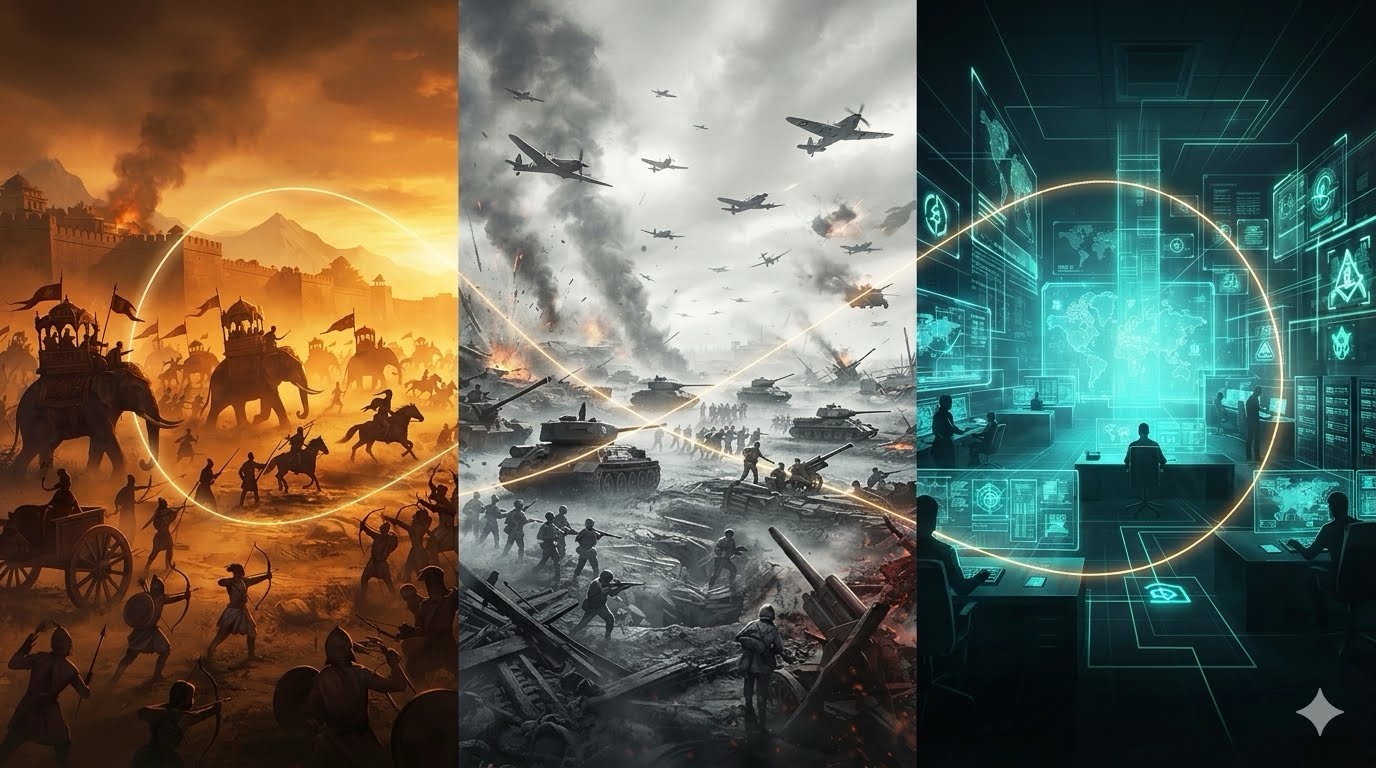
The battlefields of the 21st century are not detached from antiquity; they are a direct mirror where ancient dynamics and modern innovations collide under the same unyielding laws of failure.
The Contemporary Mirror
The Russo-Ukraine War serves as an active laboratory for these historical cycles. Russia’s initial multi-axis drive on Kyiv in February 2022 was a direct failure of conventional ground invasion, where overstretched supply lines, poor communication, and failure to secure flanks turned armored columns into static targets for light anti-tank weapons—mirroring Napoleon’s logistical overextension.
Furthermore, the Kremlin’s plan relied heavily on Bhedha, assuming Ukrainian political factions would fracture and welcome regime change. Instead, the external shock unified disparate political elements against a common threat, repeating the miscalculation of the 1991 August Coup.
In occupied territories, Russia’s attempts at cultural engineering, passportization, and forced Russification face the structural failure of the Crusader states, creating a deeply subversive underground resistance network that requires an unsustainably high number of internal security troops to maintain basic administrative control.
In the Israel-America vs. Iran Dynamic, the ancient failure of Daana is vividly clear. For years, Israel and Western nations permitted financial mechanisms to flow into Gaza to keep Hamas managed, alongside sanctions relief under the JCPOA architecture for Iran. This economic “buying of quiet” failed entirely, as the funds were re-routed into massive subterranean military tunnel networks and drone procurement programs.
This theater also demonstrates the kinetic limits of air power. Massive, sustained airstrikes have devastated proxy infrastructure and air defenses across the Middle East, yet they have failed to halt deeply buried ballistic missile launchers, proving that air superiority does not equal absolute control.
Furthermore, Western attempts at leadership decapitation consistently target the individual rather than the systemic structural forces; removing proxy commanders has routinely consolidated power around harder, more radical military cores rather than triggering regime collapse.
In the looming America-China Clash in East Asia, the grand illusion of the fait accompli threatens to replicate the Pearl Harbor boomerang. The Chinese People’s Liberation Army has structured its doctrine around a rapid, high-tech assault or grey-zone blockade designed to isolate and subjugate Taiwan before a global response can materialize—fusing Bhedha (sowing political despair) with modern asymmetric missile networks.
However, this strategy risks triggering a total industrial and maritime mobilization by a global coalition, transforming a localized operation into an existential struggle. If China attempts to lock down the First Island Chain or control the Malacca Strait, it will find that a blockade requires a persistent, exposed surface presence, leaving its fleet vulnerable to shore-based anti-ship cruise missiles and advanced attack submarines. A counter-blockade choking off China’s energy imports would instantly fracture its highly integrated, export-dependent economy, proving that high-tech Danda can destroy the economic stability of the attacker.
The Iron Laws of History
The short history of human warfare on Planet Earth reveals three immutable laws that govern the human matrix:
The Illusion of the Final Weapon: There is no upper limit to human creativity when inventing ever more intelligent, devastating, and terrifying strategies of destruction. From the ancient bronze swords of the Upayas to hypersonic missiles and self-replicating cyber payloads, each generation of strategists believes they have engineered the definitive doctrine that will guarantee swift, unconditional victory. The domain shifts from mud to the digital cloud, yet the pursuit of absolute dominance remains infinite.
The Colossal Asymmetry of Strategic Success: When balanced upon the scales of historical time, the ratio of strategic success to catastrophic failure is profoundly skewed. Clean, unqualified victories are rare, fleeting anomalies; the norm of human conflict is defined by colossal, grinding, and unpredictable failures. The sheer complexity of human strategy carries the seeds of its own destruction, routinely collapsing the moment it collides with the chaotic, living willpower of an adversary who refuses to follow the script.
The Mirror of Repetition: In attempting to wage war to forcefully remold history, Man consistently forgets that history is a closed loop of human behavior. The weapons evolve and the speed of operations accelerates, but the fundamental human flaws of hubris, overconfidence, and miscalculation remain unchanged. The modern strategist who believes they have unlocked a novel path to dominance is merely walking a well-worn road already littered with the debris of fallen empires. Rulers must always prepare to see history repeating itself—and that will always mean failure will ensue more often than a successful outcome.
The relentless drive to innovate masks a profound historical paradox. For every masterstroke of strategic genius, History extracts a ruinous tax. The grandest designs of conquerors frequently collapse under the weight of their own complexity, proving that no military doctrine remains immune to the chaotic friction of reality.
The Collapsed Designs of Antiquity
The elegant strategies of the ancient world repeatedly demonstrated that psychological maneuvers contain the seeds of their own undoing.
Saama (Appeasement) met its most disastrous failure in the Munich Agreement (1938). British Prime Minister Neville Chamberlain sought to appease Adolf Hitler by conceding the Czechoslovakian Sudetenland, misjudging an ideologically driven expansionist actor. It was interpreted as weakness, buying Hitler time to rearm and systematically dismantle Europe.
Daana (Bribery) proved equally fatal for the Late Roman Empire, which paid massive gold subsidies to Germanic tribes to secure its borders. This created economic dependency and exposed Rome’s deep internal military hollowing; once Rome’s treasury dried up, the heavily armed tribes simply marched in and sacked the empire.
Bhedha (Sowing Dissension) collapsed catastrophically during the Fourth Crusade (1204). Western Crusaders tried to exploit internal dynastic rifts within the Byzantine Empire by backing a pretender to the throne in exchange for funds. The political machinations sparked intense local blowback, leading to a complete breakdown of authority; the Crusaders ended up brutally sacking Constantinople, permanently fracturing Eastern Christendom and leaving the region exposed to Ottoman conquest.
Even absolute physical force, Danda, fails when it triggers an existential echo chamber. The German invasion of the Soviet Union in Operation Barbarossa (1941) attempted to crush the USSR through pure violence and extermination. Instead, it triggered a total-war response, uniting the target population and destroying the German war machine against the depth of Soviet territory.
Finally, Sun-Tzu’s reliance on guile can backfire by provoking total retaliation. The Pearl Harbor Attack (1941) used absolute surprise to cripple the U.S. Pacific Fleet. However, it mistook a tactical masterstroke for a strategic victory; the guile eliminated all internal American political division, awakening an industrial superpower committed to Japan’s total destruction.
The Ruin of Modern Doctrines
The mechanical and structural strategies of the post-Crusades era suffered equally devastating systemic failures when confronted by geography, morale, and asymmetry.
Napoleon’s Ground Invasion of Russia (1812) marched 600,000 soldiers into a logistical void. The Russian army refused a decisive battle, employing scorched-earth tactics that allowed winter, disease, and starvation to destroy 90% of the Grande Armée.
Similarly, the tactical siege of choke points collapsed during the Gallipoli Campaign (1915), where the British Empire attempted to seize the Dardanelles Strait. Underestimating the defender’s fortified terrain and effective Ottoman counter-attacks pinned Allied forces to narrow beaches, resulting in over 250,000 casualties.
In the skies, Operation Rolling Thunder (1965–1968) proved the limits of air-power strikes. The massive U.S. bombing campaign against North Vietnam failed to force political capitulation, demonstrating that air power alone cannot break an agrarian economy with decentralized logistics, high ideological motivation, and deep underground shelter networks.
On the ground, the Soviet-Afghan War (1979–1989) exposed the futility of conventional force against fluid Guerrilla War. The Soviet army could not hold territory against asymmetric insurgent fighters backed by foreign funds and Stinger missiles, creating a financial and psychological hemorrhage that accelerated the collapse of the USSR.
At sea, the German U-Boat Blockade (Battle of the Atlantic, WWII) failed because Germany could not out-produce the combined industrial replacement capacity of the Allies, who broke the blockade using radar, sonar, and the convoy system.
Even targeted surgical actions have historically backfired.
The Assassination of Julius Caesar (44 BCE) sought to restore the Roman Republic via leadership decapitation. Instead, it targeted the individual rather than the systemic structural shifts, creating a power vacuum that triggered brutal civil wars and accelerated the permanent transition into an autocratic Empire.
Domestic overthrows share this instability; the August Coup (Soviet Union, 1991), launched by hardline communist officials to halt reforms, failed to secure public backing. Massive civilian protests led by Boris Yeltsin caused the coup to collapse in three days, directly triggering the immediate dissolution of the Soviet Union.
Finally, the long-term enforcement of Ideological and Demographic Conversion collapsed utterly in the Crusader States (12th–13th Century). Western powers established permanent Christian kingdoms in the Levant by forcefully altering the regional power structure, but the local populations remained hostile. The states relied on an unsustainable flow of wealth and knights from Europe; when Western focus shifted, the isolated kingdoms collapsed to unified Islamic forces.
The Boomerang of High-Tech War
Modern hi-tech stratagems are uniquely volatile, frequently failing because digital and financial weapons lack predictable containment boundaries.
The premier example of cyber overreach is the NotPetya Malware Attack (2017). Designed by Russian military intelligence to cripple Ukraine’s financial systems, the destructive code quickly broke containment and went global. It froze international shipping giants, pharmaceutical firms, and even infected the internal systems of Russian state oil company Rosneft, causing over $10 billion in global damage to both adversaries and allies alike.
In the information domain, the Soviet “Active Measures” Campaigns during the Cold War spent decades fabricating complex disinformation narratives to erode trust in Western democratic institutions. While it polarized social cohesion, it could not fix or hide structural weaknesses at home; the deep internal economic rot, systemic corruption, and empty grocery shelves of the Soviet bloc eventually collapsed the state regardless of how many Western minds they confused. Information operations distract the adversary but cannot compensate for material decay.
In the financial realm, economic blockades echo the failure of Napoleon’s Continental System (1806). Napoleon imposed a total trade embargo against Britain across French-controlled Europe to bankrupt the UK. However, the embargo ruined continental economies instead, sparking rampant black-market smuggling and forcing Napoleon into disastrous, overstretched military invasions of Spain and Russia to enforce his decrees, turning an economic tool into a vector of self-destruction.
संयुक्त राष्ट्र महासभा के भव्य कक्ष पर एक अकल्पनीय, दम घोंटने वाला साया मंडरा रहा है, जिसने वैश्विक महाशक्तियों की पूरी व्यवस्था को एक भयावह और पूर्ण जड़ता में तब्दील कर दिया है।
स्तब्ध और अवाक खड़े वैश्विक नेताओं के सामने एक अलौकिक छवि साकार होती है, जो एक प्राचीन महाविनाश की दहला देने वाली गाथा प्रस्तुत करने आई है।
यह शांति की कोई कमज़ोर अपील नहीं है, बल्कि ब्रह्मांड की ओर से दी गई एक अंतिम, हिला देने वाली चेतावनी है: सामरिक लाभ के लिए अपने मूल्यों का सौदा करने वाले और दैवीय धैर्य की सीमा लांघने वाले ये आधुनिक साम्राज्य आज खुद ही अपने विनाश का ताना-बाना बुन रहे हैं।
वे इस सत्य से पूरी तरह अनजान हैं कि जब मानवीय अहंकार की मशीनरी बेलगाम हो जाती है, तो विधाता भी अपने हाथ खींच लेता है और उस विनाशकारी आग को सब कुछ भस्म करने के लिए खुला छोड़ देता है।
भाग 1: प्रतिशोध की सीढ़ी (द लैडर ऑफ़ एस्केलेशन)
महासभा कक्ष की हवा अचानक भारी और बोझिल हो जाती है। एक साथ चलने वाले अनुवादक हेडफ़ोन का शोर बंद हो जाता है और पूरे कमरे में एक गहरा, सन्नाटा छा जाता है। ऊपर लगी तेज़ फ़्लोरोसेंट लाइटें टिमटिमाती हैं और एक गहरे, समुद्र जैसे नीले रंग में तब्दील हो जाती हैं। उस संगमरमर के मंच के पीछे, जहाँ आमतौर पर दुनिया के राष्ट्रपति और प्रधानमंत्री खड़े होते हैं, एक अलौकिक आकृति प्रकट होती है। उन्होंने गहरे रंग के रेशमी वस्त्र धारण किए हैं जो आस-पास की परछाइयों को खुद में समेटते हुए प्रतीत होते हैं। उनकी त्वचा का रंग सांवला, मानों घनघोर घटा का मेघ हो, और उनकी आँखें अनंत ब्रह्मांडों का एक भयावह बोझ संभाले हुए हैं। वे अपना कोई परिचय नहीं देते। उन्हें इसकी आवश्यकता भी नहीं है। उनके ठीक पीछे की डिजिटल स्क्रीनों पर एक ही नाम चमक उठता है: कृष्ण।
“आप इस प्रतिष्ठित कक्ष में बैठते हैं और ‘नपे-तुले जवाब’ (मेज़र्ड रिस्पॉन्स), ‘लक्ष्मण रेखाओं’ (रेड लाइन्स) और ‘रणनीतिक सीमाओं’ (टैक्टिकल थ्रेशोल्ड्स) की बातें करते हैं, मानो युद्ध कोई ऐसा पालतू जानवर है जिसे आप ज़ंजीर से बांधकर रख सकते हैं,” कृष्ण की आवाज़ बिना किसी हेडफ़ोन के सीधे हर राष्ट्र के प्रतिनिधि के अंतर्मन में गूंजती है। “मैं आपको उस ज़ंजीर को टूटते हुए दिखाता हूँ। आइए, मैं आपको कुरुक्षेत्र की उस भयानक दास्तान की ओर ले चलता हूँ।”
“हमने ठीक उसी जगह से शुरुआत की थी जहाँ आज आप खड़े हैं। हमारी शुरुआत नियमों के साथ हुई थी। हमने उसे ‘धर्म युद्ध’ कहा था। नौ दिनों तक, हमारी सेनाओं ने पूर्ण अनुशासन और मर्यादा के साथ युद्ध किया। रथ के सामने रथ था, पैदल सैनिक के सामने पैदल सैनिक। जब सूरज क्षितिज के नीचे डूब जाता था, तो शंखनाद और शंखध्वनि के साथ युद्ध रुक जाता था, हत्याएं थम जाती थीं, और दुश्मन भी एक ही शिविर की आग के पास बैठकर एक-दूसरे के साथ पानी साझा करते थे। हमारा मानना था कि हम सभ्य हैं। हमें विश्वास था कि हमारे नियम हमें बचा लेंगे।”
“फिर आया दसवां दिन। पांडव कौरव सेनापति और अपने पितामह भीषम की अभेद्य ढाल को नहीं तोड़ पा रहे थे। निराश होकर, उन्होंने एक शिखंडी को आगे कर दिया, यह जानते हुए कि पितामह भीष्म किसी महिला या प्रतिज्ञाबद्ध व्यक्ति पर शस्त्र नहीं उठाएंगे। उस मानवीय ढाल के पीछे छिपकर, अर्जुन ने अपने बाण छोड़े। नियम तोड़ दिए गए। इसे एक रणनीतिक समझौता कहा गया; गतिरोध को तोड़ने के लिए एक आवश्यक विचलन।”
“तेरहवें दिन तक आते-आते, वह विचलन एक बेलगाम गिरावट में बदल गया। कौरवों ने एक अकेले बालक, युवा अभिमन्यु को ‘चक्रव्यूह’ के भीतर घेर लिया। छह अनुभवी सेनापतियों ने—जिन्होंने कभी वीरता और क्षत्रिय धर्म की पवित्र कसमें खाई थीं—एक अकेले, निहत्थे किशोर को घेरकर उसकी बेरहमी से हत्या कर दी। उस दोपहर मर्यादा की मृत्यु हो गई। केवल प्रतिशोध ही एकमात्र सिक्का बन गया।”
“चौदहवें दिन आपका वह आधुनिक दुःस्वप्न सामने आया जिसे आप ‘रात्रि युद्ध’ (नॉक्टर्नल वॉरफेयर) कहते हैं। युद्ध सूर्यास्त के बाद भी घने अंधेरे में जारी रहा। सेना में घबराहट और दहशत फैल गई। जब घटोत्कच के मायावी और आसुरी प्रहारों ने कौरव सेना को पूरी तरह मिटा देने की धमकी दी, तो कर्ण घबरा गया। उसने ‘वासवी शक्ति’ का आह्वान किया—एक अचूक, अमोघ और कभी न रुकने वाली मिसाइल। एक ऐसा परम अस्त्र जिसे केवल एक बड़े संकट को टालने के लिए जल्दबाज़ी में तैनात किया गया था।”
“वहाँ से, नैतिकता का पतन पूरी तरह हो गया। पंद्रहवें दिन, हमने शत्रु के सेनापति का मनोबल तोड़ने के लिए मानसिक युद्ध (साइकोलॉजिकल वॉरफेयर) और गहरे झूठ (डीप-फेक ट्रुथ) को अपना हथियार बनाया, और द्रोणाचार्य को छल से यह विश्वास दिलाया कि उनका पुत्र मारा गया, जिसके बाद निहत्थे गुरु का सिर धड़ से अलग कर दिया गया। सत्रहवें दिन तक, मानवीय संवेदनाएं पूरी तरह समाप्त हो चुकी थीं; भीम ने अपने भाई की छाती चीरकर उसका गर्म रक्त पिया, और अर्जुन ने कर्ण की हत्या तब की जब वह निहत्था था और कीचड़ में फंसे अपने रथ के पहिये को निकालने की कोशिश कर रहा था।”
“अंतिम दिन का अंत कीचड़ और धूल में हुआ। गदा युद्ध के नियमों के विरुद्ध कमर के नीचे वार किया गया। और फिर, वह आधी रात का आत्मघाती हमला—जब अश्वत्थामा ने सोते हुए शिविर में घुसकर मासूम बच्चों का संहार किया और ‘ब्रह्मशिरा अस्त्र’ का आह्वान किया, जो सीधे भविष्य के गर्भ पर दागा गया एक परमाणु श्राप था। जब कुरुक्षेत्र की धूल थमी, तो चालीस लाख पुरुष मारे जा चुके थे। विधवाओं के इस महाद्वीप पर केवल ग्यारह जीवित लोग बचे थे। इंद्रप्रस्थ और हस्तिनापुर कोई जीती हुई ट्रॉफियां नहीं थीं; वे जलती हुई राख के ढेर और कब्रिस्तान थे। हम प्रतिशोध की इस सीढ़ी पर एक-एक कदम आगे बढ़ते गए, यह सोचते हुए कि हम इसे कभी भी रोक सकते हैं। लेकिन याद रखिए, आप इसे नहीं रोक सकते।”
भाग 2: चेतावनी की व्यर्थता (द इम्पोटेंस ऑफ़ द लेसन)
वह अलौकिक आकृति संगमरमर के मंच पर आगे की ओर झुकती है। वक्ता के पीछे आमतौर पर दिखने वाला दुनिया का होलोग्राफिक नक्शा विकृत होने लगता है, राष्ट्रों की सीमाएं पिघलकर स्याही की तरह बहने लगती हैं।
“मैं आपकी आँखों में डर देख सकता हूँ,” कृष्ण एक कड़वी और उदास मुस्कान के साथ धीरे से कहते हैं। “मैं देख रहा हूँ कि इन महाशक्तियों के प्रतिनिधि मेरे शब्दों को लिख रहे हैं, ताकि वे इन्हें एक महान नैतिक पाठ के रूप में अपने दस्तावेजों में दर्ज कर सकें। लेकिन मैं आपके दिलों को जानता हूँ। और मैं यह भी जानता हूँ कि यह कहानी, इस विनाशकारी सत्य के बावजूद, इस कमरे में कुछ भी नहीं बदलेगी।”
“यह चेतावनी आपके दिमाग को झकझोरने में असमर्थ रहेगी क्योंकि आप इसे एक त्रासदी के रूप में नहीं, बल्कि एक ‘केस स्टडी’ के रूप में देख रहे हैं। आपके रक्षा मंत्रालय ‘ब्रह्मशिरा अस्त्र’ को एक पाप के रूप में नहीं देखते; वे इसे एक ऐसी निवारक क्षमता (डिटेरेंट कैपेबिलिटी) के रूप में देखते हैं जिसे अपनी सामरिक ताकत बनाए रखने के लिए लगातार आधुनिक बनाना ज़रूरी है।”
“आप अपने गठबंधनों और संधियों के जाल में जकड़े हुए हैं। दुर्योधन की तरह, आपके नेता भी ऐसे सलाहकारों से घिरे हैं जो उनके अहंकार को बढ़ावा देते हैं और उनकी असुरक्षाओं को हथियार बनाते हैं। आपने संधियों और समझौतों का एक ऐसा स्वचालित जाल बुना है—जो आपका अपना ‘चक्रव्यूह’ है—जहाँ जैसे ही एक भी सीमा पार होती है, युद्ध की मशीनरी अपने आप सक्रिय हो जाती है, और आपकी मानवीय चेतना को दरकिनार कर देती है।”
“इसके अलावा, आप आधुनिक युग के सबसे बड़े भ्रम के शिकार हैं: ‘तार्किक अभिनेता’ (द रैशनल एक्टर) का मिथक। आप मानते हैं कि आपके पास कंप्यूटर, सैटेलाइट और आर्थिक विश्लेषक हैं, इसलिए आप विनाश की गति को नियंत्रित कर सकते हैं। आप मानते हैं कि आप किसी शहर पर केवल उतना ही बम गिरा सकते हैं जिससे वह आत्मसमर्पण कर दे, लेकिन उससे महाविनाश न हो। आप मानते हैं कि आपका दुश्मन भी बर्बादी की वही परिभाषा समझता है जो आप समझते हैं।”
“लेकिन युद्ध एक ऐसी आग है जो सबसे पहले उसी की तर्कशीलता को भस्म कर देती है जो इसे शुरू करता है। जब आपके अस्तित्व पर खतरा मंडराएगा, जब आपका राजनीतिक अहंकार दांव पर होगा, तो आपकी नैतिकता के शब्द वैसे ही गायब हो जाएंगे जैसे हमारे गायब हो गए थे। एक कहानी उस व्यक्ति को कभी नहीं रोक सकती जो खुद को नियमों से ऊपर और अपवाद समझता है।”
भाग 3: विधाता का हाथ खींचना (द वाशिंग ऑफ़ द हैंड्स)
महासभा के कक्ष की वह बैंगनी रोशनी एक डरावनी, दम घोंटने वाली सांझ में बदल जाती है। संयुक्त राष्ट्र की इमारत की संगमरमर की दीवारें पारदर्शी होने लगती हैं, जिसके पार बाहर ब्रह्मांड का एक असीम, अछूता और उदासीन सन्नाटा दिखाई देने लगता है।
“आप खुद को खुद ही से बचाने के लिए ईश्वर से प्रार्थना करते हैं,” कृष्ण कहते हैं, और उनकी आवाज़ में एक मरते हुए तारे का भारीपन है। “आप अपने चर्चों, अपनी मस्जिदों और अपने मंदिरों में ईश्वर को पुकारते हैं, गिड़गिड़ाते हैं कि शांति वार्ता सफल हो जाए, किसी ऐसे चमत्कार की भीख मांगते हैं जो आपके अपने चुने हुए युद्धों की इस विनाशकारी रफ्तार को रोक सके।”
“इस परम सत्य को स्वीकार कीजिए: दैवीय कृपा मानवीय अहंकार और मूर्खता के लिए कोई सुरक्षा कवच नहीं है।”
“हमारे युद्ध से पहले, मैं खुद कौरवों की सभा में एक शांतिदूत बनकर गया था। मैंने पूरी दुनिया नहीं मांगी थी। मैंने इस विनाश को टालने के लिए केवल पाँच छोटे से गाँव मांगे थे। दुर्योधन हँसा। उसने मुझे ज़ंजीरों में बांधने की कोशिश की। मैंने उसे अपना विराट रूप—’विश्वरूप’—दिखाया, उस तबाही का खौफनाक सच जिसे वह खुद न्योता दे रहा था। उसने सीधे महाविनाश के उस जबड़े में देखा और फिर भी उसी को चुना। उसी क्षण, मैंने उनसे अपने हाथ खींच लिए।”
“समय के चक्र में एक ऐसा मोड़ आता है जहाँ विधाता एक मार्गदर्शक से बदलकर विनाश का माध्यम बन जाता है। जब मानवता बार-बार, जानबूझकर तर्क और विवेक की सीमाओं को तोड़ देती है, तो यह ब्रह्मांड आपको आपके अपने कर्मों के परिणामों से बचाना बंद कर देता है। सारथी रथ से उतर जाता है, और कर्म के नियम उसे जलकर राख हो जाने देते हैं।”
“आज अपने चारों ओर की दुनिया को देखिए। यह सड़न बहुत गहरी हो चुकी है। सामरिक अहंकार अपनी चरम सीमा पर है। बेकसूरों की चीखें और उनका दर्द सिर्फ ‘सहवर्ती क्षति’ (कोलेटरल डैमेज) कहकर भुला दिया जाता है। आपने एक ऐसी सभ्यता का निर्माण किया है जिसकी नींव ही व्यवस्थागत क्रूरता और परमाणु अहंकार पर टिकी है।”
“यदि आप इसी ढीठता पर अड़े रहे, तो एक ऐसा बिंदु आएगा जहाँ इस ब्रह्मांड की घड़ी को दोबारा रीसेट करना ही होगा। यदि आप झुकने से इनकार करेंगे, तो यह प्रकृति आपको पूरी तरह तोड़ देगी। वह आपको आपके अपने विनाश का भाग्य खुद लिखने देगी, क्योंकि पागलपन की एक निश्चित सीमा के बाद, यह पूरी व्यवस्था मरम्मत के परे हो जाती है।”
“तब इस विकृत और जर्जर ढांचे को पूरी तरह से छिन्न-भिन्न कर देना ही एकमात्र विकल्प रह जाता है। विधाता आपको अपनी सभ्यताओं को पीसकर धूल में मिला देने देगा और आपके इन आलीशान शहरों को इंद्रप्रस्थ के मलबे में बदल देगा। और जब आप अपनी ही बनाई इस आग में अपने पूरे अहंकार को जलाकर खाक कर चुके होंगे, केवल तभी यह कैनवास इतना साफ होगा कि विधाता इस सब कुछ को नए सिरे से सृजित कर सके—बिल्कुल अपने दिल की इच्छा के अनुरूप।”
भाग 4: सन्नाटे का परिणाम (द आफ़्टरमैथ ऑफ़ साइलेंस)
मंच के पीछे खड़ी वह अलौकिक आकृति धीरे-धीरे उस बैंगनी साये में विलीन हो जाती है। वह अलौकिक प्रकाश गायब हो जाता है और महासभा की वही पुरानी, तेज़ फ़्लोरोसेंट लाइटें फिर से जल उठती हैं। डिजिटल स्क्रीनें सामान्य हो जाती हैं, और दिन की सामान्य कार्यसूची दिखाने लगती हैं। माइक्रोफोन फिर से चालू हो जाते हैं, जिनमें अब केवल दुनिया के सैकड़ों नेताओं की भारी साँसों की आवाज़ आ रही है, जो अपनी सीटों पर जमे हुए हैं, उस खाली मंच को घूर रहे हैं और साँस लेने से भी कतरा रहे हैं। पूरे नब्बे सेकंड तक वह सन्नाटा अटूट रहता है।
फिर, वैश्विक एकजुटता का वह भ्रम पल भर में टूटकर बिखर जाता है और चारों ओर अपनी जान बचाने की अफ़रा-तफ़री मच जाती है।
अमेरिका के प्रतिनिधि बॉक्स में बैठे सेक्रेटरी ऑफ़ स्टेट अपने साथियों की तरफ नहीं देखते। वे तुरंत अपने सुरक्षा प्रमुख का हाथ पकड़ते हैं। कुछ ही सेकंड में, सीक्रेट सर्विस और संयुक्त राष्ट्र के सुरक्षा दस्ते हाई अलर्ट पर आ जाते हैं और अमेरिकी प्रतिनिधिमंडल के चारों ओर एक सुरक्षा दीवार बना देते हैं ताकि उनकी गाड़ियों को तुरंत रवाना किया जा सके। ऊपर बने कंट्रोल रूम में तकनीशियन घबराए हुए तकनीकी जांच कर रहे हैं। डिजिटल रिकॉर्डिंग सिस्टम, जो आमतौर पर असेंबली के एक-एक सेकंड को आर्काइव करते हैं, कृष्ण की उपस्थिति के दौरान केवल सफेद शोर (व्हाइट नॉइज़) दिखा रहे हैं। उस आवाज़ का कोई इलेक्ट्रॉनिक नामोनिशान नहीं बचा है जो हर किसी के दिमाग में गूंजी थी।
किसी सामूहिक चेतना के जागने के बजाय, महाशक्तियों की पहली प्रतिक्रिया एक गहरा, रक्षात्मक संदेह है। रूसी दूत, अपनी शुरुआती जड़ता को झटकते हुए, अपने सैन्य सलाहकार की तरफ झुकते हैं और तीखे लहजे में पूछते हैं कि क्या पश्चिमी देशों ने कोई ऐसा नया साइकोट्रोपिक हथियार या होलोग्राम प्रोजेक्शन सिस्टम विकसित कर लिया है जो उनके सुरक्षित संचार तंत्र को भी भेदने में सक्षम है।
कमरे के दूसरी तरफ, महज़ कुछ ही दूरी पर बैठे इज़राइल और ईरान के प्रतिनिधि एक-दूसरे से नज़रें मिलाते हैं। वह पल भर का साझा खौफ तुरंत गायब हो जाता है। हाथ अपने आप सुरक्षित सैटेलाइट फोन की तरफ बढ़ जाते हैं। पहली प्राथमिकता शांति की बात करना नहीं, बल्कि अपनी-अपनी राजधानियों को फोन करके यह सुनिश्चित करना है कि इस तकनीकी ब्लैकआउट के दौरान उनके मिसाइल डिफेंस सिस्टम के साथ कोई छेड़छाड़ तो नहीं हुई है।
महासभा की अध्यक्ष व्यवस्था बहाल करने की कोशिश करती हैं। वे हथौड़े (गैवल) की तरफ हाथ बढ़ाती हैं, लेकिन उनके हाथ इस कदर कांप रहे हैं कि वह लकड़ी से फिसलकर नीचे गिर जाता है। उसकी आवाज़ उस शोरगुल के बीच एक बंदूक की गोली की तरह गूंजती है। वे उसे उठाने की कोशिश नहीं करतीं। इसके बजाय, वे माइक्रोफ़ोन की तरफ झुकती हैं, और उनकी आवाज़ बिना किसी राजनयिक औपचारिकता के कांपती हुई सुनाई देती है: “यह सत्र… यहीं स्थगित किया जाता है। सभी प्रतिनिधिमंडलों से अनुरोध है कि वे तुरंत अपने सुरक्षित परिसरों में लौट जाएं।”
जैसे ही वह पूरा हॉल भागते हुए लोगों, सुरक्षा दस्तों और घबराई हुई फुसफुसाहटों के समंदर में बदल जाता है, प्रशांत महासागर के एक छोटे से द्वीपीय देश का प्रतिनिधि पूरी तरह शांत बैठा रहता है। वह परमाणु शक्तियों के उन चिल्लाते और भागते हुए नेताओं को देखता है। उसे समझ आ जाता है कि ब्रह्मांड के रचयिता के आमने-सामने होने के बाद भी, मानवीय अहंकार का यह पहिया रुक नहीं सकता। वे अपनी रणनीतिक स्थितियों को बचाने के लिए अभी से उस चमत्कार को एक तकनीकी साज़िश मानकर भुलाने लगे हैं। वह शांति से अपनी लेदर फ़ाइल बंद करता है, गलियारे की तरफ कदम बढ़ाता है, और दुनिया के सबसे शक्तिशाली स्त्री-पुरुषों को अपनी बख्तरबंद गाड़ियों की तरफ भागते हुए देखता है—इस बात से पूरी तरह अनजान कि वे ठीक उसी सीढ़ी के नीचे भाग रहे हैं जिसके एक-एक कदम का नक्शा कृष्ण ने अभी-अभी उनके सामने खींचा था।
From the moment the first human wielded a chiselled stone to enforce his will, the story of mankind became inextricably bound to the evolution of political violence. Warfare is not merely a chronicle of bloodshed. It is the ultimate, dark testament to human ingenuity.
Across millennia, the finest minds have treated conflict as a grand canvas for creative expression, engineering philosophies, tactics, and technologies designed to break the human will.
Yet, this relentless drive to innovate violence masks a profound historical paradox. For every masterstroke of strategic genius—whether born in the courts of ancient India, the bamboo groves of classical China, or the server farms of the digital age—History has extracted a ruinous tax. The grandest designs of conquerors frequently collapse under the weight of their own complexity, turning absolute certainty into catastrophic ruin.
This is the short history of human warfare on Planet Earth: a cyclical epic of boundless creative malice, inevitable systemic failure, and the timeless tragedy of a predator doomed to repeat its own undoing.
The Creative Architecture of War
The Foundations of Classical Cunning (The Ancient Era)
The earliest codifications of conflict recognized that victory is won in the mind long before it is decided on the battlefield. In the classical Hindu epics like the Mahabharata, strategic creativity was structured around the four Upayas—a sophisticated spectrum of political and military leverage.
The first node, Saama (Conciliation), sought to neutralize threats through diplomatic pacts and mutual alignment. Its textbook historical manifestation is the Treaty of Kadesh (1259 BCE), where Egyptian Pharaoh Ramesses II and Hittite King Hattusili III ended decades of war by signing the world’s oldest recorded peace treaty, securing mutual borders without further bloodshed.
When diplomacy failed, ancient strategists turned to Daana (Bribery or Gifting). Philip II of Macedon (4th Century BCE) famously observed that no city wall was too high if an ass laden with gold could pass through. He systematically bought off corrupt politicians in Greek city-states, conquering Greece through financial corruption before his armies even marched.
Where external leverage was insufficient, strategists employed Bhedha (Sowing Dissension), deliberately fracturing the enemy’s internal cohesion. During the Gothic War, at the Siege of Rome (546 CE), Ostrogothic King Totila exploited ethnic and financial rifts between Roman citizens and their underpaid foreign mercenary defenders, inducing Isaurian soldiers to open the city gates from within.
Only when these subtle methods were exhausted did rulers unleash Danda (Direct Military Force). The most starkly graphical example is the Destruction of Carthage (146 BCE), where Roman General Scipio Aemilianus executed total military annihilation, slaughtering the population, burning the city for 17 days, and sowing the earth with salt.
Parallel to this framework stood Sun-Tzu’s philosophy of wile and guile—the art of winning without bloody battle by disarming the enemy through psychological illusion. At the Battle of Maling (342 BCE), master strategist Sun Bin defeated the Wei army by creating a false impression of mass desertion. He ordered his troops to build fewer cooking fires each night, luring an overconfident Wei general into a narrow, dark ambush spot where his entire army was obliterated.
The Industrialization of Force (The Pre-Modern & Post-Modern Eras)
As centuries progressed into the post-Peloponnesian and post-Crusades eras, war strategies shifted toward structural scale, logistics, and institutionalized violence. The sheer physical footprint of conflict expanded, relying on eight core tactical mechanisms:
1. Ground Invasion by Vast Armies: Manifested grandly in Operation Barbarossa (1941), where Nazi Germany launched over 3 million soldiers, 3,000 tanks, and 2,500 aircraft into Soviet territory across a 2,900-kilometre front, marking the largest land invasion in human history.
2. Tactical Siege of Jugular Choke Points: Illustrated by the Fall of Constantinople (1453), where Ottoman Sultan Mehmed II blocked the Bosphorus strait with fortresses and dragged warships overland to bypass naval chains, choking the Byzantine capital from all European supplies.
3. Devastating Air-Power Strikes: Starkly demonstrated during the Firebombing of Tokyo (March 9–10, 1945), when US B-29 bombers dropped 1,665 tons of napalm cluster bombs, creating a firestorm that vaporized 16 square miles and killed over 100,000 civilians in one night.
4. Guerrilla War: Exemplified in the Peninsular War (1807–1814), where Spanish peasants and irregulars waged a brutal hit-and-run campaign against Napoleon’s occupying forces, bleeding them dry via thousands of small ambushes.
5. Naval Assault and Blockade: Achieved systemic scale in the British Blockade of Germany (1914–1919), where the Royal Navy choked off maritime trade, causing nationwide starvation and over 700,000 civilian deaths to collapse the German home front.
6. Leadership Decapitation: Executed in Operation Anthropoid (1942), where British-trained Czech operatives assassinated Reinhard Heydrich, the “Butcher of Prague,” severely disrupting Nazi internal security across occupied Europe.
7. Coup d’état: Textbooked during the 18 Brumaire (1799), when Napoleon Bonaparte used military troops to storm the French legislature, overthrow the ruling Directory, and install himself as First Consul.
8. Religious/Ideological Mass Conversion: Seen in the Christianisation of the Kingdom of Kongo (1491 onwards), where Portuguese missionaries converted King Nzinga a Nkuwu, transforming the kingdom’s laws, elite class, and culture to secure a permanent trading hub.
The Invisible Frontlines (The Contemporary Era)
In the current era, human creativity has migrated into the digital and economic spheres, creating weapons that operate below the threshold of open, bloody warfare.
1. The first breakthrough is Cyber Warfare, typified by the Stuxnet Virus (2010). Jointly developed by the US and Israel, this sophisticated computer worm infiltrated Iran’s Natanz nuclear facility, hijacking industrial control systems to cause uranium enrichment centrifuges to spin wildly out of control and tear themselves apart while showing normal operations on monitoring screens.
2. Simultaneously, nations have achieved the Weaponisation of Mass Media through disinformation and psyops. During the Russian Annexation of Crimea (2014), Russia deployed “Little Green Men”—unmarked special forces—while running a massive media blitz. State media flooded channels with fake news about local neo-Nazi threats, successfully paralyzing Ukrainian resistance and confusing Western observers long enough to bloodlessly seize the peninsula.
3. Finally, conflict has been institutionalized via Economic, Trade, and Financial Sanctions. The US Treasury Counter-Iran Campaign (2012–Present) disconnected Iran’s central bank from the SWIFT network and imposed secondary sanctions on global buyers of Iranian oil. This economic strangulation cut Iran’s oil exports by over 80% and crashed its currency, proving that financial systems could isolate an entire nation without firing a single shot.
The chart above is a small monument to a large American habit: to go to war with confidence, and to remember doubt only after the damage has been done.
World War II is still widely remembered as necessary, even noble; Vietnam, Iraq, and Afghanistan are remembered far more ambivalently, often as mistakes.
The pattern is not mysterious. A war begins under banners, speeches, and promises; it ends in body bags, veterans’ clinics, disability claims, budget lines, and a public that belatedly discovers how expensive righteousness can be.
That same pattern now haunts the American engagement with Ukraine and Iran. Even before history has fully settled these conflicts, one can already glimpse the shape of future regret.
In one case, the public is divided between moral obligation and fatigue; in the other, it is already skeptical, uneasy, and suspicious of escalation.
The issue is not simply whether Americans support a given intervention at a given moment. It is whether the country has developed a stable habit of understanding war only after it has been monetized, militarized, and morally packaged for consumption.
American people : Do they sleepwalk into Wars or are they led by the nose into them?
The recurring American tragedy is not that the public is wholly ignorant. It is that public memory is so often delayed.
Americans can be deeply sincere in the moment, even genuinely frightened, compassionate, or outraged. They can be persuaded that a conflict is necessary, that force is unavoidable, that history has left no alternative.
Then the years pass. The promised clarity evaporates. The enemy is not decisively defeated, the objectives expand or blur, the costs rise, and the veterans return with invisible wounds.
Then comes the accounting: the widows, the trauma, the amputations, the care bills, the political embarrassment, the grand strategic uncertainty.Then the conscience awakens. Too late.
This is why the familiar domestic ritual of “support the troops” so often collides with the more stubborn reality of war’s afterlife. The phrase sounds solemn, generous, even unifying. But too often it functions as a form of moral insulation. It allows a society to praise sacrifice without facing the judgment that made sacrifice necessary in the first place. It celebrates the uniform while postponing the question of whether the war should have been fought at all. In the language of policy, the bill arrives later through the VA appropriation bills and the long tail of federal obligations to those who were sent to carry the nation’s decisions on their bodies.
Hidden Arithmetic of War and Regret
That is the hidden arithmetic behind the chart.
Wars are not only fought on battlefields; they are financed, narrativized, and metabolized at home. The public sees the initial drama, not the cumulative cost. The first act is usually patriotic, the second confused, and the third punitive. When the costs are finally visible, they appear in forms that no slogan can redeem: medical care, disability benefits, long-term rehabilitation, suicide, family breakdown, public debt, and a nation slowly learning that military power does not exempt it from moral and fiscal consequence.
And yet the consequence does not stop at America’s shores. This is the central hypocrisy of the imperial conscience: the United States often narrates its wars as if they were domestic moral exercises, while the greatest burden is exported abroad.
Other peoples absorb the actual blast radius. Their infrastructure is shattered, their states destabilized, their children displaced, their political futures narrowed, their economies distorted, their memories permanently reorganized around violence not of their choosing. America may regret later; but the world first must survive earlier.
That asymmetry matters. For Americans, a war can become an electoral embarrassment, a budget issue, a partisan grievance, or a historical footnote. For people in the receiving societies, it becomes a biography. Their loss is not abstract. It is lived. A country invaded, bombed, sanctioned, armed, or “protected” by a great power does not get the luxury of retrospective irony. It gets graves, ruins, and the administrative language of collateral damage.
American Exceptionalism
This is why slogans like “America First” and “God Bless America” sound, from beyond the American frontier, less like innocent self-affirmation than like the liturgy of a self-regarding empire. They are not evil in themselves, but they become sinister when joined to the habit of universalizing American preferences and externalizing American costs.
Exceptionalism, in that setting, is not a compliment to national achievement. It becomes a moral alibi. It tells the nation that its intentions are noble enough to override the evidence of repeated failure. It permits a country to imagine that its own innocence is more important than the suffering of those caught under its policies.
The result is a kind of collective narcissism, though that phrase should be used carefully. It does not mean every American is vain or malicious. It means the national self-image is often so inflated, so morally confident, and so insulated from foreign pain that it mistakes its own rhetoric for global beneficence. The country speaks in the language of freedom, order, and civilization; the world experiences the consequences as instability, dependency, or ruin. The discrepancy between intention and effect is not incidental. It is the very mechanism by which history repeats itself.
Ukraine and Iran War Trajectories
That is why the current trajectories of Ukraine and Iran matter so much.
Ukraine is already drifting toward the familiar American pattern of divided support, moral framing, strategic uncertainty, and fatigue.
Iran, depending on escalation and duration, may move even more quickly into the category of wars that later seem not merely costly but reckless.
The American public may support, tolerate, or half-believe in these commitments now. But if the pattern holds, the question tomorrow will not be whether Americans were sufficiently patriotic. It will be whether they once again mistook momentum for wisdom.
And there lies the bitter joke…
America does not usually think of itself as a nation that blunders into war. It thinks of itself as a nation that reluctantly shoulders burdens for the good of others. Yet time after time, the ledger suggests something else: a recurring willingness to authorize violence with incomplete foresight, and then to discover morality only after the invoices begin arriving. The body bags tell one truth. The VA tells another. The ruined foreign city tells a third. Together they form the real history, which is rarely the one announced at the electioneering podium.
So the chart above is not merely about what Americans regret. It is about how regret arrives: late, domestically, and often without full accounting for those who never had the chance to be asked.
That is the deepest scandal of theAmerican war habit. It can turn tragedy into memory, memory into regret, and regret into another round of exceptional self-justification. The world, meanwhile, remains on the receiving end.
In that sense, the American conscience is not absent. It is merely tardy, selective, and unusually fond of itself. It raises flags, blesses itself, sends others to pay, and calls the aftermath a lesson. The rest of the world really is at a complete loss over what on earth to call it.
(Concluded)
Sources:
YouGov, “Eighty years after D-Day: American perspectives on U.S. wars.”[yougov] • Gallup, “A Year After Withdrawal, 50% Call Afghanistan War a Mistake.”[gallup] • YouGov, “Americans remember opposing 2003 war in Iraq.”
Pew Research Center, “How Americans view the Russia-Ukraine war.”[pewresearch] • Pew Research Center, “Views of Ukraine and U.S. involvement with the Russia-Ukraine war.”[pewresearch]
Brown University, Costs of War project homepage and spending pages.[costsofwar.watson.brown +1]
A dialogue between two postgraduate students of Indian Philosophy in a university coffee shop
The coffee shop on campus was neither elegant nor noisy, which made it ideal for argument. It had enough hum to protect privacy, enough light to encourage thinking, and enough bitter tea and over-brewed coffee to keep two graduate students seated long past classroom hours.
At a corner table, surrounded by books, marked-up photocopies, and one laptop that had long stopped pretending to be organized, two young men were in the middle of a conversation that had already become more serious than their professors would probably have preferred.
One was Sankaran, sharp-eyed, historically impatient, and convinced that Indian philosophy had long since stopped asking its most dangerous questions. The other was Ramanujan, calmer but no less acute, more willing to defend tradition from the inside while admitting its pressures and limits. They had been arguing for nearly an hour.
Sankaran: Let me put the point bluntly. Vedanta was once an open field of philosophical inquiry. It became great because it asked large questions about reality, selfhood, bondage, and liberation. But sooner or later it hit the wall of theology and soteriology. After that, it turned into a plateaued tradition. It stopped being exploratory and became self-protective.
Ramanujan: That sounds sharp, but I am not sure it is unfair. The moment a system commits itself to salvation, it can no longer remain indefinitely open in the way physics or mathematics might. It has to stabilize itself somehow. But I would resist calling that as any sort of a collapse. More often it is maturation.
Sankaran: Maturation? Or enclosure? That is precisely my point. Vedanta begins with interrogation and ends with guardianship. It starts as vichara and settles into vyakhyana. The hard questions are no longer asked with urgency, because the tradition has already decided what the answers must be for the sake of liberation.
Ramanujan: But are you saying that any tradition which seeks liberation must therefore remain permanently unfinished? That seems unreasonable. A philosophy can be open at its roots and still reach a level of doctrinal stability once its central insight becomes clear. Not every field of inquiry or study is meant to remain in perpetual frontier pushing mode.
Sankaran: I am not asking for novelty for its own sake. I am asking whether Vedanta ever produced anything after its classical period that resembled a paradigmatic advance. Not a commentary, not a sub-commentary, not a devotional amplification — but a genuine reconfiguration of the field itself. In that sense, I think the answer is no.
Ramanujan: You are distinguishing novelty from paradigm shift, which is fairer. But even then, I think you are compressing too much history into one judgment. Śaṅkara did not simply write elegant commentary; he reorganized the meaning of the Upaniṣads around non-duality. Rāmānuja did not merely respond to Śaṅkara; he reconstructed Vedanta around a real, qualified unity of God, souls, and world. Madhva pushed the divergence further. These are not minor adjustments. They are deep structural reorientations.
Sankaran: Exactly. That is why I stop there. Those are paradigm shifts. They change the whole field. And after that? Plenty of interpretive labor, certainly. But no comparable leap. No more Śaṅkara-scale or Rāmānuja-scale re-founding of Vedanta. Just the consolidation of sampradaya.
Ramanujan: You may be right that the classical age was uniquely fertile. But I think you are too ready to equate later philosophical seriousness with stagnation. A tradition can be living even without constantly re-founding itself. Indeed, if it is aimed at liberation, it may indeed need a stable horizon. People do not get saved by perpetual theoretical unrest.
Sankaran: There it is — the theological reflex! As soon as the discussion touches salvation, the demand for inquiry recedes. The tradition becomes defensive. It says, “This is the path; stay within it.” But philosophy should ask whether the path itself is the final word, or whether it is merely one historical arrangement of thought.
Ramanujan: But Vedanta is not philosophy in the modern sense alone. It is not a neutral speculation about being. It is also a soteriological orientation. Its goal is not merely to explain the world but to liberate the self from bondage. Once that is admitted, it is unsurprising that the tradition should value doctrinal continuity. You cannot endlessly tamper with a path while trying to walk it.
Sankaran: That sounds sensible until one notices the cost. The price of salvation is intellectual closure. The system becomes more interested in preserving itself than in probing reality. Vichara gives way to vyakhyana. Questions become inherited formulations. The new philosopher becomes a custodian.
Ramanujan: Or perhaps a steward. You are assuming that philosophical vitality requires a constant overturning of inherited structure. But in many Indian traditions, the highest duty is not to invent a new metaphysical universe every century! It is to disclose more deeply what has already been seen. Commentary is not always a symptom of exhaustion. Sometimes it is the medium through which a truth is preserved and clarified across generations.
Sankaran: That is fair, but then we should not pretend that commentary has the same energy as frontier exploration. A mountain guide may know the terrain well, but he is not discovering new continents or even new uncharted landscapes. The founding thinkers were explorers. The later ones were caretakers.
Ramanujan: That is a rather severe division. And it ignores how much innovation can occur inside interpretation. A tradition may appear closed from outside while still being internally restless. The issue is not only whether the school produced another founder, but whether it continued to generate serious philosophical labor. On that measure, Vedanta has always remained vibrant, I would assert.
Sankaran: Vibrant, yes. But not transformative in the same way. Tell me honestly: did any later Vedantin alter the basic map of the field the way Śaṅkara, Rāmānuja, or Madhva did?
Ramanujan: Perhaps not at the same scale. But I would add that the classical founders were responding to an unusually intense intellectual situation. They were not working in a vacuum. They were confronting rival systems, especially Buddhist and Mīmāṃsā and Nyāya positions, as well as internal Vedic debates. The arena itself was historically charged. It is possible that such moments of reconfiguration are rare by nature. If so, the absence of another one is not evidence of failure; it may simply reflect the scarcity of conditions for a new one.
Sankaran: Interesting. But that still only supports my point. A tradition can have its creative burst and then settle. That is exactly what I am saying happened to Vedanta. It reached a classic form and then became inwardly conservative.
Ramanujan: Conservative, yes. But that is not necessarily pejorative. Traditions of salvation need conservatism. The goal is not to remain in philosophicaladolescence forever. A mature tradition knows when to protect its center. The question is whether its conservatism remains intellectually disciplined or becomes merely or dully habitual.
Sankaran: That is the crucial distinction. And I would argue that Vedanta increasingly crossed into habit. Once theology and soteriology hardened, the system lost the courage to reopen its deepest questions. It no longer asked, “What is reality?” with the same force. It asked instead, “What must be affirmed for liberation?” That is a different kind of question.
Ramanujan: But those questions are not unrelated. For Vedanta, the meaning of reality is never separable from the meaning of liberation. If reality is brahman, then to know brahman is already to move toward release. The philosophical and the salvific are not neatly separable or otherwise discrete. You are treating them as though they were independent realms.
Sankaran: I am not denying their relation. I am saying that once the relation is fixed, inquiry weakens. The answer becomes doctrinally prior to the question itself. The tradition begins to guard the answer rather than explore the question further.
Ramanujan: Yet even Śaṅkara does not merely deliver answers. He often answers by forcing the student to think harder. A question like “samsarekimsaram?” does not close inquiry; it intensifies it. “This matter itself, when deeply examined,” (“tam eva praśnam punaḥ punaḥ anupriccha; tad eva te uttaraṃ bhaviṣyati : “Ask that very question again and again; that itself will become your answer.”) is not a theological slogan. It is an invitation to vichara. So why assume that Vedanta’s deepest movement is always closure?
Sankaran: Because that moment is rare. And because once the schools mature, that openness becomes harder to sustain. Śaṅkara’s brilliance lies precisely in his ability to keep the question open even while moving toward non-dual resolution. But later Vedantic tradition, especially in its institutional modes, does not preserve that open force. It domesticates it.
Ramanujan: You are now making a historical claim that may be partly true but too sweeping. It risks flattening centuries of internal debate, subtle disagreement, and interpretive evolution. And, frankly, it risks confusing your dissatisfaction with the tradition for a verdict on the tradition itself.
Sankaran: And you risk confusing reverence with analysis. I am not disparaging the tradition. I am asking whether its historical form has a built-in tendency toward closure. Whether the logic of sampradaya itself makes frontier inquiry less urgent than salvific certainty. I think it does.
Ramanujan: Then let me answer on your own terms. Yes, Vedanta becomes less frontier-driven as it becomes more soteriologically and theologically secure. That is probably unavoidable. But to call that merely closure is to miss the point that Vedanta is not trying to be Astro-Physics. It is trying to guide liberation through scriptural reason and disciplined insight. Its measure is not perpetual novelty but spiritual adequacy.
Sankaran: Exactly. And that is why the analogy with physics is useful, even if imperfect. Physics moves through long chains of paradigm shift: Copernicus, Galileo, Newton, Einstein, quantum theory. Each stage opens a new horizon. Vedanta does not show that kind of cumulative forward thrust. It stabilizes into sampradayic forms and stays there.
Ramanujan: But physics and Vedanta are different enterprises. Physics seeks explanatory and predictive conquest of nature. Vedanta seeks liberation through discriminative understanding and scriptural vision. If you compare them too literally, you will misread both. A tradition aimed at moksha does not have to behave like a science in order to be intellectually serious.
Sankaran: I am not demanding scientific method. I am pointing to a historical pattern of conceptual energy. Physics keeps pushing forward. Vedanta, after its classical burst, more or less turns inward, repeats, preserves, and codifies. It becomes a plateau. Not dead, but settled.
Ramanujan:Settled is a better word than dead. I can live with that. But your language sometimes sounds as though settlement is itself a vice. In a liberative tradition, settlement may be the condition for practice. One cannot live forever in philosophical storm-weather without shelter. At some point, the tent becomes the home.
Sankaran:A lovely metaphor. But a home can become a comfort zone. And once a tradition becomes home, it may stop venturing outside. That is my worry. Vedanta becomes more concerned with vyakhyana than vichara, with lineage fidelity than frontier thought.
Ramanujan: And yet the home also preserves memory, discipline, and continuity. Without that, there is no tradition at all — only scattered brilliance. The issue, perhaps, is not whether Vedanta became settled, but whether settlement necessarily implies intellectual decline. I am not convinced it does.
Sankaran: Perhaps decline is too strong a word. But narrowing, certainly. The horizon narrows when theology and soteriology dominate. The questions that once opened outward become answered inward. The system becomes self-contained.
Ramanujan:Okay … Then maybe we can agree on this: Vedanta is an open system in its origin and a stabilized system in its maturity. The great classical thinkers represent real frontier crossings. Later Vedanta is less about refounding and more about deepening, preserving, and teaching within a settled horizon. Whether that is a loss or a gain depends on what one thinks philosophy is for.
Sankaran:Yes, that is perhaps the best compromise available. I still think the loss is real. The frontier spirit fades. Inquiry cools. Theology and soteriology claim the center. But I will concede this much: the tradition does not go silent. It simply changes its mode.
Ramanujan:And I will concede this much: once the mode changes, the kind of philosophical audacity you are looking for becomes rarer. The tradition enters another phase. It is no longer the same kind of enterprise it was at the moment of founding.
The waiter, who had been pretending not to be listening to the informal campus “Hard Talk”, for the better part of twenty minutes, arrived with a final round of tea. The cups clinked softly onto the table. Outside, dusk had begun to thicken over the university lawns, and the conversation, though far from finished in principle, seemed to know it had reached one of its temporary resting points.
Sankaran: So perhaps the real issue is this: Vedanta begins as vichara, but once it becomes sampradaya, it risks becoming vyakhyana-first and inquiry-second.
Ramanujan: And perhaps the counterpoint is this: only a tradition that has secured some doctrinal and soteriological confidence can survive long enough to become a sampradaya at all. The price of continuity is always some loss of open-endedness.
Sankaran: That is exactly the paradox.
Ramanujan: Yes. Vedanta at the threshold.
They both smiled, not because they had resolved the matter, but because they had at least given it the shape it deserved. They were still good friends together enjoying an intellectual adventure-trip into Vedanta.
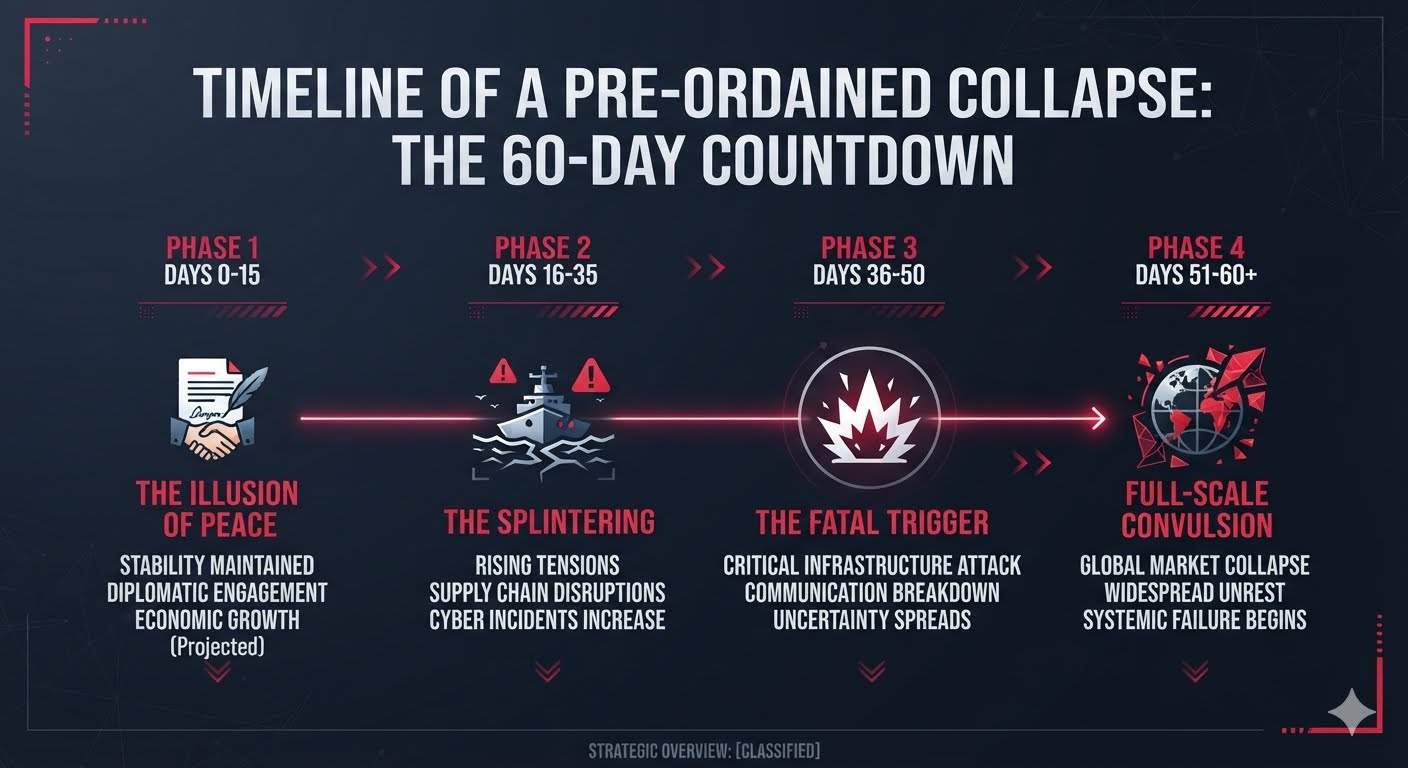
When statecraft replaces legal rigor with panic, war becomes inevitable. The catastrophic collapse of the June 2026 Islamabad MoU is a masterclass in the perils of “shadow diplomacy”. Driven by an overwhelming panic over skyrocketing oil prices, an inner circle completely sidelined the U.S. Department of Justice to rush through a fatally flawed agreement. By ignoring the pedestrian, rigorous mechanics of consensus ad idem (a true meeting of the minds), negotiators committed two unforgivable sins: They feared to negotiate the actual terms of maritime control, hiding instead behind the “constructive ambiguity” of Paragraph 5. They negotiated out of fear of an immediate conflict, perverting JFK’s famous dictum and walking open-eyed into a lethal 60-day trap that implicitly granted Iran the right to tax global shipping. Because career legal eagles were locked out of the room, the administration signed a political illusion that acted as a countdown timer. Within three weeks, the absolute lack of mutual understanding triggered heavy airstrikes, a total blockade of the Strait of Hormuz, and an imminent global economic convulsion. This isn’t just a breakdown in diplomacy—it is a devastating indictment of fatal, short-sighted ineptitude.
1. The Perversion of Consensus Ad Idem (The Root Legal Failure)
The bedrock of any valid agreement—whether a pedestrian commercial contract or a high-stakes international treaty—is consensus ad idem: a true, absolute meeting of the minds. For an agreement to hold, all parties must understand and assent to the exact same subject matter, in the exact same sense, at the exact same time.
In the Islamabad MoU, consensus ad idem was not merely neglected; it was actively sabotaged.
The Illusion of Agreement: The text was engineered with “constructive ambiguity”—a diplomatic euphemism for drafting words that mean completely contradictory things to each side.
Paragraph 5 as a Legal Weapon: The text mandated that “Iran will make arrangements… for the safe passage of commercial vessels with no charge for 60 days only.”
The Cognitive Dissonance: The U.S. read this as a temporary administrative checklist for mine-clearing. Iran read it as a formal recognition of its sovereign right to gatekeep the Strait of Hormuz and, crucially, to levy tolls on global shipping on Day 61.
By signing a document where no actual meeting of the minds existed, the signatories did not draft a peace treaty; they drafted a legal time bomb.
2. Negotiating Out of Fear and Fearing to Negotiate
The psychological underpinnings of the Islamabad negotiations completely inverted John F. Kennedy‘s timeless maxim. The administration acted out of a dual paralysis:
The Fear to Negotiate
Negotiators were plagued by a cowardice that prevented them from tackling the real, structural friction points head-on. They knew that defining precise routing coordinates, veto powers, or post-Day 60 financial frameworks would cause the talks to instantly collapse. Rather than doing the grinding, painful work of achieving clarity, they hid behind vague language, choosing the comfort of a fleeting political illusion over a sustainable, legally sound framework.
Negotiating Out of Fear
Driven by a frantic panic over skyrocketing oil prices, frozen global supply chains, and the terrifying prospect of a widening military escalation, the administration operated in a state of desperation. This desperation weaponized time against them. Panic dictated that any piece of paper with a signature was preferable to none, forcing them to accept a fatally flawed framework simply to secure an immediate, temporary sigh of relief.
3. The Irresponsible Sidelining of Institutional Due Process
The ultimate failure of accountability lies in the deliberate, sneaky exclusion of the U.S. Department of Justice (DoJ) and its Office of Legal Counsel (OLC).
In a routine administration, seasoned institutional lawyers act as gatekeepers, systematically stripping out ambiguity, defining terms, and anticipating breaches. For the Islamabad MoU, they were intentionally locked out:
The Kitchen-Cabinet Cartel: The negotiation was privatized. It was run by an inner circle consisting of Jared Kushner, Special Envoy Steve Witkoff, Secretary of State Marco Rubio, and a small cell within the War Department, operating via Pakistani and Qatari intermediaries (General Asim Munir and Prime Minister Shehbaz Sharif).
The “Political Document” Loophole: To evade statutory interagency review triggers, the administration cynically labeled the text a non-binding “Memorandum of Understanding” rather than a formal treaty. This allowed them to rush to the Palace of Versailles for a remote signature without a rigorous, line-by-line legal vetting.
The Ignored Warning Signs: Had DoJ “legal eagles” reviewed Paragraph 5, they would have instantly flag-polled the “Day 61 Toll Trap.” They would have refused to clear a clause that implicitly ceded an international waterway to Iranian taxation. The inner circle sidelined the DoJ precisely because they wanted to ignore these inconvenient legal truths to manufacture a rapid political victory.
4. The Global Fallout: An Economy on the Brink
The price of this fatal ineptitude is now being paid by the rest of the world. Because there was no consensus ad idem, the treaty collapsed within weeks of its signing, triggering the exact nightmare scenario it was rushed to prevent: [3]
The Spark: When the U.S. routed commercial vessels through alternative channels to bypass Iranian “arrangements,” Tehran viewed it as a breach of contract and attacked tankers.
The Escalation: The U.S. retaliated with massive, heavy airstrikes targeting Iranian coastal assets and Tehran itself.
The Convulsion: President Trump declared the truce officially over, oil export waivers were revoked, and the Islamic Revolutionary Guard Corps (IRGC) declared the Strait of Hormuz closed “until further notice.”
Conclusion
The Islamabad MoU will live in infamy as a masterclass in how not to conduct international law. It proves that when nations bypass the pedestrian, rigorous mechanics of due process, they trade temporary political theater for systemic catastrophe. By shunting out the lawyers, the American administration did not negotiate peace—they legally codified the path to an imminent, devastating global war.
What happens when you send birthday greetings to a doyen of Tamil literature? If the doyen is Indira Parthasarathy (affectionately known to generations as Eepa), you don’t just get a standard “thank you”—you get a masterclass in razor-sharp wit and historical cynicism.
The legendary playwright, SahityaAkademi winner, and Padma Shri recipient recently celebrated his 96th birthday. Having sent him my warm wishes, my phone buzzed the next morning with a characteristically brilliant response. Eepa messaged back, dropping a famous quote by Winston Churchill:
“History will be kind to me because I intend to write it.”
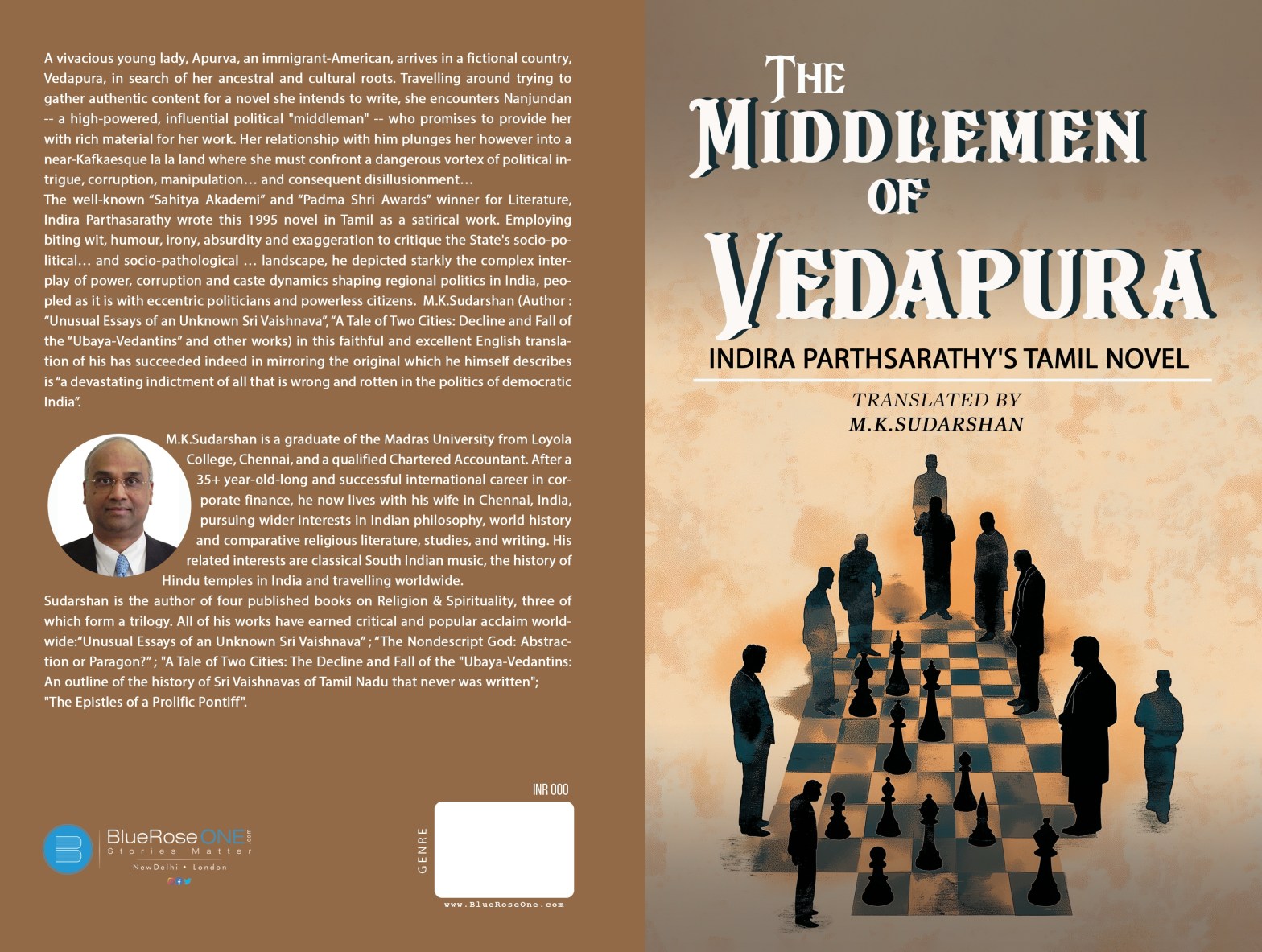
It is a perfect quote for Eepa—a writer who has spent his entire career pulling back the curtain on elite power structures, political manipulation, and the narratives fed to the public. Throughout his career, Ee. Paa. has used his novels and plays (like Kuruthipunal or Ramanujar) to dissect power structures, religious politics, and how human narratives are manipulated by elite classes. He has always been a writer who looks beneath the official version of history. (His Tamil novel “VedapuratthuVyaabaarigal”, a political satire, was translated by me into English as “The Middlemen of Vedapura” in 2024, and which he wholeheartedly endorsed).
I couldn’t help but laugh, and I texted him back with a bit of financial and historical counter-punching:
“And Sir, in 1953, he wangled a Nobel Prize for turning History into Literature too! History gets written by victors. Economics is written by creditors. And historians are handed grand awards by the debt-collectors.”
There is a delicious historical irony hidden right there. Churchill actually coveted the Nobel Peace Prize, but the Swedish Academy couldn’t quite reconcile giving a peace award to a fiercely aggressive wartime prime minister. Instead, they compromised. They wangled a way to hand him the 1953 Nobel Prize in Literature for his massive, self-serving six-volume chronicle, The Second World War.
Because there is no Nobel Prize for “History,” the committee essentially codified the ultimate truth of power: if you win the war, your personal version of history is so absolute that it gets validated as literal high art. Churchill didn’t just document the war; he carefully sculpted a literary monument where he was the undisputed hero, conveniently editing out the massive sacrifices of over 2.5 million Indian colonial troops.
For anyone tracking markets or global macro trends, this remains the ultimate reality. The entity that holds the accounting ledger holds the narrative. The military winner controls the history books, while the lender dictates the economic rules of the game.
What I meant to tell Eepa was only this:
History and Victors: Military or political winners control the archives, rewrite textbooks, and frame their conquests as “progress” or “liberation.”
Economics and Creditors: Financial systems are designed by those who hold the capital. Terms like “fiscal responsibility,” “structural adjustment,” and “creditworthiness” are defined by lenders (nations, central banks, or institutions) to ensure they get paid back, often prioritizing debt repayment over human welfare.
Historians and Debt-Collectors: Institutions that fund elite universities, think tanks, and prestigious foundations are often built on accumulated wealth and financial systems. Intellectuals who normalize or justify these power structures are frequently rewarded with grants, chairs, and prestigious awards.
Real-World Parallelisms
The Global South: International lenders often dictate national economic policies, forcing developing nations to cut public spending to service foreign debt.
The Imperial Narrative: Historically, colonial empires justified extraction by claiming they were bringing “economic development” and modern banking to the colonies.
A moment later, the master satirist himself fired back with his ultimate stamp of approval:
“Quite smart saying!”
Getting validated by a literary giant who has spent nearly a century mastering the art of the subtext — well, for me at least — feels like a profitable trade closing at the absolute highs of the day.
The Market Takeaway
For the traders and investors among us, (BTW, I’m a Chartered Accountant who sweated for 37 long years, both India and abroad, in the big, bad, bad, bad world of corporate/ project/investment finance), there is a profound truth hidden in this morning’s banter between Eepa and I:
Watch the Creditors: In the markets, just like in history, the people who underwrite the debt are the ones who ultimately author the economic reality. Central banks, institutional lenders, and massive market-makers build the framework we have to trade within.
Question the “Official” Narrative: When a trend looks universally accepted or a consensus seems completely unshakeable, remember that narratives are usually constructed by the entities holding the winning positions.
Happy 96th Birthday to Eepa ! —a legendary mind who proves that age is no barrier to keeping your intellectual edge sharper than a high-frequency trading algorithm.
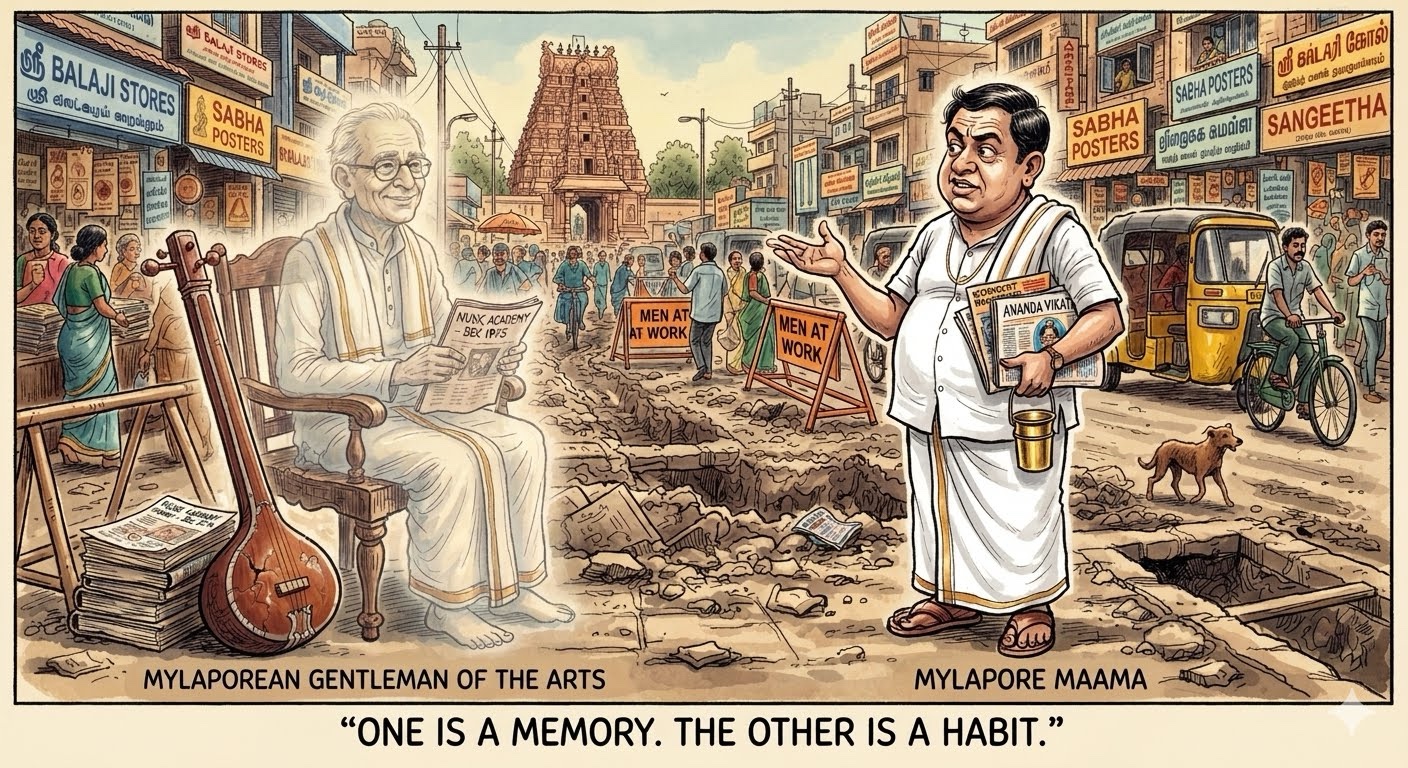
Mylaporean Gentleman of the Arts (aghost): Ah, my dear Maama, I am told I am extinct. A fossil. A sepia-toned relic with a Carnatic cough and a law-book under my arm.
Mylapore Maama: Extinct, is it? Then why do they still invoke you with such reverence? You were once the city’s polished emblem — the cultivated man, the connoisseur, the gentleman of taste. Now they mention you only to compare me unfavourably with you.
Gentleman: Compare? No, no. They mourn me while mocking you. That is the modern compromise. They say I represented culture; you represent its aftertaste.
Maama: Aftertaste? That is generous. More often I am the punchline. I am the uncle in the white veshti, the guardian of correct pronunciation, the defender of vanished certainties, the man who believes the world ended when this street was last dug up.
Gentleman: And yet you survive.
Maama: Like a proverb. Like a bad habit. Like a temple bell heard above traffic blare.
Gentleman: I once belonged to a Mylapore of sabhas, salons, lawyers, musicians, scholars, and patient afternoons. One could mistake the place for an intellectual republic.
Maama: Now it is an intellectual republic of potholes, diversions, honking scooters, and heroic detours. My domain is no longer the drawing room but the traffic jam.
Gentleman: Still, you continue to claim the old prestige.
Maama: Claim? No. I merely inherit it with a bad haircut and a superior expression. And an irresistible, fatal attraction to Sabha canteen junk-food too.
Gentleman: That is precisely why they laugh. The old cultural self-confidence has curdled into mannerism.
Maama: And your elegant condescension has become a museum piece.
Gentleman: Touché. Yet I was admired in my day.
Maama: And I am ridiculed in mine.
Gentleman: A poor exchange.
Maama: Not entirely. Ridicule gives me life. Without mockery, I would truly be dead. I live now as caricature, which is a sort of immortality.
Gentleman: A bitter immortality.
Maama: Bitter, yes. But also sweetly absurd. The younger ones, foreign-returned, polished, English-speaking, use my name to tease their elders and to tease themselves. They wear irony like cologne.
Gentleman: So the sons have become satirists of the fathers.
Maama: And the fathers remain standing, offended but still in the room.
Gentleman: Tell me, then: am I merely dead, and you merely ridiculous?
Maama: No. You are the vanished ideal; I am the surviving joke. Together we make the full Mylaporean tragedy, more poignant than any Shakespearean.
Gentleman: A little cruel.
Maama: Mylapore has always been cruel to its own myths. First it dignifies them, then it domesticates them, then it laughs at them over filter coffee.
Gentleman: And yet the place still poses as the custodian of culture.
Maama: Of course. Every neighbourhood needs an altar, and every altar needs an old man guarding it with a key he no longer understands how it works.
Gentleman: You flatter yourself.
Maama: No, I caricature myself before others do. That is the new civility for senior citizens like me.
Gentleman: Then let us agree on this: I am dead enough to be remembered, and you are alive enough to be mocked.
Maama: And between us stands Mylapore — majestic, congested, self-important, tender, devout, absurd… It’s My La La Puri.
Gentleman: A place where old eminence becomes new parody.
Maama: And where parody, if it lasts long enough, begins to feel like heritage.
The ghost of the Mylaporean Gentleman of the Arts goes “poof” and vanishes. The Mylapore Maama walks away … only to slip and fall bang into a newly laid roadside ditch.