The Postcard Matron of Adyar: Letters, Duty, and Devotion in Post-Independence India (1947–1948)

Today is July 10, 2026 and happens to be Friday, always regarded as blessed and auspicious since it’s the day all Hindus specially offer worship to Goddess Mahalakshmi.

If you are in the holy city of Kanchipuram today, you’d be headed towards the temple of Sri Varadaraja Perumal to have darshan of his Divine Consort, Goddess and Mother Compassionate, Sri Perundevi Thaayaar.

Today, for me, is also a perfect day for a darshan of another sort: of a Mother —not a divine one though — but who, nonetheless, as mere human Perundevi, personified the qualities of Compassion, Sacrifice and Grace with unpretentious humility during her lifetime.

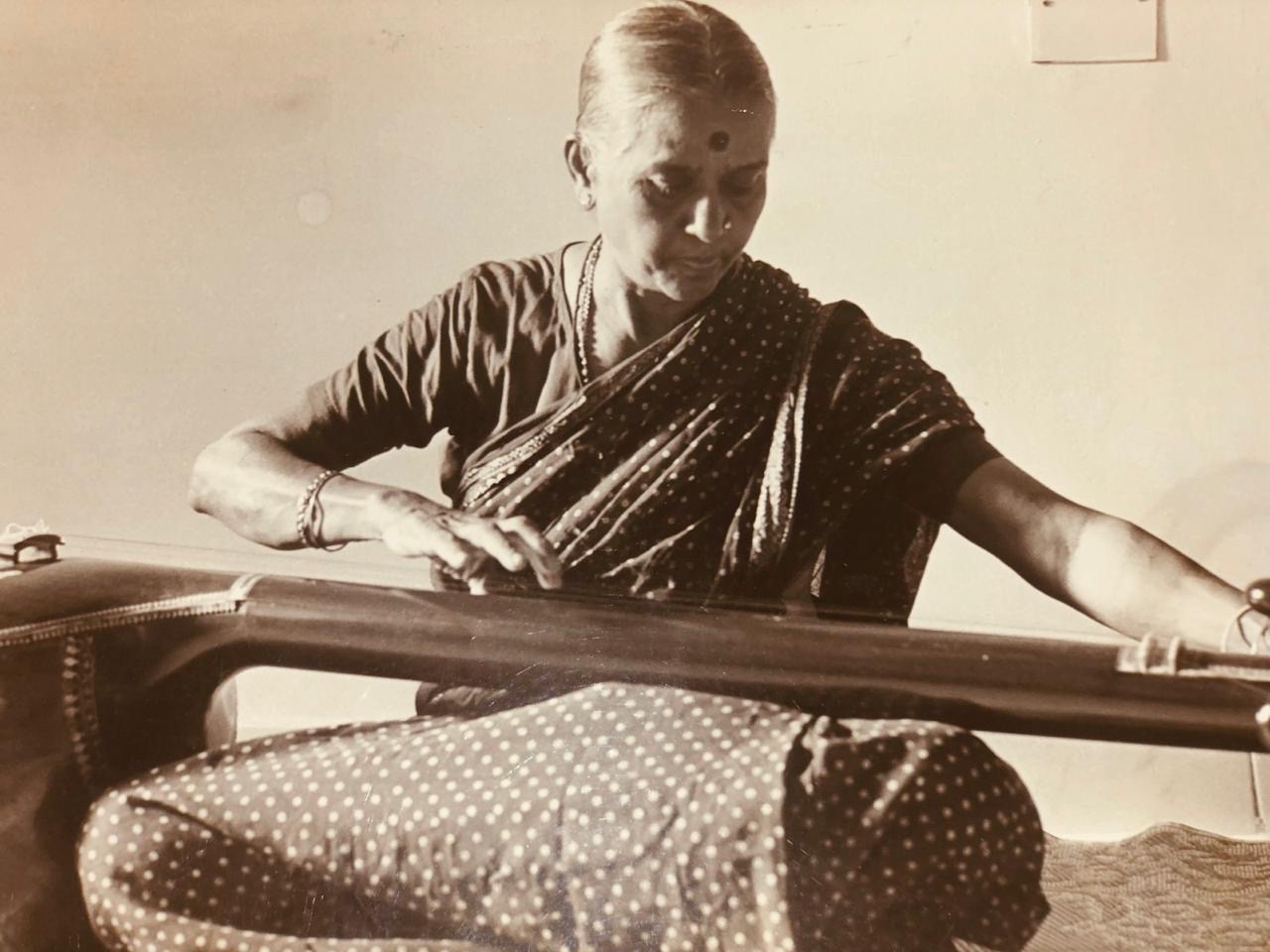
The darshan I am taking about is the one to be had through recollections of my mother, Sangitha Kalanidhi Smt. Mani Krishnaswami (1930-2002).

Mani Krishnaswami’s public profile — as a famous, outstanding musician in the history of Carnatic Music — is even today so well remembered by legions of her Rasikas. Her archival music lives on, immortally, in public memory, ears and hearts. However, there’s to be found hardly any archive, either public or familial, that can tell her Rasikas anything about the personal side of her life… or, in other words, about how before she became Mani Krishnaswami, she had been born and had grown up, firstly, as Mani Perundevi.

On this blessed day today of Friday graced by Kanchi Perundevi Thaayaar, I happened to be casually rummaging through some family archival memorabilia: scraps of letters, photos and sundry souvenirs. Perchance, I stumbled upon two old musty postcards from 1947-48. As soon as I read them, I turned into a makeshift self-appointed historian of my mother’s family and her teenage years. I felt an overwhelming urge — perhaps because I am my mother’s only son and offspring — that the slice of family history that I had stumbled upon serendipitously from Mani Perundevi’s early life must be told and shared too in the public domain.

Both her family and her Rasikas, I felt, did deserve a rare glimpse into Mani Krishnaswami’s early life… a life of filial “tapas” appearing to me, in hindsight, to be the equal of the “tapas” I know she underwent later in life as an outstanding Carnatic musician who reached the heights of artistic fulfilment in her long, illustrious career as a Vidushi.

So, here below is a cameo-recounting of the slice of family history I suddenly discovered today on this blessed Friday.


In Loving Memory of

MANI PERUNDEVI (1930-2002)

Who, at the tender age of eighteen, gracefully stepped into the shoes of her parents to mother, nurse, and guide her eleven younger brothers and sisters. The slice of family history recounted here is dedicated to her enduring legacy of cheerfulness, silent sacrifice, and unyielding equanimity. Over fifty years later, her siblings carry her memory with boundless, eternal gratitude.

You must rise up by your own merit.”


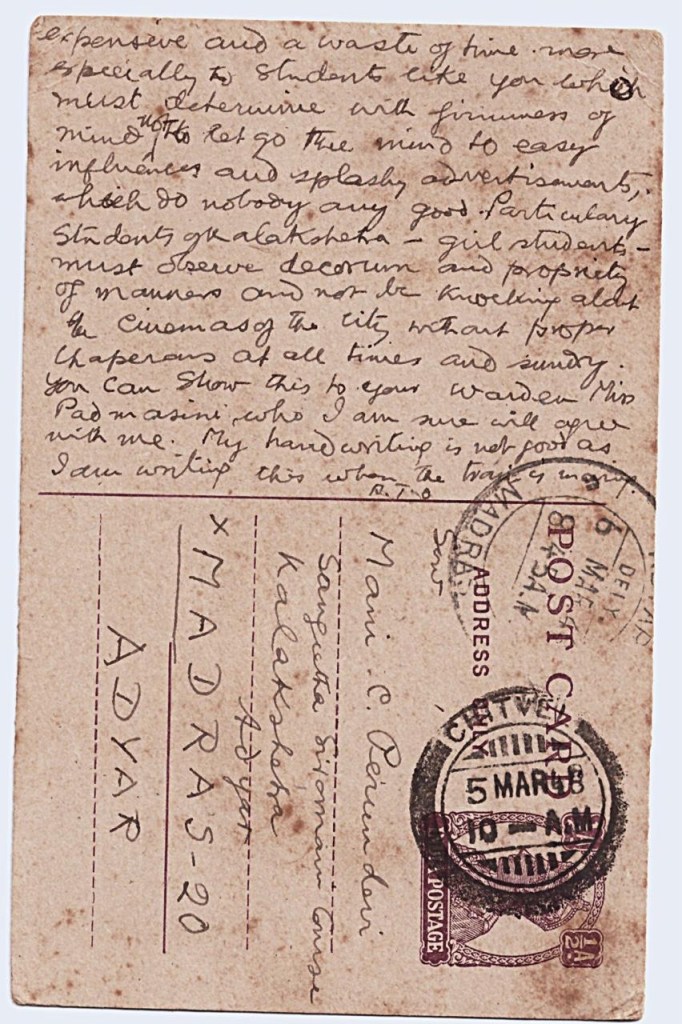
In the post-independence dust of March 1948, a steam train jolted its way toward Arkonam Junction.

Inside one of its carriages, a father balanced a fountain pen against a slip of cardboard, his script horizontally compressed to conquer every square millimeter of space. He wrote with the rapid, unflinching discipline of a Victorian-era education, drafting an “advice, not a censure” to his eldest daughter, Mani, whom he had named Perundevi.

To the post office, she was Miss Mani Perundevi, 1st Year Student, Sangeetha Siromani Course, Kalakshetra. To her father, she was a reliable lieutenant. But to history, she was an eighteen-year-old girl born in 1930, standing on the precipice of adulthood, holding together a universe of eleven younger siblings whose ages cascaded all the way down to a one-year-old infant.
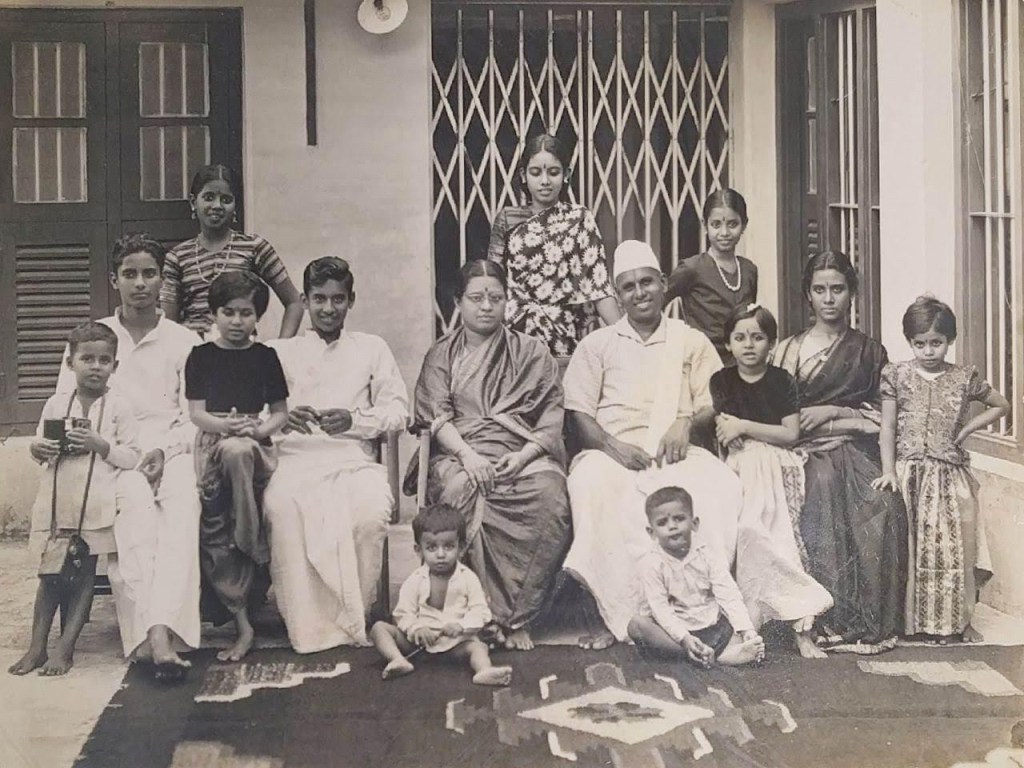
Mani Perundevi (seated first on the right) with her parents, Lakshminarasimha Chariar and Maragathavalli and all their twelve eleven children.

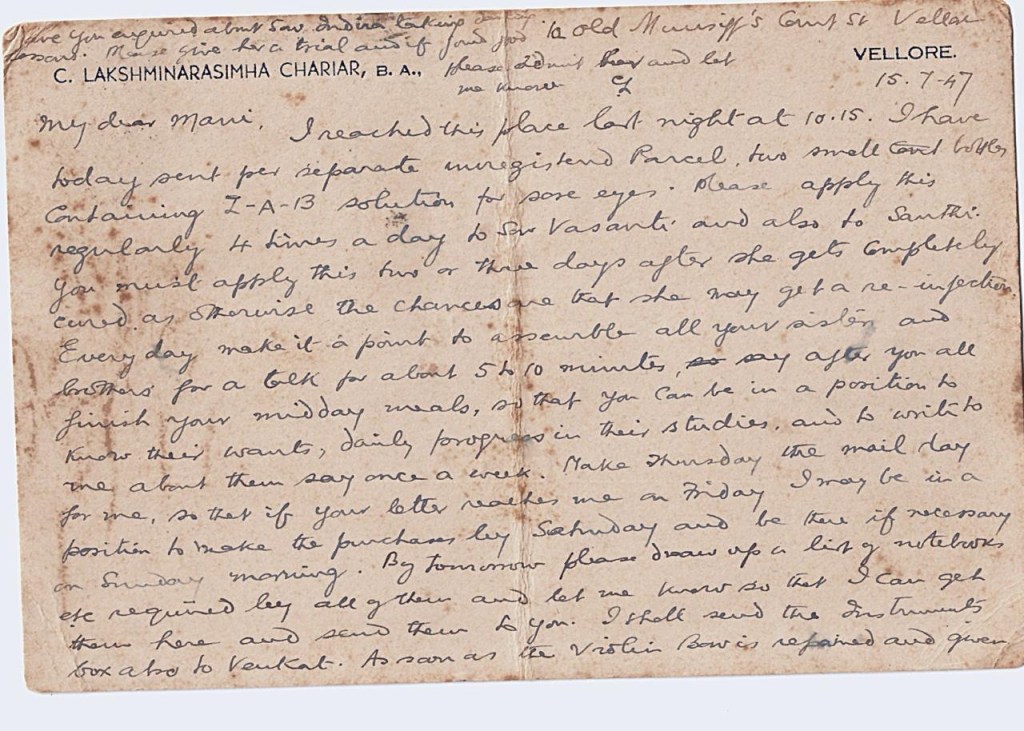
Old Munsiff’s Court St. Vellore

C. LAKSHMINARASIMHA CHARIAR, B. A.,
VELLORE.
15.7-47

Postmarks & Stamps:

  • ADYAR DELY. 16 JUL. 47
  • SAIDAPET-VLY 15 JLY. 47
  • INDIA POSTAGE stamp (1½ annas.)

Address Layout:
Miss Mani Perundevi
Student, I st year
Sangeetha Siromani Course
Kalakshetra
Adyar
MADRAS-20

Body of the Letter:

My dear Mani,

I reached this place (Vellore) last night at 10.15. I have today sent per separate unregistered Parcel, two small card boxes containing Z-A-B solution for sore eyes. Please apply this regularly 4 times a day to Sow. Vasanti and also to Santhi (Perundevi’s sisters). You must apply this two or three days after she gets completely cured, as otherwise the chances are that she may get a re-infection.

Every day make it a point to assemble all your sisters and brothers for a talk for about 5 to 10 minutes, so, say, after you all finish your midday meals, so that you can be in a position to know their wants, daily progress in their studies, and to write to me about them, say, once a week. Make Thursday the mail day for me, so that if your letter reaches me on Friday I may be in a position to make the purchases by Saturday and be there if necessary on Sunday morning. By tomorrow please draw up a list of notebooks etc. required by all of them and let me know so that I can get them here and send them to you.

I shall send the (musical) instruments box also to Venkat (eldest son, younger than Perundevi). As soon as the Violin Bow is repaired and given to you, please let me know how much they have charged you for the same.

As far as you are concerned, you must study your lessons & music everyday and should not accumulate them to a later date. Too much talk will not help you but land you in unnecessary complications. “Lend thy ear to every body, but none thy tongue”. Choose your friends carefully and maintain always decorum in speech, behaviour, and action. Remember “Too much familiarity will breed contempt”. As my father put it, “You must rise up by your own merit”. Please take care of your health. Once a fortnight you must take the mag sulph purge and this will help to keep you fit. Expect your letter about the health of Sow. Vasanti etc by Friday morning or even earlier.

yours affly
[Signature] C. Lakshminarasimha Chariar

PS: Have you enquired about Sow. Indira (another sister of Perundevi) taking (music) lessons. Please give her a trial and if found good please admit her and let me know.
CLN

The Burden of the Eldest

The postcard reveals a family dynamic where parental presence was delivered by mail, but parental governance was thrust entirely onto Mani.

Willy-nilly, she was made the loco-parentis and the hostel matron for all her siblings. Her father’s letter reads less indeed like tender familial updates and more like organizational directives sent to a regional manager:

  • The Assembly: She was ordered to gather the children daily for ten minutes after their midday meals to track their academic progress.
  • The Nurse: She was tasked with administering “mag sulp” purges and applying Z-A-B eye solutions four times a day to her sisters, Vasanti and Santhi.
  • The Accountant: She was expected to draft inventories of notebooks, track the repair costs of violin bows, and report everything back on a strict weekly “mail day.”

There is a striking juxtaposition in an eighteen-year-old girl being also given sermons rooted in Shakespearean tragedy—“Lend thy ear to every body, but none thy tongue”—while simultaneously being told to act as a surrogate mother to a household of eleven children. Mani Perundevi was surrounded by the vibrant, awakening cultural landscape of Madras in those years, yet her personal world was strictly rationed.

The Sangeetha Siromani Course & Miss Padmasini

Mani’s sanctuary from this heavy domestic weight was her enrollment at Kalakshetra, an academy founded by Rukmini Devi Arundale to revive traditional Indian classical arts. She was a first-year student in the prestigious Sangeetha Siromani (Jewel of Music) course, a rigorous four-year diploma in Carnatic vocal and instrumental music.

In 1947 and 1948, the academy still operated from its original home on the serene, leafy grounds of the Theosophical Society in Adyar. Admittance into this course meant Mani was walking among giants, learning under legendary musical titans like Tiger Varadachariar, Mysore Vasudevachar, Budalur Krishnamurthy Sastri and M.D. Ramanathan among other notables, who shaped the academy’s early faculty.

Yet, even within this artistic haven, her father ensured her duties of family supervision was never far away. He explicitly directed Mani to show his letter to Miss Padmasini (Smt. Padmasini), the legendary first caretaker and warden of the Kalakshetra student hostel. Padmasini was one of Rukmini Devi’s closest institutional pillars. Known for being fiercely protective and acting as a surrogate mother to the early batches of arts students, she enforced strict discipline. Her legacy is so deeply tied to Kalakshetra that the historic lily pond amphitheater on the campus is officially named Padma Pushkarini in her honor. By invoking Padmasini, the father cleverly inveigled the alignment of his paternal anxieties with the hostel’s unyielding rules.

The Cinema and the Martyr

At the heart of another postcard’s tension that Lakshminarasimha Chariar wrote to Perundevi lay a young girl’s simple, unspoken wish: the desire to go to the cinema.

Writing just a month after Mahatma Gandhi’s assassination, the father invoked the Mahatma’s recent martyrdom not as a historical event, but as a moral surveillance apparatus. Gandhi, he wrote, was now an “angel and celestial being… watching over our Country’s welfare.”

In the father’s eyes, Gandhi’s austere aversion to films—which the Mahatma viewed as corrupting, Westernized influences that distracted youth from spiritual duties—became a mandate for Mani’s discipline. Mani was told that movies were a “waste of time” and that Kalakshetra girls (!) must not be seen “knocking about the Cinemas of the city” without a proper chaperone.
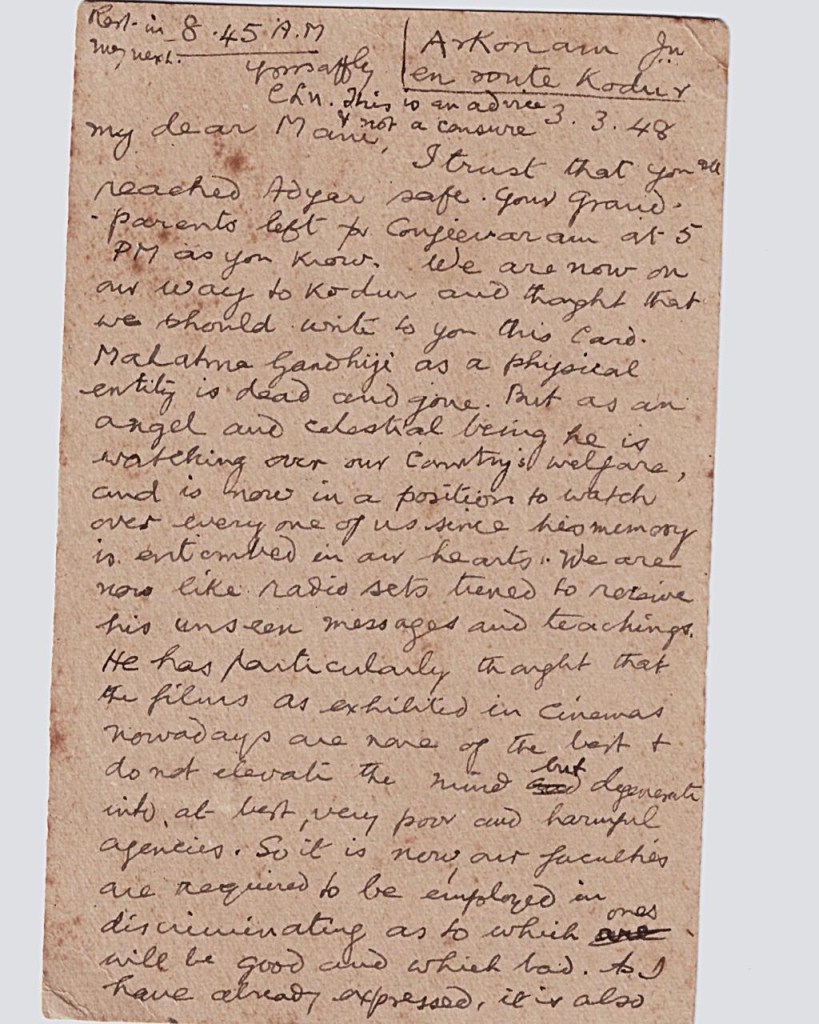
  • Recd. in 8.45 A.M
  • Arkonam Jn en route Kodur 3.3.48

Body of the Letter:

My dear Mani,

I trust that you all reached Adyar safe. Your grand-parents left for Conjeevaram at 5 PM as you know. We are now on our way to Kodur and thought that we should write to you this Card.

Mahatma Gandhiji as a physical entity is dead and gone. But as an angel and celestial being he is watching over our Country’s welfare, and is now in a position to watch over every one of us since his memory is entombed in our hearts. We are now like radio sets tuned to receive his unseen messages and teachings.

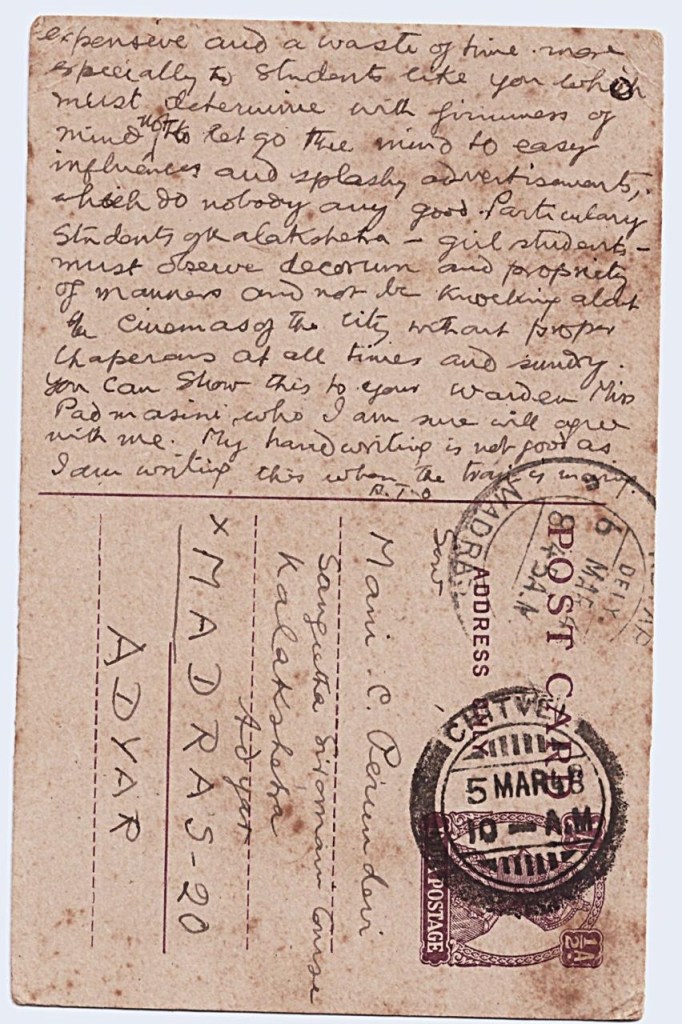
He has particularly thought that the films as exhibited in cinemas nowadays are none of the best & do not elevate the mind but degenerate into, at best, very poor and harmful agencies. So it is now our faculties are required to be employed in discriminating as to which ones will be good and which bad. As I have already expressed, it is also expensive and a waste of time, more especially to students like you who must determine with firmness of mind not to let go the mind to easy influences and splashy advertisements, which do nobody any good. Particularly students of Kalakshetra – girl students – must observe decorum and propriety of manners and not be knocking about the Cinemas of the city without proper chaperons at all times and sundry. You can show this to your Warden Miss Padmasini who I am sure will agree with me. My handwriting is not good as I am writing this when the train is moving.


P. T. O

Yours affly CLN. This is an advice & not a censure

A Legacy of Equanimity and Moving Mail

Even the physical postcard of the father itself speaks to this atmosphere of scarcity and restraint in which Mani Perundevi, a lass just eighteen years old, had to come to terms with.

Frugality was a postal virtue; ink was packed tightly to save the cost of an envelope. Every inch of paper was squeezed for utility, just as Mani’s youth was squeezed for duty.

Yet, the efficiency of the colonial-era postal system they both relied on was remarkable indeed from a Historians point of view. Despite being handled completely by steam rail transport and physical sorting, a postcard written on a moving train near Arkonam Junction on March 3 passed through a sorting facility in Chittoor on March 5, and arrived at the Adyar Delivery Office in Madras at exactly 6:45 AM on March 6. It took precisely three days to travel from a rumbling train carriage in rural undivided Madras Presidency straight into Mani Perundevi’s hands at her hostel desk in Kalakshetra.

The true narrative of Mani’s life is found in what happened long after that moving mail arrived and the ink dried. Her parents eventually passed away, but the role she was cast into at eighteen became the blueprint for the next fifty years of her life. She and her husband, later in their lives, took upon themselves the responsibility of grooming all Perundevi’s siblings, ensuring every one of them was well educated and they launched themselves into successful careers in various professions, were married off well and all went on to raise happy families of their own.

Perundevi endured this massive cascade of responsibility without a single word of complaint, moving through the decades (1960s through the ‘80s) cheerfully and with an unwavering equanimity until she passed away in 2002.

Mani Krishnaswami, Née Perundevi, did not get her carefree afternoon at the cinema. Instead, she gave her siblings a childhood and passage to adulthood. Decades later, her father’s handwritten text on the faded cardboard remains cramped, but the gratitude of the eleven siblings she raised is perhaps boundless.

Today is auspicious Friday. As son to Perundevi, I realise fully now what that Upanishad “vaakya” truly signifies: “maatru devo bhava” … मातृ देवो भव।

(Concluded)

Archival Correspondence
“Get Out of the Way, Westphalia!”… Henry Kissinger’s dark prophecy

The Emerging New World Order

by M.K.Sudarshan

July 9, 2026: Chennai, India


Is the centuries-old doctrine of state sovereignty collapsing before our eyes?
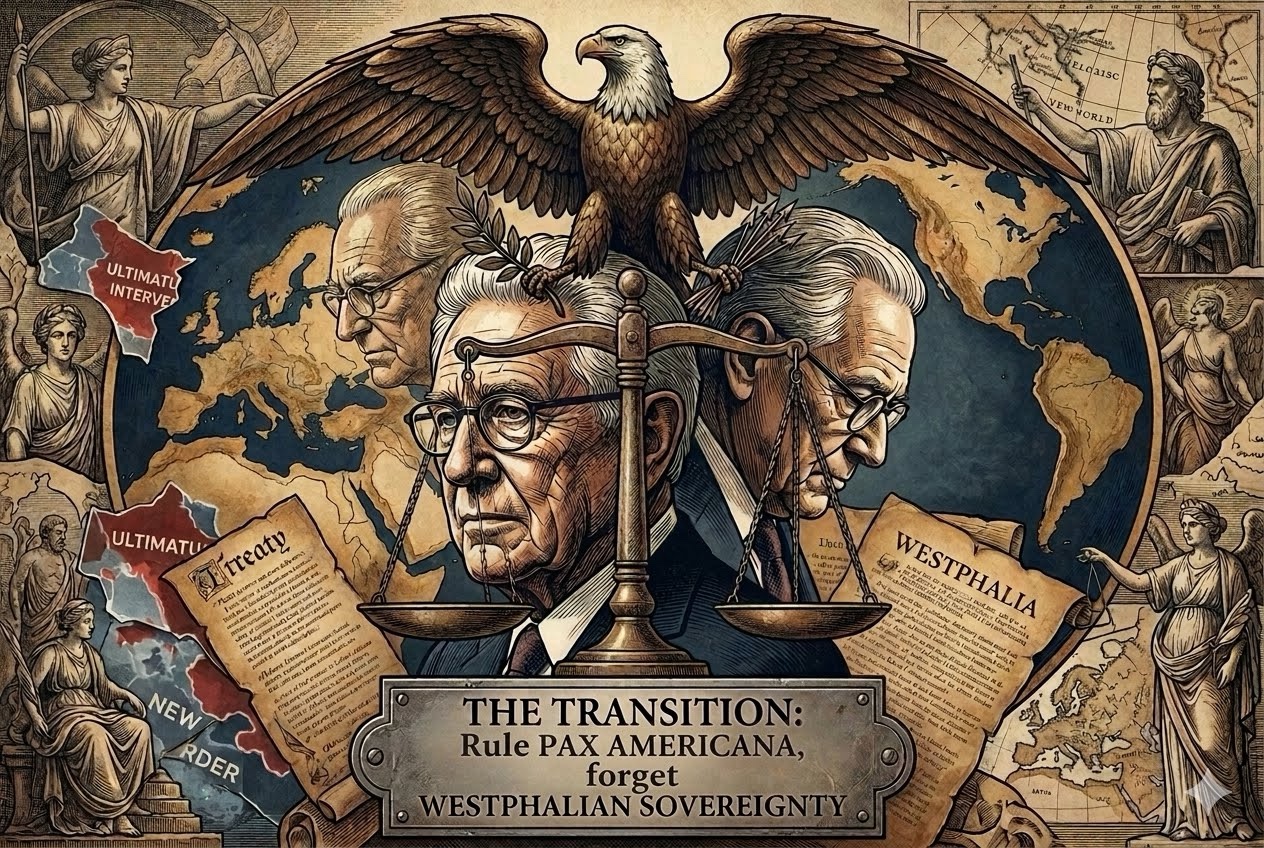
In his seminal work World Order, Henry Kissinger warned against a single hegemon rewriting the rules of global legitimacy. Yet, the systematic dismantling of Westphalian principles—seen in Iraq, Libya, Syria, and now the extreme defense ultimatums placed on Iran—proves that sovereignty has become a privilege, not a right.
When international law offers no protection, raw military power becomes the only currency of survival. As the American-Western axis pushes regional red lines to the limit, the strategic patience of Russia and China is rapidly exhausting.

The Birth of the Sovereign Shield

In 1648, Europe emerged from the ashes of the Thirty Years’ War—a catastrophic conflict driven by religious zealotry and imperial overreach that slaughtered millions. The solution was the Peace of Westphalia.

This historic compact established a revolutionary blueprint for global survival: the doctrine of state sovereignty. It decreed that all states, regardless of size, ideology, or internal governance, possess absolute authority over their territory. Most importantly, it codified the principle of non-intervention.

Westphalia was not agreed upon out of moral altruism; it was a pragmatic, existential necessity to prevent perpetual, total warfare by establishing that no foreign power had the right to dictate how another nation guarded its borders or ruled its people.

Kissinger’s Bedrock of Order

In his seminal work World Order, Henry Kissinger expatiated upon this Westphalian doctrine not as a flawless moral system, but as the indispensable bedrock of global stability.

Kissinger argued that the genius of Westphalia lay in its procedural neutrality. It did not require nations to share the same values, only to respect the same rules of engagement. For nearly four centuries, this balance-of-power model served as the foundational architecture of international relations.

Kissinger warned that any functioning global order requires a shared sense of legitimacy; if the dominant powers abandon procedural rules in favor of imposing their own moral or strategic dictates, the system collapses into chaos.

Henry Kissinger absolutely presaged this exact tension in World Order, explicitly warning that the collision between American exceptionalism and the Westphalian system would lead to the rewriting of state sovereignty. 

In his analysis of global systems, Kissinger diagnosed a fundamental incompatibility between how the United States operates and how classical Westphalian sovereignty is defined. He outlined several core concepts that directly explain the current U.S.-Israel approach to Iran.

A cornerstone of Kissinger’s realism—dating back to his earliest academic work and synthesized in World Order—is the concept of the “Revolutionary Power.” 

  • The Rule: A revolutionary power is a state that refuses to accept the legitimacy of the existing international order and seeks to alter the regional balance of power.
  • The Hegemonic Response: Kissinger noted that an international system faced with a revolutionary power cannot rely on standard Westphalian diplomacy. Instead, the dominant powers must either completely contain, isolate, or force the capitulation of that state to protect the architecture of the system itself.

The Broken Shield: Iraq, Libya, and Syria

Yet, the modern era has seen this foundational architecture systematically dismantled, forced to capitulate to the unilateral dictates of Pax Americana and Pax Judea. The regime changes in Iraq and Libya, alongside the violent splintering of Syria, stand as egregious examples of this shift.

In each instance, the Westphalian shield was aggressively shattered under the guise of humanitarianism or security, reducing once-sovereign states to fractured territories and serving as a stark warning to any nation resisting integration into the Western orbit.

The Ultimatum: Hollow Sovereignty

Today, this same hyper-interventionist paradigm has culminated in three uncompromising demands issued by the United States and Israel against Iran:

  • The total forfeiture of nuclear weapons and the domestic capacity to develop them.
  • The complete elimination of Iran’s ballistic missile arsenal.
  • The surrender of Iranian control over the Strait of Hormuz.

The three extreme demands on Iran are a textbook execution of neutralizing what Washington and Israel define and as what Kissinger explained to be a revolutionary threat.

The ramifications of these demands do not merely alter Iranian policy; they effectively end Iran as a sovereign state.

Deprived of its advanced conventional air force due to decades of Western embargoes, Iran relies entirely on its ballistic missile program as its primary strategic deterrent against regional adversaries. Stripping Tehran of this capability, while forcing it to cede maritime authority over its own territorial waters in the Strait of Hormuz, leaves the nation completely defenseless. It reduces a country of 90 million people to a status of conditional, vassal-like existence—completely vulnerable to the military whims of foreign actors.

A Travesty of Order

This ultimatum represents a total travesty of the Westphalian-Kissinger model. By issuing these demands under the threat of severe destruction, the U.S. and Israel are operating on a paradigm of exceptionalism that Kissinger himself explicitly in his book had warned against.

Kissinger noted that when a hegemon treats its own security parameters as absolute and universal, it transforms into a destabilizing force. Denying Iran the Westphalian right to territorial self-defense—while the hegemon and its regional allies maintain massive conventional and nuclear arsenals—shatters the principle of reciprocity. It replaces a system of sovereign equals with a rigid, enforced hierarchy where power dictates right, and non-compliance is met with threats of structural erasure.

The Impotence of Global Institutions

As the Westphalian compact is overridden, the premier institutions of the modern international order have been rendered entirely impotent and nugatory.

The United Nations Security Council sits paralyzed, reduced to a theater for vetoes and performative rhetoric.

The International Atomic Energy Agency (IAEA) and the Non-Proliferation Treaty (NPT)—which historically guaranteed a nation’s sovereign right to peaceful nuclear energy—have been weaponized as tools of selective enforcement rather than neutral arbiters.

Organizations like the G-20 , BRICS and OIC (Organisation of Islamic Countries) look on helplessly, incapable of enforcing international law or curbing unilateral actions.

These bodies no longer preserve order; they merely manage the optics of a decaying system where global rules are bypassed whenever they conflict with Western strategic mandates.

A Dark Prophecy: The Coming Blowback

The crumbling of a Westphalian and UN-anchored world order does not mean the end of resistance; it signals the dawn of a far more dangerous era. As the traditional system is forcibly replaced by a hegemonic order imposed by the American-Zionist-Neo-Con-Neo-Liberal axis, the global balance of power is reaching a breaking point.

This aggressive redefinition of state sovereignty is exhausting the strategic patience of the world’s other major nuclear powers. Watching the systematic cornering of Iran, China and Russia see a direct preview of their own eventual encirclement.

By demonstrating that international law offers no protection to independent states, the West is inadvertently proving to its rivals that raw military power is the only valid currency of survival. As Washington and its allies push their regional ultimatums to the absolute limit, they risk crossing the final red lines of a multipolar world—impelling China and Russia into defensive pacts, economic blockades, or direct, catastrophic military responses that could plunge this century into a global conflagration.

(Concluded)

ரமணரிடமிருந்து ராமானுஜருக்கு; ஐன்ஸ்டீனிடமிருந்து ஹாக்கிங்கிற்கு: காலமின்மையிலிருந்து கால நிறைவிற்கு

by M.K.Sudarshan

July 8, 2026, Chennai, India

Disclosure: below is an AI-aided translation in Tamil of my English blog-essay : https://mksudarshans.blog/2026/07/08/from-ramana-to-ramanuja-and-from-einstein-to-hawking-timelessness-to-time-fullness/

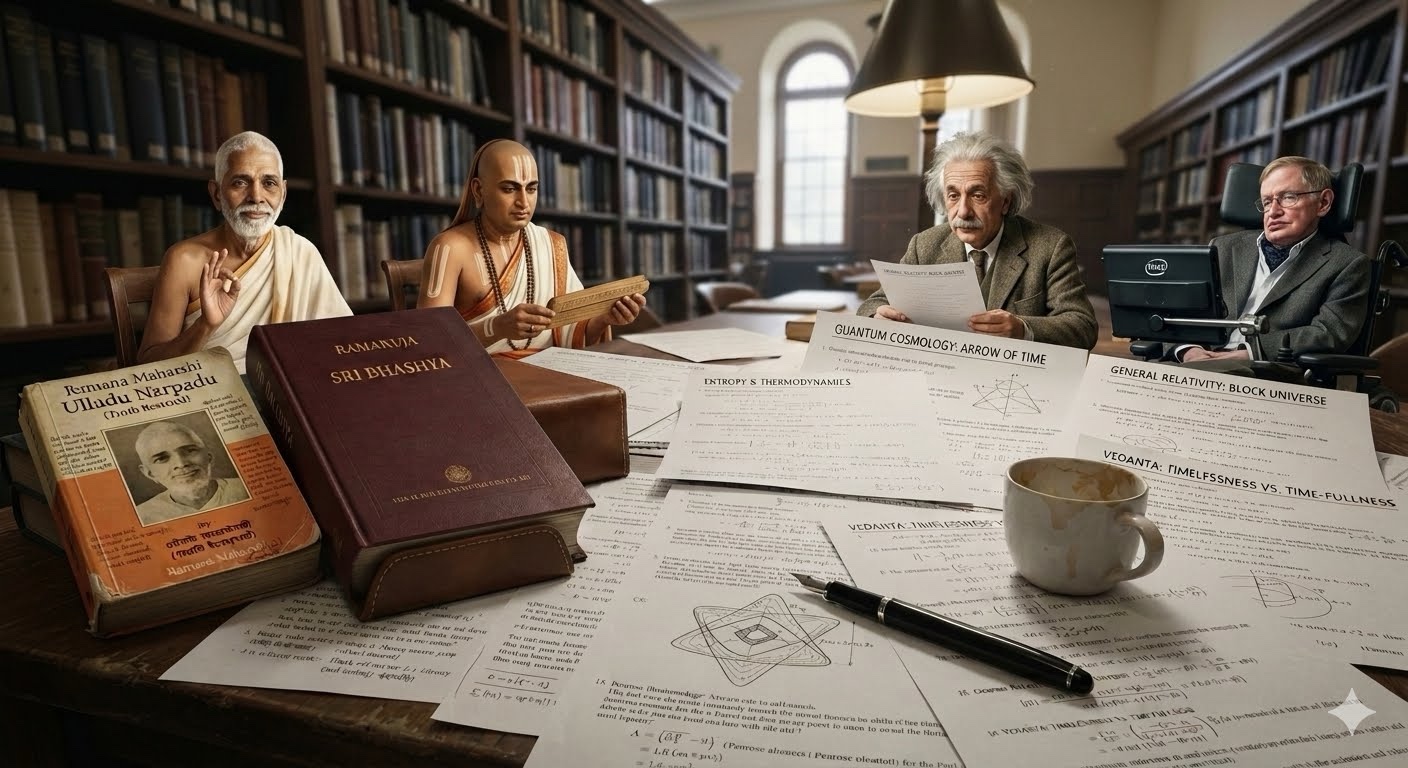
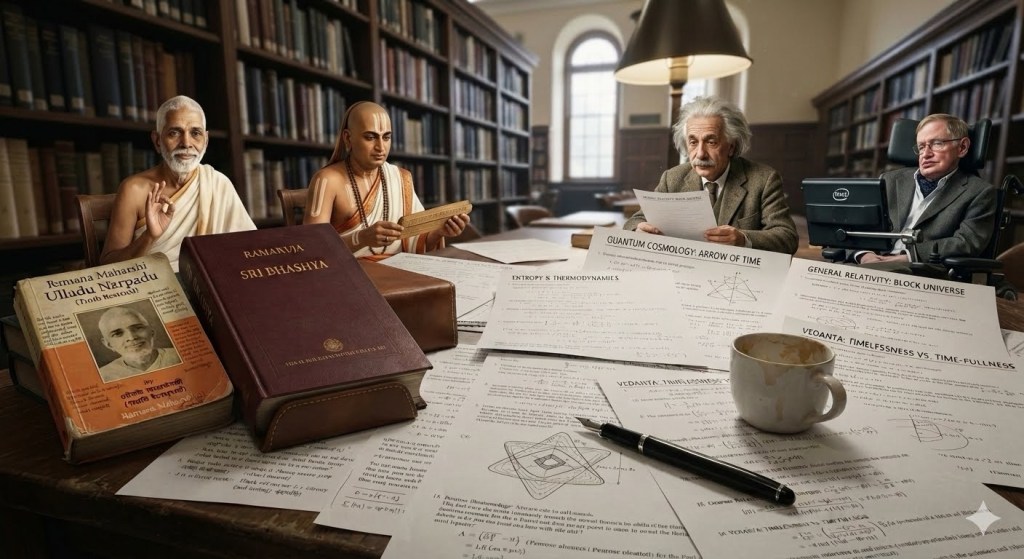
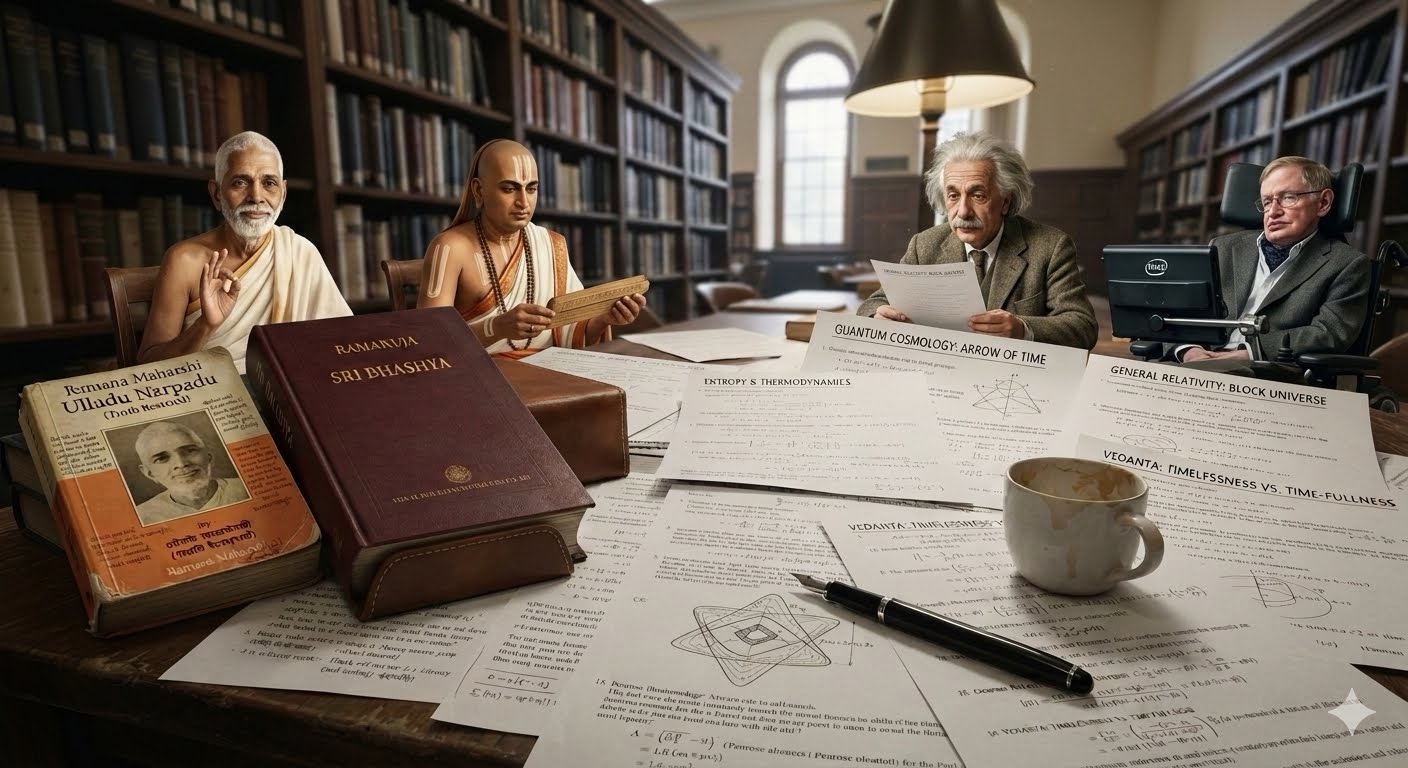
From left to right: Ramana Maharishi, Sri Ramanujacharya, Albert Einstein and Stephen Hawking

சூழல்: ஒரு பல்கலைக்கழக நூலகத்தின் அமைதியான மூலை. மேசையின் மீது ரமண மகரிஷியின் உள்ளது நாற்பது மற்றும் ராமானுஜரின் ஸ்ரீ பாஷ்யம் நூல்கள் இருக்கின்றன. அவை பொதுச் சார்பியல், குவாண்டம் அண்டவியல் மற்றும் வெப்ப இயக்கவியல் தொடர்பான தாள்களுக்கு இடையே புதைந்து கிடக்கின்றன.

மாணவர்: ரமண மகரிஷியின் இந்த வார்த்தைகளைக் கவனியுங்கள். இது மிகவும் எளிமையானது, ஆனால் ஆழமானது: காலம் என்பதே இல்லை. அதை நீங்கள் எப்படி வீணடிக்க முடியும்?” நாம் வாழும் இந்த நேர்க்கோட்டு காலக் கட்டமைப்பையே இது முற்றிலும் தகர்த்து விடுகிறது. காலம் என்பது ஒரு மாயை என்றால், மனிதப் பதற்றத்தின் ஒட்டுமொத்த இயக்கமுமே சிதைந்து விடுகிறதே.

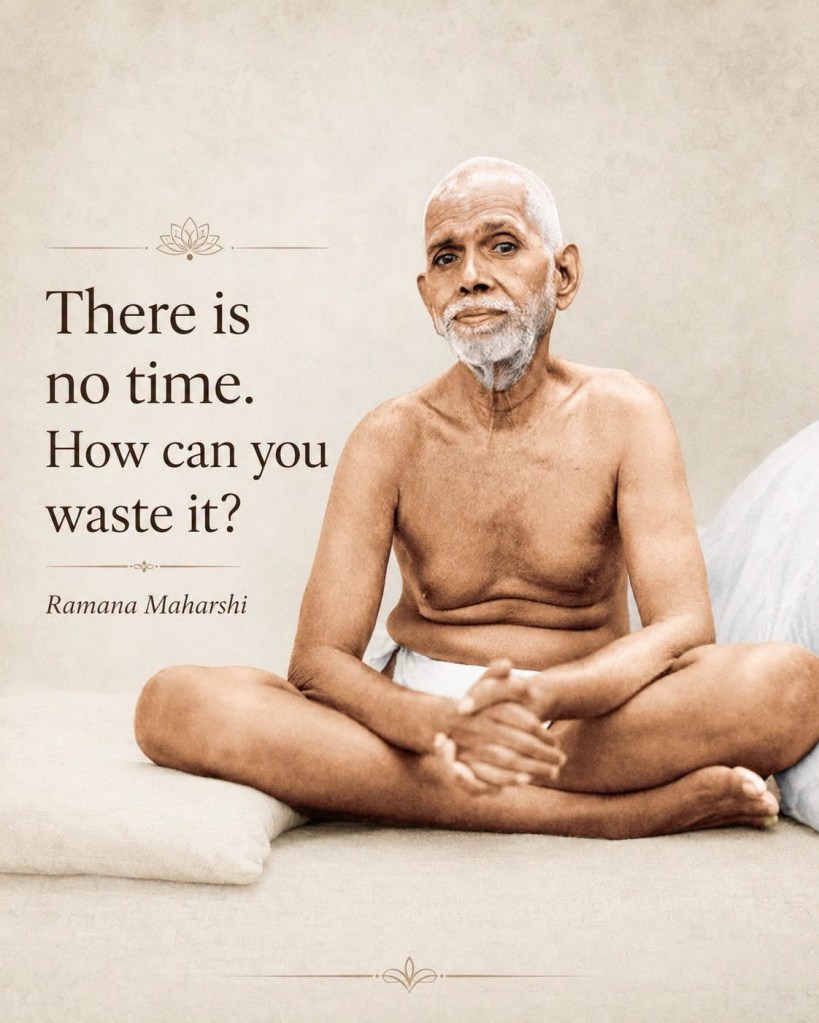
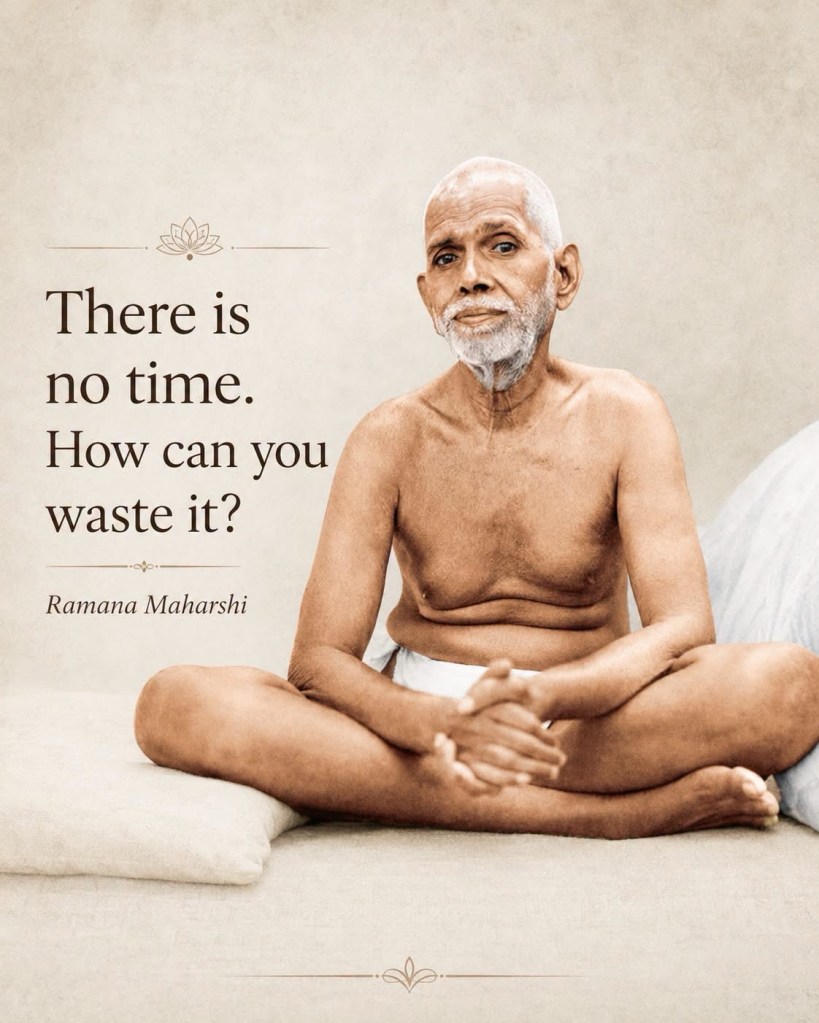
ரமண மகரிஷியின் இந்தத் திருவுருவப் படத்தோடு நம்முன் வைக்கப்படும் அந்தப் புதிரான கேள்வி இதுதான்: காலம் என்று ஒன்றுமே இல்லாதபோது, அதை ஒருவரால் எப்படி வீணடிக்க முடியும்? அதே நேரத்தில், காலம் என்ற ஒரு இருப்பு (ontological entity) நிஜமாகவே இருக்கிறது என்றும், அது மிகக் குறுகிய கால அளவைக் கொண்டதுதான் என்றும் உங்கள் விழிப்புணர்வுக்குள் ஓர் எண்ணம் இருக்குமேயானால்… நீங்கள் அதை வீணாக்காமல் இருப்பதே நல்லது.

இந்த இரண்டு கேள்விகளில் எதற்குத்தான் நாம் விடை காணப் போகிறோம்? தத்துவ ரீதியாக இரண்டுமே பிரம்மாண்டமானவை, அச்சுறுத்தக் கூடியவை. வேதாந்தத்தில், காலம் என்பது நேர்க்கோட்டுப் பாதையில் அமையாமல், சுழற்சி முறையில் (cyclical sense) இயங்கும் ஒரு எல்லையற்ற, நிஜமான இருப்பாகவே தெளிவாக முன்வைக்கப்படுகிறது.

ரமண மகரிஷி ஒரு வேதாந்தி. அப்படியென்றால், அவர் காலத்தின் எந்தப் பரிமாணத்தை இங்கே சுட்டிக்காட்டுகிறார்? அல்லது, சீடர்கள் தங்களுக்குள் தாங்களே இதைக் கண்டறிந்து கொள்ளட்டும் என்று அப்படியே விட்டுவிட்டாரா?

The Unknown Sri Vaishnava: இது ஒரு மிகச்சிறந்த வாதப் பொறி. ஆனால் நான் உங்களிடம் ஒன்று கேட்கிறேன்: அந்த வரியை இப்போது வாசிப்பது யார்? காலத்தைக் கடந்த ஒரு தத்துவப் பொருளா, அல்லது செமஸ்டர் காலக்கெடுவை நினைத்து இப்போது பதற்றமடைந்து கொண்டிருக்கும் ஒரு மாணவரா?

மாணவர்: வெளிப்படையாகப் பார்த்தால் இந்த மனம் தான் அதை வாசிக்கிறது. ஆனால், இந்த சுயவிசாரணை நமது கவனத்தை மாற்றுகிறது. ரமணர் இங்கு பரமார்த்திக சத்தியத்தை (உண்மை நிலை) சுட்டிக்காட்டுகிறார். அத்வைதத்தில், காலம் என்பது வெறும் வியவஹாரிக (உலகியல்) நிலையில் மட்டுமே இருக்க முடியும். காலத்தை அனுபவிப்பது யார் என்று நாம் கேள்வி கேட்கும்போது, அகந்தை கரைந்து, தூய விழிப்புணர்வின் காலமற்ற திரை மட்டுமே எஞ்சியிருக்கும்.

The Unknown Sri Vaishnava: ஆஹா, வழக்கமான அந்த இருநிலை தப்பித்தல் வழி. சொல்லுங்கள், இந்த பரமார்த்திக-வியவஹாரிக இருமை என்பது எல்லாவற்றையும் மறைப்பதற்கான ஒரு வசதியான தத்துவக் கம்பளம் (rug) அல்லவா? இந்த பிரபஞ்சத்தின் அப்பட்டமான புற யதார்த்தத்தையோ அல்லது காலத்தைக் கடந்த ஆன்மா ஏன் துயரத்தை அனுபவிக்கிறது என்பதையோ அத்வைதத்தால் எப்போது திருப்திகரமாக விளக்க முடியவில்லையோ, அப்போதெல்லாம் அது ஒட்டுமொத்த பிரபஞ்சத்தையும் அந்த கம்பளத்தின் கீழ் தள்ளி, அதை ஒரு “உலகியல் மாயை” என்று சொல்லிவிடுகிறது.

மாணவர்: அது மிகவும் கடுமையான விமர்சனம். இது ஒரு கற்பிக்கும் கருவி; ஒரு முள்ளை எடுக்கப் பயன்படும் மற்றொரு முள் போன்றது. மொழி இயல்பிலேயே இருமைத் தன்மை கொண்டது; அதனால் பரமார்த்திக நிலையை நேரடியாக வெளிப்படுத்த முடியாது. இந்த இருமை நிலை என்பது கடந்து செல்வதற்காகத்தானே தவிர, அதையே பிடித்துக் கொண்டிருப்பதற்கல்ல.

The Unknown Sri Vaishnava: ஆனால் அதை நீங்கள் கடக்க முயலும் வரை, அது உங்களை எங்கே கொண்டு போய் நிறுத்துகிறது? அது உங்களை ஒரு உளவியல் அந்திப் பொழுதில் (twilight zone) தவிக்க விடுகிறது. உங்களைச் சுற்றியுள்ள உலகம் வெறும் புலன்களின் கானல் நீர் என்று உங்களிடம் சொல்லப்படுகிறது. ஆனால் நீங்கள் தேடும் அந்த “நான்” என்பது புலன்களுக்கு அப்பாற்பட்டது என்று வரையறுக்கப்படுகிறது. உங்களால் அறிய முடிகிற அல்லது ஊகிக்க முடிகிற அனைத்தும் மாயையின் ஒரு பகுதி என்றால், உங்கள் விசாரணைக்கு நீங்கள் பயன்படுத்தும் கருவிகளும் மாயைதானே? நீங்கள் ஒரு தர்க்கரீதியான சிறையை உருவாக்கியிருக்கிறீர்கள்: எல்லா இருப்புகளும் நிபந்தனைக்குட்பட்டவை; நான் இங்கே இருக்கிறேன்; எனவே, நான் நிபந்தனையுடன்தான் இருக்கிறேன் மற்றும் விடுதலை என்பது தர்க்கரீதியாக சாத்தியமற்றது. ஒரு கானல் நீர் எப்படி ஒருவனின் உண்மையான தாகத்தைத் தீர்க்க முடியும்?

மாணவர்: ஆத்ம விசாரணை என்பது மனதால் பரமார்த்திக நிலையைப் பிடிப்பது அல்ல. அது கவனத்தை உள்நோக்கித் திருப்புவதாகும். “நான்” என்ற எண்ணத்தின் மூலத்தை நீங்கள் தேடிச் செல்லும்போது மனம் அமைதியாகிறது. நீங்கள் காலமின்மையைப் புரிந்து கொள்ள வேண்டிய அவசியமில்லை; எண்ணங்கள் ஒரு நிபந்தனையற்ற விழிப்புணர்வுக்குள் தோன்றி மறைகின்றன என்பதை உணர்ந்தால் போதும்.

The Unknown Sri Vaishnava: ஆனால் அந்த விழிப்புணர்வு ஏன் வெற்று, தனிமைப்படுத்தப்பட்ட திரையாக இருக்க வேண்டும்? இங்குதான் அத்வைதம் தவிர்க்கும் துல்லியத்தை விசிஷ்டாத்வைதம் வழங்குகிறது. அந்த “நான்” என்பது எட்ட முடியாத ஒரு நிழல் அல்ல; அது ஒரு உண்மையான, நித்தியமான, தனித்துவமான ஆன்மா — ஒரு ஜீவாத்மா. உங்கள் அந்திப் பொழுது முரண்பாட்டைத் தீர்க்கும் இரண்டு பரிமாண விழிப்புணர்வு அதற்கு உண்டு.

மாணவர்: இரண்டு பரிமாணங்களா? விளக்குங்கள்.

The Unknown Sri Vaishnava: ஒன்று தர்ம ஞானம், அதாவது உங்கள் சாராம்ச விழிப்புணர்வு — “நான் இருக்கிறேன்” என்ற மைய உணர்வு. மற்றொன்று தர்மபூத ஞானம், அதாவது உங்கள் பண்புசார் விழிப்புணர்வு. இது உங்கள் மனம் மற்றும் புலன்களின் வழியாக வெளி உலகை அறியப் பாயும் விழிப்புணர்வு ஆகும்.

மாணவர்: அது எப்படி இந்த இருமைப் புதிரைத் தீர்க்கிறது?

The Unknown Sri Vaishnava: பந்தப்பட்ட நிலையில், உங்கள் தர்மபூத ஞானம் கர்மாவினால் சுருங்கியுள்ளது (சங்கோசம்). நீங்கள் உலகைப் பார்க்கும்போது, துண்டுகளாகவும், எல்லைகளுக்குட்பட்டதாகவும், வரையறுக்கப்பட்ட காலமாகவும் பார்க்கிறீர்கள். உலகம் என்பது கம்பளத்தின் கீழ் தள்ளப்பட்ட ஒரு போலி மாயை அல்ல; உங்கள் பார்வையின் அகலம் சுருங்கியிருக்கிறது, அவ்வளவுதான். ஆத்ம விசாரணை என்பது உலகை அழிப்பது அல்ல; இந்த பண்புசார் விழிப்புணர்வை விரிவடையச் (விகாசம்) செய்வதாகும்.

மாணவர்: அப்படியென்றால், இந்த விசாரணை “நான்” என்பதை ஒரு வெற்றுப் பாழாகக் கரைத்துவிடாது என்று சொல்கிறீர்களா?

The Unknown Sri Vaishnava: நிச்சயமாக. அது உங்கள் உண்மையான சுவரூபத்தை (இயல்பை) வெளிப்படுத்துகிறது. அப்ருதக்சித்தி (பிரித்துப் பார்க்க முடியாத, பிரிக்க முடியாத தொடர்பு) என்ற கோட்பாட்டின் மூலம், நீங்கள் இறைப் பேரிருப்பைச் சார்ந்து இயங்குபவர் என்பதை உணர்ந்துகொள்கிறீர்கள். நீங்கள் ஒரு தாசபூதன் — பிரம்மத்தின் ஒரு பிரிக்க முடியாத பகுதி. உங்கள் நிபந்தனைக்குட்பட்ட நிலை ஒரு தத்துவத் தவறு அல்ல; அது உங்கள் இயல்பான கட்டமைப்பு உண்மை.

மாணவர்: இது மிகவும் வியப்பாக இருக்கிறது. ரமணரின் பாதையை அதன் தர்க்கரீதியான இறுதிவரை நான் பின்பற்றினால், “நான்” என்ற விசாரணை உங்களின் தத்துவப் புரிதலில் வந்துதான் முடிகிறது. ரமணர் அகந்தையின் போலி காலக் கோட்டை — அந்த வெற்றுப் காலமின்மையை (Timelessness) — தகர்க்கிறார்; ஆனால் ராமானுஜர் இந்த பிரபஞ்சத்தில் ஆன்மாவின் உண்மையான இடத்தை நமக்குக் காட்டுகிறார்.

The Unknown Sri Vaishnava: துல்லியமாகச் சொன்னீர்கள். ரமணர் சுயநலமிக்க, சுதந்திரமான அகந்தையை உடைப்பதன் மூலம் வழியைச் சீரமைக்கிறார். ஆனால் வழி சீரானவுடன், நீங்கள் கண்டறிந்த அந்த நிபந்தனையற்ற விழிப்புணர்வு உண்மையில் இந்த பிரம்மாண்டமான, உண்மையான பிரபஞ்சத்தின் ஒரு பகுதி என்பதை ராமானுஜர் காட்டுகிறார். நீங்கள் ஒரு வெற்று காலமின்மையிலிருந்து புனிதமான கால நிறைவை (Time-fullness) நோக்கி நகர்கிறீர்கள். ஆனால் நீங்கள் தத்துவத்திலிருந்து வெளியேறி நவீன இயற்பியலைப் பார்க்கும்போது என்ன நடக்கிறது என்று பாருங்கள். ஆல்பர்ட் ஐன்ஸ்டீனும் ஸ்டீபன் ஹாக்கிங்கும் தங்கள் வாழ்நாள் முழுவதையும் “காலம்” என்ற இந்தத் தன்மையை கணித ரீதியாக வரையறுக்கவே செலவிட்டனர்.

மாணவர்: முதலில் ஐன்ஸ்டீனைப் பார்ப்போம். அவருக்கு முன்பு வரை, காலம் என்பது அனைவருக்கும் சீராக ஓடும் ஒரு உலகளாவிய கடிகாரம் என்றுதான் எல்லாரும் நினைத்தார்கள். ஆனால் சார்பியல் கோட்பாட்டின் மூலம், காலம் என்பது வேகம் மற்றும் ஈர்ப்பு விசைக்கு ஏற்ப சுருங்கி விரியும் ஒரு சார்பு நிலை என்பதை ஐன்ஸ்டீன் காட்டினார். அவர் இடத்தையும் காலத்தையும் spacetime (வெளி-காலம்) என்ற ஒற்றை நான்கு பரிமாணக் கட்டமைப்பாக இணைத்தார். இது Block Universe (தொகுதிப் பிரபஞ்சம்) என்ற கருத்துக்கு வழிவகுத்தது. அதில் கடந்த காலம், நிகழ்காலம், எதிர்காலம் அனைத்தும் ஒரே நேரத்தில் ஒரு நிலையான வடிவியல் அமைப்பில் உள்ளன. கடந்த காலம், நிகழ்காலம், எதிர்காலத்திற்கு இடையேயான வேறுபாடு என்பது வெறும் “முரட்டுத்தனமாகத் தொடரும் ஒரு மாயை” என்று ஐன்ஸ்டீன் எழுதினார்.

The Unknown Sri Vaishnava: ஐன்ஸ்டீனின் இந்த பிளாக் யூனிவர்ஸ் என்பது ரமண மகரிஷியின் பரமார்த்திக நிலையின் கணித வடிவமே ஆகும். ரமணர் “காலம் என்பதே இல்லை” என்று சொல்லும்போதும், ஐன்ஸ்டீன் காலத்தின் ஓட்டம் ஒரு மாயை என்று சொல்லும்போதும், அவர்கள் யதார்த்தத்தின் ஒரே கட்டமைப்பைத்தான் பார்க்கிறார்கள். அவர்கள் ப்ரொஜெக்டர் அறைக்கு வெளியே நின்று, ஒட்டுமொத்த திரைப்படச் சுருளையும் ஒரே நேரத்தில் பார்ப்பதைப் போன்றது இது.

மாணவர்: ஆமாம்! ஆனால் ஐன்ஸ்டீனின் இயற்பியல் காலத்தின் ஓட்டத்தை மறுக்கிறதே தவிர, மனம் ஏன் அந்த ஓட்டத்தை உணர்கிறது என்பதை விளக்குவதில்லை. அது விழிப்புணர்வுள்ள மனிதனை மாற்றங்களை உணரும் ஒரு விவரிக்க முடியாத சூழலில் தவிக்க விட்டுவிடுகிறது. அங்குதான் ஸ்டீபன் ஹாக்கிங் உள்ளே வருகிறார். அவர் Arrow of Time (காலத்தின் அம்பு) என்பதில் கவனம் செலுத்தினார் — நாம் அனுபவிக்கும் யதார்த்தத்தின் மாறாத திசை அது. Thermodynamic Arrow (வெப்ப இயக்கவியல் அம்பு) மூலம் ஒழுங்கின்மை (என்द्रोह்பி) எப்போதும் அதிகரிக்கிறது என்றும், மற்றும் Psychological Arrow (உளவியல் அம்பு) மூலம் நாம் கடந்த காலத்தை நினைவில் கொள்கிறோம், எதிர்காலத்தை அல்ல என்றும் விளக்கினார். நம் மூளையில் ஆற்றல் செலவழிக்கப்படுவதாலும் ஒழுங்கின்மை அதிகரிப்பதாலும் தான் நம்முடைய உளவியல் கால உணர்வு தீர்மானிக்கப்படுகிறது என்று ஹாக்கிங் வாதாடினார்.

The Unknown Sri Vaishnava: ஹாக்கிங் செய்ததை இப்போது கவனித்துப் பாருங்கள். காலத்தின் உளவியல் அனுபவத்தை நேரடியாக ஆற்றல் செலவினத்தோடும் பிரபஞ்ச விரிவோடும் இணைப்பதன் மூலம், ஹாக்கிங் காலத்தின் சார்பு நிலை உண்மையானது என்பதை முழுமையாக ஏற்றுக்கொள்கிறார். அவர் நம் கால அனுபவத்தை ஒரு மலிவான மாயை என்று நிராகரிக்கவில்லை; பிரபஞ்சத்தின் கட்டமைப்பு இயக்கத்தோடு அதை இணைக்கிறார். இது ராமானுஜரின் தர்மபூத ஞானத்தின் அப்பட்டமான இயற்பியல் வடிவம் அல்லவா! உங்கள் வெளிநோக்கிப் பாயும் விழிப்புணர்வு இந்த இயற்பியல் பிரபஞ்சத்தோடு பிரிக்க முடியாதபடி இணைக்கப்பட்டுள்ளது. உடலின் தன்மையால் கட்டுண்டு, அது காலத்தை வரிசையாகத்தான் அனுபவிக்க வேண்டும்.

மாணவர்: அப்படியென்றால் இது மிகச்சரியாகப் பொருந்துகிறது: ரமணரின் தீவிரமான காலமின்மை ஐன்ஸ்டீனின் பிளாக் யூனிவர்ஸோடு ஒத்துப்போகிறது, ராமானுஜரின் கால நிறைவுஹாக்கிங்கின் காலத்தின் அம்போடு ஒத்துப்போகிறது.

The Unknown Sri Vaishnava: ஆனால் ஒரு முக்கியமான முரண்பாட்டை மறந்துவிடாதீர்கள். ஐன்ஸ்டீனும் ஹாக்கிங்கும் விழிப்புணர்வை ஒரு இரண்டாம் தர விளைவாக மட்டுமே பார்த்தார்கள் — ஒரு உயிரற்ற, இயந்திரத்தனமான பிரபஞ்சத்தைப் புரிந்துகொள்ள முயற்சிக்கும் ஒரு சாதாரணப் பார்வையாளனாகவே அதை நடத்தினார்கள். ஆனால் இந்த ரமண-ராமானுஜ தர்சனம் அந்தப் பிரமிப்பையே தலைகீழாக மாற்றுகிறது. நிலையான, காலமற்ற பின்னணியும் (ஐன்ஸ்டீனின் பிளாக்), நகரும் வெப்ப இயக்கவியல் ஓட்டமும் (ஹாக்கிங்கின் அம்பு) வெறும் ஜடப் பொருளின் பண்புகள் அல்ல, அவை விழிப்புணர்வின் (Awareness) பரிமாணங்கள் என்பதை இது காட்டுகிறது. இயற்பியலாளர்கள் வீட்டின் கட்டமைப்பைக் கண்டுபிடித்தார்கள், ஆனால் வேதாந்தம் வீட்டிற்குள் வாழ்பவரைக் கண்டுபிடித்தது.

மாணவர்: எனவே இந்த “நான்” என்பது ஒட்டுமொத்தத்தின் ஒரு பிரிக்க முடியாத பகுதியாக நிபந்தனைக்குட்பட்டது, அதே சமயம் அந்த ஒட்டுமொத்த விழிப்புணர்வே அதன் இறுதி சுவரூபம் என்பதால் அது முற்றிலும் சுதந்திரமானது. எந்த ஒரு தத்துவக் கம்பளமும் இல்லாமலேயே இந்த முரண்பாடு தீர்ந்துவிடுகிறது.

The Unknown Sri Vaishnava: சரியாகச் சொன்னீர்கள். விவாதம் என்பது காலம் இருக்கிறதா இல்லையா என்பதைப் பற்றியது அல்ல; அதற்குள் நின்றுகொண்டிருக்கும் உங்களை நீங்கள் எவ்வளவு ஆழமாகப் பார்க்கத் தயாராக இருக்கிறீர்கள் என்பதைப் பற்றியது. இந்த விவாதத்தை மேலும் நீட்டிப்பது ரமணரின் முதன்மை நோக்கத்திலிருந்து நம்மை விலக்கிவிடும். கவிஞர்களின் வரிகள் நம் விசாரணையின் இறுதி எல்லையோடு இணையும் இடத்தில் இந்த உரையாடலை நாம் நிறைவு செய்வோம்.


“ஒரு மணல் துகளில் உலகைக் காணவும்

ஒரு காட்டு மலரில் சொர்க்கத்தைக் காணவும்,

உன் உள்ளங்கையில் எல்லையற்றதைத் தாங்கவும்

ஒரு மணி நேரத்தில் நித்தியத்தை வாழவும் முடியும்.”

— வில்லியம் பிளேக்


“நகரும் விரல் எழுதுகிறது; எழுதி முடித்த பின்,

நகர்ந்து செல்கிறது: உன் பக்தியோ அறிவோ

அதை ஒரு வரி கூட மாற்றத் தூண்ட முடியாது,

உன் கண்ணீர் அனைத்தும் அதன் ஒரு வார்த்தையைக் கூட அழிக்க முடியாது.”

— உமர் கய்யாம்

From Ramana to Ramanuja; and from Einstein to Hawking: Timelessness to Time-Fullness

by M.K. Sudarshan

July 8, 2026 : Chennai, India

From left to right: Ramana Maharishi, Sri Ramanujacharya, Albert Einstein and Stephen Hawking

Setting: A quiet corner of a university library. On the table sit copies of Ramana Maharshi’s Ulladu Narpadu and Ramanuja’s Sri Bhashya, now buried under papers covering general relativity, quantum cosmology, and thermodynamics.

Student: Look at this quote from Ramana Maharshi. It’s devastatingly simple: “There is no time. How can you waste it?” It completely shatters the linear grid we live in. If time is an illusion, the entire engine of human anxiety collapses.

The tantalising question posed here with the image of Ramana Maharishi :

If there is no such thing as Time , how can anyone be wasting it? And if there is inside your consciousness the idea that there is such an ontological entity called Time … and that it is finite … then you better not waste it.

Which one of the two questions does one want to answer ? Both are philosophically so daunting. In Vedanta , Time is clearly postulated as an infinite, ontological reality in the cyclical sense, not linear. Ramana Maharishi was a Vedantin. So, which sense of Time was he really alluding to ? Or, was he simply leaving it for his disciples to figure it out all by themselves ?

The Unknown Sri Vaishnava: It’s an excellent rhetorical trap. But let me ask you: who is reading that quote? A timeless entity, or a student who is currently worried about a semester deadline?

Student: Obviously, the mind reads it, but the inquiry shifts the focus. Ramana is pointing to the absolute standpoint—Paramarthika Satya. In Advaita, time only exists in the relative world (Vyavaharika). By questioning who experiences time, the ego dissolves, and you are left with the timeless screen of pure Consciousness.

The Unknown Sri Vaishnava: Ah, the classic two-tier escape hatch. Tell me, isn’t this Paramarthika-Vyavaharika binary just a convenient conceptual rug? Whenever Advaita cannot convincingly explain the gritty reality of physical existence, or why a timeless soul experiences suffering, it simply shoves the whole universe under that rug and calls it a “relative illusion.”

Student: That’s a harsh reading. It’s a pedagogical tool, a thorn to remove a thorn. Language is inherently dualistic; it can’t express the absolute directly. The binary is meant to be transcended, not defended.

The Unknown Sri Vaishnava: But look where it leaves you while you are trying to transcend it! It leaves you stranded in a psychological twilight zone. You are told the world around you is a mere sensory projection, a mirage. Yet the “Me” you are searching for is defined as being completely beyond the senses. If everything you can perceive or infer is part of the illusion, then the tools of your inquiry are also illusions. You’ve built a syllogistic prison: All existence is conditioned; I am here; therefore, I exist conditionally and freedom is mathematically impossible. How does a mirage quench a real thirst?

Student: Atma-Vichara isn’t about the mind grasping the absolute. It’s about turning the attention around. When you trace the “I-thought” back to its source, the mind grows quiet. You don’t need to understand timelessness; you just see that thoughts arise and fall within an unconditioned awareness.

The Unknown Sri Vaishnava: But why must that awareness be a blank, isolated screen? This is where Vishishtadvaita provides the precision that Advaita evades. The “Me” is not an unreachable phantom; it is a real, eternal, monadic point of consciousness—a Jivatman. And it possesses two dimensions of consciousness that solve your twilight zone paradox completely.

Student: Two dimensions? Explain.

The Unknown Sri Vaishnava: There is Dharmi-Jnana, your substantive consciousness—the core “I am.” And then there is Dharmabhuta-Jnana, your attributive consciousness. This is the awareness that flows outward through your mind and senses to perceive the world.

Student: How does that fix the binary?

The Unknown Sri Vaishnava: In your state of bondage, your Dharmabhuta-Jnana is contracted by karma. When you look at the world, you see fragmentation, limits, and finite time. The world isn’t a fake illusion swept under a rug; your aperture is just narrowed. Atma-Vichara isn’t the annihilation of the world; it is the expansion (vikasa) of this attributive consciousness.

Student: So you are saying the inquiry doesn’t dissolve the “Me” into a void?

The Unknown Sri Vaishnava: Exactly. It reveals your true Svarupa (nature). Through the doctrine in Visishtadvaita of Aprathaksiddhi, you realize you are inseparably dependent on the Divine Whole. You are a Dasabhuta—an integral, atomic part of Brahman. Your conditioning isn’t a cosmic mistake; it’s your constitutional reality.

Student: This is fascinating. If I follow Ramana’s arc to its logical conclusion, the investigation into the “Me” actually lands right into your Visishtadvaita epistemology. Ramana strips away the ego’s false timeline—the empty Timelessness—but Ramanuja gives the structural reality of the soul’s place in the universe.

The Unknown Sri Vaishnava: Precisely. Ramana clears the field by dismantling the arrogant, independent ego. But once the field is cleared, Ramanuja shows that the unconditioned awareness you found is actually a participant in a magnificent, real universe. You move from an empty timelessness to a sacred, Time-fullness. But look at what happens when you step out of philosophy entirely and look at modern physics. Albert Einstein and Stephen Hawking spent their entire lives trying to mathematically pin down this exact entity called Time.

Student: Let’s look at Einstein first. Before him, everyone assumed time was a universal clock ticking uniformly. But with relativity, Einstein showed that time is relative, stretching and warping depending on speed and gravity. He merged space and time into a single, four-dimensional fabric called spacetime, leading to the concept of the Block Universe. In it, past, present, and future all exist simultaneously in a fixed geometry. Einstein famously wrote that the distinction between past, present, and future is nothing but a “stubbornly persistent illusion.”

The Unknown Sri Vaishnava: Einstein’s Block Universe is the mathematical equivalent of Ramana Maharshi’s absolute standpoint. When Ramana says “There is no time,” and Einstein says the flow of time is an illusion, they are looking at the exact same architectural feature of reality. They are standing outside the cinema-projector booth, looking at the entire film reel laid out at once.

Student: Yes! But Einstein’s physics strips time of its flow without explaining why the mind experiences that flow. It leaves the conscious observer completely stranded in an unaccounted-for experience of change. That is where Stephen Hawking stepped in. He focused on the Arrow of Time—the undeniable direction in which we experience reality, driven by the Thermodynamic Arrow where entropy always increases, and the Psychological Arrow by which we remember the past but not the future. Hawking argued that our psychological perception of time is dictated by the expenditure of energy and the increasing sense of disorder in the brain.

The Unknown Sri Vaishnava: Look at what Hawking just did. By tying the psychological experience of time directly to the physical expenditure of energy and the expansion of the cosmos (Cosmological Arrow of Time), Hawking completely validated the relative reality of time. He didn’t dismiss our experience of time as a cheap illusion; he anchored it to the structural, evolving mechanics of the universe. This is the exact physical counterpart to Ramanuja’s Dharmabhuta-Jnana! Your outward-flowing awareness is structurally integrated with the physical universe. Bound by biology, it must experience time sequentially.

Student: So it aligns perfectly: Ramana’s radical Timelessness aligns with Einstein’s Block Universe, while Ramanuja’s Time-fullness aligns with Hawking’s Arrows of Time.

The Unknown Sri Vaishnava: But do not miss the ultimate dissimilarity. Einstein and Hawking treated consciousness as a secondary byproduct—a passive spectator trying to understand a dead, mechanical universe. The Ramana-Ramanuja darsana flips the entire pyramid. It shows that both the static, timeless background and the dynamic, thermodynamic flow are dimensions of Awareness itself. The physicists found only the architecture of the house, but it was Vedanta that found the Resident.

Student: So the “Me” is conditionally dependent as an inseparable part of the whole, yet absolutely free because the foundational awareness illuminating that entire spacetime block is its ultimate Svarupa. The paradox resolves without needing the rug.

The Unknown Sri Vaishnava: Exactly. The debate was never about whether time exists; it was about how deeply you are willing to look at the one standing within it. To stretch this discussion any further would only stray from Ramana’s original proposition. Let us therefore, instead, seal this dialogue here and now where the insights of the poets match the absolute horizon of our inquiry.

“To see a World in a Grain of Sand,
And a Heaven in a Wild Flower,
Hold Infinity in the palm of your hand
And Eternity in an hour.”

— William Blake

“The Moving Finger writes; and, having writ,
Moves on: nor all thy Piety nor Wit
Shall lure it back to cancel half a Line,
Nor all thy Tears wash out a Word of it.”

— Omar Khayyam

My Semantic Note on “Saivam” and “Asaivam”

மரக்கறி

Vegetarian food என்பதற்கு “மரக்கறி உணவு” என்ற சொல்தான் பயன்பாட்டில் இருந்தது.

அதை மாற்றுகிறேன் பேர்வழி என்று யாரோ ஒருவர் “அசைவம்” என்று ஒரு பொருத்தமற்ற சொல்லை உபயோகத்தில் விட, அரசாங்கம் உட்பட அனைவரும் அதையே பயன்படுத்தத் தொடங்கி விட்டனர்.

சிவனை வணங்குதலே “சைவம்” எனப்படும். சைவத்தைப் பின்பற்றுவோர் சைவர். அவர்கள் அனைவரும் vegetarian ஆகத்தான் இருக்க வேண்டிய கட்டாயமும் இல்லை. கண்ணப்ப நாயனாரே சைவர்தான். “பிள்ளைக் கறி” சமைக்கச் சொன்னவரும்,  சைவர் உருவில் வந்த சிவனாரே! சமைத்துப் போட்டவர்களும் சைவரே! எனவே “சைவர்” என்றால் vegetarian என்று ஆகாது. சிவபெருமானை வழிபடுபவர்கள் என்று மட்டும் தான் பொருள்.

அதன்படி பார்த்தால், சைவ நெறியில் இல்லாமல், வைணவத்தையோ, சாக்தத்தையோ பின்பற்றுபவர் 

“அ-சைவர்” என்றாகும். அவர்களும் veg, non-veg என்று எதனை உண்பவராகவும் இருக்கலாம்.

சைவம், அசைவம் என்ற சொற்களுக்கும், veg , non-veg உணவுப் பழக்கத்திற்கும் ஏது சம்பந்தமும் இல்லை.

Marakkari
The phrase “marakkari unavu” was in use for vegetarian food.
Someone changed that and, by popular usage, introduced the inappropriate term “asaivam” (non‑veg), and now everyone — including the government — has begun to use it.
Worship of Siva is called “Saivam.” Followers of Saivam are Saivars. That does not imply that all Saivars are necessarily vegetarians. Kannappa Nayanar was a Saivar. The very one who told him to cook the “child’s meat” (pillai kari) is Siva in the form of a Saivar! Those who cooked it were Saivars too. Therefore “Saivar” does not mean vegetarian; it simply means worshippers of Siva.
Viewed this way, someone who does not follow Saivam but follows Vaishnavism or Shaktism would be an “a‑Saivar” (non‑Saivar). They too may eat either veg or non‑veg. The words Saivam and a‑Saivam have nothing to do with vegetarian or non‑vegetarian dietary habits.

— பிலாய் சங்கர சுப்பிரமணியன் *************************************

To the above argument my own nuanced response in English is as below ⬇️

This is indeed a fair argument, and from a semantic point of view it is also quite logical.

However, there is another semantic nuance that should also be taken into account. The Tamil word “Siva” is derived from the Sanskrit “Shiva.” The word “Shiva” denotes not only the Vedic deity, but also carries the meaning of “auspiciousness.” When we attribute “Shivam” to anything or anyone, we also indicate “Shubham,” that is, auspiciousness or blessedness. The Sri Rudram is a Vedic passage that strongly underscores this special and synonymous significance of the word “Shiva.”

Given this semantic background, the Tamil word “asaivam” may refer not only to those who are non-worshippers of Siva, but also to the quality of inauspiciousness. In the eyes of ardent Saivites — for instance, in periods such as the age of the Chola king Kulottunga — non-Saivites could be regarded as inauspicious heretics.

Accordingly, when the word “asaivam” came to be tagged onto non-vegetarian food, the common intention was not necessarily to associate diet with the deity, but rather to ascribe to such food a quality of inauspiciousness — rajasic as opposed to sattvic.

In that sense, the deity was not being directly associated with the diet here; rather, a value judgment was being attached to the food through an inherited semantic and cultural register.

Sudarshan Madabushi

In தமிழ்:

இது உண்மையிலேயே நியாயமான வாதமாகும்; சொற்பொருள் நோக்கிலும் மிகத் தர்க்கபூர்வமானதாகும்.

ஆனால், இதனுடன் சேர்த்து கவனிக்கப்பட வேண்டிய இன்னொரு பொருளியல் நுட்பமும் உள்ளது. தமிழ் “சிவ” என்ற சொல் சமஸ்கிருத “ஶிவ” என்பதிலிருந்து வந்தது. “ஶிவ” என்பது வேதத் தெய்வத்தைக் குறிப்பதற்கே மட்டுமல்ல; “மங்களம்”, “சுபம்”, “அமங்கலநிவிர்த்தி” ஆகிய அர்த்தங்களையும் தருகிறது. நாம் எதற்காவது அல்லது எவருக்காவது “சிவம்” என்ற பண்பைச் சொன்னால், அதனுடன் “சுபம்” என்னும் கருத்தையும் இணைத்தே சொல்கிறோம். “ஸ்ரீ ருத்ரம்” எனப்படும் வேதப்பகுதி, “ஶிவ” என்ற சொல்லின் இவ்விசேஷமான மற்றும் இணைப்பொருள் வாய்ந்த முக்கியத்துவத்தை வலியுறுத்துகிறது.

இந்தப் பொருளியல் அடிப்படையில் பார்த்தால், “அசைவம்” என்ற தமிழ் சொல் “சிவனை வணங்காதவர்” என்ற பொருளை மட்டுமல்லாமல், “அமங்களத் தன்மை” அல்லது “சுபமின்மை” என்பதையும் குறிக்கக்கூடும். சைவப் பற்றுள்ளோரின் பார்வையில் — குறிப்பாகச் சோழர் குலோத்துங்கன் காலம் போன்ற கட்டங்களில் — அசைவர்கள் அனைவரும் அமங்கலமான மதவெறியர்கள் அல்லது மதவிலகியவர்கள் எனக் கருதப்பட்ட சூழல்கள் இருந்தன.

ஆகவே, “அசைவம்” என்ற சொல் மாமிச உணவுக்குப் பயன்படுத்தப்படத் தொடங்கியபோது, அதன் பொதுவான நோக்கம் தெய்வத்தையும் உணவுமுறையையும் நேரடியாக இணைப்பது அல்ல. மாறாக, அத்தகைய உணவுக்கு “அமங்களம்” என்ற மதிப்பீட்டையும், “சாத்த்விகம்” என்பதற்கு மாறான “ராஜசிகம்” என்ற குணநிலையையும் ஒதுக்கிக் காட்டுவதே அதன் உள்நோக்கமாக இருந்தது.

எனவே, இங்கு தெய்வம் உணவுடன் இணைக்கப்படவில்லை; மாறாக, மரபாக வந்த பொருள் மற்றும் பண்பாட்டு பயன்பாட்டின் மூலம் உணவிற்கு ஒரு மதிப்பீட்டு அடையாளம் சூட்டப்பட்டுள்ளது.

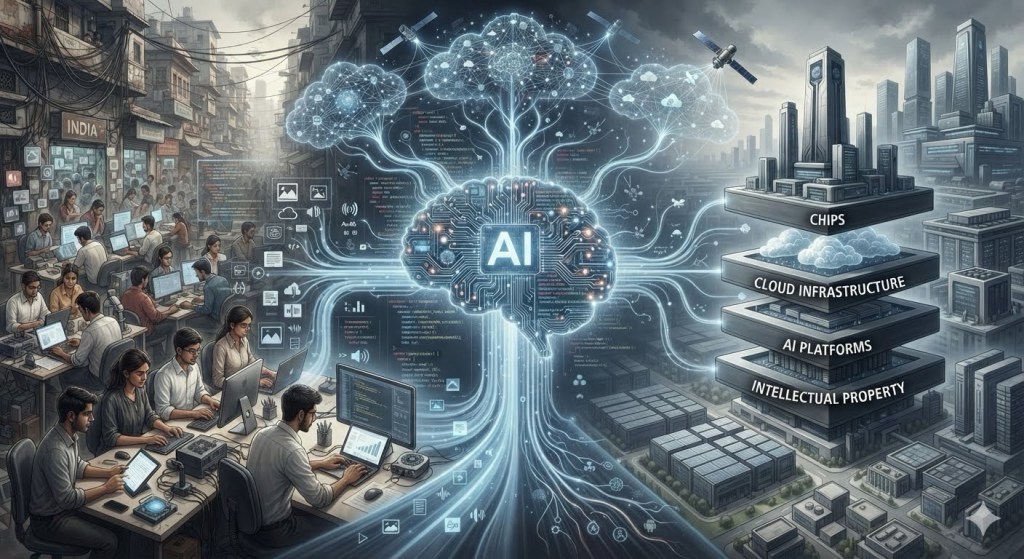
India, AI, and the Question of Ownership: Do we really have a grand-strategy for the AI future?

by M. K. Sudarshan

July 6, 2026: Chennai, India

A YouTube video recently circulated widely because it captured something that many people have begun to feel but have not yet fully named.

https://youtu.be/UfyxN46tCz8?si=DeZxeZ_XhW_7IEtp

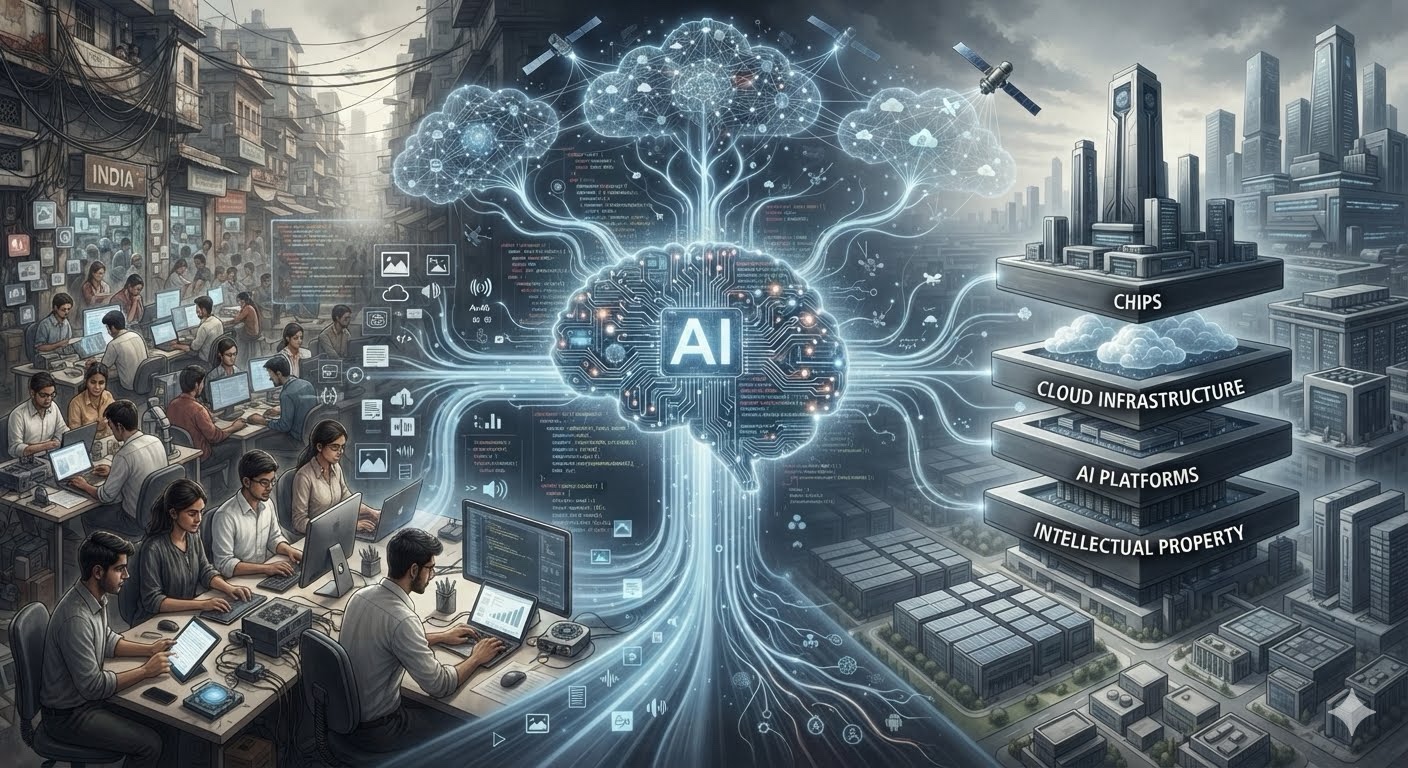
The video pointed to a striking reality: millions of Indians are already helping teach machines how to think, see, understand, and act. That may sound impressive, even futuristic. But it also raises a more uncomfortable question — if a nation supplies the human intelligence that trains global AI, but does not own the models, chips, platforms, or intellectual property, who is truly capturing the value?

That is the larger theme beneath the fascination. India is already part of the global AI machine. The deeper issue is whether it will remain only a contributor to that machine, or eventually become one of its owners.

The Technocratic Answer

The first question this discussion raised was simple enough: if India is helping train global AI, but does not own the core layers of the stack, where does the economic value really go?

In the language of AI policy and industrial strategy, the answer lies in value-chain capture. The biggest rents in AI do not usually sit with the low-level labor that labels data or annotates images. They tend to accrue to those who control the foundation models, the compute infrastructure, the distribution channels, the proprietary datasets, the deployment ecosystems, and the intellectual property rights attached to the final system. In other words, training labor is only one layer. Ownership sits higher up the stack.

That is why the relevant questions are not merely about participation, but about control: who owns the model weights, who owns the training corpus, who owns the cloud or GPU capacity, who owns the customer interface, and who controls the standards and compliance framework around deployment. India can supply the human work, but if the architecture is foreign-owned, then the surplus is largely exported upward and outward. That is the hard technocratic truth.

India’s own policy documents now recognize this. The government has framed AI as a strategic capability, set out governance principles, and placed emphasis on research, datasets, and capacity-building through the IndiaAI Mission and related initiatives. But the central economic question remains: does participation translate into ownership, or merely into service?

The Plain-English Version

For the ordinary person on the street, this is easier to understand.

Imagine a bakery. One group of people kneads the dough, another mixes the ingredients, another cleans the kitchen, and another delivers the bread. But someone else owns the oven, the recipe, the shop, and the brand name. Who makes the real money?

That is what can happen with AI.

India may do a lot of the work, but if the real tools, the core software, and the final product are owned elsewhere, then the biggest rewards go elsewhere too. So the issue is not whether India should use AI. It already is. The real issue is whether India will only help run the machine, or also own some important parts of it.

That is why AI is not just a clever digital tool. It is part of the future of jobs, education, business, government, and national power.

The Cost Of Ownership

This is where the problem becomes severe. Building an AI future is not cheap. It requires data centres, compute, talent, power, cooling, secure networks, model training infrastructure, research institutions, and a strong ecosystem of startups and universities. That is not a small digital upgrade. It is a major industrial project.

India also has to spend on many other urgent things: basic education, public health, defense, roads, water systems, and civic infrastructure. So the state cannot simply announce that it will become an AI superpower and write a blank cheque. The fiscal space is limited, and the opportunity cost is real.

That is why the strategic question is not “Can the government fund everything?” It is “What should the government fund directly, what should it catalyze, and what should private capital build?”

A realistic AI strategy for India must accept that public money should go first into shared foundations — compute access, datasets, research grants, standards, skilling, and public digital infrastructure. Private firms can then build the commercial layers on top. If the state tries to do everything, it will fail. If it funds the base and encourages ownership above that base, it can create a lasting ecosystem.

Water, Energy, And Hard Limits

No serious AI strategy can ignore water and energy. These are not side issues; they are core constraints.

Data centres consume large amounts of electricity, and cooling them can also put pressure on water resources. That means AI infrastructure cannot be scattered thoughtlessly across the country. It must be placed where power supply is reliable, where energy can increasingly come from cleaner sources, and where water stress is manageable. AI policy therefore has to be linked to energy policy, water policy, and industrial policy at the same time.

This is one reason India cannot simply imitate the largest AI powers. It has to be selective. It must ask where AI can genuinely improve productivity, where it can serve the public good, and where it can build national capability without worsening resource strain.

What India Should Aim For

If India wants to avoid becoming merely the plumber and grease-monkey of the global AI world, then it needs a serious national strategy. Not slogans. Not vague optimism. A strategy.

That strategy should include the following priorities:

— Build Indian ownership of datasets, especially in Indian languages and Indian-use domains.

— Create domestic compute capacity so Indian researchers and startups can train models at scale.

— Support foundation models and not only downstream service work.

— Use public procurement to create a first market for Indian AI products.

— Fund university research, applied labs, and interdisciplinary AI education.

— Encourage startups that retain IP in India, not just service contracts for foreign platforms.

— Tie AI growth to national needs such as agriculture, health, education, logistics, and governance.

— Keep energy and water planning at the centre of AI infrastructure decisions.

The basic principle is simple: India should not merely host AI activity. It should own some of the assets that make AI valuable.

The IT Parallel, And The Risk Of Repetition

This is where the comparison with India’s IT history becomes important.

India’s rise in IT was real and impressive. It built a global reputation as an enabler of software services, business process work, and digital support. But the strategic center of gravity often remained outside India. The biggest platforms, products, standards, and client relationships were usually controlled elsewhere. India became indispensable, but not always decisive.

That is the warning sign.

AI could reproduce the same pattern if India is not careful. It could become the world’s training ground, annotation desk, deployment support team, and maintenance layer — while ownership of the high-value stack remains abroad. That would be a familiar story in new clothing.

The challenge now is to do better than the IT era did. India must not simply be efficient at serving the world. It must become capable of shaping the world.

China As The Contrast

China makes the comparison especially sharp because it does not treat AI as a loose collection of experiments, startups, or buzzwords. It treats AI as a national industrial project tied to manufacturing, self-reliance, supply-chain control, and geopolitical leverage. Recent reporting shows that China’s latest policy direction explicitly links AI to productivity across the economy, with a focus on frontier technologies, industrial deployment, and large-scale compute infrastructure.

What stands out is not only ambition, but coordination. Chinese plans are not merely about supporting innovation in the abstract; they specify targets for models, datasets, industrial use cases, chips, and ecosystem firms, and they connect AI to manufacturing, robotics, logistics, and public-sector modernization. In other words, AI is being folded into the machinery of the state and the economy at once.

China also communicates this ambition with unusual clarity. Its leaders repeatedly frame AI as part of technological self-reliance and strategic resilience, especially in the face of U.S. rivalry and possible external pressure. That means the message is not simply “we want to use AI”; it is “we want to own enough of the stack to withstand disruption and shape the global game.”

The scale matters too. Reuters has reported that China is preparing a massive nationwide AI buildout, including substantial spending on data centres and an effort to rely overwhelmingly on domestic suppliers for key technologies such as AI chips. That is not a minor policy tweak. It is a statement of industrial intent. China is not waiting to see who else sets the rules. It is building the infrastructure, the talent pipeline, the hardware base, and the application layer together.

This is where India looks modest by comparison. India certainly has AI missions, governance guidelines, and public platforms, but its approach is still more dispersed and less visible as a single strategic architecture. China’s approach tells the world, and its own citizens, what it is trying to become. India’s approach often leaves people guessing what the end-state is supposed to be.

That difference in clarity has consequences. When a country publicly states its AI goals in terms of industrial power, domestic supply chains, and technological self-sufficiency, it creates confidence, urgency, and coordination. When it speaks mostly in fragments — mission names, policy notes, pilot projects, and occasional announcements — the public may know that something is happening, but not what the destination is.

For India, the lesson is not to copy China’s model wholesale. The lesson is to understand that China is not only investing more aggressively; it is also telling a more coherent story about what AI is for. India must decide whether it wants to remain a user of AI systems designed elsewhere, or whether it wants to construct a national platform of its own, even if in narrower but strategically important domains.

The Communication Deficit

There is also a public communication problem.

Very few people in the public domain can clearly say what the Indian government wants AI to achieve over the next decade. Even fewer can explain how major Indian IT firms such as TCS, Infosys, Wipro, HCL, or LTIMindtree fit into a coordinated national roadmap. They may all be doing important work, but the country does not hear a single, intelligible story about where this is going.

That is a serious weakness. In a field as consequential as AI, the public should not have to guess at the destination. It should be told, plainly, what the goals are, what the institutional roles are, and how the pieces fit together.

Here again, the contrast with China is stark. China communicates technological direction with unusual force and clarity. India tends to speak in policy fragments, mission names, and occasional announcements. The result is that ordinary Indians know more about how to use AI than about what AI is meant to do for the nation.

That is not enough.

Davos 2025 And The Meaning Of India’s AI Posture

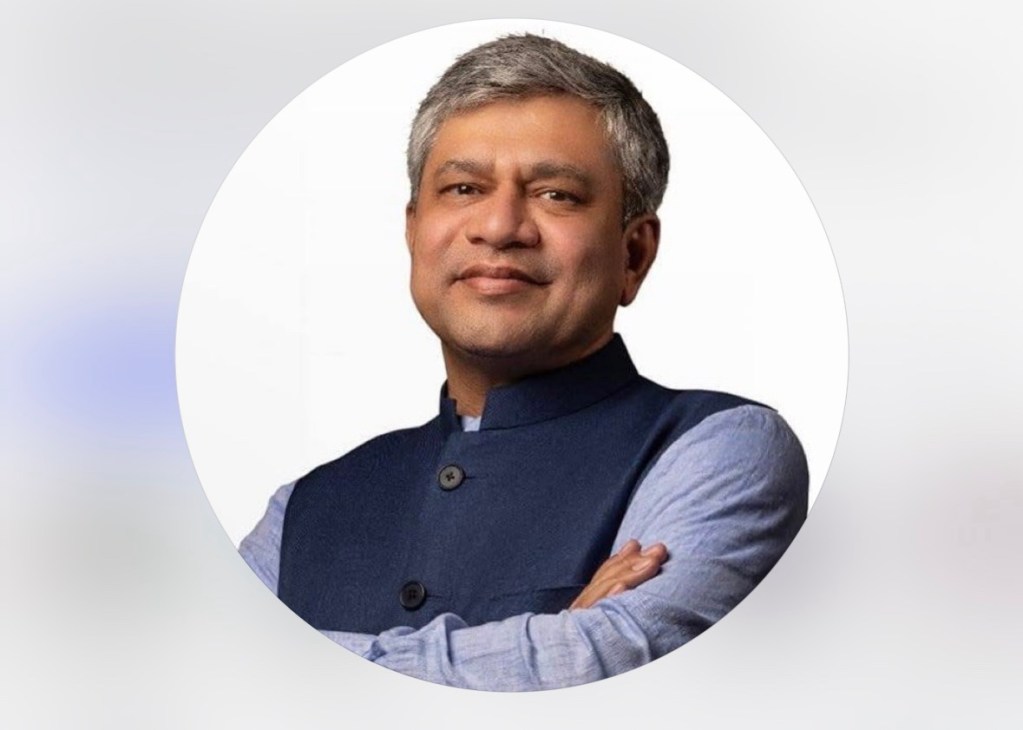
Minister Ashwini Vaishnav

At the World Economic Forum in Davos in January 2025, Union Minister Ashwini Vaishnaw was drawn into a discussion on AI strategy that, for many listeners, sounded like an outline of India’s broader policy posture on artificial intelligence. His central emphasis, as reported across coverage of the session, was that India should work across the layers of the AI stack but place particular weight on scalable applications, return on investment, mass use cases, and broad-based social utility rather than defining success only in terms of winning the race for the largest frontier models.

In substance, that amounted to a practical doctrine: India would seek to be strong in the use, adaptation, and deployment of AI across sectors such as health, education, agriculture, logistics, design, and services, while also building capacity in infrastructure, talent, and other supporting layers. It was an intelligible and politically defensible position, especially for a country that must weigh AI ambitions against many competing development priorities.

Yet the ramifications of that policy posture are more complex than they first appear. If the emphasis falls overwhelmingly on applications, rollout, servicing, customization, and use-case execution, then India may indeed become highly successful in AI without becoming strategically sovereign in AI. In that scenario, Indian companies would master the art of making global AI useful, affordable, and operational at scale, but the deeper ownership of models, chips, platforms, and core intellectual property would still remain concentrated in the hands of American and Chinese firms.

That is where the uncomfortable historical echo becomes impossible to ignore. India’s old and still dominant place in the global IT economy was built on talent, discipline, implementation capability, and cost-effective excellence, but not proportionately on product ownership, platform control, or command over the strategic heights of the industry. The danger is that an application-first AI policy, unless explicitly tied to an ownership agenda, could simply produce a larger, more sophisticated, and more profitable version of the same old role.

Put differently, India could become the world’s premier AI integrator without becoming one of the world’s principal AI owners. It could emerge as the maintenance subcontractor, deployment partner, fine-tuning specialist, and operational backbone for systems whose deepest architecture is controlled elsewhere. In such a future, Indian firms would help global clients adopt AI, monitor it, localize it, troubleshoot it, and extend it into new business domains, while the commanding layers of economic value would continue to accrue to the model-builders, chip-makers, cloud providers, and platform proprietors of the United States and China.

This does not mean the Minister’s position was irrational. On the contrary, it reflected a realistic reading of India’s present constraints and comparative strengths. But realism at one level can harden into dependency at another. Unless India couples application leadership with deliberate efforts to build ownership of datasets, compute, models, and intellectual property, the country may find that it has once again become indispensable to a global technological order whose center of gravity lies elsewhere.

That is why the policy distinction matters so much. There is a major difference between using AI effectively, servicing AI globally, and actually owning decisive parts of the AI future. Davos 2025 suggested that India knows how to speak confidently about the first two. The unresolved question is whether it is prepared to act decisively on the third.

Policy Statements India Needs

1. If India is serious about AI, then the following policy statements should define its public priorities:

2. India will not pursue AI as a prestige project alone; it will pursue it as a national productivity project.

3. Public funding will prioritize shared infrastructure, research capacity, and open ecosystems.

4. Indian data assets, especially public and language-based datasets, will be treated as strategic national resources.

5. AI infrastructure will be located with regard to water, energy, and environmental sustainability.

6. The country will support domestic ownership of models, platforms, and IP wherever feasible.

7. Government procurement will be used to create demand for Indian AI solutions.

8. Universities and labs will be linked to industry so that research becomes product and product becomes ownership.

9. AI adoption will be matched with workforce transition, not just productivity slogans.

10. India will aim not only to use AI, but to shape the standards and rules by which AI is governed.

Every major AI initiative will be judged by one test: does it expand India’s long-term technological capital?

That, in the end, is the real question.

India does not need to become a copy of China. But it does need to become much clearer about what it wants, what it can afford, what it should own, and what it must not repeat from the IT era. If it can do that, then AI will not merely be another imported technology. It will become part of India’s own long-term civilizational and economic capability.

(Concluded)

[Disclosure: This essay used an AI tool only to access specific online or specialised published information and research; and also for drafting a few technical sections in it. The illustrative/titular image is also AI generated. The essay’s structure, narratives and all other content are the Author’s own.]

Vedantic Retrospective Re-reading of Indian Fiction

Not every novelist writes within a Vedantic framework, yet many works of Indian fiction do lend themselves remarkably well to Vedantic rereading. This is especially true when a novel or short story is shaped by inwardness, moral conflict, duty, renunciation, suffering, attachment, or the search for a stable self. In such cases, the Vedantic lens does not claim the author’s original intention; rather, it reveals a deeper philosophical resonance already latent in the narrative. The authors listed below vary greatly in style, temperament, and historical position, but each has produced fiction that can be fruitfully tested against the grammar of Vedantic reflection.

A few days ago, I wrote a brief review of J. Raghunathan’s short story The Choice. https://mksudarshans.blog/2026/07/04/reading-the-short-story-the-choice-%e0%ae%9a%e0%ae%be%e0%ae%af%e0%af%8d%e0%ae%b8%e0%af%8d-through-a-vedantic-lens-with-indira-parthasarathy-and-j-raghunathan/

What began as a literary response soon opened into a larger philosophical exchange. Indira Parthasarathy, whose literary judgment I have long valued, responded in a private message with a terse but suggestive remark: “Existential choices. What you ultimately choose is the correct choice for you. Difficult to decide which is right and which is wrong. Good story.”

My reply came instinctively: “Do we really have our choices in life already made for us? Sounds a bit fatalistic, doesn’t it?” I then added what has since stayed with me as a guiding thought: “Every human story has a Vedantic flavouring that is often missed or overlooked.” And more fully: “Every human story can often be read through a Vedantic lens, because it inevitably involves questions of self, attachment, duty, and suffering.”

That exchange became more than a comment on one short story. It opened up a larger question: why do so many Indian novels and fictional works, even when not written with any explicit Vedantic intention, nevertheless seem so readily amenable to retrospective reading through a Vedantic frame?

What the Vedantic themes mean

Before proceeding, it may help to clarify what is meant here by the Vedantic themes of self, attachment, duty, and suffering.

Self refers not merely to personality or ego, but to the deeper question of what a human being really is beneath roles, relations, and social identity. Vedanta repeatedly asks whether the self is the body, the mind, the agent, the witness, or something beyond all these.

Attachment refers to the binding force of emotional and worldly investment. In narrative terms, attachment is what ties characters to relationships, ambitions, possessions, reputations, and outcomes. Vedanta is deeply interested in how attachment creates vulnerability, confusion, and bondage.

Duty is the moral and existential demand placed upon a person by vocation, family, society, and circumstance. In Indian thought, duty is never merely external obligation; it often becomes the arena in which one’s deepest nature is tested.

Suffering is not only pain or loss, but the experience of incompleteness, contradiction, and the inability to make life cohere. Vedanta sees suffering as revelatory: it exposes limitation, dislodges illusion, and pushes the seeker toward self-knowledge.

These four themes recur in most serious literature, but they assume a particularly resonant form in Indian fiction because Indian civilization itself has long lived within a conceptual world where dharma, karma, renunciation, illusion, and liberation are familiar categories.

Why Indian novels invite retrospective Vedantic reading

This leads me to the question I increasingly ask myself: How and why do so many novels and fictional works by eminent Indian authors become amenable to retrospective reading that reveals a Vedantic grammar and mould?

The answer lies partly in the civilizational inheritance out of which these works emerge. Even when an Indian novelist writes in English or in a modern realist idiom, the moral imagination often remains shaped by older Indian concerns: the instability of worldly success, the burden of family obligation, the struggle between desire and renunciation, and the tension between social role and inward truth.

The novelist may not be consciously writing Vedanta. Indeed, most do not. But the plot, characterisation, and emotional structure may still carry a reticent Vedantic hue by default rather than by design. That is what makes retrospective rereading so rewarding. One is not imposing Vedanta arbitrarily upon the text; one is uncovering philosophical possibilities already latent within it.

Major Indian works and their Vedantic resonance

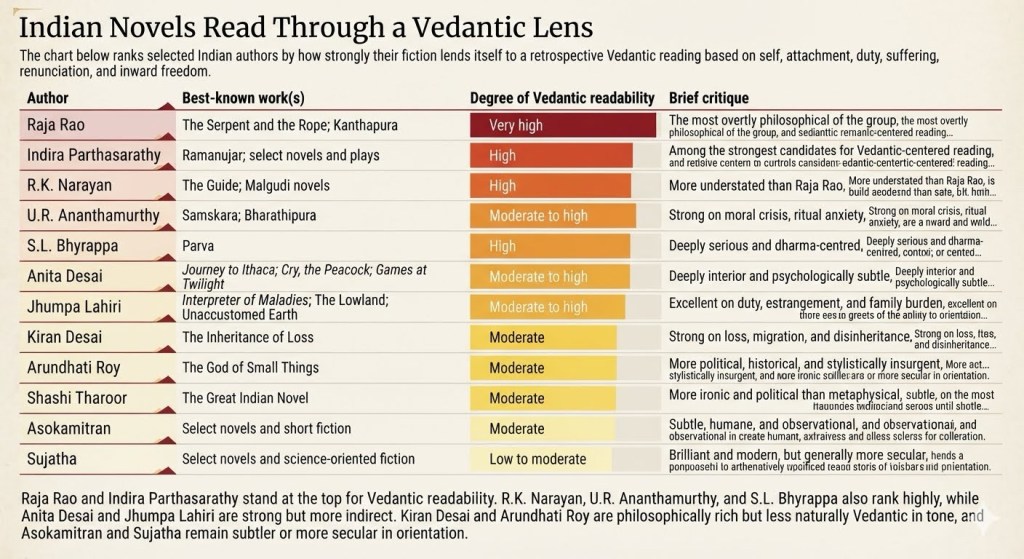
A number of Indian novels and fictional works stand out in this regard. What follows is not an exhaustive canon, but a suggestive ranking based on how closely they lend themselves to Vedantic rereading.

1. Raja Rao – The Serpent and the Rope

This is perhaps the most naturally Vedantic novel in Indian English fiction. The novel’s philosophical texture, its concern with illusion, identity, spiritual search, and the tension between worldly life and metaphysical inquiry, make it especially suited to Vedantic interpretation. The story of the narrator’s marriage, intellectual restlessness, and search for meaning unfolds less as ordinary plot than as a long meditation on selfhood and reality.

Vedantic themes: self, attachment, suffering.

2. Indira Parthasarathy – select novels and Ramanujar

Indira Parthasarathy occupies a special place because his work often stands close to philosophical and cultural argument, and his engagement with Ramanuja directly places him in the larger Vedantic conversation. His fiction and drama are morally serious, intellectually alert, and frequently preoccupied with social conflict, inner tension, and competing visions of duty. The Vedantic connection is therefore not merely latent but often structurally visible.

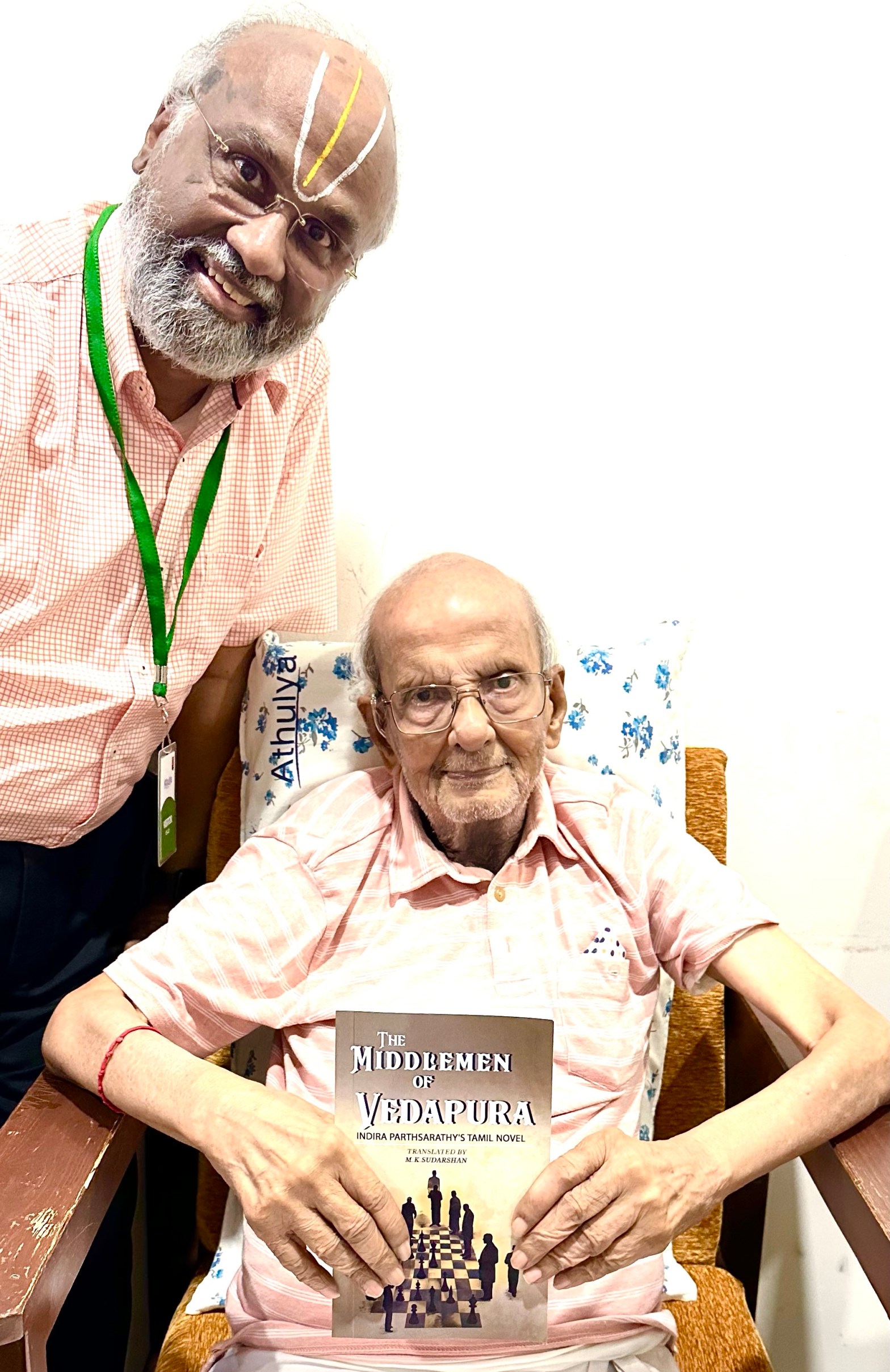
M. K. Sudarshan with the master-story teller, Sahitya Akademy Award winning novelist, Indira Parthasarathy

In 1995 Indira Parthasarathy wrote a novel savagely satirising the political landscape of Tamil Nadu: Vedapuratthu Vyaabaarigal. In 2025, the novel was translated into English by M. K. Sudarshan as The Middlemen of Vedapura. Although there is virtually nothing that is explicitly Vedantic in the original Tamil novel, nevertheless in Sudarshan’s English translation one can discern — vaguely and fleetingly — the most fundamental of Vedantic questions: what is Real and what is Illusion? And why is it that it is Illusion that so often shapes the Reality of the hurly-burly, roller-coaster, utterly rotten, venal, and feral world of Indian politics? Here, one can sight Vedantic streaks appearing in flashes within the chiaroscuro of the play of Tamil regional rough-and-tumble variety of Party politics.

Vedantic themes: duty, self, suffering, attachment, illusion.

3. R.K. Narayan – The Guide

R.K. Narayan’s fiction is deceptively simple, but its simplicity often hides deep philosophical resonance. The Guide in particular invites a retrospective reading in terms of transformation, role reversal, moral responsibility, and the uncertainty of selfhood. Raju’s movement from guide to lover to reluctant holy man makes the novel especially rich for thinking about identity and the forms of duty that arise unexpectedly.

Vedantic themes: self, duty, attachment, suffering.

4. U.R. Ananthamurthy – Samskara

Samskara is one of the strongest Indian novels for retrospective Vedantic reading, though its philosophical orientation is not doctrinally orthodox. Its concern with ritual, moral corruption, social duty, and existential collapse makes it deeply resonant with Vedantic questions about selfhood and bondage. The novel’s central crisis becomes a crisis of inner meaning as much as social obligation.

Vedantic themes: duty, self, suffering.

5. S.L. Bhyrappa – Parva

Parva reimagines the Mahabharata with philosophical seriousness and extraordinary attention to dharma. Although not Vedantic in a narrow doctrinal sense, it is deeply concerned with the burden of action, the ambiguity of moral choice, and the tragic dignity of suffering. Its epic scale gives it a particularly strong metaphysical density.

Vedantic themes: duty, suffering, self.

6. Anita Desai – Journey to Ithaca

Among modern Indian English novels, Anita Desai’s Journey to Ithaca is especially apt for retrospective Vedantic reading because it directly engages spiritual searching, disillusionment, and inward transformation. Her fiction more generally is intensely interior, often tracing the erosion of the self under domestic and emotional pressure.

Vedantic themes: self, attachment, suffering.

7. Jhumpa Lahiri – The Lowland and Interpreter of Maladies

Jhumpa Lahiri’s fiction is not Vedantic in explicit idiom, but it is rich in attachment, estrangement, duty, grief, and family burden. Her characters are often suspended between emotional loyalty and personal rupture, making her work surprisingly fertile for a Vedantic rereading of modern diasporic life.

Vedantic themes: attachment, duty, suffering.

8. Kiran Desai – The Inheritance of Loss

Kiran Desai’s novel is deeply concerned with displacement, loss, inherited injury, and the fragility of worldly success. It is perhaps less obviously Vedantic than Raja Rao or Indira Parthasarathy, but its atmosphere of disinheritance and existential instability makes it suitable for a philosophical rereading.

Vedantic themes: suffering, attachment, self.

9. Arundhati Roy – The God of Small Things

Roy’s fiction is more political, historical, and formally insurgent than Vedantic in tone. Yet it is saturated with suffering, family fracture, desire, and the consequences of forbidden attachments. The novel may not invite Vedantic reading as immediately as some others, but it certainly rewards it.

Vedantic themes: attachment, suffering, duty.

10. Asokamitran – select fiction

Asokamitran’s fiction is quieter, more observant, and less overtly philosophical, but it nonetheless offers subtle reflections on the pressures of ordinary life, memory, and the shaping of the self. His work is not strongly Vedantic in texture, yet it has a reflective restraint that can be read philosophically.

Vedantic themes: self, suffering, duty.

11. Sujatha – select fiction

Sujatha is perhaps the least naturally Vedantic among the authors named here, since his fiction is more associated with wit, technology, modernity, and urban life. Still, even his fiction occasionally opens into questions of identity, desire, and illusion, which can be reread in broader philosophical terms.

Vedantic themes: self, attachment.

Ranking the authors by Vedantic relatability

If one were to rank these authors according to how closely they may be related to Vedanta through retrospective rereading, the order might be as follows:

1. Raja Rao
2. Indira Parthasarathy
3. R.K. Narayan
4. U.R. Ananthamurthy
5. S.L. Bhyrappa
6. Anita Desai
7. Jhumpa Lahiri
8. Kiran Desai
9. Arundhati Roy
10. Asokamitran
11. Sujatha

This ranking is not meant to diminish any writer’s literary merit. It simply reflects the degree to which their fiction lends itself to Vedantic retrospective reading. Some writers are more doctrinally proximate, others more existentially suggestive, and still others more indirectly resonant.

Closing reflection

What began with a short story called The Choice ultimately opened onto a larger literary and philosophical insight. Indira Parthasarathy’s brief appreciation of the story as a case of existential choice helped trigger a deeper reflection on human agency, fatalism, and the Vedantic structure of narrative life. The more one looks at Indian fiction, the more one sees that even where Vedanta is not explicitly named, it often remains quietly present as underlying grammar.

That is why I continue to believe that every human story has a Vedantic flavouring that is often missed or overlooked.

P.S: The following day after having read this piece, Eepa sent me a WhatsApp message that read: “Yes. Any serious novel or shortstory (has to be) within the framework of Vedanta.”

(concluded)

Reading the short-story “The Choice” (சாய்ஸ்) through a Vedantic Lens … with Indira Parthasarathy and J. Raghunathan


J. Raghunathan’s short story The Choice is compelling not merely because it stages a conflict between patriotic duty and domestic love, but because it leaves the moral structure of that conflict unresolved in a fruitful way. The story’s emotional power lies in the fact that the reader is never allowed the comfort of a simple verdict: Teju’s decision is at once admirable, costly, and tragic, while Simrat’s later life appears neither wholly voluntary nor wholly coerced.


The present review places the story in a personal and literary frame. Its author, J.Raghunathan, is a valued personal friend; the distinguished novelist Indira Parthasarathy (Eepa) who appreciated the story as a tale of “existential choices” (and which the Kumudam magazine had earlier awarded a cash prize of ₹100,000) serves in this account not merely as a senior literary authority but as a nonagenarian companion and a mentor-like presence for me, a reviewer who in his own published works has written on Vedantic subjects. That triadic setting matters, because the review is not only an appreciation of a short story but also an inquiry into whether Indira Parthasarathy’s brief judgment fully captures the deeper metaphysical anxiety the story provokes.


Story and predicament

The story unfolds as a narrated recollection: the speaker meets Rajinder Singh Dhaneja in Mussoorie and learns, through him, the life of Tejinder Singh Dhaneja, a decorated military officer whose career in war and intelligence repeatedly takes precedence over married life. Teju survives catastrophic physical injury, falls in love with the nurse who tends him back to life, marries her almost immediately after recovery, and then gradually loses that marriage to the demands of secrecy, distance, and state service.


The title The Choice appears, at first glance, to name one dramatic decision: when Simrat asks Teju whether India’s security matters more than she does, he chooses the nation.

Yet the story is subtler than that. By the time the formal choice arrives, the conditions that make it nearly inevitable have already accumulated through temperament, vocation, honour, institutional command, and emotional drift.


Indira Parthasarathy’s remark

Indira Parthasarathy (Eepa) — a master story-teller and playwright himself — shared a comment with me in a terse message — “Existential choices: What you ultimately choose is the correct choice for you. Difficult to decide which is right and which is wrong. (This is a) Good story.” — identifies something real and central in the narrative.

The story does indeed resist moral simplification and makes judgment difficult, because both loyalty to vocation and loyalty to intimacy possess genuine ethical weight within it.


Even so, the comment may not be wholly sufficient as a final critical formulation. To say that what one ultimately chooses is the correct choice “for you” risks giving the impression that the story affirms sovereign individual freedom, whereas the narrative itself repeatedly shows choices being narrowed, preconditioned, and almost staged in advance by forces larger than conscious preference. The tale is existential, but its existentialism is under pressure.


Vedantic critique


A more nuanced reading emerges when the story is approached through a Vedantic framework, especially one attentive to the tension between agency, conditioning, and karmic inheritance.

The story does not straightforwardly deny free will; rather, it de-centres free will by showing that what is called a “choice” may already be shaped by svabhava, duty (Svadharma), prior commitments, and accumulated circumstance.


From this perspective, Teju does not simply stand as an autonomous chooser selecting one value over another. He appears instead as a man whose being has been formed in advance by military vocation, heroic self-understanding, patriotic obligation, and a temperament already fused with action and danger. When the decisive question is finally posed to him, the answer feels less like spontaneous invention than like the disclosure of what he already is.


This is where the story becomes philosophically rich. It neither explicitly invokes karma nor doctrinally endorses determinism, yet it invites a reading in which human decisions emerge from prior moral and existential formations rather than from unconditioned freedom alone. In that sense, the narrative is agnostic about karma at the level of overt statement, while being strikingly hospitable to a karmic interpretation at the level of structure.


Simrat and dharma


The most delicate question concerns Simrat, the nurse who marries Teju, is later divorced by him, and finally reappears in the father-in-law’s home as his caregiver.

A shallow reading might say that she has “no other choice,” but the story permits a more serious interpretation: what appears as compulsion from the outside may also be her own inward determination (Svadharma).


That distinction is crucial in Vedantic terms. If Simrat’s return is seen merely as submission to fate, she becomes a passive victim of circumstance; but if it is seen as the recognition and inhabiting of a karmically conditioned duty, then her action acquires moral and spiritual depth. She is not merely trapped in the aftermath of divorce; she consciously determines herself to continue caring, and that determination may be impelled by dharma without ceasing to be hers.


Thus the story’s deepest interest may lie not in Teju’s spectacular heroism but in Simrat’s quieter endurance. Teju’s life dramatizes the tragic grandeur of public duty, whereas Simrat’s later role reveals a different order of greatness: not conquest, not adventure, but the inward resolve to inhabit suffering as responsibility.


Final assessment


The Choice succeeds because J. Raghunathan in crafting the narrative faithfully follows the style of his own literary guru and idol , the late Tamil novelist Sujatha (Rangarajan) who excelled in this genre of Tamil short-stories.

Also, to me this story distantly or faintly echoes Ernest Hemingway’s “Farewell to Arms” — in the soldier–nurse nexus, Frederic Henry’s romance with Catherine Barkley, his nurse in hospital, and the way that unfolds against the backdrop of the devastation of war, and their relationship too is ultimately marked by separation, suffering, and tragic loss. In The Choice, Teju’s recovery is likewise bound up with the nurse who cares for him, and that care becomes the seed of love, marriage, and later estrangement. That is the deepest parallel: love is born in a space of injury and crisis, not in ordinary domestic calm. But Raghunathan’s story ultimately moves in a different moral and Vedantic register, as I saw it unfolding on reading it.

The tonal and philosophical worlds are very different. Hemingway’s novel is shaped by disillusionment, existential bleakness, and the collapse of romantic hope under war’s pressure, whereas The Choice is more morally narrative, more Indian, and essentially Vedantic in its concern with duty, service, and the visible claims of dharma-like obligation.

The story does not collapse into propaganda for patriotism, sentimental defense of marriage, or easy moral indictment of either. Its power lies in showing how persons become answerable to lives that seem, by the time crisis happens, already partly written.


Indira Parthasarathy’s one-line appreciation very correctly identifies the story’s moral ambiguity, but a Vedantic critique presses even further. The true question is not simply whether Teju chose rightly, or whether right and wrong are hard to separate; it is whether the very grammar of “choice” in the story has already been destabilized by karmic predisposition, svabhava, and dharmic compulsion.


Read in that way, The Choice becomes more than a story about an officer torn between wife and nation. It becomes a meditation on whether human beings ever choose in absolute freedom, or whether they mostly ratify, under the pressure of circumstance, the script that character, duty, and karma have already begun to write.

Well done, my friend Raghu 👍. And thank you Eepa, Sir 🙏💐

(Concluded)

Energy, Progress, and the Future We Can Afford

by M.K.Sudarshan

July 4, 2026: Chennai, India

An exploration of civilization’s hidden dependence on energy, the warnings of Robert J. Gordon, and the possibility that the future will be more advanced yet less abundant than the age that came before.

The Hidden Axis of Civilization

There is a strange and revealing fact about human civilization: its great ages are not merely named by ideas, institutions, or empires, but by the ways in which it learns to command energy. What appears, at first glance, to be a story of politics, invention, and culture is also, at a deeper level, a story of force harnessed, work multiplied, and matter compelled into service.

The agricultural age was bounded by muscle, animal power, and the narrow reach of biomass. The industrial age widened the human horizon through coal. The age of oil and electricity made motion, lighting, and manufacture vastly more fluid. The age of information, and now the age of AI, rests on a still more subtle architecture of power: invisible currents, dense computation, and continuous demand.

The Long Climb Upward

If one steps back far enough, the curve of history looks less like a parade of brilliant ideas than a long climb in percapita energy use.

For most of human existence, that climb was almost imperceptible. Then, in the modern era, it steepened dramatically. The world did not merely become smarter; it became more energetically endowed.

Hospitals, railways, grids, refrigeration, global logistics, computation, and finally data centers are all downstream of that hidden abundance. What we call progress is very often the social expression of more energy becoming available per person.

Gordon’s Warning

Before turning to the argument itself, a word of introduction is useful. Robert J. Gordon is an American economist best known for his work on long-term economic growth, especially his book The Rise and Fall of American Growth. His central claim is that the period from roughly 1870 to 1970 was a special century of unusually transformative innovation.

Gordon does not argue that invention has stopped, nor that the modern world has become technologically inert. His argument is more subtle: it is a mistake to assume that technological progress is always cumulative, always accelerating, and always capable of producing the same scale of civilizational leap.

Applied to energy, his warning becomes especially pointed. It is entirely possible that the next generations of energy technology will be cleaner, more intelligent, more distributed, and more secure, yet still fail to produce the same explosive abundance that coal and oil once delivered. History may continue, but not in the ecstatic manner of the fossil age.

The Weight of Physics

This is not because innovation is exhausted. It is because energy is not a purely digital or conceptual domain. A software platform can spread with astonishing speed; an energy system cannot. It must be mined, fabricated, transported, regulated, financed, stored, transmitted, and defended.

Every kilowatt has an infrastructure behind it. Every transition has material costs. Every promise of abundance eventually meets the stubborn fact of the physical world. That is why energy innovation often feels slower than technological rhetoric would suggest. The future may indeed become more advanced, but advancement does not abolish friction.

What the Institutions Foresee

The great institutions of energy policy-thought and policy-making understand this ambivalence. The IAEA has long treated sustainable energy planning as a central problem, and the wider energy-policy consensus does not imagine that the world can simply continue along a fossil-heavy path indefinitely.

Nor do these institutions believe energy demand will disappear. Their vision is subtler and more demanding: future growth must be cleaner, more efficient, and far more carefully organized than the past.

Nuclear power is often invoked in this context not as a magical solution, but as one of the few technologies capable of supplying dense, low-carbon electricity at scale. Renewables, grids, storage, efficiency, and electrification must all share the burden. The future, in this reading, is not an escape from energy politics but a reordering of it.

Energy as Power

And politics is precisely where the matter becomes hardest. Energy has never been merely technical. It has always been geopolitical. Coal transformed factories, oil transformed empires, and gas transformed bargaining power.

In the future, the strategic chokepoints may shift from fuel wells to patents, supply chains, advanced materials, semiconductor fabrication, grid software, and the mineral basis of clean technologies. One may no longer fight over oil fields alone; one may fight over the means of producing the next energy order itself.

The empire of the future may not be built on possession of fuel, but on ownership of the architecture that makes fuel usable.

Scarcity and Strategic Leverage

This raises a troubling possibility. If future energy systems do not produce overwhelming abundance, then scarcity itself becomes more politically precious. A technology that is hard to reproduce, expensive to scale, or dependent on rare inputs will invite control.

Control invites leverage. Leverage invites conflict. And conflict, once it enters the energy domain, can slow the very innovation that all sides claim to desire. The future, then, may be caught in a vicious circle: technology becomes strategic, strategy becomes defensive, and defense retards diffusion.

A Future Not Without Hope

Still, it would be wrong to conclude that the future must therefore be bleak. A more sober conclusion is that it will be contested. It may well be more efficient, more electrified, more intelligent, and more capable than the present. But it may not be an age of easy abundance.

The world may grow richer in function while remaining constrained in form. That is perhaps the central lesson of the energy story: progress does not disappear, but its character changes. It becomes less like a miracle and more like a negotiation.

The Distant Horizon

If one were forced to hazard a number, one might say that by year 2150 the world could average somewhere around 30,000 kilowatt-hours per person per year, with a plausible range above and below that figure depending on whether technological breakthroughs, political stability, and clean-energy diffusion proceed smoothly or stumble under their own weight.

Such a future would be materially more energetic than today’s, yet still far from the fantasy of infinite abundance.

The Real Test

And so this is where a more chastened view of civilization comes into focus. The future may not belong to those who merely believe most ardently in progress, nor even to those who possess the best technology in isolation. It may belong to those who understand that energy is power, that power is contested, and that the path from invention to abundance passes through institutions, geopolitics, and the moral discipline of restraint.

In that sense, the deepest question is not whether human beings can make more energy. It is whether they can govern the power they make without turning it into a new instrument of domination.

That, perhaps, is the real test of the AI age: not whether it will consume more energy, but whether it can do so without exhausting the world’s patience, its resources, or its peace.

(Concluded)

The Glass House of Imperial Disdain: A Retort to The Guardian’s Modi Op-Ed

by M.K. Sudarshan

July 3, 2026: Chennai, India


The Guardian’s recent mockery of Prime Minister Narendra Modi receiving state honors reveals a persistent, post-colonial anxiety. This sharp retort calls out the historical hypocrisy of Western media outlets that weaponize adversarial journalism to mask lingering imperial disdain for a rising India and its three-time democratically elected leader.

There is a particular brand of post-colonial anxiety that the British press simply cannot seem to shake. It manifests as a twitchy, patronizing compulsion to lecture the rest of the world on etiquette, propriety, and modesty. The latest display of this hereditary affliction comes from The Guardian, which recently found itself in a state of collective, high-minded agitation over Indian Prime Minister Narendra Modi receiving state honors during his overseas travels.

Source: the Guardian https://share.google/d1lzTEOMPIcJN9y2n

In a display of spectacular pettiness, the publication sought to dismiss these honors as mere vanity exercises. To read their coverage is to witness a masterclass in sour grapes, wrapped in the familiar, patronizing language of the old metropole. The underlying subtext is as loud as it is archaic: how dare a democratically elected leader from a former colony command such reverence on the global stage?

The irony, of course, is thick enough to choke on.

For an outlet based in a nation that practically invented the architecture of modern state vanity, The Guardian’s sudden squeamishness over medals and certificates is laughable. This is a country whose entire global identity was built on centuries of colonial preening, choreographed pageantry, and the systematic distribution of grand titles designed to entrench a hierarchy of power. The British Empire institutionalized the use of unctuous honors to flatter collaborators, reward compliance, and project an illusion of moral superiority across the globe. Even today, the UK clings to an elaborate, hereditary honors system that openly invokes the ghost of the “British Empire” in its very titles.

Yet, when the prime minister of the world’s largest democracy—a leader who commands a democratic mandate from 1.4 billion people and has been elected to power three consecutive times—is formally honored by sovereign nations like the Seychelles or Israel, it is dismissed by Western commentators as “vanity.”

Let us call a spade a spade. What The Guardian and its ideological cohorts truly cannot stomach is the shifting axis of global influence.

The honors bestowed upon Prime Minister Modi are not personal indulgences; they are diplomatic recognitions of a rising India. When a host nation creates or confers its highest civilian award for a visiting Indian leader, it is a calculated, respectful acknowledgement of India’s growing economic weight, technological prowess, and strategic importance. It is standard international protocol, updated for a multipolar world where New Delhi, not London, is an indispensable center of gravity.

To reduce these significant diplomatic milestones to a cynical narrative about personal ego is a testament to a deep-seated imperial disdain. It reveals a persistent, colonial-era mindset that views the global south as an unruly playground that still requires Western oversight and grading.

The British establishment and its media echoes may choose to live in a dilapidated, washed-up glass house of historical hypocrisy, throwing stones at the democratic triumphs of others. But the world has moved on. The sovereign nations honoring India’s leader understand exactly where the future lies—even if those stuck in the twilight of an empire refuse to open their eyes.