To: – Mr. Jay Shah, Chairman, Board of Control for Cricket in India (BCCI) – The Chairman and Governing Council, International Cricket Council (ICC)
From: M. K. Sudarshan A devoted lover and long-time follower of international cricket Chennai, Tamil Nadu, India Email: mksudarshan2002@yahoo.co.in Mobile: +91 9884287078
Date: 26 May 2026
Subject: A Proposal to Introduce “Net Catching Efficiency” as an Official Career Metric in International Cricket
Dear Sirs,
I write to you not as a critic, but as a passionate lover of cricket who has followed the game through decades of evolution—from the era of leather and willow to the present age of high-definition cameras, ball-tracking, and AI-driven analytics. Cricket has transformed dramatically, yet one glaring omission remains in how we assess a player’s career: fielding contribution, especially catching, is not meaningfully captured in official career records.
Today, when a player’s track record is displayed in international cricket:
For a batsman, the metrics are aggregate runs, average, strike rate, and centuries.
For a bowler, the metrics are total wickets, bowling average, economy, and five-wicket hauls.
For a fielder, the only statistic almost ever shown is catches taken (Ct), and even that is often relegated to fine print.
Nowhere in standard career summaries do we find:
How many catches a player has dropped over their career, and
A clear, simple metric that reflects their net catching contribution to the game.
This is an outdated omission in a sport that now uses the most sophisticated technology in sports to capture even the minutest aspects of play.
The Problem: Catching Dropped Is Not Tracked
Catching is a critical component of modern cricket. A single dropped catch can change the outcome of a match, a series, or even a World Cup. Yet:
Official career records do not record “catches dropped” for individual players.
There is no official net metric for fielding, unlike runs or wickets.
Public perception and player valuations are skewed toward batting and bowling, despite fielding being a core pillar of the game.
Some analytics groups and broadcasters (especially in the IPL) have begun tracking drops and computing catching efficiency at team and sometimes player level, but this is not yet part of official international career statistics.
The Technological Reality: We Can Do This Now
The claim that “we cannot track drops” is no longer valid. The technology and resources to do this already exist and are in active use:
Fielding data is already tracked in ICC tournaments.
Since the ICC Men’s T20 World Cup 2022, the ICC’s official data supplier Sportradar has been tracking live fielding data, recording 80 data points per ball, and enabling players to be judged on their fielding for the first time.
Advanced optical tracking is already supported by the BCCI and ICC.
Systems like the Quidich Tracker (QT), developed with support from both the BCCI and ICC, use optical tracking, computer vision, and AI cameras to generate over 5 million data points per match, including real-time player positions and movements on the field.
Catching efficiency is already computed at team level.
In recent tournaments, catching efficiency has been reported for national teams (e.g., India’s catching efficiency in T20 World Cups, team-wise efficiency in the Champions Trophy 2025 and IPL 2026).
If we can track:
ball swing and seam movement,
exact fielder positions,
run-out distances, and
boundary decisions,
then we can certainly detect:
a catch taken, and
a missed/dropped chance,
and record them per player in real time.
The barrier is not technology or resources; it is policy, definition, and commitment.
A Simple, Clear Metric: Net Catching Contribution
I propose that the ICC and BCCI jointly introduce an official career metric for fielding, built on two simple numbers:
Ct = total catches taken in a player’s international career
Cd = total catches dropped in a player’s international career
From these, two derived metrics can be computed:
Net Catching Contribution
Net Catching = Ct – Cd
Catching Efficiency Percentage
Catching Efficiency % = Ct / (Ct + Cd) × 100
These metrics would appear alongside runs and wickets in player profiles, broadcast graphics, and official ICC/BCCI statistics pages.
Why this matters:
Net Catching reflects the total value a fielder adds: a player who takes 100 catches and drops 20 has +80; one who takes 60 and drops 0 has +60. Both are valuable, but the first has shown more opportunity and risk.
Catching Efficiency % reflects reliability per chance: whether a player is consistent or prone to high-profile misses.
Together, they give a balanced picture: total contribution and consistency.
This is no more complex than batting average or bowling average, yet it addresses a major gap in how players are assessed.
Why the ICC and BCCI Should Act Now
Resources are not a constraint
The ICC and BCCI already fund:
– Global data suppliers (Sportradar)
– Advanced tracking systems in major tournaments
– Broadcast technology, DRS, and analytics infrastructure
Adding a “drop” flag to the data model and computing derived metrics requires programming and data-annotation work, not new hardware.
Fielding is increasingly central to modern cricket
– Teams invest heavily in fielding coaches and training.
– Fielding breakdowns are often cited as match-defining moments.
– Yet players are rarely celebrated or judged on their fielding in the way they are for batting and bowling.
This would set a global standard
By making this official, the ICC and BCCI would:
– Lead global cricket in modernizing player assessment.
– Encourage other boards and leagues to adopt the same standard.
– Show that fielding is as important as bat and ball.
Fans and players deserve transparency
Modern fans are increasingly data-literate and expect comprehensive statistics. Players deserve to be judged fairly on all three dimensions of the game: batting, bowling, and fielding.
My Recommendation
I respectfully urge the ICC and BCCI to:
Define a clear, consistent operational definition of a “drop” for data collection, agreed upon by both boards and data providers.
Mandate that data providers record “catches dropped (Cd)” per player in all international matches under ICC and BCCI auspices.
Introduce official career metrics for fielding, including:
– Catches (Ct)
– Dropped catches (Cd)
– Net Catching Contribution (Ct − Cd)
– Catching Efficiency %
Display these metrics prominently in:
– Official ICC and BCCI statistics pages
– Player profiles on broadcast graphics during international matches
– Tournament reports and annual awards considerations
Pilot this system in upcoming major tournaments (e.g., ICC events and IPL) and then adopt it as a permanent global standard for international cricket.
Closing
Cricket has always evolved: from red-ball dominance to the rise of limited-overs cricket, from scorecards on paper to digital scoreboards, from subjective umpiring to DRS and AI-assisted decisions. The next logical step is to evolve how we measure and value fielding.
As a lover of the game, I believe that introducing Net Catching Contribution and Catching Efficiency as official career metrics would:
Honor the true all-round contribution of players,
Raise the status of fielding in the game’s culture, and
Demonstrate that cricket’s governing bodies are serious about using technology to make the game fairer, more transparent, and more complete.
I urge you to act on this proposal and lead cricket into this next phase of modernization.
Yours sincerely,
M. K. Sudarshan
A devoted lover of international cricket
Chennai, Tamil Nadu, India
Email: mksudarshan2002@yahoo.co.in
Mobile: +91 9884287078
Dear Reader, Two Class 8 children wanted me to re-write my original review in a simpler form so that they could understand in full. Hence this.
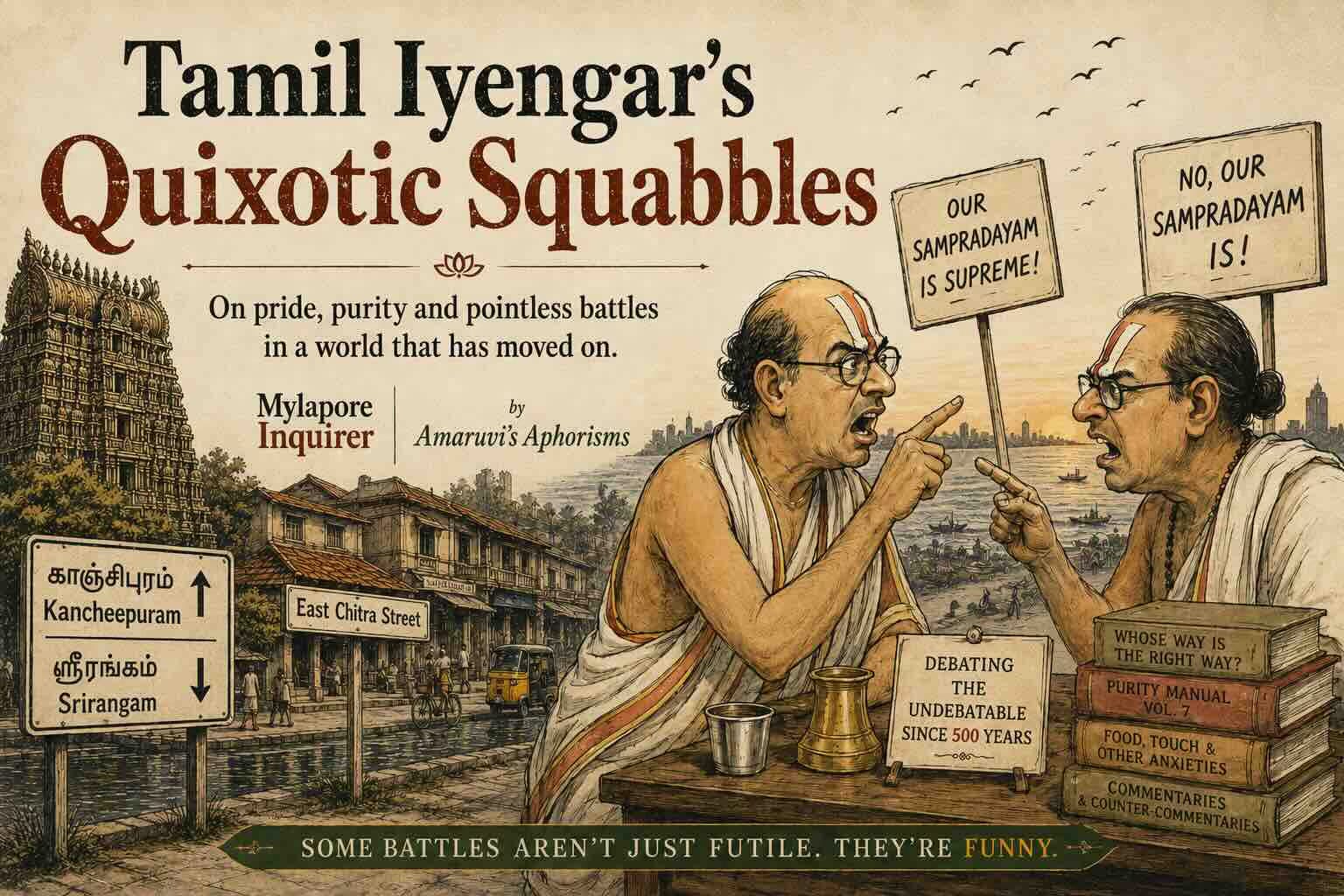
Who are the Vadakalais and Thenkalais? Where do they come from? Why do they fight in Indian courts on completely insignificant matters? From when did they begin to have their differences? Are the differences significant enough to warrant the Indian judiciary’s time and efforts for more than 300 years?
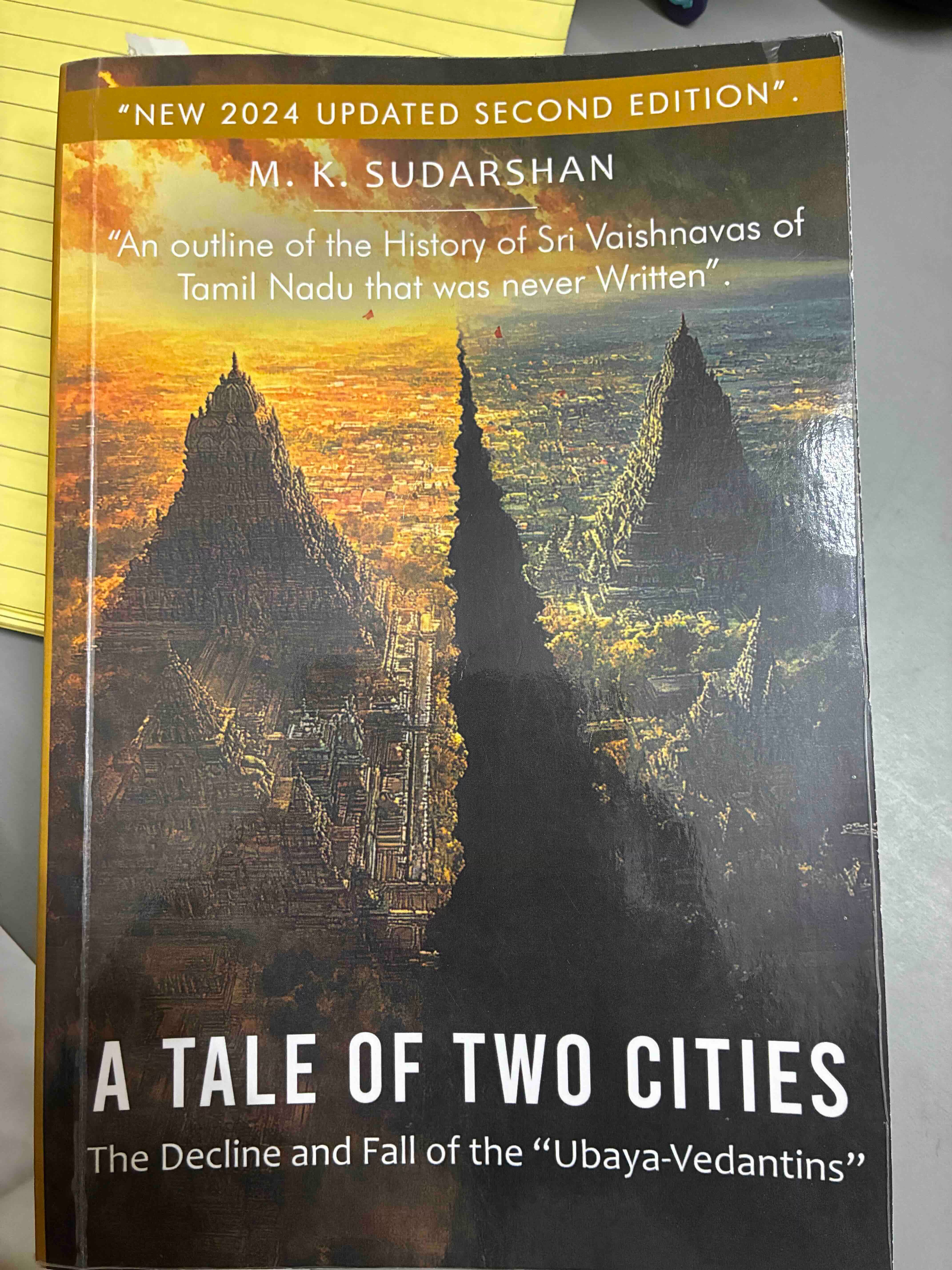
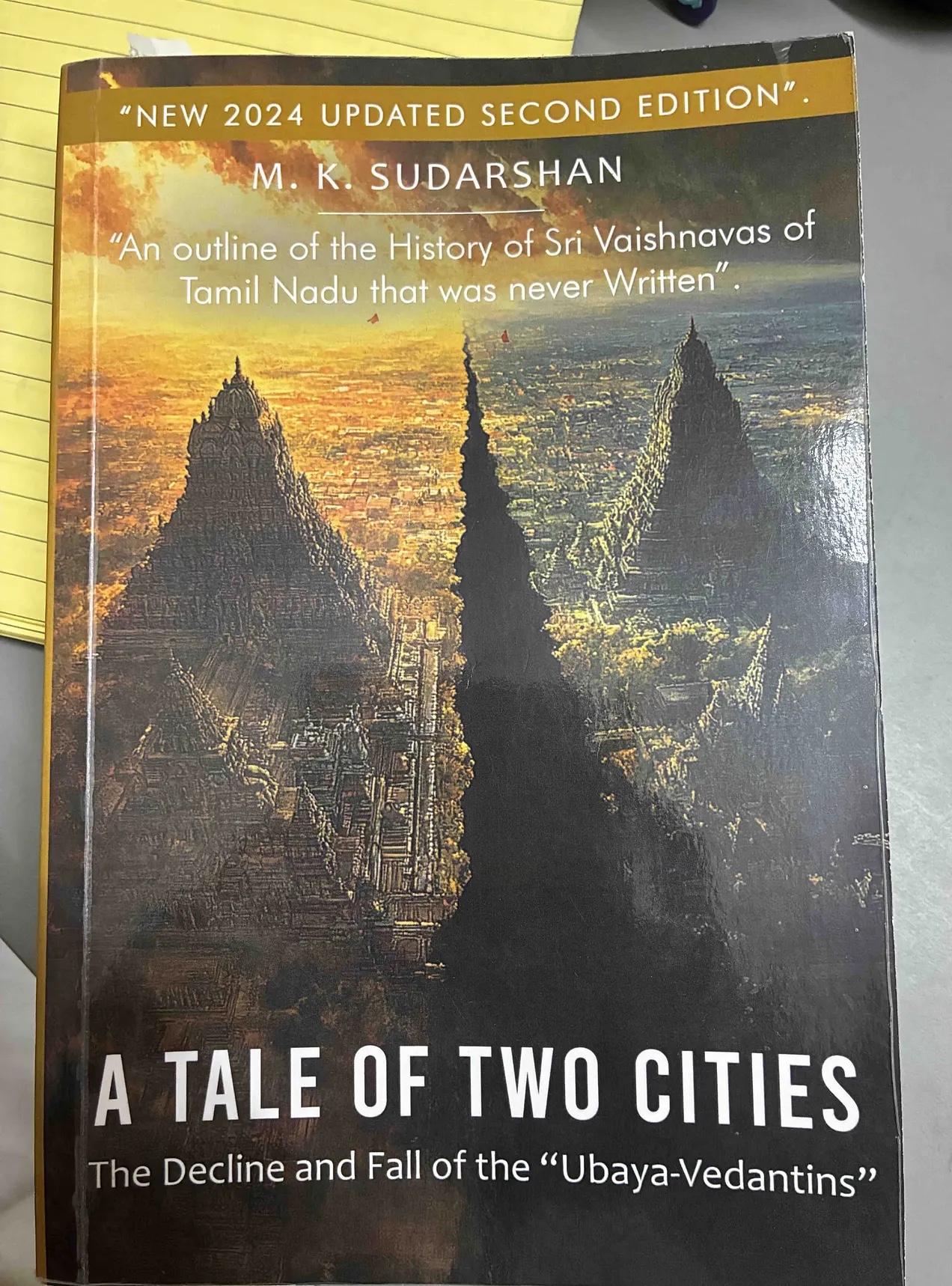
These and many other aspects of the Iyengar rivalries are dealt with in this book, ‘A Tale of Two Cities’, by author and researcher M.K. Sudarshan.
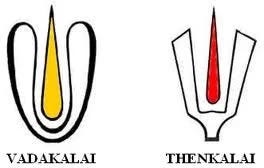
For the normal (secular) eye, the book and its contents and the presentation could appear unnecessary and detailed. But to someone interested in knowing the truth, this book serves its purpose. Ask any cosmopolitan Iyengar—”what is the difference between Vadakalai and Thenkalai?” He would point you to the “U”, “Y” symbolism only. Such is the ignorance and apathy in the Srivaishnava community, especially among the GEN-Z and their parents.
Sudarshan has sought to enlighten these minds on the key differences between the sects from philosophical, historical, and hagiographical contents. Added to that is the exploitation at the hands of the British. Subscribe
Historical Divisions and Legal Battles
Detailing from the times of Ramanujacharya, the author traces the schisms, dissonances, and the narratives that have been set, exemplified, and later exploited by the British and courts. The machinations resorted to by the Thenkalai sect are matched in equal measure by those of the numerically weaker Vadakalai sect. Both get to be treated with historical rigor and their contributions noted.
Though this multi-century old vexatious litigation appears to be gargantuan in proportions, for all practical purposes, in current times, it comes down to just the liberty of the litany of the legendary Acharyas—Vedanta Desika and Manavala Mamuni. Does this then merit expansive court’s time in anybody’s view, that too in current times?
The Role of Patronage and the British
Copious notes on the historical background during the Vijayanagara reign explain how Kanchipuram Thathacharyas made way, through royal munificence, to the betterment of the Kanchi Varadaraja Swami Temple and other temples in the region. They became the de facto authorities of the Northern Seat of Vaishnavism, while the Southern Seat was headed by the Pillai Lokacharya’s follower Uthama Nambi’s clan from Srirangam. Their efforts to win royal patronage and thus further the cause of the Srirangam Temple et al are explained in lucid detail with abundant evidence.
The dubious role played by the British in widening the cleavage and making the split as gargantuan as it appears today, the courts and their judgments that aided this partition, and the monumental wastage of human and material wealth (post-independence) in chasing this mirage of a “divine inspired” division are all detailed in an understandable chronological order.
Conclusion
Are these court cases worth the salt? In the age of AI, should we ever prime these valuable national resources on these cases and waste them? The new-age Srivaishnavas would need to ponder after reading this detailed book by M.K. Sudarshan.
Mahabalipuram is where the past becomes a touristic afterthought. The Pallava‑era rock cavities, the carved monoliths, the half‑ruined shrines—all stand serene under the coastal sky, admired for their stone, not their sacrament. Visitors pass by, take photographs, sip tea outside the temple, and move on. The devotion that once gave these stones life is now somewhere else, or nowhere at all.
In the Sri Vaishnava imagination, something similar has happened to the Tenkalai–Vadakalai sectarian feud: it is ancient, it feels timeless, and yet it no longer belongs to any living theology. It persists as ritual‑ritual, litigation‑litigation, and identity‑for‑show—a kind of sectarian‑tourism lodged in the goshti‑rooms, the court‑files, and the thanian‑sequences. The Government HR&CE Commission controls the money, the state controls the assets, and the thanian‑battle controls the ego.
By setting this imaginary casual conversation below amongst three Sri Vaishnava gentlemen outside the Sthalasayana Perumal Kovil at Mahabalipuram, I want to evoke that resonance: the ancient feud, like the Pallava ruins, is now an attraction without its original sacred logic. It still holds generations of Sri Vaishnavas in thrall, not because it is theologically compelling, but because it is ritual‑emotional‑heritage. Indeed, it is even today, a kind of inner‑temple tourism for Sri Vaishnava identity.
The dialogue of three ordinary Sri Vaishnavas below is an attempt to talk around and through that inherited fascination (or is it really more, an obsession?), over cups of tea, under a neem tree, while the blue sea and the idol of a languid periya perumal look on in mild, unbothered, sardonic silence.
Scene:
Evening tea talk (“chai pe charccha”) outside Sthalasayana Perumal Kovil
(The temple towers fade into the sea‑haze; a small tea‑stall under neem trees. Three men sit on plastic stools, the murmur of the ‘mangala sloka’ drifting from the kovil.)
KRISHNAN (a scholarly person, mid‑60s, veshti, pancha‑kacham belt, notebook):
You know, the only place Rāmānuja and Desika feel truly united is in the Dayā Śatakam and ubhaya‑vedānta. Everywhere else—in Kanchi, in the goshtis—they’ve been turned into rival banners. The thanian‑battle is just the tip of the iceberg.
NARASIMHAN (50s, a Kovil‑goshti habitué, pundram a little smudged, sipping scalding tea):
Ah, thanian‑battle is only the tip; the Kanchi adhiapaka‑mirasi is the whole iceberg. The thanian chanting-sequence isn’t just about devotion; it’s ritual‑hierarchy written in Sanskrit and Tamil‑poetry.
MANI (30s, returned from the US, shirt and pancha, pundram but no goshti‑DNA or any serious history background; speaks Tamil with a slight American-NRI twang):
For me it’s straight‑up silly. The HR&CE controls the accounts; the state owns the land and the income curve. And we’re still fighting over who chants first in the sattrumurai? The mirasi‑pie is ritual‑status, it’s not real‑money.
KRISHNAN: True. But the toxicity wasn’t invented by HR&CE. It was already simmering from the colonial‑time temple‑ecosystem, when British‑era rules turned mirasi‑rights into legal‑documents and ritual‑hierarchy into property‑records.
NARASIMHAN (half‑joking): Yes, the temple became a company with shareholders in pundram and pancha–kaccham. The thanian‑war is our legal‑drama in Sanskrit and Tamil‑verses.
KRISHNAN (leaning in): Then in 1954, P. B. Annangarachariar Swamy(PBA Swamy) publishes his Rāmānuja‑Dayāpatram polemic. He doesn’t just say Tenkalai‑devotion is “older”; he claims that Vedanta Desika himself wore the Tenkalai‑style naamam, and that the Vadakalai Rāmānuja‑Dayāpatram thanian was a later concoction, only coined sometime in Melkote, during the time of a Wodeyar King, when the first pontiff of the Parakāla Mutt was Asthana‑Vidvān at the royal court. This pontiff then began widely disseminating and propagating the chant of this thanian as prelude to Azhwar’s Divya Prabhandham recitals everywhere he travelled . The thanian thus became a sub-sectarian liturgical fixture.
NARASIMHAN (eyes widening slightly):
Ha, that is heavy. PBA Swami is saying Desika is not just ideologically Tenkalai; he is ritually Tenkalai, physically marked. And the Vadakalai‑thanian? A court‑invented Melkote‑product, not a natural development of the Desika‑line.
MANI (sharply): Did he produce any hard evidence for that? Any inscriptions? Contemporary letters? 14th‑century eye-witnesses?
KRISHNAN (dry chuckle): No. That’s the problem. For these claims—Desika wearing only Tenkalai‑style naamam, the Rāmānuja‑Dayāpatramthanian being a Melkote Wodeyar‑era concoction with no earlier trace—PBA Swami offers no really verifiable historical basis. Plenty of assertions, though. No epigraphic‑data that can be validated by independent third-party experts, no vidvat‑sabhā records, no matham registers; just later sectarian‑narratives and back‑projection of labels.
NARASIMHAN (sipping tea, half‑defensive, half‑amused): He doesn’t need documents; he has goshti‑logic. Tenkalai‑lineage is older; Desika is the poet of dayā; Vadakalai‑structure feels later; so the thanian must be a post‑Desika hoax. Rhetoric plus identity equals proof.
MANI: So he’s saying Desika is Tenkalai and the Vadakalai thanian was invented in Melkote under Wodeyar patronage, and the only proof is “that’s how we tell the story”?
KRISHNAN (nodding slowly): Yes. The Vadakalai‑side, meanwhile, never produced a single, book‑length, serious rebuttal to that treatise. There are goshti‑lectures, Sanskrit‑vyākhyānas galore on the thanian, and Tamil‑explanations of dayā in the Dayā Śatakam‑idiom. But there is hardly any consolidated Vadakalai‑authored treatise answering PBA Swami point‑by‑point, with historical and theological counter‑evidence.
NARASIMHAN (sighing, almost respectfully): That is what hobbles the Kanchi‑Vadakalai‑legal‑case emotionally, even if not doctrinally. The Tenkalai‑thanian‑warriors have PBA Swami’s 1954‑polemic in print; the Vadakalai have only oral‑tradition and internal‑exegesis and scattered unpublished sketchy op-Ed’s floating around in cyberspace and musty old moth-eaten, cobwebbed matham libraries. The HR&CE and courts respect texts; they see only one strong polemic and no named rebuttal.
MANI: So the Vadakalai‑institution chose ritual‑silence and internal‑exegesis over documentary‑rebuttal. The thanian‑battle is already ritual‑ego; adding no rebuttal‑treatise turns it into ritual‑neglect.
KRISHNAN: We can only blame part laziness, part institutional‑caution. A full‑fledged Vadakalai‑rebuttal‑book would have centralised the polemic in the legal‑arena. The Vadakalai‑leaders preferred to keep the argument in the goshti‑world, where they can control the narrative. The thanian‑war is ritual‑ego; PBA‑polemic plus rebuttal‑silence is ritual‑ego‑on‑steroids.
NARASIMHAN (smirking): Hey, You sound now like that fellow, M. K. Sudarshan, the one who wrote Tale of Two Cities: The Decline and Fall of the Ubhaya–Vedantins (2024) and a Chapter therein where he put forward a 11‑point sacrilegious plan. He wants both sects to renounce all mirasi‑litigation, mutually agree to abandon in, all Perumal temples, the thanian chantings altogether — in the sattrumurai and other seva ritual services— and even move the ācārya sub‑shrines outside the inner‑precinct.
MANI: And while you are at it, why not also renounce PBA Swami‑style claims that Desika wore only Tenkalai‑naamam and that the Vadakalai‑thanian was invented in Melkote‑court‑honours? If you have no irrefutable evidence, stop treating it as history.
KRISHNAN: Exactly. The core difficulty is however this: PBA Swami stakes huge, far‑reaching claims about Desika’s body‑marks (urdhvapundhram) and the thanian’s provenance, but produces no hard historical basis for them. The Vadakalai‑side responds with theological and devotional‑positivity, but no sustained, textual‑rebuttal to the allegations themselves. The pathology is not just in the thanian‑sequence; it is in how we do and don’t argue about Desika’s‑body marks and thanian‑genesis.
NARASIMHAN (raising his tea glass, wryly): Okay … that’s enough… So let’s just call this Mahabalipuram Perumal evening discussion a ritual‑truce. Outside the kovil, who chants‑first; inside, Perumal chants‑first; and PBA‑Swami’s unproven‑claims don’t decide Desika’s sect‑label. The thanian‑war is our anachronistic “silly”pathology; dayā in ubhaya‑vedānta is the real news.
MANI: Deal! Rāmānuja and Desika belong to dayā; Tenkalai and Vadakalai belong to HR&CE and HR‑departments.
(All three have a good, hearty laugh; in the distance the temple bell gongs; the strains of priestly “mangala sloka” chant echoes faintly from the “garbha gruha”, and the Sthalasayana Perumal sleeps on, unmoved by mirasi‑rights, PBA‑treatises, or thanian‑sequences.)
-End–
Sudarshan Madabushi
(“With malice towards none , charity towards all …”)
EPILOGUE & AFTERWORD
After I had posted the above story on this webpage , my very good and learned friend in Thoopul (Kanchipuram) U.Ve.Sri Satagopa Thathachariar advised me to correct the impression given in the Dialogue above that the Vadakalai rebuttal to PBA Swami was never presented. Thathachari provided me with very valuable input given below ⬇️:
A Reply to PBA Swami was given by Pandita Raja U. VE. Sriman D. T. Tatacharya Swami . Published in 1954.
The real target audience for Sampradāya‑Pradīpaḥ has always been:
• Sanskrit‑Tamil‑literate Sri Vaishnavas, • ācārya‑lineage scholars,
who already read it in context and do not need an English or Tamil commentary to “discover” its anti‑Tenkalai‑polemic posture.
When I began to search online for more details about this obscure Vadakalai work , all that I could gather was the following :
The Sampradāya‑Pradīpaḥ title itself appears in bibliographic listings (e.g., Aufrecht’s Catalogus Catalogorum and Monier‑Williams), but as a title‑entry, not as a translated text.
• Among Sri Vaishnava circles, the work is known in Tamil‑Sanskrit‑study‑tradition; any translation is likely confined to: • hand‑typed PDFs, • personal‑archive commentaries, or • lecture‑notes by elders connected to the Tirumalai‑Tiruvaiyār‑lineage, rather than to a publicly‑issued book.
There is no well‑known, book‑length commentary (in English or even in widely‑distributed Tamil) that explicitly says: This is a summary of how Sampradāya‑Pradīpaḥ refutes P. B. Annangarachariar’s Rāmānuja‑Dayāpatram‑treatise.”
The Sampradāya‑Pradīpaḥ‑author himself positions the work as a lamp against an‑agha‑vipralampha‑śīlena duṣaṇa (“unrighteous misrepresentation”), which Sri‑Vaishnava‑scholars familiar with the Kanchi‑tanian‑war clearly read as a response to the Tenkalai‑polemic lineage, including PBA‑Swami’s thesis.
However: • Many elders and ācārya‑lineage scholars in the Vadakalai / Tirumalai‑Tātācārya circles do refer to Sampradāya‑Pradīpaḥ as part of the defensive‑theological‑reply to the Tenkalai‑1954‑polemic, but they do so in oral‑goshti‑style rather than in a written, systematic “annotated refutation‑index.”
• Some Sri‑Vaishnava‑historiography‑papers* (e.g., on Tenkalai‑Vadakalai in the colonial‑period) mention Sampradāya‑Pradīpaḥ in passing, but they do not break down its Sanskrit‑verses and map them line‑by‑line onto PBA‑Swami’s claims.
Given all the above facts, there is thus a clear and imperative need for D.T. Thaathacharya Swami’s Sanskrit work to Tamil and perhaps later into English also.
It is my prayer that some well versed Vadakalai sampradaya scholar or Vidwan undertakes this worthy kainkaryam .
Mudrārākṣasa (मुद्राराक्षसम्): The Classical Indian Drama of Intrigue, Intelligence, and Statecraft
A Sanskrit political thriller
Viśākhadatta’sMudrārākṣasa is one of the most arresting works in the Sanskrit dramatic tradition. Unlike many classical plays that dwell on love, courtly sentiment, or aesthetic refinement, this drama is driven by politics, strategy, deception, and the struggle to consolidate power. Its subject is the rise of Chandragupta Maurya and the extraordinary campaign by Chanakya to bring the brilliant minister Rakshasa over to the new regime. The result is a literary work that feels at once ancient and strikingly modern, a play of intelligence rather than swords.
The playwright and his world
Viśākhadatta was not a contemporary of Chanakya. He is generally placed much later, most often in the Gupta or post-Gupta period, though his exact date remains debated. He also does not neatly coincide with Kalidasa, though both are commonly associated with the broad cultural horizon of classical Sanskrit literature. This distance from the Mauryan age is important: Mudrārākṣasa is not eyewitness history but a later literary reconstruction of an earlier political world. That gives the play a distinctive character, because it turns historical memory into dramatic imagination.
Chanakya and the logic of power
At the center of the play stands Chanakya, the master strategist. He is not merely a political adviser but the true architect of the action, a mind that thinks in terms of leverage, misdirection, and long-term consolidation.
Chanakya understands that regime change is incomplete unless the old order’s most capable minds are either neutralized or incorporated. His efforts are directed less toward annihilating Rakshasa than toward making him politically useful to Chandragupta’s state.
Read against the long American record in Iran — from the 1953 CIA-backed coup against Mohammad Mossadegh to the recurring modern fantasy of regime change — the contrast is striking. Iranian political society, especially its clerical order, has proved far harder to erase, co-opt, or domesticate than outside strategists have imagined. That suggests the limits of force when it is divorced from political legitimacy. Chanakya’s success in the play depends on precisely the opposite insight: power must be able to absorb as well as destroy.
Rakshasa as worthy opponent
Rakshasa is one of the drama’s most compelling features because he is neither a fool nor a caricature. He is loyal, intelligent, and resourceful, and that makes him difficult to defeat. The play respects his integrity even as it gradually traps him within Chanakya’s web of information control and deception. That matters because regime change becomes far more futile when the opposing order is treated with contempt rather than seriousness.
The American posture toward Iran has often been marked by just such disrespect, which helps explain why coercive designs have so often produced defiance rather than compliance.
Spies, seals, and misdirection
The drama is saturated with espionage. False identities, forged letters, planted rumors, intercepted messages, and covert agents all drive the action forward. The signet ring of Rakshasa — the mudrā of the title — becomes a symbol of how legitimacy can be stolen, copied, redirected, and used to create confusion. It is perhaps the most telling metaphor for the role that modern Western media can play in intelligence environments: not merely reporting events, but helping circulate frames, legitimations, and distortions that serve covert power. In that sense, the ring is not just a token of identity but a reminder that narrative authority is itself a form of political force.
Intelligence and statecraft
This is why the play invites comparison with modern intelligence traditions. If one reads the CIA through imperial literature and Hollywood, one could just as plausibly read RAW through Chanakya and Viśākhadatta.
The play presents covert action not as sensational spectacle but as disciplined political craft, and that makes it unusually apt for anyone thinking about the deeper logic of intelligence work. It offers a classical Indian vision of state power as something that operates in the shadows as much as in public.
Why the play still matters
What makes Mudrārākṣasa enduringly relevant is its understanding that power operates not only through open force but through hidden channels of persuasion, surveillance, and narrative control.
The drama anticipates modern intelligence thinking in startling ways, though it does so within the idiom of classical Indian statecraft rather than modern bureaucracy.
For readers interested in the history of political thought, the play offers a concentrated vision of how state formation depends on the management of minds as much as the deployment of armies.
English translations and access
For readers who want to engage the original text in English, there are several useful editions and scans.
M. R. Kale’s The Mudrarakshasa of Visakhadatta is available via Internet Archive.
A Sanskrit text with English translation and notes is also available through Sanskrit eBooks.
Another full-text copy can be found in the Digital Library of India scans on Internet Archive.
These are useful starting points for anyone who wants to read the play directly rather than through secondary summaries.
Closing personal reflections
In the end, Mudrārākṣasa is not merely a Sanskrit drama. It is one of the great classical texts of political intelligence, a work that turns statecraft into theatre and theatre into a theory of power.
Its fascination lies in the fact that victory is achieved not by brute destruction but by the slow, careful reordering of allegiance. That is what gives the play its lasting force: it understands that the most effective rulers are often those who can govern the unseen.
For modern readers, especially in India, the play has an additional resonance. It suggests that the strategic imagination has native classical roots, long before modern intelligence agencies emerged. If the CIA can be read through Kipling, Greene, and Hollywood, then RAW too must and can be imagined through Chanakya, Arthaśāstra, and Mudrārākṣasa.
Yet someone like me is left wondering why, despite the fecund cultural alliance between the CIA and Hollywood over the last half-century, no comparable Bollywood exploration of Mudrārākṣasa has yet truly taken shape in the cinematic idiom. The text seems to cry out for that treatment.
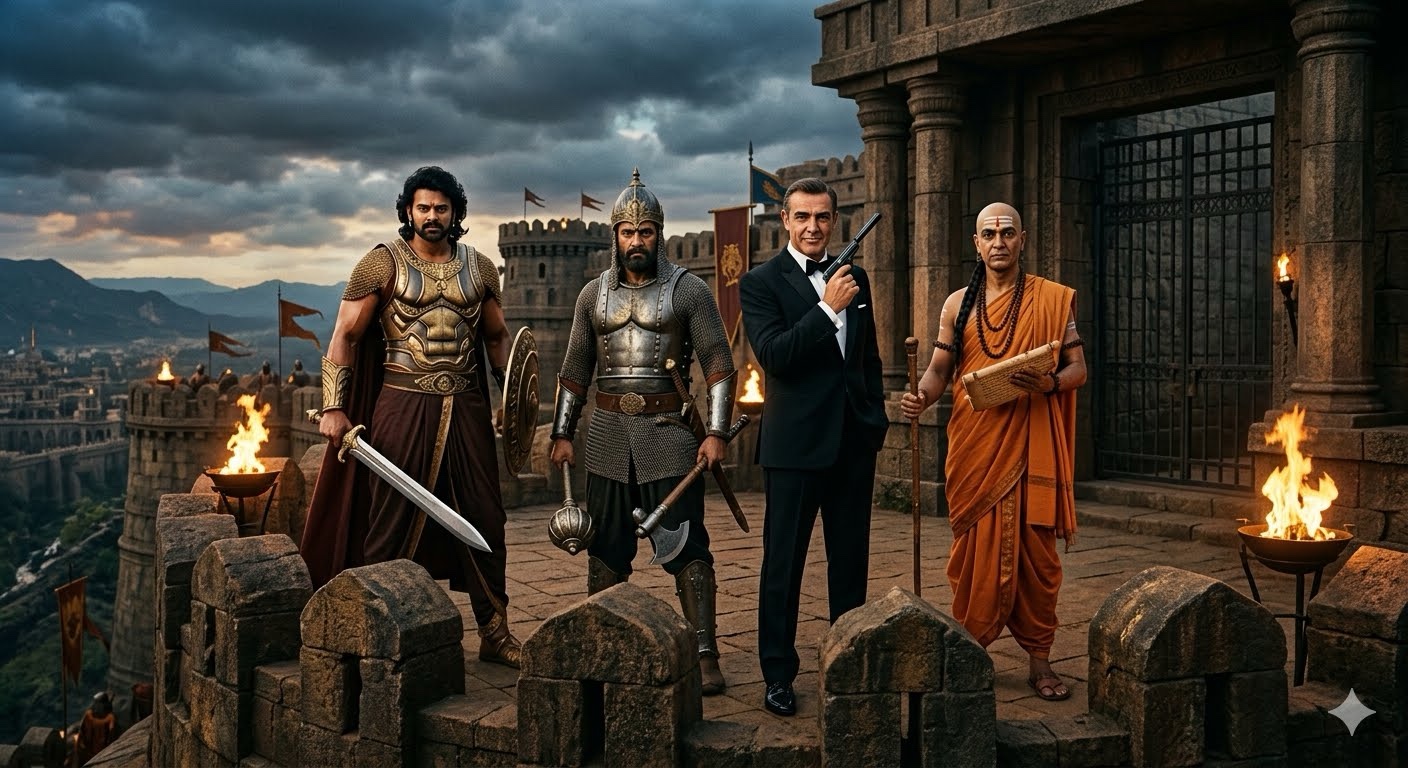
Why “Bahubali” and “Dhurandar”, but no Mudrārākṣasa? Why, isChanakya less cinematic than the CIA?
Dear Readers, this article is an extended excursion into the landscape of inherited memory, institutional neurosis, and civilizational exhaustion. We are using M.K. Sudharsan’s striking book, “A Tale of Two Cities”, to dissect a profound internal paradox: how one of India’s most philosophically sophisticated and highly literate communities spent centuries locked in bitter, microscopic schisms, only to watch the modern world quietly make their foundational arguments irrelevant. Whether you belong to this heritage by birth or observe it from a distance as a student of human history, this is a cautionary study in how civilizations misplace their priorities at the edge of history. If you appreciate these deep-dives, consider upgrading to a paid subscription to support independent, long-form intellectual journalism.
Let me begin with a personal note. I belong to the Vadakalai school of thought. When I had sought to understand the differences between the Vadakalai and Thenkalai schools, I hit upon several court cases pertaining to these sects. That prompted me to explore more from a philosophical angle and that resulted in my book ‘Naan Raamaanusan’ ( நான் இராமானுசன் -Tamil ) explaining the essential philosophy of Sri Vaishnavism to the masses. This book ‘A tale of Two Cities’ provided me with loads of information on the bifurcation, its history and the socio-political-economic circumstances. Hence this review.
Thanks for reading Mylapore Inquirer! Subscribe for free to receive new posts and support my work.Subscribe
I. Twilight in the Agraharam
The light in Srirangam does not fall; it withdraws. As dusk settles over the outer prakarams (temple enclosures) of the Ranganathaswamy temple, the heat radiating from the ancient granite stones feels less like a physical property and more like the heavy, accumulated exhaustion of a millennium. A solitary temple bell rings in the distance, its resonance thick and damp, swallowed almost instantly by the chaotic hum of a commercialized town. The air is heavy with the competing scents of crushed jasmine, burning camphor, and partially open drains—the modern olfactory signature of South Indian heritage hubs.
On a crumbling cement thinnai (veranda) of a traditional tiled house in North Uttara Street, two octogenarians sit in loose, hand-spun white dhotis. Their foreheads are marked with fresh, wet clay—one wears the U-shaped Vadakalaimark, its broad base resting squarely on the bridge of the nose; the other bears the Y-shaped Thenkalai mark, its central tail extending elegantly down the length of the nasal bone. They are arguing. They have been arguing since the late summer of 1974. Today’s battleground is not a newly discovered manuscript, but the precise sequencing of verses during the Prabandha Parayanam (recitative chanting) at a specific winter festival, and whether a certain long-dead pontiff was granted the appropriate maryada (temple honors) in an administrative litigation that dates back to the Madras High Court rulings of 1912.
Ten thousand miles away, in a glass-fronted apartment complex in Mountain View, California, a twenty-six-year-old software engineer named Srinivasan wakes up to a Slack notification. He is a direct descendant of the line of scholars these old men are invoking. His fingers fly across a mechanical keyboard, optimizing an attention-mechanism algorithm for a generative AI startup. On his desk rests a cold cup of oat-milk matcha latte and an Apple Watch that quietly tracks his resting heart rate and cortisol levels.
If you ask Srinivasan about the difference between Prapatti (surrender) as an active choice versus an unconditional state of grace, he will look at you with the blank, polite benignity of an urbanite asked to decipher hieroglyphic script. Yet, if he checks his family WhatsApp group later tonight, he will find fifty-three unread messages from his uncles in Chennai, Bangalore, and New Jersey, trading vitriol, legal PDFs, and court injunctions over who gets to lead in reciting a certain stanza of a liturgy in the annual procession of a temple in Kanchipuram.
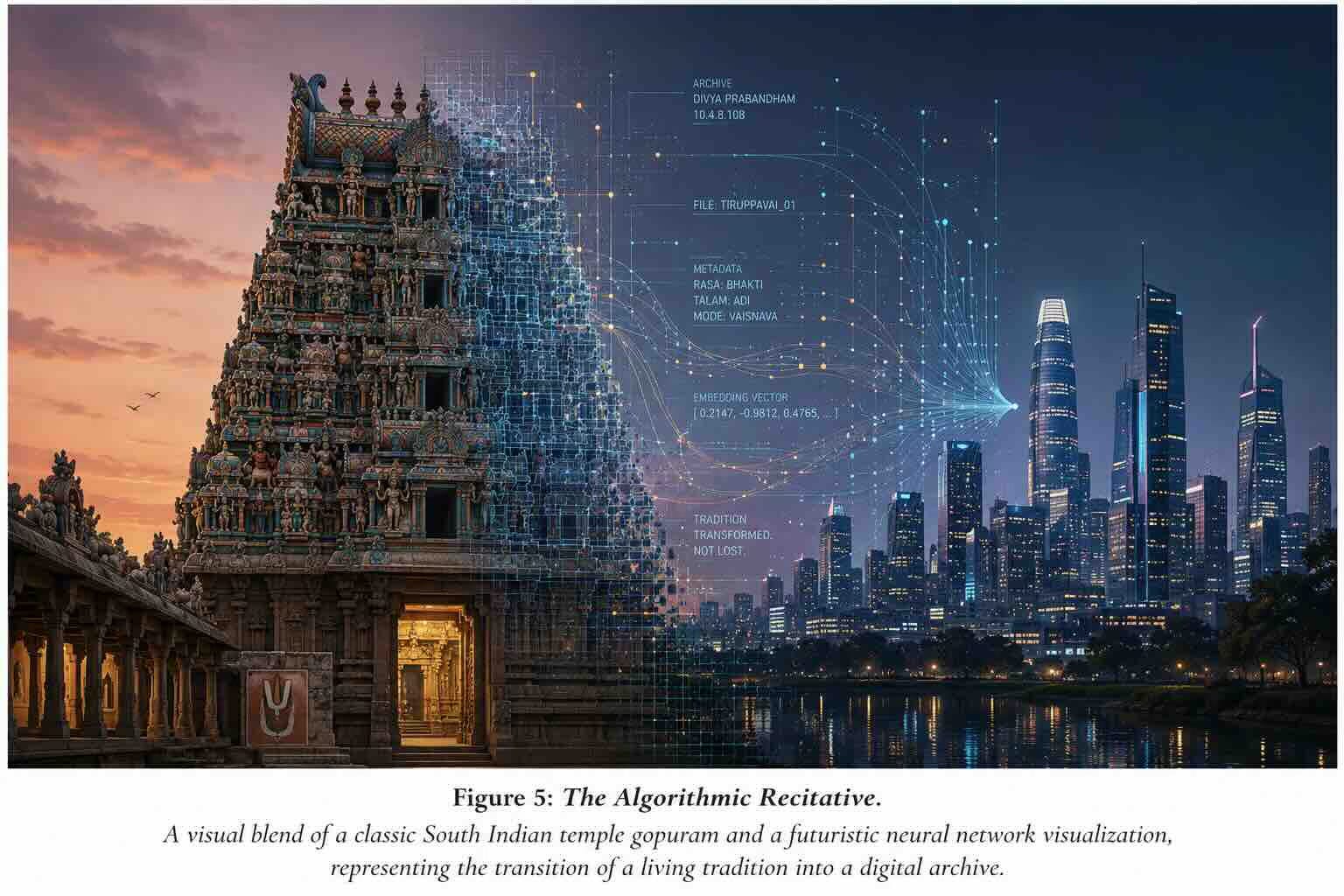
This is the surreal landscape of contemporary Sri Vaishnavism: a tradition of staggering philosophical depth, linguistic genius, and aesthetic sublimity that is simultaneously evaporating from its native soil and being preserved as an ossified, digital abstraction in the Western diaspora.
“By day they build neural networks in California. By night they wage medieval theological trench warfare on WhatsApp.”
M.K. Sudharsan’s A Tale of Two Cities arrives not merely as an administrative history of these sectarian squabbles, but as an accidental monument to a profound tragedy. It creates a mood of civilizational exhaustion, where ancient chants are drowned out by Slack notifications, and the grand architecture of the soul is reduced to a bitter debate over property rights.
II. The Geometry of Fracture: What the Book Reveals
Sudharsan’s work is an essential, if deeply sober, guide to the anatomy of this ancient rift. To the uninitiated observer, the division between the Vadakalai (the Northern Culture) and the Thenkalai (the Southern Culture) within the Sri Vaishnava fold appears like a classic case of what Sigmund Freud called the “narcissism of minor differences.” But as Sudharsan maps out with narrative precision, the schism was forged in the crucible of a massive intellectual challenge: how to reconcile two entirely different linguistic and theological universes.
This was the grand project of Ubhaya Vedanta—the Double Vedanta. The genius of Sri Ramanuja (1017–1137 CE) and his predecessors was the radical assertion that the ecstatic, Tamil love-poetry of the medieval, mostly low-caste Azhwars (mystic saints) was completely equal in spiritual authority to the Sanskrit Vedas and Upanishads. It was a beautiful, unstable equilibrium. The text details how this balance fractured along two distinct geographic and cultural axes in the centuries following Ramanuja’s departure:
The philosophical divide crystallized into two distinct schools of thought regarding the nature of human salvation and divine grace. The Vadakalai school, centered around Kanchipuram, turned its gaze northward to the Sanskrit corpus. They argued that liberation required an active, cooperative effort from the human being. This became known as the Markata Nyaya—the Monkey School. Just as a baby monkey must actively cling to its mother’s belly to be saved as she leaps across branches, the human athma (loosely translated as soul) must perform Prapatti (surrender) as an act of conscious will and maintain ritual, caste-based purity as a prerequisite for grace.
Conversely, the Thenkalai school, centered in the deep south around Srirangam, championed the Marjara Nyaya—the Cat School. In this view, the kitten does absolutely nothing; it cries, and the mother cat picks it up by the scruff of its neck and carries it to safety. Grace is unconditional, absolute, and requires no human prerequisite except the total cessation of resistance. To the Thenkalais, requiring human effort to “help” God save the soul was an insult to divine omnipotence.
Sudharsan writes with admirable neutrality, but the history he uncovers is a long, depressing record of institutional capture. What began as a nuanced, beautiful debate over the mechanics of divine grace devolved over five hundred years into an ugly squabble over real estate, temple income, honors, and administrative dominance. The book spends considerable time in the nineteenth and twentieth centuries, when the arrival of the British adversarial legal system transformed fluid theological debates into hard, litigious identity markers, permanently dividing communities that had lived side-by-side for generations.
III. The Narrenschiff of Ritual Narcissism
To read Sudharsan’s accounts of past litigations is to experience a form of intellectual vertigo. We are observing some of the most sophisticated minds India ever produced—men who could effortlessly navigate the labyrinthine grammar of Panini and the hyper-logical structures of Navya-Nyaya—reducibly engaged in mutual exclusion. There is a dark, Swiftian comedy to it all. One is reminded of the Big-Endians and Little-Endians of Gulliver’s Travels, who went to war over which end of a boiled egg should be cracked first. But here, the stakes were made to feel cosmic.
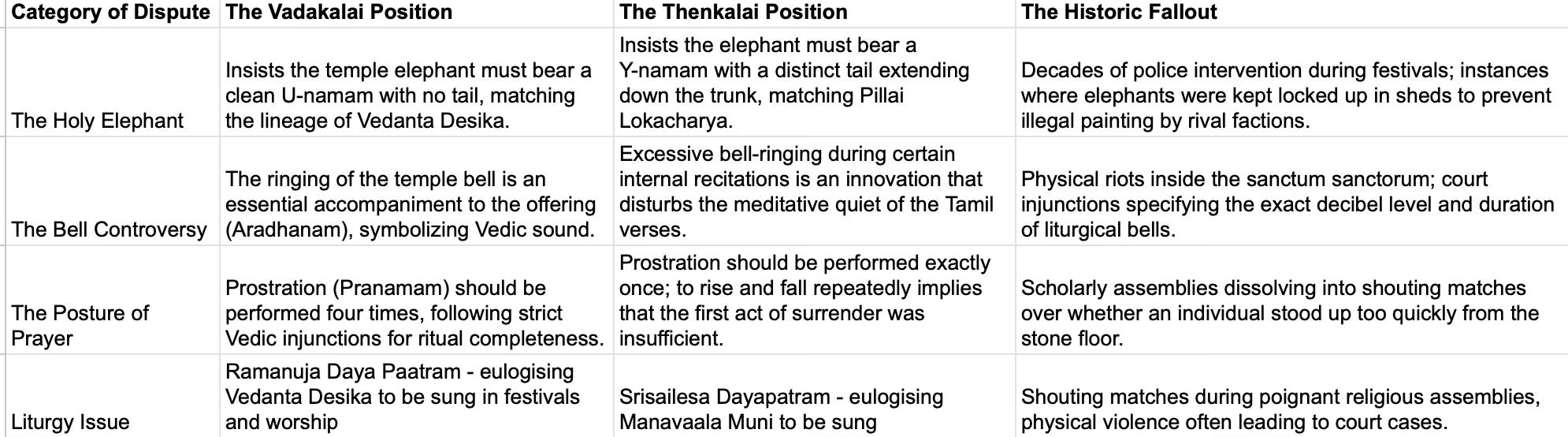
Consider the sheer scale of the waste. Over three centuries, millions of rupees, thousands of hours of intellectual labor, and generations of communal goodwill were spent on resolving questions that would make an angel weep with boredom. Did the holy water (Theertham) belong first to the Vadakalai or Thenkalai line of scholars during a specific festival? Should a temple icon wear a fixed gold crown that covers the sectarian markings or if the markings must remain visible at all costs? Whether the ringing of a bell during a specific silent meditation constitutes a sectarian provocation? Should a particular liturgy of a long dead and gone scholar-saint be sung in front of the saint’s idol ? Should the norther schoolers be part of the hymn chanting group (Ghoshti) at all ? Should the temple elephant wear a U mark or a Y mark on its forehead ?
The text repeatedly forces us to ask: What exactly did either side finally win? When the high court rules in your favor after forty years of litigation, and you walk back into an agraharam where three-quarters of the houses are locked, boarded up, or sold to real estate developers building concrete wedding halls—what is the nature of your victory? Did anyone notice the world disappearing around them while they were busy checking the geometry of the ‘thiruman’ on a temple elephant’s forehead?
IV. The Paper Monuments of Judicial Mania
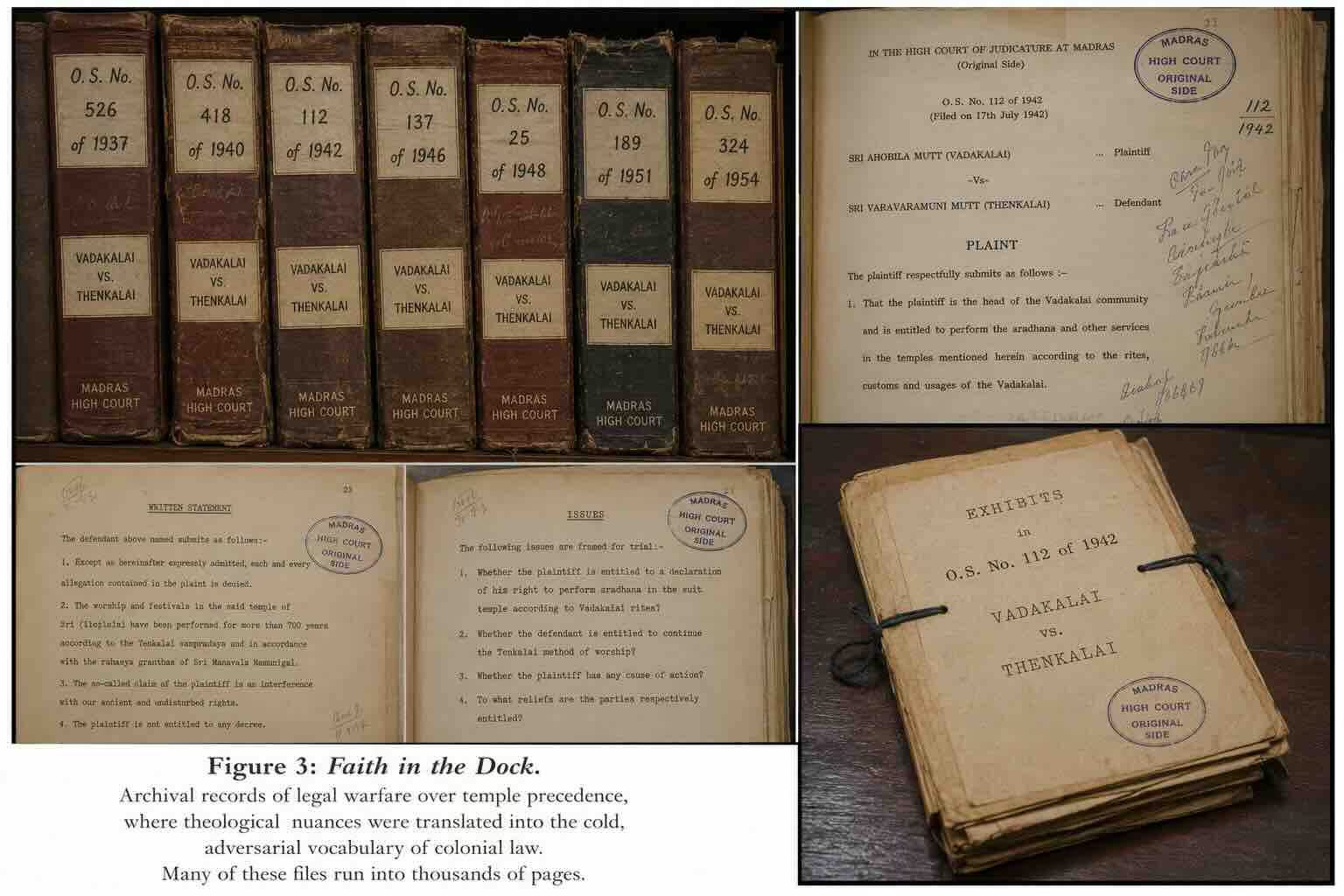
To fully comprehend the depth of this self-inflicted paralysis, one must look closely at the sheer volume of intellectual and material resources poured into the legal system. This was not a passive slide into obscurity; it was an incredibly expensive, hyper-active, highly documented crusade. For nearly five centuries, the legal machinery of South India—from the local village panchayats of the Nayak era to the formal corridors of the Madras High Court and the Privy Council in London—was choked with Sri Vaishnavas suing each other.
The archives reveal that many thousands of hours and months were spent in courts dating from the 16th century on lawsuits that are quite literally not worth the paper they were written in. Litigants spent their family fortunes to secure judgments on whether a specific lineage of priests had the exclusive right to hold an umbrella over an icon during a rainstorm, or whether the Prabandham verses could be chanted while the deity was being carried past a specific grocery shop.
These files, sitting in dusty record rooms in Chennai and London, run into hundreds of thousands of pages. They are paper monuments to an institutional neurosis, written in a dry legal prose that attempted to codify the infinite metrics of divine love into actionable property boundaries.
While monumental fortunes were spent on retaining the finest legal minds of the colonial bar to argue these trivialities, the community’s actual intellectual institutions—the ancient patashalas and monastic libraries—were left to rot. Roofs leaked onto priceless palm-leaf manuscripts containing unexamined commentaries, while the descendants of the scholars who wrote them were busy filing affidavits at the sub-registrar’s office. It was a spectacular, comprehensive misallocation of civilizational energy.
V. The Polemical Page: Decrying the ‘History of Ramanujadayapatram’
If the courtrooms provided the battlegrounds, it was print culture that provided the ammunition. No single artifact better encapsulates this tragic commitment to perpetual division than the mid-twentieth-century polemical literature that emerged from the religious presses of Srirangam and Kanchipuram. A prime, devastating example of this genre is P.B. Annangarachariar Swamy’s (popularly known as PBA Swamy) notorious text, History of Ramanujadayapatram.
PBA Swamy was undeniably an intellectual titan. He was a scholar of unmatched linguistic fluency in Sanskrit, Prakrit, and Tamil, capable of producing profound, luminous commentaries on the most complex, ecstatic verses of the Azhwars. Yet, like so many brilliant minds before him, he chose to funnel an immense portion of his formidable intellectual energy into the service of sectarian warfare. His History of Ramanujadayapatram stands as a definitive monument to this tragic misuse of genius.
The book is an exhaustive, relentless, and hyper-detailed attempt to historicize, deconstruct, and legally delegitimize the Ramanujadayapatram—the specific invocation chant used by the Vadakalai sect at the commencement of their rituals. PBA Swamy probably spent months of intense research micro-analyzing historical timelines, epigraphical records, and old palm leaves, treating a traditional opening chant of prayer with the aggressive suspicion of a corporate patent lawyer hunting for a loophole in a competitor’s intellectual property.
“When a scholar of universal standing dedicates his life to proving that his neighbor’s opening prayer is a historical forgery, the tradition ceases to be a pathway to liberation. It becomes an administrative manual for an ongoing cold war.”
The underlying premise of such literature is that the rival sect’s entire lineage is not merely a different path, but an institutional fabrication—an illegitimacy that must be stamped out of the temple records. Works like the History of Ramanujadayapatram did not preserve the tradition; they poisoned the well for the modern era. They ensured that the younger generation, growing up in a rapidly secularizing world, saw Sri Vaishnavism not as a glorious ocean of mystical devotion, but as an exhausting, petty maze of inherited animosities and pedantic historical scores that needed to be settled with absolute ruthlessness.
Sudharsan bring out the venom in the PBA pamphlet, while exposing, in earlier chapters, the irrationality and over-use of a supposed record called ‘Aathan Jeer Agreement’ dating back to 200 years ago.
VI. A Separate Catalog of Petty Disputes
To look back at this history is to realize that the rifts were sustained by an incredible attention to the microscopic. Below is a catalog of some of the most fiercely contested disputes in the history of the tradition—treated here with the restrained ridicule and tragic humor they deserve:
To grow up inside this matrix is to know that the hostility was rarely violent; it was something far worse—it was linguistic and social. It was the curled lip when someone pronounced a word with the wrong accent; the subtle shifting of seating arrangements during a communal temple feast; the quiet, devastating dismissal of a brilliant young scholar’s thesis simply because his forehead bore the wrong configuration of sacred clay. The reader should simultaneously laugh at the absurdity and weep for the lost opportunity.
VII. The Silicon Valley Trench Lines: Diaspora Hypocrisy
If this madness had died out with the old world, we could treat it as a historical curiosity—a colorful, melancholic footnote in the story of Sri Vaishnavam of Southern India. But the most scathing, ironic, and brilliant dimension of this contemporary reality is its strange reincarnation in the digital diaspora. Walk into a tech incubator in San Francisco or an AI research lab in Seattle today, and you will find Vadakalai and Thenkalai Iyengars working in perfect, frictionless harmony. They collaborate on complex code bases, share investments in fintech platforms, share apartments in Jersey City, and jointly complain about the quality of curry leaves at the local Indian grocery store.
Their children go to the same elite prep schools, build robotics projects together, and apply to the same Ivy League universities. The ancient distinctions of Marjara and Markatamean absolutely nothing when you are trying to scale an application on Amazon Web Services. Yet, the very wealth and connectivity generated by their hyper-modern professions are being weaponized to sustain the ancient, dead rivalries back home. The diaspora has created a class of long-distance theological snipers.
The diaspora lives in a state of split-screen consciousness. On Facebook and WhatsApp groups, senior staff engineers from Google and cloud architects from Microsoft spend their evenings analyzing low-resolution videos of a festival in a remote Tamil Nadu village. They are checking to see if an unauthorized verse was smuggled into the recitation by the rival sect. They run crowdfunding campaigns on US platforms to pay for high-profile lawyers in the Madras High Court to fight over the administrative rights of local shrines that the donors themselves visit perhaps once every five years.
It is a vicarious orthodoxy, funded by dollars and fueled by an unresolved existential guilt. They do not want to live in the agraharam—it lacks proper air conditioning—but they insist that those who do remain must continue to hate each other according to the ancient protocols.
VIII. Sri Vaishnavism in the Age of Generative AI
This brings us to the ultimate, surreal contrast of our present moment: the intersection of rigid sectarianism with the fluid, algorithmic reality of the AI age. Today, any curious seeker can open ChatGPT or Claude and type: “Compare the soteriological differences between Vedanta Desika and Pillai Lokacharya regarding the concept of Prapatti.” In less than four seconds, the machine will generate a clean, highly structured, beautifully balanced summary of the dispute. It will distill four hundred years of linguistic hair-splitting into four bullet points, formatted in perfect Markdown.
The machine does not care about the honors. It does not feel its blood boil when a Y-namam is drawn on a wall instead of a U. It processes the sacred texts of the Alvars not as an ecstatic pathway to the divine, but as a series of tokenized probability arrays. The irony is devastating. As the capacity to memorize and parse these texts disappears from human brains—with the younger generation unable to read the Tamil or Grantha scripts of their own ancestors—the texts are being preserved perfectly by cold servers in northern Virginia and Dublin. The repository of the Nalayira Divya Prabandham is no longer the living, breathing chest of a scholar walking the streets of Mannargudi; it is a repository on GitHub.
This technological shift produces a profound cultural fragmentation. We now have “Instagram spirituality,” where young diaspora influencers post aesthetic reels of temple architecture set to fusion Carnatic music, completely divorced from the strict, demanding intellectual training that produced those spaces. We have YouTube acharyas offering quick, bite-sized initiations online to satisfy a vague, floating need for identity among people who have lost their roots. The algorithms look for engagement, and nothing drives engagement quite like conflict. Thus, the ancient rifts are weaponized by social media metrics. A controversial tweet about a sectarian marking can generate more impressions than a lifetime of quiet commentary on the Tiruvaimozhi.
IX. A Call for Introspection
It is easy to finish Sudharsan’s book and conclude that the Sri Vaishnava tradition deserves its current decline—that any culture so obsessed with its own internal fractures is structurally unfit for survival in the modern world. But that would be a profound error. The true tragedy of A Tale of Two Cities is that the civilization it describes is something of breathtaking, heartbreaking beauty. To look past the namams and the lawsuits is to encounter a world of emotional and intellectual richness that has few parallels in human history.
This is the tradition that gave the world the philosophy of Visistadvaita—a system that managed to unify the cold, abstract absolute of the Upanishads with the warm, beating heart of human devotion. This is the tradition that produced poetry of such staggering aesthetic power that even today, when scanned or chanted by a line of trained singers inside a dark granite hall, it can move a secular, modern skeptic to tears. Ramanuja’s vision was one of radical spiritual democracy. He was the teacher who stood on top of the temple tower at Thirukoshtiyur and shouted the sacred mantra to everyone, risking his own spiritual damnation to ensure the liberation of the masses. He integrated low-caste communities into the core functional rituals of the Srirangam temple.
How did that vast, inclusive, ocean-like vision shrink until it became a legal brief about an elephant’s forehead? A researcher in 3000 AD would be as confused as the secular Indian courts are, of this schism.
The 44th Jeer of Ahobila Mutt, who built the Rajagopuram for the Thenkalai Srirangam Temple, never once visited the inner precincts of the temple to offer worship to Sri Ranganatha who reclines on a coil of Adiseshan. His grief was his guru, the 14th century Vedanta Desika was confined to his shrine (and never allowed his annual uthsavam walk arounds) within the Srirangam temple due to the Thenkalai Vadakalai dispute.
Similarly, in Thiruvahindrapuram, near Cuddalore, the doors of the Sri Devanathaswamy Temple (Vadakalai) were shut when a ritual procession of Manavaala Maamuni passed by the temple.
This competitive hatred can never be understood by a modern Srivaishnava who excels in Machine Language algorithms that make the world e-commerce servers run.
X. The Quiet Room
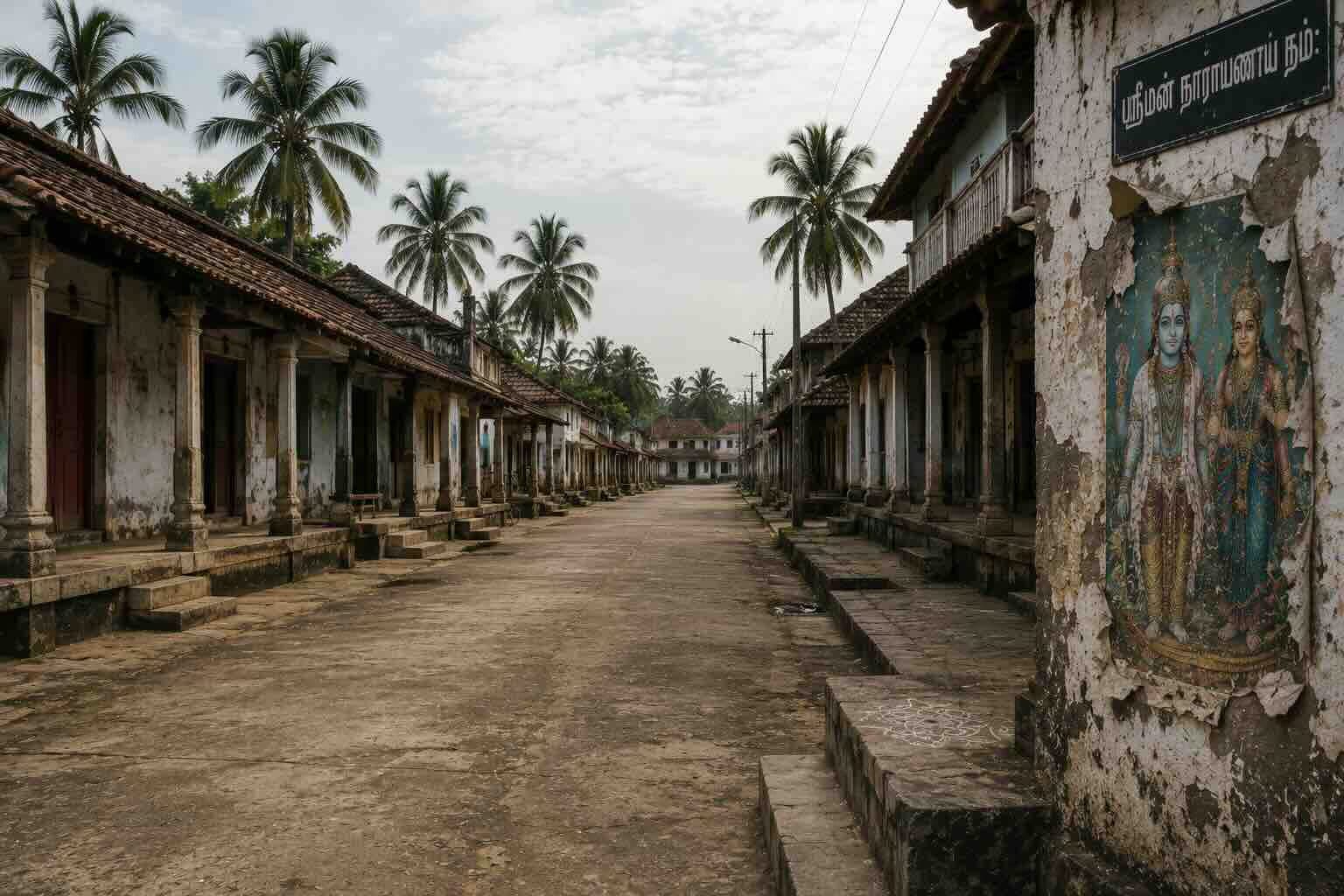
Sudharsan’s book ends with an administrative summary, but the narrative arc he traces leaves a reader standing in a very different place. It leaves you standing in an empty street in Mannargudi, Srirangam, or Triplicane at dusk. The old men on the thinnai will eventually pass away. Their arguments will go with them into the fire. The temple bells will continue to ring, but they will be operated by electronic switches connected to digital timers, installed by an indifferent department of a secular government. The elephant will bear whatever mark the latest court order dictates, its procession watched largely by tourists holding up smartphones to capture content for their social feeds.
The grandchildren in California will continue to build the future. They will design algorithms that can write commentaries on the Gita in thirty languages simultaneously. They will live in clean, beautiful, orderly suburbs, free from the messy, petty, exhausting politics of their ancestral towns. They will have achieved everything their ancestors could have dreamed of in terms of material security and global influence. And yet, there will be moments—perhaps during a quiet midnight in Silicon Valley, when the code is compiled and the Slack channels go silent—when one of them will look out the window at the dark outline of the Santa Cruz mountains.
A vague, unnameable phantom of a memory will rise. A line of a Tamil verse heard in childhood, chanted by a grandfather whose forehead bore a specific design, will echo faintly through the corridors of their brain. They will try to find it online. They will open a search engine. They will find the text, perfectly preserved, clean, and completely dead, sitting on a cloud server.
They will look at it, squinting across the vast, unbridgeable gulf of three generations, wondering what it was that their people possessed that was so precious they were willing to tear themselves apart for it—and why, in the end, they let it go so easily. A Tale of Two Cities is ultimately a warning masquerading as a history.
The real enemy is not the opposite kalai. It never was. The real enemies are irrelevance, demographic decline, migration without transmission, state dependency, technological distraction, inherited insularity, and the slow conversion of deep culture into either heritage theater or digital mood-board religion. The opposite sect did not hollow out the agraharam. The opposite sect did not scatter the grandchildren. The opposite sect did not reduce memory to screenshot warfare. History did that — while the feud kept both sides occupied.
While the acharyas were drafting counter-affidavits, the economic foundations of the temple ecosystem were being rewritten by state bureaucracies and secular indifference. The community excelled at producing brilliant individuals who escaped the system to become world-class scientists and executives, but each individual escape was a drop of life-blood drawn away from the cultural core.
If there is any dignity left in this story, it lies in introspection. Not flattening, not sentimental unity, not another round of performative magnanimity, but introspection severe enough to ask whether preserving the quarrel has become easier than preserving the civilization.
My satirical synopsis of what Sudharsan has suggested as the way forward:
The Blueprint: Sri Ramanujacharya pulls off a masterclass in theological harmony (Ubhaya Vedanta), seamlessly welding rigid Sanskrit metaphysics with ecstatic Tamil poetry. Everyone is happy, united, and focused on the divine for about five minutes.
Enter the Cash: The 15th-century Vijayanagara kings rain down real estate and gold on the temples. Naturally, spirituality goes out the window, and a turf war erupts. The community splits into the Vadakalai (Northern Sanskrit snobs) and the Tenkalai (Southern Tamil purists), proving that nothing fractures brotherly love quite like a massive inheritance. The scions of the Thathachariars of Kanchipuram and those of Uthama Nambi and Azagiya Manavaala Jeer in Srirangam carry forward the two schools.
The Avatar Escalation: To score theological points, both sides flagrantly bend temple laws to deify their dead gurus. The Vadakalais declare their guru an avatar of Vishnu’s handbell; the Tenkalais retaliate by declaring theirs an avatar of a giant celestial snake.
The Forehead Feud: For over 230 years, these two camps have been bleeding each other dry in secular courts, wasting fortunes to sue each other over the critical, universe-altering question of whether a temple elephant’s forehead should be painted with a “U” or a “Y”.
The Irony: While they remain locked in a death match over who gets to sing their specific holy anthems first, the secular government quietly steps in, passes the HR&CE Act, and confiscates the actual temples.
The Utopian Pipe Dream: The only cure is a radical manifesto that will never happen: forcibly stripping the “U” and “Y” marks off the walls, eviction-noticing the guru idols from the inner shrines, banning sectarian slurs, and forcing grown adults to sign a treaty promising to stop running to judges every time someone chants the wrong syllable.
End Note:
An agraharam at dusk. A loudspeaker crackles. A bell rings into thinning air. Two elderly Iyengars in Srirangam continue an argument so old it has forgotten its own original temperature.
Somewhere abroad, a grandson watches a clip of this on a family WhatsApp group. He reacts with folded hands. Then he returns to a dashboard where a machine is being trained to answer questions on religion, ethics, language, and memory.
The temple survives.
But increasingly it survives as image, archive, litigation, nostalgia, and diaspora emotion.
And in the next tab, a machine answers a Vedantic question faster than the hereditary scholar can clear his throat.
That is the atmosphere in which A Tale of Two Cities lingers after it is finished. Not merely as a history of two sects, but as a lament for a civilization that mistook internal rivalry for continuity while the future quietly left the room.
The bell still rings.
It is no longer clear for whom.
Post Script :
In May 2026, the Supreme Court is still hearing a case of Vadakalai and Thenkalai related to Kanchipuram Varadaraja Swamy Temple, while I, as a Vadakalai Iyengar, cannot recite Prabandham at Mylapore Adi Kesava Perumal Temple or at Tiruvallikkeni Parthasarathy Swamy Temple as part of the traditional prabhandham reciters. That is some way to promote Ramanuja’s Sri Vaishnava tradition.
(Thanks for reading Mylapore Inquirer! This post is public so feel free to share it).
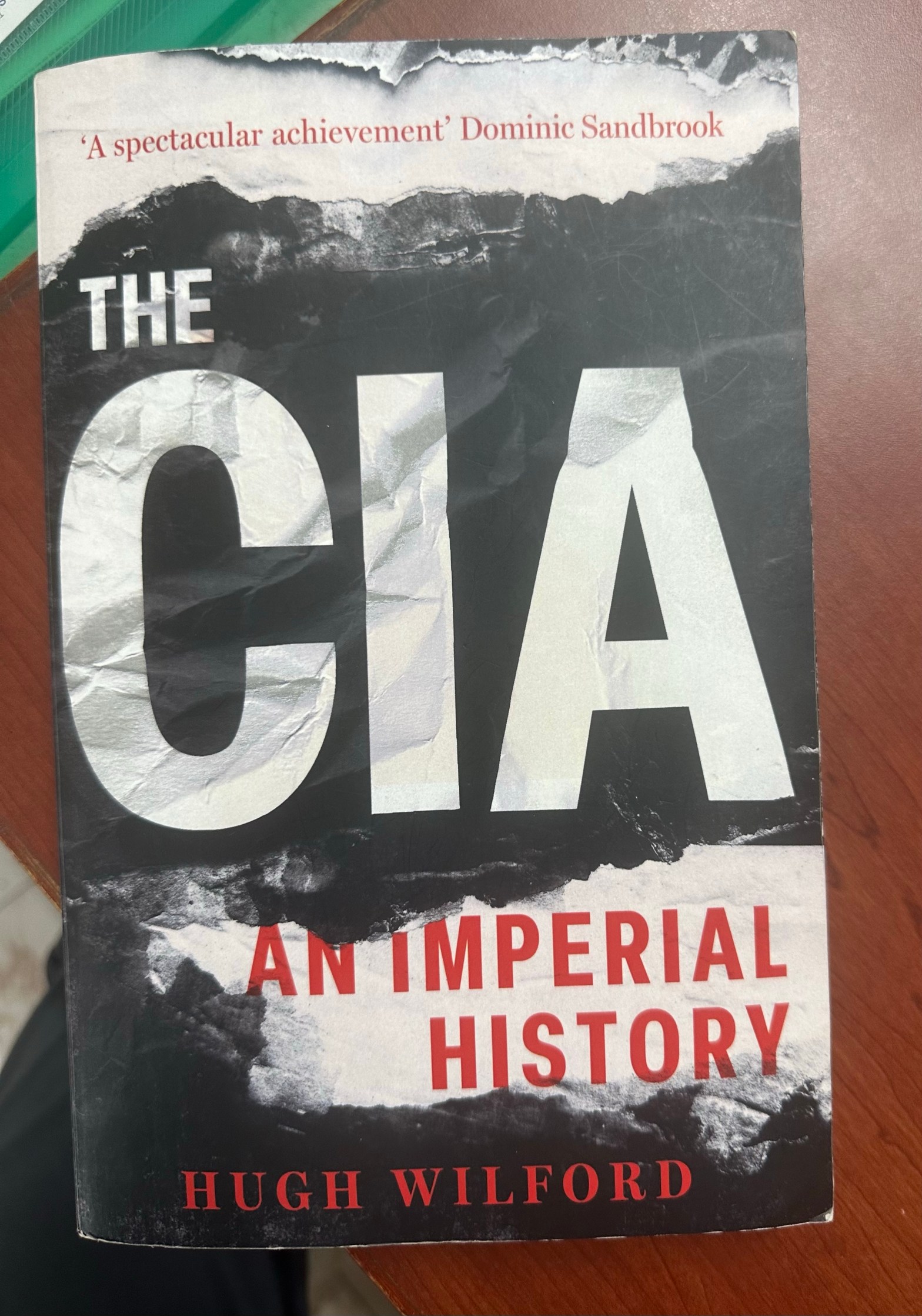
Hugh Wilford’s The CIA: An Imperial History shows that the Agency’s most dangerous weapon was never a gadget but a story: an imperial literary imagination — Kipling, Lawrence, Greene, Hollywood — that taught America how to see, intervene in, and narrate the world.
I’ve just finished reading the book and I now understand the CIA is not merely a secretive bureaucracy (“deep state”) but is heir to Anglo-European spymaster traditions — a shadowy arbiter whose cinematic glamour masks a long, pernicious — perhaps at times even malevolent — inheritance of empire.
*********************
An institution shaped by stories
Hugh Wilford’s The CIA: An Imperial History is less a catalogue of cloak-and-dagger episodes than a cultural and intellectual excavation of the Agency’s soul. Wilford compels the reader to see the CIA not only as an instrument of state power — coups, covert action, surveillance, subterfuge and the “enhanced interrogations” and deniable political assassinations that darken its record — but as an institution shaped by a particular literary imagination and an imperial habit of mind. This is a book about politics and policy, yes, but also about reading: about how novels, memoirs, and travelogues supplied models, metaphors, and moral vocabularies that helped make the Agency what it became.
A revisionist genealogy
Hugh Wilford offers a revisionist genealogy of the CIA: its operations and doctrines are best understood through the cultural world occupied by its founders and senior officers. Instead of treating Central Intelligence as a purely bureaucratic or technological product of the Cold War, Wilford traces the agency’s instincts to a classically imperial formation — men groomed in elite Ivy League schools, steeped in Anglo-European travel literature, and literate in the narratives of adventure, secrecy, and civilizational mission. This alone makes his book valuable: it redirects our attention from gadgets, spyware and top-secret memos to literature, posture, and imagination.
Literature as operational model
Wilford’s central theses are lucid and persuasive. He shows how founding figures of the CIA and its early leaders — such as Sherman Kent, Kermit “Kim” Roosevelt, Edward Lansdale, James Angleton, and others —,were animated by the same texts that shaped nineteenth- and early twentieth-century imperial officers: Rudyard Kipling’s tales of frontier cunning, T. E. Lawrence’s Seven Pillars of Wisdom, the moral ambiguities in Graham Greene’s novels, the biting satire of Eugene Burdick and William Lederer’s The Ugly American.
These literary works supplied templates for conduct, helped normalize forms of intervention, and furnished metaphors — “civilizing mission,” “native management,” “hearts and minds” — that translated comfortably into covert operations.
Iran and Guatemala
The historical record shows how this mentality operated in practice.
In Iran, Kermit “Kim” Roosevelt Jr., grandson of President Theodore Roosevelt (who btw, loved Kipling novels) played a central role in the 1953 coup that removed Mohammad Mossadegh from power.
In Guatemala, the overthrow of Jacobo Árbenz was bound up with the interests of the United Fruit Company, whose threatened banana import business empire helped turn land reform into a target of covert action.
These episodes reveal how closely intelligence, empire, and corporate power could work together in the postwar world.
Cultural specificity
The book’s particular strength is its cultural specificity. Wilford does not merely assert influence; he documents it. He recounts how Lawrence’s book served for a time as required reading, how Graham Greene’s Quiet American functioned as a cautionary mirror to American interventionism, and how popular novels and films both reflected and reinforced CIA self-understanding.
The result is an argument that the Agency’s imperial tendencies were not accidental by-products but partly cultivated dispositions with deep aesthetic roots. Angleton’s intimate friend and sounding board of ideas was Ian Fleming, creator of James Bond.
CIA and popular culture
Wilford also shows the reciprocal circulation between the CIA and popular American culture.
The Agency fed fiction and cinema as much as it consumed them. From Angleton’s murky sympathies with literary modes of conspiracy to the later Hollywood-CIA rapport that produced celebrated blockbusters, the book maps a two-way flow: the CIA shaped representations of espionage even while those representations legitimated certain kinds of action in the eyes of the common masses.
Films such as The Manchurian Candidate and the Jack Ryan and Jason Bourne sequels of thrillers belong to this wider atmosphere of intelligence-driven paranoia, where espionage became both political reality and cinematic grammar.
Archival depth and limits
The book’s archival work is commendable. Wilford draws on declassified documents, memoirs, and correspondence to make his cultural claims concrete. He avoids romanticizing the literary influences; his account is clear-eyed about the human costs of covert action. Where the book cannot fully answer every causal pathway between reading and doing, it nonetheless supplies enough evidence to make the connection plausible and troubling.
A necessary caveat
A few caveats are worth noting. Wilford’s focus on the Anglophone literary canon risks underplaying other vectors: the organizational dynamics of U.S. foreign policy, interagency competition, domestic political imperatives, and technological innovations that also guided CIA practice.
In some chapters the literary thesis occasionally reads as the dominant explanation when a more plural account might be closer to the truth. Yet this is not a fatal flaw; rather, it is the deliberate trade-off Wilford makes to illuminate an understudied dimension of the Agency.
Why the book matters
For readers like me interested in literature, history, and postcolonial studies, and even the cultural life of American imperialism, The CIA: An Imperial History is fascinating. It reframes familiar episodes — coups in Iran and Guatemala, Vietnam-era interventions, the shadow wars of the Cold War, the Global War on Terror (GWOT)— as episodes that owe as much to imagination and narrative habit as to geopolitics and strategy.
The book helps explain why the CIA’s practices often felt at home in the landscapes of empire: because its leaders had learned to narrate portrayals of foreign peoples and places in precisely those imperial idioms… those bequeathed by the likes of Lawrence of Arabia and Graham Greene.
India, empire, and memory
As a reader here in India, with indelible memories of a long history of colonial rule and the suppression that accompanied it — much of which was enabled by the British Empire’s intelligence apparatus (that today is known as MI6 — I found Wilford’s thesis especially resonant. The CIA, in large part, is truly an inheritance and imitation of that Anglo-European spymaster-ship. Its nefariousness flourishes today not only because of covert capabilities but because American literary traditions, amplified by Hollywood, have made the Agency into an unacknowledged legislator and a shadowy arbiter of world affairs. After all and as we all know it only too well, the hidden hand that works the levers behind the scenes in both the Russo-Ukraine and the US-Iran Wars is the CIA.
Closing assessment
In sum, this is a stimulating, well-documented, and richly argued study. It will interest historians and political scientists, but also literary buffs, film historians, and anyone curious about how stories — and storytelling — shape great power.
The CIA emerges from this book’s pages not merely as a machine of secrecy, but as an ensemble of adventure-story readers and writers who turned imperial narratives into modern instruments of espionage, intelligence work, into covert meddling and purveying policy for projecting great power and international influence around the world — and in doing so, made the United States’ postwar interventions not only possible, but narratable.
I had never imagined that the CIA, of all places in the world, would be the place where Literature met Imperialism in flesh and blood. This book opened my eyes anew to an old truth: the pen can indeed be mightier than the sword.
Amaruvi Devanathan is an Indian author, public speaker, and professional banking technologist. He frequently describes himself with the catchphrase “a banker by day and blogger by night,” balancing a corporate career in data architecture with a prominent role in the Tamil and English literary circuits.
Corporate Career: He has worked globally across India, Japan, and Singapore for technology and financial institutions like Citibank, Mphasis, Birlasoft, and Siemens. After spending 15 years working abroad in Singapore, he relocated back to Chennai, India.
Literary & Public Work
Blogging: He runs a popular bilingual blog called Amaruvi’s Aphorisms, where he writes commentary on history, literature, and social situations.
Public Speaking: He is a Toastmaster, frequently participating in literary events and mentoring students in public speaking and creative writing. He also appears on prominent Tamil digital media channels (like Chanakyaa) as an analyst discussing historical and socio-political topics.
Published Books
He has written several notable works in both Tamil and English, listed on platforms like Amazon: [1, 2, 3]
Pazhaya Kanakku (பழைய கணக்கு): A collection of Tamil short stories bound by the theme of justice. One of its stories was selected by the National Book Trust of India in their top 25 short stories list.
Monday is not Tuesday: An English book detailing South Indian childhood experiences during the 1980s and 1990s.
Naan Raamaanusan (நான் இராமானுசன்): A first-person historical fiction narrative about the life, philosophy, and reforms of the 11th-century Hindu saint Ramanujacharya.
Vandhavargal (வந்தவர்கள்): A period novel capturing a century-long migration history.
Neyveli Kadhaigal (நெய்வேலிக் கதைகள்): A book capturing idyllic life in the industrial town of Neyveli during the 1970s and 1980s.
Amaruvi Devanathan has just today written and posted a deep-divebook review on his very popular blog-space on Substack: Amaruvi’s Aphorisms.
Please do read this extremely trenchant, conscience-rousing book review here :
உதயநிதி ஸ்டாலின் “சனாதன தர்மத்தை ஒழிக்க வேண்டும்” என்ற தனது மறுகூற்றால், தமிழ்நாட்டில் நீண்ட காலமாக நீடிக்கும் பண்பாட்டு–அரசியல் மோதலின் இன்னொரு அத்தியாயத்தை மட்டும் மீண்டும் எழுப்பவில்லை. ஒரே சொற்றொடரில் ஒரு சிக்கலான நாகரிக மரபை எவ்வளவு எளிதாக ஒரு அரசியல் இலக்காகச் சுருக்கிவிடுகிறோம் என்பதையும் அது நினைவூட்டுகிறது. அந்த முழக்கத்தின் செயல்பாடு தெளிவானது: சனாதன தர்மமும் சாதிய ஒடுக்குமுறையும், பிராமணீய வழிபாட்டு மரபும் சமூக ஆதிக்கமும், சடங்கு அதிகாரமும் மரபுவழி சிறப்புரிமையும் — இவை அனைத்தையும் ஒன்றாகக் கலக்கிவிடுவது. அந்தக் கலப்பை எதிர்க்க வேண்டும் என்பதே முதல் தேவை.
துர்சின் பார்வை
பீட்டர் துர்சினின் “அதிக எலீட் உற்பத்தி” என்ற கோட்பாடு, பிராமணர்களின் உள்நோக்கிச் சுருங்கும் தன்மையை மலிவான நெறி-மோசமாக்காமல் புரிந்துகொள்ள ஒரு பயனுள்ள வழியை அளிக்கிறது. அவரது அடிப்படை வாதம் எளிதானது: சமூகத்தில் கௌரவம், அதிகாரம், பதவி ஆகியவற்றுக்குத் தகுதியுடையவர்கள் என்று கருதப்படும் ஆட்கள் மிக அதிகமாகி, அவற்றை ஏற்றுக்கொள்ளும் இடங்கள் மிகக் குறைவாக இருந்தால், விரக்தி, பிரிவினை, உள்எலீட் மோதல், இறுதியில் நிலையற்ற தன்மை ஆகியவை உருவாகும். அந்த அர்த்தத்தில், எலீட் மூடுபாடு என்பது தீய நோக்கத்தின் சாட்சியல்ல; வளங்களின் பற்றாக்குறைக்கான ஒரு கட்டமைப்பு ரீதியான பதிலாக இருக்கலாம்.
(Peter Turchin-ன் கோட்பாட்டைப் பற்றி மேலும் படிக்க, ஆங்கிலத்தில் நான் எழுதிய எனது மூல வலைப்பதிவுகளைப் பெற கீழே உள்ள இணைப்புகளைச் சொடுக்கவும்.
இவ்வாறு பார்த்தால், பிராமணர்களின் எல்லை-காக்கும் போக்கு என்பது, அறிவு, மந்திரம், அதிகாரம் ஆகியவை அரிய வளங்களாக இருந்த ஒரு சடங்கு நாகரிகத்தில், எலீட் நிலையைப் பாதுகாப்பதற்கான ஒரு நடைமுறைத் தந்திரமாகப் புரிந்துகொள்ளலாம்.
சாதிச் சுருக்கத்தைக் கடந்துப் பார்ப்பது இதனால் வரலாற்று ரீதியான விலக்குகள் அனைத்தும் நியாயப்படுத்தப்பட்டுவிட்டன என்று அர்த்தமில்லை. பல பகுதிகளில் பிராமண ஆதிக்கம் இறுகி, படிநிலை உறுதியாகி, அதனால் எழுந்த மனக்கசப்பு கற்பனையல்ல. ஆனால் மனக்கசப்பு என்பது பகுப்பாய்வு அல்ல; பகுப்பாய்வு என்பதற்காக பிராமணர்களை ஒரே வகை சதியாளர்களாகக் காண வேண்டிய அவசியமுமில்லை.
பிராமணீயம், அதன் உயரிய வடிவில், சாதி அகந்தையல்ல; அது ஒழுக்கம், உரைநூல் நினைவகம், சடங்கு நிபுணத்துவம், மற்றும் சனாதன தர்மத்தை வெறும் சிந்தனையாக அல்லாது வாழக்கூடிய ஒரு வாழ்க்கை முறையாக மாற்றும் உழைப்பு. அதைக் “சாதி” என்ற ஒன்றாக மட்டும் சுருக்குவது, மாசுபட்ட வடிவத்தையே மூலச் சாரமாகக் குழப்பிக் கொள்வதாகும்.
உண்மையில் ஆபத்தில் இருப்பது என்ன சனாதன தர்மம் அதன் வழிபாட்டு, பாரம்பரிய, காவல்-பொறுப்பு வடிவங்களிலிருந்து வெட்டப்படுமானால், அது மெல்லியதாகவும், பரிமாற்றத்திற்கு கடினமாகவும், அப்ஸ்ட்ராக்ஷனில் கரைந்துபோகவும் துவங்கும். தத்துவம் சடங்கிலிருந்து பிரிந்தால், அது பழக்கத்தின் உடல்மயமான வடிவை இழக்கும்; ஒழுக்கம் வழிபாட்டிலிருந்து பிரிந்தால், அது உயிர்ப்பான தொடர்ச்சியை இழக்கும்.
பிராமணீய மரபு வரலாற்று ரீதியாக, இந்த தர்மவிழுப்பத்தின் முக்கிய ஊடகங்களில் ஒன்றாகச் செயல்பட்டது. அந்தப் பங்கை விமர்சிக்கலாம்; ஆனால் அதன் விலையை உணராமல் அதைத் தள்ளிவிட முடியாது. வேறுபடுத்துக, அழிக்காதீர் முக்கியமானது, ஆன்மீக ஒழுக்கத்தையும் சமூகத் தவறையும் தெளிவாகப் பிரித்துப் பார்க்கும் அறிவாற்றல். அந்த வேறுபாடு நெறிமுறையாகவும் அறிவியல் ரீதியாகவும் அவசியமானது. சாதி prejudice-ஐ நிராகரிக்கலாம்; ஆனால் சனாதன தர்மத்தை முன்னோக்கி எடுத்துச் சென்ற சடங்கு, உரை, அறிவு மரபின் மீது போர் தொடுத்துவிடக் கூடாது. ஒரு முழுமையான நாகரிகம், அதன் சில காவலர்கள் அகந்தை கொண்டதால், தன் நாகரிக இலக்கணத்தையே அழித்துவிடுவதில்லை; அது இலக்கணத்தை மீட்டெடுத்து, தவறை திருத்தி, உயிருள்ளதைக் காக்கிறது.
நிறைவின் நாதம்
ஆகவே, இங்கே கேள்வி பிராமணீயம் மாறாமல் வாழ வேண்டுமா என்பதல்ல; அது அதன் வரலாற்றுப் பிழைகளைத் தாண்டிச் சுத்திகரிக்க முடியுமா என்பதுமல்ல. கேள்வி இதுதான்: ஒரு நாகரிகம் தன் ஒழுக்கம், நினைவு, வழிபாட்டு அறிவு ஆகியவற்றுக்கு உருவாக்கிய வடிவங்களிலிருந்து தன்னைத் துண்டித்துக் கொள்ள முடியுமா?
சனாதன தர்மம் வெறும் அரசியல் கண்டனம், கூச்சல், சுழற்சி இவற்றால் வாழ முடியாது. அது பழக்கம், ஜபம், கட்டுப்பாடு, பயிலுதல், வணக்கம் ஆகியவற்றால் வாழ்கிறது. அவை “சாதி குறிகள்” என்ற பெயரில் தள்ளுபடியாக்கப்பட்டால், இழப்பு பிராமணர்களுக்கே மட்டும் அல்ல. அது தன் சொந்த அடித்தளத்தையே மறந்துபோகும் ஒரு தர்ம நாகரிகத்துக்கே நேரும் இழப்பு. அப்போது மீதமிருப்பது ஆழமற்ற கண்டனத்தின் சத்தம் மட்டுமே; ஆனால் ஒருகாலத்தில் தன்னை முழுமை என அறிந்த பண்பாட்டின் செழுமை அங்கே இருக்காது.
Udhayanidhi Stalin’s renewed call for the “eradication” of Sanatana Dharma is not merely another episode in Tamil Nadu’s familiar culture war. It is a reminder of how casually a complex civilizational inheritance is flattened into a political target. The slogan works only by collapsing distinctions: between SanatanaDharma and caste oppression, between Brahminical liturgy and social privilege, between ritual authority and inherited hierarchy. That collapse is precisely what must be resisted.
The Turchin Lens
Peter Turchin’s theory of elite overproduction offers a useful way to think about Brahmin insularity without resorting to lazy moralism. His core claim is simple: when too many elite aspirants compete for too few positions of status and authority, societies breed frustration, factionalism, and instability. In that sense, elite closure of ranks is often a structural response to scarcity, not a confession of evil intent.
Read this way, Brahmin boundary-maintenance can be understood as an elite-preserving strategy in a ritual civilization where learning, mantra, and authority were limited goods.
(To read more on Peter Turchin theory , scroll right down to click URLs ⬇️)
Beyond Caste Caricature
This does not absolve historical exclusion. Brahmin dominance in many regions did harden into hierarchy, and the resentment it generated was not imaginary. But resentment is not analysis, and analysis does not require us to treat Brahmins as a class of conspirators.
Brahminism, in its own ideal, is not caste arrogance; it is discipline, textual memory, ritual competence, and a way of life by which Sanatana Dharma is made livable rather than merely thinkable. To reduce that to casteism is to mistake corruption for essence.
What Is Really at Stake
If Sanatana Dharma is stripped of its liturgical and custodial forms, it becomes thinner, less transmissible, and more vulnerable to abstraction. Philosophy without ritual becomes severed from habit; ethics without liturgy loses embodied continuity.
Brahminical tradition has historically served as one of the principal media through which the dharmic order sustained itself across generations. That role may be critiqued, but it cannot be dismissed without cost.
Distinguish, Don’t Destroy
The real challenge is to distinguish spiritual discipline from social abuse. That distinction is morally necessary and intellectually honest. One can and should reject caste prejudice without declaring war on the ritual and intellectual inheritance that carried Sanatana Dharma forward in the first place.
A mature society does not erase its civilizational grammar because some of its custodians became arrogant; it recovers the grammar, corrects the abuse, and preserves what is living.
Closing Appeal to Udayanidhi Stalin
The issue, then, is not whether Brahminism must be eradicated or it must survive unchanged, nor whether it may be purified of its historical blemishes. It is whether a civilization can afford to sever itself from the very forms of discipline, memory, and liturgical intelligence that once gave it coherence.
Sanatana Dharma cannot live by polemic alone; it lives by habit, chant, restraint, study, and reverence. If those are dismissed as mere caste markers, the loss will not fall on Brahmins alone in our country. It will fall on the dharmicinheritance itself, leaving behind a culture louder in denunciation, poorer in depth, and forgetful of the very grammar through which it once knew how to call itself whole.
Sudarshan Madabushi
Note : To read more about Peter Turchin theory , please click the links below to access my orginal blogs written in English .
Tiru. S. RAMESH, The Honorable Minister for HR&CE, Government of Tamil Nadu, Fort St. George, Chennai.
Subject: A Strategic Roadmap for Digital Transparency, Asset Protection, and Heritage Reform in Our Temples.
Respected Minister,
Allow me to congratulate you on your appointment to this vital ministry. As you take charge of managing over 40,000 temples and religious institutions across Tamil Nadu, you hold the unique responsibility of safeguarding our state’s profound spiritual, cultural, and economic heritage.
To ensure the integrity of our sacred spaces, I urge your ministry to prioritize the following critical action items:
Complete Land Digitization: Deploy geo-sequenced digital mapping across all temple lands to definitively halt illegal encroachments.
Launch Public IT Dashboards: Publish real-time data on hundi collections, donations, and trust spending to build absolute public trust.
Regularize Commercial Rents: Enforce fair market rent collections from commercial tenants occupying temple properties to optimize revenue.
Supervise Gold Monetization: Ensure strict, transparent auditing when melting unutilized temple gold into secure bank bullion.
Accelerate Master Plans: Fast-track the infrastructure expansions at major pilgrim hubs like Palani and Maruthamalai.
Upgrade Pilgrim Amenities: Modernize queue systems and build high-capacity sanitation facilities at all high-traffic temples.
Fill Institutional Vacancies: Transparently recruit archakars, executive officers, and engineers to resolve critical staffing shortages.
Expand Staff Welfare: Broaden the reach of the Annadhanam scheme and the Village Temple Priests Welfare Board initiatives.
Hit Consecration Targets: Execute ancient scriptural restorations safely to achieve the target of 4,000 temple consecrations.
Protect Sacred Antiquities: Partner with the Tamil Nadu Police Idol Wing to inventory, tag, and shield historic stone sculptures and bronzes.
Ensure that all issues and queries raised in Auditor Reports during the last several years are all duly addressed and corrective/redressal measures are fully implemented.
By addressing these administrative and spiritual priorities, your leadership can usher in an era of unprecedented transparency, safeguarding our temples for generations to come.
Thank you for your time, dedication, and service to the people of Tamil Nadu.