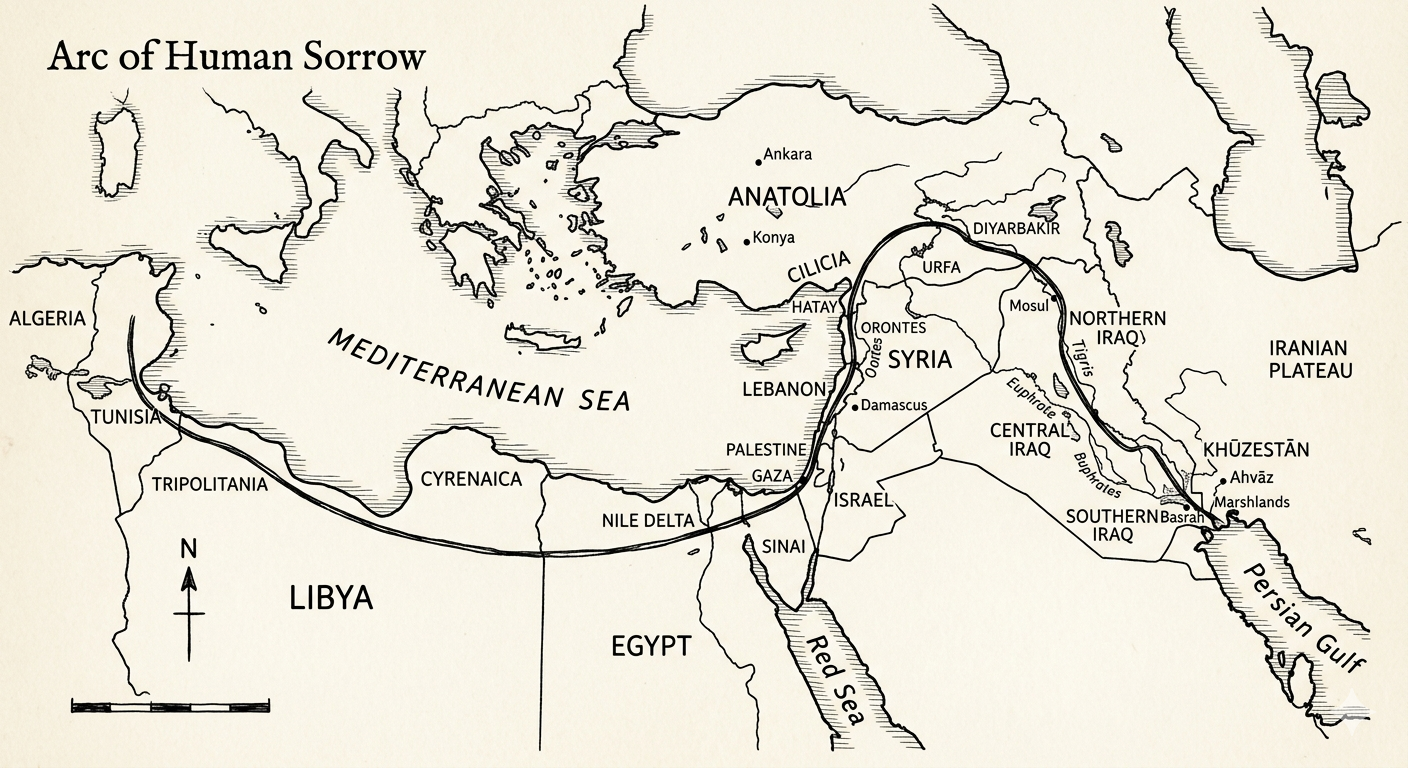
If the arc can be read as a product of resources and strategic geography, it can also be read as a mirror of power asymmetry. Throughout most of human history, the making of the arc’s fate has been reserved for what I call the “One‑Tenthers”—the small minority of great‑power states, imperial elites, and ruling‑class networksContinue reading “The Moving Arc and the “One‑Tenthers” – Part 2 of 3”
Tag Archives: Bhagavath Gita
The Arc of Human Sorrow – Part 1 of 3
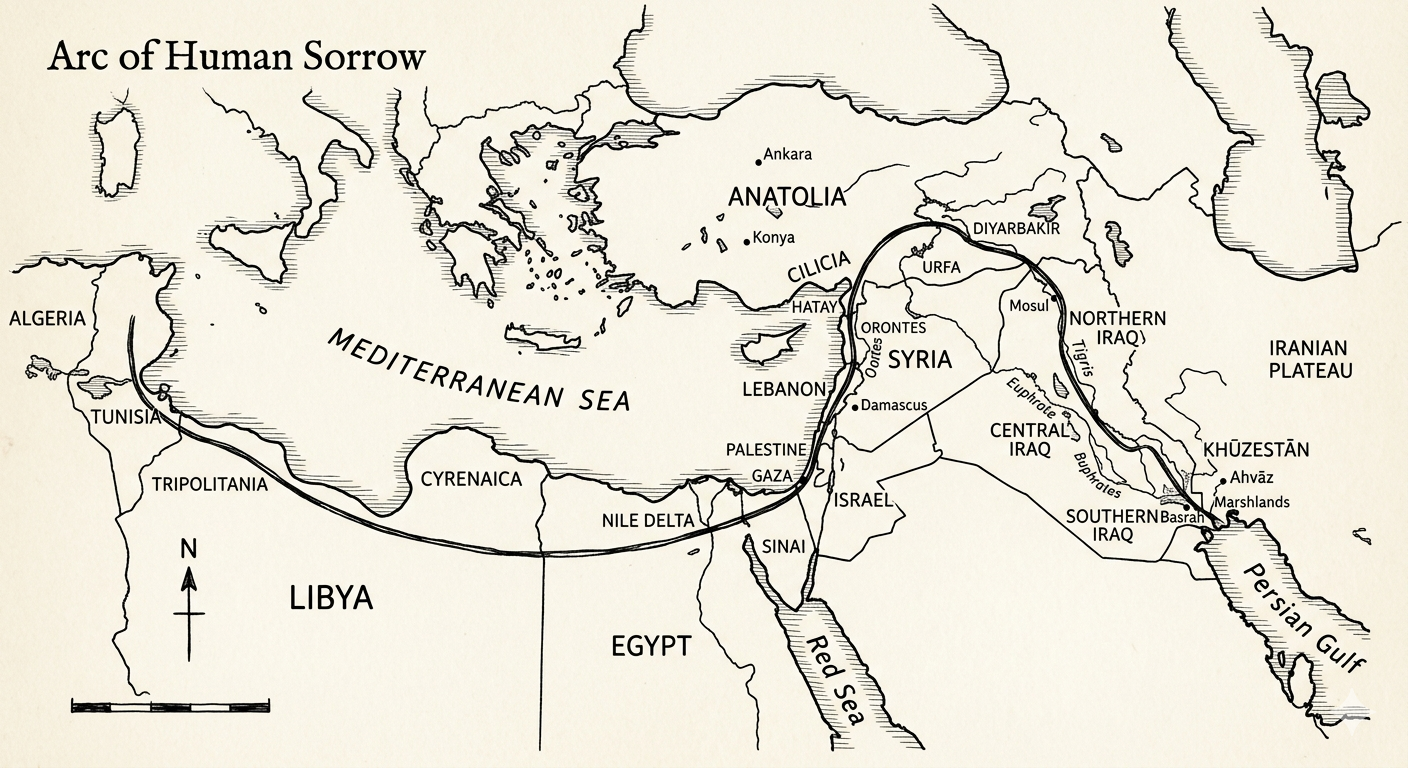
I. The Arc of Human Sorrow in the World If one were to trace, on a single map, the heaviest concentration of war, pillage, and displacement across human history, the line would run from Libya through Anatolia, the Levant, Mesopotamia, and Persia—an arc that has, for millennia, been less a geographical accident than a structuralContinue reading “The Arc of Human Sorrow – Part 1 of 3”
Mapping the “Dreams of the World”: Freud, Jung and the Bhagavath Gita

What a fascinating Infograph indeed on the Freudian stuff that the Dreams of the whole world is about! If you study the map closely, you will not fail to notice that nearly the whole of world populations have either the “Snake” or the “Falling of Teeth“ to be objects appearing as recurring themes in theirContinue reading “Mapping the “Dreams of the World”: Freud, Jung and the Bhagavath Gita”
சம்ஸ்கிருதம் – சில கேள்விகள்: A Few Questions about the Sanskrit language

சம்ஸ்கிருதம் – சில கேள்விகள் https://tamilhindu.com/2009/07/sanskrit-few-questions/ The above article written in Tamil contains many detailed historical, cultural, and political arguments supporting the philosophical, linguistic, and cultural integration of Sanskrit and Tamil, refuting claims of Sanskrit as an exclusively Brahmin language or a threat to Tamil. It highlights the coexistence and mutual enrichment of these languages inContinue reading “சம்ஸ்கிருதம் – சில கேள்விகள்: A Few Questions about the Sanskrit language”
Now Available for sale in a bookstore near you: “The Epistles of a Prolific Pontiff” (My book of English translations of the Tamil “arul mozhi” of the 44th Azhagiyasingar of Sri Ahobila Mutt)

Peter Turchin, “Manu-Smriti” and the “distress” of “Elite Overproduction” looming over India – (Part 2 of 3)
The Varnashrama system, as described in Manusmriti and other ancient texts, was structured fundamentally to organize society based on vocational aptitudes and duties, aiming to maintain social order and harmony in accordance with cosmic and moral laws (dharma). (Chapter 1.88-91). This system classified society into four main varnas: Brahmins (priests and teachers), Kshatriyas (warriors and rulers),Continue reading “Peter Turchin, “Manu-Smriti” and the “distress” of “Elite Overproduction” looming over India – (Part 2 of 3)”
Tharoorian balderdash: ‘Why am I a Hindu?’: (Part 2 of 2-Concluded)
In the book Ten Heads of Ravana edited by Rajiv Malhotra, the well-known Hinduism scholar and historian, and his co-author, Divya Reddy, compiled ten excellent essays portraying ten prolific and very influential contemporary Hinduphobic writers in India and abroad. Shashi Tharoor finds a place of pride in the pantheon of those notorious ten who areContinue reading “Tharoorian balderdash: ‘Why am I a Hindu?’: (Part 2 of 2-Concluded)”
“For the skeptical souls, there is no happiness either in this world or the next”…. Says the Bhagavath-Gita
I chanced to read the below quote of the famous English philosopher Bertrand Russel. When I read it I found it truly so thought-provoking that I could not resist the urge to share it online with many of my dear friends and family who are thoughtful souls too . One of them is a veryContinue reading ““For the skeptical souls, there is no happiness either in this world or the next”…. Says the Bhagavath-Gita”
“kaarpannya dosham”: Acedia of Arjuna and the cowgirls in “Tiruppaavai” – Part 2 of 3
It is rather too facile to translate the Sanskrit word for the mental affliction of “kaarpanya-dosham” into its near-equivalent Tamil, “மனத் தொய்வு” which, again in a very facile fashion, gets often roughly translated into the English “despair“, “mental depression” or “faintness of mind”. Overall however, as the Tamil literary doyen and my revered friend, Sri.Continue reading ““kaarpannya dosham”: Acedia of Arjuna and the cowgirls in “Tiruppaavai” – Part 2 of 3″
“kaarpanya dosham”: Acedia of Arjuna and the cowgirls in “Tiruppaavai” – Part-1 of 3
The pursuit of spiritual progress often means ploughing a lonely furrow. It can very often mean journeying through landscapes of dark, mental desolation. Trying to connect — and furthermore to also remain strongly connected — with one’s own divine self can be a very trying and frustrating religious experience indeed. Practitioners of “saadhana” or spiritualContinue reading ““kaarpanya dosham”: Acedia of Arjuna and the cowgirls in “Tiruppaavai” – Part-1 of 3″