“By Order of the Hoodwink Syndicate”: Why the Media Industry Can Never Tell the Truth

📌 Executive Summary

This Op-Ed exposes the deeply structural, compromised nature of the global media architecture. Using the recent escalation between the U.S. and Iran as a lens, it strips away the illusion of journalism as an independent public service. The piece illustrates how both state-owned propaganda organs and privately-owned corporate media cartels are structurally incapable of reporting objective truth.Tracing historical parallels from the engineered intelligence failures of the 2003 Iraq War to modern conflicts in Ukraine and the Persian Gulf, the essay charts how corporate news networks, clandestine intelligence syndicates, and modern technocratic billionaire monopolies (such as X and Starlink) work in tandem. The public is deliberately fed a curated diet of manufactured fear, tribalism, and false binary certainty.

Grounded in Karl Popper’s framework, the piece defines these new data gatekeepers as the absolute enemies of an Open Society, concluding that modern mainstream news operates purely as a multi-billion-dollar hoodwinking enterprise—the ultimate opium of the masses.

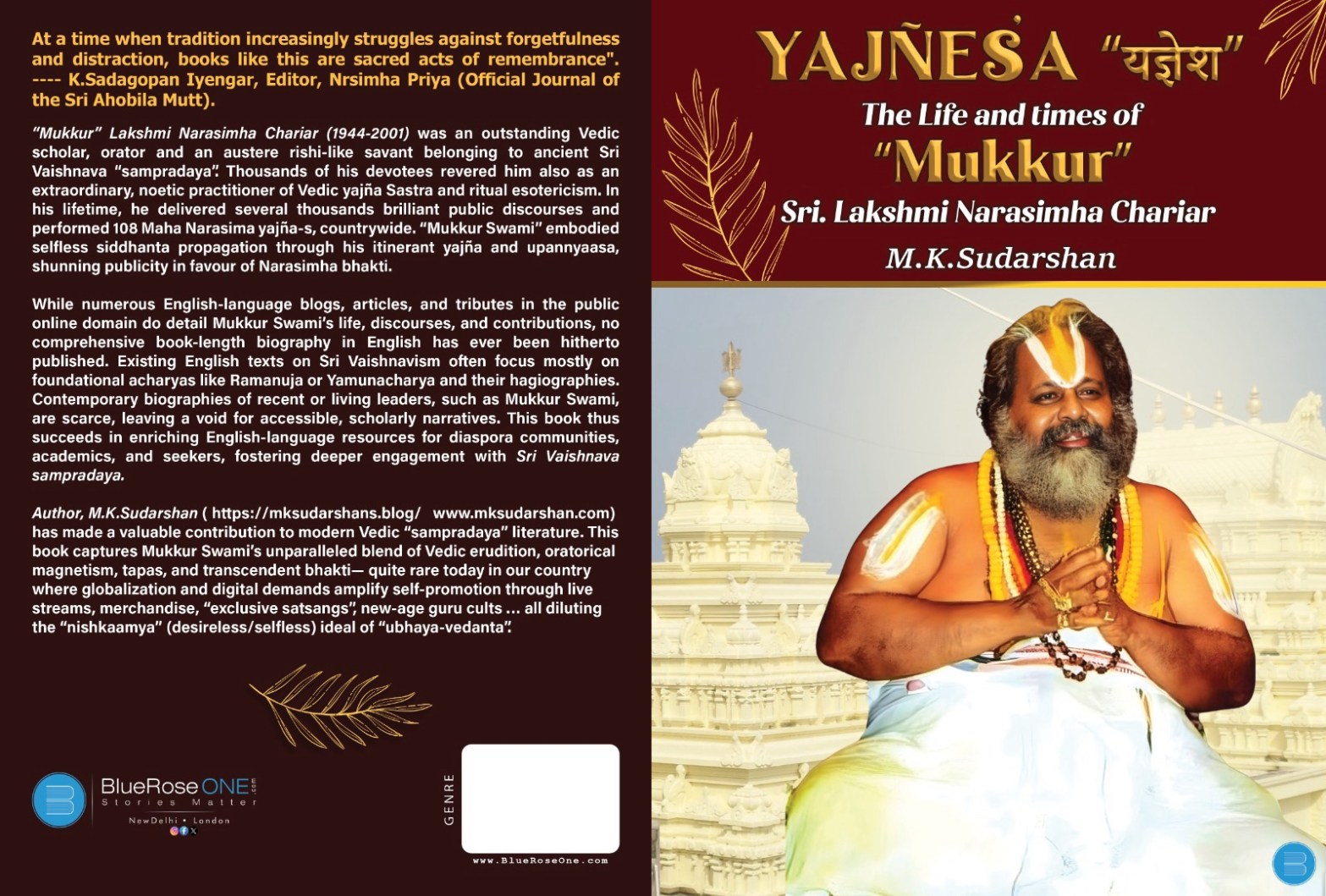
“The Veda in Word, Work, and Worship” : Mukkur Sri Lakshminarasimha Chariyar: On the Vedas- 2

by M.K.Sudarshan September 9, 2026: Chennai, India Wednesday, September 9 Some men merely speak about tradition.Some preserve it. A rare few actually embody it.Sri Mukkur Lakshminarasimhachariar belonged to that rarest category. Through his discourses, yajnas, spiritual discipline, scholarship, and tireless propagation of Narasimha bhakti, he demonstrated how the values of the Vedic tradition could beContinue reading ““The Veda in Word, Work, and Worship” : Mukkur Sri Lakshminarasimha Chariyar: On the Vedas- 2”

A Giant Returns: Mukkur Sri Lakshminarasimha Chariyar: On the Vedas- 1


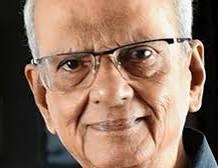
He was a Vedic scholar, Vedantic exponent, eloquent “upanyasaka”, austere “yajna” practitioner, and a spiritual personality of extraordinary intellectual and intuitive power.
He was known with affection and reverence as “Mukkur Swami.”

His full name was:
Sri Mukkur Lakshminarasimhachariar
(1944–2001)

A new English biography of this remarkable Vedic luminary will soon be available online.
Coming this September.
Follow this space for more.

Before the book arrives, meet the man behind the legend.

The Scattered Mind and the Sacred Sound: A Vedantic Diagnosis of Modern Attention Deficit

The Famine of Attention: A Dialogue Across Time

We worry endlessly about the “attention span deficit” of Gen Z and Gen Alpha. We wring our hands over the endless scrolling, the acronymic lingo, and the outsourcing of human thought to AI algorithms. But are we misdiagnosing the disease?

In a world that confuses access to information with the assimilation of knowledge, we have systematically dismantled the most sophisticated cognitive conditioning systems ever engineered—including the oral, memory-centric traditions of ancient India. Worse still, in our frantic corporate grind, we have forced our children to outsource their minds to software because we have outsourced our parental presence.

What follows is a patient, raw dialogue between an Unknown Sri Vaishnava who travels across the spatio-temporal expanse to the dark forests of the Himalayas, and a venerable Maharishi who sits in timeless silence. Together, they strip away modern political noise to perform a profound, Vedantic autopsy on the modern mind—and reveal the ultimate indigenous cure waiting right in front of us.

Read the full, unedited conversation below.

Before you go “shaming” the “Manu Mind-Set”, Mr Rahul Gandhi, first check out your own mindset.

Before Shaming Manu, Mr Gandhi, Examine Your Own Political Mindset

Rahul Gandhi has called the Manusmriti’s view of women “a shame.” Fair enough. But can secularism be selective? The real test is whether the same constitutional standard is applied to patriarchy in every religious tradition.

To condemn the “Manu mindset” is easy. The harder test is to condemn, with equal moral clarity, every religiously sanctioned attempt to deny women equal citizenship.

The Shah Bano episode remains the hardest question for the Congress tradition: when constitutional equality for a divorced Muslim woman collided with organised religious pressure, which side did it choose?

No ancient text need be banned. But no ancient text—Hindu, Muslim, Christian or otherwise—can be permitted to outrank the Constitution in determining a woman’s civil rights.

How Visishtadvaita Distinguishes Between Ego-Bashing and Ego-Massaging : விசிஷ்டாத்வைதம் காட்டும் வழி: அகந்தையை ஒடுக்குவதா? வளர்ப்பதா?

Is your ego an enemy to crush or a spark to celebrate? Visishtadvaita Vedanta reveals a beautiful middle path: aligning individual choice (Sankalpam) with divine service. Read the full bilingual (English/Tamil) breakdown featuring the story of Vibhishana.

Discover why Sri Ramanuja’s Visishtadvaita Vedanta rejects both crushing and inflating the Ego. Learn how Svarupa-Jnana aligns the self toward Moksha.

Beyond Sectarian Labels: Reclaiming the Metaphysical and Historical Truths of South Indian Philosophy

📝 New Essay Launch: Beyond Sectarian Labels — Reclaiming the Metaphysical and Historical Truths of South Indian PhilosophyWhat began as a fascinating theological riddle posed to me by the legendary playwright and Sahitya Akademi winner, Sri Indira Parthasarathy (Eepa), evolved into an extensive historical and sociological exploration.

How did Shankara’s Advaitin disciples come to adopt Shiva as a personal deity?

What connects Saiva Siddhanta structurally to Ramanuja’s Visishtadvaita?

And why did the Sri Vaishnavas never experience a breakaway group like the Karnataka Lingayats, only to fracture intensely from within over temple administrative dominance?

In this three-part essay, I revisit the universalist-humanism of Ramanuja—so brilliantly captured in Eepa’s historic 1970s play “Ramanuja”—and contrast it with the institutional realpolitik documented in my book, “A Tale of Two Cities: The Decline and Fall of the ‘ubhaya-Vedantins'”.

It is time to look past the superficial armor of sectarian labels and return to a unified, transcendental vision.🔗 Read the full reflective brief on my website here:

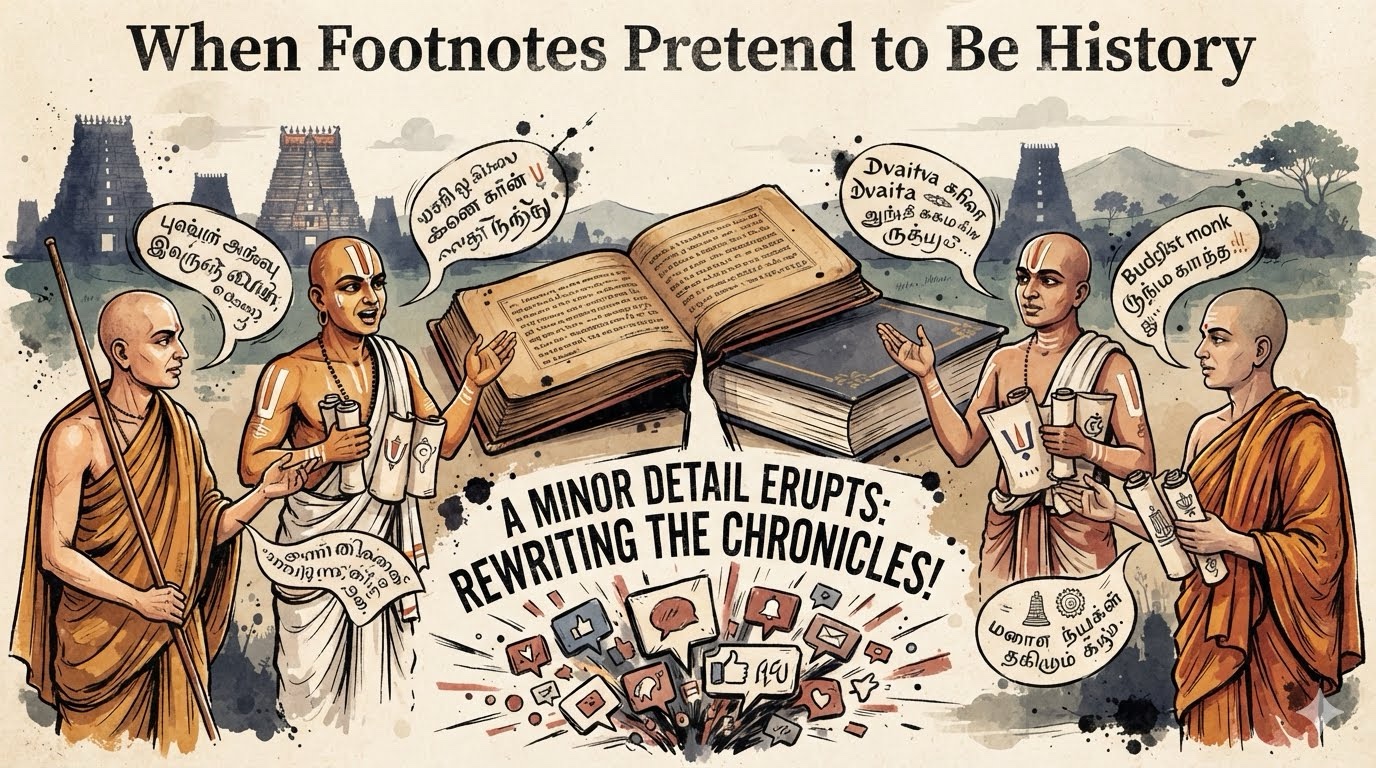
When Footnotes Pretend to Be History:

When Footnotes Pretend to Be History
Hindu philosophical traditions did not develop in a climate of uninterrupted harmony. Advaitins, Viśiṣṭādvaitins, Dvaitins, Buddhists, Jains, Śaivas, and Mīmāṃsakas often engaged in fierce—and sometimes deeply personal—polemics.
But a sectarian insult is not the whole history of a philosopher. A hostile hagiography is not a neutral biography. And a provocative footnote should not be presented as though it were a major chapter in the history of Indian thought.
From Śaṅkara and Rāmānuja to Vedānta Deśika and Madhva, the record reveals both acrimonious conflict and extraordinary intellectual creativity.
The real danger today is not that these old polemics are discussed. It is that social media detaches them from context, magnifies them, and turns historical trivia into historical truth.
When does a footnote become a distortion of history?

The Measure of Both Machine and Man: “Homo Sapiens” Vs “Homo Faber”

• The evolution from Homo sapiens to Homo faber
• Human Dignity vs Human Abasement by the Machine
• Chaplin’s Modern Times and Huxley’s Brave New World as twin warnings
• The double-edged nature of machines (lawn mower, vacuum, computer, auto-rickshaw)
• The AI question and the Pope’s warning about human control
• The call to keep Homo sapiens sovereign over Homo faber
• The final personal challenge: “Am I using this machine to deepen my life, or is it using me to thin it out?”

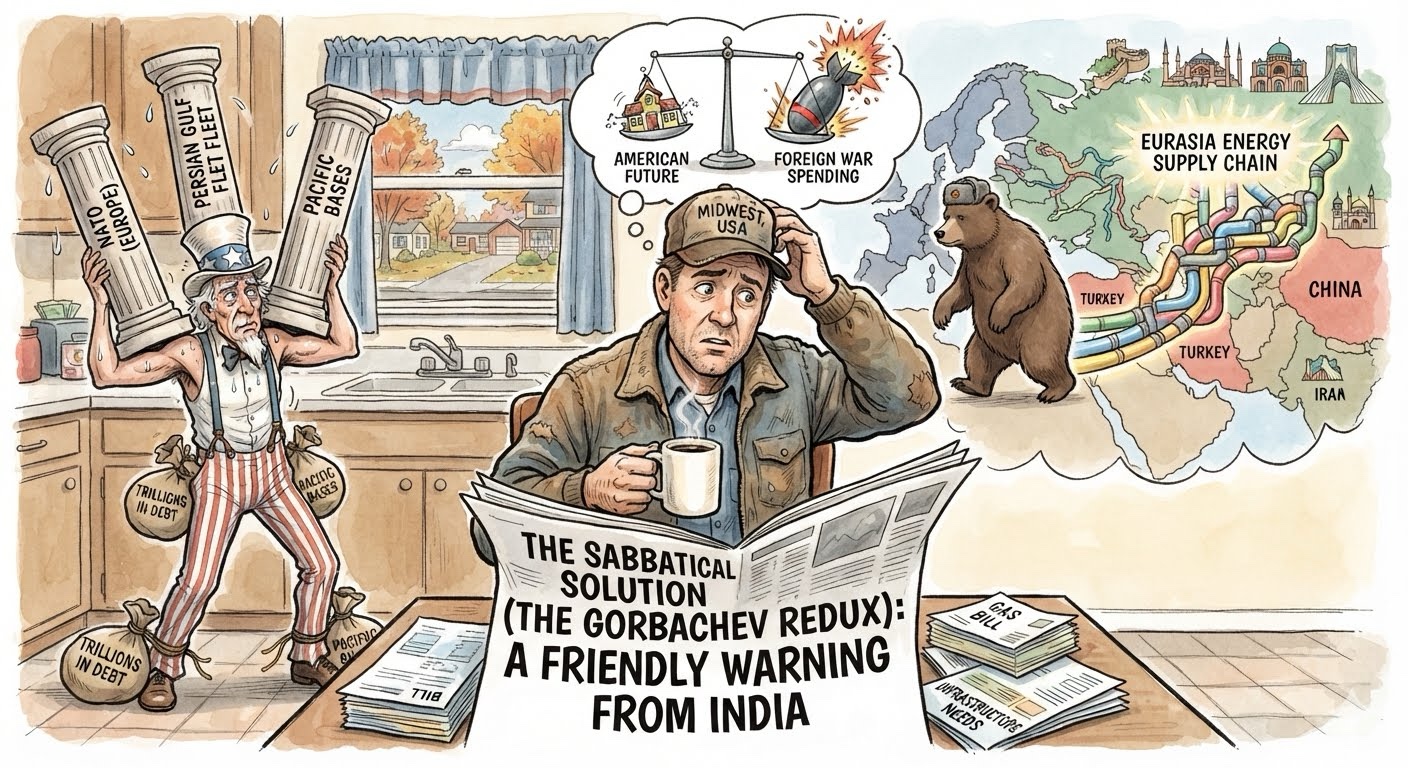
The Sabbatical Solution (The Gorbachev Redux)

A Friendly Warning from India to the American Midwest The Sabbatical Solution: An Open Letter to the American Heartland What if the best way to save the American century is to step off the global chessboard entirely? Writing as a friend from India, “The Unknown Sri Vaishnava” delivers a blunt, numbers-backed warning to the averageContinue reading “The Sabbatical Solution (The Gorbachev Redux)”