Author Archives: theunknownsrivaishnavan
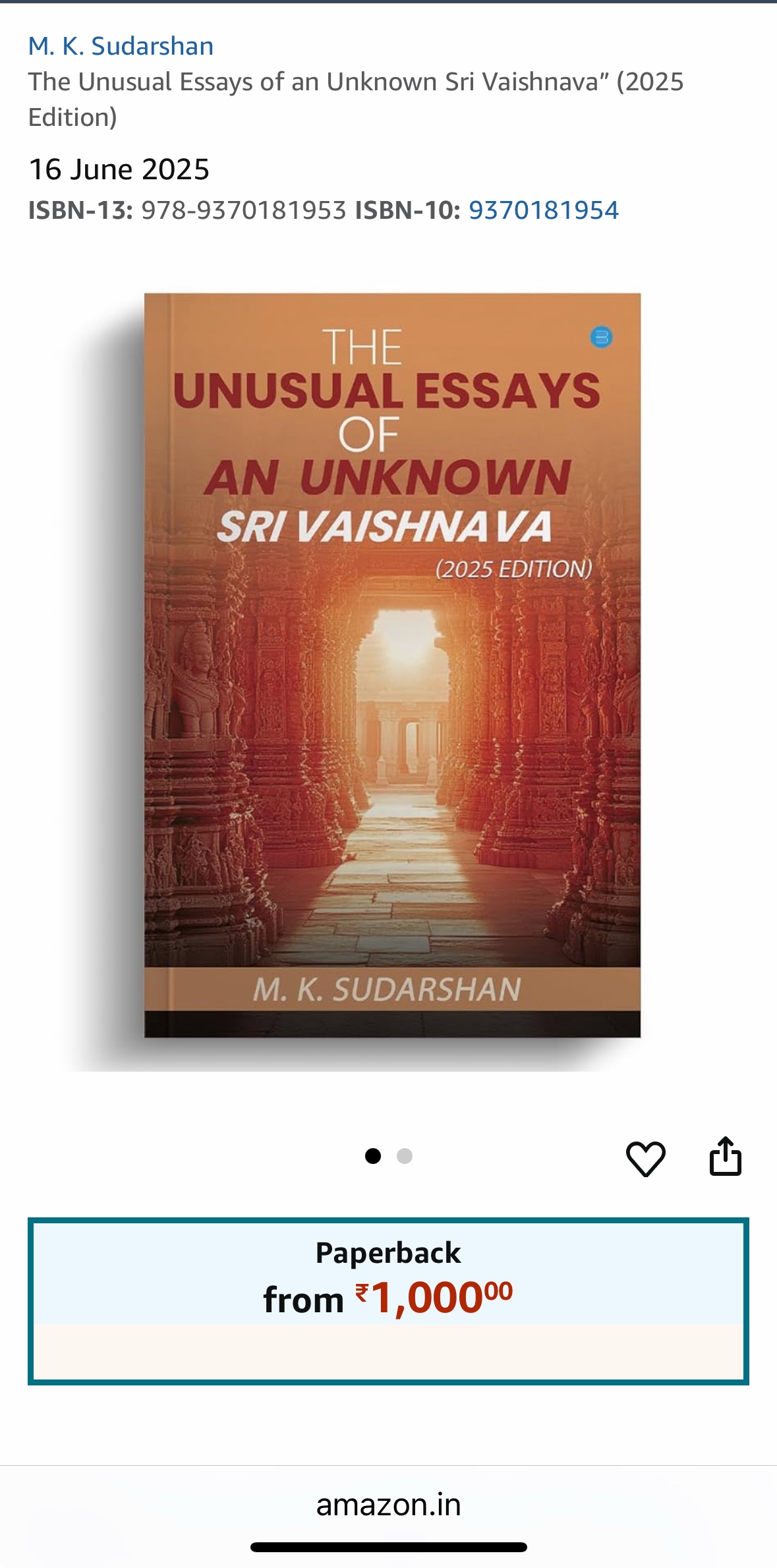
“YAJÑEŚA: The Life and Times of Mukkur Sri Lakshminarasimhachariar” by M. K. Sudarshan is now available globally !

https://www.facebook.com/share/1CBWA9zqnA/?mibextid=wwXIfr “YAJÑEŚA: The Life and Times of Mukkur Sri Lakshminarasimhachariar” by M. K. Sudarshan. [Blue Rose Publishers, India/ UK] This book is now available globally ! Subject: Global DistributionHello Author, Hope you are doing great!Congratulations! Your book is now available globally. Spread the word today amongst your friends and family! Amazon.com https://www.amazon.com/Yajñeśa-यज्ञेश-Lakshmi-Narasimha-Chariar/dp/9378259014/ref=sr_1_1?crid=1ZD9P7E46PGAX&dib=eyJ2IjoiMSJ9.jgxI6mctIhS5c6P1V-nnkA.vod42emrykhHFrIInsU55bZXC6Vq9fZMvDsg5ovpyGU&dib_tag=se&keywords=9789378259012&qid=1792388270&s=books&sprefix=9788167446909%2Cstripbooks-intl-ship%2C333&sr=1-1 Amazon.co.uk https://www.amazon.co.uk/dp/9378259014/ref=sr_1_1?crid=3UNA2XTJ043EX&dib=eyJ2IjoiMSJ9.jgxI6mctIhS5c6P1V-nnkA.Xtut97T83379RdlTywHu9KiZDf0jLzxMnBQS0EInn1U&dib_tag=se&keywords=9789378259012&qid=1792388275&s=books&sprefix=9789378259012%2Cstripbooks%2C238&sr=1-1 Amazon.itContinue reading ““YAJÑEŚA: The Life and Times of Mukkur Sri Lakshminarasimhachariar” by M. K. Sudarshan is now available globally !”
Medhā Sūktam: The Goddess Who Makes Speech Sacred

In the auspicious fortnight of Navarathri and on the sacred day of observance of the Mahasamadhi Day of Her Holiness Sathguru Gnananda Saraswathi, the VishnuMohan Foundation held a special religious event at the Ashram of Sri Sriharidas Swami-ji by conducting Vedic Homam and Devi Puja. The event was attended by a large gathering of Swami-Ji’s devotees who participated in the Guru puja, Devi puja and Homam.
At the kind invitation of Sri Sriharidas Swami-ji and with His Blessings, I delivered a talk on the occasion on “MEDHA SUKTAM”. The full transcript of the talk is reproduced here.
The Refineries That Saved India’s Pumps
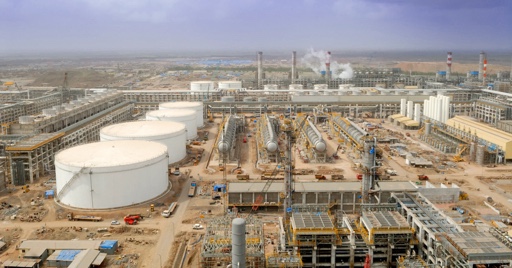
Title: The Refineries That Saved India’s Pumps
Subtitle: While America and Europe face a looming refining-capacity crisis, self-sufficient India should thank its public sector—and Ambani
The article argues that India’s relative freedom from the diesel shortages now troubling the United States and Europe is not luck, but the result of a seven-decade effort to build domestic refining capacity. While Western economies face pump-level supply stress, India remains broadly self-sufficient in petrol and diesel, even though it imports most of its crude oil.
It traces India’s refining history from the first post-Independence refinery in 1954, through IndianOil’s creation in 1959 and the nationalisation of the oil industry in 1976, to the public-sector refinery network that still forms the backbone of national fuel supply.
The piece credits successive governments—especially those of Nehru, Indira Gandhi, P. V. Narasimha Rao, Vajpayee and Manmohan Singh—for building and expanding this capacity across very different political eras.
Reliance’s Jamnagar complex receives substantial but qualified praise. Commissioned in 1999 and expanded in 2008, it became the world’s largest single-site refinery, with about 1.4 million barrels per day of capacity, giving India export strength and flexibility during the current global diesel squeeze.
The article’s central argument is balanced: India should credit both the public sector, which built the foundation, and Reliance, which added world-scale private capacity. But it also cautions that Jamnagar’s success does not settle concerns about crony capitalism, market concentration or unequal access to state policy.
India’s energy security, it concludes, was built by long-term public and private investment—and must not be taken for granted in future crises.
The Illusion of Failure: Why the Wars in Iran and Ukraine Are Going Exactly as per Plan, and Why Huntington is Not Dead

Discover why media narratives of Western failure in Ukraine and Iran are an illusion.
This Op-Ed exposes the financial oligarchy and civilisational architecture driving the 21st-century global order.
Beyond the Sanctum: Preserving Sanatana in an Age of Too Many Temples

Beyond the Sanctum: Preserving Sanatana in an Age of Too Many Temples
Temples and consecrated murtis have long been at the heart of Hindu devotion. But when temple-building becomes a measure of faith, do we risk forgetting what the murti was meant to awaken?
Nammazhvar begins the Tiruvaymozhi not by pointing to a shrine, but by telling the mind to rise: “O my mind, worship the radiant feet that end sorrow.”
This essay is not a case against archa murthy aradhana. It is a quiet plea to restore balance: to honour the visible Divine, while remembering that the highest sanctuary is consciousness itself.
“The King Who Must First Know Himself”: Plato, Dharma, and the Elusive Philosopher-Kings of India

Plato wanted philosopher-kings. India dreamed of the rājarṣi. From Ashoka’s dhamma to modern democracy, the search for a ruler wise enough to wield power remains unfinished.
What happens in a world where red lines drawn by Goliath are no longer respected by Davids?
As Washington’s deterrence fades, regional powers are rewriting the rules of global diplomacy. Discover how a fractured giant and asymmetric defiance are ushering in a volatile new era of messy multipolarity.
The ‘Samarpanam’ of “YAJÑEŚA” to Sri “Yajñamurthy” at the Yajñavatika near the precincts of Sri Mattapallinathan Temple

The ‘Samarpanam’ of “YAJÑEŚA” to Sri “Yajñamurthy” at the temple of Sri Mattapallinathan.
https://www.instagram.com/p/DeRDSb5kjZ9/?exln=MTZ0eWd6cGIydThyZA==
The Nobel Awards Committee: institutional instrument of Euro-Atlanticist “soft power” and cultural hegemony

Summary:
The Nobel Prize is fundamentally a geopolitical instrument of Western hegemony rather than a neutral, international arbiter of human excellence.
By analyzing structural exclusions—such as the rejection of traditional medical systems like Ayurveda, the omission of non-Western economic models, and a distinct geopolitical bias in Literature and Peace—the Nobel Foundation consistently rewards individuals who conform to a secular, liberal, and Eurocentric worldview.
The historical denial of a posthumous award to Mahatma Gandhi, contrasted with exceptions made for European candidates, exemplifies this institutional double standard.
Ultimately, for non-Western nations to seek validation from Stockholm is an act of ideological capitulation to Western cultural imperialism.